Nooelec NESDR v5
8.4Editor score100 kHz to 1.75 GHz
0.5 PPM TCXO
3 antennas included
SMA input connector
Find the right sdr receivers for 2026. We compare 10 standout options by build quality, useful features, owner feedback, value, and everyday trade-offs.
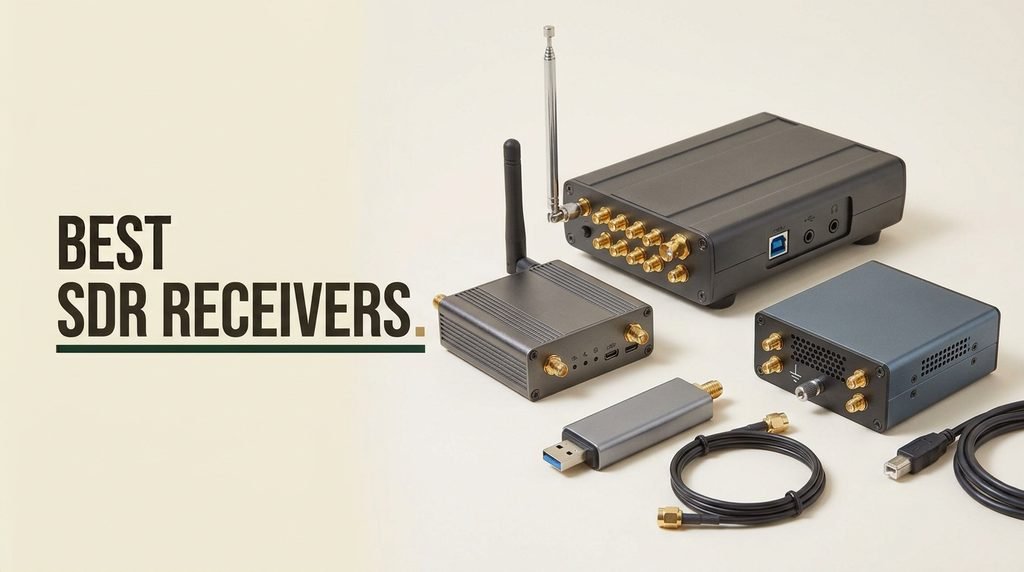
Choosing the right SDR receiver for 2026 means balancing frequency range, bandwidth, tuner performance, and included accessories against your intended monitoring goals. We compare 10 standout software defined radios by the factors that matter most to listeners: HF, VHF, and UHF coverage, sampling bitrate, TCXO precision, direct sampling capability, antenna options, software compatibility, build quality, and whether each unit genuinely suits beginner, intermediate, or advanced applications.
SDR receivers split into several categories that serve different needs. Low-cost USB dongles from RTL-SDR Blog and Nooelec provide affordable entry points for scanner, ADS-B, and general-purpose monitoring. Standalone portable receivers add touchscreen displays and battery operation for field use. Premium wideband receivers like the RX888 MKII deliver professional-grade HF performance for serious enthusiasts.
Whether you need a sub-50-dollar dongle to learn SDR fundamentals, a complete HF bundle with upconverter for shortwave listening, or a portable field receiver for outdoor monitoring, the picks below cover the most practical options available. Read on to find the SDR receiver that matches your frequency interests, your technical comfort level, and the kind of signals you actually want to monitor.
We compared 10 SDR receivers using the details that actually help a buyer decide: frequency coverage, instantaneous bandwidth, tuner chip quality, TCXO precision, direct sampling or upconverter requirements for HF, included antennas and accessories, software compatibility across platforms, build quality, and value against competing products. The notes focus on practical trade-offs so each pick connects to how hobbyists actually use SDR equipment, from basic ADS-B plane tracking and FM radio reception to serious shortwave DXing and professional-grade signal analysis.


Compare key features, scores, and current prices side by side. A shorter feature list means fewer details were available, not necessarily fewer capabilities.


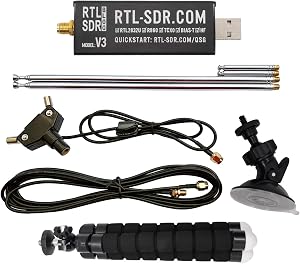


The RTL-SDR Blog V3 has established itself as the reference standard for affordable software defined radio experimentation, and for good reason. The RTL-SDR Blog team specifically designed this dongle to address the shortcomings of generic RTL-SDR units with meaningful improvements in component tolerances, thermal stability, and overall performance. For beginners entering the SDR hobby and experienced users who want reliable baseline equipment, this is the dongle most SDR tutorials and software are tested against.
We may earn a commission when you buy through this link, at no additional cost to you.
The 1 PPM temperature compensated oscillator (TCXO) is a critical upgrade over generic RTL-SDR dongles that use crystals drifting by 50 PPM or more with temperature changes. Stable tuning accuracy matters significantly when decoding narrow signals like SSB voice, APRS packets, or digital modes where even small frequency errors can prevent successful decoding. The R860 tuner chip is a step up from older R820T2 units in both sensitivity and performance.
The 500 kHz to 1.7 GHz tuning range covers virtually all practical civilian radio applications when combined with the HF direct sampling mode. The SMA F connector accepts quality antennas without requiring adapters, and the aluminum shielded case with thermal pad provides passive cooling that prevents the thermal drift and performance degradation that plague cheaper plastic-cased dongles during extended use. The activatable bias tee circuit powers externally mounted LNAs and preamps directly through the coax, simplifying installation of improved antenna systems.
Software defined radios use a reference oscillator to accurately tune to specific frequencies. A standard crystal oscillator drifts significantly with temperature changes, which means your tuned frequency moves as the dongle warms up or cools down. A 1 PPM TCXO drifts only 1 part per million with temperature changes, which translates to accuracy within a few hundred Hz at UHF frequencies. For digital modes, SSB voice decoding, and narrow-signal reception, this stability makes the difference between successful decoding and garbled audio.
This dongle is the right choice for buyers who want the reference SDR that software is specifically designed and tested against. The main tradeoffs are that this version includes only the dongle without antennas (the kit version adds a dipole), and HF performance in direct sampling mode is limited compared to dedicated HF receivers or upconverter-equipped setups. For general-purpose SDR use covering VHF and UHF monitoring, this is the baseline recommendation that defines the category.
Buyers who need antennas included or those requiring professional-grade HF performance without additional equipment like upconverters.
We may earn a commission when you buy through this link, at no additional cost to you.
The Nooelec NESDR v5 Bundle represents the direct competitor to RTL-SDR Blog V3 and offers a compelling package for buyers who want everything needed to start SDR experimentation out of the box. The complete bundle includes the premium NESDR v5 dongle, a magnetic antenna base with 2-meter RG-58 feed cable, and three different antenna masts for various UHF and VHF applications, including a variable-frequency telescopic antenna.
We may earn a commission when you buy through this link, at no additional cost to you.
The NESDR v5 uses a 0.5 PPM TCXO for even better tuning precision than the standard RTL-SDR Blog V3, which matters when working with digital modes and narrow signals. The 100 kHz lower frequency limit extends further down than many competing units, which improves usability for HF reception in direct sampling mode. Compared with the previous NESDR v3, Nooelec claims up to 15 dB improvement in HF signal-to-noise ratio and up to 6 dB improvement in VHF and UHF performance.
Compatibility covers Windows, Mac OS, Linux, and Android, making this dongle usable with virtually any computer or mobile device for SDR applications. The receiver supports an impressive range of signal types including broadcast AM and FM, shortwave, CB, public safety, trunked radio, air traffic control, ACARS, ADS-B, AIS, POCSAG pagers, NOAA weather satellites, DAB, DVB-T video, and much more. The 2-year warranty with Nooelec support provides meaningful long-term coverage.
A dongle without antennas is unusable, and sourcing appropriate antennas separately can be more expensive than the dongle itself for first-time buyers. The NESDR v5 Bundle solves this by including three different antennas optimized for different frequency ranges plus a quality magnetic base. For buyers who want to get started experimenting with SDR without multiple orders and research into compatible antennas, this bundle approach significantly accelerates the learning curve.
This bundle is the right choice for first-time SDR buyers who want a complete starter package without having to source antennas separately. The main tradeoff compared to the standalone RTL-SDR Blog V3 is the slightly lower user rating, which may reflect the broader bundle complexity. For HF reception below 25 MHz, direct sampling provides adequate performance but a dedicated upconverter like the Ham It Up still delivers better results for serious HF work.
Buyers who already have quality SDR antennas or those who want the specific RTL-SDR Blog V3 for compatibility with specific tutorials and software.
We may earn a commission when you buy through this link, at no additional cost to you.
The Nooelec NESDR Mini provides a budget entry point into software defined radio for buyers who want to try SDR without significant financial commitment. The included dongle and antenna let you start receiving signals immediately after installing SDR software like SDR# or GQRX. For hobbyists testing whether SDR interests them before investing in premium equipment, this starter kit removes the barrier to entry.
We may earn a commission when you buy through this link, at no additional cost to you.
The R820T tuner chip is one generation older than the R820T2 used in newer Nooelec premium models, which means slightly reduced performance but adequate capability for learning SDR fundamentals and basic monitoring tasks. The RTL2832U interface chip is the standard RTL-SDR implementation that works with virtually all SDR software packages. These are custom USB devices tuned specifically for SDR rather than generic DVB-T dongles that may lack proper RF shielding and components.
The MCX input connector is less common than the SMA connectors used on premium RTL-SDR Blog V3 and Nooelec NESDR v5 units, which may require adapters when connecting to professional antennas. The ESD-safe antenna input provides protection against electrostatic discharge that can damage the sensitive tuner chip. The included antenna provides starting capability for FM broadcast, ADS-B plane tracking, and other common SDR applications.
SDR has a learning curve that can be frustrating for newcomers who buy premium equipment and struggle with software setup, antenna selection, and signal identification. Starting with a budget dongle like the NESDR Mini lets you learn the fundamentals without major financial risk. If you discover SDR is not for you, your investment is modest. If you find yourself hooked, you can upgrade to premium equipment later with much better understanding of what features matter for your specific interests.
This dongle is the right choice for budget-conscious buyers who want to try SDR without committing to premium equipment. The main tradeoffs are the older R820T tuner that delivers slightly reduced performance compared to current premium alternatives and the MCX connector that may limit future antenna upgrades. For learning SDR fundamentals and basic monitoring, however, this NESDR Mini delivers meaningful capability at an affordable entry price.
Serious hobbyists who need the superior performance of newer R820T2 or R860 tuner chips and TCXO-equipped premium dongles.
We may earn a commission when you buy through this link, at no additional cost to you.
This portable DSP SDR radio takes a fundamentally different approach from USB dongle receivers by providing standalone operation without requiring a connected computer. The built-in 4.3-inch touchscreen displays spectrum and waterfall information, letting you tune, demodulate, and monitor signals entirely on the device itself. For field operations, portable use away from power outlets, and buyers who want a self-contained listening solution, this standalone design offers genuine practical advantages.
We may earn a commission when you buy through this link, at no additional cost to you.
The 100 kHz to 149 MHz frequency range covers the critical shortwave and VHF low bands that interest most casual listeners and ham radio enthusiasts, including international shortwave broadcasters, amateur radio HF bands, aviation receive frequencies, and FM broadcasters. Supported demodulation modes include CW, AM, SSB (both USB and LSB), WFM, and FM stereo, which covers virtually all common signal types in this frequency range.
The 192 kHz real-time spectrum display provides immediate visual feedback showing active signals across a reasonable bandwidth, which simplifies finding activity and identifying signal types. The 16-bit sampling delivers adequate dynamic range for most listening applications. Touch screen controls combined with a physical rotary encoder provide the precision tuning that serious listeners need, and the ability to preset up to 99 channels including station names and settings makes the receiver practical for monitoring favorite stations.
USB dongles like the RTL-SDR Blog V3 require a computer running SDR software, which provides maximum flexibility but requires carrying additional equipment. Standalone receivers like this portable DSP radio sacrifice some flexibility for self-contained operation on battery power. For home use at a desk, computer-based SDR usually provides better capability. For outdoor use, travel, and situations where portability matters, standalone receivers avoid the complication of also carrying a laptop or tablet.
This receiver is the right choice for buyers who want a standalone SDR experience without computer dependence, particularly for outdoor and travel use where a laptop would be impractical. The main tradeoffs are the limited frequency coverage that stops at 149 MHz (missing all UHF applications) and the lower user rating that may reflect quality control issues or software limitations compared to established USB dongle options. For HF and VHF low-band listening in a portable format, however, this receiver fills a unique niche.
Buyers who need UHF coverage above 149 MHz for ADS-B, air band, satellite, or amateur radio UHF bands.
We may earn a commission when you buy through this link, at no additional cost to you.
This portable SDR radio delivers a bright 800×480 IPS touchscreen display that provides exceptional visibility of spectrum and waterfall information in a handheld package. The resistive touch interface combined with a physical rotary encoder lets you tune precisely while viewing real-time spectrum activity across the 192 kHz spectrum display, which simplifies finding and identifying active signals across the 100 kHz to 149 MHz range.
We may earn a commission when you buy through this link, at no additional cost to you.
The DSP digital demodulation technology supports CW, AM, SSB (both LSB and USB), WFM, and FM stereo modes, which covers virtually all common signal types in the covered frequency range. The high-gain retractable antenna provides adequate sensitivity for most reception scenarios, though serious users will likely want to connect external antennas for better performance on weak signals. The powerful DSP chip provides good signal processing capability within the limitations of the frequency range.
The all-aluminum alloy CNC shell delivers both durability and premium feel in a compact 140x74x22mm form factor weighing just 315 grams. The handheld size makes this receiver practical for outdoor use, travel, and situations where a larger benchtop setup would be impractical. The built-in rechargeable battery provides substantial operating time away from power sources, which is essential for portable field use.
Portable SDR receivers rely heavily on their displays for all tuning, demodulation, and spectrum monitoring. The 800×480 IPS display on this receiver provides significantly better visibility than lower-resolution screens, with the IPS technology ensuring consistent appearance from various viewing angles. For outdoor use in bright conditions, display quality often matters more than many spec sheet features that look impressive but have limited practical impact.
This receiver is the right choice for buyers who want a premium portable SDR experience with high-quality display and construction. The main tradeoffs mirror the companion portable DSP SDR Radio: limited frequency coverage stopping at 149 MHz, and user ratings below the established USB dongle options which may reflect software or firmware limitations. For buyers specifically interested in shortwave and VHF low-band monitoring in a portable high-quality format, however, this receiver offers compelling display and build quality.
Buyers needing UHF coverage, those who want established brand support, or users who prefer computer-based SDR flexibility.
We may earn a commission when you buy through this link, at no additional cost to you.
The Nooelec NESDR v5 provides the same premium dongle as the complete bundle but without the included antennas and accessories, at a significantly lower price point. For buyers who already have quality SDR antennas or who prefer to source specific antennas separately for their intended applications, this dongle-only option saves money without sacrificing dongle quality.
We may earn a commission when you buy through this link, at no additional cost to you.
The 0.5 PPM TCXO delivers even better frequency stability than the 1 PPM TCXO on the RTL-SDR Blog V3, which matters for digital modes and narrow-signal reception. The 100 kHz lower frequency limit extends further down than the 500 kHz starting point of the RTL-SDR Blog V3, which improves usability for HF reception in direct sampling mode. Nooelec claims up to 15 dB improvement in HF signal-to-noise ratio compared with the earlier NESDR v3, with up to 6 dB improvement in VHF and UHF performance.
The 1.75 GHz upper frequency limit covers all civilian radio applications of interest including the complete UHF range, satellite downlinks, and ADS-B. The SMA input connector accepts standard antennas without adapters, and the aluminum enclosure provides passive cooling that prevents thermal drift during extended operation. The 2-year Nooelec warranty with US and Canada-based support provides meaningful long-term coverage.
The NESDR v5 and RTL-SDR Blog V3 are the two most popular premium SDR dongles. The NESDR v5 offers tighter 0.5 PPM TCXO precision versus 1 PPM on the RTL-SDR Blog V3, lower 100 kHz starting frequency versus 500 kHz, and better HF SNR performance. The RTL-SDR Blog V3 has stronger community support, more tutorials written specifically for it, and includes an activatable bias tee circuit for powering remote LNAs. For most users, either choice delivers excellent capability and the decision often comes down to specific feature priorities.
This dongle is the right choice for buyers who want the premium Nooelec NESDR v5 performance without paying for antennas they do not need. The main tradeoffs are the lack of included antennas (budget separately for suitable antennas), and the HF reception below 25 MHz requires direct sampling or an external upconverter for best results. For buyers building a custom SDR setup around specific antennas, this dongle-only approach delivers excellent value.
First-time SDR buyers who need included antennas and would benefit from the complete bundle version.
We may earn a commission when you buy through this link, at no additional cost to you.
The Nooelec NESDR SMArt HF Bundle provides a complete HF-focused SDR solution for buyers who are serious about shortwave listening, amateur radio HF monitoring, and other HF applications. Rather than relying on the compromises of direct sampling mode for HF reception, this bundle includes the Ham It Up upconverter that properly shifts HF signals up to the dongle's optimal operating range, resulting in dramatically better HF performance.
We may earn a commission when you buy through this link, at no additional cost to you.
Direct sampling implementations in standard RTL-SDR dongles work but produce reduced gain, loss of gain control functionality, and generally poorer HF reception compared to proper upconverter approaches. The Ham It Up upconverter addresses all these limitations by converting HF signals to the VHF range where the RTL-SDR dongle performs optimally. The result is HF reception that approaches dedicated HF receiver quality at a fraction of the cost of standalone HF SDR hardware.
The complete bundle includes a Ham It Up v1.3 upconverter installed in a custom black aluminum enclosure, an NESDR SMArt RTL-SDR, 3 antennas optimized for different applications, an impedance matching balun for longwire and dipole antennas, and interconnect adapters. The balun is particularly valuable for buyers who want to make their own HF antennas, since it provides the impedance transformation needed to connect long wires or dipoles to the standard 50-ohm SDR input.
Direct sampling mode on RTL-SDR dongles works by bypassing the tuner chip entirely to sample HF frequencies directly. This approach suffers from several limitations including no gain control, image rejection problems, and generally reduced sensitivity. An upconverter shifts HF signals up to the VHF range where the tuner chip operates optimally, providing proper gain control, image rejection, and full tuner sensitivity. For serious HF reception, the difference between direct sampling and upconverter-based reception is often dramatic.
This bundle is the right choice for shortwave listeners, amateur radio operators focused on HF, and anyone who wants serious HF SDR capability without piecing together components separately. The main tradeoffs are the significantly higher price compared to basic dongle-only options and the added complexity of operating the upconverter alongside the SDR software. For HF-focused SDR use, however, this bundle delivers capability that no basic dongle can match.
Buyers who do not need HF capability or those on tight budgets who could start with a basic dongle and add an upconverter later.
We may earn a commission when you buy through this link, at no additional cost to you.
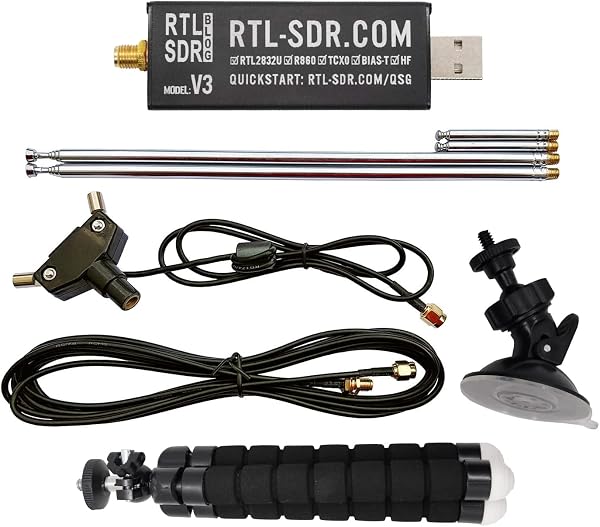
The RTL-SDR Blog V3 Kit combines the industry-reference RTL-SDR Blog V3 dongle with a versatile multipurpose dipole antenna, delivering a complete starter package without requiring separate antenna purchases. For buyers who want the RTL-SDR Blog V3 dongle quality that software is specifically tested against, plus a quality VHF and UHF antenna, this kit provides excellent value compared to buying components separately.
We may earn a commission when you buy through this link, at no additional cost to you.
The included multipurpose dipole antenna kit is well-designed for terrestrial VHF and UHF reception plus satellite work, which covers most common SDR applications of interest to beginners and intermediate users. The dipole supports mounting outdoors on a tripod for temporary use at specific locations, which is particularly useful for satellite reception where antenna orientation matters significantly. The antenna is not suitable for HF reception, since HF antennas require significantly longer elements than practical in a portable dipole kit.
The dongle itself provides all the features that make the RTL-SDR Blog V3 the industry reference: 1 PPM TCXO for stable tuning, R860 tuner chip for improved sensitivity, aluminum shielded case with thermal cooling pad, SMA F connector for standard antennas, and activatable bias tee circuit for powering external LNAs. The 500 kHz to 1.7 GHz tuning range with HF direct sampling capability covers virtually all practical civilian radio applications.
The RTL-SDR Blog dipole antenna kit became popular with the SDR community because it offers meaningful performance in a portable, affordable package. Unlike single-frequency antennas, the adjustable dipole can be tuned to resonance at various frequencies by changing element length. For buyers who monitor different bands at different times, this flexibility provides much better performance than fixed-length antennas across the full RTL-SDR frequency range.
This kit is the right choice for new SDR buyers who specifically want the RTL-SDR Blog V3 reference dongle with a quality VHF and UHF antenna to start experimenting immediately. The main tradeoffs are that the included dipole is not designed for HF reception, so serious shortwave listeners will need to add long-wire or dipole antennas separately, and the antenna is designed for temporary outdoor use rather than permanent installation. For general SDR learning and VHF/UHF monitoring, this kit provides excellent completeness.
Buyers focused on HF reception who need antennas optimized for shortwave frequencies rather than VHF and UHF.
We may earn a commission when you buy through this link, at no additional cost to you.
The Nooelec NESDR Mini 2+ provides TCXO-equipped SDR capability at a lower price point than premium models, making it an attractive upgrade from basic R820T-equipped dongles like the original NESDR Mini. The 0.5 PPM TCXO delivers the same tuning stability as premium Nooelec models, which matters significantly for digital modes and narrow-signal reception where frequency accuracy affects decoding success.
We may earn a commission when you buy through this link, at no additional cost to you.
The R820T2 tuner provides substantial performance improvements over R820T-based devices, including better sensitivity, improved image rejection, and more consistent gain characteristics across the tuning range. For buyers moving up from basic SDR dongles who want improved real-world performance, the R820T2 upgrade combined with the TCXO delivers meaningful benefits that justify the modest price premium.
The complete kit includes the dongle, a magnetic antenna base, and a male MCX to female SMA adapter that allows connection to standard SMA antennas. This adapter is important for buyers who want to use quality aftermarket antennas, which typically use SMA connectors rather than the MCX connector on the dongle itself. The redesigned RF-suitable 3.3v power supply reduces noise significantly compared to earlier NESDR models, improving overall receiver performance.
Moving from a basic RTL-SDR without TCXO to a TCXO-equipped model represents one of the most meaningful performance upgrades available in affordable SDR equipment. The frequency stability improvement affects every type of signal reception, with the most dramatic benefits for digital modes, SSB voice, and narrow-signal applications. For buyers who have outgrown basic generic SDR dongles, upgrading to a TCXO-equipped model like the NESDR Mini 2+ provides tangible benefits without major investment.
This dongle is the right choice for buyers who want TCXO stability and R820T2 performance at a budget price point. The main tradeoffs compared to the premium NESDR v5 are the slightly smaller frequency range coverage and the older generation design that lacks some of the latest performance enhancements. For general SDR use where the price difference matters, this NESDR Mini 2+ delivers excellent value with meaningful performance improvements over basic SDR dongles.
Buyers who want the latest frequency range extensions and performance improvements of the newer NESDR v5 series.
We may earn a commission when you buy through this link, at no additional cost to you.
The RX888 MKII represents the professional end of affordable SDR receivers, built specifically for serious HF monitoring and advanced applications that exceed the capabilities of basic RTL-SDR dongles. The direct sampling architecture across the full 1 kHz to 64 MHz range provides HF performance that no RTL-SDR dongle can match, with the ability to sample the entire HF spectrum simultaneously for serious analytical work.
We may earn a commission when you buy through this link, at no additional cost to you.
The variable gain amplifier (VGA) with adjustment range from -10 to +33 dB provides significantly more gain control flexibility than fixed-gain receivers, which matters for optimizing reception across the wide dynamic range of HF signals from very weak distant stations to strong local broadcasters. The attenuator with -32 to 0 dB adjustment range further extends the receiver’s ability to handle strong signals without overloading, which is a common problem on crowded HF bands.
The 1 kHz lower frequency limit extends well below the capabilities of most SDR receivers, enabling monitoring of VLF signals including military communications, time standards, and natural atmospheric phenomena. The upper 64 MHz limit covers the complete HF spectrum plus the lower VHF range including the 6-meter amateur band. The direct sampling approach eliminates the compromises of upconverter-based HF solutions.
The RX888 MKII represents a significant investment compared to basic RTL-SDR dongles with upconverters. The decision to invest at this level typically depends on serious HF applications including DX reception of weak distant stations, dedicated amateur radio monitoring, radio research, or professional applications. For casual shortwave listening, the Nooelec HF Bundle delivers adequate performance at much lower cost. For buyers whose HF monitoring is a primary focus and who demand the best performance available, however, dedicated receivers like this RX888 MKII provide capability that justifies the investment.
This receiver is the right choice for serious HF enthusiasts, radio researchers, and buyers who need professional-grade HF performance at a price point still well below dedicated commercial receivers. The main tradeoffs are the significantly higher price compared to basic SDR dongles and the lower user rating that may reflect quality control issues or firmware limitations compared to more established options. For dedicated HF monitoring where performance justifies the investment, however, the RX888 MKII delivers capabilities that basic dongles cannot approach.
Casual SDR enthusiasts or those focused on VHF and UHF applications where this HF-focused receiver is not applicable.
We may earn a commission when you buy through this link, at no additional cost to you.
Selecting an SDR receiver involves matching frequency coverage, tuner performance, and included accessories to your specific monitoring interests. The receivers in this guide range from entry-level USB dongles to professional HF-focused equipment. This guide walks through the factors that genuinely matter when choosing software defined radio equipment.
The first consideration when choosing an SDR receiver is which frequency ranges you want to monitor. Standard RTL-SDR dongles like the RTL-SDR Blog V3 and Nooelec NESDR v5 cover 500 kHz or 100 kHz up to 1.7 or 1.75 GHz, which spans HF through most civilian UHF applications. The portable DSP SDR radios limit coverage to 100 kHz through 149 MHz, missing all UHF applications. The RX888 MKII focuses specifically on 1 kHz to 64 MHz for dedicated HF work.
Match frequency coverage to your actual interests. For general SDR exploration including FM broadcast, aviation, amateur VHF/UHF, ADS-B plane tracking, and satellite reception, a wideband dongle like the RTL-SDR Blog V3 or NESDR v5 covers virtually everything. For dedicated shortwave and HF amateur radio work, the Nooelec HF Bundle with upconverter or the RX888 MKII provide better HF performance. For portable field use focused on HF and VHF low bands, the standalone portable receivers offer self-contained operation.
Start with your actual monitoring interests rather than buying based on maximum specifications. A receiver that covers your target bands well is more valuable than one with impressive specs for bands you will never monitor.
RTL-SDR dongles vary significantly in tuner chip quality and TCXO frequency reference. The most important tuner chips are the older R820T (used in the Nooelec NESDR Mini), the improved R820T2 (used in the Nooelec NESDR Mini 2+ and NESDR v5), and the newest R860 (used in the RTL-SDR Blog V3). Each generation provides improved sensitivity, better image rejection, and more consistent performance across the tuning range.
TCXO precision affects frequency stability across temperature changes. Generic RTL-SDR dongles use standard crystals that drift 50 PPM or more, which is unacceptable for digital modes and narrow signals. Quality dongles use 1 PPM TCXO (RTL-SDR Blog V3) or even 0.5 PPM TCXO (Nooelec NESDR v5 and Mini 2+). This precision matters for successful decoding of digital modes, SSB voice, and other narrow-signal applications where frequency accuracy is critical.
For serious SDR work including digital modes and narrow-signal reception, choose a dongle with at least 1 PPM TCXO and preferably a current-generation tuner chip. For basic exploration and wideband applications, older tuners and standard crystals may be adequate.
HF reception on standard RTL-SDR dongles uses direct sampling mode, which bypasses the tuner chip to sample HF frequencies directly. Direct sampling works but suffers from several limitations including no gain control, image rejection problems, and generally reduced sensitivity compared to proper tuner-based reception. For casual HF monitoring, direct sampling provides adequate capability. For serious HF work, dedicated solutions perform significantly better.
The Nooelec HF Bundle addresses HF reception properly by including the Ham It Up upconverter that shifts HF signals up to the dongle’s optimal operating range. This provides full gain control, better image rejection, and significantly improved HF sensitivity compared to direct sampling. The RX888 MKII takes a different approach with native HF sampling architecture designed specifically for the full HF spectrum, delivering professional-grade performance.
For casual HF listening, basic dongles with direct sampling are adequate. For serious shortwave DXing, amateur radio HF work, or professional applications, invest in an upconverter-based solution or dedicated HF receiver.
SDR dongles without antennas are completely useless, so antenna availability significantly affects total cost and startup complexity. The RTL-SDR Blog V3 (dongle only) and Nooelec NESDR v5 (dongle only) require separate antenna purchases, which adds to the total investment but allows selection of antennas optimized for specific applications. The RTL-SDR Blog V3 Kit and Nooelec NESDR v5 Bundle include antennas for immediate use.
Quality of included antennas varies significantly. The RTL-SDR Blog V3 Kit includes a multipurpose dipole designed for VHF and UHF with adjustable elements for different bands, which is a popular design choice. The Nooelec NESDR v5 Bundle includes three different antennas plus a magnetic base for various applications. For beginners who need everything to start experimenting immediately, bundles offer better value than piecing together separate components.
If you already have quality SDR antennas, choose dongle-only options to save money. If you need antennas, bundles typically offer better value than separate purchases, especially for first-time SDR buyers.
SDR software support matters significantly for daily usability. All RTL-SDR-based dongles including those from RTL-SDR Blog and Nooelec work with the extensive ecosystem of SDR software including SDR# (Windows), GQRX (Linux and Mac), SDR++, CubicSDR, and many others. This broad compatibility is one of the major advantages of RTL-SDR-based receivers over proprietary SDR hardware with limited software support.
Mobile device support increasingly matters for portable SDR applications. The Nooelec NESDR v5 explicitly supports Android, which enables tablet-based SDR monitoring in the field. The standalone portable SDR radios eliminate the need for computer connection entirely, which is the ultimate solution for portability but limits software flexibility.
For maximum software compatibility and community support, choose RTL-SDR-based dongles from established manufacturers like RTL-SDR Blog and Nooelec. For portable use without computer dependence, standalone receivers provide self-contained operation at the cost of software flexibility.
SDR dongles generate heat during operation that can cause frequency drift and performance degradation. Premium dongles like the RTL-SDR Blog V3 and Nooelec NESDR v5 use aluminum enclosures with thermal pads to passively dissipate heat, which maintains stable performance across extended operation. Budget dongles with plastic cases often suffer from thermal drift that affects tuning accuracy during warm-up periods.
The ESD-safe antenna input on dongles like the Nooelec NESDR Mini provides protection against electrostatic discharge that can damage the sensitive tuner chip. This protection matters particularly for outdoor antennas that can accumulate static charge during normal use. Build quality also affects longevity, with premium brands typically offering longer warranty coverage (2 years from Nooelec vs. 1 year from some budget alternatives).
For long-term reliability and consistent performance, invest in premium dongles with proper thermal management and ESD protection. For casual experimentation, budget dongles provide adequate capability for learning the fundamentals.
Initial setup for most RTL-SDR dongles involves installing drivers and SDR software before you can receive any signals. The RTL-SDR Blog V3 and Nooelec units come with quickstart guides that walk through driver installation using the Zadig tool on Windows or built-in driver support on Linux. Download SDR# (SDRSharp) for Windows, GQRX for Linux and Mac, or SDR Touch for Android to start exploring. Spend time learning your chosen software before trying to receive challenging signals, since SDR has a learning curve that reward patience.
Antenna selection and placement often matter more than dongle quality for actual reception performance. For general SDR exploration, position the included antenna away from computer equipment, cellular phones, and other RF sources that generate interference. Mount outdoor antennas as high as practical for better range, and use quality coax cable with minimal connectors to preserve signal integrity. For specific applications like ADS-B plane tracking, FM broadcast DXing, or satellite reception, invest in antennas designed specifically for your target frequency range.
Long-term care involves protecting the dongle from thermal stress and physical damage. Allow dongles to breathe during extended operation to prevent overheating, which can cause frequency drift and shorten useful life. Keep antenna connections clean and tight to maintain signal integrity. For bias tee-equipped dongles like the RTL-SDR Blog V3, remember that enabling bias tee feeds DC voltage to the antenna port, so disconnect any antennas not designed for bias tee operation before enabling the feature. Back up your SDR software configurations periodically so you can restore your setup after software updates or system changes.
SDR receivers can monitor an enormous range of radio signals including broadcast AM and FM radio, shortwave international broadcasters, amateur radio bands, aviation communications, marine VHF, public safety trunked radio, ADS-B plane tracking, AIS ship tracking, weather satellite imagery, pager traffic, and much more. The exact capability depends on your dongle's frequency coverage and the software you use. SDR is primarily a receive-only technology, so you cannot transmit with these receivers.
No, SDR receivers are receive-only devices that do not require a license to own or use for monitoring in the United States. The frequencies you can legally monitor vary by country and situation, but general-purpose receiving of broadcast and amateur radio signals is widely permitted. Transmitting on any amateur radio or other licensed frequencies would require appropriate licensing, but SDR dongles in this guide cannot transmit.
RTL-SDR refers to a family of dongles based on the RTL2832U chip originally designed for DVB-T television reception. Hobbyists discovered these could be repurposed as general-purpose SDR receivers at very low cost, which created the modern RTL-SDR ecosystem. Other SDR types include dedicated devices like the RX888 MKII (direct HF sampling), HackRF (transmit capable), and SDRplay (improved HF performance). RTL-SDR dongles offer the best value for most users but have specific technical limitations compared to purpose-built SDR hardware.
TCXO stands for Temperature Compensated Crystal Oscillator, which maintains frequency stability as the dongle temperature changes during operation. Generic RTL-SDR dongles use standard crystals that drift 50 PPM or more with temperature, causing tuning errors that prevent successful decoding of digital modes and narrow signals. Quality dongles use 1 PPM TCXO or better, which maintains frequency accuracy within a few hundred Hz at UHF frequencies. For serious SDR work, TCXO is essential rather than optional.
SDR dongles can receive many types of police communications, but modern public safety systems increasingly use digital trunking that requires decoder software. Analog police communications and conventional digital systems can be monitored with SDR software like SDRTrunk or OP25. However, encrypted communications cannot be decoded by any legal receiver. Before buying an SDR for scanner purposes, verify that your local public safety agencies use systems that SDR software can decode.
Antenna selection depends entirely on your target frequencies. For VHF and UHF monitoring, dipole antennas like the one included with the RTL-SDR Blog V3 Kit work well. For FM broadcast DXing, directional Yagi antennas provide better results. For HF reception, long wire or dipole antennas significantly outperform the small telescoping antennas included in starter kits. Many SDR enthusiasts eventually own multiple antennas optimized for different frequency ranges and applications.
SDR runs on virtually any modern computer, though faster CPUs enable higher sample rates and better processing of complex signals. Windows computers typically have the best SDR software selection, but Linux and Mac also work well. Mobile devices including Android tablets can run SDR software, which enables portable SDR applications. For most RTL-SDR dongles, any computer less than 10 years old provides adequate processing power for basic SDR operation.
Direct sampling on RTL-SDR dongles bypasses the tuner chip to sample HF frequencies directly, which provides HF reception but with reduced sensitivity, no gain control, and image rejection problems. An upconverter like the Ham It Up included in the Nooelec HF Bundle shifts HF signals up to the dongle's optimal operating range, providing proper gain control, better image rejection, and significantly improved HF sensitivity. For serious HF monitoring, upconverter approaches deliver dramatically better results.
SDR receivers can monitor amateur radio communications across all bands they cover, which is useful for learning about ham radio before getting licensed and for monitoring activity while licensed. However, SDR dongles in this guide cannot transmit, so they cannot be used for two-way amateur radio communication. For transmit-capable SDR, look at products like the HackRF One or dedicated amateur radio SDR transceivers, which are significantly more expensive than receive-only dongles.
ADS-B operates at 1090 MHz, which falls well within the frequency range of all SDR dongles in this guide. The Nooelec NESDR Mini is specifically marketed for ADS-B use and includes an antenna optimized for the 1090 MHz frequency. However, any RTL-SDR dongle with a quality 1090 MHz antenna works well for ADS-B. For maximum ADS-B reception range and reliability, use a dedicated 1090 MHz antenna rather than general-purpose antennas, and consider external filters that reject out-of-band signals that can overload the dongle.
The RTL-SDR Blog V3 stands out as the strongest overall choice for buyers who want the industry-reference SDR dongle that software is specifically designed and tested against. The combination of 1 PPM TCXO frequency stability, R860 tuner chip, aluminum passive cooling case, and activatable bias tee circuit delivers the capabilities that serious SDR enthusiasts rely on daily. For general-purpose SDR exploration covering virtually all civilian radio applications, this is the baseline recommendation that defines the category and provides a known-good platform for learning SDR fundamentals.
For buyers with different priorities, several strong alternatives serve specific needs. The Nooelec NESDR v5 Bundle delivers premium dongle performance with complete starter accessories at competitive pricing. The Nooelec HF Bundle addresses serious shortwave listening with proper upconverter-based HF reception. The RTL-SDR Blog V3 Kit combines the reference dongle with a quality dipole antenna for immediate VHF and UHF use. Budget-conscious buyers get solid capability from the Nooelec NESDR Mini and Mini 2+ at lower price points. The portable DSP SDR radios offer standalone operation without computer dependence. The RX888 MKII delivers professional HF performance for dedicated enthusiasts.
Choosing the right SDR receiver starts with understanding your intended monitoring applications, your technical comfort level, and whether you need included antennas or already have suitable options. For general SDR exploration, start with the RTL-SDR Blog V3 or Nooelec NESDR v5. For HF-focused applications, consider the Nooelec HF Bundle or RX888 MKII. For portable field use, the standalone portable receivers eliminate computer dependence. Any of the 10 receivers in this guide will serve its intended purpose well when matched to the right user and application, so focus on fit for your specific needs rather than chasing the most impressive specifications on paper.