Samsung QN70H 43-Inch
8.6Editor score43-inch Mini LED
Quantum Mini LED
NQ4 AI processor
100% color volume
Find the right qled tvs for 2026. We compare 10 standout options by build quality, useful features, owner feedback, value, and everyday trade-offs.
Finding the right QLED television in 2026 means weighing panel technology, screen size, refresh rate, HDR format coverage, gaming performance, smart platform, and audio capability against your room and budget. We compare 10 standout quantum dot TVs across these practical factors so you can match the right display to how you actually watch, game, and set up your living space.
The gap between a basic QLED and a flagship Mini LED model has grown wider than most shoppers realize. Local dimming zones, peak brightness, variable refresh rate support, and processor quality all shape how a TV handles bright rooms, dark movie scenes, fast sports, and competitive gaming in ways that specification sheets alone do not reveal.
This guide breaks down the trade-offs that separate these quantum dot televisions, from affordable 55-inch models to premium 75-inch Mini LED flagships. You will find clear guidance on which TV suits a cinephile’s dedicated theater, which handles 144Hz gaming on a modern console, and which delivers the strongest value for mainstream mixed-use viewing.
We compared 10 quantum dot televisions using the factors that actually guide a serious shopper: panel technology, local dimming zone count, peak brightness, HDR format coverage, refresh rate and VRR support, processor quality, smart platform usability, port selection, audio capability, and real-world value. The notes focus on practical trade-offs so each pick connects to how people actually watch movies, follow sports, play games, and build a home theater around a premium flat-panel display.


Compare key features, scores, and current prices side by side. A shorter feature list means fewer details were available, not necessarily fewer capabilities.


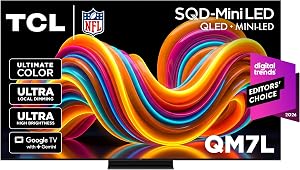


The TCL T7 65-inch delivers one of the most compelling value propositions in the quantum dot category by combining a true 144Hz panel, comprehensive HDR support, and Google TV in a 65-inch package at a mainstream price. For buyers who want a large living room display that handles streaming, sports, and modern gaming without stepping up to premium Mini LED pricing, this model hits a practical sweet spot.
We may earn a commission when you buy through this link, at no additional cost to you.
Picture performance benefits from quantum dot technology covering nearly the entire DCI-P3 color space, which produces richer and more accurate colors than standard LED-LCD panels. The AIPQ Pro processor handles contrast, clarity, and color optimization in real time, which helps the TV look its best across different content types. Full HDR format support including Dolby Vision, HDR10+, HDR10, and HLG means every disc and streaming source plays at its intended quality.
The 144Hz refresh rate paired with Motion Rate 480 and MEMC frame insertion keeps fast content smooth, which matters for sports broadcasts, action films, and PC or console gaming. Four HDMI inputs including one with eARC provide room for a soundbar, two consoles, and a streaming device without constant cable swapping. Google TV support means voice control through Google Assistant, Amazon Alexa, and Apple HomeKit all work out of the box.
A 144Hz refresh rate is often associated with PC gaming, but it benefits movie and sports viewing as well. The higher refresh rate allows smoother interpolation of lower frame rate content and more responsive handling of fast motion like football and racing. Even if you never game, a 144Hz panel typically delivers cleaner motion than a 60Hz display across all content.
The main trade-off is that this is a direct LED backlit panel rather than Mini LED, so peak brightness and local dimming performance will not match premium models like the TCL QM8L. For buyers who want strong QLED color, high refresh rate gaming, and complete HDR coverage without paying Mini LED prices, however, the T7 is one of the strongest 65-inch choices available today.
Buyers who want flagship Mini LED performance with thousands of local dimming zones.
We may earn a commission when you buy through this link, at no additional cost to you.
The Samsung QN70H 43-inch is unusual because Mini LED technology at this screen size is still uncommon. Most Mini LED TVs start at 55 inches or larger, which makes this model particularly appealing for buyers who want premium panel technology in a bedroom, home office, kitchen, or smaller living space where a 65-inch display would feel overwhelming.
We may earn a commission when you buy through this link, at no additional cost to you.
Picture quality uses Quantum Mini LED backlighting, which uses smaller LEDs than traditional LED-LCD TVs to produce more precise local dimming and better contrast between bright and dark areas of the screen. Combined with 100% color volume from the quantum dot layer, this produces vibrant color even in the brightest highlights, which standard LED panels often struggle with as brightness increases.
The NQ4 AI processor handles 4K upscaling for lower-resolution content and optimizes picture and audio settings based on what you are watching. Color Booster Pro uses AI to enhance hues dynamically for more immersive visuals. The Tizen smart platform provides access to Samsung TV Plus with hundreds of free channels along with all major streaming services and smart home integration.
Mini LED technology provides more precise brightness control than standard LED backlighting, which improves contrast and reduces light bleed in dark scenes. On a 43-inch TV, these benefits are visible but less dramatic than on a 65 or 75-inch screen, where the increased dimming zone count has more room to work. The compact format is best for shoppers who prioritize room fit alongside picture quality.
The main consideration is that a 43-inch Mini LED TV has fewer dimming zones than larger models in the same lineup, which limits the maximum benefit of the backlighting technology. The compact size also means less immersive viewing for primary home theater use. For buyers who specifically need a premium small-format TV, however, this is one of the most capable options available in the category.
Buyers who want a large primary living room display with maximum Mini LED zone count.
We may earn a commission when you buy through this link, at no additional cost to you.
The Samsung QN70F 65-inch sits at the top of this guide thanks to its combination of Neo QLED Mini LED backlighting, the NQ4 AI Gen2 processor, and comprehensive 144Hz gaming support. For buyers building a serious home theater or mixed-use entertainment room, it delivers flagship-level picture processing and gaming features without stepping all the way up to Samsung's most expensive 8K models.
We may earn a commission when you buy through this link, at no additional cost to you.
Picture quality is driven by Quantum Matrix Technology, which uses precisely controlled Mini LEDs to deliver sharp, accurate contrast and crisp detail. The NQ4 AI Gen2 processor uses 20 AI neural networks to analyze content and upscale lower-resolution sources to near-native 4K quality. Auto HDR Remastering intelligently converts SDR content to HDR-like quality with brighter highlights and more vibrant colors, which gives older content a visible lift.
Gaming performance is a standout feature, with VRR support at up to 4K 144Hz enabling smooth, tear-free play on PS5, Xbox Series X, and gaming PCs. Motion Xcelerator keeps fast sports and action content smooth, and the Tizen platform includes a dedicated gaming hub for cloud gaming services. Samsung Vision AI adds personalized recommendations and content organization through machine learning.
Quantum Matrix Technology refers to Samsung’s precision-controlled Mini LED backlighting system. By using thousands of tiny LEDs instead of fewer, larger ones, the TV can dim or brighten specific zones of the screen independently. This produces deeper blacks in dark scenes while keeping bright highlights intensely vivid, which is particularly noticeable in HDR content with mixed bright and dark elements.
The main consideration is that Samsung TVs do not support Dolby Vision, which some streaming services and Ultra HD discs master in. The TV handles HDR10+ and HDR10 well, which covers most content, but committed Dolby Vision enthusiasts should look at TCL alternatives. For buyers who want a premium 65-inch Neo QLED with top-tier gaming features and AI processing, however, this is the strongest choice in the comparison.
Dolby Vision enthusiasts who want full dynamic HDR format support across all content.
We may earn a commission when you buy through this link, at no additional cost to you.
The TCL QM8L 75-inch represents the premium end of this guide, combining a flagship SQD Mini LED panel with up to 4,000+ discrete dimming zones and peak brightness reaching 6,000 nits. For buyers building a dedicated home theater or large living room setup where picture quality and screen size matter most, this is one of the most capable consumer televisions in the quantum dot category.
We may earn a commission when you buy through this link, at no additional cost to you.
Picture performance leverages TCL’s Ultra Color Filter with 5-nanometer particles compared to the 60-nanometer standard, which produces more accurate and saturated color across the full visible spectrum. The high static contrast ratio of 7,000:1 combined with precision dimming eliminates the blooming and halo effects that can affect lesser Mini LED designs. Complete HDR format support including Dolby Vision ensures compatibility with every major content source.
The TCL Enhanced Halo Control System combines multiple backlighting technologies to produce halo-free images in dark scenes, which is particularly important in a 75-inch panel where backlight uniformity issues become more visible. Google Gemini Interactive AI brings conversational voice control to the smart platform, and the TCL Game Pack includes 288Hz Game Accelerator VRR, AMD FreeSync Premium Pro, and a Game Bar for competitive play.
HDR content is mastered with peak brightness in mind, typically targeting 1,000 or 4,000 nits depending on the production. A TV that can reach 6,000 nits can display HDR highlights at or above the mastered intent, producing the full dynamic range the colorist intended. On lower-brightness displays, these highlights get tone-mapped down and lose some of their intended impact, especially in bright viewing environments.
The main consideration is that this is the most expensive TV in the guide and requires substantial room size and viewing distance to use effectively. The 75-inch panel is best suited to viewing from eight to twelve feet away. For buyers with the space and budget who want reference-level brightness, Mini LED precision, and comprehensive AI features, however, this is a benchmark-setting large-format QLED.
Shoppers with smaller rooms or buyers who do not want to invest in a premium flagship display.
We may earn a commission when you buy through this link, at no additional cost to you.
The Insignia QF 65-inch is the most affordable path into QLED technology at a 65-inch screen size. For buyers who want quantum dot color performance and Dolby Vision HDR support without paying mid-range or premium prices, this model proves that modern panel technology has become accessible across a wide range of budgets. It is well suited to secondary rooms or buyers upgrading from an older LCD TV.
We may earn a commission when you buy through this link, at no additional cost to you.
Picture quality uses quantum dot technology to enhance color brightness and accuracy compared to standard LED-LCD panels. Dolby Vision support ensures that Dolby Vision-mastered content from streaming services and Ultra HD discs plays with dynamic metadata optimization. The direct LED backlight provides uniform brightness across the screen, though it lacks the local dimming precision of Mini LED models at higher price points.
The Fire TV platform brings access to over 500,000 streaming movies and TV episodes across major services, with Alexa voice control through the included remote. Dolby Atmos audio processing adds spatial sound to compatible content, which creates a more immersive experience without requiring an external sound system. The metal bezel-less design keeps the overall look clean in modern living spaces.
Even an entry-level QLED produces noticeably better color than a standard LED-LCD TV at a similar price. The quantum dot layer expands the color gamut, which translates to more lifelike skin tones and richer saturation in nature and sports content. If you have been watching a non-QLED TV, upgrading to any QLED model, including entry-level options like the Insignia QF, provides a visible improvement in daily viewing.
The main consideration is that this TV uses a 60Hz panel and includes three HDMI inputs rather than four, which limits connectivity for complex home theater setups and provides less headroom for high-refresh gaming. For buyers who prioritize affordable quantum dot picture quality at a large screen size, however, this is one of the most practical choices in the category.
Gamers who need 120Hz or 144Hz refresh rate or buyers who need four HDMI inputs.
We may earn a commission when you buy through this link, at no additional cost to you.
The Samsung QN80H 55-inch brings Neo QLED Mini LED technology to a mid-range 55-inch size, which makes premium backlighting more accessible for medium-sized living rooms and bedrooms. The Full Array Mini LED configuration delivers precisely controlled lighting zones that reveal shadow detail in dark scenes while allowing bright scenes to shine with lifelike intensity.
We may earn a commission when you buy through this link, at no additional cost to you.
Picture processing uses the NQ4 AI Gen2 processor to analyze and enhance content in real time, producing sharper images, smoother motion, and more vibrant colors across different content types. Motion Xcelerator 144Hz with VRR support eliminates stutter and tearing during fast-paced gaming and sports, which is a meaningful upgrade over the 60Hz panels typically found at this price point.
4K AI Upscaling ensures that lower-resolution sources look clean on the 55-inch panel, while Auto HDR Remastering converts SDR content to HDR-like quality with brighter highlights and more vibrant colors. The Tizen smart platform provides access to Samsung TV Plus free channels, all major streaming apps, and smart home device control through Alexa and Bixby integration.
A 3.9 star rating is still above average but noticeably lower than other models in this comparison. When considering a product with mixed ratings, read recent reviews carefully to understand whether issues relate to specific use cases, shipping damage, or persistent product concerns. This context helps you decide whether the trade-offs apply to your situation.
The main consideration is that this model has the lowest star rating in the guide at 3.9, which suggests some buyers have experienced issues worth researching before purchasing. Like other Samsung TVs, Dolby Vision is not supported. For buyers who want Neo QLED technology in a 55-inch size and are comfortable with the Samsung ecosystem, however, this remains a capable mid-range option worth considering alongside its alternatives.
Dolby Vision users or buyers who prefer products with consistently higher owner ratings.
We may earn a commission when you buy through this link, at no additional cost to you.
The TCL QM6K 55-inch brings QD-Mini LED technology to a compact 55-inch form factor at a price that undercuts most competing Mini LED offerings. For buyers who want premium backlighting technology and comprehensive HDR support in a mid-size screen suitable for bedrooms, apartments, and smaller living rooms, this model is one of the strongest value picks in the lineup.
We may earn a commission when you buy through this link, at no additional cost to you.
Picture quality combines ultra-precise Mini LEDs with Quantum Dot technology to deliver high brightness, bold contrast, and over a billion vibrant colors. The TCL Halo Control System uses advanced local dimming to eliminate the halo effects that can appear around bright objects on dark backgrounds, which is a common criticism of lesser Mini LED designs. Full HDR support including Dolby Vision ensures compatibility across every major content source.
The 144Hz native refresh rate paired with Motion Rate 480 keeps fast content smooth, which matters for sports and gaming. The Google TV smart platform provides a familiar interface for Android users along with Google Assistant voice control and casting from Android devices. Onkyo-tuned Dolby Atmos audio delivers better built-in sound than most competing TVs at this price, reducing the immediate need for a soundbar.
QD-Mini LED combines quantum dot color enhancement with Mini LED backlighting to produce both wide color gamut and precise contrast control. This hybrid approach aims to deliver OLED-like black levels through local dimming while maintaining the high brightness advantage of LED backlighting. For bright rooms where OLED panels struggle, QD-Mini LED is often the better choice.
The main consideration is that this TV has fewer local dimming zones than TCL’s higher-tier QM7L and QM8L models, which limits the maximum precision of its backlighting. The 55-inch size also means less immersive viewing compared to 65 or 75-inch alternatives. For buyers who want Mini LED performance in a compact and affordable package, however, this is one of the standout picks in the guide.
Buyers who want maximum local dimming zone count or need a 65-inch or larger display.
We may earn a commission when you buy through this link, at no additional cost to you.
The TCL QM7L 55-inch sits above the QM6K in TCL's lineup, adding more sophisticated local dimming with up to 2,100 precisely controlled zones along with Bang & Olufsen tuned audio. For buyers who want a 55-inch display with closer-to-flagship picture quality and improved built-in sound, this model bridges the gap between mainstream and premium Mini LED options.
We may earn a commission when you buy through this link, at no additional cost to you.
Picture quality uses TCL’s Ultra Color Filter with 5-nanometer particles for pixel-perfect color accuracy, and the HVA 2.0 Pro Panel delivers high contrast with anti-reflective properties that help in bright rooms. The LD2100 Precise Dimming Series uses up to 2,100 dimming zones to produce pure black levels in dark scenes while maintaining bright highlight performance in HDR content.
The AIPQ Pro processor dynamically controls picture clarity, contrast, color, motion, upscaling, and backlighting based on the incoming signal, which produces consistent quality across different content types. Google Gemini Interactive AI brings conversational voice control to the smart platform, and the TCL Game Pack includes 288Hz Game Accelerator VRR, AMD FreeSync Premium Pro, and a Game Bar for serious gaming performance.
More local dimming zones generally mean better contrast control and less visible blooming around bright objects on dark backgrounds. The jump from a few hundred zones on entry-level Mini LED models to 2,100 zones on the QM7L produces visibly better performance in challenging scenes like starfields, candlelit interiors, and bright titles over dark backgrounds. This precision becomes particularly important for serious movie viewing in dim rooms.
The main consideration is that this TV sits at a premium price point for its 55-inch size, which may make the larger QM6K at a lower price or a 65-inch alternative at a similar price more attractive depending on your priorities. For buyers who specifically want a compact flagship-quality Mini LED with high-end audio tuning, however, the QM7L delivers an uncompromising experience in a space-efficient package.
Buyers who want a larger screen or prefer to spend less on a solid mid-range Mini LED.
We may earn a commission when you buy through this link, at no additional cost to you.
The Samsung Q8F 65-inch is designed for buyers who prioritize a slim, wall-friendly design alongside quantum dot picture quality and 144Hz gaming performance. The AirSlim profile allows the TV to blend into a wall with minimal depth, which is particularly valuable in minimalist living spaces or when wall-mounting against a flat surface for a nearly flush appearance.
We may earn a commission when you buy through this link, at no additional cost to you.
Picture quality uses quantum dot technology to deliver 100% color volume, meaning colors remain accurate and saturated even in the brightest scenes. The Q4 AI processor handles upscaling and content optimization, bringing lower-resolution sources closer to 4K quality through intelligent processing. HDR content benefits from scene-by-scene brightness and contrast analysis, though Dolby Vision is not supported.
Gaming support includes VRR at up to 4K 144Hz, which keeps modern console and PC games smooth without screen tearing. The Tizen platform provides access to 2,700+ free channels including 400+ Samsung TV Plus premium channels, which is substantial for cord-cutters looking to reduce streaming subscriptions. Samsung Vision AI adds personalized recommendations and content organization through machine learning.
A slim TV profile matters particularly for wall mounting, where thicker TVs can look bulky and protrude noticeably from the wall. The AirSlim design minimizes this gap for a more integrated look. If you plan to wall-mount your TV in a visible location, a slim-profile model can make a real difference in how the final installation looks compared to a standard thickness panel.
The main consideration is that this is a standard QLED without Mini LED backlighting, so contrast and local dimming performance will not match the Neo QLED models in Samsung’s lineup. For buyers who want a slim, design-focused 65-inch QLED with strong gaming features and comprehensive smart capabilities, however, the Q8F offers a well-rounded package at a competitive mid-range price.
Buyers who want Mini LED backlighting or require Dolby Vision support for their content library.
We may earn a commission when you buy through this link, at no additional cost to you.
The TCL F8D 75-inch delivers quantum dot picture quality and 144Hz gaming at a 75-inch screen size for substantially less than premium Mini LED alternatives. For buyers who prioritize screen size and modern gaming features over flagship backlighting technology, this model provides a cinematic viewing experience without stretching into luxury pricing territory.
We may earn a commission when you buy through this link, at no additional cost to you.
Picture quality covers 93% of the DCI-P3 color spectrum through quantum dot technology, which produces richer and more accurate colors than standard LED-LCD panels. Full HDR support including Dolby Vision, HDR10+, HDR10, and HLG ensures compatibility with every major content source. The high brightness LED backlight helps the TV remain usable in well-lit rooms, where glare and reflections can wash out lesser displays.
Gaming performance includes 144Hz native refresh with VRR, Auto Low Latency Mode, and TCL Game Accelerator 288 for responsive play on PS5, Xbox Series X, and gaming PCs. The Fire TV smart platform integrates with Alexa+ for conversational voice control, and AirPlay 2 compatibility lets you cast content from iPhones and iPads. HomeKit support rounds out the smart home integration for Apple ecosystem users.
AirPlay 2 lets you stream content directly from iPhones, iPads, and Macs to your TV without additional hardware. This is particularly useful for sharing photos, playing music, or mirroring content from an Apple device during gatherings. Combined with HomeKit support, Apple users get a more integrated smart home experience than TVs lacking these features.
The main consideration is that this is a direct LED backlit panel rather than Mini LED, so peak brightness and local dimming performance will not match premium models like the QM8L. For buyers who want a large 75-inch QLED with modern features and broad smart home compatibility at a competitive price, however, this TV delivers a strong overall package that fits well in most living rooms.
Buyers who want flagship Mini LED backlighting or need a smaller screen for compact rooms.
We may earn a commission when you buy through this link, at no additional cost to you.
Choosing a quantum dot television involves balancing panel technology, screen size, gaming features, HDR support, smart platform, and price against the way you actually watch content. This section walks through the specifications that make a real difference so you can prioritize the right features for your room and viewing habits.
Standard QLED uses quantum dots to enhance color brightness and accuracy over traditional LED-LCD panels, but it typically relies on edge or direct LED backlighting without precise local dimming. Mini LED, sometimes marketed as Neo QLED by Samsung or QD-Mini LED by TCL, uses thousands of smaller LEDs to produce much finer local dimming control, which dramatically improves contrast and reduces blooming around bright objects on dark backgrounds.
The practical difference is most visible in dark scenes and HDR content with mixed bright and dark elements. On a standard QLED, bright elements can produce visible halos as the backlight bleeds into surrounding dark areas. On a Mini LED display with thousands of dimming zones, those halos are largely eliminated, producing a cleaner, more cinematic image. The trade-off is price: Mini LED TVs cost significantly more than standard QLEDs at the same screen size.
If you watch mostly in bright rooms or do not watch much HDR content, standard QLED delivers excellent color at a lower price. For dedicated movie watching, HDR enthusiasts, and dim-room viewing, Mini LED provides a meaningful upgrade worth the additional investment.
Screen size should match both your room dimensions and your preferred viewing distance. A 55-inch TV works well at six to eight feet, 65 inches suits seven to ten feet, and 75-inch models look best at nine to twelve feet. Going larger than your viewing distance supports can cause eye fatigue and make the pixel structure visible, while going smaller leaves you missing immersion that modern 4K content was designed to provide.
Measure your actual seating distance before deciding on screen size. The jump from 55 to 65 inches often feels dramatic in daily viewing, while the jump from 65 to 75 inches requires more room to use effectively. For dedicated home theater rooms where you can control seating and lighting, going larger is usually the right call. For mixed-use living rooms, 65 inches is often the sweet spot that works across multiple viewing situations.
When in doubt, size up rather than down for primary rooms. Most buyers wish they had gone larger after a few months of use, especially with 4K content that reveals its full detail on bigger screens.
HDR comes in several formats, and TV support varies by brand. HDR10 is the baseline standard supported by every modern TV. HDR10+ uses dynamic metadata for scene-by-scene optimization and is supported across both Samsung and TCL lineups. Dolby Vision also uses dynamic metadata and is supported by TCL, Insignia, and most other brands but notably not by Samsung. HLG is used primarily for broadcast content.
The practical implication depends on your content library. Netflix, Disney Plus, Apple TV Plus, and many Ultra HD Blu-ray releases use Dolby Vision as their primary HDR format, which plays as standard HDR10 on Samsung TVs. Prime Video uses HDR10+ for its originals, which plays as standard HDR10 on TVs that lack HDR10+ support. If you want the best possible HDR performance across all content, choose a TV that supports both Dolby Vision and HDR10+ along with HDR10.
TCL models in this guide generally offer the most complete HDR format support. Samsung models skip Dolby Vision but handle HDR10+ well. Match the TV’s HDR capabilities to the content you watch most.
Refresh rate affects both motion smoothness and gaming performance. 60Hz is the standard and works for most viewing, but 120Hz or 144Hz panels produce visibly cleaner motion for sports, action films, and high-frame-rate gaming. Variable Refresh Rate matches the display’s refresh rate to the game’s frame rate dynamically, eliminating screen tearing during gameplay. Auto Low Latency Mode automatically switches to Game Mode when a console is detected, reducing input lag.
For serious console gaming on PS5 or Xbox Series X, prioritize a TV with 120Hz or higher refresh rate, VRR support, HDMI 2.1 inputs, and ALLM. Several models in this guide, including the TCL T7, Samsung QN70F, and TCL F8D, support 144Hz with VRR for competitive gaming. For casual gaming or non-gaming use, these advanced features are less critical and should not drive your purchase decision.
If gaming is a primary use case, choose a model with explicit 120Hz or 144Hz VRR support. If gaming is incidental, a 60Hz panel from the same lineup usually saves money without affecting your typical experience.
The smart TV operating system shapes your daily experience as much as picture quality. Google TV, found on most TCL models, offers a familiar interface for Android users with strong voice search and smart home integration through Google Assistant. Samsung Tizen provides a polished interface with access to 2,700+ free channels through Samsung TV Plus and tight integration with other Samsung devices. Fire TV, found on Insignia and some TCL models, integrates deeply with Amazon services and offers excellent Alexa voice control.
Each platform supports all major streaming services including Netflix, Prime Video, Disney Plus, Hulu, Max, and Apple TV Plus. The differences come down to interface design, voice control preferences, and ecosystem integration. If you already use Alexa smart home devices, Fire TV may feel most natural. If you own other Samsung products, Tizen provides tighter integration. For Android phone users, Google TV offers seamless casting and search.
Spend a few minutes trying each platform in a store or at a friend’s house if possible. The interface you find most intuitive will provide the best long-term experience regardless of underlying features.
Peak brightness determines how impactful HDR highlights appear and how well the TV performs in bright rooms. Entry-level QLEDs typically reach 400 to 600 nits, mid-range Mini LEDs reach 1,000 to 2,000 nits, and flagship models like the TCL QM8L push up to 6,000 nits. Higher brightness allows HDR content to display at its mastered intent and keeps the picture visible in sunlit rooms where lower-brightness TVs become difficult to watch.
Local dimming zone count works alongside brightness to produce contrast. More zones mean the backlight can brighten specific areas while keeping surrounding areas dark, which produces OLED-like black levels on an LED-based display. The TCL QM8L offers up to 4,000+ zones, while the QM7L provides up to 2,100. Entry-level Mini LED TVs typically have a few hundred zones, which is still better than no local dimming but noticeably less precise than flagship models.
For bright rooms and HDR enthusiasts, prioritize high peak brightness. For dim movie-watching rooms, higher dimming zone counts matter more than raw brightness numbers.
Built-in TV speakers have improved steadily, with technologies like Dolby Atmos processing and Object Tracking Sound creating a wider soundstage from compact arrays. However, built-in speakers rarely match a dedicated soundbar or surround system. Some TVs in this guide, including the TCL QM7L and QM8L, feature Bang & Olufsen tuned audio that performs noticeably better than typical built-in speakers.
If you plan to use a soundbar or receiver, built-in audio quality matters less because you will primarily use the external system. If you want to avoid adding extra audio hardware, prioritize models with upgraded speaker systems and Dolby Atmos support. HDMI eARC compatibility ensures you can upgrade to a soundbar later without rewiring, so even if you start with built-in audio, future upgrades remain simple.
Budget for a soundbar if sound quality matters to you. Even a modest soundbar in the $200 to $400 range dramatically improves the audio experience compared to most built-in TV speakers.
Spend time calibrating your picture settings during initial setup rather than leaving the TV in its default mode. Most QLED TVs ship in a Standard or Vivid mode that oversaturates colors and boosts brightness to look impressive in showroom lighting. Switching to Movie, Cinema, or Filmmaker Mode produces more accurate colors and reduces eye fatigue during long viewing sessions. Many models offer separate settings for daytime and nighttime viewing, which is worth configuring if your room lighting changes significantly.
Position your TV to minimize glare and reflections, which can degrade the picture even on high-brightness Mini LED models. Avoid placing the screen directly opposite a window where sunlight hits during peak viewing hours. If wall mounting, maintain at least a few inches of clearance for ventilation, especially for larger models that generate more heat. Use a soft microfiber cloth and avoid household cleaning sprays when cleaning the screen, as abrasive chemicals can damage anti-glare coatings over time.
Keep firmware updated by connecting the TV to Wi-Fi and allowing automatic updates. Manufacturers regularly release improvements for picture processing, streaming app compatibility, HDR performance, and gaming features. If you notice issues like streaming stutters, audio dropouts, or picture inconsistencies, a firmware update often resolves them. For TVs with built-in gaming features, enabling Game Mode automatically through ALLM reduces input lag significantly when a console is detected, which is worth confirming in the settings menu.
QLED uses an LED backlight with a quantum dot layer to enhance color, while OLED uses self-emissive pixels that produce their own light. OLED typically delivers better black levels and infinite contrast, while QLED achieves higher peak brightness and better performance in bright rooms. For dim movie rooms, OLED is often preferred. For bright living rooms or buyers concerned about burn-in from static content, QLED is generally the safer choice.
Standard QLED delivers excellent color and works well for most mixed-use viewing in moderately lit rooms. Mini LED provides significantly better contrast and HDR performance through precise local dimming, which matters most in dark rooms and for serious movie or HDR content viewing. If you watch mostly in bright rooms or do not prioritize HDR, standard QLED saves money without major compromises. For dedicated home theater use, Mini LED is worth the upgrade.
Samsung has chosen to support HDR10+ exclusively rather than paying Dolby Vision licensing fees. HDR10+ offers similar dynamic metadata benefits to Dolby Vision but is less widely adopted by streaming services and disc releases. On Samsung TVs, Dolby Vision content plays as standard HDR10, which still looks very good but lacks the scene-by-scene optimization. For buyers who want full HDR format support, TCL is often a better choice.
Measure your typical viewing distance in feet. A 55-inch TV works well at 6 to 8 feet, 65 inches suits 7 to 10 feet, and 75 inches is best at 9 to 12 feet. For primary living rooms, most buyers prefer 65 inches as a balanced size that works for both casual and immersive viewing. Going larger than your room supports causes eye fatigue, while going smaller leaves immersion on the table.
A 144Hz panel benefits more than just gaming. Higher refresh rates produce cleaner motion for sports broadcasts and action films, with better handling of fast camera pans and movement. The improvement over 60Hz is subtle but noticeable in daily viewing. However, if gaming is not a priority and most of your content is dialogue-driven dramas or standard streaming, 60Hz performs well enough that paying extra for 144Hz may not be necessary.
Both formats use dynamic metadata to optimize HDR on a scene-by-scene basis, producing better results than standard HDR10. Dolby Vision is more widely adopted by streaming services like Netflix, Disney Plus, and Apple TV Plus along with most Ultra HD Blu-rays. HDR10+ is supported by Prime Video and some disc releases. Having both formats, as TCL TVs offer, ensures the best HDR performance across all content sources.
Yes, most QLED TVs support VESA wall mounting, with specific VESA patterns listed in the product specifications. Larger TVs require sturdier mounts rated for the weight of the panel. Models with AirSlim designs like the Samsung Q8F sit particularly close to the wall for a more integrated look. Always confirm the mount is rated for your specific TV's weight and VESA pattern before installation.
QLED TVs do not suffer from burn-in the way OLED displays can. Because QLED uses an LED backlight rather than self-emissive pixels, static content like news tickers, game HUDs, or channel logos does not cause permanent image retention. This makes QLED a safer choice for buyers who watch a lot of content with static elements or use their TV as a monitor for extended periods.
Each platform has strengths and weaknesses. Google TV offers strong Android integration and voice search. Samsung Tizen provides tight ecosystem integration and 2,700+ free channels. Fire TV excels at Alexa voice control and Amazon service integration. All platforms support major streaming apps, so the best choice depends on your existing devices and interface preferences rather than feature gaps.
A soundbar is one of the best upgrades you can add to any TV, including a premium QLED. Even TVs with Bang & Olufsen tuned audio or Dolby Atmos processing cannot match a dedicated soundbar for dialogue clarity, bass response, and surround effects. A modest soundbar in the $200 to $400 range dramatically improves the viewing experience, especially for movies and sports.
The Samsung QN70F 65-inch stands out as the strongest overall choice in this guide, combining Neo QLED Mini LED backlighting, the NQ4 AI Gen2 processor, Quantum Matrix Technology, and VRR gaming at up to 4K 144Hz. For buyers building a serious home theater or mixed-use entertainment room where picture quality, gaming performance, and modern smart features all matter, it delivers a flagship-level experience without pushing into the highest tier of premium pricing.
Different priorities point to different models. The TCL T7 65-inch offers outstanding value with a 144Hz panel, complete HDR format support including Dolby Vision, and Google TV at a mainstream price. The TCL QM8L 75-inch delivers reference-level brightness and contrast for dedicated home theater buyers with the room and budget to support it. The Insignia QF 65-inch provides affordable quantum dot picture quality for secondary rooms, while the TCL QM6K 55-inch brings Mini LED technology to compact spaces.
Choose based on how you will actually use the TV and the environment where it will live. For dedicated movie viewing in a dim room, prioritize Mini LED with high dimming zone counts like the TCL QM8L or QM7L. For bright living rooms with mixed use, strong QLED models like the TCL T7 or Samsung Q8F balance performance and value. For gamers, prioritize models with 144Hz VRR support like the Samsung QN70F or TCL F8D. In every case, these quantum dot televisions represent the current state of the art in LED-based picture quality.