VEVOR 350 LBS
8.8Editor score350 lb load capacity
13.8-36 inch range
16.3×13.8 inch deck
Foot-operated hydraulic lift
Find the right motorcycle lifts for 2026. We compare 10 standout options by build quality, useful features, owner feedback, value, and everyday trade-offs.
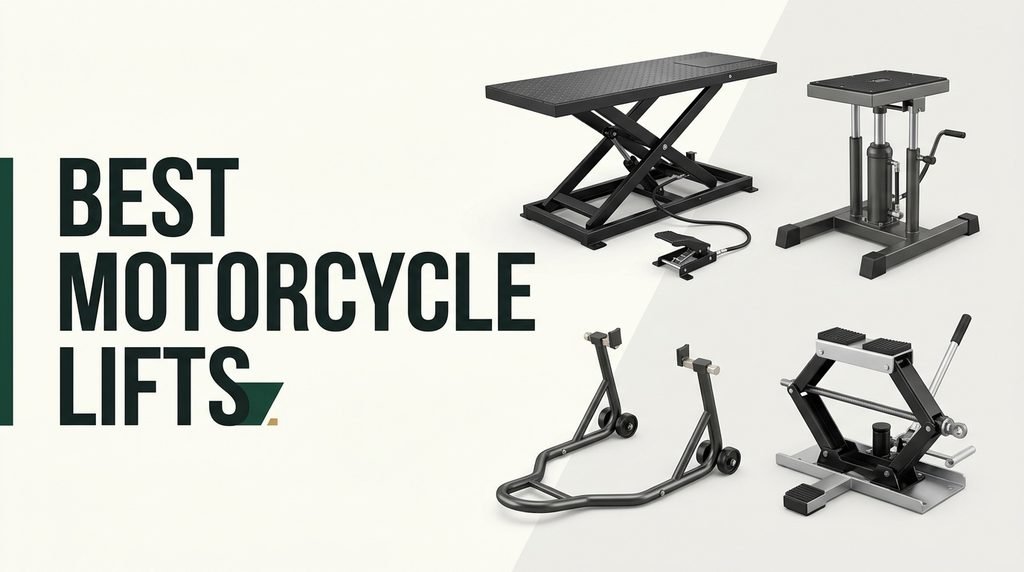
Find the right motorcycle lift for 2026 by matching its capacity, lifting range, platform design, and safety system to your bike and workspace. This guide compares 10 options ranging from compact manual scissor jacks to full pneumatic lift tables, with practical attention to stability, clearance, mobility, storage, and everyday service needs.
The biggest differences are not always found in the advertised weight rating. A low-profile center jack may be ideal for tire or chain work, while a full table lift makes loading and eye-level repairs easier. Hydraulic pedals, screw handles, wheel clamps, tie-downs, mechanical locks, and platform dimensions all change how confidently you can work.
Use the comparison below to narrow the field according to your motorcycle type, garage layout, and maintenance routine. Riders who need occasional cleaning or wheel access may prefer a compact lift, while frequent repair work or heavier touring bikes call for a broader platform, stronger restraints, and a greater lifting range.
We compared 10 motorcycle lifts using the details that most affect safe and practical maintenance: rated capacity, minimum and maximum height, platform dimensions, lifting method, mechanical safety locks, wheel clamps or tie-down provisions, caster design, storage footprint, compatibility notes, owner ratings, and overall value. The selections reflect real trade-offs between portability, working height, loading convenience, stability, and the space available in a home garage or professional shop.


Compare key features, scores, and current prices side by side. A shorter feature list means fewer details were available, not necessarily fewer capabilities.

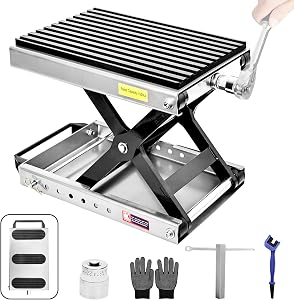




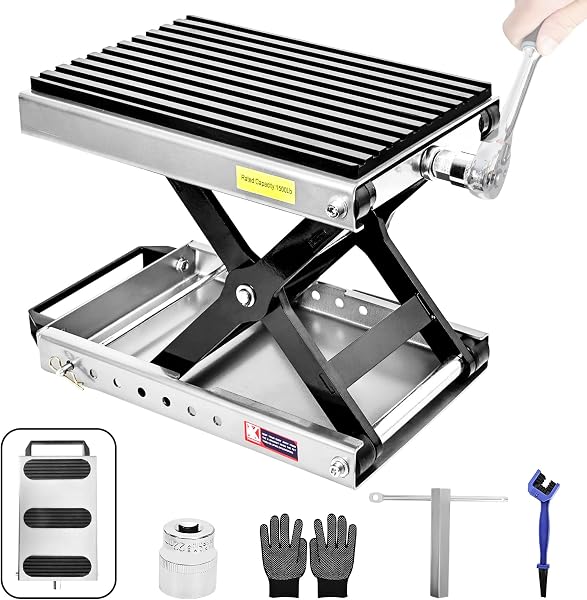
For routine motorcycle maintenance, a compact manual scissor jack can be more practical than a larger hydraulic table. This VEVOR model supports up to 1100 pounds and is specifically suited to street bikes, cruisers, and touring motorcycles. Its low starting height also makes it easier to place under bikes that do not have much ground clearance.
We may earn a commission when you buy through this link, at no additional cost to you.
The detachable handle raises the deck from 3.7 to 13.8 inches, giving useful access for tires, chains, brakes, and other lower components. Manual operation means there is no hydraulic pedal or compressed-air system to maintain, though turning a crank naturally takes more time than pumping a hydraulic jack.
The 14.4 by 9 inch platform has a striped rubber pad that gives the underside a more secure contact surface. A six-position safety pin holds the scissor mechanism at multiple working heights, and the powder-coated finish is easier to wipe clean after contact with oil or grease. The jack folds down to 3.7 inches for storage in a cabinet or under a workbench.
A manual center lift works well when the same motorcycle remains in one service position for tire changes, cleaning, chain work, or winter preparation. The small folded footprint makes it easy to store between sessions, while the mechanical safety positions avoid relying solely on hydraulic pressure. Plan the bike’s placement before lifting because the jack itself is not intended for rolling relocation.
This is the strongest value choice for riders who want high capacity and compact storage without paying for a full lift table. Its limitations are equally clear: it does not roll under the motorcycle, and the maximum height is better for seated or crouched service than for upright workshop work.
Anyone who needs to roll a raised motorcycle around the garage or perform frequent standing-height repairs.
We may earn a commission when you buy through this link, at no additional cost to you.
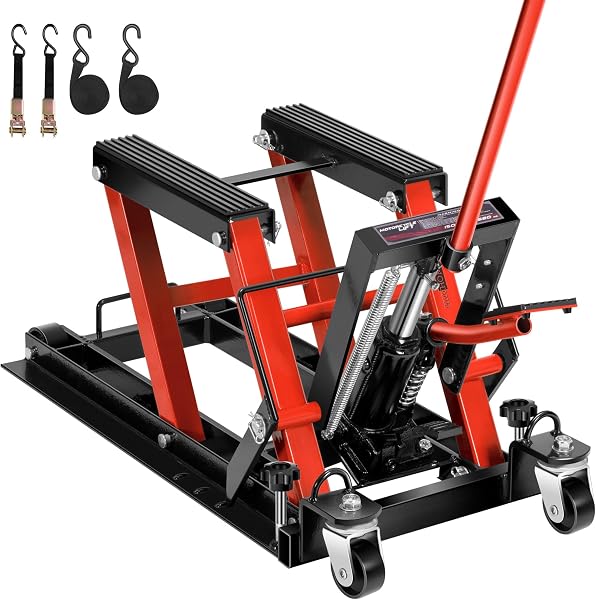
This VEVOR lift is aimed at dirt-bike and off-road owners who want to bring a relatively light motorcycle to a comfortable service height. Its 350-pound rating is much lower than the heavy-duty jacks in this guide, but the 36-inch maximum height is unusually useful when you need to work standing rather than crouched over a low center stand.
We may earn a commission when you buy through this link, at no additional cost to you.
The foot-operated hydraulic mechanism lets you raise the platform while keeping both hands available for positioning the motorcycle. The lift starts at 13.8 inches and rises to 36 inches, so it is better suited to bikes with suitable underside clearance than to machines that sit very close to the ground. Confirm the clearance and weight of your specific bike before buying.
A 16.3 by 13.8 inch platform gives the bike a defined contact area, while rubber stripes help reduce sliding and protect the underside from direct contact with bare steel. Two swivel casters and two lockable casters make it easier to move the jack into place, and the brakes should be engaged before any maintenance begins.
A tall lift with a narrow platform is useful only when the contact points under the motorcycle are compatible with its deck. Inspect the frame rails, skid plate, or other approved support areas before placing the jack under the bike. The listed lifting range begins well above the floor, so clearance should be treated as a first-fit requirement rather than something to solve after purchase.
The safety pin and J-hook are important parts of the setup rather than optional extras. The pin provides a mechanical holding point at the chosen height, while the hook helps limit movement during service. Choose this model when vertical working height and off-road compatibility matter more than the ability to lift a heavy touring or cruiser motorcycle.
Heavy cruisers, touring motorcycles, or any bike and equipment combination exceeding 350 pounds.
We may earn a commission when you buy through this link, at no additional cost to you.
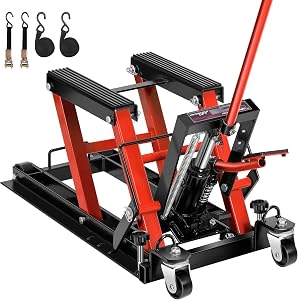
The VEVOR 1500 LBS hydraulic jack is built for buyers who need substantial capacity without moving up to a large shop table. It can support motorcycles, ATVs, UTVs, and other powersports equipment within its rating, making it a flexible choice for a garage that services more than one type of vehicle.
We may earn a commission when you buy through this link, at no additional cost to you.
Its hydraulic pump raises the deck from 4.7 to 15 inches through a combination of a long handle and foot pedal. That range is appropriate for wheel, chain, brake, and underside access, although it is not designed to bring the motorcycle to a standing work height. The 1500-pound rating also gives useful headroom for heavier machines, provided the load is properly centered.
A three-position safety pin creates a mechanical backup at selected heights, while the non-slip rubber strip helps keep the motorcycle from shifting on the deck. Two ratchet belts add another restraint layer, but they must be routed and tightened correctly around suitable parts of the motorcycle. Four casters make positioning easier, with two universal and two directional wheels.
The deck and hydraulic cylinder support the load, but they should not be treated as the entire stability system. Position the motorcycle centrally, engage the safety pin, lock the casters, and use the included ratchet belts before applying force to stubborn fasteners. Restraints are especially important when removing a wheel or other component changes the motorcycle’s balance.
This lift is a practical fit for a home garage that needs capacity, mobility, and straightforward hydraulic operation. It is less appealing if you want extensive height adjustment or a built-in wheel vise, and the relatively low maximum height means you will still spend some time kneeling or bending during certain jobs.
Riders who need a lift table that raises a motorcycle above waist height for standing repairs.
We may earn a commission when you buy through this link, at no additional cost to you.
The VIVOHOME hydraulic lift is a sensible middle-ground option for a home garage that services standard motorcycles, dirt bikes, and ATVs. Its 1500-pound capacity is generous for a center jack, while the compact form avoids the floor commitment of a long motorcycle table. The key compatibility warning is that it is not suitable for motorcycles with full lower fairings.
We may earn a commission when you buy through this link, at no additional cost to you.
The foot-pedal hydraulic system raises the platform from 4.5 to 14.8 inches, enough for access to tires, chains, forks, and much of the undercarriage. Because the working height remains relatively low, this style of jack is best for a mechanic who is comfortable sitting or kneeling for portions of the job rather than expecting a standing service position.
A three-position mechanical lock provides fixed support at selected heights, and the included tie-down straps help prevent sideways lean. The alloy-steel construction has a powder-coated finish that resists common garage contaminants, while the rubber pad protects the contact area from scratches and unwanted sliding. At 59.4 pounds, it is substantial but still more manageable than a full lift table.
Full lower fairings can interfere with a center jack even when the motorcycle’s total weight is within the rating. Inspect the underside for a strong, level support area and compare it with the lift’s platform position. If the fairing extends below the frame or leaves no safe contact point, a table-style lift with a continuous platform may be a better direction.
Choose this model when you want a stable hydraulic platform for routine home maintenance and your motorcycle has suitable underside clearance. The main trade-off is fitment: a high capacity does not make the lift universal, so the fairing warning and minimum clearance should be checked before ordering.
Motorcycles with full lower fairings or owners seeking a high-rise, standing-height work platform.
We may earn a commission when you buy through this link, at no additional cost to you.
This compact motorcycle jack is designed for riders who value portability without giving up a 1500-pound rating. The built-in handle makes it easier to move from a garage to a trailer or track area, and the compact folded size of 14.8 by 9.1 by 3.9 inches leaves little storage burden when the lift is not needed.
We may earn a commission when you buy through this link, at no additional cost to you.
An upgraded bearing is intended to reduce friction during raising, which is helpful when lifting a heavier motorcycle manually. The height range runs from 3.9 to 14.6 inches, covering many common wheel, chain, brake, and cleaning tasks. As with any center jack, the motorcycle must rest on an appropriate structural contact area rather than a vulnerable panel or exhaust component.
The upper rubber pad measures 0.48 inches thick and is intended to protect the bike from scratches while improving grip. Anti-slip pads on the bottom help keep the jack from sliding against the floor. Those details are especially useful on smooth garage concrete, but they do not replace proper balance, a mechanical support method, or careful positioning.
A carrying handle is useful when the lift must travel with the motorcycle, but portability also means accepting a smaller support footprint and manual positioning. Before lifting, place the jack on a clean, level surface and align the bike carefully over the center of the pad. That preparation matters more with a portable center jack than with a long table that naturally supports more of the motorcycle.
This jack is a good fit for a rider who needs to carry equipment between locations or store it in a crowded garage. The trade-off is that the compact center-stand format does not offer wheels, a wheel vise, or a broad loading ramp, so it is better for maintenance access than for rolling a complete motorcycle onto a raised workstation.
Users who need a rolling lift table, front wheel clamp, or broad platform for loading a motorcycle.
We may earn a commission when you buy through this link, at no additional cost to you.
The Black Widow pneumatic lift table is built for riders, mechanics, and shops that perform enough service work to justify a permanent workstation. Its 105.5 by 24 inch platform supports the motorcycle across a much longer surface than a center jack, and the 31.25-inch maximum height allows considerably more work to be done while standing.
We may earn a commission when you buy through this link, at no additional cost to you.
A foot pedal operates the compressed-air lift, which requires a 90 to 110 PSI supply. The platform rises from 7 inches, and the removable 20-inch ramp simplifies loading and unloading. An adjustable wheel clamp helps hold the front of the motorcycle upright while the safety straps connect to built-in tie-down points.
The table includes integrated dolly wheels for maneuvering, a rear drop-out panel for wheel access, and a separate center jack. These details make it more versatile than a simple platform, particularly when servicing wheels or working underneath the motorcycle. The eight-position safety lock provides several mechanical support points across the lifting range.
A long platform and removable ramp let you roll the motorcycle onto the lift instead of trying to position a compact jack under the frame first. The wheel clamp then helps keep the bike upright while straps are attached. This loading sequence is a major advantage for frequent service, especially when the lift will remain in one dedicated location.
This is the premium choice for a dedicated repair area rather than a casual rider who needs occasional chain or tire access. Its capacity and height are useful, but the large platform and compressed-air requirement create real installation and space considerations. Measure the garage thoroughly and confirm that an appropriate air supply is available before choosing it.
Small garages without room for a 105.5-inch platform or access to compressed air between 90 and 110 PSI.
We may earn a commission when you buy through this link, at no additional cost to you.
Unlike a center jack, this VEVOR combination stand supports the motorcycle at the front and rear. That arrangement is useful when both wheels need to be off the ground for cleaning, tire work, chain maintenance, or longer periods of storage. It is aimed at motorcycles with compatible fork and swingarm or spool support points.
We may earn a commission when you buy through this link, at no additional cost to you.
The front stand adjusts from 6.5 to 9.5 inches, while the rear U-shaped support covers 8.9 to 13.8 inches. A pair of L-shaped fork heads adds another rear support range from 9.1 to 13 inches. This gives the setup flexibility across different motorcycle designs, but the correct head must be selected and aligned before lifting.
The steel construction uses reinforced joint areas and limit clips to help control movement, while four three-inch polypropylene casters and extended handles make the stands easier to position. The 850-pound capacity is enough for many street motorcycles, but owners of heavier touring machines should compare the complete bike weight against the rating rather than assuming compatibility from the brand fitment list.
A combination stand is effective only when its fork heads and rear supports contact strong, compatible points. Identify whether your motorcycle uses suitable fork bottoms, swingarm spools, or another supported interface before assembly. Once the correct heads are selected, raise the front and rear in a controlled sequence and confirm that both stands are evenly loaded.
Choose this system if you want both wheels accessible and already know your motorcycle has the required fork or spool interfaces. It is less universal than a wide center lift, and it may require more careful setup because the front and rear supports must work together to keep the motorcycle balanced.
Motorcycles without compatible fork or rear support points, or bikes exceeding the 850-pound capacity.
We may earn a commission when you buy through this link, at no additional cost to you.
This hydraulic lift table is designed for mechanics who want a workshop-style loading ramp and a stable platform rather than a portable center stand. Its 1000-pound capacity covers many motorcycles, and the 81.25-inch table length gives the bike a more complete support surface during service.
We may earn a commission when you buy through this link, at no additional cost to you.
The hydraulic system uses dual pedals and raises the platform to 34 inches. A front-wheel clamp with a safety locking bar helps hold the motorcycle upright, while strap access ports provide designated places for additional restraint. The diamond-plate surface is intended to reduce slipping as the bike is loaded and positioned.
A rear drop panel creates access around the back of the motorcycle, which is useful for work involving the rear wheel or related components. The approach ramp measures 25.75 by 21.75 inches, and the table itself is listed at 293 pounds. That weight supports a permanent-shop approach, but it also means the lift should be positioned carefully before installation.
A full ramp lift needs more than the listed table length because you also need approach room, working clearance around the sides, and space behind the motorcycle for access. Mark the intended footprint on the garage floor before ordering. A lift that cannot be approached straight on will be harder and less controlled to load, even when its hydraulic system is strong enough for the motorcycle.
This model suits a home workshop or professional bay where the lift can remain in place and the owner values loading convenience and working height. It is not a practical choice for a small garage that must be cleared regularly, and the 1000-pound limit should be checked against the motorcycle, accessories, and tools placed on the table.
Riders who need a lightweight, storable lift or have less than a dedicated workshop bay available.
We may earn a commission when you buy through this link, at no additional cost to you.
The Black Widow hydraulic jack is a compact option for garage owners who want a strong load rating without a long ramp table. It supports up to 1500 pounds and lifts from 4.88 to 16 inches, a useful range for many motorcycle and ATV maintenance tasks that require access beneath the chassis.
We may earn a commission when you buy through this link, at no additional cost to you.
A foot pedal provides the lifting action, while three lock stops at 9.25, 12.5, and 15 inches create defined mechanical support positions. These fixed points are useful when you need the machine to remain at a chosen height instead of relying on hydraulic pressure alone. The powder-coated steel body is suited to normal garage service conditions.
The lifted platform measures 13.33 by 13.75 inches, while the full lift dimensions are 33 by 16 inches. Ball-bearing swivel rear casters and a removable handle help with repositioning when the jack is empty, but this is still a compact center lift rather than a wheeled table for moving a raised motorcycle.
The three lock-stop heights make it possible to choose a working position that matches the task, but the motorcycle should be stable before the jack is placed on a stop. Raise gradually, confirm that the load remains centered, and use appropriate straps or additional support when removing heavy components that could change the balance.
This model is a good fit for routine service where capacity matters more than maximum height. It offers a reassuringly strong rating and useful locking positions, but buyers should pay close attention to the motorcycle’s underside support points because the small platform does not provide the same broad contact area as a full table.
Users who need a large loading surface, a wheel vise, or a lift that reaches full standing height.
We may earn a commission when you buy through this link, at no additional cost to you.
The OMT motorcycle lift is a straightforward mechanical jack for owners who prefer manual control and do not need a hydraulic pump. Its 1100-pound capacity covers many cruisers, dirt bikes, and other motorcycles, while the 9.1 by 14.6 inch deck provides a useful contact area for a compact center lift.
We may earn a commission when you buy through this link, at no additional cost to you.
The T-handle raises the platform from 3.7 to 14.6 inches, and the mechanism can also be operated with a 3/8-inch socket and ratchet wrench. Manual operation gives you a measured, deliberate lift rather than a quick pedal stroke, but the manufacturer recommends manual use to reduce wear on the screw system.
A five-hole safety bar creates mechanical lock positions after the motorcycle reaches the desired height. The rubber tabletop helps keep the bike from sliding, and the double-crossbar design with plug-welded joints contributes to the frame’s support. Because the jack has no rolling casters, it should be positioned before the motorcycle is raised.
The crank format makes it easier to pause at any point while checking balance and contact, which is useful when a motorcycle has an unusual frame shape. Keep the load centered, raise in small increments, and insert the safety bar before applying side force. The slower process is part of the appeal, but it also means this stand is best for planned service rather than rapid turnaround.
This OMT is a strong option for home mechanics who want a durable, compact lift that does not depend on hydraulic fluid or air. It is not the quickest choice for repeated professional service, but the broad deck, socket compatibility, and physical locking bar make it well suited to deliberate maintenance work.
Professional shops that need rapid hydraulic lifting or anyone who must reposition the motorcycle after it is raised.
We may earn a commission when you buy through this link, at no additional cost to you.
The right motorcycle lift is determined by more than its maximum weight rating. Start with the motorcycle’s underside clearance and support points, then consider how high you need to work, how the bike will be loaded, and whether the lift must move or be stored after every service session.
Motorcycle lifts generally fall into three useful formats: compact center jacks, front-and-rear stand systems, and full table lifts. A center jack supports the motorcycle from underneath and is usually the easiest option to store. It works well for wheel, chain, brake, cleaning, and undercarriage tasks when the motorcycle has a suitable flat support area. The VEVOR 1100 LBS scissor lift, OMT crank stand, and Black Widow compact jack all follow this approach.
A front-and-rear stand combination lifts each end separately and can leave both wheels accessible. That is valuable for tire work, wheel cleaning, and storage, but it requires compatible fork, swingarm, or spool contact points. Full table lifts use a ramp and broad platform, making loading more straightforward and providing better support for frequent shop service. They also demand more floor space and are usually much harder to relocate.
Choose a center jack for occasional maintenance and limited storage space, a combination stand when both wheels need to be off the floor, or a full table when loading convenience and upright work matter most.
The stated capacity should be compared with the entire supported load, not just the motorcycle’s dry weight. Accessories, luggage, fuel, tools, and the force applied while loosening fasteners all affect how much stress the lift experiences. The options here range from 350 pounds to 1500 pounds, so the difference between a compact off-road jack and a heavy-duty hydraulic model is substantial.
Capacity alone does not guarantee stability. A high-rated jack with a small contact area can still be a poor match if the motorcycle’s weight is not centered over the platform. Likewise, a table’s rating assumes the load is distributed across the structure rather than concentrated at an unsupported edge. Check the motorcycle’s actual ready-to-service weight and leave practical headroom for equipment placed on the lift.
For lighter dirt bikes, a 350-pound lift may be appropriate; heavier motorcycles and mixed powersports use call for an 1100- or 1500-pound model. Never use the rating as permission to exceed the manufacturer’s stated limit.
Lift height determines which jobs are comfortable and which still require kneeling or bending. Compact center jacks in this guide generally rise to between 13.8 and 16 inches, which is enough for wheel access and many underside repairs. A full table such as the Black Widow pneumatic model reaches 31.25 inches, bringing more of the motorcycle toward a standing working position.
A low minimum height is equally important. Motorcycles with limited ground clearance may not accept a jack that starts too high, while a full table with a ramp can be easier to load than a center jack that must be positioned beneath the frame first. Measure the lowest approved support point on your motorcycle and compare it with the lift’s minimum height, not only its advertised maximum.
Prioritize maximum height if you perform long service sessions or work professionally. Prioritize minimum height if your motorcycle sits low or has limited underside clearance.
Platform dimensions tell you how much room the motorcycle has to rest on the lift. Compact decks such as the 9.1 by 14.6 inch OMT platform are convenient to store but require accurate positioning. Wider rubberized decks give more contact area, while full tables support the motorcycle along a much longer section and generally make loading less demanding.
The platform must contact a strong part of the frame or approved underside support area. Avoid resting a center jack on exhaust components, thin body panels, or parts that can deform under concentrated pressure. Motorcycles with full lower fairings may not work with certain center jacks, as the VIVOHOME model specifically notes. The correct lift is therefore determined by geometry as much as by capacity.
Measure the space between the motorcycle’s safe support points and compare it with the deck dimensions. If the contact area is uncertain, select a table-style lift or consult the motorcycle’s service guidance before raising it.
A hydraulic cylinder or screw mechanism raises the motorcycle, but a mechanical lock should carry the load while you work. Safety pins, locking bars, and fixed stop positions prevent the lift from depending solely on hydraulic pressure or screw resistance. The VEVOR manual jack uses six safety positions, the OMT uses five locking holes, and the Black Widow compact jack provides three lock stops.
Restraints also matter because removing a wheel, loosening a fastener, or shifting a component can change the motorcycle’s balance. Tie-down straps, J-hooks, wheel clamps, and built-in strap access points help reduce sideways movement. They do not compensate for incorrect platform placement, an uneven floor, or a load that exceeds the rating, so the basic setup still has to be correct.
Choose a lift with a mechanical lock that covers the working height you need, then use its straps, clamps, or hooks whenever the design provides them. Engage caster brakes before applying force.
Hydraulic lifts use a foot pedal, handle, or both to raise the motorcycle with relatively little physical effort. They are convenient for repeated service and are available in compact jack formats as well as full tables. Manual screw lifts use a crank or T-handle and do not require hydraulic fluid or compressed air, but they take longer to raise and lower. That slower operation can be an advantage when you want careful incremental positioning.
Pneumatic tables use shop air, as the Black Widow ProLift does with a required 90 to 110 PSI supply. They are well suited to a professional bay where an air compressor is already available, but they add equipment and installation requirements. Consider what happens when the lift is used away from the main workshop: a manual jack is easier to transport, while a pneumatic table is tied to its air source.
Choose hydraulic operation for convenience, manual operation for compact storage and simple control, or pneumatic operation when a dedicated shop already has the necessary compressed-air infrastructure.
Mobility means different things depending on the lift style. Casters on a compact jack can help position an empty lift, but they do not necessarily make it appropriate to move a raised motorcycle. A full table may have dolly wheels, a long ramp, and a wheel clamp, but its overall weight and footprint can make it effectively stationary once installed. The Black Widow pneumatic table and the 1000-pound hydraulic table are examples of this shop-oriented approach.
Folded dimensions matter in a shared garage. The VEVOR 1100 LBS scissor jack folds to 3.7 inches, while the portable bearing jack folds to 3.9 inches and includes a carrying handle. These designs can be stored under a bench or against a wall, but they require the motorcycle to be positioned over the jack before lifting. A ramp table is easier to load but may remain on the floor permanently.
If the garage must serve other purposes, choose a compact jack or stand. If the motorcycle is serviced in one dedicated bay, a table lift can make loading and repeated access more efficient.
Motorcycle fitment includes more than brand compatibility. Check weight, underside clearance, frame shape, fairing placement, wheel support points, and the distance between front and rear contact areas. A lift may support most standard motorcycles while still being unsuitable for a specific model with a low exhaust, full fairing, unusual frame rail, or unsupported swingarm design.
Front and rear stands require compatible fork bottoms, swingarm spools, or other approved interfaces. Center jacks require a stable underside area that can accept the platform without damaging components. Full tables are generally more forgiving because the motorcycle rolls onto a broad deck, but the front wheel clamp and tie-down points must still accommodate the machine’s dimensions.
Before buying, measure the motorcycle and compare those measurements with the lift’s platform and range. If the product includes a compatibility warning, treat it as a fitment requirement rather than a minor footnote.
Set the lift on a level, solid surface before loading the motorcycle. Read the rated capacity and identify the correct frame or support points, keeping the bike centered over the platform. With a center jack, position the deck before lifting; with a table lift, roll straight up the ramp and use the wheel clamp or tie-down points. Engage caster brakes and verify that the motorcycle is balanced before raising it further.
Raise the motorcycle gradually and stop to check for movement, contact-point changes, or interference with exhausts, fairings, cables, and controls. Once the desired height is reached, engage the mechanical safety pin, bar, or lock stop before working underneath or applying force to a stuck fastener. Use included straps, J-hooks, or wheel restraints when available, particularly when removing wheels or other components that can shift the load.
Keep the platform free of oil, loose gravel, and metal debris that could reduce grip or damage rubber pads. Wipe hydraulic or steel components after dirty work, inspect casters and fasteners periodically, and keep manual screw mechanisms clean according to their care requirements. Store compact lifts in a dry location, protect pneumatic equipment from unnecessary moisture, and never exceed the rated capacity or use a lift as a substitute for properly supported long-term storage.
A compact hydraulic or manual center jack is usually the easiest fit for a home garage because it stores in a small area and handles common maintenance tasks. A full table is better when you have a dedicated bay and want a ramp, wheel clamp, and higher working position. The best choice depends on clearance, motorcycle weight, and whether the floor must be cleared after each session.
Choose a lift rated above the complete motorcycle and anything else that will remain supported on the platform. Lighter dirt bikes may fit a lower-capacity model, while cruisers, touring motorcycles, ATVs, and mixed powersports use are better matched with an 1100- or 1500-pound lift. Do not rely on the rating alone; the motorcycle must also sit correctly on the contact area.
A scissor jack can be safe when it is placed on a level surface, used within its capacity, and secured with its mechanical safety system. The motorcycle should be centered over a strong frame support point, and straps or other restraints should be used when supplied. Never work under a raised motorcycle while relying only on hydraulic pressure or an unsecured screw mechanism.
It depends on the fairing shape and the lift's platform position. Some center jacks cannot be used with full lower fairings because there is no safe, unobstructed support area underneath the motorcycle. Measure the clearance and inspect the frame contact points before buying, or choose a broad table lift if the fairings prevent safe center support.
Hydraulic lifting is faster and requires less physical effort, which is useful for repeated service or heavier motorcycles. A manual crank lift is simpler, compact, and does not depend on hydraulic components, making it attractive for occasional home maintenance. Neither style is automatically safer; correct positioning, a mechanical lock, and proper restraints matter more than the lifting method alone.
You may not need one if your main jobs are chain cleaning, tire access, brake work, or occasional underside inspection. A center jack can handle those tasks with a much smaller storage footprint. A full table becomes more valuable when you load motorcycles frequently, need standing-height access, want a wheel clamp, or service bikes in a dedicated professional workspace.
Do not assume that casters make a raised motorcycle safe to move. Some lift designs are intended only for positioning the empty jack, while others include wheels for limited shop maneuvering. Check the lift's intended use, lock the load securely, and avoid moving a raised motorcycle unless the design specifically supports that operation and the floor is smooth and clear.
Confirm that the motorcycle has compatible front fork and rear swingarm or spool support points. Select the correct fork heads, verify that both stands are level, and check that the supports contact strong components rather than brake lines or bodywork. Raise the bike in a controlled sequence and make sure it remains balanced before removing either wheel.
The necessary height depends on the job. A range around 13 to 16 inches is often enough for wheel, chain, and brake work, while a full table reaching roughly 31 to 34 inches provides a more comfortable standing position. Also check the minimum height because a low motorcycle may not fit beneath a platform that starts too high.
The VEVOR 1500 LBS hydraulic jack is the strongest all-around choice for many home garages because it combines a substantial capacity, foot-operated lifting, four-wheel positioning, a safety pin, and included ratchet restraints. It offers more practical range than a small manual jack without requiring the floor space or compressed-air supply of a full table.
For compact storage and a high owner rating, the VEVOR 1100 LBS manual scissor lift is a compelling alternative, while the Black Widow pneumatic table is better for professional or dedicated-shop use where standing-height service and ramp loading justify its larger footprint. The OMT and compact Black Widow jacks suit riders who want controlled, lower-cost center support.
Choose according to the motorcycle's actual weight, underside clearance, and support points first. Then decide whether your priorities are portability, hydraulic speed, maximum height, front-and-rear wheel access, or full-table loading convenience. A correctly matched lift with a mechanical lock and proper restraints is more useful than a higher-rated model that does not fit the motorcycle or the garage.