BIG RED 4
9.0Editor score4-ton capacity
7.5 to 14.3 inch
Drop-forged alloy steel
Storage case included
Find the right bottle jacks for 2026. We compare 10 standout options by build quality, useful features, owner feedback, value, and everyday trade-offs.
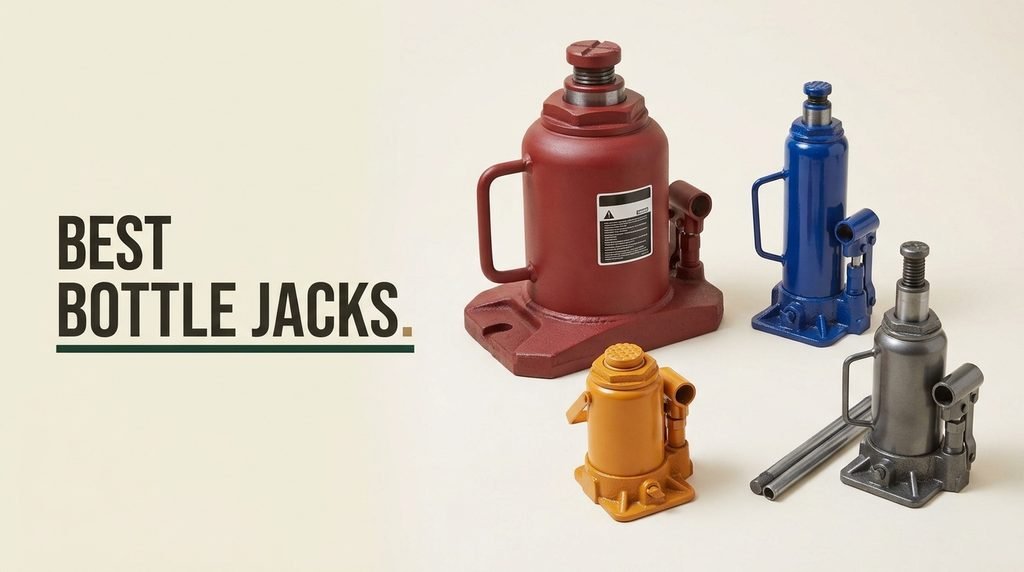
Choosing the right bottle jack for 2026 means matching lift capacity, extended height, build quality, and portability to the vehicles and equipment you actually work on. We compare 10 standout hydraulic jacks by the factors that matter most in a working garage: tonnage rating, minimum and maximum lift height, saddle design, overload protection, drop-forged steel construction, screw extension travel, and whether the jack suits occasional home use or professional daily service.
Bottle jacks vary significantly in capacity and features. Light-duty 4-ton units like the BIG RED and YELLOW JACKET models handle passenger cars and small trucks, while heavy-duty 20-ton jacks from BIG RED, VEVOR, and Pro-Lift lift box trucks, RVs, and farm equipment. Specialty designs add pneumatic operation or extended lift ranges for specific applications.
Whether you need an affordable jack for occasional tire changes, a heavy-duty unit for truck service, or a pneumatic model for professional shop use, the picks below cover the most practical options available. Read on to find the bottle jack that matches your capacity needs, your working heights, and the kind of jobs you tackle most often.
We compared 10 bottle jacks using the details that actually help a buyer decide: load capacity in tons, minimum and maximum lifting range, screw extension travel, saddle design and serration, overload bypass protection, build material and welded construction quality, included accessories, and value against competing jacks. The notes focus on practical trade-offs so each pick connects to how home mechanics and shop professionals actually use these tools, from quick tire changes to heavy truck service and industrial lifting applications.


Compare key features, scores, and current prices side by side. A shorter feature list means fewer details were available, not necessarily fewer capabilities.



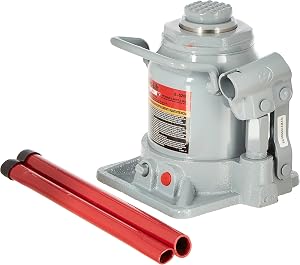
The BIG RED 20 Ton TAM92003B delivers serious heavy-duty capacity for buyers who service trucks, RVs, farm equipment, trailers, and even house lifting applications. The 40,000-pound rating provides capacity well beyond what passenger vehicle work requires, which translates to substantial safety margin and the ability to tackle jobs that lighter jacks cannot handle safely.
We may earn a commission when you buy through this link, at no additional cost to you.
The drop-forged alloy steel construction with inner and outer welded structure delivers the structural integrity needed to handle 20-ton loads reliably across years of regular use. The oil-bypass and overload valve integrated into the hydraulic system prevents operation beyond rated capacity, protecting both the jack and operator from hydraulic seal failure that could cause sudden load drops.
The 9-7/16 to 17-5/8 inch lifting range covers the clearance needs of medium and heavy-duty trucks, RVs, and larger commercial vehicles. The adjustable screw top extension adds versatility for reaching higher jacking points. The serrated heat-treated saddle grips contact points securely under heavy loads, and the glide-action pressure pump requires manageable effort even when lifting substantial weights.
A 20-ton jack provides capacity well above what most passenger vehicle work requires. The practical value comes from safety margin, longevity, and versatility. Operating a jack at 25 percent of rated capacity rather than 90 percent dramatically extends hydraulic seal life. Having 20-ton capability also lets you tackle occasional heavy jobs like truck axle service, farm equipment repair, or house lifting projects without buying additional equipment. For buyers who want one jack to handle any likely application, 20-ton capacity provides headroom that smaller jacks cannot match.
This jack is the right choice for home mechanics who work on trucks or RVs, professional mechanics servicing commercial vehicles, and anyone needing heavy-duty lifting capacity from a trusted brand. The main tradeoffs are the 9.4-inch minimum height that rules out very low-clearance applications and the significant weight compared to lighter jacks. For heavy-duty work where capacity and reliability matter most, this BIG RED delivers excellent value.
Owners of low-clearance passenger cars who cannot accommodate the 9.4-inch minimum height.
We may earn a commission when you buy through this link, at no additional cost to you.
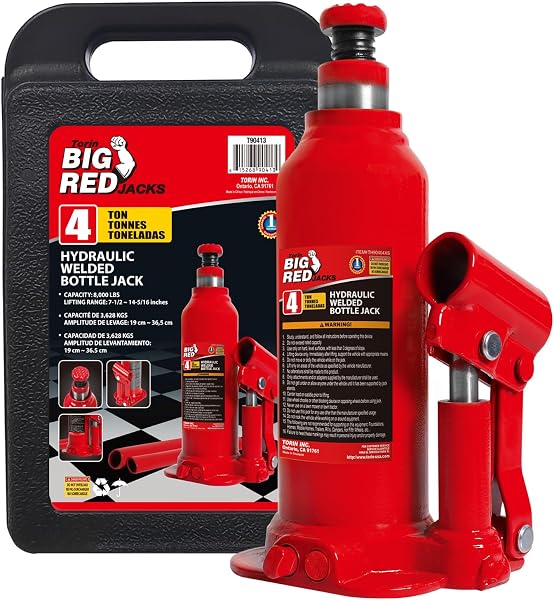
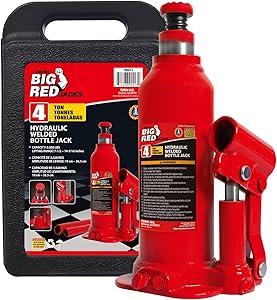
The BIG RED 4 Ton bottle jack targets home mechanics who service passenger cars, small SUVs, and light trucks and want a reliable hydraulic jack that fits easily in a trunk or garage shelf. The 8,000-pound capacity handles the vast majority of passenger vehicles without concern about load limits, and the compact 7.4 by 4.72 by 11.02 inch footprint takes up minimal storage space when not in use.
We may earn a commission when you buy through this link, at no additional cost to you.
The drop-forged alloy steel construction with reinforced stress points delivers durability that budget stamped-steel jacks cannot match. The inner and outer welded structure prevents the oil leaks that plague cheaper jacks after a few seasons of occasional use, and the high-quality hydraulic oil resists corrosion over long periods of storage between uses. For a jack that will spend most of its life sitting in a trunk, this leak-free construction is particularly important.
The 7.5 to 14.3 inch lifting range covers typical passenger car ground clearance, with the adjustable screw top extension adding additional height when needed. The serrated heat-treated saddle provides a secure grip against the vehicle frame or jacking point to prevent slippage during lifting. The glide-action pressure pump requires minimal effort to achieve full lift, which matters when you are changing a tire on the side of the road.
A bottle jack stored loose in a trunk picks up dirt and road debris that eventually works into the hydraulic seals and causes premature failure. The included plastic blow mold case protects the jack from contamination and keeps it organized alongside other emergency tools. For a jack that lives in your vehicle for roadside emergency use, this protection extends useful life significantly compared to loose storage in a trunk compartment.
This jack is the right choice for passenger car owners, light truck drivers, and anyone who wants a reliable emergency jack that fits in a trunk or small garage. The main tradeoff is the 4-ton capacity, which rules out heavy trucks and large SUVs. For most daily driver vehicles including sedans, compact SUVs, and small pickups, however, this capacity provides substantial safety margin and the included storage case keeps the jack organized and protected.
Owners of full-size trucks, large SUVs, or anyone who needs more than 14.3 inches of lift height for taller vehicles.
We may earn a commission when you buy through this link, at no additional cost to you.
The BIG RED T91003B steps up to 10-ton capacity for buyers who service heavier vehicles including full-size trucks, large SUVs, and small RVs or trailers. The 20,000-pound rating provides substantial safety margin even for the heaviest passenger vehicles, and the ASME PASE safety standards compliance confirms the jack meets established industry performance and safety requirements.
We may earn a commission when you buy through this link, at no additional cost to you.
The oil-bypass and overload valve integrated into the hydraulic system prevents operation beyond rated capacity, which is an important safety feature that protects both the jack and the operator from catastrophic hydraulic failure. Drop-forged alloy steel construction throughout the jack body delivers the structural integrity needed to handle 10-ton loads reliably across years of regular use.
The 8.8 to 17.6 inch lift range covers the clearance needs of trucks, SUVs, and most light-duty commercial vehicles. The adjustable screw top extension provides additional height when needed to reach higher jacking points. The serrated heat-treated saddle grips vehicle contact points securely to prevent slippage, and the glide-action pump requires minimal effort to achieve full lift even under heavy loads.
ASME PASE is the Portable Automotive Service Equipment standard established by the American Society of Mechanical Engineers. Jacks meeting this standard have been tested to specific performance and safety requirements including load capacity verification, structural integrity, and operational reliability. For buyers who want confidence that a jack will perform as rated, ASME PASE compliance provides meaningful third-party verification beyond manufacturer claims alone.
This jack is the right choice for mechanics who service a mix of passenger and light commercial vehicles and want serious capacity in a Torin-brand product with meaningful warranty coverage. The main tradeoffs are the heavier weight compared to 4-ton options and the taller minimum height that may not clear very low-slung vehicles. For garage and shop use where capacity matters more than portability, the T91003B delivers reliable performance at a reasonable price.
Buyers who need jack capability for extremely low-clearance vehicles or those who service only lighter passenger cars.
We may earn a commission when you buy through this link, at no additional cost to you.
The YELLOW JACKET 4 Ton bottle jack offers a budget-friendly alternative for home mechanics who want basic hydraulic lifting capability at an accessible price point. The 8,000-pound capacity matches the BIG RED 4 Ton for passenger car and small SUV service, and the included carrying case keeps the jack organized for trunk or garage storage.
We may earn a commission when you buy through this link, at no additional cost to you.
The multi-directional use feature allows horizontal operation in addition to the standard vertical lifting position, which adds versatility for applications where you need to apply hydraulic force sideways rather than straight up. This flexibility can be useful for pressing, straightening, or other shop tasks beyond simple vehicle lifting. The durable welding structure and high-quality steel plate provide leak-free performance for the hydraulic system.
The 7-3/8 to 14-5/16 inch lifting range covers typical passenger car ground clearance adequately. Built-in safety features including a bottom valve help balance internal air pressure and provide extra protection during use. The compact design and carrying case fit easily in your car or workspace, making this jack practical for both emergency roadside use and routine garage work.
A bottle jack that can operate horizontally expands its usefulness beyond simple vehicle lifting. Horizontal operation enables tasks like pressing bearings into or out of housings, straightening bent components, or applying force in confined spaces where vertical lifting is impractical. While most users will primarily lift vertically, the ability to operate sideways means one tool handles more shop tasks.
This jack is the right choice for buyers who want to save money on a basic 4-ton bottle jack and appreciate the versatility of multi-directional operation. The main tradeoffs are the limited 4-ton capacity that rules out heavier vehicles and the smaller brand recognition compared to established names like BIG RED. For home mechanics with passenger car service needs who prioritize budget pricing, however, this YELLOW JACKET delivers practical functionality at a lower price point.
Buyers who want established brand reputation or need heavier capacity for trucks and larger vehicles.
We may earn a commission when you buy through this link, at no additional cost to you.
The BIG RED 12 Ton TAM91203B occupies a useful middle ground between the 10-ton and 20-ton jacks in the Torin lineup, offering 24,000-pound capacity with a slightly taller 18-inch maximum lift height. For buyers who find 10 tons insufficient for their heavier vehicles but do not need the full 20-ton capability, this 12-ton option provides a practical capacity match without unnecessary oversize.
We may earn a commission when you buy through this link, at no additional cost to you.
The 18-inch maximum lift is 0.4 inches taller than the 10 and 20 ton models in this lineup, which can matter when working on trucks or RVs with slightly higher jacking points. The 9-inch minimum height is reasonable for most light truck and SUV applications. The adjustable screw top extension provides additional height adjustability for fine-tuning the fit against specific jacking points.
Drop-forged alloy steel construction with inner and outer welded structure provides the durability expected of the Torin brand, with the oil-bypass and overload valve protecting against operation beyond rated capacity. The serrated heat-treated saddle grips contact points securely, and the glide-action pressure pump requires manageable effort to achieve full lift even under heavy loads. One-year manufacturer warranty backs the construction quality.
The BIG RED Torin lineup offers 10-ton, 12-ton, and 20-ton bottle jacks that may seem redundantly similar. The 10-ton serves passenger cars and light trucks adequately. The 20-ton provides maximum capacity for heavy applications. The 12-ton splits the difference with slightly more capacity than 10 tons and slightly taller lift than either alternative. For most buyers, either the 10-ton or 20-ton serves well. Choose the 12-ton specifically when you need capacity between the two or when the extra 0.4 inches of maximum lift matters for your typical jobs.
This jack is the right choice for buyers who service a mix of trucks and larger SUVs and want capacity between the 10 and 20 ton options with slightly extended lift height. The main tradeoffs are the 9-inch minimum height that limits low-clearance use and the fact that most buyers can be served by either the 10-ton or 20-ton options rather than this middle size. For buyers who specifically need 12 tons or the 18-inch maximum, however, this jack fills a useful niche.
Buyers who could be adequately served by the simpler choice between 10-ton and 20-ton options at similar prices.
We may earn a commission when you buy through this link, at no additional cost to you.
The BIG RED 10 Ton TAM91003B provides the same 20,000-pound capacity and lifting range as the T91003B model but at a lower price point without the explicit ASME PASE certification. For buyers who do not specifically need the industry-standard certification, this jack delivers the same practical lifting capability at better value.
We may earn a commission when you buy through this link, at no additional cost to you.
The 10-ton capacity handles full-size trucks, large SUVs, small RVs, and most light commercial vehicles with substantial safety margin. The oil-bypass and overload valve integrated into the hydraulic system protects against operation beyond rated capacity, which is a critical safety feature that many budget jacks lack. Drop-forged alloy steel construction throughout provides the structural integrity needed for 10-ton loads.
The 8-13/16 to 17-5/8 inch lift range covers typical truck and large vehicle clearance requirements. The adjustable screw top extension provides height adjustability for fine-tuning the fit against specific jacking points. The serrated heat-treated saddle grips contact points securely to prevent slippage during lifting under heavy loads. One-year manufacturer warranty backs the Torin brand construction.
The TAM91003B and T91003B share essentially identical construction, materials, and specifications. The main difference is explicit ASME PASE testing and certification on the T91003B. For most home garage use, both jacks deliver equivalent practical performance. Professional shops may need certified equipment for insurance, warranty, or regulatory reasons. Home mechanics typically can save money with the TAM91003B without meaningful performance compromise, since the construction and materials match the certified version.
This jack is the right choice for buyers who want 10-ton capacity at the best price point in the BIG RED lineup. The main tradeoff compared to the T91003B is the lack of explicit ASME PASE certification, which may matter for professional shop use or where regulations require certified equipment. For home garage use where buyers trust the brand and construction quality, however, this TAM91003B delivers excellent value for truck and SUV service work.
Professional shops that require explicitly certified ASME PASE equipment for insurance or regulatory compliance.
We may earn a commission when you buy through this link, at no additional cost to you.
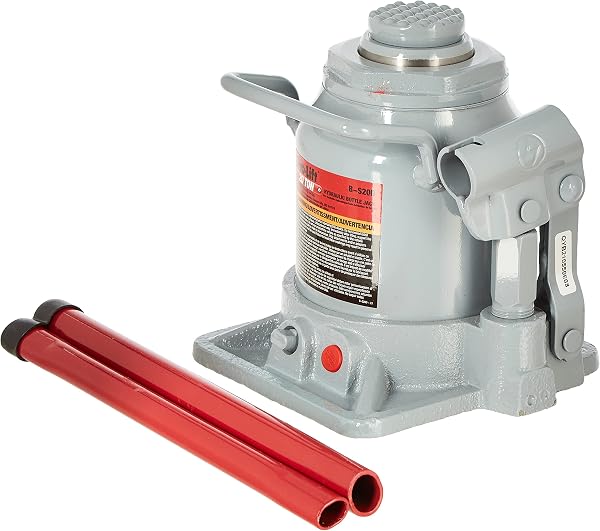
The VEVOR 20 Ton bottle jack delivers heavy-duty 44,092-pound capacity at a competitive price point with features aimed at field portability. The three-section long handle provides significant leverage for raising the jack with less effort, which matters when operating in field conditions where you may not have ideal body positioning. The all-welded construction prevents the oil leaks that plague cheaper jacks.
We may earn a commission when you buy through this link, at no additional cost to you.
The lifting range extends from 8.9 inches up to 17.1 inches, with a 2.4-inch screw extension for fine-tuning height when space is tight. This range covers typical pickup truck, SUV, and RV service needs, with the compact size making the jack easy to carry in a vehicle trunk or storage compartment. The rubber-sealed oil port prevents messy leaks that occur with inferior seal designs over time.
Built-in safety features include the overload valve that prevents operation beyond rated capacity and the solid saddle that stays steady under load. Operation requires no compressor or electricity, which makes the jack ready to work anywhere including remote locations where power is unavailable. The sliding pump and controllable release valve enable both lifting and safe descent through counterclockwise valve rotation.
Hydraulic jack handles work as levers that multiply your pumping force. A longer handle provides more leverage, which reduces the effort required to lift heavy loads. For a 20-ton jack lifting a substantial load, handle leverage can be the difference between manageable and exhausting operation. Three-section handles like the VEVOR’s are typically longer when fully assembled than single-piece handles, delivering better mechanical advantage during actual lifting operations.
This jack is the right choice for buyers who want 20-ton capacity in a portable package suitable for field use including farm work, construction equipment service, or roadside RV emergencies. The main tradeoffs are the lower user rating compared to established BIG RED alternatives and VEVOR’s smaller brand presence in the US market. For buyers prioritizing capacity, portability, and value over brand recognition, however, this VEVOR offers compelling specifications at a reasonable price.
Buyers who prioritize established brand reputation and extensive user feedback over value pricing.
We may earn a commission when you buy through this link, at no additional cost to you.
The VEVOR Air Hydraulic 20 Ton bottle jack adds pneumatic operation to the standard hydraulic bottle jack format, dramatically reducing lifting time for shops with compressed air available. In pneumatic mode, the jack lifts quickly with minimal effort through standard quick-connect fittings. When air is unavailable, the manual mode continues to work normally, which maintains functionality in field conditions or during compressor failures.
We may earn a commission when you buy through this link, at no additional cost to you.
The 10.2 to 19.5 inch lifting range extends significantly higher than most 20-ton bottle jacks, with a 2.6-inch screw extension for fine-tuning the final height. This extended reach makes the jack suitable for taller trucks and RVs where standard-range jacks would not reach the frame or axle. The 44,092-pound capacity handles box trucks, RVs, pickups, SUVs, farm equipment, and construction machinery with substantial safety margin.
Construction details reflect serious shop-use design. The aluminum cylinder seals tightly for lasting performance, built-in valves prevent overload operation, and dual springs reset the piston quickly after each lift for faster cycle times. The oil fill port stays leak-free through quality seal design, and the cast iron and carbon steel construction handles heavy loads even in extreme temperatures where lesser jacks would see oil freeze or seal swelling.
Manual bottle jacks can take 20 to 30 pumps to reach full extension under load. Pneumatic jacks can achieve the same lift in seconds with air pressure doing the work. For shops doing multiple lifts per day, this time savings adds up to significant productivity gains. For home garage use with occasional lifts, pneumatic operation is less critical and the extra cost may not justify the convenience. Match the operation type to your actual lift frequency and available compressed air access.
This jack is the right choice for professional shops with compressed air that want faster lifting times, mobile mechanics with portable compressors, and buyers who service tall vehicles requiring extended lift height. The main tradeoffs are the higher price compared to manual-only jacks and the dependence on compressed air for the pneumatic mode. For shops where speed matters and air is available, however, the pneumatic operation saves significant time across many lift cycles.
Home mechanics without compressed air access or those who do not need faster lifting from pneumatic operation.
We may earn a commission when you buy through this link, at no additional cost to you.
The Pro-Lift 20 Ton bottle jack offers ANSI PALD certification compliance with the quality control that specification requires. The adjustable extension screw provides accommodation for various work heights across different lifting applications, and the steel lifting saddle holds loads securely during operation. For buyers who want certified equipment at a reasonable price, this Pro-Lift provides a credible alternative to the BIG RED and VEVOR options.
We may earn a commission when you buy through this link, at no additional cost to you.
Heat-treated critical stress areas ensure long-life performance and durability under heavy loads, addressing the typical failure points where cheaper jacks develop cracks or deformation over time. The built-in bypass system protects against ram over-travel to ensure safe operation, and the 20-ton capacity handles the full range of auto, truck, farm, and shop applications where heavy lifting is required.
The integrated carrying handle is a thoughtful design detail that makes the heavy jack easier to transport between work locations in a shop or farm environment. For 20-ton jacks that typically weigh 20 pounds or more, having a dedicated carrying point beats trying to grip the jack body. The ANSI PALD compliance confirms the jack meets current safety and quality standards.
ANSI PALD and ASME PASE represent similar sets of safety and performance standards for portable automotive lifting devices. Both require testing of load capacity, structural integrity, and operational reliability. Jacks meeting either standard have been verified to perform as rated. For buyers who want certified equipment, either certification provides meaningful assurance. The specific choice between brands often comes down to secondary factors like warranty coverage, included accessories, and user reputation rather than certification alone.
This jack is the right choice for buyers who want 20-ton capacity with ANSI certification from a smaller brand than BIG RED. The main tradeoffs are the smaller brand presence and fewer online reviews available for research. For buyers who prioritize certification and the practical convenience of the carrying handle, however, this Pro-Lift delivers solid heavy-duty capability at competitive pricing.
Buyers who specifically want the broader brand recognition and user feedback available for BIG RED Torin products.
We may earn a commission when you buy through this link, at no additional cost to you.
The BIG RED T92003B provides the same 20-ton capacity and lift range as the TAM92003B model but with explicit ASME PASE safety standards compliance. For professional shops that need certified equipment for insurance, warranty, or regulatory reasons, this certification matters significantly even though the construction and materials appear identical to the non-certified version.
We may earn a commission when you buy through this link, at no additional cost to you.
The 40,000-pound capacity handles the heaviest truck and RV applications with substantial safety margin, and the oil-bypass and overload valve protects against operation beyond rated capacity. Drop-forged alloy steel construction with inner and outer welded structure delivers the durability expected of the Torin brand name, and the serrated heat-treated saddle grips contact points securely under heavy loads.
The 9-7/16 to 17-5/8 inch lifting range covers truck, RV, and commercial vehicle service needs. The adjustable screw top extension provides fine-tuning for specific jacking point heights. The glide-action pressure pump requires manageable effort even when lifting substantial loads. One-year manufacturer warranty backs the quality claims, and the ASME PASE certification provides third-party verification of safety and performance standards.
Professional shops may require certified equipment for several reasons including insurance requirements, state or federal regulations, warranty terms on the vehicles being serviced, or liability concerns if equipment fails during customer work. For these environments, the modest price premium for certified equipment is clearly justified. For home garage use where none of these factors apply, equivalent non-certified equipment typically delivers the same practical performance at better value. Choose certification based on your actual professional or regulatory requirements.
This jack is the right choice for professional shops that specifically need certified equipment, or buyers who want the extra assurance that ASME PASE compliance provides. The main tradeoffs are the higher price compared to the equivalent non-certified TAM92003B model and the minimum height that limits very low-clearance use. For professional environments where certification matters more than modest cost savings, however, this T92003B delivers the certified heavy-duty capability that justifies its position.
Home mechanics without specific certification requirements who can get equivalent construction quality in the non-certified TAM92003B at lower cost.
We may earn a commission when you buy through this link, at no additional cost to you.
Selecting a bottle jack involves matching capacity, lift range, construction quality, and safety features to the vehicles and equipment you work on most often. The jacks in this guide range from 4-ton units for passenger cars to 20-ton heavy-duty options. This guide walks through the factors that genuinely matter when narrowing down your choice.
Capacity rating is the most important specification when choosing a bottle jack. Passenger cars typically weigh 3,000 to 4,000 pounds, light trucks 5,000 to 7,000 pounds, full-size trucks 7,000 to 10,000 pounds, and heavy-duty trucks 15,000 pounds or more. However, you only need to lift one corner at a time, which means a vehicle’s weight is distributed across the jack’s actual load. A 4-ton jack easily handles any passenger car corner, while a 10-ton jack handles any light-duty vehicle corner with substantial safety margin.
Choose capacity with meaningful safety margin above your actual loads. Operating a jack near its rated capacity creates hydraulic stress that reduces useful life and increases risk of failure. A good rule is to select a jack rated at least 50 percent above the heaviest single-corner load you expect to lift. For passenger cars, 4-ton capacity provides excellent margin. For trucks and larger vehicles, 10-ton or 20-ton capacity delivers appropriate headroom.
Match capacity to the heaviest vehicles you actually service, with appropriate safety margin. Buying significantly more capacity than needed costs more and adds unnecessary weight. Buying insufficient capacity creates safety hazards and premature equipment failure.
Bottle jacks have both minimum and maximum lift heights that affect which vehicles they can serve. The minimum height determines whether the jack fits under the vehicle at its normal resting position. The maximum height determines how far the vehicle can be lifted for service work like tire changes or under-vehicle access. The 4-ton jacks in this guide typically start at 7.4 to 7.5 inches, while 10 to 20 ton jacks typically start at 8.8 to 10.4 inches.
Lower-slung sports cars and modified vehicles may require low-profile jacks that bottle jacks cannot match, so verify minimum height against your actual ground clearance before buying. Taller trucks and RVs may need extended lift heights beyond standard bottle jack range, which is where models like the VEVOR Air Hydraulic 20 Ton with its 19.7-inch maximum reach provide advantages. The adjustable screw top extension on most bottle jacks provides additional height adjustment for fine-tuning the fit against specific jacking points.
Measure your vehicle’s ground clearance and your typical jacking point heights before buying. For low-clearance vehicles, consider floor jacks instead of bottle jacks. For most trucks and SUVs, standard bottle jack lift ranges work well.
Bottle jack construction quality varies significantly between budget and premium options. Drop-forged alloy steel construction with inner and outer welded structure characterizes quality jacks like the BIG RED Torin lineup, delivering the structural integrity needed for repeated heavy use without developing cracks or deformation. Lower-quality jacks may use stamped steel or inferior welding that fails under repeated load cycles.
Hydraulic seal quality determines leak-free performance over the long term. Welded structures with rubber-sealed oil ports like those on the VEVOR models and quality seal designs on the BIG RED jacks prevent the oil leaks that plague cheaper alternatives after a season or two of occasional use. Serrated heat-treated saddles provide the secure grip against vehicle contact points that prevents dangerous slippage during lifting.
For jacks you expect to use regularly over many years, invest in quality construction with drop-forged steel and welded hydraulic systems. For occasional emergency use, mid-range quality is usually sufficient.
Modern bottle jacks should include overload protection valves that prevent operation beyond rated capacity. The oil-bypass valves integrated into BIG RED Torin and VEVOR jacks protect both the equipment and the operator from hydraulic failure when operators accidentally try to lift loads beyond jack capability. This safety feature is standard on quality jacks but absent on some budget alternatives.
Certifications from ASME PASE or ANSI PALD provide third-party verification that jacks meet established safety and performance standards. Certified jacks like the BIG RED T91003B, T92003B, and Pro-Lift 20 Ton have been tested for load capacity, structural integrity, and operational reliability. For professional shop use where regulations or insurance may require certified equipment, these certifications matter significantly. For home garage use, equivalent non-certified construction usually provides the same practical performance at lower cost.
Prioritize overload protection valves on any jack you buy, and prioritize certifications only if your use case specifically requires them.
Bottle jacks are generally more portable than floor jacks due to their compact vertical form factor. Light-duty 4-ton jacks like the BIG RED 4 Ton weigh around 10 pounds and fit easily in car trunks for emergency use, with included storage cases that keep the jack organized and protected. Heavy-duty 20-ton jacks weigh considerably more and are better suited to garage or shop installation than trunk storage.
For jacks intended for roadside emergency use, the included carrying case on the BIG RED 4 Ton and YELLOW JACKET models protects the jack from debris and keeps it organized alongside other emergency tools. For professional shop use, the integrated carrying handle on the Pro-Lift 20 Ton makes moving the heavier jack between work locations more practical. Consider how you will transport and store the jack when evaluating options.
Match the jack’s size and weight to your actual storage situation. Trunk-stored emergency jacks need compactness and protective cases. Shop jacks can be larger and heavier if they stay in one place or move only short distances.
Most bottle jacks operate purely manually through a hydraulic pump handle, which requires physical effort to achieve lift. For occasional home use, manual operation is perfectly adequate. For professional shops with high lift volume, pneumatic bottle jacks like the VEVOR Air Hydraulic 20 Ton dramatically reduce lift time by using compressed air to do the pumping work.
Pneumatic operation requires compressed air availability, which may limit the jack to shop use where compressors are available. Jacks with dual operation modes like the VEVOR Air Hydraulic maintain manual function when air is unavailable, which preserves utility in field conditions or when the compressor fails. Handle leverage also matters for manual operation, with longer handles like the three-section VEVOR 20 Ton Manual providing more mechanical advantage for easier lifting.
For home use, manual operation is almost always the right choice. For high-volume professional use with available compressed air, pneumatic operation delivers meaningful time savings that may justify the higher cost.
Safe operation starts with proper positioning. Place the jack on firm level ground beneath the manufacturer-specified lifting point on your vehicle. Pump the handle smoothly rather than jerking, watching the saddle contact the vehicle before transferring significant weight. Once the jack supports the load, continue pumping to achieve your desired lift height. Never work under a vehicle supported only by hydraulic pressure. Always transfer the load to properly rated jack stands before any under-vehicle work. The jack is for lifting, not for sustained support.
Routine inspection extends jack life and prevents dangerous failures. Before each use, check for visible hydraulic fluid leaks around the ram and base, inspect the saddle for damage or excessive wear, and verify that the release valve operates smoothly. Test the jack with no load to confirm it extends and retracts properly before attempting to lift any vehicle. Any sign of leakage, binding operation, or failure to hold position should be addressed before further use.
Long-term maintenance keeps your jack working reliably across years of use. Store the jack with the ram fully retracted to protect hydraulic seals from unnecessary exposure. Keep the jack clean by wiping down the ram and body after use to prevent dirt and moisture from damaging seals. Check hydraulic fluid level annually through the fill port, topping off with recommended hydraulic jack oil if necessary. Address any developing issues like slow lifting or incomplete retraction promptly rather than hoping they resolve themselves, since hydraulic failures can occur suddenly and dangerously under load.
Bottle jacks are vertical hydraulic jacks that lift straight up from a compact base. Floor jacks are horizontal units with wheels that roll under vehicles and lift via a long handle operating a horizontal hydraulic system. Bottle jacks are generally more compact and portable, better for high-lift applications, and typically more affordable. Floor jacks offer easier operation, lower minimum heights for low-clearance vehicles, and faster lifting for frequent use. Many garages own both types for different applications.
Match capacity to the heaviest vehicle corner you expect to lift, with substantial safety margin. Passenger cars typically require 4-ton capacity. Light trucks and SUVs benefit from 6 to 10-ton capacity. Full-size trucks and RVs need 10 to 20-ton capacity. Industrial and commercial applications may require 20-ton or greater capacity. Buying more capacity than you need reduces hydraulic stress and extends useful life, so err toward higher capacity when uncertain.
Verify that your vehicle's ground clearance exceeds the jack's minimum height before buying. Low-clearance sports cars and modified vehicles may require low-profile floor jacks rather than bottle jacks. Always lift from manufacturer-specified jacking points to prevent damage to the vehicle frame or body. Consult your vehicle owner's manual for the correct jacking point locations, which are typically marked with arrows or notches on the frame rails.
Yes, absolutely. Bottle jacks are lifting tools, not sustained support devices. Hydraulic systems can fail unexpectedly, and even properly functioning jacks should never be relied upon to hold a vehicle while you work beneath it. Always transfer the load to properly rated jack stands after lifting with the bottle jack, and verify the stands are stable before any under-vehicle work. Jack stands are inexpensive and essential safety equipment that no mechanic should work without.
ASME PASE is the Portable Automotive Service Equipment standard established by the American Society of Mechanical Engineers. Jacks meeting this standard have been tested for load capacity verification, structural integrity, and operational reliability. For professional shop use where regulations or insurance may require certified equipment, ASME PASE compliance matters significantly. For home garage use, equivalent non-certified construction typically provides the same practical performance at lower cost.
Hydraulic fluid leaks indicate worn or damaged seals, usually at the ram shaft or fill port. Minor leaks on older jacks may be addressable through seal replacement if parts are available. Significant leaks typically mean the jack needs replacement, since repair costs often exceed the price of a new quality jack. Prevent future leaks by storing the jack with the ram retracted, keeping it clean, and avoiding operation beyond rated capacity.
Lower the jack completely to retract the ram. Remove the fill port plug, usually located on the side of the jack body. Add hydraulic jack oil until the fluid reaches the fill port level. Do not use motor oil, brake fluid, or other automotive fluids that have different properties than hydraulic jack oil. Replace the fill plug and pump the handle several times with no load to work out any air bubbles before using the jack.
Yes, bottle jacks can lift any load within their rated capacity when properly supported. Common applications include lifting houses for foundation work, raising heavy equipment for repair, pressing bearings or bushings into housings, and various construction and farm applications. Verify the jack sits on a firm level surface, lift straight up to prevent side-loading the hydraulic ram, and always use appropriate supports to hold the load after lifting.
A quality bottle jack from established brands like BIG RED Torin, Pro-Lift, or VEVOR typically lasts 10 years or more with proper care and reasonable use. The main failure modes are hydraulic seal wear from heavy use or environmental exposure, and structural issues from operation beyond rated capacity. Jacks used occasionally for home garage work can last decades. Jacks used daily in professional shops may need replacement sooner based on cycle count rather than age.
Pneumatic bottle jacks like the VEVOR Air Hydraulic 20 Ton dramatically reduce lifting time compared to manual operation, which matters for shops with high lift volume and available compressed air. For home garage use with occasional lifts, manual operation is adequate and the premium for pneumatic capability may not justify the cost. Consider pneumatic jacks if you have compressed air readily available and lift frequently enough that time savings matter.
The BIG RED 20 Ton TAM92003B stands out as the strongest overall choice for most buyers who want serious heavy-duty capacity from a trusted brand at a reasonable price. The 40,000-pound capacity handles everything from passenger vehicles to trucks and RVs with substantial safety margin, drop-forged alloy steel construction delivers the durability needed for years of regular use, and the oil-bypass overload valve provides essential safety protection. For home mechanics and small shops building a quality tool collection, this jack represents the sweet spot of capability and value in the BIG RED lineup.
For buyers with different priorities, several strong alternatives serve specific needs. The BIG RED 4 Ton provides excellent value for passenger car owners who want a compact trunk-stored emergency jack. The YELLOW JACKET 4 Ton offers budget-friendly 4-ton capability with carrying case convenience. The BIG RED T91003B and T92003B deliver explicit ASME PASE certification for professional shops. The VEVOR Air Hydraulic 20 Ton brings pneumatic operation for shops that value fast lifting. The Pro-Lift 20 Ton offers ANSI PALD compliance with practical carrying handle convenience. The VEVOR 20 Ton Manual provides capacity and leverage at competitive pricing for budget-conscious buyers.
Choosing the right bottle jack starts with honestly assessing the vehicles and equipment you actually service, the clearance requirements of your typical jacking points, and whether you need certification for professional or regulatory reasons. Match capacity to your heaviest likely loads with meaningful safety margin, verify that minimum lift height clears your vehicle ground clearance, and prioritize overload protection and quality construction regardless of brand. Any of the 10 jacks in this guide will serve its intended purpose well when matched to the right user and application.