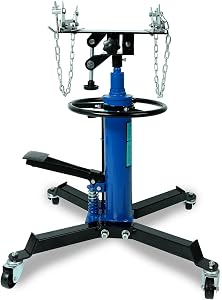
VEVOR 1322 LB
8.8Editor score1322 lb capacity
32-67 inch lift
30-degree tilt saddle
Four swivel wheels
Find the right transmission jacks for 2026. We compare 10 standout options by build quality, useful features, owner feedback, value, and everyday trade-offs.
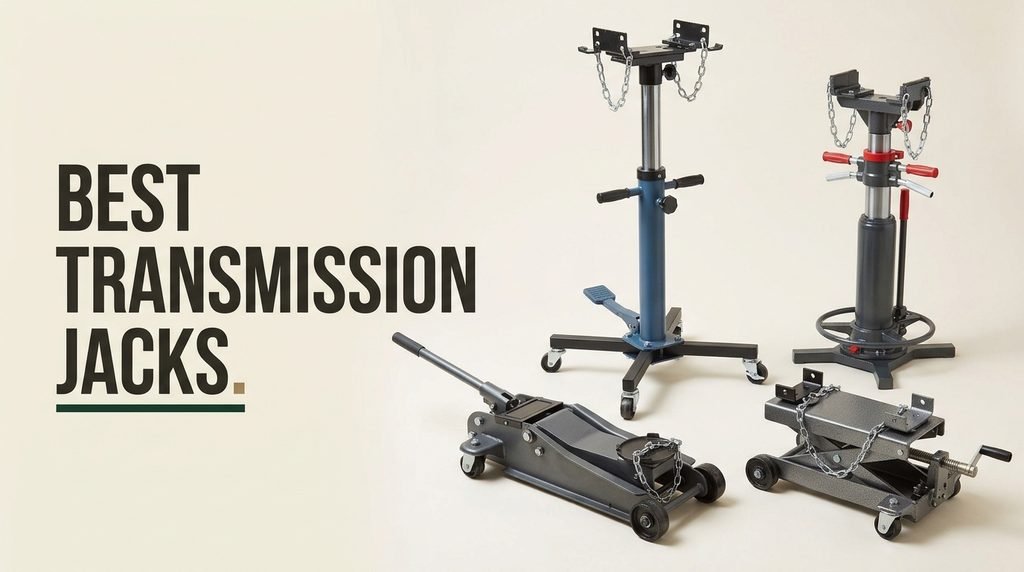
Choosing the right transmission jack for 2026 means matching lift capacity, telescoping range, saddle design, and mobility to the vehicles you actually service. We compare 10 standout hydraulic jacks by the factors that matter most in a working garage: load rating, minimum and maximum lift height, saddle tilt adjustment, foot pedal operation, wheel quality, safety chains or straps, build material, and whether the jack suits overhead lift work or low-clearance under-vehicle service.
Transmission jacks split into two main categories that serve very different needs. Telescoping high-lift jacks reach 60-plus inches to work with vehicles on two-post lifts, while low-profile jacks slide under vehicles raised only on jack stands. Capacity ranges from 450 pounds for light passenger transmissions to over 1,600 pounds for truck and commercial applications.
Whether you need a budget-friendly jack for occasional home garage work, a dual-plunger professional unit for a busy shop, or a specialized low-profile jack for compact spaces, the picks below cover the most practical options available. Read on to find the transmission jack that matches your workspace, your typical jobs, and the equipment you already own.
We compared 10 transmission jacks using the details that actually help a mechanic decide: load capacity, minimum and maximum lift height, saddle tilt and adjustment, hydraulic operation style, wheel quality and brake inclusion, safety chain or strap system, overall build material, and value against competing jacks. The notes focus on practical trade-offs so each pick connects to how shops and home mechanics actually use these tools, from under-lift transmission swaps to low-clearance drivetrain work on jack stands.


Compare key features, scores, and current prices side by side. A shorter feature list means fewer details were available, not necessarily fewer capabilities.



The Sunex 7793B represents the professional end of the transmission jack market, with features that reflect decades of experience serving commercial automotive shops. Sunex Tools has built a reputation for durable equipment that holds up to years of daily use, and this transmission jack reflects that heritage with construction details that budget alternatives cannot match.
We may earn a commission when you buy through this link, at no additional cost to you.
The 74-inch maximum height is one of the tallest in this category, which lets you work on vehicles raised fully on commercial two-post lifts without having to compromise lift height. The telescopic ram design extends in stages, which also lets you lower the jack enough to transfer the transmission from the jack to a work table once removed from the vehicle. This handoff capability matters significantly when you are doing extensive teardown or rebuild work.
The foot-activated pump pedal lifts the ram without requiring hand pumping, keeping both hands free for positioning. The nylon strap tie-down secures the transmission to the saddle, which is essential for safe handling of components that can weigh several hundred pounds. The overload valve prevents the jack from being used beyond its 1000-pound rated capacity, which protects both the equipment and the operator from catastrophic hydraulic failure.
An overload valve is a hydraulic pressure relief that prevents the jack from exceeding its rated capacity. Without this feature, continuing to pump a jack that is already at maximum capacity can cause hydraulic seal failure, which may result in the load dropping suddenly. For commercial use where multiple operators use the same equipment and may not be aware of specific capacity limits, overload protection is a significant safety feature. For home use where you know your own loads, the protection is still valuable insurance against mistakes.
This jack is the right choice for professional shops, serious enthusiasts, and anyone building a long-term tool collection where quality matters more than price. The main tradeoffs are the significant premium over consumer-grade jacks and the 1000-pound capacity, which is lower than some newer competitors. For professional use where reliability and safety features matter more than maximum capacity, the Sunex delivers quality that justifies the investment.
Budget-conscious buyers or those who need maximum lift capacity above 1000 pounds.
We may earn a commission when you buy through this link, at no additional cost to you.
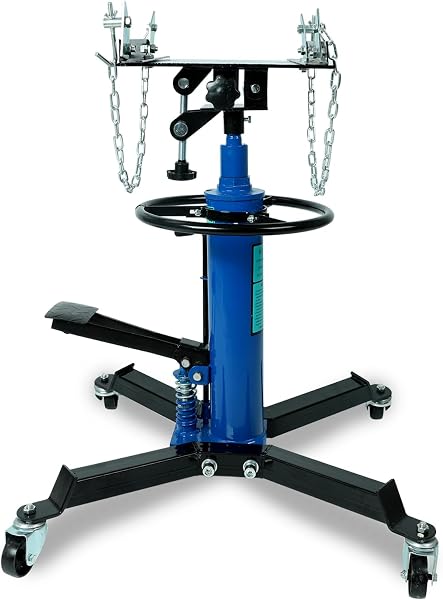
The VEVOR 1322 LB transmission jack is built for home mechanics and small-shop professionals who need serious lifting capacity at a reasonable price. Supporting up to 1322 pounds, it handles the vast majority of car and light truck transmissions without concern about load limits. For garages equipped with two-post or four-post lifts, this is the kind of jack that gets daily use without complaints.
We may earn a commission when you buy through this link, at no additional cost to you.
The hydraulic foot pedal lifts the jack through its full range from 34.3 inches to 68.5 inches, which covers everything from working under a vehicle on jack stands to reaching components on a raised two-post lift. Foot pedal operation keeps both hands free for positioning the transmission as it rises, which matters significantly when you are aligning input shaft splines with the clutch and pilot bearing on reinstallation.
The saddle tilts up to 30 degrees in multiple directions, controlled by adjustment bolts that let you match the angle of transmissions as they sit at various mounting positions. Upgraded screws keep the saddle stable during use rather than wobbling under load, which prevents the frustrating problem of the transmission shifting unexpectedly when you need precise alignment. Four swivel wheels with two brakes let you position the jack precisely under the component, then lock it in place.
Transmissions and transfer cases often sit at angles that reflect the drivetrain geometry of the vehicle. A jack with only a flat saddle forces you to fight the angle during installation, which can bind input shaft splines and risk damaging seals. A saddle that tilts 30 degrees in multiple directions lets you match the component’s natural angle, which makes alignment and installation significantly easier and safer. For automatic transmissions with torque converter alignment requirements, this capability is especially valuable.
This jack is the right choice for mechanics who service vehicles on lifts and need reliable high-reach capacity at a mid-range price. The main tradeoff is the minimum height of around 34 inches, which means this jack cannot slide under vehicles sitting only on jack stands or ramps. For traditional under-vehicle work without a lift, you need a low-profile jack like the Garvee or 1100 LB low profile option. For lift-based work, however, the VEVOR 1322 LB delivers excellent value.
Mechanics working on vehicles raised only on jack stands or ramps without clearance for a 34-inch minimum height jack.
We may earn a commission when you buy through this link, at no additional cost to you.
This dual plunger transmission jack addresses one of the most common frustrations with hydraulic lifting equipment: the time and effort required to reach maximum height. The twin plunger design cuts lift time to approximately 20 seconds for the full range, which is significantly faster than traditional single-plunger jacks that can take a minute or more of foot pumping to reach full extension. For busy shops doing multiple transmission jobs, this speed advantage adds up to meaningful time savings.
We may earn a commission when you buy through this link, at no additional cost to you.
The 1322-pound capacity matches the higher-end jacks in this category, built on robust carbon steel construction with a wide base for stability. Two heavy-duty safety anchor chains secure the load to the saddle, which is critical when moving a 200-pound transmission around a shop floor. The 8mm thick anti-slip pad on the saddle provides additional grip to prevent components from sliding during positioning.
The two-stage telescoping design adjusts from 33.5 inches to 69 inches, covering the full range needed for lift-based transmission work. The foot pedal provides superior control compared to manual pump handles, and the handle release allows slow controlled descent that enables precise positioning during reinstallation. For automatic transmissions where torque converter alignment requires careful handling, this descent control matters significantly.
Traditional single-plunger jacks pump a single hydraulic cylinder that extends gradually. Dual plunger systems use two cylinders that work together to move oil faster, which reduces lift time proportionally. For a transmission jack that may lift 60-plus inches, the time savings per operation can be a minute or more. Over the course of a busy day with multiple transmission jobs, this efficiency gain becomes significant without compromising load capacity or safety.
This jack is the right choice for professional mechanics and busy enthusiasts who value time efficiency and want modern dual-plunger speed. The main tradeoff compared to simpler single-plunger designs is additional hydraulic complexity, which could theoretically mean more failure points over very long service life. For most users, however, the time savings during daily use outweigh any theoretical reliability concerns, especially given the solid construction and safety features.
Mechanics who prefer the simplicity of single-plunger designs or those working on vehicles with low ground clearance.
We may earn a commission when you buy through this link, at no additional cost to you.
The Garvee transmission jack targets home mechanics and smaller shops that work on vehicles raised on jack stands rather than full lifts. The 7-inch minimum height lets the jack slide under cars and small trucks sitting at normal jack-stand height, which is impossible with the tall telescoping jacks designed for lift use. For garages without overhead lifts, this low-profile design is essential.
We may earn a commission when you buy through this link, at no additional cost to you.
The 450-pound capacity is appropriate for lighter transmission work including transfer cases, differentials, and smaller manual transmissions in passenger cars. This is a critical specification to verify against your actual components before buying, since heavier automatic transmissions in trucks and SUVs can easily exceed this limit. For the right applications, however, the Garvee delivers solid capability at a budget price.
The 2M heavy-duty safety straps are longer than most included tie-downs, which gives you more flexibility in how you secure components for safe lifting. Four universal brake wheels allow full 360-degree movement and secure locking, so the jack stays precisely where you position it during work. The adjustable 7-to-23-inch lift range covers the vertical travel needed for most under-vehicle component removal and installation on jack stands.
Low-profile transmission jacks like the Garvee serve a fundamentally different purpose than tall telescoping jacks like the VEVOR 1322 LB. Low-profile jacks slide under vehicles on jack stands with minimal clearance, perfect for home garages without lifts. High-lift jacks reach up to 60-plus inches to work with vehicles on commercial lifts. Many professional shops own both types to handle different working situations. For home use, choose based on whether you work on lifts or jack stands.
This jack is the right choice for budget-conscious home mechanics who work on passenger cars and smaller light-duty vehicles on jack stands. The main tradeoff is the 450-pound capacity, which rules out heavy truck transmissions and limits versatility. For buyers who exclusively service light-duty vehicles and want affordable low-profile capability, this Garvee delivers practical value. Verify your component weights before buying.
Mechanics working on heavy truck transmissions or in shops with vehicle lifts that require high-reach jack capability.
We may earn a commission when you buy through this link, at no additional cost to you.
The VEVOR 1100 LB transmission jack provides a mid-range alternative to the brand's higher-capacity 1322 LB model, offering sufficient capability for most passenger car and light truck transmission work at a slightly lower price point. The 1/2-ton capacity handles the vast majority of automotive transmission jobs that a typical home garage or small shop encounters.
We may earn a commission when you buy through this link, at no additional cost to you.
The 33.5-to-67-inch lift range covers the full span needed for working under raised vehicles on lifts, with the foot-operated pedal keeping both hands free for component positioning. Two-stage telescoping extends the ram through its full range efficiently, and the hydraulic release provides controlled descent for precise reinstallation alignment.
The adjustable saddle tilts up to 30 degrees in multiple directions, controlled by adjustment bolts for matching the natural angle of transmissions during installation. Two heavy-duty safety anchor chains secure the load firmly to the saddle, which is essential when moving components around the shop. Four swivel casters provide full mobility, and the central auxiliary ring gives you a handhold for pushing or pulling the loaded jack between work positions.
Passenger car automatic transmissions typically weigh 100 to 200 pounds, while light truck units can reach 300 pounds or more. Heavy-duty truck transmissions and transfer cases often exceed 400 pounds. For the vehicles you plan to service, add about 20 percent safety margin above your heaviest component when choosing jack capacity. A 1100-pound jack handles most passenger vehicles comfortably, while heavy truck work benefits from the higher-capacity 1322 or 1660 LB options.
This jack is the right choice for home mechanics and small shops that primarily service passenger cars and lighter trucks and want solid VEVOR quality without stepping up to the 1322 LB price. The main tradeoff is the lower capacity, which may not comfortably handle the heaviest heavy-duty truck transmissions. For typical passenger vehicle work, however, this jack delivers reliable performance at a reasonable price point.
Mechanics working on heavy-duty trucks with transmissions exceeding 800 pounds or those needing low-clearance jack-stand access.
We may earn a commission when you buy through this link, at no additional cost to you.
This 1100-pound low-profile transmission jack solves a problem that the lighter Garvee cannot address: handling heavier transmissions in garages that only have jack stands rather than lifts. The combination of a 7.68-inch minimum height and 1100-pound capacity is uncommon in this category, since most low-profile jacks sacrifice capacity for low-clearance capability.
We may earn a commission when you buy through this link, at no additional cost to you.
The 7.68-to-24.8-inch lift range covers the vertical travel needed for removing and installing transmissions on vehicles raised to typical jack-stand heights. The heavy-duty steel construction supports the full 1100-pound capacity for transmission removal, installation, drivetrain service, and component positioning. For home garages and workshops without lifts, this capability is genuinely enabling.
The universal saddle features forward and backward tilt adjustment to help position and align transmissions during installation. The adjustable support platform accommodates different transmission housings while providing controlled positioning. Four 360-degree swivel casters let you roll, turn, and reposition the jack beneath vehicles in confined garage spaces where larger wheeled equipment would not fit.
A 7.68-inch minimum height requires sufficient under-vehicle clearance to slide the jack into position. Standard jack stand heights of 15 to 20 inches typically provide adequate clearance for low-profile transmission jacks. Before buying, measure the actual clearance you have under your vehicle on your jack stands at the position where you need to work. Factor in the thickness of the transmission or component you plan to lift, since the jack needs to lift from below the component.
This jack is the right choice for home mechanics who service full-size vehicles in garages without lifts and need capacity above the 450-pound limit of lighter low-profile jacks. The main tradeoff is the limited maximum height, which rules out use with vehicles on commercial lifts. For dedicated jack-stand work on passenger cars and lighter trucks, however, this jack offers an uncommon combination of capacity and low-clearance capability.
Mechanics with vehicle lifts who need jacks reaching 60-plus inches for raised vehicle work.
We may earn a commission when you buy through this link, at no additional cost to you.
This 1660-pound high-lift transmission jack delivers the kind of capacity usually reserved for premium professional equipment at a surprisingly competitive price. For mechanics who regularly handle heavy-duty truck transmissions, transfer cases, and large components that would exceed the 1100-to-1322-pound limits of mid-range jacks, this capacity opens up jobs that lighter equipment cannot handle safely.
We may earn a commission when you buy through this link, at no additional cost to you.
The 35-to-72-inch lift range is among the longest in this category, letting you work with vehicles on fully raised commercial lifts without compromise. The two-stage telescopic design efficiently extends through the full range, and the foot-operated hydraulic pedal provides hands-free lifting with precise descent control for safe positioning. This vertical reach makes the jack usable in commercial shops where lift heights vary significantly.
The saddle tilts 30 degrees for accurate transmission alignment during installation and removal, with adjustable bolts for secure positioning. The heavy-duty retaining chain keeps transmissions firmly in place, reducing the wobble and shifting that can lead to component damage or dropped loads. Upgraded 360-degree swivel solid wheels provide smooth movement across garage floors with the stability needed to support the higher load capacity.
Buying a jack with capacity well above your actual loads provides significant benefits beyond just handling heavier components. Operating a jack at 50 percent of rated capacity rather than 90 percent dramatically reduces hydraulic seal stress and extends useful life. Higher-capacity jacks also typically have more robust construction throughout, which improves stability and reduces wobble under any load. For buyers who plan to use their jack for many years, extra capacity is often worth the modest price premium.
This jack is the right choice for buyers who want serious load capacity without stepping up to premium Sunex pricing, or anyone who services heavy-duty trucks and larger vehicles regularly. The main tradeoffs are the larger overall body size that requires more storage space and the higher minimum height that limits use with vehicles on jack stands. For lift-based heavy work, this jack delivers exceptional capability at a competitive price.
Mechanics with limited storage space or those who need low-clearance capability for jack-stand work.
We may earn a commission when you buy through this link, at no additional cost to you.
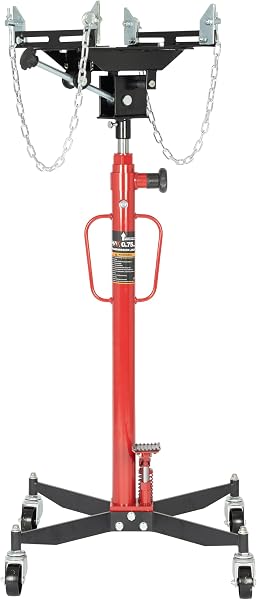
This 0.75-ton hydraulic transmission jack combines a strong 1660-pound capacity with practical storage convenience through its foldable foot pedal design. For garages where every square foot matters, the ability to fold the pedal flat against the body when not in use allows the jack to be stored in tighter spaces or against walls without the pedal projecting outward.
We may earn a commission when you buy through this link, at no additional cost to you.
The hydraulic telescoping feature provides adjustable height for different vehicle sizes and lifting tasks, with four 360-degree swivel wheels enabling maneuverability in tight spaces. For positioning the jack precisely under components in confined garage environments or working around other equipment, this mobility is essential for daily use.
The 1660-pound capacity handles everything from lighter transmissions to heavy transfer cases and differentials with substantial safety margin. The high-quality steel frame construction supports this capacity without flexing under load, which is critical for stability when working with components that can easily cause injury if dropped. For home garages and professional workshops, this capacity capability is often more than you need day-to-day but provides headroom for occasional heavy jobs.
Transmission jacks are among the larger pieces of garage equipment, and their footprint affects how well they fit into limited shop space. A fixed foot pedal projects outward, requiring clearance that may force the jack into less convenient locations. A foldable pedal lets you store the jack more flexibly, including against walls or under workbenches where it stays out of the way until needed. For small home garages where space is at a premium, this storage advantage can be a meaningful daily benefit.
This jack is the right choice for buyers who value storage flexibility and need serious capacity without the premium pricing of top-tier brands. The main tradeoff is the lower user rating compared to some competitors, which may reflect less refinement in details that matter for daily use. For buyers who prioritize capacity and storage convenience over premium build quality, this jack offers a reasonable value proposition.
Buyers who prioritize premium build quality and refined details over basic capacity and storage convenience.
We may earn a commission when you buy through this link, at no additional cost to you.
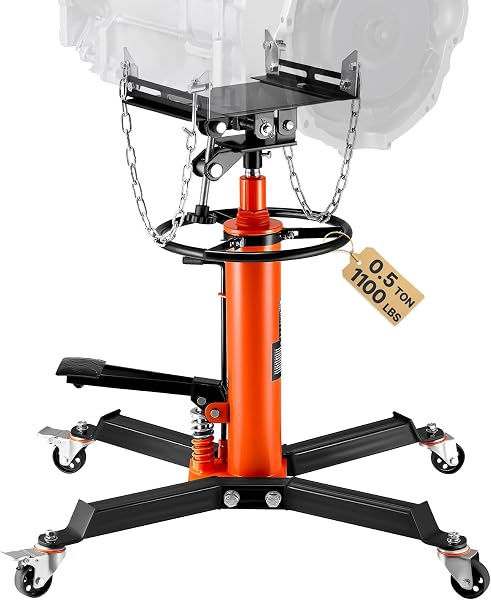
This orange VEVOR transmission jack offers an entry-level option with the brand's basic feature set at a lower price point than the premium 1322 LB and 1100 LB models in the same lineup. The 1100-pound half-ton capacity covers typical passenger car and light truck transmission work, and the 33.5-to-67-inch lift range matches other high-lift jacks for use with vehicles on commercial lifts.
We may earn a commission when you buy through this link, at no additional cost to you.
Enhanced hydraulic pressure provides the extended lifting range needed for lift-based work, and the foot-operated pedal keeps both hands free for component positioning during the critical alignment steps of transmission installation. The adjustable saddle tilts 30 degrees in multiple directions, with adjustment bolts for securing the angle to match the natural orientation of different transmissions.
Two heavy-duty safety anchor chains secure the load firmly to the saddle, and four swivel casters provide full mobility across the shop floor. The central auxiliary ring gives you a secure handhold for pushing or pulling the loaded jack between work positions. The high-grade steel frame provides the structural integrity needed to support the rated capacity reliably.
A 3.4 star rating indicates meaningfully mixed user experiences compared to 4.5-star alternatives. For equipment that handles heavy loads around sensitive automotive components, consistent quality matters significantly. When comparing jacks with similar specifications but different ratings, the higher-rated option typically delivers more consistent performance and fewer disappointing experiences. The price difference between this VEVOR 1100 LB Orange and the VEVOR 1100 LB 2-Stage is relatively modest for a substantial quality improvement.
This jack is the right choice for budget-conscious buyers who want VEVOR features at the lowest possible price. The significant tradeoff is the lower user rating compared to other VEVOR transmission jack models, which suggests more variable quality or user experience than the higher-rated alternatives. For buyers willing to accept some quality uncertainty for lower pricing, this jack offers an entry point to telescoping transmission jack capability. For reliability-focused buyers, the 1100 LB 2-Stage or 1322 LB models are better choices.
Buyers who prioritize reliability and consistent quality over the lowest possible price point.
We may earn a commission when you buy through this link, at no additional cost to you.
The Powerbuilt Triple Lift floor jack takes a fundamentally different approach from dedicated transmission jacks by offering a versatile multi-purpose design that handles cars, trucks, motorcycles, ATVs, snowmobiles, and transmissions from a single tool. For home mechanics with limited budget or storage space who service multiple vehicle types, this versatility can represent genuine value compared to buying multiple specialized jacks.
We may earn a commission when you buy through this link, at no additional cost to you.
The 2-ton capacity is substantial for a multi-purpose jack, exceeding what most dedicated transmission jacks offer. ASME and PALD certification confirms that the jack meets or exceeds established safety and performance standards, which provides confidence that the versatile design does not compromise structural integrity. The locking safety bar adds an additional safety mechanism beyond the hydraulic hold.
The patented triple lift design accommodates different vehicle types through multiple lifting configurations, and the tie-down loops allow securing loads during movement or when the jack serves as a transmission support. For garages that work on diverse vehicles, having one jack that handles passenger cars, motorcycle frames, ATV repairs, and occasional transmission work can significantly simplify tool inventory.
Dedicated transmission jacks are optimized for the specific challenges of transmission work: tall reach for lift use, tilting saddles for alignment, controlled descent for installation. Multi-purpose jacks sacrifice some of this optimization for versatility across other jobs. For mechanics who do transmission work regularly, dedicated tools are usually worth owning. For home mechanics who do occasional transmission work alongside many other vehicle maintenance tasks, the versatility and value of a multi-purpose jack often outweighs the specialization benefits of dedicated equipment.
This jack is the right choice for budget-conscious buyers with diverse vehicle maintenance needs or limited garage space for multiple specialized jacks. The main tradeoff is that a multi-purpose design cannot match the specific optimization of dedicated transmission jacks for transmission work specifically. The lift range, saddle configuration, and operation style are compromises aimed at serving multiple purposes. For dedicated transmission work, specialized jacks offer better alignment, control, and clearance. For buyers who need versatility across multiple vehicle types, however, the Powerbuilt delivers compelling value.
Professional mechanics or dedicated enthusiasts who do frequent transmission work and want specialized tools optimized for that specific job.
We may earn a commission when you buy through this link, at no additional cost to you.
Selecting a transmission jack involves matching lift capacity, height range, saddle features, and mobility to your specific vehicle service situation. The jacks in this guide range from compact low-profile units to professional high-lift models. This guide walks through the factors that genuinely matter when narrowing down your choice.
The most important specification for any transmission jack is its load capacity rating. Standard passenger car automatic transmissions typically weigh 100 to 200 pounds, light truck transmissions can reach 300 pounds, and heavy-duty truck transmissions often exceed 400 pounds. Transfer cases, differentials, and other drivetrain components add their own weight considerations. The jacks in this guide range from the 450-pound Garvee low-profile model up to the 2-ton Powerbuilt and 1660-pound high-lift options.
Choose capacity with meaningful safety margin above your heaviest expected load. Operating a jack near its maximum rated capacity creates hydraulic stress that reduces useful life and increases risk of failure. A good rule is to choose a jack rated at least 25 percent above your heaviest planned load, and more if you can afford it. For home mechanics servicing passenger cars, 1100-pound capacity provides substantial headroom. For truck and commercial work, 1322 to 1660 pounds becomes more appropriate.
Match capacity to the vehicles you actually service, not the most ambitious job you might someday tackle. Buying significantly more capacity than you need wastes money and adds unnecessary bulk. Buying insufficient capacity creates safety hazards and premature equipment failure.
Transmission jacks fall into two broad categories based on lift height. Low-profile jacks like the Garvee and the 1100 LB low-profile option start at 7 to 10 inches and reach 20 to 25 inches, which lets them slide under vehicles raised on jack stands. High-lift telescoping jacks like the VEVOR 1322 LB and Sunex 7793B start at 32 to 35 inches and reach 67 to 74 inches, designed for use with vehicles on commercial two-post or four-post lifts.
The right height range depends entirely on how you raise vehicles for service. Shops with vehicle lifts need high-lift jacks that can reach components on vehicles raised 5 to 6 feet off the floor. Home garages typically rely on jack stands at 15 to 20 inches, which requires low-profile jacks that can slide underneath. Owning both types is common in professional shops that handle diverse jobs. For most home mechanics, choose based on your typical vehicle elevation method.
Measure your actual working heights before buying. For lift use, confirm the jack reaches your typical lift height with reasonable overhead clearance. For jack-stand use, confirm the minimum jack height is less than your stand height with transmission thickness accounted for.
The saddle is the surface that contacts and supports the transmission during lifting. Most quality transmission jacks include 30-degree tilt adjustment in multiple directions, which matters significantly during installation. Transmissions sit at angles that match the drivetrain geometry of the vehicle, and a saddle that can match these angles makes alignment much easier than fighting a flat saddle. Models like the VEVOR 1322 LB and the Dual Plunger include adjustment bolts for securing the angle precisely.
Beyond tilt, saddle features that matter include anti-slip pads, safety chains, and overall size. The Dual Plunger 1322 LB includes an 8mm thick anti-slip pad that grips the transmission housing. Safety chains or straps secure the component to prevent sliding during movement, with the Sunex 7793B using nylon straps and most others using heavy-duty chains. Saddle size should match your typical components, with wider saddles providing better support for larger housings.
For mechanics who do frequent transmission work, prioritize full tilt capability and robust safety chain or strap systems. For occasional use, basic saddle designs with safety chains are adequate.
Hydraulic operation varies in important ways across transmission jacks. Single-plunger systems use one hydraulic cylinder for lifting, which is reliable but slow to reach full extension. Dual-plunger systems like the Dual Plunger 1322 LB use two cylinders working together to cut lift time to approximately 20 seconds for the full range, which saves significant time in busy shops.
Foot pedal operation is now standard on quality transmission jacks because it keeps both hands free for positioning components during the critical alignment phase of installation. Hand-pump jacks exist but are significantly less convenient for transmission work specifically. Beyond lift control, descent control matters as well. Quality jacks like those from Sunex and the Dual Plunger provide slow controlled descent that enables precise positioning during reinstallation.
For busy shops, dual-plunger systems with excellent descent control deliver real time savings and precision benefits. For occasional home use, single-plunger foot pedal operation is adequate and simpler.
Transmission jacks loaded with components can easily exceed 300 to 500 pounds total weight, which must roll smoothly across shop floors without binding or wobbling. Quality jacks include four 360-degree swivel casters with at least two incorporating brakes for secure positioning. The wheel design, bearing quality, and overall caster construction significantly affect how the loaded jack behaves during use.
Brake wheels matter more than they first appear. Without brakes, the jack can roll away during use if the shop floor has any slope, which can be catastrophic when positioning a heavy transmission. Two wheels with brakes is the minimum for safe operation, and four wheels with brakes like the Garvee low-profile option provide maximum security. Central auxiliary rings or handholds on the jack body make pushing and pulling easier than relying on the ram or saddle for leverage.
For professional use, prioritize robust wheel construction and comprehensive brake coverage. For occasional home use, standard quality wheels with brakes on at least two casters are usually sufficient.
Transmission jacks endure substantial loads, repeated use, and sometimes rough handling in busy shop environments. Build quality affects both daily performance and long-term reliability. Premium jacks like the Sunex 7793B use higher-grade steel, better welds, and more refined hydraulic components than budget alternatives. Mid-range options like VEVOR and the Dual Plunger strike a balance between quality and price. Budget options may show their cost savings in less refined components that fail sooner under heavy use.
Beyond basic construction, consider safety certifications and brand reputation. ASME and PALD certifications like those on the Powerbuilt indicate that the equipment meets established industry standards for performance and safety. Established brands like Sunex Tools have decades of reputation to protect, which typically translates to better quality control than newer brands. User ratings provide additional insight into real-world durability.
For professional daily use, invest in established brands with safety certifications. For occasional home use, mid-range options with solid user ratings deliver appropriate quality at reasonable prices.
Safe operation starts with proper setup. Position the jack directly beneath the transmission with the saddle centered on the component. Pump the foot pedal slowly to raise the saddle into contact, then adjust the tilt to match the transmission’s natural angle before transferring any significant weight. Attach safety chains or straps firmly before lifting the transmission off its mounting points, since these restraints are the only thing preventing the component from sliding if the jack shifts. Never work under a transmission supported only by hydraulic pressure. If you need to work under the load for extended periods, use additional supports.
Routine inspection extends jack life and prevents dangerous failures. Before each use, check hydraulic fluid level if your jack has a visible fill port, inspect the ram and seals for leaks that indicate seal wear, and verify that safety chains or straps are intact without frayed sections. Test the brake function on wheels before loading the jack, and confirm that the saddle tilt mechanism holds its adjustment securely. Any sign of hydraulic leakage, binding movement, or safety component wear should be addressed before further use.
Long-term maintenance keeps your jack performing reliably. Store the jack with the ram fully lowered to protect seals from unnecessary exposure. Keep the jack clean by wiping down the ram and body after use to prevent dirt from damaging seals. For heavy-use environments, change hydraulic fluid periodically according to manufacturer recommendations, typically every one to two years. Lubricate wheel bearings and swivel points occasionally to prevent binding. Address any developing issues promptly rather than hoping they resolve themselves, since hydraulic failures can occur suddenly and dangerously under load.
Floor jacks lift vehicles from the chassis or frame for general service. Transmission jacks are specialized tools designed to support, lift, and position transmissions and other drivetrain components for removal and installation. Transmission jacks feature adjustable tilting saddles that match component angles, safety chains to secure the load, and either low-profile or high-lift designs matched to specific working situations. The Powerbuilt Triple Lift bridges these categories with a versatile design that handles both jobs.
Match capacity to the heaviest component you plan to lift with meaningful safety margin. Passenger car transmissions typically weigh 100 to 200 pounds, light truck transmissions reach 300 pounds, and heavy-duty transmissions can exceed 400 pounds. For passenger vehicle work, 1100 pounds provides substantial safety margin. For truck work, 1322 to 1660 pounds is more appropriate. Operating near maximum capacity reduces jack life and increases risk, so err toward higher capacity when possible.
Choose based on how you raise vehicles for service. If you use jack stands at 15 to 20 inches, you need a low-profile jack like the Garvee or 1100 LB Low Profile that can slide underneath. If you have a vehicle lift that raises vehicles 5 to 6 feet, you need a high-lift jack like the VEVOR 1322 LB that reaches up to 67 inches. Professional shops often own both types. For home use, choose based on your typical vehicle elevation method.
Saddle tilt lets the jack's support surface pivot in multiple directions to match the natural angle at which transmissions sit in vehicles. During installation, this angular match significantly eases alignment of input shaft splines with the clutch and pilot bearing or converter alignment on automatic transmissions. Most quality transmission jacks offer 30-degree tilt capability with adjustment bolts to secure the angle. Without tilt, you fight the transmission's natural orientation during critical installation steps.
Yes, transmission jacks work well for transfer cases, differentials, and other drivetrain components that are too heavy to handle manually. Many jacks are specifically marketed for this broader use. Verify that the component weight falls within the jack's capacity and that the saddle can accommodate the component shape. The Powerbuilt Triple Lift explicitly supports multiple component types with versatile saddle configurations.
Essential safety features include multiple safety chains or straps to secure the component to the saddle, wheel brakes to prevent the loaded jack from rolling unexpectedly, and an overload valve that prevents operation beyond rated capacity. Anti-slip pads on the saddle improve grip against the transmission housing. Established brands like Sunex Tools include these features as standard, while budget options may skip some safety components to reduce cost.
Signs that your jack needs attention include visible hydraulic fluid leaks around the ram or hoses, slow lifting or inability to reach full height, failure to hold position under load, binding wheel movement, or difficulty engaging brakes. Any of these issues should be addressed before continued use, since hydraulic failures can occur suddenly and dangerously under heavy loads. Routine fluid changes every one to two years prevent most common issues in regularly used jacks.
Transmission jacks are relatively straightforward tools, but proper use requires understanding of basic safety principles. Always secure loads with safety chains before lifting. Never work under a load supported only by hydraulic pressure. Use the jack within rated capacity. Position the saddle to match component angle before transferring weight. For first-time users, review the included manual thoroughly and consider watching installation videos for your specific transmission type to understand proper handling techniques.
Most transmission jacks use standard hydraulic jack oil, which is available from auto parts stores and tool suppliers. Avoid using motor oil, brake fluid, or other automotive fluids that have different additive packages and viscosity profiles. Check your specific jack's manual for the recommended fluid type, since some manufacturers specify particular formulations. Keep the system clean during fluid changes, since contamination can damage internal seals and components.
The VEVOR 1322 LB high-lift stands out as the strongest overall choice for most buyers who need serious lifting capacity with proven features at a reasonable price. Its 1322-pound capacity handles the vast majority of car and light truck transmission work, the 32-to-67-inch lift range covers lift-based service situations completely, and the 30-degree tilt saddle with foot pedal operation delivers the practical features that matter during actual transmission jobs. For home mechanics and small shop professionals building a quality tool collection, this jack represents the sweet spot of capability and value.
For buyers with different priorities, several strong alternatives serve specific needs. The Sunex 7793B delivers professional-grade quality with 74-inch maximum reach for commercial shops where reliability matters more than price. The High Lift 1660 LB jack offers maximum capacity at a competitive price for heavy truck work. The Garvee and 1100 LB low-profile options address the needs of home mechanics working on jack stands without vehicle lifts. The Dual Plunger 1322 LB speeds up busy shops with its 20-second full-range lift time. The Powerbuilt Triple Lift provides versatility for buyers who need one jack to handle multiple vehicle types.
Choosing the right transmission jack starts with honestly assessing your working situation: whether you use vehicle lifts or jack stands, what capacity you actually need for your typical components, and whether you prioritize budget pricing or long-term quality. Match the lift height to your elevation method, choose capacity with meaningful safety margin, and look for the features that will actually matter during your typical jobs. Any of the 10 jacks in this guide will serve its intended purpose well when matched to the right user and work environment.