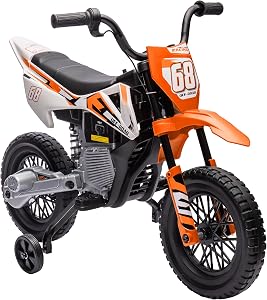
K1 36V Dirt
8.6Editor score700W peak motor
Three selectable speeds
36V 5.2Ah battery
Sixteen MPH maximum
Find the right kids dirt bikes for 2026. We compare 10 standout models by comfort, intensity levels, safety features, ease of use, recovery value, and.
Finding the right kids dirt bike in 2026 starts with matching the bike to a child’s size, confidence, and riding space. We compare 10 standout electric and gas models by speed settings, motor power, braking, suspension, tires, runtime, rider limits, owner feedback, and everyday trade-offs.
Electric dirt bikes are generally quieter and simpler to operate, with controlled speed modes and no fuel mixing. Gas mini bikes can offer longer range and stronger off-road character, but they also require more maintenance, more supervision, and a suitable place to ride responsibly.
Prioritize rider fit before maximum speed. A manageable throttle, dependable brakes, pneumatic tires, and suspension can matter more than outright power for a young rider learning on grass, packed dirt, or other private off-road spaces.
We compared 10 kids dirt bikes using the details that matter most to families: rider age guidance, weight capacity, motor or engine type, speed range, battery or fuel capacity, braking system, tire construction, suspension, charging needs, owner feedback, and value. The notes focus on practical trade-offs, including when training wheels help, why selectable speed modes are useful, and when a gas-powered mini bike is appropriate for an experienced, properly supervised rider.

Compare key features, scores, and current prices side by side. A shorter feature list means fewer details were available, not necessarily fewer capabilities.
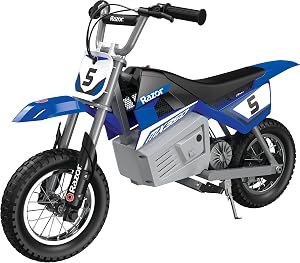




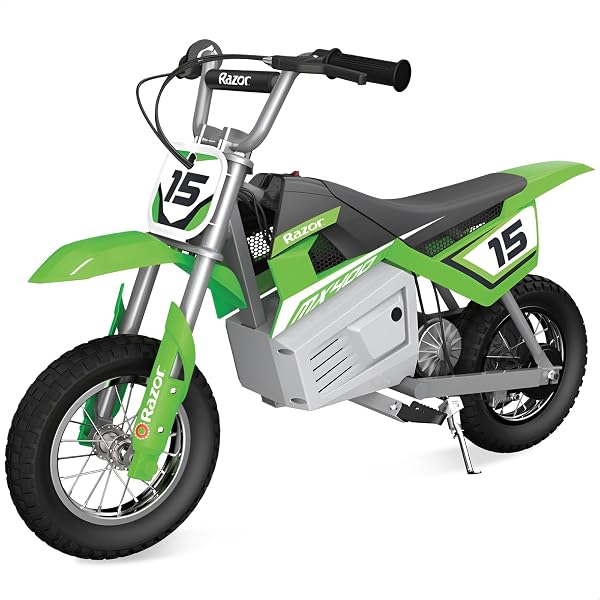
The Razor MX350 is a well-established choice for children ages eight and up who want a more authentic dirt bike layout than a small toy motorcycle. Its steel frame, double-crown fork, and chain-driven motor give it a more substantial off-road feel than lightweight toddler models.
We may earn a commission when you buy through this link, at no additional cost to you.
The bike reaches up to 14 MPH and uses 12-inch pneumatic knobby tires. Pneumatic tires are a meaningful feature because they provide more grip and compliance over packed dirt and gentle grassy slopes than solid plastic wheels.
Comfort-focused details include soft rubber grips, adjustable-angle riser handlebars, folding foot pegs, and a retractable kickstand. The listed high-speed runtime is up to 30 minutes, so it is best suited to shorter supervised riding sessions rather than all-day trail use.
Pneumatic tires are especially useful when the riding area includes compacted dirt, grass, or small surface irregularities. Keep them inflated to the recommended pressure because underinflation can affect handling and shorten tire life.
The MX350 is the strongest all-around pick for an older child who is ready for a simple, traditional electric dirt bike. Its main limitation is the fixed performance approach: it does not offer the stepped speed settings found on several newer electric alternatives.
First-time riders who need a very low beginner speed setting before progressing.
We may earn a commission when you buy through this link, at no additional cost to you.
The K1 is built for families who want an electric dirt bike that can begin gently and remain useful as a child develops better throttle and braking control. Its three speed modes create a clear progression from 6 MPH to 9 MPH and then a listed 16 MPH maximum.
We may earn a commission when you buy through this link, at no additional cost to you.
A 700W peak motor and 36V lithium battery give the bike more performance headroom than entry-level 12V models. The stated range of up to 14 miles will vary with speed setting, rider weight, temperature, surface, and hills, so it should be viewed as a best-case estimate.
The practical safety equipment is strong for this category. It has a manual rear brake, inverted spring hydraulic front fork, high-strength rear shock absorption, and 12-inch anti-skid tires. The 176-pound stated rider limit is unusually generous, though rider height and control still matter more than capacity alone.
Selectable speed settings are useful because a bike can remain familiar while the rider’s skill improves. Low mode is the right place to begin, even if the child seems eager to use the highest setting immediately.
This is a good match for a child who has some riding coordination and a safe private area to practice. Start in low mode, establish clear boundaries, and move up only after smooth starts, controlled turns, and consistent braking become routine.
Toddlers or riders without the maturity to handle a hand brake and twist throttle.
We may earn a commission when you buy through this link, at no additional cost to you.
The Razor MX125 is the smallest electric dirt bike in the Razor Dirt Rocket range and is a practical starting point for riders ages five and older. Its 8 MPH maximum is easier to manage than the faster MX350, MX400, or MX650 models.
We may earn a commission when you buy through this link, at no additional cost to you.
The high-low speed switch is the key buying feature. It lets an adult choose a lower maximum speed while the rider learns basic balance, throttle control, looking ahead, and braking. In low mode, the listed 12V sealed lead-acid battery can provide up to 80 minutes of continuous use.
A crossbar-reinforced handlebar, 12-inch spoked pneumatic wheels, retractable kickstand, and hand-operated rear brake give it useful dirt-bike-style hardware. It still requires protective equipment and an open riding area, even at its lower speed ceiling.
A reduced top speed gives a beginner more time to process steering and braking decisions. It also makes it easier for an adult to coach from nearby without needing to chase the rider across a large area.
Choose the MX125 for a younger child who needs a deliberately modest first electric bike. It is not the best fit for a taller or more experienced rider who will quickly outgrow 8 MPH performance.
Older children looking for faster acceleration and more demanding off-road performance.
We may earn a commission when you buy through this link, at no additional cost to you.
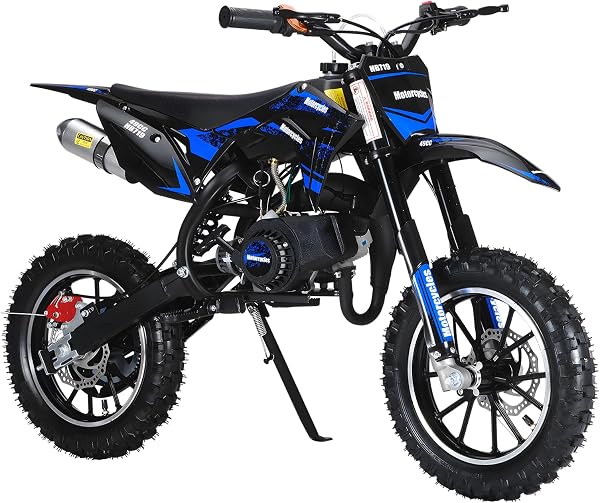
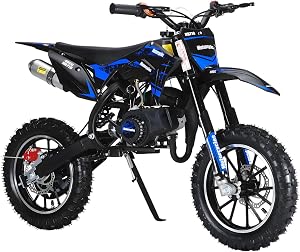
The FROSTYRIDER 50cc is a gas-powered mini motorcycle for riders roughly eight to fourteen years old who have an appropriate private off-road place to ride. It is considerably more demanding than an electric bike because its two-stroke engine, fuel handling, and stated speed capability require careful adult oversight.
We may earn a commission when you buy through this link, at no additional cost to you.
Its useful control features include an adjustable throttle, emergency kill switch, front and rear disc brakes, and 10-inch inflatable off-road tires. The 23.6-inch seat height and 165-pound capacity should be checked against the rider’s inseam and ability to place feet securely when stopped.
The engine uses a 25:1 fuel-to-oil ratio and a 0.32-gallon fuel tank. Those details mean families need to mix and store fuel correctly, inspect the bike before riding, and follow the manufacturer instructions for starting and maintenance.
A gas mini bike requires routine checks beyond charging. Before riding, inspect fuel lines, throttle movement, brakes, tire condition, chain area, fasteners, and the kill switch according to the owner’s instructions.
This is a budget-conscious gas option for a rider with suitable supervision and prior riding preparation. The stated 40 MPH maximum is not appropriate as a learning target; controlled, low-speed practice should come first.
Families seeking quiet operation, simple charging, and low-maintenance backyard riding.
We may earn a commission when you buy through this link, at no additional cost to you.
This 50cc gas mini bike is for older or more experienced young riders who need more range than a battery-powered model can typically provide. Its 49cc two-stroke engine, 1.2L fuel tank, and stated 30 to 35 mile range make it oriented toward longer private-property or off-road sessions.
We may earn a commission when you buy through this link, at no additional cost to you.
It uses 10-inch off-road tires, front and rear disc brakes, inverted front shocks, and rear suspension. Those components matter because they help the bike cope with bumps and provide more controlled stopping than basic toy-grade motorcycles.
The listed 330-pound capacity is high, but the bike is still marketed for children ages eight to fourteen. Rider fit, skill, and ability to operate the brake and throttle safely are more important than maximum frame capacity.
Longer fuel range is convenient, but it can also encourage longer sessions than a young rider can handle safely. Build in rest breaks, inspect the bike between sessions, and avoid riding once fatigue affects attention or coordination.
Choose this model only if a gas bike is genuinely appropriate for the rider and riding location. Its favorable rating and full-suspension specification are appealing, but it remains a faster combustion-powered machine that needs disciplined use.
New riders who would benefit from a lower-speed electric bike with selectable modes.
We may earn a commission when you buy through this link, at no additional cost to you.
The Hiboy DK1 is an appealing electric choice for families who value a longer listed battery runtime. It uses a 36V sealed lithium battery and is rated for up to 90 minutes of riding under the stated 88.2-pound test weight.
We may earn a commission when you buy through this link, at no additional cost to you.
Its three speed modes offer 5 MPH, 7.5 MPH, and 15.5 MPH limits. This is a useful spread for a household with a developing rider, but the highest setting should be reserved for a child who has already demonstrated dependable throttle and brake control.
Front hydraulic shocks and high-strength shock-absorbing springs aim to improve comfort over uneven surfaces. The bike is listed for riders ages three to thirteen and up to 140 pounds, which is a very broad range; adult judgment should narrow that range based on actual size and skill.
Battery runtime is usually measured under controlled conditions. Heavier riders, grass, slopes, frequent starts, and high speed mode all reduce the actual time available between charges.
Pick the DK1 for an electric rider who benefits from long playtime and staged speed progression. It offers more usable runtime than many higher-speed models, but it still needs a properly fitted helmet and close supervision.
Parents who want a very low-speed toddler bike with training wheels.
We may earn a commission when you buy through this link, at no additional cost to you.
This 36V electric dirt bike is a strong option for parents focused on braking and traction hardware. It combines an EABS brake system with a drum brake, giving it a more safety-focused specification than models that list only a basic rear hand brake.
We may earn a commission when you buy through this link, at no additional cost to you.
The 700W peak mid-drive motor reaches a listed 15.5 MPH and can handle slopes up to 15 degrees according to the product information. Three speed settings at 5, 7.5, and 15.5 MPH allow a careful progression from beginner practice to more confident riding.
Its 12 by 2.75-inch pneumatic fat tires, rear spring suspension, reinforced crossbar handlebar, and protective pad are sensible additions for grass, dirt, and uneven private riding areas. The 36V 4Ah battery is listed for up to 90 minutes, subject to riding conditions.
Teach braking on level, dry ground before allowing a child to ride on slopes or loose surfaces. Riders should practice rolling off the throttle, applying the brake smoothly, and looking ahead rather than at the front wheel.
This bike is a good fit for a child who needs a more stable off-road electric platform with braking features that support controlled practice. It is still too quick for unsupervised young riders, especially when set to high mode.
Families wanting a compact indoor-friendly ride-on rather than an outdoor electric dirt bike.
We may earn a commission when you buy through this link, at no additional cost to you.
The Razor MX400 sits between the smaller MX125 and the more powerful MX650. It is designed for riders ages eight and up, with a 250W motor, 24V battery system, 14 MPH maximum speed, and 140-pound rider limit.
We may earn a commission when you buy through this link, at no additional cost to you.
Its steel construction and shatter-resistant plastic fairings support the traditional Dirt Rocket format. Twelve-inch pneumatic knobby tires are useful for outdoor riding because they improve contact and stability compared with solid-wheel alternatives.
The listing includes a 30-minute high-speed ride time in the title while also describing up to 60 minutes of uninterrupted riding in the product details. Because conditions affect battery performance, buyers should plan around shorter sessions and confirm current manufacturer documentation before purchase.
When battery runtime information differs across product materials, use the more conservative number for planning. Actual performance depends heavily on rider weight, terrain, battery condition, and throttle use.
Choose the MX400 for an older child who wants a straightforward electric dirt bike from a familiar line without stepping up to the faster MX650. Its fixed speed approach makes it less adaptable for complete beginners.
Children who need a low-speed setting while learning fundamental bike control.
We may earn a commission when you buy through this link, at no additional cost to you.
The Razor MX650 is the performance-focused option in the Dirt Rocket range. Its 650W electric motor, listed 17 MPH top speed, authentic dirt bike frame geometry, and larger wheel sizes make it better suited to an experienced older child than a first-time rider.
We may earn a commission when you buy through this link, at no additional cost to you.
The front tire measures 16 inches and the rear measures 14 inches, which gives the bike a more substantial stance than the MX125, MX350, or MX400. Dual suspension and riser handlebars are intended to improve comfort and control over uneven outdoor surfaces.
The chain-driven motor uses variable speed control and the electrical system is listed as UL2272 compliant. Battery life is up to 40 minutes, so it trades extended runtime for more powerful performance.
Larger tires can improve bump absorption and stability, but they also make the bike physically more substantial. Check the rider’s ability to mount, hold the bike upright, reach the controls, and manage it while stopped.
Choose the MX650 when the rider already has proven braking, turning, and throttle discipline and needs a more capable electric bike. It is not a beginner dirt bike, and the faster top speed raises the importance of protective gear and a controlled riding area.
Young or inexperienced riders who should start on a slower, lighter electric model.
We may earn a commission when you buy through this link, at no additional cost to you.
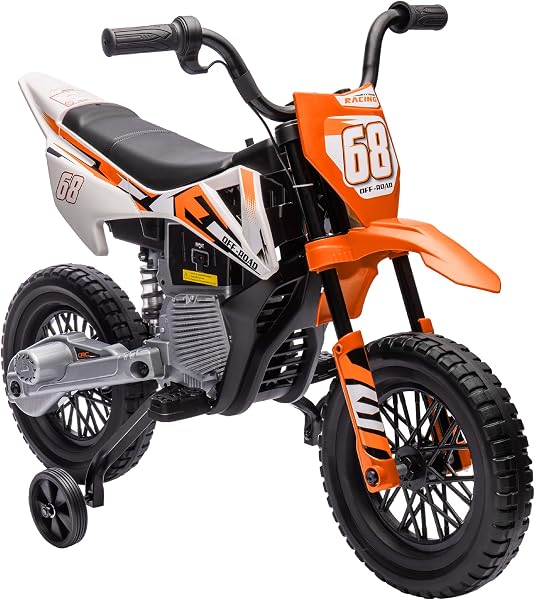
The Qaba 12V is a toddler-oriented electric motorcycle rather than a true off-road dirt bike. Its 1.5 to 3.1 MPH speed range, training wheels, and recommended age range of 36 to 72 months make it the most approachable model in this guide for early riding practice.
We may earn a commission when you buy through this link, at no additional cost to you.
The twist-grip throttle introduces a basic motorcycle-style control in a much slower format. Training wheels help maintain balance, while rear shock absorbers are intended to smooth rides on cement, asphalt, and brick surfaces.
A built-in music system and battery indicator add child-friendly convenience, but the 66-pound capacity and small-scale design make this a short-term developmental toy rather than a bike for challenging trails. Assembly is required before use.
Training wheels help a young child stay upright at slow speeds, but they can catch on uneven ground. Keep the riding surface smooth and avoid curbs, loose gravel, slopes, and deep grass.
Choose the Qaba for a preschool-aged child who needs a stable first powered ride-on. It is best used on flat, hard, clear surfaces under direct adult supervision and should not be treated as a substitute for a larger off-road bike.
Children over the recommended age range or riders seeking genuine off-road performance.
We may earn a commission when you buy through this link, at no additional cost to you.
A kids dirt bike should fit the rider, the riding area, and the level of supervision available. The best choice is not automatically the fastest, most powerful, or most expensive model. It is the one that lets a child learn controlled riding skills while staying within appropriate limits.
Electric dirt bikes are usually the simplest starting point for families. They are quieter, avoid fuel mixing, and often include speed modes that make it easier to limit performance as a child learns. Models such as the Razor MX125, Hiboy DK1, K1, and 36V 700W Electric bike use rechargeable battery systems and twist throttles with relatively straightforward daily operation.
Gas dirt bikes offer a different ownership experience. The FROSTYRIDER and 50cc Gas Mini use two-stroke engines, fuel tanks, pull starts, and more intensive maintenance routines. They can offer extended range, but they also introduce fuel handling, engine noise, exhaust, chain and brake inspection, and more significant speed potential. A gas mini bike should only be considered when the child has suitable experience and a legal, safe off-road place to ride.
For most younger riders, an electric model is the practical first step. Choose gas only when its extra capability is genuinely needed and the family can manage the safety and maintenance responsibilities.
Speed is one of the most important specifications, but it should be interpreted as a safety decision rather than a performance contest. The Qaba begins at 1.5 to 3.1 MPH, the MX125 reaches 8 MPH, and models such as the K1, Hiboy DK1, and 36V 700W Electric bike offer multiple settings from roughly 5 MPH to 15.5 or 16 MPH. These staged options can make one bike useful over a longer period.
A twist-grip throttle requires coordination. The rider needs to roll on power gradually, keep both hands stable, look ahead, and release the throttle before braking. A common mistake is selecting the highest speed mode immediately because the rider has used a pedal ride-on or bicycle before. Powered dirt bikes react differently, especially on loose ground.
Start at the lowest available mode and practice only on open, level ground. Increase speed only after the child can repeatedly start, stop, turn, and follow boundaries without reminders.
Age recommendations are useful starting points, but they are not enough on their own. A rider must be able to reach the controls, hold the bike upright, use the brake confidently, and place feet securely when stopped. The MX125 is scaled for younger riders, while the MX650 has larger wheels and a more substantial chassis better suited to a capable older child.
Weight capacity should also be treated as a limit, not an indication of ideal fit. The K1 lists a 176-pound maximum, the MX350 and MX400 list 140 pounds, and the Qaba lists 66 pounds. A child can be below the capacity yet still be too tall, too short, or too inexperienced for a particular bike.
Check seat height, wheel size, handlebar reach, and rider posture before buying. A properly fitted smaller bike is usually safer and more enjoyable than a powerful model the child cannot manage comfortably.
Brake design affects how a child learns control. Most electric models here use a hand-operated rear brake, while gas mini bikes list front and rear disc brakes. The 36V 700W Electric bike adds EABS and a drum brake. Whatever the system, a child should practice smooth braking before riding on slopes, loose dirt, or near obstacles.
Pneumatic tires are generally preferable for outdoor riding because they provide better grip and absorb small bumps more effectively than hard tires. The MX350, MX400, MX650, and several electric competitors use pneumatic tires. Suspension also improves comfort, with options ranging from rear shocks to full or dual suspension systems on models like the 50cc Gas Mini and MX650.
Prioritize reliable braking and pneumatic tires over cosmetic features. The bike should be used only on surfaces its tires and suspension can handle safely.
Electric bike runtime depends on battery voltage, amp-hour capacity, motor demand, rider weight, terrain, temperature, and speed setting. A 12V MX125 can list up to 80 minutes in low mode, while the Hiboy DK1 and 36V 700W Electric bike list up to 90 minutes under specified conditions. Faster models such as the MX350 and MX650 list shorter high-speed runtimes.
Charging time matters as much as runtime. The K1 and several 36V models list roughly four to six hours for charging. Families should set up a dry, ventilated charging location and charge only with the specified equipment. Avoid treating battery charging as an overnight afterthought, particularly where children or pets can reach cords.
Plan rides around conservative runtime expectations. If your child rides mostly on grass or hills, expect less time than the best-case figure.
Not every dirt bike belongs on every surface. Toddler models with training wheels are best on smooth pavement, brick, or similarly firm areas. Pneumatic-tire electric bikes can handle packed dirt, short dry grass, and mild bumps when used responsibly. Gas bikes require substantially more open space, clear boundaries, and terrain that matches the rider’s ability.
Avoid public roads, traffic areas, steep slopes, standing water, loose deep sand, and crowded spaces. A small backyard may be enough for a slow 12V ride-on, but it is not necessarily appropriate for a 16 MPH electric bike or a gas-powered 50cc mini motorcycle. Always verify local rules for motorized vehicles and off-road riding.
Choose the bike around your actual riding space. A lower-speed electric model is often the better purchase when available terrain is limited.
Every rider should wear a properly fitted helmet, and additional protective equipment such as gloves, long pants, closed footwear, and pads can reduce injury risk. The K1 specifically advises protective gear and adult supervision, but those practices apply to every bike in this guide, including the slowest toddler model.
Supervision should be active, especially during early rides. An adult should establish a route, identify stopping areas, prevent access to driveways or roads, and make sure the rider understands throttle, braking, and emergency stopping. For gas models, adults also need to handle fueling, pre-ride mechanical checks, and storage responsibly.
Do not let speed capability replace good judgment. A calm rider on a modest bike with full gear and close supervision is in a better position than an unprepared rider on a faster model.
Before every ride, inspect the tires, brake response, throttle return, handlebars, visible fasteners, chain area if applicable, and battery charge or fuel level. Use a clear, dry riding area away from roads, water, vehicles, pedestrians, steep slopes, and hard obstacles. Begin each new rider on the lowest speed setting and practice controlled starts and stops before attempting turns or uneven ground.
For electric bikes, use only the intended charger and charge in a dry, ventilated location. Allow the bike to cool after an extended ride before charging when practical, and follow the owner’s guidance for battery storage during long periods of nonuse. Keep charging cables away from children and never use a visibly damaged charger or battery pack.
For gas mini bikes, follow the specified fuel-to-oil ratio and maintenance instructions exactly. Inspect brakes, tires, fuel lines, chain components, and controls before riding, and store fuel in an approved container away from ignition sources. Clean off mud and debris after use, but avoid spraying electrical parts or engine openings with high-pressure water.
Age guidance varies by model, but rider maturity, fit, and coordination matter more than age alone. The Qaba is intended for ages 36 to 72 months, while the Razor MX125 is for ages five and up and several larger models are intended for ages eight and above. Always choose the lowest practical speed and supervise closely.
An electric dirt bike is usually the easier first choice because it avoids fuel handling and often includes lower speed settings. Gas models need more maintenance and can have much higher speed potential. A beginner should gain throttle and braking confidence on a manageable electric bike before considering gas power.
Yes. Speed modes let adults limit performance while a child learns balance, throttle control, and braking. They can also extend the useful life of a bike because the rider can progress without switching models immediately.
Runtime depends on rider weight, terrain, speed mode, temperature, and battery condition. Several models list between 30 and 90 minutes, though high speed riding and hills reduce that figure. Use the most conservative runtime estimate when planning an outing.
Suspension is helpful on uneven outdoor surfaces because it reduces bumps and helps keep the tires in contact with the ground. It is less important for a slow toddler ride-on used on smooth pavement. Suspension does not make steep, rough, or unsafe terrain suitable for a young rider.
Pneumatic tires can provide better traction, cushioning, and stability on dirt, grass, and small bumps than hard plastic wheels. They require regular pressure checks and can be punctured, but they are generally more appropriate for genuine outdoor riding.
Yes. A helmet is essential even on low-speed electric models. Gloves, closed footwear, long pants, and pads are also sensible protection, particularly when riding on dirt or uneven ground.
In most situations, no. Local laws vary, and many dirt bikes are intended only for private property or approved off-road areas. Check state and local regulations before riding anywhere outside a controlled private space.
Check tire condition, brake function, throttle movement, steering, battery charge or fuel level, and visible loose hardware. On gas models, also inspect fuel lines, chain-related components, and the kill switch. Do not ride if anything feels loose, damaged, or unresponsive.
The Razor MX350 is the strongest overall choice for many older children because it combines a durable steel frame, pneumatic knobby tires, a manageable 14 MPH maximum speed, and a strong 4.6 owner rating. It offers a traditional electric dirt bike experience without moving immediately to the highest-powered category.
For younger beginners, the Razor MX125 provides a more controlled entry point with its high-low speed switch, while the Qaba is designed for preschool-aged riders who need training wheels and very low speeds. The K1, Hiboy DK1, and 36V 700W Electric bike are better choices for families wanting selectable speed progression and longer electric runtime.
Choose based on the rider's fit, confidence, supervision, and riding area rather than maximum speed. Start slowly, use proper protective equipment, maintain the bike carefully, and progress only when the child can demonstrate calm, repeatable control.