Timberland PRO Gridworks
8.8Editor scoreSoft toe moc design
Anti-fatigue geometric cushioning
Waterproof ASTM-rated membrane
All-weather TPU wedge outsole
Find the right work boots for 2026. We compare 10 standout options by build quality, useful features, owner feedback, value, and everyday trade-offs.
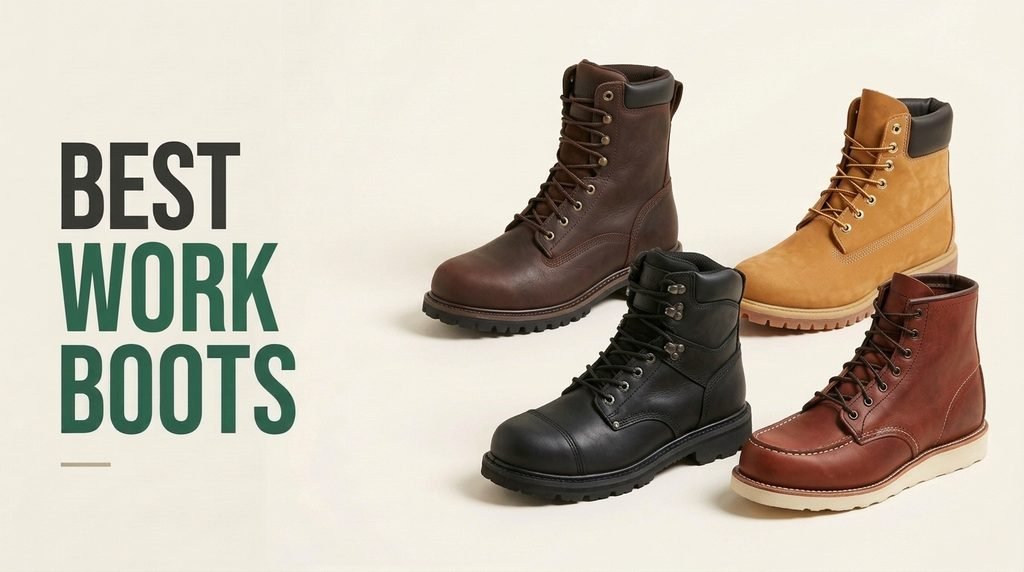
Find the right work boots for 2026. We compare 10 standout options by the factors that matter in this category, such as safety toe ratings, waterproofing, slip resistance, underfoot cushioning, upper durability, electrical hazard protection, owner feedback, value, and everyday jobsite trade-offs.
Standing for ten hours on poured concrete, walking through wet jobsite trenches, or climbing slick scaffolding quickly exposes weak footwear. While some boots prioritize heavy composite or steel toe armor for industrial sites, others focus on flat-floor wedge comfort, lightweight hiker agility, or insulated cold-weather traction.
Before choosing a pair, identify your non-negotiable workplace safety standards and match the outsole profile to your primary walking surfaces. This guide breaks down how each boot handles real-world shifts so you can invest in lasting protection and comfort without overpaying for unnecessary bulk.
We compared 10 work boots using the details that actually help a buyer decide: ASTM safety toe impact ratings, waterproof membrane verification, electrical hazard protection, outsole slip and oil resistance, midsole fatigue reduction, upper leather durability, construction method, owner feedback, and overall value. The notes focus on practical trade-offs so each pick connects directly to how tradespeople stand, climb, lift, and protect their feet across demanding shifts.

Compare key features, scores, and current prices side by side. A shorter feature list means fewer details were available, not necessarily fewer capabilities.





Boasting the highest customer rating in our lineup at 4.6 stars, the Timberland PRO Men's Direct Attach MaxTRAX Soft Toe SRO Boot is a specialist built for cold, wet, and treacherously slick working environments. It is an ideal match for cold-storage warehouse crews, beverage delivery drivers, commercial kitchen and food-processing maintenance staff, and winter outdoor workers who do not require a hard safety toe.
We may earn a commission when you buy through this link, at no additional cost to you.
Weather defense starts with a waterproof leather upper fused directly to a polyurethane midsole via seam-sealed direct-attach construction, leaving zero stitch gaps for melting snow or wash-down water to penetrate. Inside, a breathable moisture-wicking lining works alongside 200 grams of Thermolite insulation—enough thermal barrier to prevent numb toes on freezing loading docks or chilly autumn mornings without turning the boot into a clumsy winter snowpack.
Where this boot truly separates itself is outsole grip: the non-marking, oil- and abrasion-resistant TPU bottom features patented MaxTRAX slip-resistant tread blocks channeled to evacuate water and grease away from the contact patch. Certified compliant with ASTM F2892-24 EH SRO standards, it pairs superior slip resistance with secondary electrical hazard protection and the arch-supporting 24/7 Comfort System.
Slips on wet tile or oily concrete happen when a smooth sole traps a thin film of liquid underneath the rubber, causing the foot to hydroplane. The MaxTRAX outsole uses sharp-angled lug edges separated by wide dispersion channels that slice through surface liquids and push oil or water outward so the TPU compound locks onto the floor.
Keep two practical limitations in mind before buying: this is a soft-toe model, so it cannot be worn where steel or composite caps are mandatory, and the 200g Thermolite insulation will feel overly warm if you work outdoors in 90-degree July heat. For workers battling wet loading bays, greasy floors, or cold-weather utility routes, the Direct Attach MaxTRAX delivers unmatched footing and dry warmth.
Hot-weather summer crews or jobsites requiring ASTM impact-rated safety toes.
We may earn a commission when you buy through this link, at no additional cost to you.
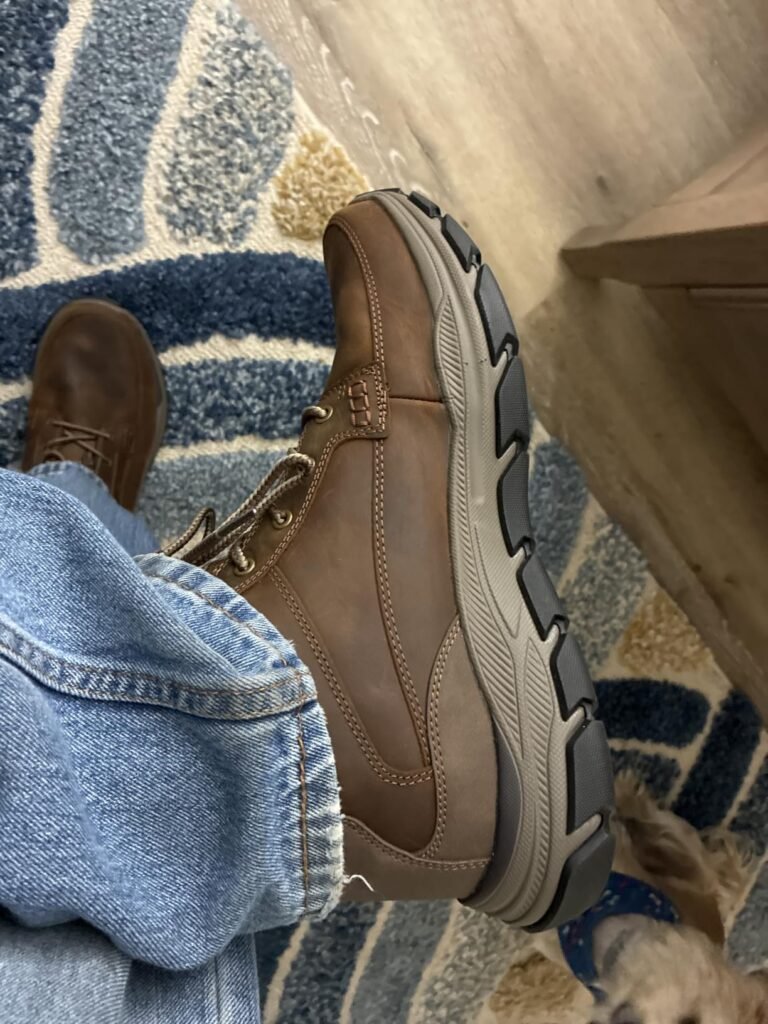
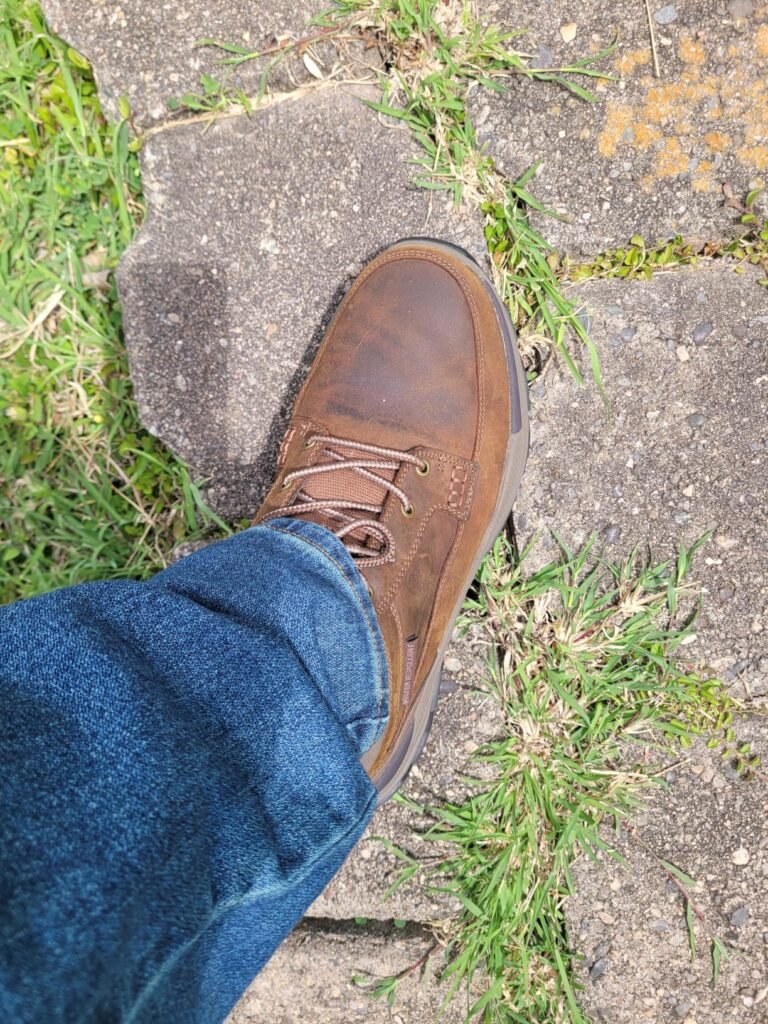
The Timberland PRO Men's Gridworks Wedge 6-Inch Moc Soft Toe Boot is engineered for carpenters, ironworkers, electricians, and warehouse specialists who spend their days walking across hard, flat surfaces without needing a rigid safety toe cap. Traditional heeled boots concentrate downward pressure onto your heel bone and forefoot ball, whereas this continuous wedge platform supports your entire arch and keeps you stable when stepping across framing joists or concrete slabs.
We may earn a commission when you buy through this link, at no additional cost to you.
Underfoot endurance comes from Timberland PRO’s Anti-Fatigue Technology, which molds inverted geometric cones directly into the midsole structure. Every time your foot strikes the floor, those geometric zones compress to absorb sharp impact energy and rebound upward as you push off. Alongside that mechanical cushioning, an internal waterproof membrane seals out standing water and meets the rigorous ASTM F1671-07 standard for barrier integrity.
Unlike soft blown-rubber wedge soles that wear down rapidly on rough asphalt or stiffen up in freezing weather, the Gridworks uses a specially formulated all-weather thermoplastic urethane (TPU) outsole. This compound remains flexible across cold temperatures while delivering dependable traction on wet concrete, frosted ice patches, and oily shop floors. The boot also provides ASTM-certified electrical hazard protection and integrates breathable ReBOTL lining fabric made with at least 50% recycled plastic.
Classic white wedge soles feel plush on day one, but their soft foam-rubber compounds often abrade down at the outer heel within six months of heavy concrete walking. By upgrading the wedge to thermoplastic urethane, the Gridworks preserves that full-contact flat posture while resisting abrasion, oil breakdown, and winter hardening far longer.
The primary trade-off is the absence of a metallic or composite toe shield, meaning you should skip this model if your site supervisor enforces ASTM impact and compression rules. Likewise, flat wedge soles are built to shed small gravel rather than dig into steep, muddy trenches. For tradespeople working on concrete, metal decking, or indoor-outdoor commercial projects who want classic moc-toe comfort with serious weather and electrical protection, the Gridworks Wedge is a standout performer.
Workers on heavy construction sites that require certified steel or composite toe impact protection.
We may earn a commission when you buy through this link, at no additional cost to you.
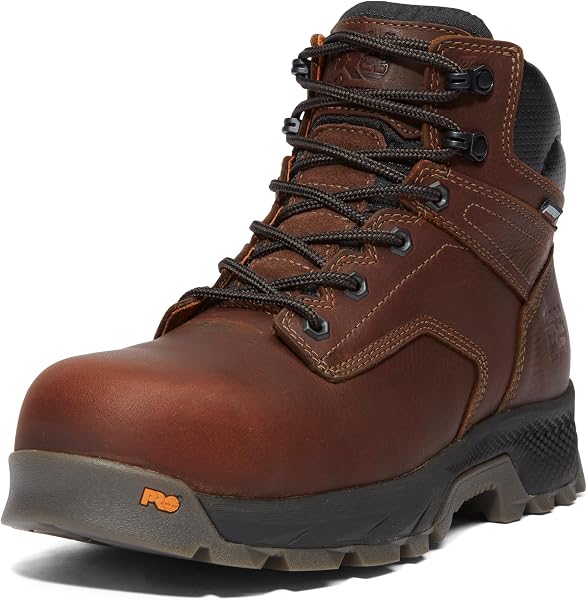
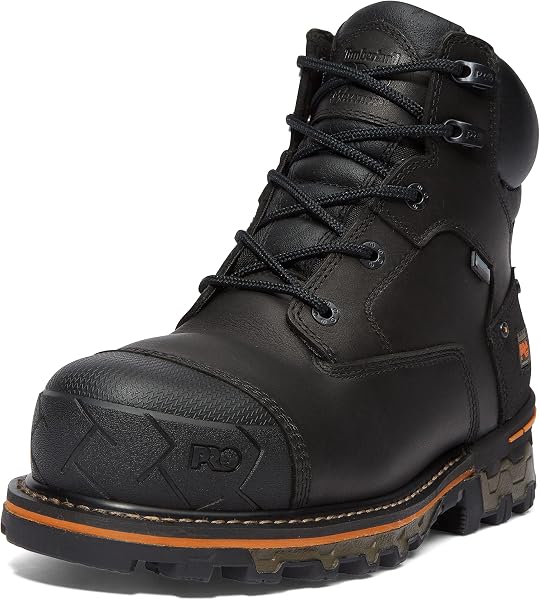
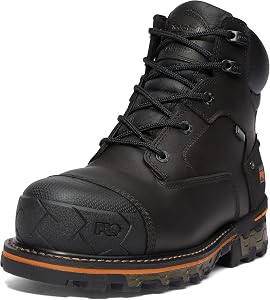
The Timberland PRO Men's Boondock 6-Inch Composite Safety Toe Waterproof Boot earns our Editor's Choice badge because it leaves zero gaps in heavy-duty jobsite protection. Designed for civil construction crews, heavy equipment operators, utility linemen, and outdoor contractors, it pairs full ASTM safety certifications with cold-weather traction and a shock-absorbing chassis built for punishing twelve-hour shifts.
We may earn a commission when you buy through this link, at no additional cost to you.
Front-end protection relies on an asymmetrical, non-metallic composite safety toe shaped specifically for left and right feet so your outer toes do not rub against a cramped dome. The cap meets ASTM F2412-18a and ASTM F2413-18 impact and compression standards while weighing less than traditional steel. Just as importantly for outdoor crews, composite material does not conduct ambient freezing cold inward toward your toes during winter shifts.
Beneath your foot, geometric Anti-Fatigue Technology absorbs repetitive shock on frozen dirt, gravel, and concrete while returning energy to your stride. An internal waterproof membrane rated to ASTM F1671-07 locks out rain and jobsite runoff, while the all-weather TPU outsole stays pliable in low temperatures to grip wet surfaces, frosted ice, and oil spills without cracking. Secondary underfoot electrical hazard protection meets ASTM F2412-18a, F2413-18, and F2892-18 standards.
Older safety boots often used generic, symmetrical toe caps that pinched the fourth and fifth toes whenever the forefoot flexed. Shaping the composite cap asymmetrically to mirror natural foot anatomy gives your toes room to splay under load while passing smoothly through security metal detectors at power plants and industrial gates.
Because the Boondock is built as an uncompromising industrial fortress, it carries more bulk and commands a higher price than light-duty warehouse shoes. If you walk miles across climate-controlled distribution center floors every afternoon, a lighter hiker or foam-cushioned boot may feel nimbler. However, for workers facing unpredictable weather, heavy materials, and rough outdoor ground, the Boondock is the most dependable all-around investment in this guide.
Indoor light-duty workers who prefer featherweight, sneaker-like flexibility over heavy jobsite armor.
We may earn a commission when you buy through this link, at no additional cost to you.
Shopping for a budget-friendly work boot often forces buyers to settle for synthetic uppers or split-grain suede that tears after a few weeks around sharp pallets and rebar. The Wolverine Men's Floorhand Waterproof Steel-Toe 6-Inch Work Boot breaks that compromise, delivering genuine full-grain waterproof leather and a protective steel toe cap at one of the most accessible prices on the market.
We may earn a commission when you buy through this link, at no additional cost to you.
Full-grain leather is the gold standard for exterior durability because it retains the tight, natural fiber density of the outer hide, shrugging off abrasive gravel, wet mud, and brush while wiping clean easily at the end of a shift. Combined with its waterproof construction, the Floorhand keeps water from seeping through the seams when you step into unexpected puddles, wet grass, or washed-down shop bays.
Underfoot, a full-length cushioned footbed softens the sting of hard concrete and packed dirt, while a molded rubber lug outsole provides dependable bite across slick, uneven surfaces. If the factory insole eventually flattens after months of daily wear, its removable design makes it simple and inexpensive to drop in a fresh aftermarket orthotic without replacing the entire boot.
Because the Floorhand invests its budget into a tough full-grain leather upper and rubber outsole, the shell often outlasts the standard factory foam insert. Pairing this affordable boot with a heavy-duty gel or polyurethane replacement insole after a few months gives you customized arch support while keeping your total spend well below hundred-dollar competitors.
To keep the price this low, Wolverine skips proprietary multi-density foam midsoles and non-metallic composite caps. The steel toe will feel chillier during mid-winter outdoor work than a composite boot, and ten-hour concrete walkers may want to upgrade the insole sooner than they would in a premium Timberland PRO model. For apprentices, landscapers, mechanics, and value-focused tradespeople who want honest leather durability and steel-toe safety without overspending, the Floorhand is a smart buy.
Workers in sub-freezing outdoor climates where metallic steel toes draw heat away from the feet.
We may earn a commission when you buy through this link, at no additional cost to you.
Not every jobsite is a flat concrete slab; surveyors, telecom technicians, landscapers, delivery drivers, and site inspectors spend their days scrambling up embankments, climbing equipment ladders, and kneeling in tight spaces where stiff, boxy work boots feel clumsy. The Timberland PRO Men's Keele Ridge Steel Safety Toe Waterproof Industrial Hiker merges the nimble footwork of an outdoor trekking boot with full industrial safety credentials.
We may earn a commission when you buy through this link, at no additional cost to you.
Inside the forefoot sits an asymmetrical steel safety toe engineered to meet ASTM F2412-18a and ASTM F2413-18 impact and compression requirements while following the natural curve of your toes. Despite its athletic silhouette, the Keele Ridge includes a full ASTM F1671-07 waterproof membrane that blocks rain, wet turf, and shallow trench water, plus ASTM-rated electrical hazard protection to guard against accidental contact with live circuits.
Ground contact is handled by a durable, heat-resistant rubber outsole formulated to resist oil breakdown, surface abrasion, and slips on wet slopes or slick shop floors. Inside the boot, breathable ReBOTL fabric linings made with at least 50% recycled plastic help wick sweat away during brisk summer climbs, and the hiker-style lacing system lets you cinch the midfoot securely so your heel stays planted on uneven grades.
Traditional 6-inch industrial boots have tall, upright shafts that restrict ankle dorsiflexion when you crouch under a sink, climb into a cab, or walk steep grades. A hiker cut drops slightly around the Achilles notch and uses a rockered forefoot profile, reducing calf fatigue when your job involves 12,000 steps a day.
The main trade-off is that a hiker-style chassis prioritizes flexible mobility over the deep-lugged ankle rigidity of the Boondock or the flat-floor footprint of the Gridworks Wedge. Its metallic steel toe will also set off security gates. If your workday requires constant walking, climbing, squats, and vehicle entry across mixed indoor and outdoor terrain, the Keele Ridge delivers certified safety without weighing down your stride.
Workers who need non-metallic security-friendly toes or heavy ankle bracing in deep rubble.
We may earn a commission when you buy through this link, at no additional cost to you.
Many workers in light-duty roles—such as retail stockrooms, light assembly, property management, courier routes, and home workshops—do not need heavy steel toes, yet still suffer from aching arches and pinched toes on hard floors. The Skechers Men's Respected Boswell Boot solves that comfort problem by building a dual-layer athletic cushioning system inside a classic mid-top leather work boot silhouette.
We may earn a commission when you buy through this link, at no additional cost to you.
Instead of a narrow, constricting toe box, the Boswell utilizes Skechers’ Relaxed Fit design, which widens the forefoot and toe area so your feet can swell naturally over an eight-hour shift without rubbing against the sidewalls. Underfoot, an Air-Cooled Memory Foam insole conforms to your unique heel and plantar shape, while supplemental Goga Mat Arch cushioning props up the medial arch to combat mid-shift pronation fatigue.
To ensure the boot holds up to daily walking better than standard foam sneakers, Skechers pairs the upper with a Goodyear Performance Outsole made from durable rubber that grips slick tile, asphalt, and concrete securely. The leather and synthetic upper is treated to be water-repellent, shrugging off light rain showers, wet parking lots, and accidental splashes while maintaining a clean, versatile look that transitions easily from the shop floor to the front office.
Standard memory foam feels pillowy at first step, but it can compress completely flat under your arch after several hours of standing. Adding a denser, high-rebound Goga Mat arch pad beneath the memory foam layer prevents that mid-shift collapse, keeping your instep supported while the top surface stays soft.
Buyers should be clear about what this boot is and is not: it has no safety toe cap, no ASTM electrical hazard certification, and a water-repellent exterior rather than a fully waterproof membrane. Never substitute it on an active construction zone that requires certified PPE. However, for wide-footed buyers and light-duty workers who prioritize plush, zero-break-in cushioning and dependable Goodyear rubber grip, the Boswell is a joy to wear.
Industrial or construction jobsites that mandate ASTM safety toes, EH ratings, or full waterproofing.
We may earn a commission when you buy through this link, at no additional cost to you.
The KEEN Utility Men's Cincinnati 6-Inch Composite Toe Waterproof Wedge Work Boot is built for heavy-duty tradespeople—including concrete finishers, welders, mechanics, and agricultural workers—who want the flat-floor stability of a wedge sole backed by true Goodyear welt durability and certified toe armor. Whereas many moc-toe wedges are soft-toed and cemented together, the Cincinnati is engineered for extreme working environments.
We may earn a commission when you buy through this link, at no additional cost to you.
Up front, left and right asymmetrical carbon-fiber composite toes meet or exceed ASTM F2412 and F2413 M I/75, C/75 EH standards while weighing 15% less than traditional steel and offering an unobtrusive, roomy fit. The exterior uses full-grain barnyard-resistant leather specifically tanned to resist the corrosive effects of oleic acid, urea, sodium chloride, and ammonium hydroxide, backed by a breathable KEEN.DRY waterproof membrane that keeps water out while venting sweat vapor.
Structural longevity is anchored by a continuous Goodyear welt construction that stitches the upper and sole structure together so the bottom will not delaminate under heavy torsional flex. Between the welt and the non-marking, siped rubber outsole sits KEEN’s Luftcell air-infused midsole, which injects microscopic air pockets into the polyurethane to provide weightless, pillow-top shock absorption across unforgiving concrete floors.
Even if you never step foot on a ranch, barnyard-resistant tanning protects leather fibers against road salt, concrete lime, sweat acids, and workshop solvents that rapidly dry out and crack ordinary hides. Combined with a continuous Goodyear welt, this leather treatment dramatically extends the life of the upper in wet, dirty trades.
Because the Cincinnati uses thick, chemical-resistant full-grain leather and a stitched Goodyear welt, it feels stout out of the box and benefits from a few days of gradual break-in around the ankle collar. Its 4.2-star rating also reflects that wedge soles are specialized for hard surfaces rather than muddy hillsides. For tradespeople who demand carbon-toe safety, chemical-resistant leather, and resoleable-style welted strength on flat worksites, the Cincinnati stands in a class of its own.
Workers navigating steep, muddy excavations who need deep heel-brake lugs rather than a flat wedge.
We may earn a commission when you buy through this link, at no additional cost to you.
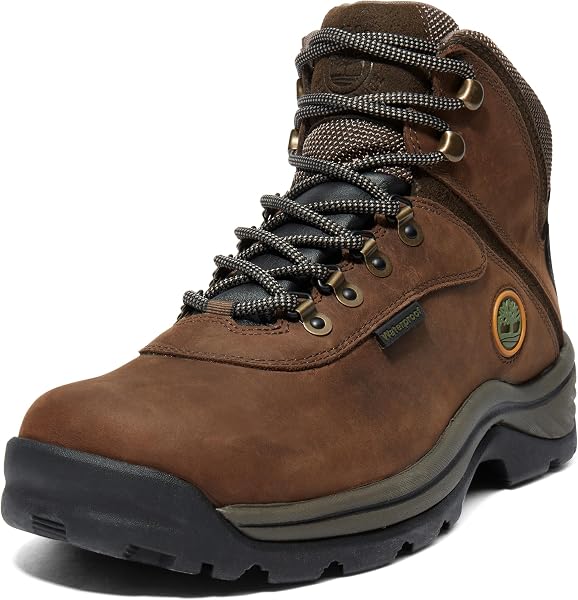
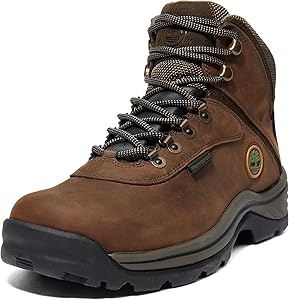
Millions of outdoor workers—including groundskeepers, residential painters, pest control technicians, delivery drivers, and estate maintenance crews—walk ten miles a day across lawns, gravel drives, and stairs where heavy industrial safety boots only cause unnecessary leg fatigue. The Timberland Men's White Ledge Mid Waterproof Boot serves these light-duty outdoor roles by delivering full-leather weather protection in an agile, low-weight package.
We may earn a commission when you buy through this link, at no additional cost to you.
The exterior is crafted from waterproof Premium Timberland Leather paired with a fully gusseted tongue that remains stitched to the sides of the upper. When you walk through wet morning grass, mulch beds, or rain puddles, water and loose debris cannot slip past the laces into your socks. Inside, a ReBOTL fabric lining containing at least 50% recycled plastic helps manage internal warmth and moisture throughout the afternoon.
Instead of heavy industrial rubber and steel shanks, the White Ledge rides on a cushioned EVA footbed and midsole that feels springy and light from the very first wear. Rustproof speed-lace hardware with open top hooks allows you to pull the ankle collar snug in seconds—even while wearing light work gloves—and release tension just as fast when stepping indoors.
When mowing, trimming brush, or shoveling gravel, airborne clippings and small stones constantly bounce against the front of your ankles. A fully gusseted tongue eliminates the open gaps on either side of the instep, ensuring you never have to stop mid-job to unlace your boot and shake out sharp pebbles.
Because this model comes from Timberland’s outdoor hiking line rather than the industrial PRO division, it does not carry a safety toe cap, electrical hazard certification, or oil-resistant shop rating. Do not wear it onto heavy construction sites or greasy mechanic bays. For outdoor service professionals and homeowners who want a tough, waterproof leather boot that feels light on the feet all day and doubles as a weekend trail boot, the White Ledge is an outstanding choice.
Industrial mechanics, electricians, or heavy construction workers who require ASTM-certified PPE.
We may earn a commission when you buy through this link, at no additional cost to you.
The Timberland PRO Men's Pit Boss 6-Inch Steel Safety Toe Industrial Work Boot is a staple of manufacturing plants, machine shops, fabrication bays, and dry construction sites for good reason: it focuses squarely on tough leather, certified steel-toe protection, and arch support without charging extra for waterproof membranes that indoor workers do not need.
We may earn a commission when you buy through this link, at no additional cost to you.
At the front of the boot, an asymmetrical steel safety toe meets ASTM F2412-18a and ASTM F2413-18 impact and compression standards to shield your forefoot against dropped castings, pipe, and heavy hand tools. Underfoot, the boot features the Timberland PRO 24/7 Comfort Suspension System, an engineered platform that supports the longitudinal arch and cushions every heel strike to curb foot fatigue across back-to-back shifts.
Traction and shop safety are anchored by a Timberland PRO rubber outsole formulated to resist heat, oil, abrasion, and slips on slick industrial concrete or metal grates. The Pit Boss also provides ASTM-certified electrical hazard protection against live circuits and uses a breathable ReBOTL lining made with at least 50% recycled plastic to help keep air moving around your socks.
While waterproof membranes are essential outdoors, they inevitably slow down evaporative cooling when you work inside a 75-degree factory or welding shop all year. Choosing an unlined-membrane leather boot like the Pit Boss lets foot perspiration vent through the leather and ReBOTL lining faster, keeping your socks drier during dry indoor shifts.
Because the Pit Boss skips a sealed waterproof membrane, your feet actually stay cooler and less sweaty inside heated warehouses or hot summer workshops than they would inside a fully sealed rain boot. The trade-off is that you should avoid deep outdoor mud trenches or torrential rain. For indoor tradespeople, machinists, and warehouse crews who want a proven, no-nonsense steel-toe workhorse, the Pit Boss remains a benchmark.
Outdoor utility or trench workers who stand in ankle-deep water and rain all day.
We may earn a commission when you buy through this link, at no additional cost to you.
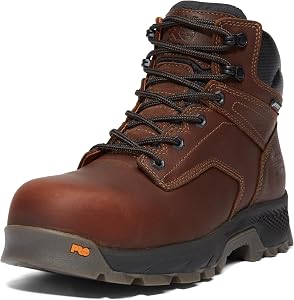
For seasoned tradespeople who log 15,000 steps a day on unforgiving surfaces and are willing to invest in the lightest, most responsive underfoot cushioning available, the Timberland PRO Men's Titan Ev 6-Inch Composite Safety Toe Waterproof Boot is our top Premium Pick. This evolution of the legendary Titan line replaces heavy, rigid midsoles with proprietary HoverSpring foam engineered specifically for harsh industrial environments.
We may earn a commission when you buy through this link, at no additional cost to you.
HoverSpring foam provides industry-leading underfoot flexibility and lightweight rebound without breaking down under heavy jobsite loads. Timberland PRO layers that resilient foam midsole directly beneath its geometric Anti-Fatigue Technology footbed, giving your heels and arches a dual-stage shock absorber that returns energy with every step and noticeably reduces lower-back stiffness at the end of a long shift.
Despite its athletic weight and bend, the Titan Ev sacrifices nothing in industrial armor. An asymmetrical, non-metallic composite safety toe meets ASTM F2412-18a and F2413-18 I and C impact and compression standards, while an internal waterproof membrane meets the strict ASTM F1671-07 standard. Underneath, a durable Timberland PRO rubber outsole resists high heat, oil, slips, and abrasion across demanding indoor and outdoor surfaces.
Single-layer EVA midsoles feel soft in the morning but often bottom out by mid-afternoon under the combined weight of a worker and a loaded tool belt. Pairing a removable geometric Anti-Fatigue footbed on top of a durable HoverSpring foam midsole ensures that even when the top layer compresses during a heavy lift, the lower midsole continues flexing and absorbing shock.
At nearly double the price of entry-level boots like the Wolverine Floorhand, the Titan Ev is a serious financial commitment. However, when you divide that cost across hundreds of pain-free hours on concrete, scaffolding, and gravel, the combination of HoverSpring foam, Anti-Fatigue geometry, waterproof protection, and composite-toe lightness makes it a premier choice for working professionals.
Occasional weekend DIYers who do not log enough hours on their feet to justify a premium price tag.
We may earn a commission when you buy through this link, at no additional cost to you.
Selecting the right pair of work boots requires matching your workplace safety requirements, floor surfaces, and climate conditions to the correct structural components. Use the seven factors below to narrow down the exact features your trade demands.
Your first decision should always be dictated by your jobsite’s Personal Protective Equipment (PPE) rules. Certified safety toes—tested under ASTM F2412 and F2413 for impact (I/75) and compression (C/75)—shield your forefoot against falling materials, rolling carts, and heavy equipment. Traditional steel toes, found in boots like the Wolverine Floorhand, Timberland PRO Pit Boss, and Keele Ridge Hiker, use a thin, high-strength metallic dome that maximizes protection at a lower manufacturing cost. However, steel conducts ambient temperatures rapidly, meaning it can chill your toes in winter cold, and it will trigger metal detectors at secure facilities.
Non-metallic composite and carbon-fiber toes—featured on the Timberland PRO Boondock, Titan Ev, and KEEN Utility Cincinnati—meet the exact same ASTM impact and compression thresholds without using metal. Carbon-fiber caps like KEEN’s are roughly 15% lighter than steel and feature slightly thinner walls than fiberglass or resin composites, preserving extra toe wiggle room. Look for asymmetrical toe caps molded distinctly for left and right feet to prevent painful pinky-toe rubbing. Meanwhile, soft-toe models like the Gridworks Wedge, Direct Attach MaxTRAX, Skechers Boswell, and Timberland White Ledge eliminate the rigid cap entirely for lighter, more flexible comfort on sites without impact hazards.
Check your employer’s safety manual first: choose steel for maximum value in temperate or indoor shops, upgrade to composite or carbon fiber if you work in freezing cold or pass through security checkpoints, and select a soft toe only when impact protection is not required.
The bottom geometry of your boot determines how well you stay upright and how evenly your body weight is supported. Flat wedge outsoles—used on the Timberland PRO Gridworks Wedge and KEEN Utility Cincinnati—place 100% of the sole’s surface area directly on the floor, bridging the gap beneath your arch. This continuous footprint prevents pressure spikes at the heel and ball of the foot on poured concrete, asphalt, and iron beams, and its shallow tread will not track huge clumps of mud indoors or catch on ladder rungs the way oversized lugs sometimes can.
Conversely, defined-heel lugged outsoles—such as those on the Timberland PRO Boondock, Wolverine Floorhand, and Keele Ridge Hiker—provide a distinct 90-degree breasted heel that locks safely onto ladder rungs and bites into loose dirt, gravel, and sloped embankments. Beyond tread shape, examine the rubber or TPU compound: heat-resistant Timberland PRO rubber handles hot metal shavings and asphalt without melting, all-weather TPU stays flexible on frosted ice, and specialized treads like the Direct Attach MaxTRAX carry ASTM F2892-24 SRO ratings or SATRA F2913 compliance for superior grip on wet, oily floors.
Pick a flat wedge outsole if you spend 80% or more of your shift walking on flat concrete, rebar, or indoor floors. Choose a defined-heel lug outsole with oil- and slip-resistant ratings if you work in outdoor trenches, climb ladders constantly, or navigate slick, greasy surfaces.
Standing and walking on unyielding industrial surfaces sends thousands of repetitive shock waves up through your calcaneus, knees, hips, and lumbar spine every shift. Basic work boots rely on a standard removable EVA or foam footbed—like the Wolverine Floorhand or Timberland White Ledge—which provides light initial cushioning for moderate duties or softer outdoor ground. For light-duty indoor roles, dual-layer comfort systems like the Skechers Boswell combine Air-Cooled Memory Foam with a supportive Goga Mat arch pad for immediate step-in softness.
For heavy industrial shifts, engineered energy-return midsoles prevent late-afternoon foot burnout far more effectively than basic foam. Timberland PRO’s Anti-Fatigue Technology (found in the Gridworks, Boondock, and Titan Ev) uses inverted geometric cones that compress under load and spring back during toe-off, while the 24/7 Comfort Suspension System (in the Pit Boss and Direct Attach) stabilizes the arch to prevent midfoot collapse. Premium designs go even further by pairing geometric footbeds with air-infused polyurethane like KEEN’s Luftcell or lightweight, high-rebound HoverSpring foam in the Titan Ev.
If you weigh over 200 pounds, carry a heavy tool belt, or walk on concrete for eight to twelve hours daily, prioritize a boot with geometric anti-fatigue cones, air-infused polyurethane, or HoverSpring foam rather than a flat single-density insole.
Wet socks soften skin and accelerate painful friction blisters, making weather protection critical for outdoor trades. However, not all water protection works the same way. Water-repellent uppers—like the treated leather on the Skechers Boswell—shed light drizzle and brief splashes but are not meant for deep puddles. True waterproof boots integrate a seam-sealed internal membrane, such as KEEN.DRY or Timberland PRO’s ASTM F1671-07 barrier (which is even tested against viral and bloodborne pathogen penetration), alongside a gusseted tongue to block standing water up to the ankle.
Remember that waterproofing always trades off against raw airflow: in a hot 85-degree indoor warehouse or dry summer machine shop, a non-waterproof leather boot like the Timberland PRO Pit Boss breathes more freely and keeps sweat buildup lower. Similarly, pay close attention to thermal insulation. A boot with 200 grams of Thermolite insulation—like the Timberland PRO Direct Attach MaxTRAX—is a lifesaver in refrigerated warehouses and winter slush, but will overheat your feet during warm summer construction.
Choose an uninsulated, non-waterproof leather boot for dry, warm indoor shops; pick an uninsulated ASTM waterproof membrane boot for three-season outdoor rain and mud; and reserve 200g insulated waterproof boots for cold climates and refrigerated facilities.
How a boot’s upper leather is joined to its midsole and outsole dictates both its structural lifespan and its flexibility. Continuous Goodyear welt construction—featured on the KEEN Utility Cincinnati—stitches a tough perimeter welt strip to both the full-grain leather upper and the internal insole, then bonds the outsole to that welt. This creates an exceptionally rigid, stable platform that resists sole separation under heavy twisting forces and heavy moisture exposure.
Direct-attach construction—used on the Timberland PRO Direct Attach MaxTRAX—injects molten polyurethane midsole material directly onto the prepared leather upper inside a mold, creating a chemical and mechanical bond without stitch holes that could leak water. It feels lighter and more flexible out of the box than a heavy Goodyear welt while remaining highly resistant to delamination. Cemented and hiker-style constructions (like the Keele Ridge or White Ledge) use high-strength industrial adhesives to keep weight low and agility high, though they are not intended for resoling.
Prioritize continuous Goodyear welt or direct-attach construction if your job involves constant kneeling, kicking shovels, or walking through corrosive mud and water that destroys ordinary glue bonds.
The exterior skin of your work boot protects your ankles from abrasion, sparks, and chemical splashes. Full-grain waterproof leather—used on the Wolverine Floorhand, Timberland White Ledge, and KEEN Cincinnati—retains the complete outer grain layer of the hide, offering far higher tear and puncture strength than thin synthetic panels. When brushed and conditioned periodically, full-grain leather molds to your ankle shape and resists cracking along the forefoot flex crease.
If you work around agriculture, concrete, livestock, or industrial solvents, ordinary leather can still dry out and rot when exposed to organic acids and salts. Specialized full-grain barnyard-resistant leather, found on the KEEN Utility Cincinnati, is specifically treated to withstand oleic acid, urea, sodium chloride, and ammonium hydroxide. Inside the upper, look for moisture-wicking mesh linings—such as recycled ReBOTL fabric—that pull perspiration away from your skin so the leather shell stays dry from the inside.
Select full-grain leather for general construction and outdoor durability, and upgrade specifically to barnyard-chemical-resistant full-grain leather if you work around wet concrete, fertilizers, road salt, or agricultural waste.
Understanding the stamped code inside a work boot’s tongue saves you from buying footwear that fails a jobsite safety inspection. Under US standards, ASTM F2412-18a defines the test methods for foot protection, while ASTM F2413-18 specifies the performance requirements for safety-toe footwear (covering both Impact I/75 and Compression C/75). If a boot is soft-toed—like the Gridworks Wedge or Direct Attach MaxTRAX—it cannot carry an F2413 rating, so it is evaluated under ASTM F2892-18 or F2892-24 for non-safety-toe protective footwear.
Across both safety-toe and soft-toe categories, look for the ‘EH’ designation (Electrical Hazard protection), which is included on almost every Timberland PRO model in this guide as well as the KEEN Cincinnati. An EH rating certifies that the outsole and heel are constructed with non-conductive compounds that isolate the wearer’s foot from the ground, providing secondary protection against accidental contact with live electrical circuits, energized conductors, or apparatus under dry conditions.
Always verify whether your jobsite requires ASTM F2413 (safety toe + EH) or allows ASTM F2892 (soft toe + EH) before purchasing, and remember that EH protection diminishes if the outsole becomes heavily worn or saturated with water.
Even the best work boots benefit from a smart break-in routine and proper lacing. Before wearing a stiff new pair of full-grain leather or Goodyear-welted boots onto a twelve-hour shift, wear them around the house or on short errands for two or three evenings with the exact cushioned merino wool or synthetic work socks you use on the job. Avoid 100% cotton socks, which trap sweat, chill your feet in winter, and cause blisters. When lacing up, kick your heel gently back into the heel pocket, snug the midfoot eyelets firmly so your foot cannot slide forward into the steel or composite toe cap, and use top speed hooks to adjust ankle flex when climbing ladders or squatting.
Daily maintenance after messy shifts dramatically extends the life of leather uppers, waterproof membranes, and slip-resistant outsoles. Knock dried mud, concrete dust, and gravel out of the tread lugs at the end of the day, and brush dirt off the leather seams with a soft nylon brush and lukewarm water. Wet concrete lime, road salt, and organic mud act like sponges that draw natural oils out of full-grain leather, causing the forefoot crease to stiffen and split if left caked on overnight. Once clean leather has dried naturally, apply a light coat of boot conditioner or wax paste compatible with waterproof membranes every few weeks to keep the fibers supple.
Whenever your boots get soaked from rain or heavy perspiration, pull out the removable anti-fatigue or foam footbeds immediately so air can circulate underneath the insoles, and let the boots dry at room temperature in a ventilated room. Never place wet leather work boots directly against a space heater, furnace register, campfire, or high-heat blower; rapid heat shrinks leather uppers, warps EVA and polyurethane midsoles, and weakens outsole adhesives. If you work fifty hours a week in damp or hot conditions, rotating between two pairs of boots every other day gives internal foam cushioning 24 hours to rebound and dry completely, often doubling the lifespan of both pairs.
Both steel and composite safety toes in certified boots meet the exact same ASTM F2413 impact and compression standards, so neither sacrifices workplace compliance. Steel toes have thinner walls and usually cost less, as seen in the Wolverine Floorhand and Timberland PRO Pit Boss. Composite and carbon-fiber toes—like those in the Timberland PRO Boondock, Titan Ev, and KEEN Cincinnati—weigh less, will not set off security metal detectors, and insulate much better against freezing winter temperatures or extreme outdoor heat.
A flat wedge outsole eliminates the hollow gap under the midfoot arch, putting the entire bottom surface of the boot in continuous contact with flat concrete or steel beams. This distributes body weight evenly from heel to toe to reduce sore spots and prevents a raised heel from snagging on rebar grids, conduit, or scaffolding planks. However, if you work in deep outdoor mud or climb round-rung ladders all day, a boot with a defined heel and deeper lugs offers better mechanical bite.
No. ASTM Electrical Hazard (EH) protection is strictly designed as a secondary source of underfoot insulation against accidental contact with live circuits or electrically energized parts in dry conditions. If the leather upper and outsole become saturated with conductive water, or if metal nails and conductive debris puncture the rubber sole, that insulating barrier is compromised. Always follow primary lockout/tagout and dielectric PPE procedures around live power.
Toes usually bump the front of a steel or composite cap either because the boot is a half-size too short or because loose midfoot lacing allows your foot to slide forward inside the shoe. Make sure you have roughly a thumb's width of space ahead of your longest toe when standing in work socks, and tighten the laces firmly across the instep bend before tying the top ankle hooks so your heel stays locked into the rear counter.
Waterproof membranes are breathable to water vapor, but they still trap more warmth than an unlined leather boot when worn inside a hot factory or warehouse for ten hours. If your job is 100% indoors on dry floors—such as machine operation or dry assembly—a non-waterproof model like the Timberland PRO Pit Boss or Skechers Boswell will vent foot heat faster. Reserve ASTM waterproof membranes for outdoor construction, landscaping, wash-down bays, and wet utility work.
While many brands casually label boots 'waterproof,' the ASTM F1671-07 standard is a stringent laboratory test originally developed for protective clothing materials to verify resistance to penetration by bloodborne pathogens and viral liquids under pressure. In a work boot, meeting ASTM F1671-07 guarantees that the internal waterproof membrane forms an unbroken, high-integrity barrier against standing water and contaminated jobsite liquids.
Under heavy daily trade use of 45 to 60 hours a week on concrete, most quality work boots last between 8 and 18 months depending on upper care and outsole abrasion. However, removable footbeds take the brunt of your body weight and often lose half their shock-absorbing rebound after 4 to 6 months. Swapping in a fresh pair of anti-fatigue or contoured insoles midway through the year can restore step-in comfort and relieve knee ache long before the exterior leather wears out.
Barnyard-resistant leather—featured on the KEEN Utility Cincinnati—is specially tanned to resist chemical breakdown from oleic acid, urea, sodium chloride (salt), and ammonium hydroxide. On industrial and construction sites, that same chemical resistance protects the leather from cracking when exposed to wet concrete lime, winter road de-icing salts, sweat acids, and workshop cleaners.
Unlike soft leather dress shoes, a steel, composite, or carbon-fiber toe cap will never stretch or widen during break-in. The forefoot must feel comfortable and pinch-free across your widest toe knuckles the very first time you try the boot on in the afternoon when your feet are naturally swollen. While the leather ankle collar and instep will soften over the first week, any rubbing against the hard safety cap on day one means you need a wider fit or an asymmetrical toe design.
For workers who need uncompromising, all-season protection across rugged outdoor jobsites, the Timberland PRO Men's Boondock 6-Inch Composite Safety Toe Waterproof Boot takes our top spot as Editor's Choice. By combining an asymmetrical non-metallic composite toe, an ASTM F1671-07 waterproof membrane, electrical hazard protection, geometric Anti-Fatigue cushioning, and an all-weather TPU lug outsole, it handles freezing mud, wet concrete, and twelve-hour shifts without weakness.
If your daily environment calls for a more specialized build, our lineup offers clear alternatives. Concrete and ironworkers who want flat-floor stability should look to the Goodyear-welted, carbon-toe KEEN Utility Cincinnati Wedge or the soft-toe Timberland PRO Gridworks Wedge. Professionals seeking ultra-lightweight rebound can step up to the HoverSpring-cushioned Timberland PRO Titan Ev, cold-storage and slick-floor crews will appreciate the insulated Direct Attach MaxTRAX, and value shoppers can get genuine full-grain leather and steel-toe safety in the Wolverine Floorhand.
Before making your final choice, confirm whether your supervisor requires an ASTM F2413 impact toe or allows a soft-toe design, then match the outsole and waterproofing to your primary floor surface and climate. Investing in the right combination of toe armor, slip traction, and arch suspension will keep your feet dry, safe, and energized from the first whistle to the end of your shift.