Garmin Instinct 3
9.2Editor score45mm fiber-reinforced case
Multi-band SatIQ GPS
Solar charging lens
Built-in LED flashlight
Find the right hiking watches for 2026. We compare 10 standout options by build quality, useful features, owner feedback, value, and everyday trade-offs.
Choosing a hiking watch in 2026 means weighing GPS accuracy, battery endurance, altimeter and compass performance, display legibility, durability standards, and how much training data you actually want. We compare 10 standout models from Garmin, Timex, and a solid budget contender so you can match satellite support, ABC sensors, and outdoor tools to the trails you’ll actually walk.
Hiking watches vary widely in capability. Solar-charged Garmin Instinct and fenix models can effectively run forever on trail, while running-focused watches like the Forerunner 165 lean into AMOLED displays and training analytics. Budget quartz and low-cost smartwatches offer basic tracking without the price tag but sacrifice serious navigation depth. Understanding these tradeoffs is what makes a purchase pay off.
This lineup spans premium multi-band GPS flagships, mid-tier all-arounders, and simple time-and-lume options for lightweight day hiking. Each entry highlights ideal use, tradeoffs, and buyer fit so whether you need topographic maps for backcountry navigation or just a reliable timekeeper with a compass, you’ll find a match here that matches your terrain and budget.
We compared 10 hiking watches using the criteria that matter most on trail: GPS accuracy and multi-band support, ABC sensors (altimeter, barometer, compass), battery life in GPS mode, durability standards like MIL-STD-810, water resistance, display readability in sunlight, navigation features such as trackback and topographic maps, health and recovery metrics, weight and case size, and value at each price point. The notes focus on practical tradeoffs so each pick connects to real hiking use.


Compare key features, scores, and current prices side by side. A shorter feature list means fewer details were available, not necessarily fewer capabilities.





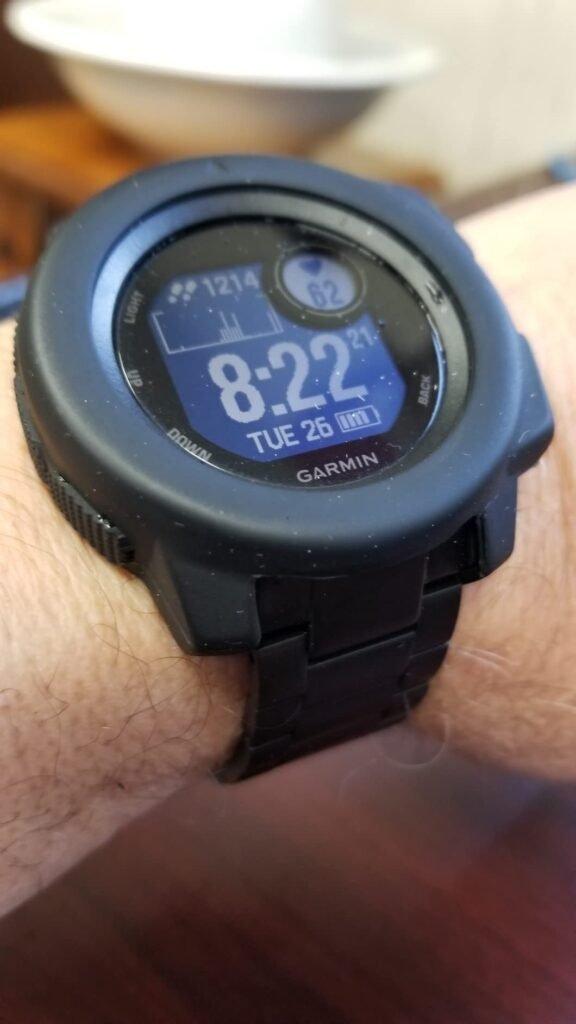
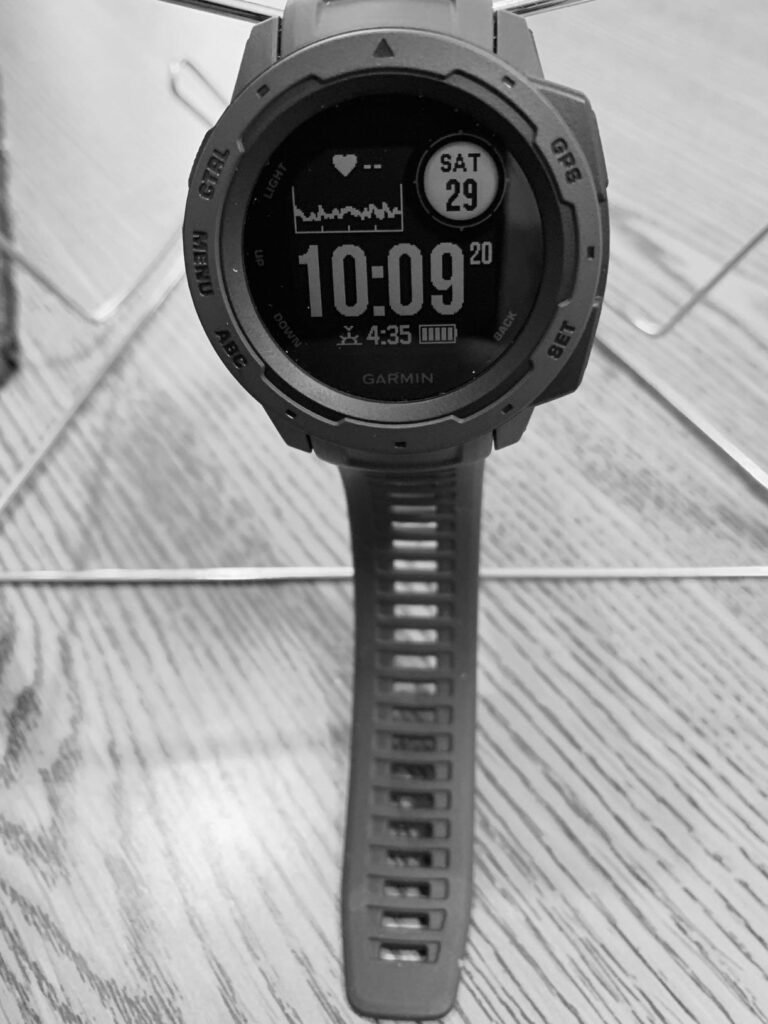
The original Garmin Instinct earns its place through a long track record and one of the highest star ratings in this roundup. It's the model that established the Instinct line's reputation for rugged reliability, and it remains an excellent choice for hikers who want proven Garmin quality at a lower price than the newest generation.
We may earn a commission when you buy through this link, at no additional cost to you.
Built to U.S. Military standard 810G for thermal, shock, and water resistance to 100 meters, the case handles anything typical hiking throws at it. Multi-GNSS support with GPS, GLONASS, and Galileo delivers accurate positioning under challenging conditions, and the 3-axis compass and barometric altimeter cover core navigation needs. The trackback feature guides you along your outbound path in reverse when you need to retrace your steps.
Battery life reaches up to 14 days in smartwatch mode, 16 hours with GPS active, and up to 40 hours in Ultratrac battery saver mode. That’s shorter than newer Instincts but still ample for most day hikes and weekend trips. Wrist heart rate, activity tracking, stress estimation, and preloaded sports profiles round out the training features, with syncing through Garmin Connect.
Ultratrac reduces GPS sampling frequency to extend battery life during long outings, reaching up to 40 hours on a single charge. Tracks become slightly less precise, but for multi-day backpacking where you mainly need total distance and general route recording, it’s a valuable option that most hikers underuse.
Choose the original Instinct if you want a proven, reliable hiking watch with real-world durability and a friendlier price than the Instinct 3 Solar. Skip it if you want longer battery life, multi-band GPS, or a flashlight. For a straightforward workhorse, it’s hard to beat.
Buyers who want the newest features like solar charging, multi-band GPS, or a flashlight.
We may earn a commission when you buy through this link, at no additional cost to you.
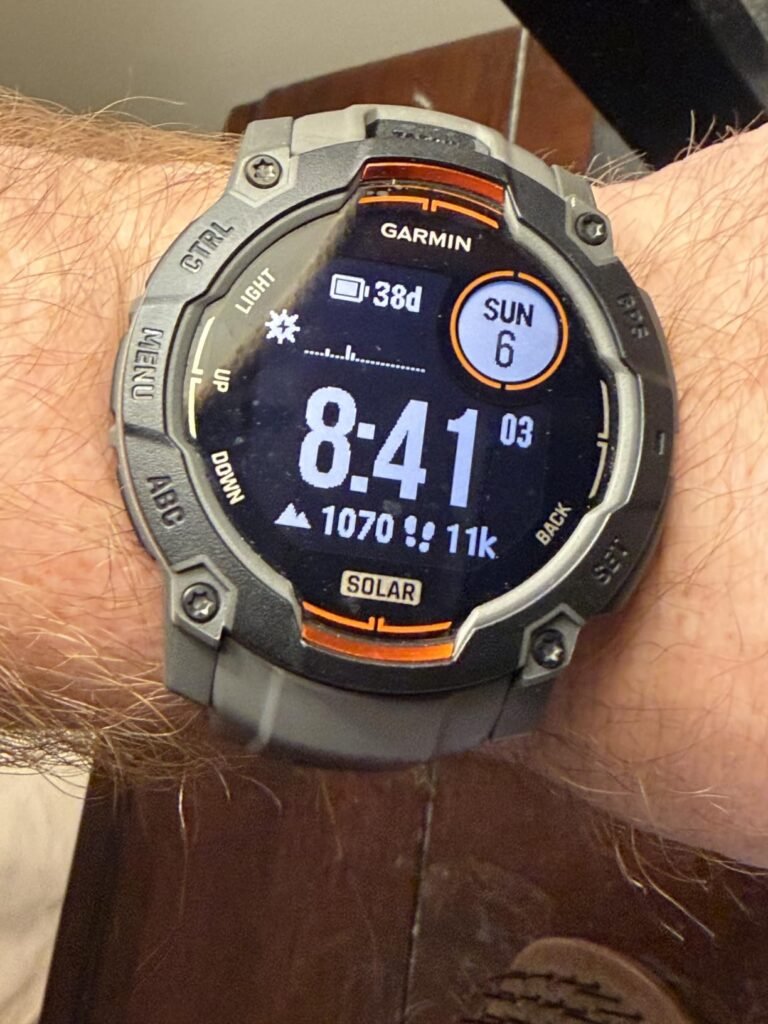
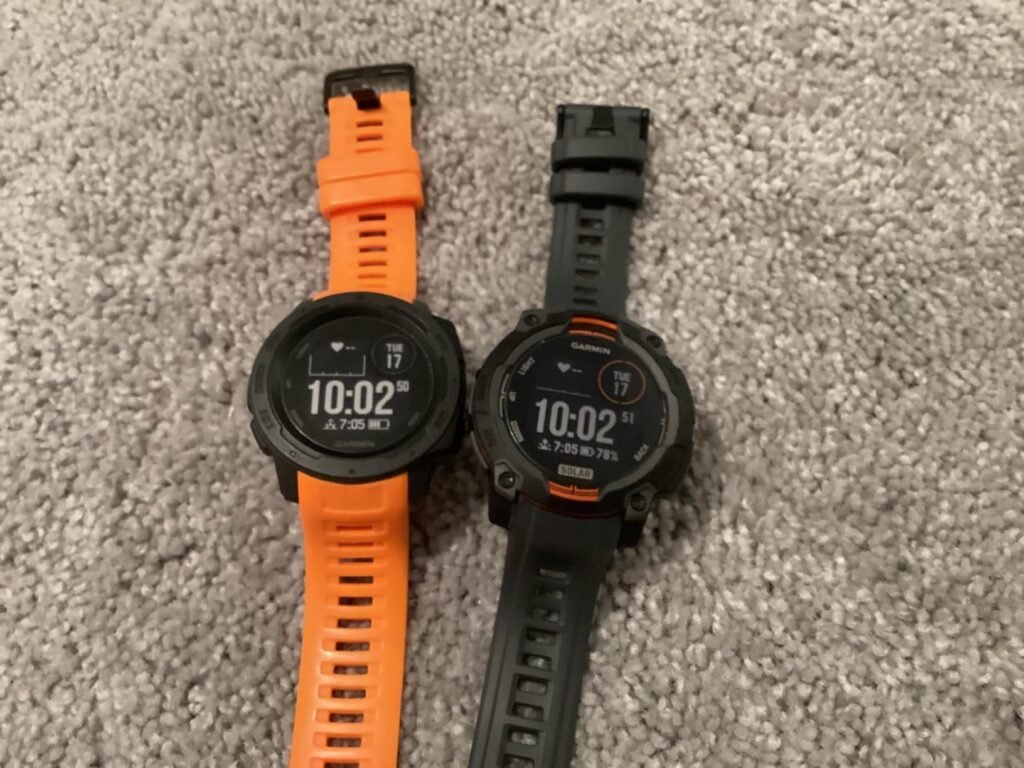
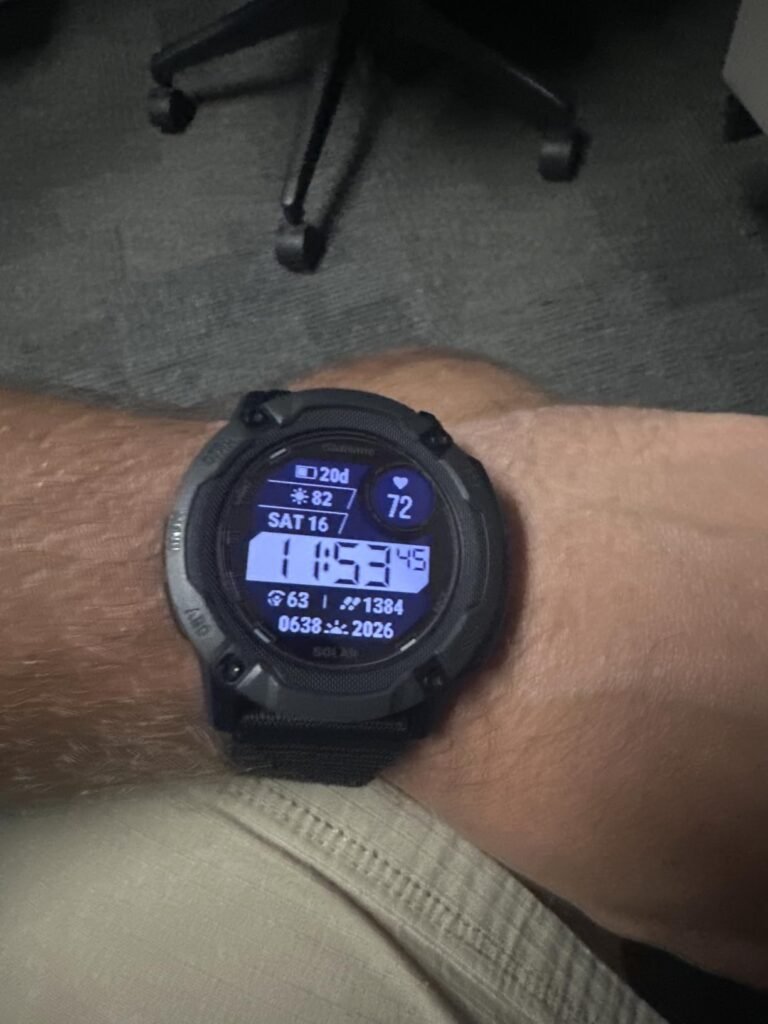
The Instinct 3 Solar is the pick for hikers who want serious battery endurance without carrying a charger. With about three hours of daily sun exposure, it can effectively run forever in smartwatch mode, which is a game-changer for thru-hikers and multi-day trip planners. The 45mm fiber-reinforced polymer case sits comfortably on most wrists while shrugging off trail bumps and drops.
We may earn a commission when you buy through this link, at no additional cost to you.
Navigation is where this watch justifies its price. Multi-band GPS with SatIQ technology intelligently switches between single- and multi-frequency reception, so it delivers accurate tracks under tree cover or in canyons while preserving battery. Paired with a barometric altimeter and 3-axis compass, it handles orientation and elevation profiles without needing a phone. The 10 ATM water rating covers stream crossings, rain, and lake swims.
Practical trail features round out the package. The variable-intensity LED flashlight is genuinely useful around camp or on early alpine starts, and incident detection can send your live location to emergency contacts when paired with a phone. Health tracking includes wrist heart rate, Pulse Ox for altitude adjustment, and advanced sleep insights, all delivered through the polished Garmin Connect app.
SatIQ automatically shifts between single-band and multi-band GPS depending on signal conditions. In open terrain it saves battery by running single-band; in canyons or dense forest it switches to multi-band for cleaner tracks. That behavior means you can leave GPS on all day without babysitting settings, which pays off on longer hikes.
The main tradeoff is the transflective display, which is unbeatable in sunlight but lacks AMOLED punch indoors. For serious hikers who prioritize battery life, GPS accuracy, and real trail utility over vivid color screens, this is one of the most complete hiking watches available today.
Buyers who want a vivid AMOLED touchscreen or preloaded topographic maps.
We may earn a commission when you buy through this link, at no additional cost to you.
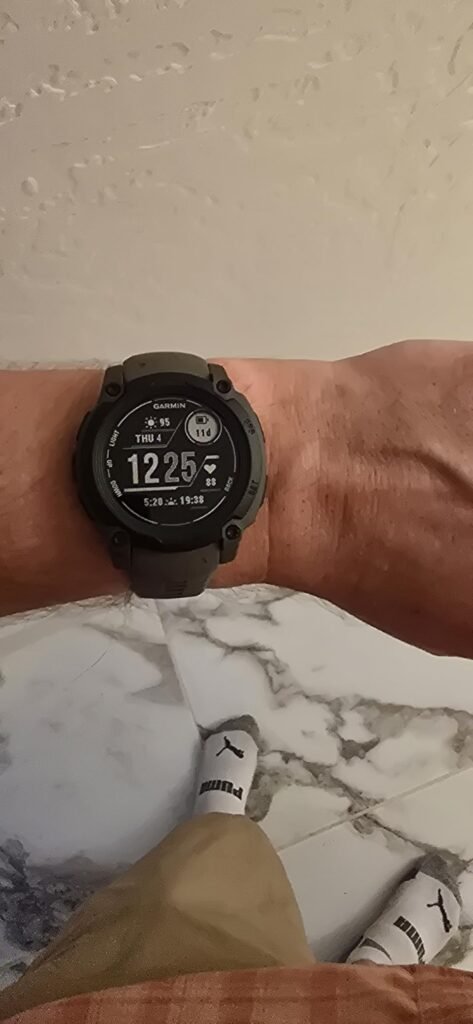
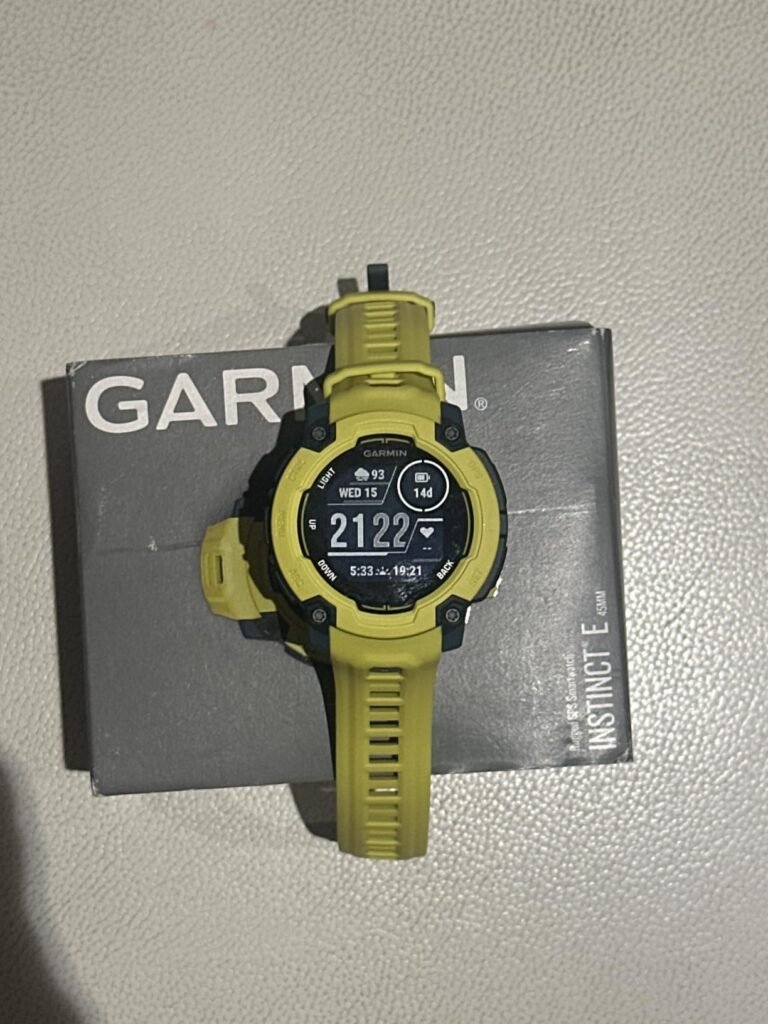
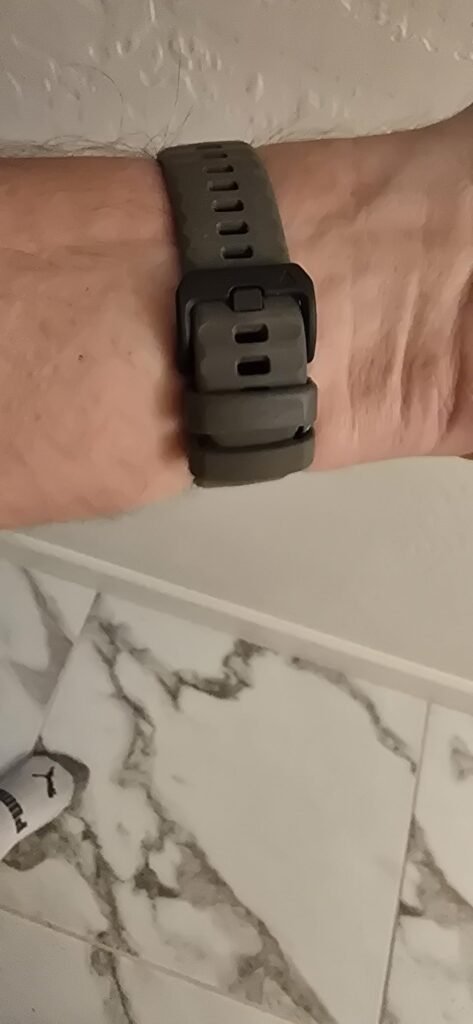
The Instinct E is the entry point into the Instinct family and a smart pick for hikers who want proven Garmin durability without paying for solar or premium features. The 45mm case, MIL-STD-810 build, and 10 ATM water rating cover the fundamentals of trail-ready construction, and the familiar button-based interface works reliably with gloves or wet fingers.
We may earn a commission when you buy through this link, at no additional cost to you.
For navigation, multi-GNSS support draws from multiple satellite constellations for reliable tracking on typical trails and runs. It won’t match the multi-band precision of the Instinct 3 Solar in extreme terrain, but for the vast majority of day hikes and weekend trips it’s more than accurate. A 3-axis compass and barometric altimeter cover orientation and elevation without external sensors.
Battery life reaches up to 16 days in smartwatch mode, which is impressive for a non-solar Garmin. Wrist heart rate, Pulse Ox, sleep tracking, and stress metrics all sync through Garmin Connect, and smart notifications plus Connect IQ app support arrive when paired with a phone. It’s a genuinely well-rounded package for the price.
Multi-GNSS (as opposed to multi-band) pulls from GPS, GLONASS, and Galileo constellations for stronger fixes than a single-satellite chip. For most hiking, that’s plenty. Multi-band adds another frequency to reject reflected signals, which mainly helps in dense forest, urban canyons, or slot canyons where reflected signals cause drift.
Skip the E if you specifically want a flashlight, solar charging, or multi-band GPS. But for a buyer who wants dependable Garmin build quality, real trail tracking, and solid battery life at a lower entry price, it remains one of the clearest values in the hiking watch category.
Backcountry navigators who need multi-band GPS or a built-in flashlight.
We may earn a commission when you buy through this link, at no additional cost to you.
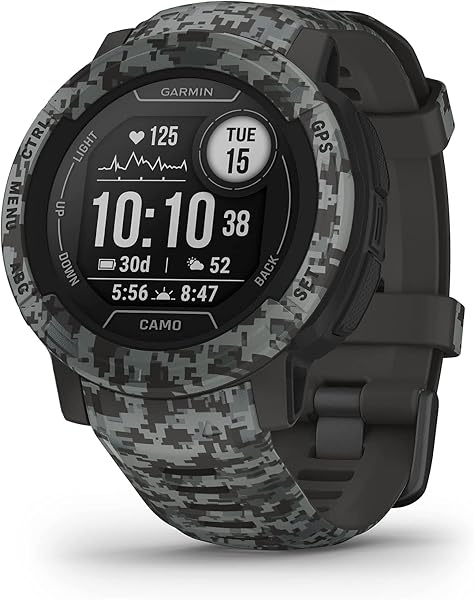
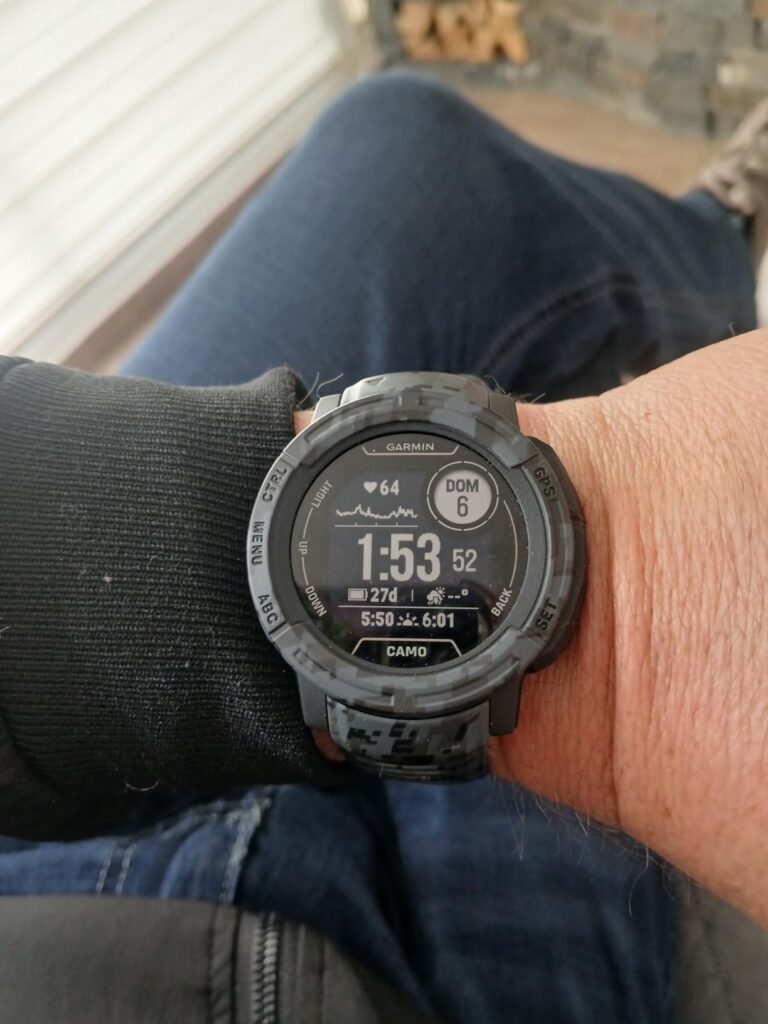
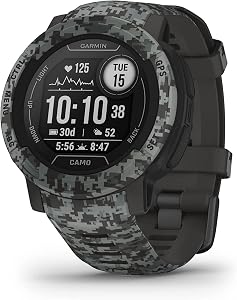
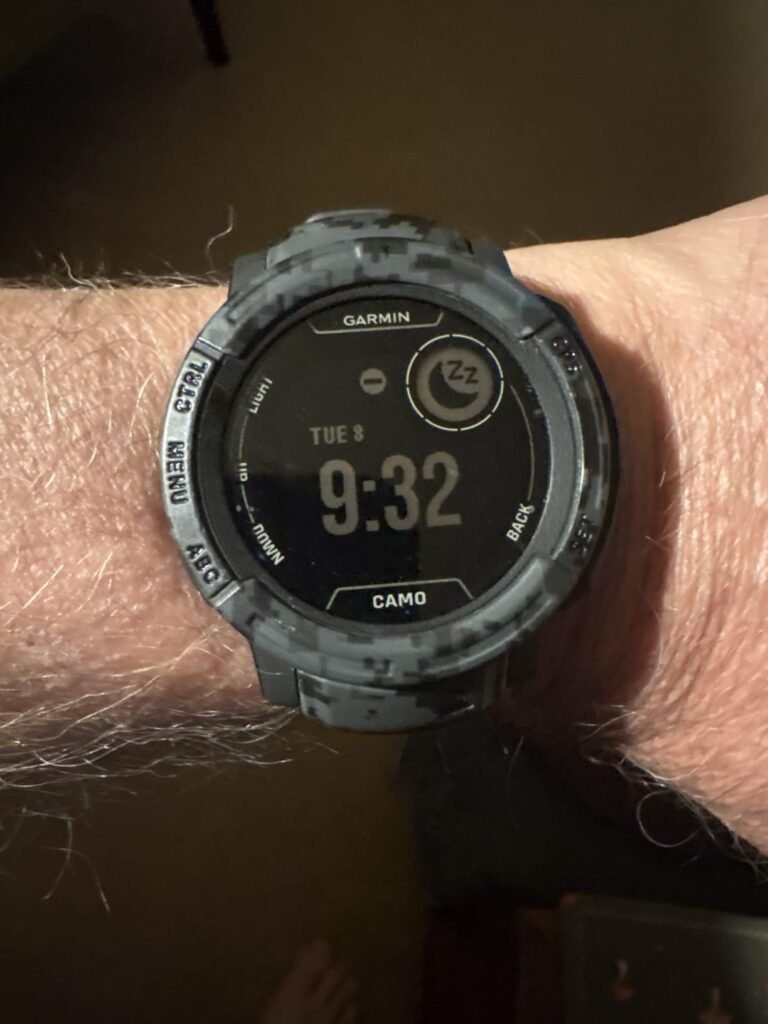
The Instinct 2 Camo edition is a well-balanced hiking watch for buyers drawn to Garmin's rugged reputation but not needing the latest generation. It uses a fiber-reinforced polymer case with scratch-resistant Corning Gorilla Glass, is water-rated to 100 meters, and meets thermal and shock standards typical of the Instinct family, all wrapped in a subtle graphite camo finish.
We may earn a commission when you buy through this link, at no additional cost to you.
On the trail, multi-GNSS support with GPS, GLONASS, and Galileo delivers dependable positioning for hiking, trail running, and cycling. A 3-axis compass and barometric altimeter round out the outdoor toolkit, and the standout trackback feature guides you along the exact reverse of your outbound path, which is genuinely valuable on unfamiliar loops or when weather closes in.
Battery life is where this model shines: up to 28 days in smartwatch mode and 30 hours with GPS active. That means a weekend hike, a week of tracking, and everyday wear rarely require charging. Health tracking includes heart rate, sleep, Pulse Ox, respiration, and standard training metrics through Garmin Connect, and Connect IQ compatibility opens the door to downloadable apps.
Trackback lets the watch guide you along your exact outbound path in reverse. On unfamiliar trails, in fog, or when side paths confuse the way, it’s an invaluable safety net. Combined with the barometric altimeter and compass, it turns the watch into a genuine phone-free navigation tool for typical hiking scenarios.
Choose the Instinct 2 Camo if you want a proven Garmin at a lower price than the newest models. Skip it if you specifically need a flashlight, sapphire glass, or the highest-end multi-band GPS. For steady, reliable hiking use with strong battery life, it remains a favorite in the category.
Buyers who want the newest solar charging, multi-band GPS, or an integrated flashlight.
We may earn a commission when you buy through this link, at no additional cost to you.
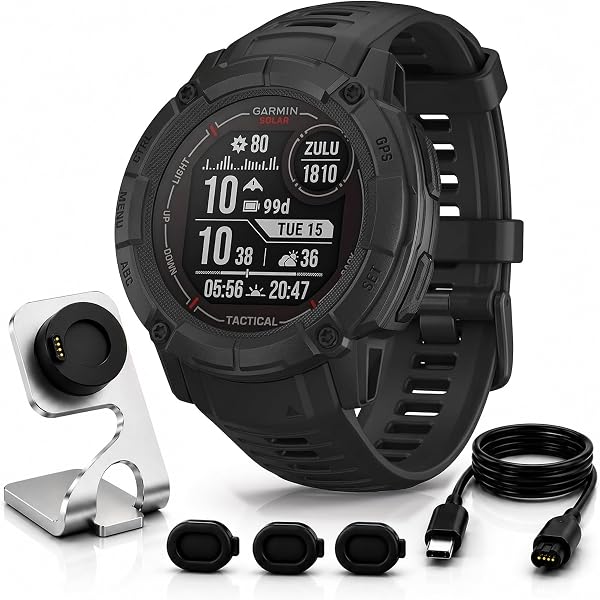
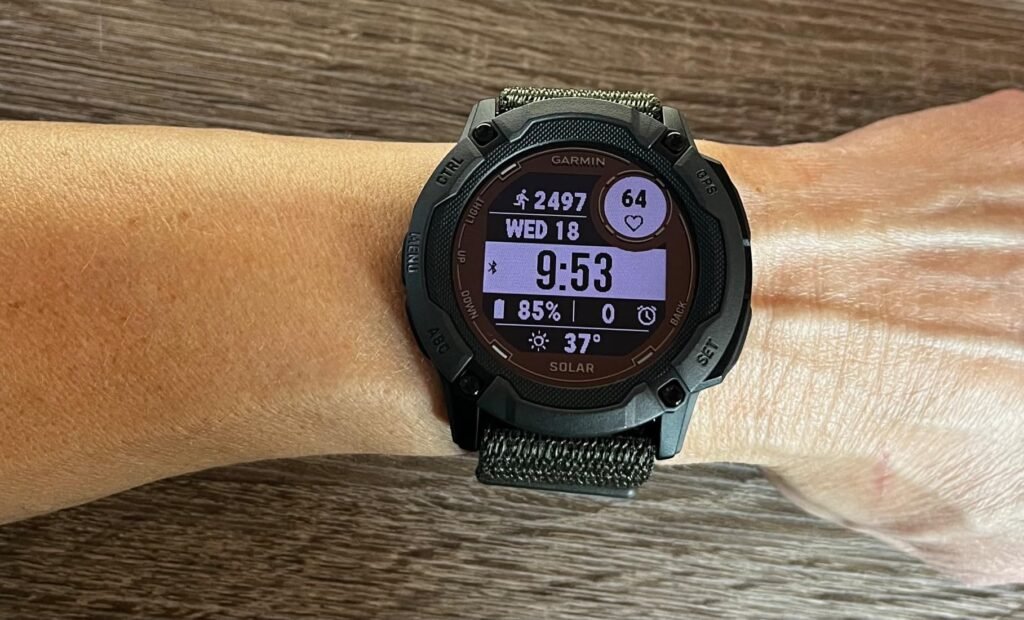
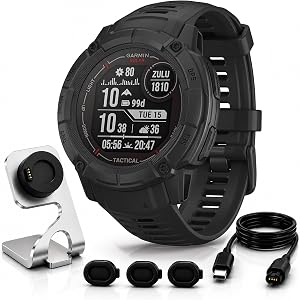
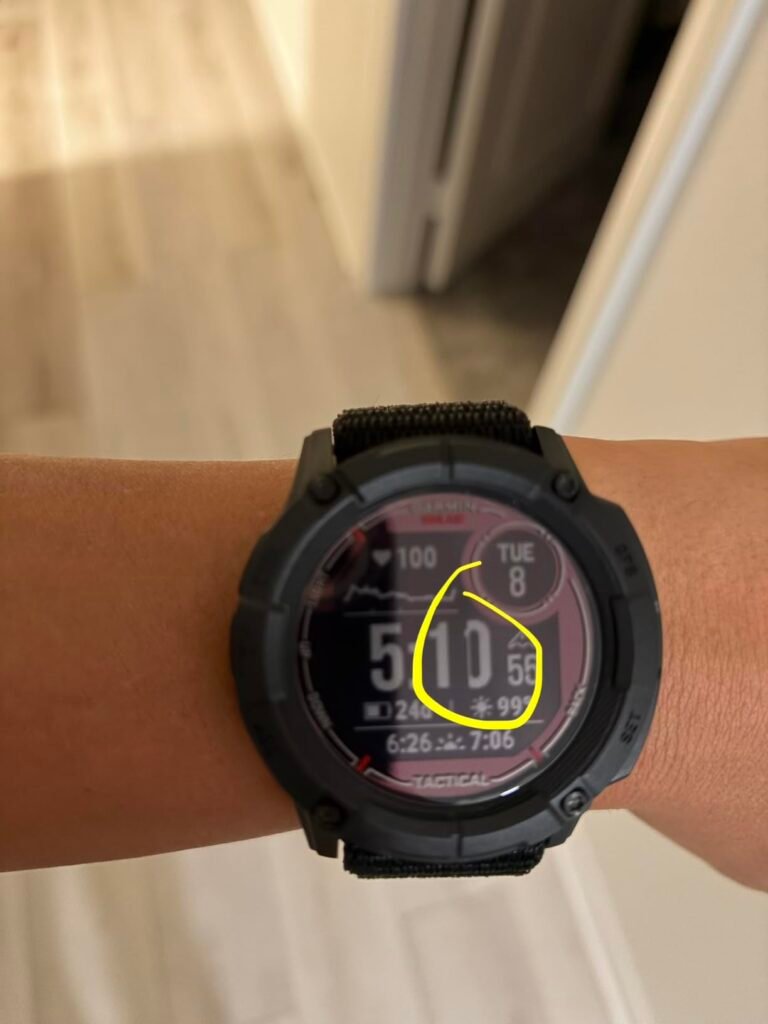
The Instinct 2X Solar Tactical bundle targets hikers, hunters, and outdoor professionals who want purpose-built field navigation with useful extras in the box. The 50mm fiber-reinforced polymer case is built to U.S. military 810 standards for thermal, shock, and 10 ATM water resistance, and the included charging dock and silicone dust cover 3-pack make daily use and port protection easier.
We may earn a commission when you buy through this link, at no additional cost to you.
Navigation tools go beyond typical smartwatch fare. Night Vision Mode, Stealth Mode, dual-position coordinate formats, Jumpmaster, Reference Point, and Applied Ballistics support (unlock fee required) turn the watch into a genuinely capable field instrument. Multi-band GPS delivers accurate positioning, and TracBack routing helps you find your way back to any point along your route.
Solar Power Glass extends battery dramatically. In smartwatch mode with regular sun exposure, runtime is essentially unlimited, and GPS-only usage can reach up to 145 hours. The multi-LED flashlight includes variable intensity, strobe, and green light mode, which is useful for preserving night vision on early morning hikes or evening camps. Health metrics include wrist heart rate, sleep score, HRV status, and Body Battery.
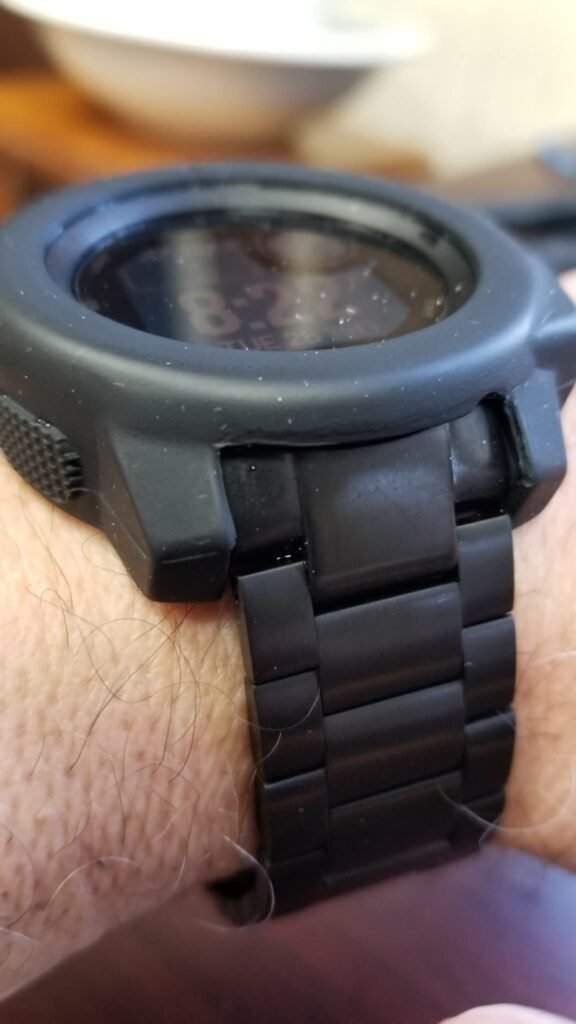
At 50mm, this is a large watch that suits bigger wrists better. Before buying, measure your wrist and consider how the watch will feel under jacket cuffs. It’s more comfortable than the raw numbers suggest thanks to the polymer construction, but users with wrists under 6.5 inches may find it visually oversized.
Consider this bundle if you want tactical features, maximum battery, and a ready-to-go accessory package. It’s larger and pricier than the standard Instinct 3 Solar, and casual day hikers won’t need the tactical extras. But for serious outdoor use, hunting, or professional field work, the extra capability earns its keep.
Smaller wrists or casual hikers who won’t use the tactical navigation tools.
We may earn a commission when you buy through this link, at no additional cost to you.
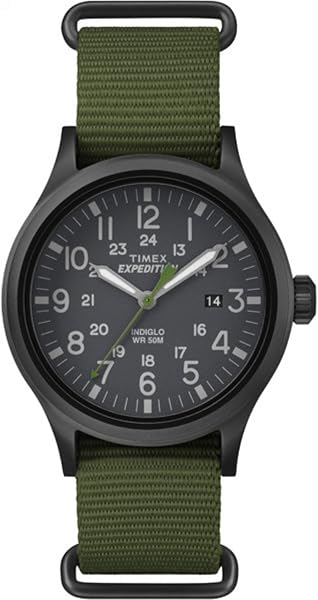
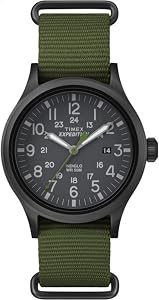
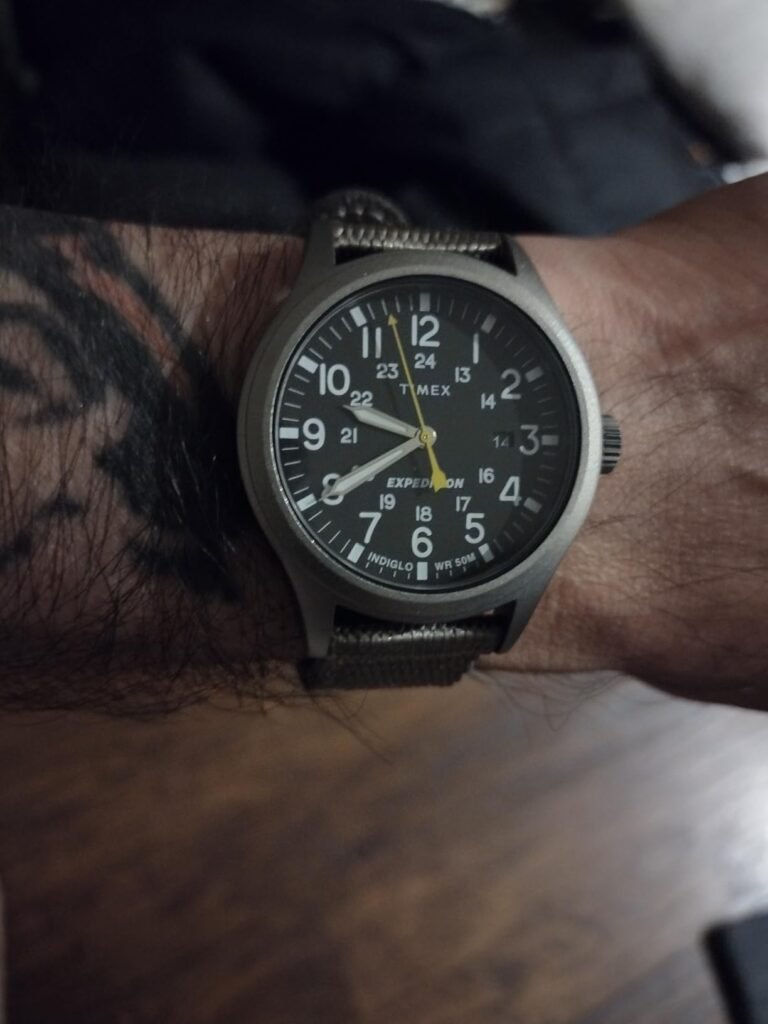
Not every hiker needs GPS or health tracking. The Timex Expedition Scout is an honest, low-cost quartz watch that suits casual day hikers who mainly want reliable time, a night light, and rugged looks without the complexity of a smartwatch. The 40mm case reads clearly at a glance, and the price makes it easy to keep as a backup.
We may earn a commission when you buy through this link, at no additional cost to you.
The INDIGLO backlight remains one of the most useful features in the affordable-watch category. A single crown press evenly lights the whole dial on demand, which is more practical than most watches that rely on passive lume. Combined with a 12- and 24-hour Arabic layout, it makes the watch easy to read at dusk, dawn, or under headlamps.
The double-layered slip-thru fabric strap is comfortable and swaps in seconds without tools, so you can rotate to NATO or leather bands for different looks. Water resistance is suitable for splashes, rain, and hand washing, but not swimming. The brass case is lighter than stainless steel and holds up well to typical trail contact.
On short day hikes with familiar trails, a GPS watch may add complexity without adding safety. A simple watch never needs charging on trail, weighs less, and can serve as a backup timekeeper when your smartwatch dies. Many experienced hikers wear one on the wrist and keep a smartphone with maps in a pocket for planning.
Pick the Scout if you want a low-fuss trail timekeeper, a backup to a GPS watch, or a first hiking watch for a new adventurer. It won’t replace a Garmin for navigation or training, but as a simple, wear-anywhere timepiece, it delivers real value.
Hikers who need GPS tracking, health metrics, or a barometric altimeter.
We may earn a commission when you buy through this link, at no additional cost to you.
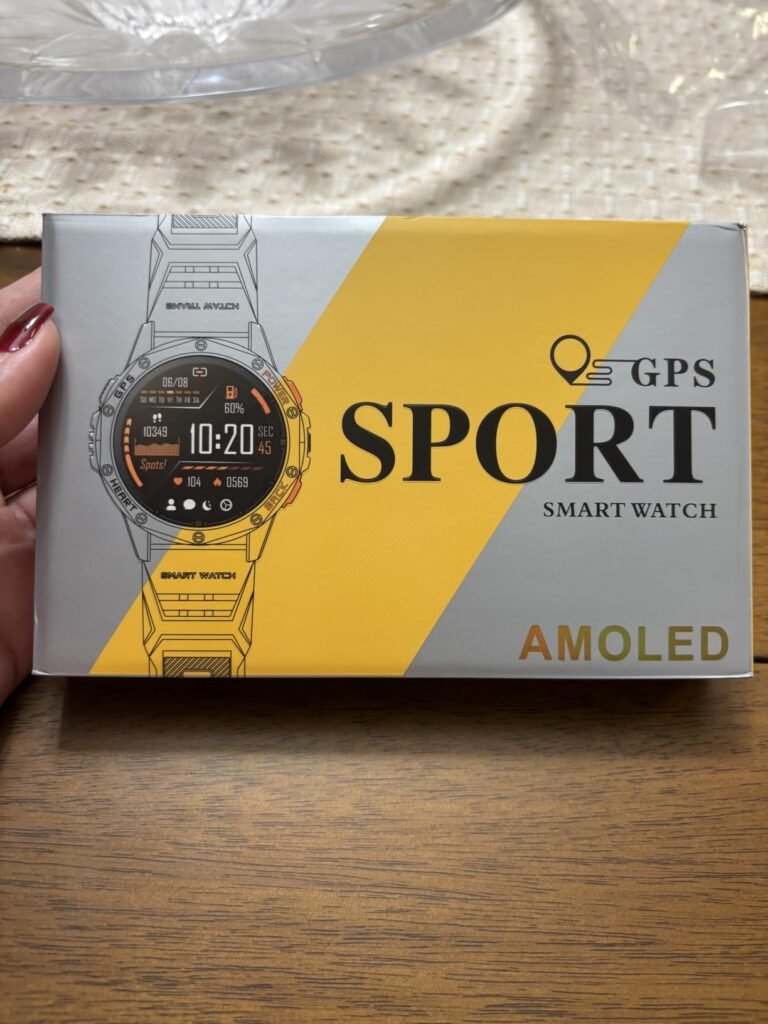
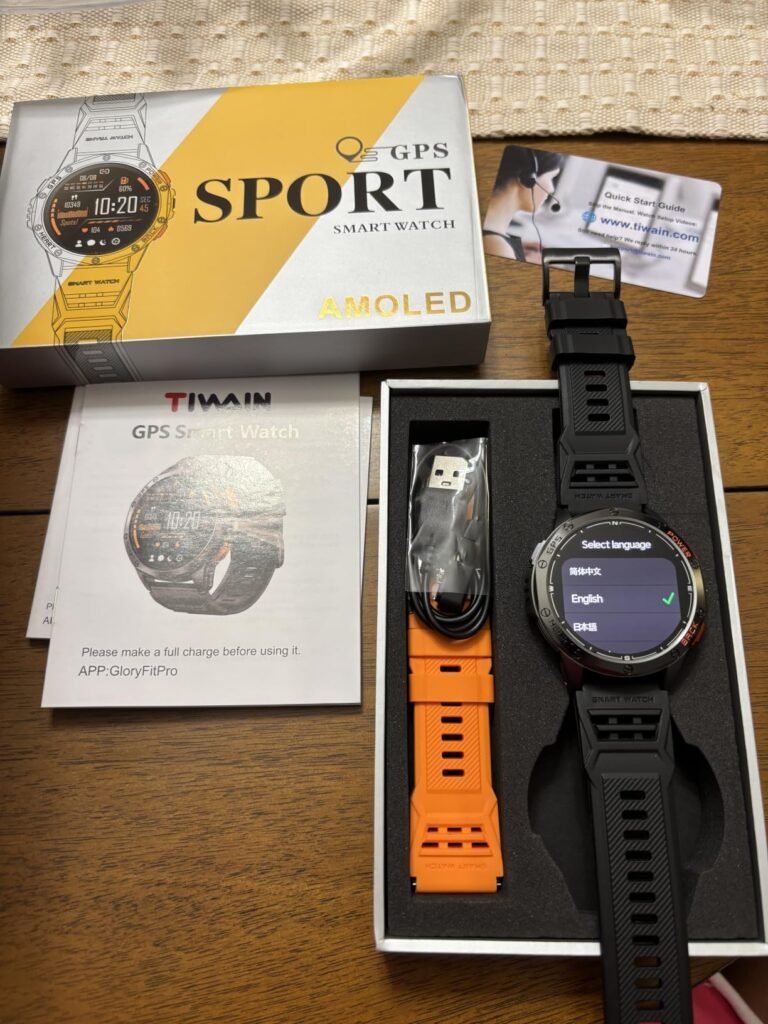
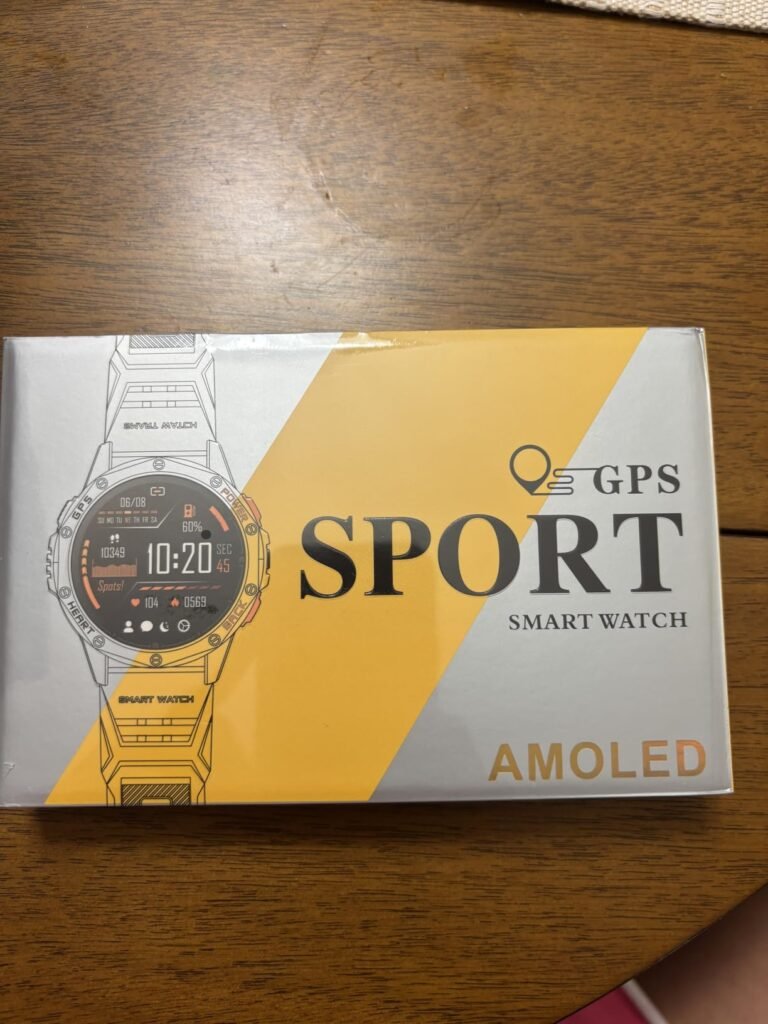
The Tiwain smartwatch is a strong budget pick for hikers who want onboard GPS, ABC sensors, and a bright AMOLED display without spending Garmin money. Built-in single-frequency GPS supports six satellite systems (GPS, GLONASS, BeiDou, Galileo, NAVIC, and QZSS), which is unusually broad coverage at this price point.
We may earn a commission when you buy through this link, at no additional cost to you.
Beyond satellite tracking, the watch includes a compass, altimeter, and barometer, giving you real-time position and elevation data. The zinc alloy case with vacuum-plated finish is engineered to military standards for extreme temperatures, low pressure, and dust resistance. The 1.43-inch AMOLED touchscreen stays legible outdoors, and a built-in LED flashlight adds evening trail utility.
Battery life reaches 7 to 10 days of typical use, up to 30 days in standby, and about 3 days of continuous GPS. Charging takes about 2 hours via magnetic connector. Health tracking includes heart rate, sleep, and blood oxygen, and the watch supports Bluetooth calls, message notifications (receive only), and 170+ sport modes through the companion app.
Onboard GPS means the watch tracks position without your phone, which matters on any hike where you might leave the phone behind or go somewhere with poor cellular service. Connected GPS (used by many cheap smartwatches) requires your phone to be nearby. The Tiwain’s onboard chip is a meaningful upgrade over phone-dependent tracking.
The IP68 rating handles rain and sweat but isn’t rated for saltwater or saunas, and the app ecosystem is smaller than established brands. Consider this watch if you want real GPS hiking capability under $100 and don’t need the deep analytics of Garmin or Coros. For casual to intermediate hikers, it’s a genuinely capable value pick.
Hikers who need deep training analytics, sapphire glass, or trusted long-term software support.
We may earn a commission when you buy through this link, at no additional cost to you.
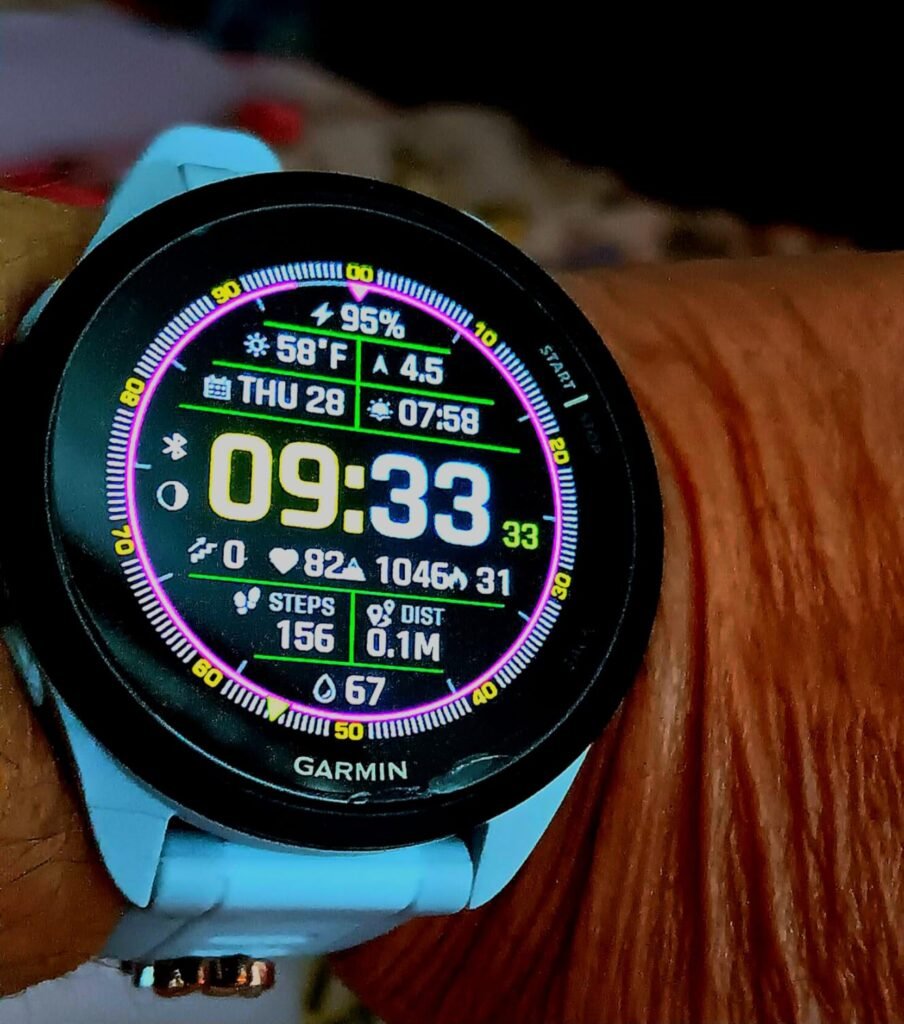
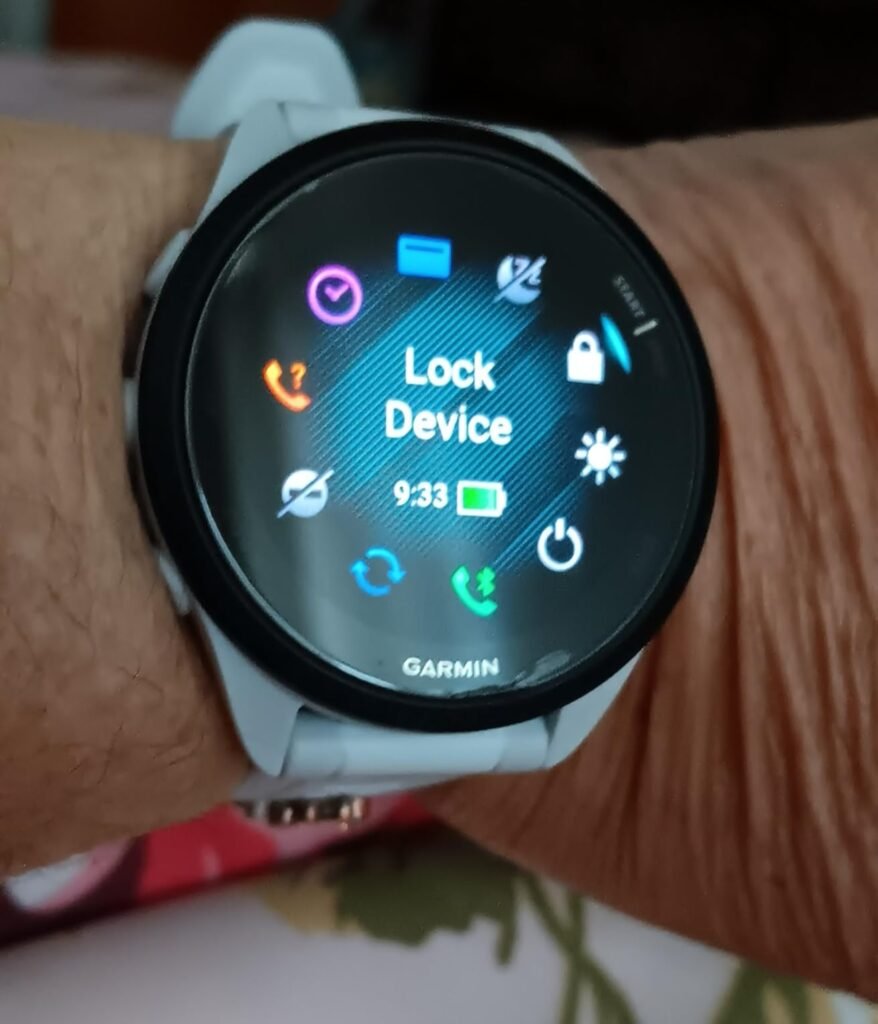
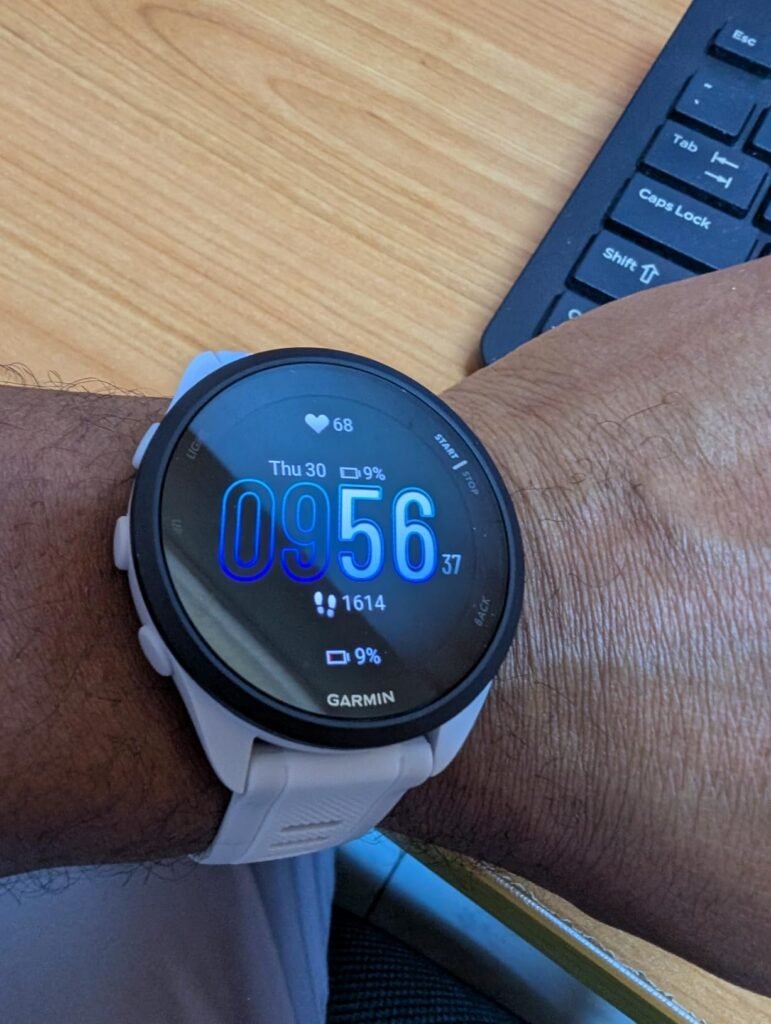
The Forerunner 165 blurs the line between running watch and hiking companion. It's built around a bright 43mm AMOLED touchscreen with traditional button controls, which reads beautifully in shade and stays legible in sun. For hikers who also run, it delivers a modern smartwatch feel with Garmin's respected training analytics.
We may earn a commission when you buy through this link, at no additional cost to you.
For hiking, built-in GPS handles pace and distance tracking reliably, and 25+ preloaded activity profiles include running, cycling, HIIT, and strength training. Battery life reaches up to 11 days in smartwatch mode and 19 hours in GPS mode, which is solid for the class but shorter than dedicated outdoor models. Wrist heart rate, sleep score, HRV, and Body Battery help you manage recovery.
Training-focused features stand out. Personalized daily suggested workouts adapt to performance and recovery, Garmin Coach and race training plans guide event prep, and morning reports summarize sleep, HRV, and readiness. Incident detection sends live location to emergency contacts during select outdoor activities when paired with a phone.
The Forerunner 165 estimates elevation from GPS, which is less precise than a barometric altimeter. On flat runs or day hikes, that’s fine. On elevation-heavy backcountry routes, a barometric altimeter delivers more accurate ascent and descent totals and better weather trend information. Consider that tradeoff based on the terrain you actually hike.
The Forerunner 165 lacks a barometric altimeter, which means less accurate elevation tracking on hikes compared to Instinct models. Choose it if you want a lightweight, AMOLED-equipped Garmin for mixed running and hiking use. For pure hiking with elevation-heavy trails, an Instinct or fenix model is a better fit.
Backcountry hikers who need precise barometric elevation data or maximum battery life.
We may earn a commission when you buy through this link, at no additional cost to you.
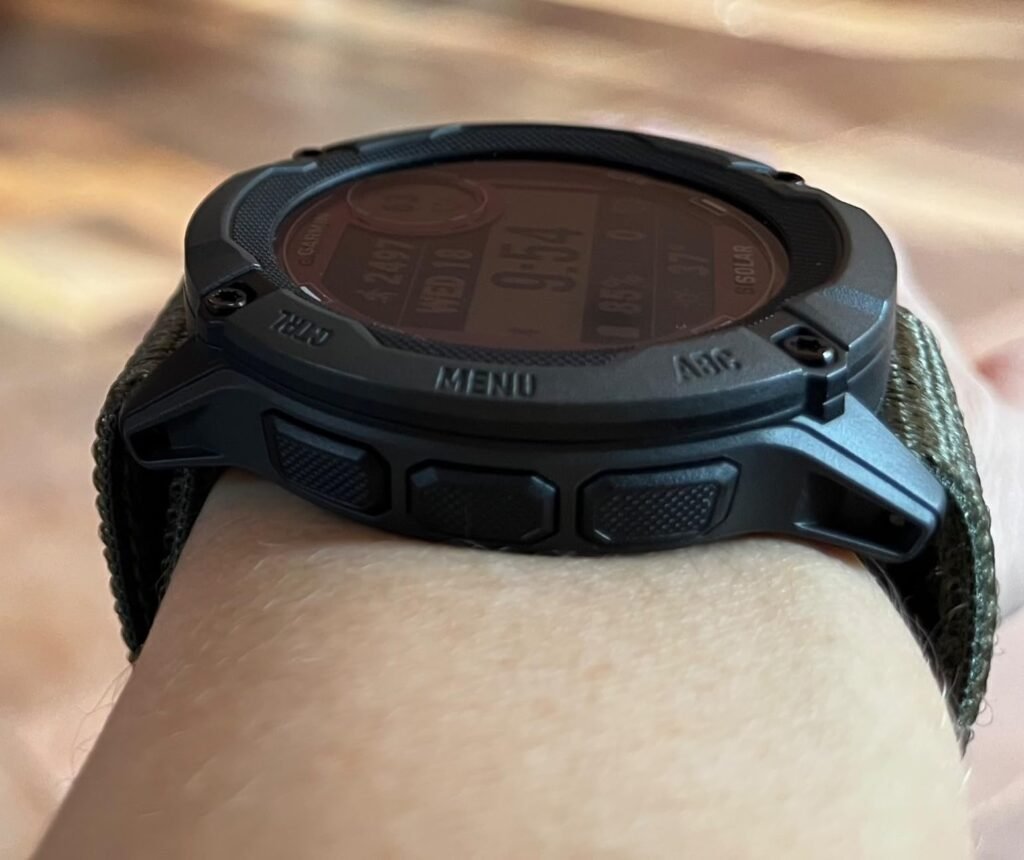
The Instinct 2X Solar is aimed at hikers who want the largest, longest-lasting Instinct without the tactical bundle extras. The 50mm polymer case houses a big solar-charged display, and Garmin's Power Glass lens produces about 50% more energy than the standard Instinct 2 Solar, extending runtime dramatically for anyone who spends real time under the sun.
We may earn a commission when you buy through this link, at no additional cost to you.
With around three hours of direct sunlight per day, the watch can effectively run forever in smartwatch mode. Multi-band signal reception outperforms single-band positioning in challenging environments, and the 3-axis compass and barometric altimeter cover fundamental navigation. The integrated LED flashlight with variable intensity and strobe modes is one of the standout features of the 2X line.
Health and training features run deep. Wrist heart rate, advanced sleep monitoring, respiration, Pulse Ox, and heart rate variability metrics from Firstbeat Analytics offer meaningful recovery insight. Sports apps cover running, biking, swimming, and strength training, plus VO2 max estimates and structured workout support through Garmin Connect.
Solar charging works best on hikes where the watch is exposed to direct sunlight for extended periods. Long-sleeve shirts, jackets, and heavy tree cover reduce solar input significantly. Even without full solar exposure, the watch still runs for weeks; sun exposure simply extends that further toward the unlimited claims Garmin advertises.
The 50mm case suits bigger wrists better and won’t fit under all jacket cuffs. If that works for you and you value maximum battery plus multi-band accuracy, this remains one of the best full-size solar hiking watches available.
Smaller-wristed hikers or anyone who prefers a low-profile smartwatch.
We may earn a commission when you buy through this link, at no additional cost to you.
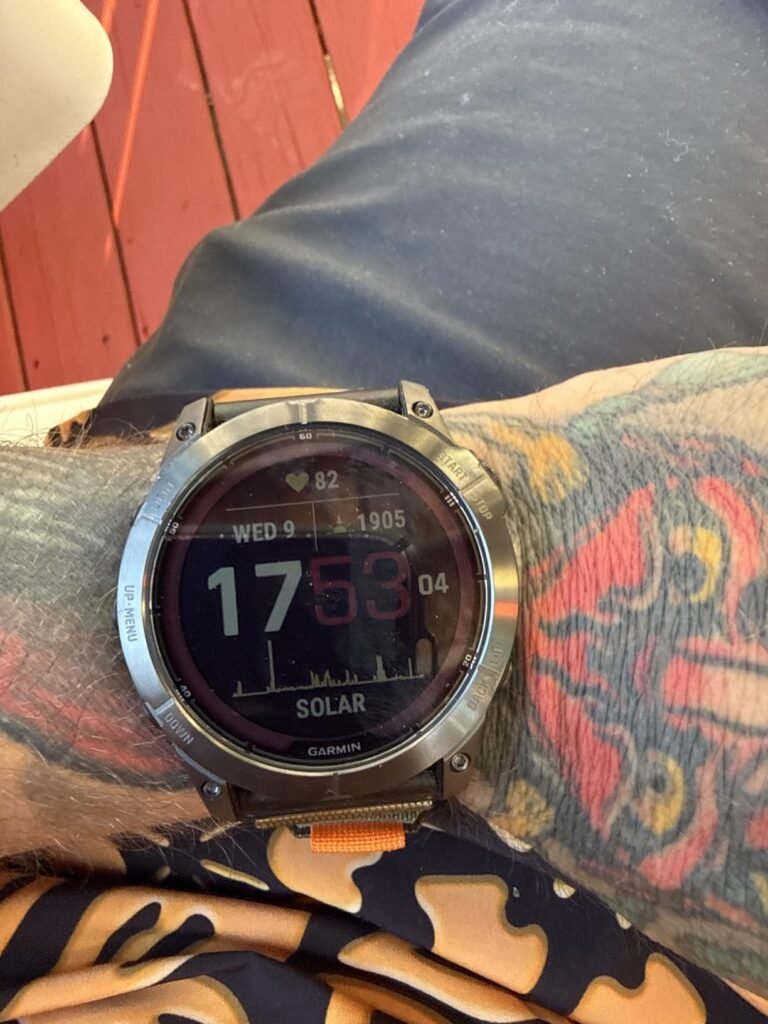
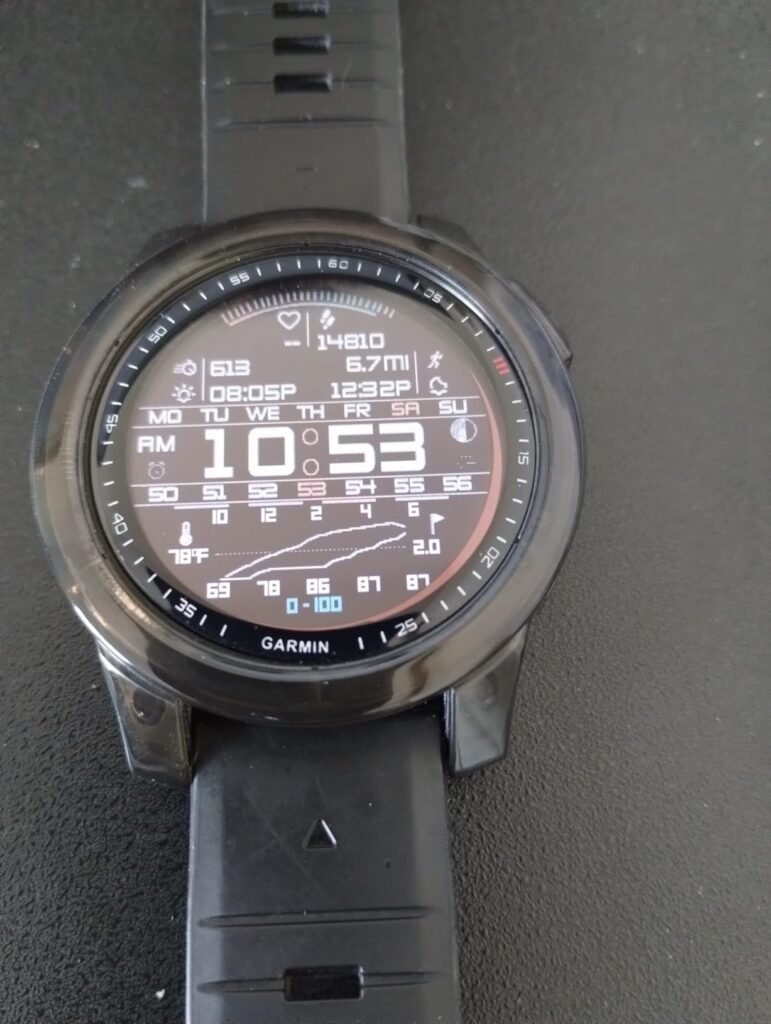
The fenix 7X Pro Sapphire Solar is the flagship of this roundup and the pick for serious hikers, mountaineers, and backcountry navigators who want on-wrist mapping and premium construction. The 51mm fiber-reinforced polymer case is topped with a titanium bezel and a Power Sapphire solar charging lens, making it both extremely durable and remarkably long-lasting.
We may earn a commission when you buy through this link, at no additional cost to you.
Navigation is the standout feature. Preloaded TopoActive maps let you see terrain, trails, and points of interest directly on the 1.4-inch display, and Up Ahead prompts flag turns and waypoints before you reach them. Multi-band GPS with SatIQ technology delivers exceptional accuracy in tough terrain, and preloaded maps for thousands of golf courses and ski resorts add year-round utility.
Beyond navigation, the fenix 7X Pro adds hill score and endurance score metrics that help you understand climbing strength and overall aerobic capacity trends over time. HRV status, training readiness, morning reports, and advanced sleep monitoring give a complete picture of health and training. The built-in LED flashlight with strobe modes and wrist-based running power features round out the package.
Topographic maps on your wrist let you check position and terrain without pulling out a phone, which matters in cold weather, rain, or steep terrain where phone handling is awkward. Preloaded maps also work fully offline, so cellular coverage doesn’t affect navigation. It’s a genuine safety and usability upgrade over map-free hiking watches.
Consider the fenix 7X Pro if you want the deepest capability set in a hiking watch and can justify the price. Casual hikers get most benefits from an Instinct model at a lower cost. But for hikers who navigate serious terrain, train seriously, and want a lifetime-quality watch, few models compete with what the fenix line offers.
Buyers with tight budgets or those who don’t need topographic maps and premium construction.
We may earn a commission when you buy through this link, at no additional cost to you.
Hiking watches range from simple $50 quartz timepieces to premium multisport GPS flagships near $700. The right pick depends on where you hike, how long you spend on trail, and how much data you want alongside pure timekeeping. Here are the factors that shape a smart buying decision.
GPS is often the single biggest reason to buy a hiking watch, and accuracy varies significantly across models. Basic GPS uses only one satellite constellation and can drift under tree cover or in canyons. Multi-GNSS (multiple constellations like GPS, GLONASS, Galileo, BeiDou) improves fixes in tough terrain. Multi-band or dual-band GPS uses two frequencies simultaneously to reject reflected signals and produce the cleanest tracks.
Models like the Garmin Instinct 3 Solar and fenix 7X Pro use multi-band GPS with SatIQ technology that intelligently switches modes based on conditions, saving battery in the open and improving accuracy where needed. Mid-tier options like the Instinct E and Instinct 2 Camo offer multi-GNSS support, which is enough for most trail conditions. Budget models like the Tiwain use single-frequency multi-constellation tracking that works well in open terrain.
If you regularly hike dense forest, mountain canyons, or backcountry, invest in multi-band. For typical trails and day hikes, multi-GNSS is plenty.
Battery life splits into two important numbers: smartwatch mode and active GPS mode. Smartwatch mode covers passive daily wear with occasional notifications, while GPS mode drains battery much faster because the satellite receiver runs continuously. Solar-equipped models like the Instinct 3 Solar, Instinct 2X Solar, and fenix 7X Pro can effectively run forever in smartwatch mode with regular sun exposure.
For active GPS tracking, expect big differences. The Instinct 2X Solar Tactical reaches up to 145 hours in GPS mode with solar, the original Instinct offers 16 hours, and the Forerunner 165 offers 19 hours. Solar helps most during long trips with plenty of sun exposure. Under jacket sleeves or heavy tree cover, solar contribution drops significantly.
Match battery to your trip length. Day hikers rarely need more than 16 hours of GPS; multi-day backpackers benefit from solar or Ultratrac battery-saver modes.
ABC sensors (altimeter, barometer, compass) are the backbone of serious hiking watch functionality. A barometric altimeter measures elevation from air pressure rather than GPS, delivering more accurate elevation profiles and total ascent/descent numbers. The barometer also detects pressure trends that hint at incoming weather. A 3-axis compass provides heading regardless of movement, unlike GPS-derived heading that needs you to be moving.
Most Garmin Instinct and fenix models include full ABC sensors, and even the budget Tiwain smartwatch adds compass, altimeter, and barometer functions. The Forerunner 165 notably lacks a barometric altimeter, estimating elevation from GPS instead. That’s fine for road running but less accurate for elevation-heavy hikes.
For any hike with meaningful elevation change, prioritize a watch with a barometric altimeter. It’s one of the most valuable hiking-specific features.
MIL-STD-810 is the most common durability standard cited for hiking watches, referring to a battery of environmental tests including shock, thermal extremes, vibration, and humidity. Nearly every Garmin Instinct and fenix model on this list meets MIL-STD-810 standards. The original Instinct notes specifically MIL-STD-810G, the current version at its release.
Water resistance is expressed in ATM or meters. 10 ATM (100 meters) covers rain, stream crossings, and swimming, which matches all the Garmin Instinct and fenix models here. The Tiwain smartwatch uses an IP68 rating suitable for rain and sweat but not for saltwater or saunas. The Timex Expedition Scout is water-resistant for splashes but not swimming.
Match durability to your terrain. Serious backcountry and wet conditions demand MIL-STD-810 and 10 ATM ratings; casual day hikes accept looser standards.
Two display technologies dominate: transflective memory-in-pixel (MIP) screens used by most Garmin Instinct and fenix models, and AMOLED displays used by the Forerunner 165 and Tiwain smartwatch. MIP screens use ambient light and remain extremely readable in bright sunlight while sipping battery. AMOLED delivers vivid colors and sharp text but pulls more power and can look washed out in intense direct sun.
For pure hiking use, MIP transflective displays are hard to beat. They read perfectly in noon sun, extend battery life dramatically, and pair naturally with solar charging. AMOLED shines for readers who want a phone-like experience, love vivid watch faces, or spend most time indoors between hikes. Both approaches work well; the tradeoff is battery and outdoor visibility versus color richness.
Choose transflective for backcountry and long trips. Choose AMOLED if display appearance in mixed use matters more than maximum battery.
Raw GPS tracking is useful, but real hiking navigation benefits from added features. Trackback (available on essentially all Garmin models here) guides you along the reverse of your outbound path, which is invaluable on unfamiliar loops or when weather closes in. Preloaded topographic maps, found only on the fenix 7X Pro in this roundup, let you see terrain and trails directly on the wrist without a phone.
Route planning integration matters too. Garmin’s Explore app lets you plan routes on desktop or phone and sync to the watch. Waypoint marking, coordinate entry, and reference points help you navigate to specific spots. On tactical models like the Instinct 2X Solar Tactical, features like dual-position coordinates, night vision mode, and Jumpmaster support serve specialized use cases.
Casual hikers get plenty of value from trackback alone. Serious backcountry navigators should prioritize preloaded maps and full route-planning integration.
Modern hiking watches increasingly double as health and training devices. Wrist heart rate is standard on every GPS model in this lineup, and features like Pulse Ox (blood oxygen) matter for hikers heading to altitude. Sleep tracking, HRV status, Body Battery, and training readiness (found on newer Garmins) help you understand recovery between hikes.
Deeper training features like VO2 max estimates, training effect, and recovery time appear on the Forerunner 165, Instinct 2X Solar, and fenix 7X Pro. The fenix line adds hill score and endurance score metrics specifically valuable for hikers and mountaineers who want to track ascent strength and long-effort capacity over time.
For casual hikers, basic heart rate and sleep are enough. Serious multisport athletes benefit from the deeper analytics on Forerunner, Instinct 2X, and fenix models.
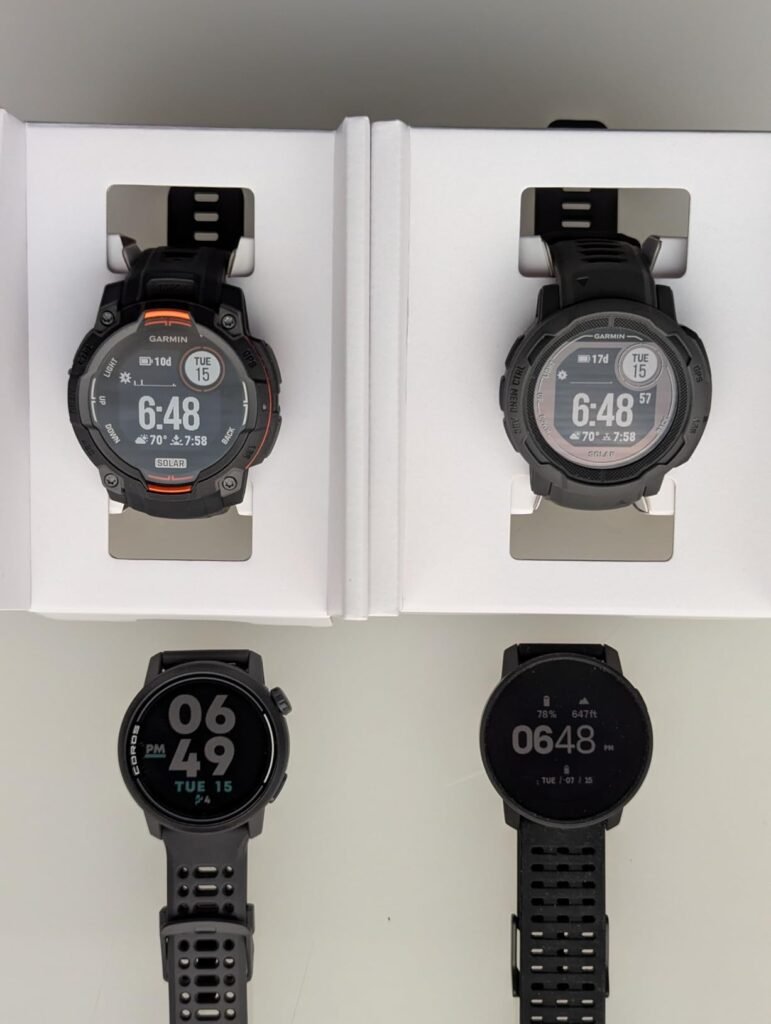
Hiking watches range from 40mm quartz cases to 51mm multisport flagships. Larger cases house bigger batteries and displays but can catch on jacket cuffs and feel top-heavy on smaller wrists. The Instinct 3 Solar and Instinct E sit at 45mm, striking a balance most wearers find comfortable. The Instinct 2X Solar and 2X Solar Tactical push to 50mm, and the fenix 7X Pro is 51mm.
Weight matters especially on long hikes and during sleep tracking. Polymer cases keep weight down; the Instinct 2X Solar weighs about 67 grams. Silicone straps are standard on all Garmin outdoor models and are comfortable for extended wear. The Timex Expedition Scout uses a lightweight fabric slip-thru strap.
Try to match case size to wrist. Under 6.5-inch wrists suit 40mm to 43mm cases; 7-inch wrists handle 45mm well; larger wrists accommodate 50mm to 51mm without visual issue.
Companion app quality shapes how you’ll interact with the watch for years. Garmin Connect is widely regarded as one of the best ecosystems in the category, with deep analytics, training plans, route planning through Garmin Explore, and Connect IQ for downloadable apps and watch faces. Regular firmware updates keep older Garmins improving over time.
Budget brands like the Tiwain smartwatch use smaller ecosystems with less refined apps and shorter software support windows. Timex quartz watches don’t require an app but also don’t offer digital features. For long-term ownership and evolving features, established outdoor brands tend to deliver better value even at higher initial cost.
If long-term software support and rich analytics matter, prioritize Garmin. If you want a set-and-forget mechanical or quartz option, simpler brands work well.
Start by pairing the watch with its companion app and completing initial setup: user profile, health metrics, notification permissions, and preferred sport profiles. Configure the data screens for hiking so the metrics you check most, like elevation, distance, and heart rate, appear first. On Garmin models, set up trackback as a default option and enable incident detection to send your location to emergency contacts during outdoor activities. Take time to explore watch face options and adjust brightness for the display technology you have.
Battery management is critical on trail. Before any hike, top up to full charge and confirm GPS mode battery estimates match your planned duration. For multi-day trips, consider battery-saver modes like Garmin’s Ultratrac, which reduces GPS sampling frequency to extend runtime significantly. Solar-equipped watches benefit from wearing outside sleeves when possible, since jacket cuffs block sun exposure. Carry a small USB power bank on longer trips as a backup, and remember that cold temperatures reduce battery capacity temporarily.
Care and cleaning extend watch life. Rinse the case and strap with fresh water after hikes in muddy, sweaty, or saltwater conditions, and dry thoroughly before storage. Never operate crowns or buttons underwater. Silicone straps benefit from occasional soap-and-water cleaning to prevent skin irritation. Have gaskets checked every few years if you swim with the watch regularly. Update firmware through the companion app periodically to keep GPS performance, security, and features current, especially on newer Garmins where updates add meaningful functionality over time.
It depends on how far you hike and where. For urban trails and short day hikes with cell coverage, a general smartwatch with connected GPS may be fine. For backcountry, multi-day trips, or trails without reliable cell service, a dedicated hiking watch with onboard GPS, barometric altimeter, and long battery life offers real safety and utility advantages. The gap widens on longer or more remote trips.
A barometric altimeter delivers more accurate elevation tracking than GPS-derived elevation, particularly for total ascent and descent numbers over long hikes. It also detects pressure changes that hint at incoming weather. For elevation-heavy terrain, a barometric altimeter is nearly essential. On flat trails, GPS elevation is usually adequate. Most Garmin Instinct and fenix models include a barometric altimeter; the Forerunner 165 does not.
For day hikes, 12 to 20 hours of GPS-mode battery covers almost any outing. Weekend backpackers benefit from 30+ hours or a solar-charged model. Thru-hikers and expedition users should prioritize solar-equipped watches like the Instinct 3 Solar or fenix 7X Pro Solar. Ultratrac battery-saver modes on Garmin models can dramatically extend runtime on very long trips at the cost of slightly lower track accuracy.
For hikers who spend real time outdoors, yes. Solar charging can effectively double battery life or make smartwatch mode essentially unlimited with regular sun exposure. The benefit depends heavily on wearing the watch outside jacket sleeves and getting several hours of direct sunlight daily. For occasional day hikers, the benefit is smaller and a non-solar Instinct like the Instinct E offers most of the practical utility for less money.
MIL-STD-810 is a durability standard covering shock, vibration, temperature extremes, and other environmental stresses. IP ratings (like IP68) specifically address dust and water ingress. Most premium hiking watches carry both types of certifications. The Garmin Instinct and fenix lines meet MIL-STD-810 plus 10 ATM water ratings, while budget smartwatches often note only IP68. For serious outdoor use, both standards matter.
Absolutely. Nearly every watch in this roundup supports multiple activity profiles including running, cycling, swimming, and strength training. The Garmin Forerunner 165 is running-focused but works fine for hiking, while the Instinct and fenix lines are truly multisport. For hikers who also want serious running analytics, the fenix 7X Pro offers the deepest feature set. For pure runners who occasionally hike, the Forerunner 165 is more focused.
Watches with onboard GPS chips work fully without a phone for tracking distance, elevation, and route recording. Features like smart notifications, incident detection alerts, contactless payments, and map downloads require phone pairing or initial setup. All Garmin models here plus the Tiwain smartwatch have onboard GPS. Budget smartwatches without onboard GPS depend on your phone for tracking, which limits their backcountry usefulness.
For serious backcountry hikers, yes. Preloaded topographic maps like those on the fenix 7X Pro let you check terrain, trails, and position without pulling out a phone, which matters in cold weather, rain, or steep terrain. For day hikers on well-marked trails, phone-based maps are usually enough and save money. Consider your typical routes when deciding whether on-wrist mapping justifies the cost.
Wear the watch for a few days of normal activity before your first big hike to verify comfort, learn the interface, and test battery drain patterns. Complete initial GPS calibration by taking the watch outside for at least 15 minutes to acquire satellites. Set up your data screens, emergency contacts, and activity profiles in advance. Practice using trackback and other navigation features close to home so they feel natural when you actually need them.
For rain, stream crossings, and sweat, 5 ATM (50 meters) or IP68 is adequate for basic protection. For swimming in lakes, snorkeling, or heavy water exposure, look for 10 ATM (100 meters) or higher. All the Garmin Instinct and fenix watches on this list are 10 ATM rated, which is comfortable overkill for typical hiking. The Timex Expedition Scout and Tiwain smartwatch handle rain but aren't ideal for swimming.
For most hikers, the Garmin Instinct 3 Solar stands out as the strongest overall pick. Its combination of solar-extended battery, multi-band SatIQ GPS, integrated flashlight, ABC sensors, and MIL-STD-810 durability makes it a genuinely complete hiking watch. The transflective display stays legible in bright sun without draining power, and the Garmin Connect ecosystem remains one of the deepest and best-supported in the outdoor category.
Different buyers benefit from different picks. The Garmin fenix 7X Pro Solar is the flagship choice for hikers who want preloaded topographic maps and premium construction. The Instinct 2 Camo delivers proven long-battery performance at a lower price. The Instinct E offers Garmin quality on a friendlier budget. The Forerunner 165 suits mixed running and hiking use with a vivid AMOLED display. The Tiwain smartwatch provides onboard GPS under $100 for casual hikers, while the Timex Expedition Scout is a reliable backup timepiece or simple day-hike companion.
Start by defining your typical hikes, trip lengths, and how much data you actually want. Weigh GPS accuracy needs against battery requirements, prioritize a barometric altimeter for elevation-heavy trails, and match case size to your wrist for all-day comfort. Any watch in this roundup can be the right choice for the right buyer, and the picks above should help you match capability to your terrain without overspending on features you won't use.