Midland GXT1000VP4
8.8Editor score50 channel count
142 privacy codes
NOAA weather alerts
Includes headsets
Find the right gmrs radios for 2026. We compare 10 standout options by build quality, useful features, owner feedback, value, and everyday trade-offs.
Choosing a reliable GMRS radio comes down to transmit power, repeater capability, weatherproofing, battery life, and how well the unit holds up in the environments where you actually use it. We compare 10 standout handheld and mobile models across wattage classes, from entry-level 5-watt units to 10-watt and 15-watt powerhouses built for serious off-road and expedition work.
The biggest differences between models show up in build quality, antenna design, and feature depth. Waterproof ratings range from IP54 to full IP67 submersion, battery life spans a single day to over five days per charge, and advanced features like GPS, APRS tracking, and Bluetooth programming separate expedition-grade units from basic walkie talkie pairs.
This guide breaks down each radio’s capabilities and real-world strengths so you can match a unit to your use case. Whether you need reliable comms for a family road trip, backcountry hunting, trail-ride spotting, or emergency preparedness, the right choice depends on a handful of measurable specifications we cover below.
We compared 10 GMRS radios using the details that matter most to buyers: transmit wattage, repeater capability, waterproof and dust ratings, battery life, antenna quality, channel count, NOAA weather alerts, programming options, GPS and APRS features where relevant, build durability, and overall value. The notes focus on practical trade-offs so each pick connects to how people actually use these radios for off-roading, hunting, overlanding, hiking, and family communication beyond cell coverage.


Compare key features, scores, and current prices side by side. A shorter feature list means fewer details were available, not necessarily fewer capabilities.



The Rocky Talkie Expedition 5W earns the highest customer rating in this comparison through a focused design philosophy that prioritizes reliability and battery life over feature overload. The specialized 1800mAh battery achieves an average of 5 days per charge even in frigid conditions, which addresses one of the most common failure points for backcountry users: dead radios on day three of a long trip. For multi-day expeditions where recharging is impractical, this battery performance is genuinely class-leading.
We may earn a commission when you buy through this link, at no additional cost to you.
The 5-watt maximum output provides the legal GMRS handheld limit, with 8 repeater channels for extending range through local networks. The removable antenna is a meaningful differentiator, as it lets you swap between the included 7.5cm compact antenna for daily carry and the 17cm option for maximum range when you need it. This flexibility is uncommon at this price point and reflects the radio’s expedition focus.
IP67 waterproofing allows submersion up to 1 meter for 30 minutes, so the radio survives river crossings, drenching rain, and accidental drops into creeks without issue. The shatterproof screen handles the inevitable impacts that come with real backcountry use, and the included steel gator clip and metal-reinforced backup leash keep the radio secured during technical sections. The 11 NOAA weather channels with alerts provide the standard emergency weather monitoring expected in this class.
Fixed antennas limit your range to whatever the manufacturer included out of the box. Removable antennas let you upgrade to higher-gain options for maximum range or swap to compact antennas for easier daily carry. For serious users, this flexibility is one of the most valuable features a handheld radio can offer, as it future-proofs the investment and adapts to different use scenarios.
The main trade-off is the premium price for a 2-pack and a feature set that focuses on reliability rather than cutting-edge technology like GPS, APRS, or Bluetooth programming. If you want text messaging or location sharing, the TIDRADIO or BTECH models in this comparison offer more features at lower prices. For buyers who want the most reliable, longest-running GMRS radio for serious backcountry use, however, the Rocky Talkie justifies its price through genuine field-tested durability.
Buyers who want advanced features like GPS tracking, text messaging, or Bluetooth programming.
We may earn a commission when you buy through this link, at no additional cost to you.
The Midland GXT1000VP4 is a strong starting point for families, road trip crews, and casual users who want a complete communication package without the complexity of programming individual channels. The pair arrives ready to use with rechargeable batteries, a desktop charger, and two included headsets, which eliminates the extra accessory purchases that budget radio pairs often require. For first-time GMRS buyers, this out-of-box readiness has real value.
We may earn a commission when you buy through this link, at no additional cost to you.
The 50 channels and 142 privacy codes provide enough flexibility to find a clear frequency in busy areas like state parks or campgrounds where multiple groups may be using the same radios. The NOAA weather scan feature is particularly useful for outdoor activities, automatically alerting you to severe weather warnings issued by the National Weather Service. This early warning capability can be critical for hikers, boaters, and anyone caught in rapidly changing conditions.
The EVOX hands-free voice activation lets you transmit without touching the radio, which matters when you are driving, climbing, or carrying gear. Dual power mode is another thoughtful touch, allowing you to swap to standard AA batteries when the rechargeable pack runs low. This flexibility makes the radios more reliable for multi-day trips where recharging may not be practical. The SOS siren, keypad lock, and 10 call tones round out the feature set.
Rechargeable batteries are convenient at home but can leave you stranded on long trips without charging access. Dual power mode lets you switch to standard AA batteries available at any gas station or general store, which keeps the radios functional even days into a backcountry trip. This single feature can make the difference between losing communication and staying connected during extended outings.
The main limitation is that this is a traditional consumer-grade GMRS pair without repeater capability or the higher 5-watt output found in more serious models. Real-world range will be measured in blocks or short distances in urban areas and perhaps a mile or two in open terrain. For buyers who want a dependable family radio pair with headsets included at a moderate price, however, this Midland set delivers excellent everyday value.
Serious off-roaders or hunters who need repeater capability and maximum legal GMRS output.
We may earn a commission when you buy through this link, at no additional cost to you.
The BAOFENG GM-15 Pro delivers 8 watts of transmit power, which exceeds the typical 5-watt output of most consumer GMRS handhelds and provides meaningful range gains in open terrain. Priced as a 2-pack at an accessible level, this radio targets hunters, hikers, and off-road groups who want serious performance without stepping into the premium price tier. The combination of higher wattage and repeater capability makes it a legitimate choice for users who need to reach beyond standard line-of-sight distances.
We may earn a commission when you buy through this link, at no additional cost to you.
With 250 memory channels, including 22 preprogrammed GMRS channels and 8 GMRS repeater channels, the radio accommodates both ready-to-use operation and extensive customization. The 154 privacy codes split between CTCSS and DCS systems help reduce interference in crowded radio environments. The 24 customizable repeater channels let advanced users dial in specific local repeaters to significantly extend communication range beyond handheld-to-handheld limits.
USB-C charging through the included cable and wall adapter means you can top off the 1500mAh battery from a power bank, laptop, car charger, or any standard USB source. This flexibility is a genuine convenience for travelers and off-grid users who may not have access to proprietary charging docks. The 11 NOAA weather channels with scanning function provide the same emergency weather awareness as more expensive models.
GMRS repeaters are stationary high-elevation stations that receive your signal and rebroadcast it at higher power, effectively multiplying your range by tens of miles. Access to local repeaters varies by region, so check online repeater directories for your area before buying. A repeater-capable radio is dramatically more useful in regions with active GMRS repeater networks than in areas without them.
The programming interface has a learning curve, especially for buyers moving up from simple consumer radios. You can configure channels through the keypad menu or via PC software for more complex setups. For buyers willing to invest some time learning the system, the 8-watt output, repeater capability, and extensive memory make this one of the strongest value picks in the GMRS category. Expect 4 to 5 miles in open areas, 3 to 4 miles in forest, and 2 to 3 miles in urban settings.
Casual users who want a plug-and-play radio without any programming or channel configuration.
We may earn a commission when you buy through this link, at no additional cost to you.
The Midland GXT67 PRO is built for buyers who actually use their radios in rough conditions and have been burned by cheap units with leaky battery doors. The fully integrated IP67 chassis withstands mud, dust, and submersion in up to 3 feet of water, which means you can hose it off after a muddy trail ride without worrying about internal damage. For overlanders, Jeep owners, and anyone running serious backcountry trips, this level of sealing is a meaningful upgrade over splash-resistant alternatives.
We may earn a commission when you buy through this link, at no additional cost to you.
The 5-watt maximum output pushes the legal GMRS handheld limit, cutting through dense treelines and valleys where lower-power radios lose signal. Repeater capability extends range even further in areas with active GMRS repeater networks. The 22 preprogrammed channels and 28 privacy codes get you connected immediately out of the box without complex configuration, which is especially useful when you need to coordinate with other radios on the trail.
The high-visibility backlit display and oversized buttons are designed to be operated while wearing gloves, a practical detail that matters on cold trail runs or snowy mountain adventures. The complete expedition kit includes a heavy-duty travel case, desktop charger, AC and DC adapters so you can charge in the vehicle, belt clip, and a high-capacity lithium-ion battery rated for days of trail use. The radio pairs seamlessly with Midland MicroMobile mobile units for integrated vehicle and spotter communication.
The GXT67 PRO is designed to work with Midland MicroMobile MXT-series vehicle-mounted radios, which transmit at higher wattages like 15 or 50 watts for even greater range. This creates a layered communication system where the driver uses the MicroMobile for long-range comms and the spotter uses the handheld for close-range coordination during technical trail sections. This two-radio approach is standard practice in serious off-road communities.
The main consideration is that this radio is sold as a single unit at a premium price, so you will need two for pair communication. For serious users building out an off-road comms system or replacing a failed cheap radio, the ruggedness and range justify the investment. Casual users with lighter needs may prefer the pack sets lower in this comparison.
Buyers who need two radios in one purchase or who do not require full submersion rating.
We may earn a commission when you buy through this link, at no additional cost to you.
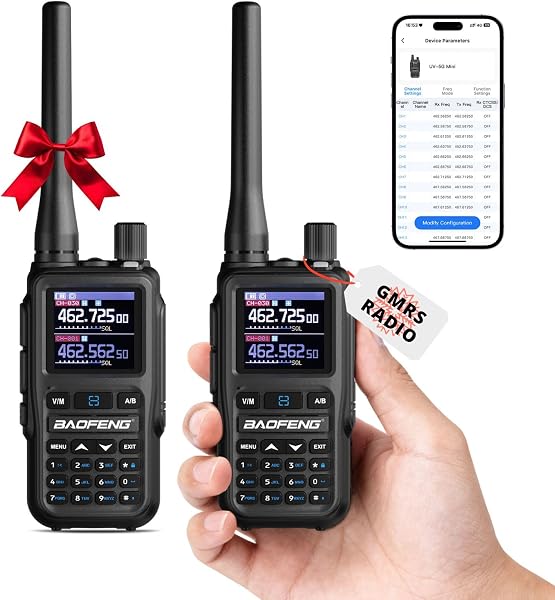
The BAOFENG UV-5G Mini packs an unusually deep feature set into a compact, affordable handheld package. The 999 total memory channels and app-based Bluetooth programming through iOS and Android apps make this one of the most flexible radios in its price class. For buyers who want to customize channel layouts without wrestling with PC software or keypad menus, the smartphone app is a major convenience that saves hours of setup time.
We may earn a commission when you buy through this link, at no additional cost to you.
The 8-band receive capability covers FM broadcast, aviation airband, NOAA weather, VHF, UHF, GMRS, GMRS repeater, and 350 MHz signals. This broad receive range turns the radio into a general-purpose scanner alongside its GMRS transmit function, which is useful for monitoring airport traffic, local public safety communications, or weather emergencies. Note that transmit is limited to GMRS frequencies in accordance with FCC rules.
The dual PTT buttons, dual-band dual-standby, DTMF dialing, VOX hands-free operation, and one-key frequency copy for easy pairing round out a surprisingly capable feature set. USB-C charging means you can top off from a power bank, car charger, or any standard USB source without a proprietary dock. The built-in battery provides reliable power for daily use, though the compact form factor limits capacity compared to larger radios.
App-based programming lets you configure channels, privacy codes, and radio settings from your smartphone in minutes, without the need for a programming cable or PC software. This is especially valuable when you need to add a new repeater on the trail or match settings between radios in your group. The convenience factor cannot be overstated for users who find traditional radio programming intimidating.
The main trade-offs are the lower transmit wattage and smaller battery that come with the mini form factor. Real-world range is around 5 miles with repeater support, which is competitive but not class-leading. For buyers who prioritize portability, deep customization, and modern conveniences like app programming at a budget-friendly price, however, the UV-5G Mini delivers remarkable value. The 2-pack pricing makes it especially attractive for families and small groups.
Users who prioritize maximum transmit power or need the longest possible battery life.
We may earn a commission when you buy through this link, at no additional cost to you.
The TIDRADIO TD-H9 is the most feature-dense handheld in this comparison, packing 10-watt transmit power on channels 15-30, built-in GPS with APRS tracking, Bluetooth connectivity, SMS text messaging, and a spectrum analyzer into a single unit. For tech-savvy users who want maximum capability per dollar, this radio delivers an unusual combination of features typically found only in significantly more expensive units.
We may earn a commission when you buy through this link, at no additional cost to you.
The 10-watt output on higher channels overcomes the 5-watt and 8-watt limits of most competing handhelds, providing meaningful range gains in open terrain and difficult environments. The GPS location sharing and APRS real-time tracking are particularly valuable for safety-conscious users, as they allow rescuers to pinpoint your position via the APRS network if you need help. The NOAA weather alert system provides real-time severe weather updates alongside the standard GMRS communication functions.
Bluetooth programming through the ODmaster app simplifies configuration dramatically compared to traditional cable-based programming. The radio also supports third-party Bluetooth HFP gear like vehicle Bluetooth systems and compatible headsets, which enables wireless hands-free operation. The 3-in-1 mode switch lets you toggle between Ham, GMRS, and unlocked frequency ranges for different use cases, though be aware that unlocked mode may not be legal in all situations and jurisdictions.
APRS, or Automatic Packet Reporting System, is a worldwide network that tracks and shares real-time location data via radio. For backcountry users, the ability to transmit your GPS position through APRS can be lifesaving in emergencies where cell service is unavailable. Rescuers monitoring the APRS network can locate you quickly, making this feature a serious safety upgrade for solo adventurers and remote travelers.
The deep feature set comes with a learning curve, and the IP54 rating is lower than the IP67 found on the Rocky Talkie and Midland GXT67 PRO. For buyers who want maximum features and are willing to invest time learning the capabilities, the TD-H9 offers remarkable value. The 2400mAh battery, 11 NOAA channels, and 30 preprogrammed GMRS channels round out a radio that genuinely rewards power users.
Users who want simple operation without complex menus or technical configuration.
We may earn a commission when you buy through this link, at no additional cost to you.
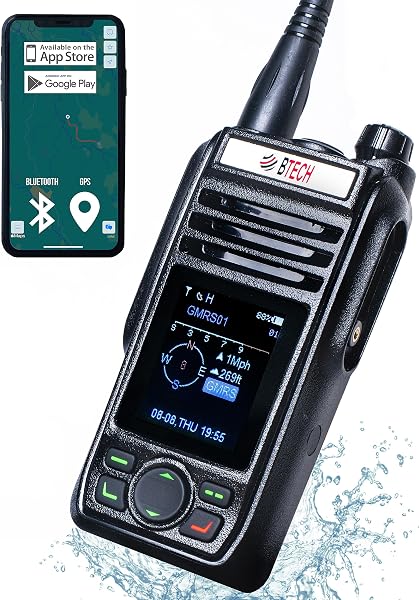
The BTECH GMRS-PRO positions itself as a smart handheld that bridges traditional radio communication with modern app-connected features. The dedicated BTECH GMRS app handles channel management, contact syncing, and radio configuration from your smartphone, which eliminates the frustration of navigating complex front-panel menus. For buyers who find traditional radio programming intimidating, this app-first approach is a major convenience.
We may earn a commission when you buy through this link, at no additional cost to you.
The 5-watt GMRS output with repeater capability provides serious range for travel, events, outdoor use, and group communication. Backward compatibility with standard GMRS and FRS radios means the GMRS-PRO works seamlessly with mixed radio groups, so you can use it alongside cheaper family radios without issues. This flexibility matters for group trips where not everyone has invested in premium gear.
The built-in GPS with digital compass displays coordinates, heading, speed, and altitude directly on the radio for navigation and location awareness when off-road or off-grid. Location sharing and nearby user tools let you share position data with other GMRS-PRO users, which improves group tracking during convoy trips or search operations. Text messaging between compatible radios adds a non-voice communication option that is useful when quiet operation is needed.
Modern smart radios connect to smartphones via Bluetooth for configuration, contact management, and feature control. This approach makes radio ownership far more accessible to users who are comfortable with smartphone apps but intimidated by traditional radio menus. The trade-off is that you depend on the manufacturer’s app being maintained and updated over time, so choose brands with a strong support track record.
IP67 dust and water protection handles rain, splashes, mud, and temporary immersion, matching the premium ruggedness of other top-tier units. The main consideration is that the GMRS-PRO is sold as a single unit at a premium price, so budget-conscious buyers may prefer the Rocky Talkie or Midland options for comparable features in pair packaging. For users who want smart app-connected features in a rugged form factor, the BTECH is a strong choice.
Buyers who want a 2-pack purchase or who prefer traditional radio operation without smartphone dependency.
We may earn a commission when you buy through this link, at no additional cost to you.
The Midland MXT275 is a mobile vehicle-mounted GMRS radio rather than a handheld, and it fills a very different role in a comprehensive communication system. The 15-watt output is three times higher than the maximum legal power for handheld GMRS units, which translates to significantly longer range especially when paired with a proper external antenna mounted high on your vehicle. For serious off-roaders, overlanders, and group trail riders, a mobile unit like this is often the primary radio in the vehicle.
We may earn a commission when you buy through this link, at no additional cost to you.
The compact MicroMobile form factor is designed to fit in modern vehicle cabins without eating up excessive dashboard space. This matters in current trucks and SUVs where available real estate for aftermarket electronics has shrunk compared to older vehicles. The microphone-based design keeps the main radio body tucked away while the mic handles all user interaction.
Repeater capability extends range even further through local GMRS repeater networks, which can turn a 15-watt vehicle radio into a 50-mile-plus communication tool in areas with active repeater coverage. This combination of raw power and repeater support makes mobile units like the MXT275 the backbone of many off-road groups’ comms systems, with handhelds serving as spotter radios for close-range coordination.
Mobile GMRS radios transmit at 15 or 50 watts, far exceeding the 5-watt handheld maximum. Combined with external antennas mounted high on a vehicle, mobile units provide dramatically longer range than any handheld can match. The trade-off is permanent vehicle installation and dependency on vehicle power. For maximum GMRS performance, the ideal setup combines a mobile unit in the vehicle with handhelds for walking around outside the vehicle.
The main consideration is that this radio requires permanent or semi-permanent installation in a vehicle and depends on an external antenna for proper performance. It is not a grab-and-go unit like the handhelds elsewhere in this comparison. For buyers building out a complete vehicle-based GMRS system, the MXT275 provides serious range from a trusted brand at a reasonable price. Pair it with handhelds from the same ecosystem for integrated operation.
Hikers, campers, or anyone who needs a portable handheld radio.
We may earn a commission when you buy through this link, at no additional cost to you.
The BAOFENG UV-9G brings IP67 waterproofing to the budget price tier, which is unusual at this price point and makes it a strong option for users who want serious water protection without the premium price tag of the Rocky Talkie or Midland GXT67 PRO. The radio survives 30 minutes of submersion in 3 feet of water, which handles rain, splashes, and accidental drops into shallow water with no issue.
We may earn a commission when you buy through this link, at no additional cost to you.
The 30 preprogrammed GMRS channels and 11 NOAA weather channels with scanning function provide the standard capabilities expected in a modern GMRS handheld. The DIY repeater channel allocation across channels 31-54 gives you 4 groups of custom repeater frequencies, which is more flexibility than many budget radios offer. The VHF and UHF receive function adds scanning capability beyond pure GMRS use.
The included BAOFENG programming cable lets you configure the radio via PC software, which is useful for setting up multiple radios with matching channels and privacy codes. The bright flashlight and tri-color LCD display provide practical visibility features for low-light conditions. The 1800mAh battery supports 24/7 standby with NOAA monitoring using minimal power, so you can leave the radio on continuously to catch weather alerts.
IP67 means the device is completely dust-tight and can be submerged in up to 1 meter of water for 30 minutes without damage. This level of protection handles virtually any real-world wet condition short of extended underwater use. For outdoor radios, IP67 is the gold standard and significantly outperforms the IP54 or splash-only ratings found on cheaper alternatives.
The main trade-offs are the smaller battery compared to premium models and the lack of advanced features like GPS or APRS. The 2-pack packaging and budget pricing make this an attractive option for buyers who need reliable waterproof radios without the extra technology layers. For families, casual hikers, or anyone wanting IP67 protection on a tight budget, the UV-9G delivers real value at an accessible price.
Users who need maximum transmit power or advanced features like GPS tracking.
We may earn a commission when you buy through this link, at no additional cost to you.
The BTECH GMRS-V2 is positioned as a budget-friendly handheld that supports deep customization through free CHIRP software, which is one of the most widely used radio programming tools in the amateur radio community. For buyers who want to organize 200 channels with custom names, load local repeaters in bulk, and create backup files for easy restoration, this software compatibility is a serious advantage over radios locked to proprietary programming tools.
We may earn a commission when you buy through this link, at no additional cost to you.
The 5-watt output provides full-power GMRS operation with repeater support for extending range through local networks. The 200 programmable channels can be organized for GMRS, NOAA, and scanner use with custom labels and layouts that match how you actually use the radio. Dual watch monitoring and dual PTT control let you manage two channels simultaneously and switch between them quickly, which is useful for monitoring repeater traffic while maintaining a working channel.
USB-C charging with the included desktop charger provides flexible power options for home, vehicle, or on-the-go use. The IP54 weather-resistant casing handles dust, splashes, and typical outdoor conditions, though it falls short of the IP67 submersion rating found on premium units. The VHF and UHF scanning capability turns the radio into a general-purpose receiver alongside its GMRS transmit function, and NOAA weather monitoring provides emergency awareness.
CHIRP is free, cross-platform radio programming software that supports dozens of radio models from multiple manufacturers. Buying a CHIRP-compatible radio means you can configure it on Windows, Mac, or Linux without purchasing proprietary software. It also means you can share configuration files with other users and tap into online repeater databases to load local repeaters quickly. For technically inclined buyers, CHIRP support is a meaningful differentiator.
The feature-packed value includes FM broadcast radio, LED flashlight, SOS alarm, VOX hands-free, tone scan, scan skip, busy channel lockout, and more. For buyers who want maximum features and customization at a budget price and are comfortable with CHIRP software, the GMRS-V2 is a strong pick. Users needing full IP67 submersion rating or who want a 2-pack purchase should look elsewhere, but for solo users building a flexible GMRS setup, this radio delivers remarkable value.
Users who need full IP67 submersion rating or want a complete out-of-box 2-pack solution.
We may earn a commission when you buy through this link, at no additional cost to you.
Selecting the right GMRS radio depends on how you plan to use it, where you will operate, and how much complexity you are willing to manage. The following factors will help you narrow the options and avoid buying a radio that falls short of your actual needs or vastly overspends on features you will not use.
GMRS handheld radios transmit at anywhere from 2 watts to 10 watts, with 5 watts being the legal maximum for most GMRS channels and 10 watts available on specific higher-channel ranges on some newer models. Vehicle-mounted mobile units can transmit at 15 or even 50 watts, which provides dramatically longer range. More wattage does help, but line-of-sight terrain, antenna quality, and operating environment typically matter more than raw power in real-world use.
Advertised range claims of 30 or 36 miles are measured in ideal conditions with no obstructions and should be heavily discounted for real-world planning. Expect 1 to 3 miles in dense urban environments, 2 to 4 miles in wooded terrain, and 5 to 10 miles in open country or on mountain tops. Access to a local GMRS repeater can extend handheld range to 20 or 50 miles depending on repeater placement and network coverage.
IP ratings tell you how well a radio resists dust and water intrusion. IP54 means the device resists dust and splashes but should not be submerged, which is adequate for casual outdoor use in fair weather. IP67 means the device is completely dust-tight and can be submerged in up to 1 meter of water for 30 minutes, which handles rain, river crossings, and accidental drops into creeks without damage.
For serious outdoor users, IP67 is the gold standard and worth paying extra for. Radios with lower ratings or no rating at all can fail quickly in rainy, muddy, or snowy conditions. Pay particular attention to how the battery door and antenna connections are sealed, as these are the most common failure points on radios that claim water resistance but leak in actual use.
Battery life matters most for multi-day trips where recharging may be impractical or impossible. Specifications vary widely, from basic radios that last a single day of heavy use to premium models like the Rocky Talkie that achieve 5 days per charge. Lower-wattage transmit draws less power than high-wattage transmit, so battery life claims are typically measured under light use conditions.
Charging method also matters for travelers and off-grid users. USB-C charging is increasingly common and offers the most flexibility, letting you charge from power banks, car chargers, laptops, or any standard USB source. Proprietary charging docks tie you to specific accessories that must be packed separately. Dual power mode with AA battery compatibility, as found on the Midland GXT1000VP4, provides a valuable backup when rechargeable batteries fail.
GMRS repeaters are stationary high-elevation stations that receive your signal and rebroadcast it at higher power, effectively multiplying your range by tens of miles. Repeater-capable radios can tap into these networks where they exist, while non-repeater radios are limited to direct handheld-to-handheld communication. Before buying a repeater-capable radio, check online directories for active repeaters in your region.
Repeater access varies dramatically by location. Some areas have robust networks maintained by local radio clubs with wide coverage, while other regions have little or no repeater infrastructure. If you live in a repeater-rich area, prioritize repeater capability. If you primarily use radios in remote areas without network coverage, a non-repeater radio with higher transmit power may serve you better.
Programming methods range from simple front-panel keypad entry to PC software, Bluetooth app programming, and CHIRP compatibility. For buyers who want plug-and-play simplicity, preprogrammed radios like the Midland GXT1000VP4 work out of the box with no setup required. For buyers who want to customize channels, add repeaters, or match settings across multiple radios, programmable radios with app or CHIRP support offer dramatically more flexibility.
Bluetooth app programming through smartphones is the most beginner-friendly option, as it leverages the familiar interface patterns of mobile apps. CHIRP software is more powerful but requires some technical comfort with desktop computing. PC-based proprietary software falls somewhere in between. Match the programming method to your comfort level and the amount of customization you actually need.
NOAA weather channel monitoring is a standard feature on most modern GMRS radios and provides automatic access to National Weather Service broadcasts and severe weather alerts. For outdoor users, this capability can be lifesaving by providing early warning of tornadoes, flash floods, winter storms, and other dangerous conditions. The feature typically draws minimal power, so you can leave it active continuously without significantly impacting battery life.
Advanced emergency features found on premium radios include GPS location display, APRS position sharing for rescue coordination, SMS text messaging between compatible radios, SOS alarms, and digital compasses. These features matter most for solo adventurers, remote travelers, and anyone operating in areas without reliable cell coverage. For casual users, basic NOAA monitoring and an SOS alarm are usually sufficient.
Antenna performance has a disproportionate impact on real-world range, often more significant than transmit wattage. Fixed-antenna radios lock you into whatever the manufacturer included, while removable-antenna radios let you upgrade to higher-gain options for maximum performance or swap to compact antennas for daily carry. The Rocky Talkie Expedition and BAOFENG models with SMA connectors offer this flexibility.
For vehicle-mounted mobile radios, antenna selection and placement matter even more. A proper external antenna mounted high on your vehicle with a quality coax cable will dramatically outperform a short rubber duck antenna, regardless of the radio’s transmit power. If you are building a serious GMRS system, budget for a quality antenna rather than cutting corners on this component.
GMRS radios come in several form factors: compact mini handhelds like the BAOFENG UV-5G, standard handhelds like most models in this comparison, rugged handhelds like the Midland GXT67 PRO, and vehicle-mounted mobile units like the Midland MXT275. Each form factor serves different use cases, and the right choice depends on how and where you will carry the radio.
Mini handhelds excel for daily carry, hiking, and situations where size and weight matter most. Standard handhelds balance features and portability for general outdoor use. Rugged handhelds add weight and bulk in exchange for serious weatherproofing and durability. Mobile units provide maximum range but require vehicle installation. Serious off-road communication systems often combine a mobile unit in the vehicle with handhelds for walking around outside.
Before first use, obtain your FCC GMRS license, which currently costs 35 dollars for a 10-year license and covers your entire immediate family. The licensing process is straightforward through the FCC website and does not require a test. Program your preferred channels and privacy codes, test range with a partner in your typical use area, and familiarize yourself with the radio’s controls before you actually need it. Reading the manual once at home is far easier than trying to figure out menu navigation while cold and tired on a trail.
During use, hold the radio vertically with the antenna pointing straight up for best transmission, and press the push-to-talk button for a brief moment before speaking to avoid cutting off the first word of your message. Keep transmissions short and clear, as prolonged key-down time drains batteries and can cause the radio to overheat. For maximum range, position yourself on high ground with clear line of sight to the other radio when possible. In vehicles, mobile units with properly mounted external antennas provide dramatically better performance than handhelds inside the cabin.
After trips, wipe down the radio with a damp cloth to remove dust, salt, and dirt that can accumulate in the controls and speaker grills. For waterproof radios, you can rinse with fresh water, but confirm all seals and battery doors are properly closed first. Store radios in a cool, dry location with batteries at approximately 50 percent charge for long-term storage to maximize battery lifespan. Periodically cycle the batteries by using them down to about 20 percent and then recharging fully to maintain capacity.
Yes. The FCC requires a GMRS license to legally transmit on GMRS frequencies, though no exam is required. The license costs 35 dollars and is valid for 10 years, covering your entire immediate family under a single license. Apply through the FCC website before using the radio. Operating without a license can result in fines, though enforcement for occasional recreational users is rare.
GMRS and FRS share some channels but have different power limits and licensing requirements. FRS radios are limited to 2 watts and require no license, while GMRS radios can transmit at up to 5 watts handheld or 50 watts mobile and require a license. GMRS also allows repeater use for extended range. Most modern GMRS radios can communicate with FRS radios on shared channels at reduced power.
Real-world range depends heavily on terrain, antenna quality, and obstructions. Expect 1 to 3 miles in urban areas, 2 to 4 miles in wooded terrain, and 5 to 10 miles in open country with handheld radios. Access to a repeater can extend range to 20 to 50 miles depending on repeater coverage. Advertised range claims of 30 to 36 miles are measured in ideal conditions and should not be used for planning.
GMRS repeaters are stationary high-elevation stations that receive your radio signal and rebroadcast it at higher power from a better location, dramatically extending your range. Repeater-capable radios can transmit on repeater input frequencies to access these networks. Repeater availability varies by region, so check online directories to see if active repeaters exist in your area before prioritizing this feature.
For outdoor users who may encounter rain, water crossings, or wet conditions, waterproof radios with IP67 ratings are strongly worth the upgrade. Non-waterproof radios can fail quickly in wet environments, leaving you without communication exactly when you need it most. For purely indoor or fair-weather use, splash-resistant IP54 ratings or even non-rated radios may be sufficient.
No. GMRS is a United States radio service, and the specific frequencies and licensing rules do not apply in other countries. Many countries have their own equivalent services with different frequency allocations and regulations. Using a GMRS radio outside the United States may be illegal and could result in confiscation or fines, so research local radio regulations before traveling internationally with any two-way radio.
Privacy codes, also called CTCSS or DCS codes, are subaudible tones that filter which transmissions your radio actually plays audibly. They do not encrypt your transmission or prevent others from hearing you if they turn off their own privacy codes. Their actual purpose is to reduce the annoyance of hearing unrelated conversations on busy channels, not to provide true communication privacy.
Handheld radios are portable and go wherever you go, which is essential for hiking, hunting, and spotter use outside a vehicle. Mobile radios mount in vehicles and transmit at much higher power with external antennas, providing dramatically longer range. For serious off-road groups, the ideal setup combines a mobile unit in each vehicle with handhelds for walking around outside, which creates a layered communication system.
Battery life matters most for multi-day trips where recharging is impractical. Premium models like the Rocky Talkie Expedition achieve 5 days per charge, while basic radios may last only a single day of heavy use. For day trips with evening recharging access, battery life is less critical. Consider whether USB-C charging flexibility or AA battery backup capability matters for your typical use scenarios.
Yes. All radios in a group need to share the same channel, frequency, and privacy code to communicate. Many programmable radios support bulk configuration through PC software, apps, or CHIRP, which makes setting up multiple matching radios much faster than programming each one individually through the keypad. One-key frequency copy features on some models let you quickly match settings between paired radios in the field.
The Rocky Talkie Expedition 5W stands out as the strongest overall choice for serious outdoor users, combining the highest customer rating in this comparison with IP67 waterproofing, class-leading 5-day battery life, a removable antenna, and shatterproof construction. For buyers who need the most reliable, longest-running GMRS radio for backcountry trips and expedition work, the Rocky Talkie justifies its premium price through genuine field-tested durability.
For budget-conscious buyers, the BAOFENG UV-5G Mini offers remarkable value with 999 channels, app programming, and 8-band receive capability in a 2-pack at an entry-level price. The TIDRADIO TD-H9 is the clear choice for tech enthusiasts who want 10-watt output, GPS, APRS, and Bluetooth programming in a single radio. For complete vehicle-based systems, pair the Midland MXT275 mobile unit with handheld spotters for maximum coverage and flexibility.
Start by identifying your primary use case, confirming whether your region has active GMRS repeater networks, and matching the radio's waterproof rating to your typical operating environment. The right GMRS radio provides reliable communication beyond cell coverage for years of outdoor adventures, so investing in appropriate power, durability, and features from the start pays off many times over the life of the radio. Do not forget to obtain your FCC GMRS license before transmitting.