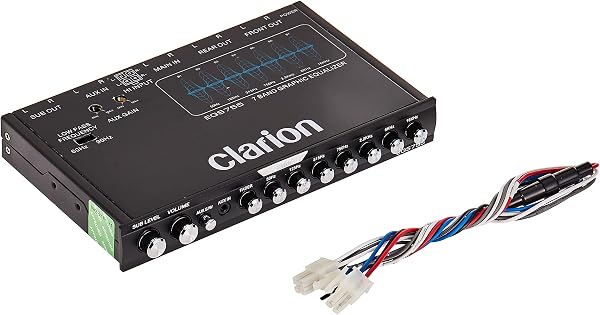
Clarion EQS755
9.4Editor scoreSeven-band graphic EQ
Eight-volt RCA outputs
Half-DIN chassis size
Built-in low-pass filter
Find the right equalizers for 2026. We compare 10 standout options by build quality, useful features, owner feedback, value, and everyday trade-offs.
Finding the right equalizer in 2026 means sorting through car audio units, guitar pedals, and studio rack gear. We compare 10 standout options by band count, output voltage, input flexibility, frequency range, build quality, and real-world value to help you shape your sound with confidence.
Equalizers range from simple seven-band car units to professional 31-band rack processors, and the differences matter more than most shoppers realize. Output voltage, signal-to-noise ratio, and crossover features can dramatically affect how your system performs once everything is wired together.
Whether you need to tame harsh highs in a car stereo, sculpt your guitar tone on a pedalboard, or fine-tune a home listening room, this guide breaks down the specifications and trade-offs that separate a good purchase from a frustrating one.
We compared 10 equalizers across car audio, guitar, and studio categories using the details that actually influence a buying decision: band count, frequency range, output voltage, input and output connectivity, signal-to-noise ratio, crossover options, build quality, and owner feedback. The notes focus on practical trade-offs so each recommendation connects to how people actually install, configure, and listen to their audio systems every day.

Compare key features, scores, and current prices side by side. A shorter feature list means fewer details were available, not necessarily fewer capabilities.




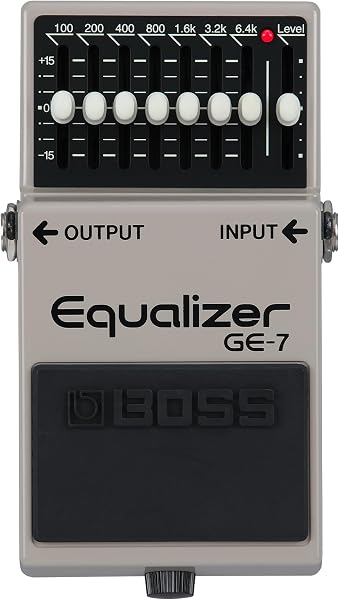
The BOSS GE-7 is the only guitar pedal on this list, and it earns its place as one of the most widely used equalizer pedals in the world. Designed specifically for guitar frequencies, its seven bands are centered at 100 Hz, 200 Hz, 400 Hz, 800 Hz, 1.6 kHz, 3.2 kHz, and 6.4 kHz, which align with the tonal ranges that matter most for electric and acoustic guitar tone shaping.
We may earn a commission when you buy through this link, at no additional cost to you.
Each band offers plus or minus 15 dB of boost or cut, which is a wider range than many competing pedals and significantly more than the 12 dB found on most car audio equalizers. This extra headroom lets you make dramatic tonal changes, from scooping mids for a modern metal sound to boosting upper mids for a cutting lead tone. The dedicated level slider is equally important, allowing you to use the GE-7 as a clean volume boost for solos or to match the output level after making significant EQ changes.
Build quality is typical BOSS, which means the pedal is housed in a rugged metal enclosure that can withstand years of touring and pedalboard use. The slider design gives you a clear visual representation of your EQ curve at a glance, which is faster to read during a live performance than trying to interpret knob positions. The five-year warranty provides additional peace of mind for a pedal that will likely stay on your board for a very long time.
One of the most practical uses for a graphic EQ pedal is as a clean boost during solos. By raising the level slider by three to six dB and adding a slight midrange boost around 800 Hz to 1.6 kHz, you can cut through a band mix without changing your amplifier settings. This approach is often more transparent than using a dedicated overdrive pedal for volume, and it lets you maintain your core tone while simply increasing your presence in the mix.
The GE-7 is the clear choice for guitarists who need reliable, flexible tone shaping in a compact format. It is not designed for car audio or studio rack use, so buyers in those categories should look elsewhere. For guitar players, however, the combination of guitar-specific frequency centers, wide adjustment range, and proven durability makes the GE-7 a benchmark that few competitors match.
Not designed for car audio systems, home stereo setups, or studio rack installations.
We may earn a commission when you buy through this link, at no additional cost to you.
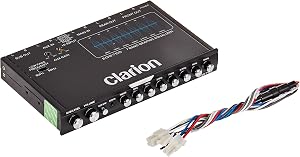
The Clarion EQS755 is a strong starting point for anyone upgrading a car audio system that still uses a factory head unit or a basic aftermarket receiver. Its half-DIN form factor fits neatly below or above a standard stereo, and the combination of RCA and high-level speaker inputs means you can connect it to almost any source without adding a separate line output converter.
We may earn a commission when you buy through this link, at no additional cost to you.
The seven frequency bands span from 50 Hz to 16 kHz, which covers the full audible range in broad strokes. While 31-band units offer more surgical precision, seven bands are more than enough for typical car listening where road noise and cabin acoustics make ultra-fine adjustments less meaningful. The eight-volt RCA outputs are a genuine advantage here, delivering a stronger signal to your amplifiers than the two- or four-volt outputs found on many budget head units, which translates to a cleaner sound at higher volumes.
Usability is straightforward thanks to the independent master volume and subwoofer level knobs on the front panel. The selectable low-pass filter lets you choose between a 60 Hz or 90 Hz crossover point for your subwoofer channel, which is helpful if your amplifier does not have its own adjustable crossover. The front-panel 3.5mm auxiliary input is a convenient bonus for quickly plugging in a phone or portable player without reaching behind the dash.
Most factory head units produce around two volts on their RCA outputs, and many budget aftermarket receivers top out at four volts. When you feed that relatively weak signal into a powerful amplifier, the amp has to work harder to reach full output, which can introduce noise and reduce dynamic range. The Clarion EQS755 outputs eight volts, giving your amplifiers a robust signal that stays clean even at high gain settings. This is especially noticeable in systems with multiple amplifiers or long cable runs where signal degradation is more likely.
This equalizer is best suited for car audio enthusiasts who want a noticeable improvement in tonal control and signal strength without moving to a full digital signal processor. If you need extremely precise room correction or plan to compete in sound quality events, a unit with more bands would serve you better, but for daily driving and solid system tuning, the EQS755 delivers reliable performance at a reasonable price.
Not ideal for buyers who need more than seven bands of equalization or who want a fully digital signal processor with time alignment.
We may earn a commission when you buy through this link, at no additional cost to you.
The Taramps TEQ 7.4 targets car audio builders who prioritize signal clarity above all else. With a frequency response that stretches from 6 Hz to 55 kHz and a signal-to-noise ratio exceeding 100 dB, this unit is designed to pass audio through with minimal coloration or added noise. That specification profile makes it a good match for systems using high-quality speakers and amplifiers where you want the equalizer to shape tone without degrading the signal.
We may earn a commission when you buy through this link, at no additional cost to you.
The seven bands cover 50 Hz to 12 kHz with plus or minus 12 dB of adjustment per band, which is standard for this category. What sets the TEQ 7.4 apart is the breadth of its frequency response beyond the adjustable bands. Even frequencies outside the EQ range pass through cleanly, so your sub-bass and upper harmonics remain intact. The three stereo output channels (front, rear, and sub) give you enough routing flexibility for a typical multi-amplifier car system.
Installation is straightforward in any 12-volt vehicle. Taramps recommends mounting the unit in a ventilated, accessible location and away from speakers to avoid vibration damage, which is sensible advice for any half-DIN component. The blue LED lighting adds a subtle visual accent that works well in most interior color schemes, though it is not adjustable if your dash uses a different accent color.
A signal-to-noise ratio above 100 dB means the audio signal is at least 100 decibels louder than the background noise the unit generates. In practical terms, you will not hear hiss or hum during quiet passages or between tracks, even with sensitive speakers and high-gain amplifiers. This specification becomes more important as your system quality improves because higher-end components reveal noise that cheaper speakers might mask.
This equalizer is a solid choice for listeners who want a clean, transparent signal path with basic tonal shaping. If your factory radio lacks RCA outputs, you will need to add a line output converter separately since the TEQ 7.4 only accepts RCA inputs. For systems that already have clean RCA sources, the TEQ 7.4 offers excellent signal integrity at a mid-range price.
Not suitable for installations that require high-level speaker wire inputs directly from a factory head unit without an external converter.
We may earn a commission when you buy through this link, at no additional cost to you.
The dbx 231s occupies a completely different category from the car audio equalizers on this list. This is a professional dual-channel 31-band graphic equalizer designed for studio monitoring, live sound reinforcement, and fixed audio installations. Each channel provides 31 bands of one-third-octave equalization, which is the industry standard for room correction and feedback control in professional environments.
We may earn a commission when you buy through this link, at no additional cost to you.
The 31 bands give you far more granular control than a seven-band unit. Instead of adjusting a broad midrange region, you can target specific problem frequencies such as a 250 Hz room resonance or a 4 kHz feedback ring without affecting the surrounding frequencies. The switchable boost and cut range lets you choose between plus or minus 6 dB for subtle adjustments or plus or minus 12 dB when you need more aggressive correction. This flexibility is valuable in venues where the acoustic challenges change from event to event.
Connectivity is professional-grade with both balanced XLR and quarter-inch TRS inputs and outputs on each channel. The four-segment LED ladders on the front panel let you monitor output levels at a glance, and the front-panel bypass switch makes it easy to compare your EQ adjustments against the unprocessed signal. The 12 dB input gain range helps you match levels when integrating the unit into an existing signal chain with mismatched equipment.
In a car, the listening environment is small and dominated by road noise, so seven broad bands are usually sufficient. In a room, however, standing waves, reflections, and resonances create narrow peaks and dips that a seven-band EQ simply cannot address. A 31-band equalizer lets you target those specific problem frequencies with one-third-octave precision, which is why this format has been the professional standard for decades in studios, theaters, and houses of worship.
The dbx 231s is the right choice for audio professionals, venue operators, and serious home studio owners who need precise room correction or live sound management. It is not designed for car audio use, and its rack-mount chassis and balanced connections would be impractical in a vehicle. If your needs are limited to tonal shaping in a car, a seven-band unit will serve you better at a fraction of the cost.
Not intended for car audio installations or buyers who only need basic tonal shaping for casual listening.
We may earn a commission when you buy through this link, at no additional cost to you.
The Clarion EQS755V is the updated version of the popular EQS755, retaining the same core feature set that made the original a favorite among car audio installers. It combines a seven-band graphic equalizer with a built-in crossover, giving you both tonal shaping and frequency routing in a single half-DIN chassis. This combination reduces the number of components in your signal chain and simplifies wiring.
We may earn a commission when you buy through this link, at no additional cost to you.
The seven bands cover 50 Hz through 16 kHz, and the eight-volt RCA outputs provide a strong, clean signal to your amplifiers. The selectable low-pass filter is one of the most useful features here, letting you choose between 60 Hz and 90 Hz crossover points for your subwoofer output. This is particularly helpful when pairing the unit with a subwoofer amplifier that lacks its own adjustable crossover, as it ensures the sub only receives the low frequencies it is designed to reproduce.
The EQS755V accepts both RCA and high-level speaker inputs, so it works with factory head units that do not have RCA outputs. The front 3.5mm auxiliary input adds another convenient source option, and the independent master volume and subwoofer level controls let you make quick adjustments without reaching for your phone or head unit. The ground loop isolation circuit helps eliminate the alternator whine that plagues many car audio installations.
A crossover directs specific frequency ranges to the appropriate speakers, sending bass to your subwoofer and midrange and treble to your full-range speakers. When your equalizer includes a built-in crossover, you eliminate the need for a separate crossover unit or an amplifier with advanced crossover controls. This simplifies your installation, reduces cable clutter, and can improve signal quality by keeping the audio path shorter.
This model is best for car audio builders who want an all-in-one equalizer and crossover solution without adding a separate digital signal processor. If you already own the original EQS755, the differences are minor enough that upgrading may not be necessary. For new installations, however, the EQS755V offers a proven combination of features, signal quality, and reliability at a competitive price.
Not the best choice for buyers who already have a digital signal processor or who need more than seven bands of equalization.
We may earn a commission when you buy through this link, at no additional cost to you.
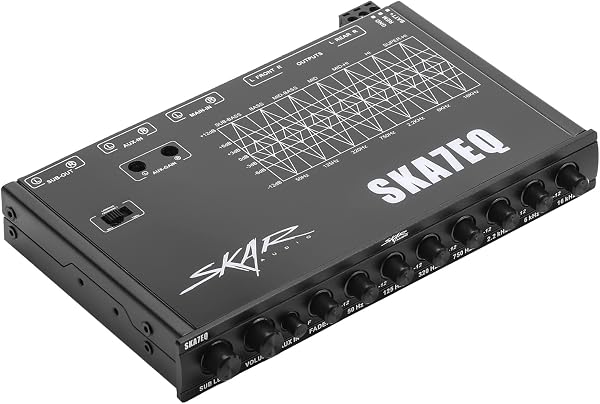
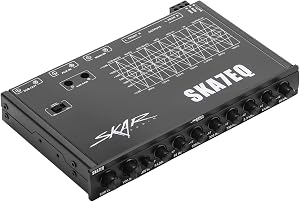
The Skar Audio SKA7EQ delivers a feature set that rivals equalizers costing twice as much, making it one of the best values in the car audio EQ category. At its price point, the seven-volt RCA outputs are the standout specification. Most equalizers in this range offer four or five volts, so the extra output voltage gives your amplifiers a stronger signal and helps maintain clarity at higher volumes.
We may earn a commission when you buy through this link, at no additional cost to you.
The distortion and noise specifications are impressive for any price range. A total harmonic distortion rating of 0.005 percent and a signal-to-noise ratio of 100 dB indicate that the SKA7EQ passes audio through with very little degradation. The 20 dB of headroom means the unit can handle signal peaks without clipping, which is important when you are running a high-output source or pushing your system hard during bass-heavy tracks.
Installation is made easier by the included mounting brackets and hardware, which is a small detail that many budget brands overlook. The half-DIN chassis fits standard mounting locations, and the front-panel controls include a fader and variable subwoofer level adjustment. The selectable low-pass filter offers 60 Hz and 120 Hz crossover points, giving you more subwoofer routing flexibility than some competitors that only offer a single fixed frequency.
Total harmonic distortion measures how much unwanted harmonic content the equalizer adds to the original signal. A THD of 0.005 percent is extremely low and means the audio passing through the unit remains virtually identical to the source. Higher distortion values can make music sound harsh or muddy, especially at high volumes. When comparing equalizers, a lower THD figure generally indicates a cleaner, more transparent signal path.
This equalizer is ideal for budget-conscious car audio builders who want high-voltage outputs and clean signal performance without spending over fifty dollars. The main trade-off is that it lacks high-level speaker inputs, so you will need an RCA source or a separate line output converter if your head unit only has speaker-level outputs. For systems with RCA outputs already in place, the SKA7EQ offers exceptional performance per dollar.
Not suitable for installations using a factory head unit with only speaker-level outputs unless you add a separate line output converter.
We may earn a commission when you buy through this link, at no additional cost to you.
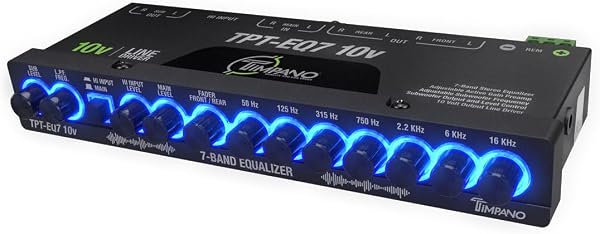
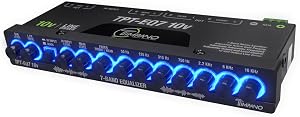
The Timpano TPT-EQ7 solves one of the most common problems in car audio upgrades: connecting an equalizer to a factory head unit that lacks RCA outputs. Its built-in high-level input converter accepts speaker wire signals directly from the factory radio and converts them to clean RCA-level outputs, eliminating the need for a separate line output converter. This simplifies the installation and reduces the number of components in your signal chain.
We may earn a commission when you buy through this link, at no additional cost to you.
The ten-volt line driver output is the highest voltage on this list among the car audio equalizers, which gives your amplifiers an exceptionally strong signal. This is particularly beneficial in systems with long cable runs or multiple amplifiers, where signal loss can become an issue. The six-channel RCA outputs cover front, rear, and subwoofer channels, and the adjustable subwoofer level control on the front panel lets you fine-tune bass response without reaching for your amplifier gain controls.
The slim profile of the TPT-EQ7 makes it one of the easiest units to fit in tight installation spaces. At just over seven inches wide and about one inch tall, it can mount in locations where a full-DIN equalizer would not fit. The seven adjustable bands provide standard tonal control from 50 Hz to 16 kHz, and the built-in crossover helps route low frequencies to your subwoofer channel.
Most factory car radios do not have RCA preamp outputs, which means you cannot connect an equalizer or amplifier directly without some form of signal conversion. A separate line output converter adds cost, complexity, and another potential point of failure. The TPT-EQ7 integrates this conversion into the equalizer itself, so you can tap into the factory speaker wires, run them to the high-level inputs, and get clean RCA outputs for your amplifiers in one step.
This equalizer is the top choice for anyone upgrading a factory car stereo system who wants to add an equalizer and line driver without purchasing additional converters. The built-in high-level input and ten-volt output handle the two biggest challenges of factory system upgrades in a single compact unit. If you already have an aftermarket head unit with RCA outputs, the high-level converter is less critical, and you might prefer a unit with more output channels or additional features.
Not the best option for buyers who already have a high-end aftermarket head unit with built-in RCA outputs and crossovers.
We may earn a commission when you buy through this link, at no additional cost to you.
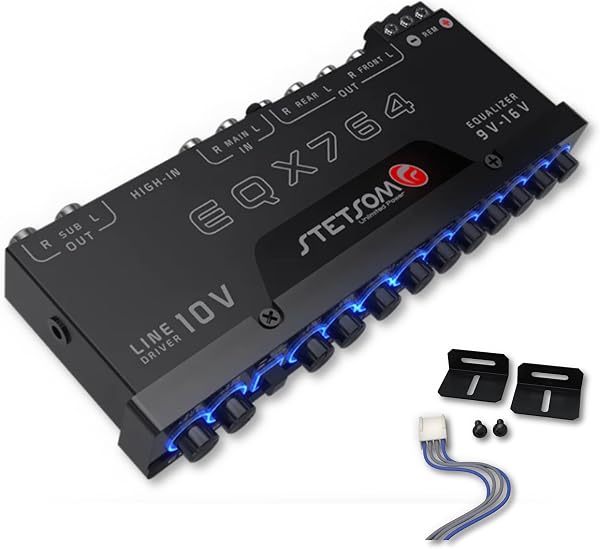
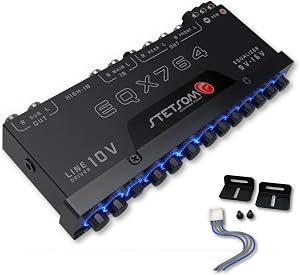
The Stetsom EQX764 is designed for car audio systems that demand more routing flexibility than a basic equalizer can provide. With four input channels and six output channels, it can handle multiple audio sources and distribute the signal to a multi-amplifier setup without requiring additional splitters or distribution blocks. This makes it a strong choice for competition-level builds or daily drivers with separate amplifiers for front, rear, and subwoofer channels.
We may earn a commission when you buy through this link, at no additional cost to you.
The ten-volt line driver output ensures that your amplifiers receive a strong, clean signal even in systems with long cable runs or multiple gain stages. The dedicated subwoofer controls are a notable advantage over simpler equalizers that only offer a basic subwoofer level knob. The EQX764 provides both level and frequency adjustment for the subwoofer output, giving you more precise control over the crossover point and bass output without relying on your subwoofer amplifier’s built-in controls.
The input selection switch lets you toggle between RCA and high-level sources, and the individual level controls for each input type help you match signal levels when switching between sources. The front and rear fader control adds another layer of adjustment for balancing the soundstage. Blue LED illumination makes the controls easy to read in dim lighting, which is helpful for making adjustments while driving at night.
If your car audio setup includes a head unit, a Bluetooth receiver, and a separate media player, you typically need a source selector or multiple inputs on your signal processor. The EQX764 handles this by offering four input channels that accept both RCA and high-level connections. This means you can connect multiple sources directly to the equalizer and switch between them without adding extra hardware, keeping your installation cleaner and your signal path shorter.
This equalizer is best suited for experienced car audio builders who need extensive routing options and want to consolidate multiple signal management functions into a single unit. Beginners may find the number of controls and connections overwhelming, and a simpler seven-band EQ with fewer inputs and outputs would be easier to configure. For complex systems, however, the EQX764 offers a level of flexibility that most competitors in this price range cannot match.
Not recommended for first-time car audio installers who only need a simple equalizer for a basic two-channel system.
We may earn a commission when you buy through this link, at no additional cost to you.
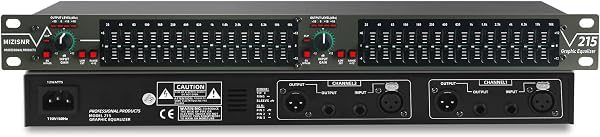
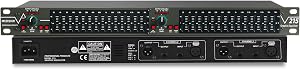
The EQ-215 fills a useful middle ground between simple consumer tone controls and expensive 31-band professional equalizers. With 15 bands per channel and a standard 1U rack-mount form factor, it is designed for home audio enthusiasts, DJ setups, and small studio installations where you need more precision than a basic bass and treble knob but do not require the surgical accuracy of a full 31-band processor.
We may earn a commission when you buy through this link, at no additional cost to you.
Each channel offers plus or minus 12 dB of adjustment per band, and the adjustable gain and decay values let you switch between six dB and 12 dB ranges for finer or broader adjustments. The low-cut filter switch is a practical feature that attenuates subsonic frequencies below the audible range, which helps eliminate turntable rumble, wind noise, floor vibrations, and electrical hum. This is especially useful in DJ and live sound applications where low-frequency noise can consume amplifier headroom and muddy the overall mix.
The bypass switch on the front panel lets you instantly compare your EQ settings against the unprocessed signal, which is essential for making sure your adjustments are actually improving the sound rather than introducing new problems. The combination of balanced XLR and unbalanced quarter-inch TRS inputs and outputs ensures compatibility with a wide range of mixers, amplifiers, and audio interfaces, whether you are working with professional balanced connections or consumer-level unbalanced gear.
Frequencies below about 30 Hz are rarely musical but can consume significant amplifier power and cause speaker distortion. A low-cut filter removes these subsonic frequencies before they reach your amplifiers, which frees up headroom and reduces the risk of woofer damage from excessive excursion. In DJ and live sound applications, the low-cut filter also helps eliminate stage rumble, microphone handling noise, and HVAC vibrations that can accumulate in the sub-bass region.
This equalizer is a practical choice for home audio systems, small DJ rigs, and project studios that need dual-channel equalization without the cost of a high-end 31-band unit. It is not designed for car audio use, and professionals working in large venues or critical mastering environments will likely need the additional precision of a 31-band model. For its price point, however, the EQ-215 offers solid functionality and flexible connectivity.
Not designed for car audio installations or professional mastering environments that require 31-band precision.
We may earn a commission when you buy through this link, at no additional cost to you.
The PRV AUDIO EQ7-15 stands out with the highest output voltage of any car audio equalizer in this guide. At 15 volts, its RCA outputs deliver nearly double the signal strength of an eight-volt unit and roughly three to four times the output of a typical aftermarket head unit. This massive voltage swing is designed for high-power car audio systems where amplifiers need every bit of signal they can get to reach full output cleanly.
We may earn a commission when you buy through this link, at no additional cost to you.
The 20 dB of headroom works in conjunction with the high output voltage to ensure that signal peaks pass through without compression or distortion. Each of the seven bands features a precision stop point at zero dB, which makes it easy to return any band to its flat position by feel alone. This is a small but useful detail for installers and tuners who frequently adjust and reset their EQ curves during system setup.
PRV AUDIO emphasizes component quality, noting the use of one-percent tolerance components throughout the circuit. Tighter component tolerances generally translate to more accurate frequency response and more consistent performance between individual units. The front-panel fader and subwoofer level controls provide the standard routing adjustments you would expect, and the overall build quality reflects a unit designed for serious car audio applications rather than casual upgrades.
Amplifiers have a maximum input voltage rating, and feeding them a signal that exceeds this rating can cause clipping and distortion. Before choosing a 15-volt equalizer, check your amplifier specifications to confirm they can accept that level of input. Most high-end car audio amplifiers are designed to handle 8 to 15 volts without issue, but some budget amplifiers may clip at voltages above four or five volts. Matching your equalizer output to your amplifier input ensures the cleanest possible signal chain.
This equalizer is the right choice for high-power car audio systems where signal voltage and headroom are critical to achieving clean, undistorted output from your amplifiers. If your system uses modest amplifiers and standard speakers, the extra voltage may not provide a noticeable benefit, and a less expensive seven-band EQ would be sufficient. For competition-level builds and systems pushing several thousand watts, however, the EQ7-15 provides the signal foundation those amplifiers need to perform at their best.
Not ideal for budget car audio systems with low-gain amplifiers that cannot accept high-voltage inputs without clipping.
We may earn a commission when you buy through this link, at no additional cost to you.
Choosing an equalizer starts with understanding where it will be used and what problems you need it to solve. The right unit for a car stereo is very different from the right unit for a guitar pedalboard or a home listening room. This section covers the key factors that should guide your decision.
The number of bands on an equalizer determines how precisely you can target specific frequencies. A seven-band equalizer divides the audible spectrum into broad regions, which is sufficient for general tonal shaping such as boosting bass, cutting harsh treble, or adjusting midrange presence. A 15-band unit offers roughly twice the resolution, letting you address narrower problem areas without affecting adjacent frequencies. A 31-band equalizer provides one-third-octave precision, which is the professional standard for room correction and feedback elimination.
More bands are not automatically better for every situation. In a car, the listening environment is small, reflective, and filled with road noise, which means ultra-fine adjustments are often masked by the environment itself. Seven bands are typically enough to make meaningful improvements in a vehicle. In a room, however, standing waves and resonances create narrow peaks and dips that require more bands to address effectively. For guitar use, seven bands centered on guitar-specific frequencies provide all the control most players need.
Choose seven bands for car audio and guitar applications, 15 bands for home audio and DJ setups that need moderate precision, and 31 bands for professional studio and live sound environments where room correction is critical.
Output voltage is one of the most important specifications for car audio equalizers because it directly affects how cleanly your amplifiers can reach full power. A typical factory head unit produces about two volts on its RCA outputs, while many aftermarket receivers offer four to five volts. Car audio equalizers boost this signal to seven, eight, ten, or even 15 volts, giving your amplifiers a stronger input that reduces the need for high gain settings and minimizes noise.
Higher output voltage is most beneficial in systems with multiple amplifiers, long cable runs, or high-power subwoofers. In these situations, a weak signal can degrade before reaching the amplifier, resulting in a noisy or compressed sound. A 15-volt equalizer like the PRV AUDIO EQ7-15 provides maximum signal strength for demanding installations, while an eight-volt unit like the Clarion EQS755 offers a significant improvement over most head units at a lower price point.
Match your equalizer output voltage to your amplifier input sensitivity. Check your amplifier specifications to confirm it can handle the voltage your equalizer produces, and choose the highest voltage your system can accept cleanly for the best signal-to-noise performance.
The types of inputs and outputs on an equalizer determine how easily it integrates with your existing equipment. Car audio equalizers typically use RCA connections for both inputs and outputs, and some models also accept high-level speaker wire inputs for compatibility with factory head units that lack RCA outputs. Studio and home audio equalizers use balanced XLR and unbalanced quarter-inch TRS connections, which are standard in professional audio environments. Guitar equalizer pedals use quarter-inch instrument cables.
The number of input and output channels also matters. A basic car audio equalizer may have two inputs and six outputs for front, rear, and subwoofer channels. More advanced models like the Stetsom EQX764 offer four inputs and six outputs, which allows you to connect multiple audio sources and route the signal to a complex multi-amplifier system. For studio use, dual-channel equalizers with independent left and right processing are standard.
Before buying, inventory your current connections. If your head unit only has speaker-level outputs, choose an equalizer with high-level inputs or plan to add a line output converter. If you are building a multi-amplifier system, make sure the equalizer has enough output channels to feed every amplifier without splitters.
Many car audio equalizers include built-in crossover functions that direct specific frequency ranges to the appropriate speakers. A low-pass filter sends only bass frequencies to your subwoofer, while a high-pass filter prevents low frequencies from reaching your smaller speakers. Some equalizers offer selectable crossover points, such as 60 Hz or 90 Hz for the low-pass filter, which lets you match the crossover to your subwoofer’s capabilities and your enclosure type.
In studio and home audio applications, low-cut filters serve a different purpose by removing subsonic noise such as turntable rumble, HVAC vibration, and electrical hum. These filters typically engage at a fixed frequency around 20 to 40 Hz and help preserve amplifier headroom by eliminating energy that is below the audible range but still consumes power.
If your amplifiers already have adjustable crossovers, the built-in crossover on an equalizer is a convenient backup but not essential. If your amplifiers lack crossover controls, choosing an equalizer with selectable low-pass and high-pass filters can save you from buying a separate crossover unit and simplify your installation.
Equalizers come in several physical formats, and the right one depends on where you plan to install it. Car audio equalizers are typically half-DIN or full-DIN units that mount in or near the dashboard. Half-DIN models are the most common and fit in the space below a standard single-DIN head unit. Guitar equalizers are compact stompbox pedals designed to sit on a pedalboard. Studio and home audio equalizers are rack-mount units that fit in standard 19-inch equipment racks.
Within the car audio category, physical dimensions vary more than you might expect. Some units are slim enough to fit in tight spaces behind a dashboard panel, while others require more depth and may need a dedicated mounting location in the trunk or under a seat. Check the dimensions carefully before purchasing, especially if you plan to mount the equalizer in a confined area.
Measure your available mounting space before choosing an equalizer. For car installations, confirm whether you need a half-DIN or full-DIN unit and check the depth clearance. For rack-mount applications, verify that you have an available 1U slot. For pedalboards, consider the physical footprint and power supply requirements.
Signal-to-noise ratio and total harmonic distortion are the two key specifications that indicate how cleanly an equalizer processes audio. A higher signal-to-noise ratio means less background hiss, while a lower THD figure means less unwanted harmonic content added to the signal. For car audio equalizers, a signal-to-noise ratio of 100 dB or higher and a THD below 0.01 percent are considered excellent. Professional rack units typically meet or exceed these figures as well.
Ground loop isolation is another important noise-reduction feature in car audio equalizers. Alternator whine is one of the most common noise problems in car audio, and it occurs when the electrical ground paths between the head unit, equalizer, and amplifiers create a loop that picks up engine noise. An equalizer with built-in ground loop isolation can eliminate this problem without requiring additional noise filters.
If you are building a high-quality system with sensitive speakers and powerful amplifiers, prioritize equalizers with strong signal-to-noise and THD specifications. In a noisy car environment, the differences may be less audible than in a quiet listening room, but clean signal processing is always beneficial and becomes more noticeable as the rest of your system improves.
Start with all bands set to the flat or zero position and listen to familiar music before making any adjustments. Make small changes of two to three dB at a time and listen for the effect before adjusting further. Boosting frequencies aggressively can introduce distortion and reduce amplifier headroom, so it is often more effective to cut problem frequencies than to boost everything else. In a car, make your final adjustments while the vehicle is parked in a quiet location, then recheck the settings while driving at highway speed since road noise will change the perceived balance.
For car audio equalizers, ensure all RCA connections are secure and that the ground wire is attached to a clean, bare metal point on the vehicle chassis. Loose connections are a common source of noise and intermittent signal loss. Route RCA cables away from power wires to minimize electromagnetic interference, and use quality shielded cables for the best noise rejection. If you hear alternator whine, check the ground connections first before adding external noise filters.
Keep your equalizer clean and free from dust, especially if it is mounted in a rack or on a pedalboard where airflow may be limited. For rack-mount units, ensure adequate ventilation around the chassis to prevent overheating during extended use. For guitar pedals, use a regulated power supply that matches the voltage and polarity requirements to avoid damaging the internal circuitry. Periodically check all connections and clean the sliders or knobs with compressed air if they become scratchy or unresponsive.
Basic bass and treble controls adjust only two broad frequency regions and offer limited precision. An equalizer with seven or more bands lets you target specific problem areas such as harsh upper mids or boomy lower mids that simple tone controls cannot address. If you are satisfied with your current sound, an equalizer may not be necessary, but if you notice specific frequency issues, an EQ will give you much more control.
Yes, but you need to check the input options. If your factory head unit lacks RCA outputs, you will need an equalizer with high-level speaker wire inputs or a separate line output converter. Models like the Timpano TPT-EQ7 include built-in high-level inputs, which simplifies the installation by eliminating the need for an external converter.
A graphic equalizer uses fixed frequency bands with sliders that adjust the boost or cut at each frequency. A parametric equalizer lets you choose the exact frequency, bandwidth, and gain for each band, offering more precision but requiring more expertise to use effectively. All the equalizers in this guide are graphic equalizers, which are simpler to operate and well suited for most buyers.
A higher output voltage does not directly increase volume, but it provides a stronger signal to your amplifiers, which allows them to reach full power more cleanly. This can result in a louder, clearer sound at high volumes because your amplifiers do not need as much gain to reach their maximum output. The benefit is most noticeable in high-power systems with multiple amplifiers.
Seven bands are sufficient for most car audio applications. The car environment is noisy and acoustically challenging, which means ultra-fine adjustments are often masked by road noise and cabin reflections. A seven-band EQ lets you make meaningful improvements to bass, midrange, and treble without the complexity of a 31-band unit. More bands are beneficial primarily in quiet room environments.
No, guitar EQ pedals are designed for instrument-level signals and guitar-specific frequency ranges. They use quarter-inch instrument cables and operate at much lower signal levels than car audio equipment. Connecting a guitar pedal to a car audio system would result in mismatched signal levels, incorrect frequency bands, and potential damage to the pedal or your car audio components.
The most common location is in the dashboard area below or above the head unit, using a half-DIN mounting slot. If dashboard space is not available, you can mount the equalizer in the center console, under a seat, or in the trunk near your amplifiers. Choose a location that is accessible for adjustments, ventilated to prevent overheating, and away from sources of vibration and moisture.
Alternator whine is a high-pitched noise that changes pitch with engine RPM, caused by electrical interference entering the audio signal through ground loops or poorly shielded cables. An equalizer with built-in ground loop isolation can help eliminate this noise by breaking the ground loop in the signal path. However, proper grounding and cable routing are the most effective long-term solutions.
Set your amplifier gains first with the equalizer in the flat position, then make your EQ adjustments afterward. If you adjust the equalizer first and then set your gains, the EQ boosts may cause your amplifiers to clip at certain frequencies. After making EQ changes, recheck your gain settings to ensure your amplifiers are still operating within their clean output range.
The best equalizer for your setup depends entirely on where and how you plan to use it. For car audio systems, the Clarion EQS755 and its updated EQS755V variant offer the most well-rounded combination of features, signal quality, and installation flexibility. For high-power car audio builds that demand maximum output voltage, the PRV AUDIO EQ7-15 and Timpano TPT-EQ7 deliver the signal strength your amplifiers need to perform at their peak.
Guitarists will find the BOSS GE-7 to be the clear standard, with its guitar-optimized frequency centers, wide adjustment range, and legendary durability. For home audio, DJ, and studio applications, the EQ-215 rack-mount equalizer and the professional dbx 231s provide the band count and connectivity that those environments require. Budget-conscious car audio builders should consider the Skar Audio SKA7EQ, which delivers impressive specifications at a price that is hard to beat.
Before making your final decision, take inventory of your current system connections, measure your available mounting space, and identify the specific audio problems you want to solve. A well-chosen equalizer can transform a mediocre system into a great one, but only if it matches your equipment, your installation constraints, and your listening priorities. Use the specifications and trade-offs outlined in this guide to make a confident choice.