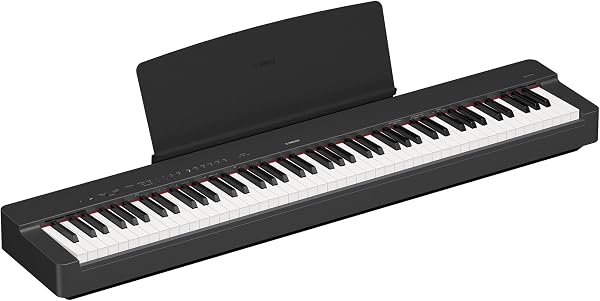
Yamaha P-225
9.2Editor score88 graded weighted keys
CFX concert grand voice
24 built-in instrument voices
Smart Pianist app support
Find the right digital pianos for 2026. We compare 10 standout options by build quality, useful features, owner feedback, value, and everyday trade-offs.
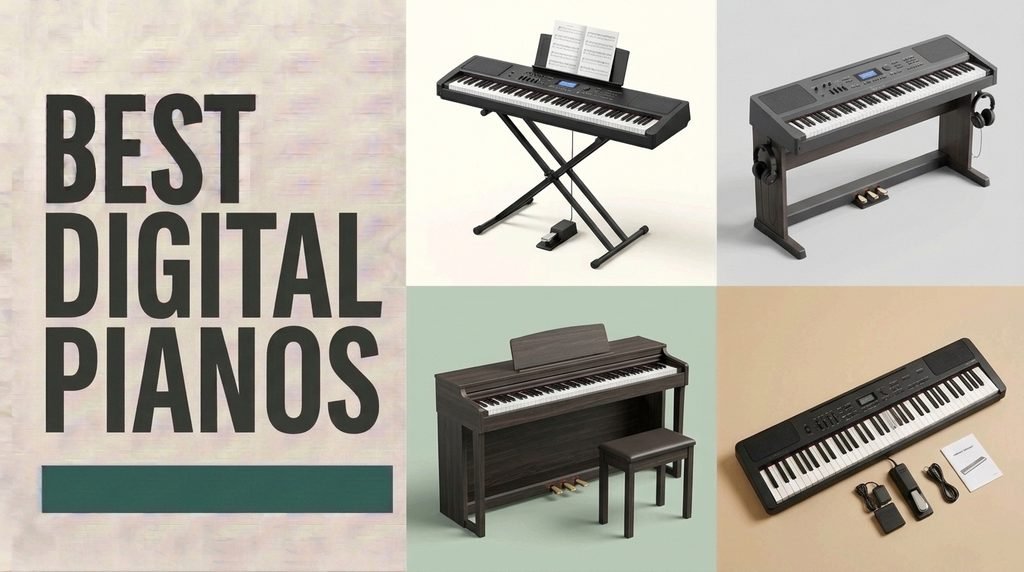
Find the right digital pianos for 2026. We compare 10 standout options by the factors that matter most in this category, including weighted key action, sound engine quality, polyphony, speaker power, pedal setups, cabinet style, connectivity, owner feedback, and the everyday trade-offs between portable slabs and furniture consoles.
Choosing a digital piano means balancing authentic acoustic feel against space, budget, and modern features. Full 88-key hammer actions build proper finger technique, while high-quality sound engines and generous polyphony keep sustained passages rich and natural. Headphone outputs, lesson modes, and app connectivity shape how easily beginners practice every day.
This guide covers portable stage-friendly slabs, complete furniture consoles with three-pedal units, and budget bundles with stands and headphones included. Whether you are buying a first piano for a child, upgrading from a basic keyboard, or furnishing a living room, the comparisons below highlight the practical differences clearly.
We compared 10 digital pianos using the details that actually help a buyer decide: 88-key hammer action quality, touch response settings, sound engine realism, polyphony limits, speaker output, pedal configuration, cabinet or slab format, USB-MIDI and Bluetooth connectivity, bundled accessories, owner feedback, and overall value. The notes focus on practical trade-offs, so each recommendation connects to how students, returning players, and home musicians actually practice and perform.


Compare key features, scores, and current prices side by side. A shorter feature list means fewer details were available, not necessarily fewer capabilities.

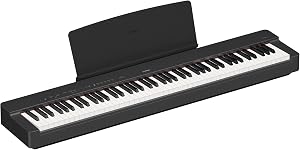





The Yamaha P71 has earned its 4.7 rating by doing one thing exceptionally well: delivering a convincing acoustic piano experience with almost zero complexity. The 88 touch-sensitive weighted keys respond to playing dynamics the way an acoustic action does, giving beginners the physical feedback they need and returning players the familiarity they expect.
We may earn a commission when you buy through this link, at no additional cost to you.
Sound quality follows the same focused philosophy. The ten-voice library is anchored by a full, resonant Yamaha grand piano tone with convincing low-end depth. Dual Mode lets you layer two voices together, such as piano and strings, which adds warmth and texture to slower pieces without any menu diving.
Everyday usability is deliberately minimal. One-button operation keeps the control surface clean, so practice time goes into playing rather than configuring settings. The slim slab format stores easily against a wall or travels in a car, and the included sustain pedal and power supply cover the essentials immediately.
Combining piano with a sustained voice like strings creates a fuller sound for ballads and film pieces. It is a simple feature, but it meaningfully expands what a ten-voice instrument can express.
The honest limitation is variety. Players who want hundreds of tones, rhythms, and recording tools will find the P71 austere. If your priority is a trusted weighted action and a beautiful core piano sound at a sensible price, this streamlined approach is a strength rather than a weakness.
Not for players who want a large sound library, built-in rhythms, or onboard recording tools.
We may earn a commission when you buy through this link, at no additional cost to you.
The Yamaha P225 is the strongest all-round choice in this lineup for players who want authentic grand piano tone without committing to a full furniture console. It is built around the sound of Yamaha's flagship CFX concert grand, capturing the natural resonance and full-bodied character that cheaper sound sources tend to flatten. For serious beginners and intermediate players, that tonal headroom makes long practice sessions far more rewarding.
We may earn a commission when you buy through this link, at no additional cost to you.
The weighted keyboard action is graded, meaning the lower keys resist your fingers slightly more than the upper keys, mirroring the mechanical feel of an acoustic grand. This matters more than any other specification for students, because it builds the finger strength and dynamic control that transfer directly to acoustic instruments. Twenty-four instrument voices, including electric pianos, organs, strings, and bass, give you room to explore beyond classical piano.
Day to day, the P225 keeps operation simple. A music rest and sustain foot switch come in the box, and the lightweight chassis is easy to shift between a bedroom, living room, or lesson studio. Connecting to the Smart Pianist app puts voice selection and settings on your phone or tablet, while Rec’n’Share makes recording practice clips straightforward.
Pairing the P225 with Smart Pianist turns your phone into a control panel for voices, metronome settings, and recording. Rec’n’Share adds quick audio and video capture, which is genuinely useful for students who send progress clips to a teacher between lessons.
The main tradeoff is price and pedal hardware. You pay more than you would for a basic slab, and players tackling classical repertoire will eventually want an optional three-pedal setup. For most home pianists who prioritize sound quality and realistic touch above everything else, the P225 earns its keep.
Not for buyers who want a built-in furniture stand and three-pedal unit included in the box.
We may earn a commission when you buy through this link, at no additional cost to you.
The Donner DEP-20 solves the most common beginner problem in one purchase: getting a complete, properly equipped piano setup without piecing together accessories. The furniture stand and three-pedal unit come included, so the instrument looks and behaves like a traditional home piano from day one. For families buying a first serious instrument, that completeness carries real value.
We may earn a commission when you buy through this link, at no additional cost to you.
Under the hood, the DEP-20 is generously specified. Its 88 full-size hammer action keys offer adjustable touch response, letting players dial in a lighter or firmer feel as their technique develops. The 238-tone library covers everything from ukulele to bass, and the 128-note maximum polyphony keeps layered voices and sustained, pedal-heavy passages from cutting off prematurely.
The backlit LCD screen is a practical touch, displaying chord names and notation while you navigate tones, recording mode, MIDI functions, and the built-in MP3 player. Two 25W amplifiers push enough volume for a living room or small gathering without external amplification, and audio inputs and outputs support more ambitious arrangements.
Polyphony is the number of notes a piano can produce at once. With 128 notes available, sustained chords held with the damper pedal and dual-layered voices ring out fully instead of dropping earlier notes, which keeps expressive playing intact.
The compromise is focus. Hundreds of tones and rhythms are fun, but students who only need a great piano sound may find the busier control panel more distracting than inspiring. If you want maximum features per dollar with a full console presentation, the DEP-20 is difficult to beat.
Not for purists who want a minimal, piano-only instrument with a stripped-back control panel.
We may earn a commission when you buy through this link, at no additional cost to you.
The Roland FP-10 is the entry point to Roland's respected FP series, and it concentrates its budget exactly where students benefit most: key feel and sound quality. The 88-note keyboard uses an ivory-feel surface with an expressive touch response that behaves convincingly like an acoustic action, while the SuperNATURAL sound engine delivers the warm, dynamically responsive tone the brand is known for.
We may earn a commission when you buy through this link, at no additional cost to you.
For lesson households, Twin Piano mode is the standout feature. It splits the keyboard into two identical octave ranges so a teacher and student can sit side by side and play the same notes in the same register, which makes demonstrating passages dramatically easier during in-person instruction.
Practical details are well considered. The key action runs quietly, which combined with the headphone output means genuine silent practice in apartments or shared homes. USB MIDI connectivity hooks straight into GarageBand, recording software, or learning apps, and the Roland Piano App lets you select sounds and set the metronome from your phone. A DP-2 foot switch and sheet music rest are included.
Instead of reaching across the keyboard or trading seats, Twin Piano gives student and teacher matching middle Cs. Demonstrations, call-and-response exercises, and duets all become simpler, which is why this mode is prized in teaching studios.
The tradeoff is furniture. The matching stand costs extra, and the single included pedal will need upgrading for players working through classical repertoire. For students who want the most authentic key action per dollar in a compact slab, the FP-10 is a benchmark choice.
Not for buyers who want a complete console with stand and three pedals included at purchase.
We may earn a commission when you buy through this link, at no additional cost to you.
The Yamaha Arius YDP-146B is the pick for households that want a permanent, furniture-grade piano with modern wireless convenience. Its classic black upright cabinet houses the full CFX concert grand voice complete with damper and string resonance, the subtle sympathetic vibrations that give acoustic pianos their depth. Nine additional instrument voices round out the palette.
We may earn a commission when you buy through this link, at no additional cost to you.
The 88-key Graded Hammer Standard action replicates the weighted feel students need to develop proper technique, and the three-pedal unit supports the full range of expressive pedaling from the start. This is a piano a beginner can grow with for many years without outgrowing the hardware.
Where the YDP-146B separates itself from older consoles is connectivity. Bluetooth audio lets you stream music through the piano’s speakers to play along, while Bluetooth MIDI connects learning apps without cables. The built-in library is unusually deep, with 303 lesson songs, 50 classical pieces, and 10 voice demo songs supporting structured self-study. A matching bench comes included.
Wireless audio streaming turns the piano’s speaker system into a playback source for backing tracks and reference recordings. Bluetooth MIDI also removes cable clutter when connecting tablets for interactive lessons, keeping the cabinet area clean.
The investment is significant, and the cabinet’s weight means choosing its position carefully during setup. For committed learners who want one piano that handles silent practice, app-based learning, and living-room presence in a single elegant package, the YDP-146B justifies its price.
Not for renters or students who need a lightweight instrument they can carry to lessons and rehearsals.
We may earn a commission when you buy through this link, at no additional cost to you.
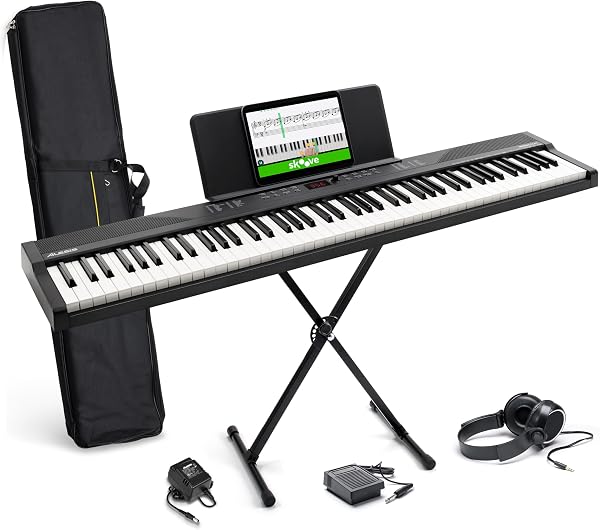
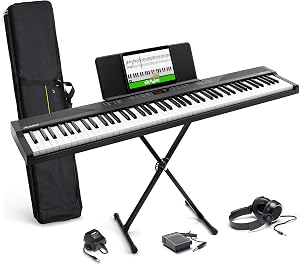
The Alesis Recital Play is built for buyers who want to start learning immediately without assembling a pile of accessories. The bundle includes an adjustable stand, sheet music and tablet rest, sustain pedal, headphones, a carry case, and a power supply. At its price, that completeness is the headline feature, since buying those items separately can approach the cost of the keyboard itself.
We may earn a commission when you buy through this link, at no additional cost to you.
The instrument offers 88 full-size, touch-sensitive keys that cover the entire piano range, which matters for students following standard method books. A library of 480 sounds, 160 rhythms, and 140 demo songs keeps practice varied, and the educational toolkit is genuinely useful: Split mode divides the keyboard for teacher-student duets, Lesson mode supports guided learning, and Record mode captures progress.
Connectivity adds long-term value. USB-MIDI plugs into a Mac or PC for recording software, and included premium lessons from Skoove and Melodics give structure to self-directed study. The option to run on six AA batteries means the keyboard can travel to a grandparent’s house or a park without hunting for an outlet.
Skoove and Melodics lessons connect over USB-MIDI and listen as you play, offering real-time feedback on notes and timing. For beginners without a weekly teacher, this structured guidance helps maintain momentum between practice sessions.
The key tradeoff is touch. The keys respond to playing velocity but lack the weighted hammer mechanism that builds acoustic-ready finger strength. For casual learners, young children testing their interest, or budget-first buyers, that compromise is reasonable. Committed classical students should consider a weighted model instead.
Not for students pursuing classical training who need weighted hammer action to develop proper technique.
We may earn a commission when you buy through this link, at no additional cost to you.
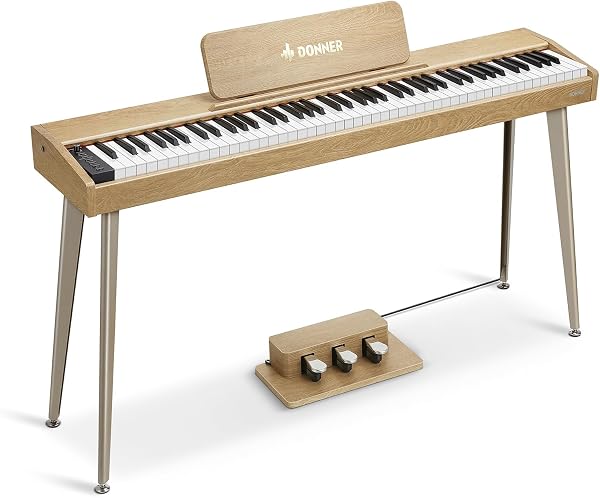
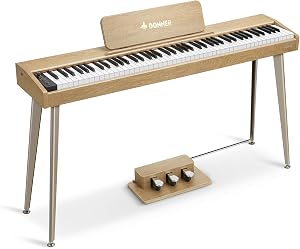
The Donner DDP-80 takes a different design path from most digital pianos in this range, presenting itself as a piece of retro-styled wooden furniture that happens to contain a serious instrument. For buyers who want a piano that enhances a room visually rather than looking like stage equipment, the warm wood finish is the immediate draw.
We may earn a commission when you buy through this link, at no additional cost to you.
The playing experience backs up the looks. The 88-key heavy hammer action captures the strength of your finger strikes and translates them into dynamic response, closely simulating the touch of an acoustic piano. The French DREAM sound source produces a realistic, rounded piano tone, and 128-note polyphony keeps dense, pedal-sustained passages from dropping notes.
Two 25W stereo speakers generate a surround-style sound field that fills a living room comfortably, while headphone mode enables private practice at any hour. USB-MIDI connectivity links the piano to teaching apps on a tablet or music editing software on a computer, so self-study, composition, and recording are all supported. The triple pedal and sheet music stand come included.
Because the DDP-80 assembles into a fixed wooden console, it behaves like traditional furniture. Position it against a wall with lighting above the music rest, and it becomes a permanent practice station that invites daily playing.
The DDP-80 concentrates on doing the core piano experience well rather than overwhelming you with hundreds of voices. Buyers who want a dignified home instrument with proper weighted action and full pedaling, and who value aesthetics as part of the decision, will find it a satisfying middle ground.
Not for gigging musicians or students who need a lightweight piano to carry between locations.
We may earn a commission when you buy through this link, at no additional cost to you.
The Eastar EUP-100 solves a real household problem: finding room for a full-size piano in a space that already works hard. Its wood-finish cabinet is designed to function as an elegant desk when the playing surface is closed, so the instrument earns its floor space in a living room, studio, or home office even on days it is not played.
We may earn a commission when you buy through this link, at no additional cost to you.
As an instrument, it covers the fundamentals properly. The 88 fully weighted hammer action keys simulate the responsive touch of a grand piano, making it a legitimate entry-level training instrument. Thirteen voices, 128 rhythms, and 31 built-in songs provide enough variety for practice and casual entertainment, while Dual Voice, Auto Chord, Transpose, and recording functions support more creative sessions.
Wireless connectivity is a practical highlight. Built-in wireless MIDI pairs with popular educational apps without cables running across the room, and MIDI IN and OUT ports cover wired setups. The bundle is generous: a triple pedal, headphones for quiet practice, piano stickers for beginners, and a protective cover are all included.
The closed cabinet presents a clean wood surface that holds a laptop, books, or decor between practice sessions. In smaller homes where every piece of furniture must justify its footprint, this dual-purpose design removes a common objection to owning a full-size piano.
Be prepared for the setup process, since the substantial cabinet weight makes assembly a two-person task. The voice count also trails feature-heavy competitors. For buyers who want proper weighted action, full pedaling, and furniture that multitasks, the EUP-100 makes a compelling case.
Not for buyers who want a lightweight instrument or who need to set up alone without lifting help.
We may earn a commission when you buy through this link, at no additional cost to you.
The Donner OURA DDP-60 is designed for buyers who care about how a piano looks in their space as much as how it plays. The slim, minimalist cabinet reads as a deliberate piece of modern furniture rather than musical equipment, and the included three-pedal unit completes the upright-style silhouette without the bulk of a traditional console.
We may earn a commission when you buy through this link, at no additional cost to you.
Feature coverage is broad for the price. You get 128 tones, 83 rhythms, 47 demo songs, and 8 reverb effects, all backed by 128-note polyphony that keeps layered sounds and sustained chords ringing cleanly. The 88 full-size keys offer four velocity-sensitive curves, so younger players can choose a lighter response while their finger strength develops.
The connectivity layout is unusually thoughtful for households with multiple learners. Three headphone jacks allow two people to practice silently at once, which is ideal for siblings or parent-child lessons, and the rear jack doubles as an auxiliary input and stereo output for speakers or amplifiers. Dual mode splits the keyboard for side-by-side teaching, and USB-MIDI handles recording and app connections.
Two under-cabinet jacks let a teacher and student monitor silently at the same time, while the rear jack connects to external speakers when it is time to be heard. Small shared spaces benefit enormously from this flexibility.
The essential caveat is the key action. Velocity-sensitive keys respond to how hard you play but do not provide the weighted resistance that classical training requires. For casual players, pop repertoire, and design-conscious homes, the DDP-60 is an elegant fit. Aspiring classical pianists should budget for a weighted model.
Not for advanced students who need fully weighted hammer action to build acoustic piano technique.
We may earn a commission when you buy through this link, at no additional cost to you.
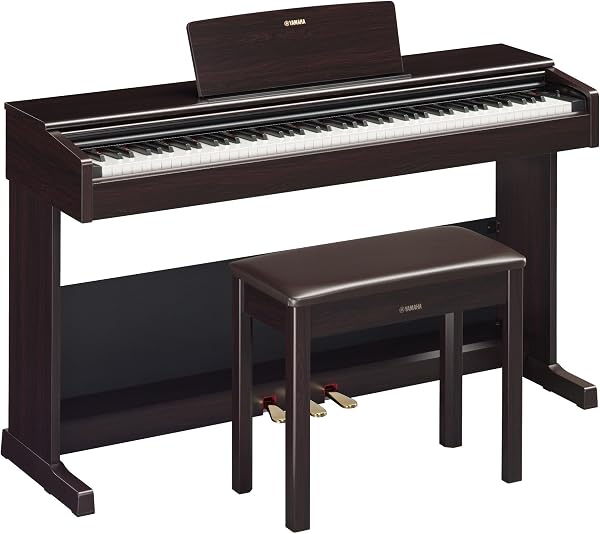
The Yamaha Arius YDP105R is the traditionalist's console: a dignified rosewood-grain upright that focuses entirely on delivering a proper piano experience for beginner and intermediate players. It arrives as a complete package with a matching bench and three-pedal unit, so nothing stands between delivery day and serious practice.
We may earn a commission when you buy through this link, at no additional cost to you.
The Graded Hammer Standard keyboard with touch response provides the weighted, graduated resistance that develops correct finger technique, heavier in the bass register and lighter in the treble like an acoustic action. The primary grand piano voice carries the rich, dynamic character Yamaha builds its reputation on, supported by nine additional instrument voices for variety.
Household practicality is well handled. Dual headphone jacks allow a student to practice silently while a parent or teacher listens alongside, which keeps lessons productive in apartments and shared homes. Ten voice demo songs and ten piano preset pieces provide reference material for early repertoire, and the built-in stereo amplifier and speakers project clearly into a living room.
Two headphone jacks mean duets, teacher-guided sessions, and late-evening practice all happen without disturbing the household. It is a simple feature that meaningfully extends when and where the piano can be used.
Compared with the newer YDP-146B, this model forgoes Bluetooth and carries a smaller onboard song library. If wireless app connectivity matters to your practice routine, the newer console is worth the step up. If you want proven Arius fundamentals in a beautiful rosewood cabinet at a lower price, the YDP105R remains a sound choice.
Not for buyers who want wireless Bluetooth streaming or a lightweight instrument that moves easily between rooms.
We may earn a commission when you buy through this link, at no additional cost to you.
Digital pianos range from sub-200-dollar starter bundles to furniture consoles that cost over a thousand dollars, and the specification sheets can blur together quickly. The good news is that a handful of decisions determine most of your long-term satisfaction: how the keys feel, how the sound engine behaves, whether you need portability, and which accessories come in the box. Work through the factors below in order, and the right model usually reveals itself.
Key action describes the physical mechanism under each key and how faithfully it mimics the weighted hammers of an acoustic piano. Fully weighted hammer action keys, like those on the Yamaha P225, Roland FP-10, and Donner DEP-20, provide real resistance that builds finger strength and teaches dynamic control. Graded actions go further by making bass keys heavier than treble keys, replicating the mechanical reality of an acoustic grand. This is the single most important specification for anyone taking structured lessons.
Touch-sensitive or velocity-sensitive keys, found on models like the Alesis Recital Play and Donner DDP-60, respond to how hard you strike but lack mechanical weight. They are perfectly usable for casual playing, pop music, and exploring whether a child’s interest will stick, but students planning years of classical study should treat weighted action as non-negotiable. Many weighted models also offer adjustable touch curves, letting you lighten or firm the response as technique develops.
Decision advice: if the player is committed to lessons or exams, choose fully weighted hammer action without compromise. For casual hobbyists, young beginners testing the waters, or tight budgets, touch-sensitive keys are an acceptable starting point with a plan to upgrade later.
The sound engine is the sampled or modeled audio source that produces each note, and quality varies enormously. Premium engines like Yamaha’s CFX concert grand sampling and Roland’s SuperNATURAL technology capture the resonance, decay, and tonal complexity of real concert instruments, while budget sound sources can feel flat during expressive passages. Polyphony, the number of simultaneous notes the piano can produce, matters more than most buyers expect: sustained chords held with the damper pedal consume polyphony rapidly, and 128-note ceilings on models like the Donner DEP-20 and DDP-80 keep dense passages intact.
Speaker systems determine how the piano sounds without headphones. Dual 25W amplifiers, as found on the DEP-20 and DDP-80, fill a living room convincingly, while smaller practice-oriented speakers suit bedrooms and headphone-heavy households. Pay attention to voice counts as well: focused instruments like the Yamaha P71 offer ten refined tones, while library-style models pack hundreds of sounds for experimentation.
Decision advice: prioritize sound engine quality over voice quantity. One beautiful grand piano voice serves students better than 200 mediocre ones. Choose 128-note polyphony or higher if you plan to use layered voices and sustain pedal work regularly.
Slab-style pianos like the Yamaha P71, P225, and Roland FP-10 are compact keyboard units designed to sit on a separate stand. They store easily, travel in a car, and suit renters, students, and anyone who might rearrange rooms. The tradeoff is that stands and upgraded pedal units usually cost extra, and a slab on an X-frame stand never quite matches the stability or appearance of a fixed console.
Console pianos like the Yamaha Arius models, Donner DDP-80, and Eastar EUP-100 integrate the keyboard into a furniture cabinet with a built-in three-pedal unit and often an included bench. They look at home in a living room, stay rock-solid during energetic playing, and the Eastar even doubles as a functional desk. The compromise is weight and permanence: consoles are awkward to move and demand a dedicated spot in your home.
Decision advice: choose a slab if flexibility, storage, or transport matters. Choose a console if the piano will live in one room permanently and appearance counts. Families buying for children often prefer consoles because the complete setup encourages consistent practice.
Pedals are easy to overlook and hard to retrofit. A basic sustain foot switch, included with slabs like the P71, P225, and FP-10, handles fundamental sustain duties and suits the first year or two of study. As repertoire advances, the full three-pedal layout found on acoustic pianos becomes relevant: sustain on the right, sostenuto in the middle, and soft una corda on the left, each shaping tone in distinct ways.
Console bundles from Donner, Yamaha Arius, and Eastar include triple-pedal units from the start, which removes a future upgrade purchase. For slab owners, check whether the manufacturer offers a matching pedal unit before buying, because proprietary connectors mean third-party pedals are not always compatible. Half-pedaling support, where the sustain pedal responds to partial depression, is another refinement worth checking for intermediate players.
Decision advice: beginners can start comfortably with an included sustain switch. Students beyond roughly two years of study, or anyone playing classical repertoire, should insist on a three-pedal unit either included or available as a matched accessory.
Modern digital pianos double as learning platforms. USB-MIDI, present across most of this lineup, connects the piano to computers and tablets for recording software and interactive lesson apps. Bluetooth audio and MIDI, as on the Yamaha YDP-146B, remove cables entirely, letting you stream backing tracks through the piano speakers and pair learning apps wirelessly. Built-in lesson content varies widely, from the Alesis Recital Play’s included Skoove and Melodics subscriptions to the YDP-146B’s 303 lesson songs.
Practice-focused features carry daily value. Twin Piano or Duo modes on the Roland FP-10 split the keyboard into identical ranges for teacher-student duets. Dual headphone jacks, found on the Yamaha consoles and in triple on the DDP-60, enable silent shared practice. Recording functions let students hear their own playing objectively, which teachers consistently recommend as one of the fastest ways to improve.
Decision advice: self-directed learners should prioritize app connectivity and recording features. Households with a weekly teacher benefit most from duet modes and dual headphone outputs. If you already use specific learning software, confirm USB-MIDI compatibility before purchasing.
Pricing in this category clusters into three useful bands. Under roughly 200 dollars, bundles like the Alesis Recital Play deliver full-size keys, accessory packages, and lesson software, accepting non-weighted keys as the compromise. The 280-to-460-dollar range is the value sweet spot for weighted action, where the Donner DEP-20, Eastar EUP-100, DDP-80, and Yamaha P71 all deliver genuine hammer action with varying cabinet styles and feature sets. Above 600 dollars, you are paying for premium sound engines, refined actions, and furniture-grade construction.
Common mistakes cluster at both extremes. Budget buyers sometimes purchase a cheap keyboard without weighted keys for a child who then struggles to adapt during lessons on an acoustic piano. At the other end, first-time buyers occasionally invest in a premium console before confirming the player’s long-term commitment. A sensible path is matching the spend to demonstrated interest: starter bundles for curiosity, weighted mid-range models for committed beginners, and premium consoles for players with established habits.
Decision advice: set your budget after deciding on key action and cabinet style, not before. Spending slightly more for weighted action upfront usually costs less than upgrading a disappointing starter instrument a year later.
Position your piano against an interior wall away from direct sunlight, radiators, and air conditioning vents, since temperature swings and UV exposure degrade plastics, finishes, and internal electronics over time. Console models benefit from a two-person assembly approach, as the Eastar EUP-100 guidance suggests, because cabinets are heavy and misaligned panels cause wobble. Check that the piano sits level before final tightening, and remove any protective films from feet or trim before first use.
Build good habits into daily practice. Use the headphone outputs for late-evening sessions to protect household peace, and keep a dedicated pair plugged in so the option is always effortless. Run the metronome during technical work rather than only for pieces, and experiment with touch response settings until the key resistance matches your developing finger strength. If your model includes recording features, capture a short passage weekly to track progress objectively.
Routine care is simple but consistent. Dust the keys weekly with a soft, slightly damp cloth and dry them immediately, avoiding household cleaners that can cloud or crack key surfaces. Keep drinks and plants off the cabinet, cover the keyboard when not in use, and unplug the power adapter during electrical storms. Periodically check pedal cable connections and stand bolts, since daily use gradually loosens hardware on both slabs and consoles.
For structured lessons, yes. Weighted hammer action builds the finger strength and dynamic control that transfer to acoustic pianos, and 88 keys ensure no piece is out of range as skills grow. Casual hobbyists playing pop chords can manage with touch-sensitive keys like those on the Alesis Recital Play. If the budget allows, weighted keys are the safer long-term choice.
Digital pianos prioritize replicating the acoustic piano experience with 88 weighted or touch-sensitive full-size keys, realistic piano sound engines, and pedal support. Keyboards emphasize portability and variety, often with lighter actions, more sounds, and rhythm features. Many instruments blur the line, but if piano technique is the goal, weighted action defines the category.
A minimum of 64 notes handles basic solo playing, but 128 notes provides comfortable headroom for layered voices, sustain pedal passages, and accompaniment features. Models like the Donner DEP-20 and DDP-80 offer 128-note polyphony, which suits most students through advanced repertoire. Only heavy multi-layered recording setups typically demand more.
Yes, every piano in this guide includes at least one headphone output that mutes the internal speakers. Models like the Roland FP-10 pair quiet key actions with headphone outputs for genuinely discreet practice. Consoles with dual headphone jacks also let a teacher or parent listen alongside during silent sessions.
Choose a slab like the Yamaha P71 or Roland FP-10 if you need to move the instrument, store it between sessions, or fit it into a multipurpose room. Choose a console like the Donner DDP-80 or Yamaha Arius models if the piano will occupy a permanent spot and you want built-in pedals and a traditional look. Households committed to daily practice generally benefit from the console's always-ready setup.
No. Digital pianos produce sound from recorded or modeled samples, so they stay perfectly in tune regardless of humidity or moving. This eliminates the annual tuning costs acoustic pianos require, typically a meaningful saving over the instrument's lifetime. Maintenance is limited to dusting, connection checks, and occasional firmware updates on connected models.
USB-MIDI lets the piano communicate note data with computers, tablets, and phones rather than producing sound itself. You can record performances into music software, use interactive lesson apps that listen as you play, or trigger virtual instrument libraries with higher-fidelity sounds. Most models in this guide, including the Donner DDP-80 and Alesis Recital Play, include the connection.
Absolutely. A bundle with a stand, bench, headphones, sustain pedal, and case, like the Alesis Recital Play package, can save a meaningful amount compared with buying items separately. Consoles that include benches and three-pedal units similarly reduce hidden costs. Always tally the full cost of reaching a complete, playable setup rather than comparing headline prices alone.
Most modern models can. USB-MIDI connections work with apps like Skoove, Melodics, and Simply Piano, and some pianos include premium lesson subscriptions in the box. Bluetooth-equipped models like the Yamaha YDP-146B pair wirelessly, while Yamaha's Smart Pianist app adds deep instrument control on compatible pianos. Confirm your preferred app's connection requirements before purchasing.
The Yamaha P225 stands as the strongest overall choice in this lineup, combining the flagship CFX concert grand voice with a graded weighted action in a body that still moves easily when life requires it. It serves committed beginners and intermediate players equally well, and the app connectivity keeps practice engaging for years.
Different buyers have better-fitting alternatives. The Donner DEP-20 delivers a complete console with stand, three pedals, and a huge sound library at a genuinely accessible price, making it the value leader. The Yamaha Arius YDP-146B answers buyers who want a permanent, furniture-grade instrument with Bluetooth and deep lesson content, while the Alesis Recital Play remains the sensible entry point for testing a new hobby on a tight budget.
Start your decision with key action, since nothing else shapes daily playing as much. Weighted hammer action is worth prioritizing for any serious student. From there, let cabinet style, connectivity needs, and included accessories narrow the field, and choose the piano that fits both your room and the way you actually plan to practice.