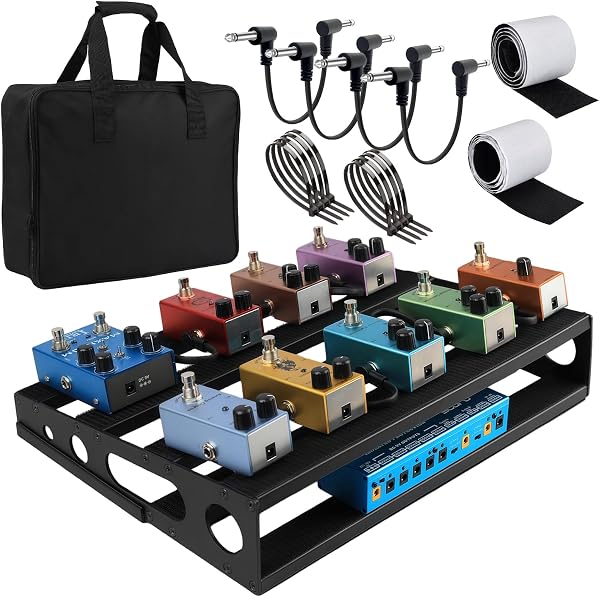
Vangoa PD-M Powered
9.0Editor scoreSolid aluminum bent frame
Ten isolated power outputs
Compact medium pedal footprint
Includes padded backpack bag
Find the right guitar pedalboards for 2026. We compare 10 standout options by build quality, useful features, owner feedback, value, and everyday trade-offs.
Find the right guitar pedalboards for 2026 without cluttering your signal chain or overpaying for gig gear. We compare 10 standout options by the factors that matter in this category, such as frame materials, power supply integration, deck dimensions, cable routing slots, angle ergonomics, bag protection, owner feedback, and practical value.
Choosing a pedalboard requires looking beyond simple board dimensions. Modern configurations range from ultralight aluminum rails and dual-tier decks to powered units with integrated isolated outputs and non-adhesive mechanical clip systems. A compact rig for local rehearsals demands very different cable management and transport features than a multi-tier stage board holding ten stompboxes.
Before selecting a model, evaluate your pedal count, power consumption needs, and how often you travel between home, studio, and gigs. The detailed reviews and buying guide below break down structural trade-offs, power distribution specs, and layout versatility so you can build a clean, reliable rig.
We compared 10 guitar pedalboards by focusing on the core details that determine stage reliability and pedalboard setup convenience: structural materials, deck dimensions, integrated versus standalone power supply options, pedal mounting mechanisms, under-board cable clearance, frame weight, and padded gig bag quality. Our analysis highlights practical trade-offs between powered all-in-one boards, adhesive-free clip-on systems, and lightweight rail frames so you can select the right foundation for your signal chain.

Compare key features, scores, and current prices side by side. A shorter feature list means fewer details were available, not necessarily fewer capabilities.


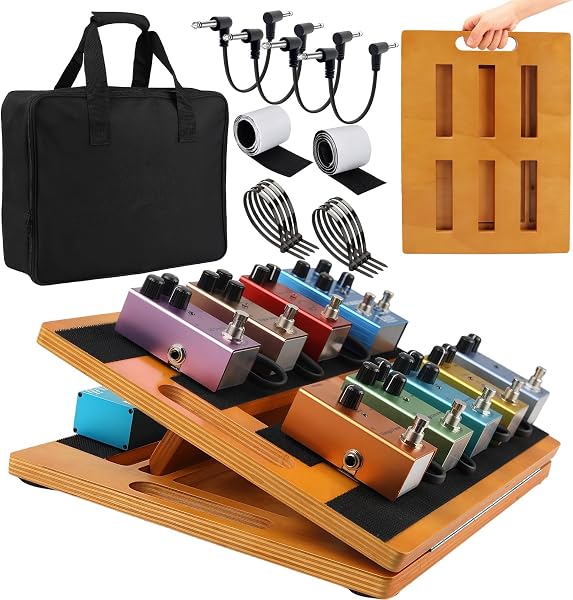
Combining classic organic aesthetic warmth with modern folding portability, the Wooden Folding Guitar Pedal Board offers a unique alternative to standard black metal rails. Measuring 15.75" x 11.8" and weighing 3.75 pounds, this real-wood board holds 8 to 10 standard pedals while folding cleanly in half to fit inside a compact carrying bag.
We may earn a commission when you buy through this link, at no additional cost to you.
The board features a 2-level adjustable height system that lets players customize the deck tilt for maximum comfort during seated studio work or standing stage performances. Deepened anti-slip grooves on the deck combined with reinforced center locking hinges keep the board solidly rigid under foot, preventing shifting or flexing when engaging footswitches.
Cable management is straightforward thanks to rear clearance cutouts designed to anchor an external power supply using included zip ties or hook-and-loop straps. The included high-capacity carry bag is crafted from tough, waterproof Oxford fabric, protecting your wood finish and pedals from weather during travel.
A center-hinged deck allows a medium 15.75″ board to fold down to roughly half its length, making it much easier to pack inside a backpack or carry-on bag when traveling to casual jams or coffeehouse gigs.
Supplied with four 6-inch patch cables, mounting tape, and cable ties, this folding wooden board is perfect for acoustic performers, indie musicians, and studio guitarists who appreciate a warm wooden aesthetic paired with clever folding convenience.
Musicians seeking a wide metal rail board with built-in power supply outputs.
We may earn a commission when you buy through this link, at no additional cost to you.
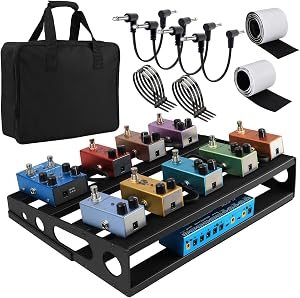
Building a tidy guitar rig usually means buying a bare frame and spending extra on an isolated power brick, mounting brackets, and extra power leads. The Vangoa PD-M Powered Pedalboard streamlines that entire process into an elegant all-in-one platform. Featuring a solid one-piece-bent aluminum construction, this 18" x 13.5" board provides an ultra-stable deck that eliminates the flex and fragile weld joints common on cheap hollow-tube frames.
We may earn a commission when you buy through this link, at no additional cost to you.
The core advantage of the PD-M is its built-in isolated power supply. Offering ten total outputs—including dedicated 9V taps alongside independent 12V and 18V ports—it delivers clean, hum-free DC power to digital delays, analog overdrives, and high-voltage preamp pedals. By embedding the power distribution system directly into the chassis architecture, Vangoa frees up valuable under-board clearance and eliminates the tangle of wall-wart adapters.
Ergonomics and travel convenience are thoughtfully designed. The folding rear legs unfold to elevate the deck at an easy-to-reach 7-degree angle, making footswithes on the back row comfortable to tap without accidentally bumping front-row knobs. When rehearsal wraps up, the legs fold flat so the 3.4-pound board slides into the included backpack-style gig bag, leaving your hands free to carry a guitar case and amplifier.
Daisy-chaining digital modulation pedals with high-gain analog drives frequently introduces high-frequency clock noise and ground-loop hum into your amplifier. The PD-M’s isolated power outputs separate electrical grounds between channels, keeping your signal path quiet during live performances and recording sessions.
For guitarists who want a medium-sized board that handles 6 to 10 standard stompboxes without requiring a separate power brick purchase, the Vangoa PD-M offers an unbeatable combination of clean power, rigid construction, and portable convenience.
Musicians who already own an expensive multi-channel isolated power supply and only need a basic unpowered frame.
We may earn a commission when you buy through this link, at no additional cost to you.
If you want the noise-free convenience of an integrated power supply combined with a warm, high-end visual aesthetic, the Donner Wood-Grain Powered Board is a standout choice. Measuring 19.7" x 12.3" and weighing 3.4 pounds, this aluminum alloy pedalboard comfortably accommodates 8 to 10 standard effect pedals while adding a stylish wood-grain finish that stands out under stage lighting.
We may earn a commission when you buy through this link, at no additional cost to you.
Under the hood, the built-in power supply features 10 independent power interfaces, each equipped with short-circuit protection to keep noise out of your signal chain. In addition to seven 9V outputs, the board includes independent 12V and 18V 200mA ports for power-hungry pedals, plus a dedicated 5V 500mA USB port that lets you charge a smartphone or tablet right from your pedalboard during long rehearsals.
The board’s subtle angled profile aligns with natural foot movement, allowing guitarists to engage high-gain leads or delay taps without stepping on nearby control knobs. Open slots across the top deck provide ample space for routing patch cables and power leads underneath, maintaining a clean playing surface free of tangled wires.
Having a built-in 5V USB port directly on your pedalboard is surprisingly useful for modern players who rely on digital chart tablets, wireless receiver bases, or phone tuning apps during live sets, keeping your control station powered without searching for extra wall outlets.
Donner ships this powered board as a complete ready-to-use kit, including a durable backpack case, power adapter, eight DC jumper cables, hook-and-loop mounting tape, and zip ties. It is a fantastic option for gigging players who want comprehensive built-in power without sacrificing visual personality.
Players who need a ultra-compact single-row board for just three or four micro pedals.
We may earn a commission when you buy through this link, at no additional cost to you.
Guitarists who prefer a focused selection of essential pedals often struggle to find a small board that includes integrated power distribution. The LEKATO Compact Powered Board solves that problem with an ultra-slim 19" x 5.1" single-row design weighing just 1.8 pounds. Built from premium aluminum alloy, this board resists warping under heavy foot pressure while keeping your overall gig weight to a minimum.
We may earn a commission when you buy through this link, at no additional cost to you.
Despite its compact size, the board houses a full-featured quiet power supply. It provides nine independent DC outputs—seven 9V 200mA ports, one 12V port, and one 18V port—alongside a 5V 500mA USB port for mobile devices. Each power channel features separate short-circuit protection, preventing a single faulty cable from knocking out power to your entire signal chain.
The board features an ergonomic angled slope that lifts the rear edge just enough to make footswitch activation comfortable while preventing your foot from bumping volume or tone knobs on adjacent pedals. Included in the package are patch cables, a power adapter, mounting tape, and a fitted carry bag with a sturdy haul handle.
A single-row layout makes signal routing extremely straightforward. Placing your tuner, overdrive, modulation, and delay side-by-side allows for short, direct patch cables while keeping all footswitches on a single flat plane for error-free switching.
For fly gigs, acoustic-electric rigs, or bassists needing a streamlined setup of four to five essential stompboxes, the LEKATO Compact Powered Board offers incredible portability without compromising power quality.
Musicians running complex 8- to 12-pedal setups that require a wide multi-row deck surface.
We may earn a commission when you buy through this link, at no additional cost to you.
Touring musicians and tone enthusiasts running expansive pedal collections need a rock-solid foundation with plenty of surface area. The Extra Large Powered Guitar Pedal Board delivers a spacious 24.02" x 12.6" aluminum alloy deck designed to accommodate 10 to 14 pedals, including oversized wah/expression pedals, digital multi-effects, and standard stompboxes.
We may earn a commission when you buy through this link, at no additional cost to you.
Integrated directly into the frame is a 10-channel independent power supply that keeps audio signals clean and hum-free. Because each output functions independently with individual short-circuit protection, a cable failure on one pedal will not shut down the rest of your signal chain. The one-piece aluminum frame features a scratch-resistant finish built to handle frequent packing and unpacking on the road.
The board’s calculated golden-angle deck tilt elevates back-row pedals to an optimal angle, helping guitarists switch effects effortlessly on dark stages. Top-surface slots allow you to pass power leads and audio patch cables directly beneath the deck, creating a neat visual layout and preventing accidental cable disconnects during energetic sets.
With over 24 inches of width, you can comfortably place large expression or volume pedals on the far right while organizing your drive sections, modulation units, and stereo delays in logical rows with clean under-deck cable routing.
Supplied with a spacious, heavily padded carry bag, hook-and-loop tape, and power cables, this extra-large board is a top-tier choice for session players, church musicians, and touring bands requiring maximum pedal real estate with built-in power security.
Minimalist guitarists who only travel with three or four basic pedals.
We may earn a commission when you buy through this link, at no additional cost to you.
Applying sticky hook-and-loop tape or heavy glue to vintage, rare, or high-end boutique pedals often ruins their finish, destroys graphic labels, and drastically reduces resale value. The Clip-On GPB-03 L Aluminum Alloy Pedal Board eliminates adhesives entirely using an innovative mechanical clamping system. Featuring adjustable fixture blocks that slide along top-deck tracks, this board locks your pedals in place mechanically without leaving a single trace of residue.
We may earn a commission when you buy through this link, at no additional cost to you.
Built from robust aluminum alloy, the GPB-03 L provides a rigid, wobble-free foundation capable of handling aggressive footswitching during live sets. Underneath the deck, engineered cable management channels allow patch cables and DC power leads to run neatly hidden beneath the pedals, leaving your playing surface completely uncluttered.
Changing up your signal chain is exceptionally fast. Instead of tearing pedals off sticky tape, you simply loosen the fixture blocks, slide your pedals into new positions, and tighten them down. The compact, travel-ready chassis fits snugly into the included heavy-duty padded gig bag, keeping your custom layout secure during transit.
Boutique pedal collectors know that original rubber feet, intact serial stickers, and mint bottom plates command higher prices on the used gear market. Mechanical clip blocks hold pedals securely by their chassis edges, preserving 100% of their original physical condition.
If you collect valuable pedals, trade gear frequently, or simply hate dealing with sticky adhesive buildup, the GPB-03 L clip-on system is one of the smartest, cleanest pedalboard investments on the market.
Players wanting an all-in-one powered board who prefer quick Velcro mounting.
We may earn a commission when you buy through this link, at no additional cost to you.
If you have ever had a lightweight aluminum pedalboard slide across a slick stage floor while trying to stomp on a boost pedal during a solo, you understand the value of raw physical stability. The Guitar Pedal Board with Power Supply Tray is constructed from heavy-duty precision-cut steel, weighing 5.43 pounds to create an immovable anchor on any floor surface.
We may earn a commission when you buy through this link, at no additional cost to you.
Measuring 15.75″ x 12.2″ x 3.15″, the board features an integrated power supply tray underneath the top deck, keeping power bricks hidden and out of the way. Elongated side hand-cutouts make lifting the board effortless, while three precision cable routing ports allow you to pass patch leads directly beneath the steel surface for clean organization.
Soft rubber feet absorb foot-stomp impact, protect delicate venue flooring, and prevent slipping on tile or polished wood stages. The board holds 8 to 10 standard pedals securely and comes with a durable Oxford fabric gig bag, four 6-inch patch cables, hook-and-loop tape, and zip ties.
The added mass of a steel chassis combined with soft rubber feet creates high surface friction, ensuring your board stays exactly where you place it even when stomping hard on heavy wah or pitch-shifter pedals.
While its steel weight is less ideal for ultra-light travelers, it is an outstanding choice for aggressive performers, high-energy rock bands, and home studio setups where absolute physical stability is the top priority.
Fly-in musicians or touring players trying to minimize total luggage weight.
We may earn a commission when you buy through this link, at no additional cost to you.
Guitarists looking for a classic open-rail aluminum board that balances ample pedal surface with ultralight portability will find exceptional value in the STRICH Standard 18 Angled Pedalboard. Weighing a mere 1.98 pounds, this 18" x 12.5" frame is built from high-strength aluminum alloy finished with a road-ready black coating.
We may earn a commission when you buy through this link, at no additional cost to you.
The open-rail design provides multiple routing channels so you can snake audio cables and power leads underneath the deck, keeping your board clean and organized. Its calculated incline angles the rear rail upward, making it simple to tap back-row footswitches without accidentally touching front-row volume or gain knobs.
The open under-board clearance accommodates most standard multi-output isolated power bricks using bracket mounts or heavy-duty zip ties. The package includes a rugged padded carry case, mounting tape, and zip ties right out of the box.
Open parallel rails allow you to zip-tie power cables along the underside channels, keeping audio patch cables separated to minimize crosstalk and ground hum.
For musicians who want a dependable, professional-grade rail frame that keeps total rig weight under two pounds, the STRICH Standard 18 is an outstanding value-packed foundation.
Players wanting a pre-installed built-in power supply system.
We may earn a commission when you buy through this link, at no additional cost to you.
When you only need five to seven core stompboxes for a gig, carrying a wide multi-row board adds unnecessary bulk. The Donner DB-2 Guitar Pedal Board provides a streamlined 20" x 8" dual-rail aluminum platform weighing just 1.3 pounds (600 grams), making it one of the lightest gig-ready boards available.
We may earn a commission when you buy through this link, at no additional cost to you.
Despite its slim profile, the DB-2 includes a universal power supply mounting bracket underneath, allowing you to secure standard power bricks out of sight. Perforated rail slots allow patch cables to pass smoothly underneath the surface, maintaining a neat layout.
The board is bundled with professional-grade adhesive hook-and-loop tape, patch cables, and a thick padded canvas gig bag that protects your pedals during transit.
The included mounting bracket uses elastic tension bands to hold various power bricks securely against the underside of the rails, saving top-deck space for pedals.
If your signal chain centers on a tuner, drive, compressor, delay, and reverb, the Donner DB-2 offers an affordable, ultra-portable solution that fits easily into crowded rehearsal rooms.
Guitarists running multi-row setups or large expression pedal combinations.
We may earn a commission when you buy through this link, at no additional cost to you.
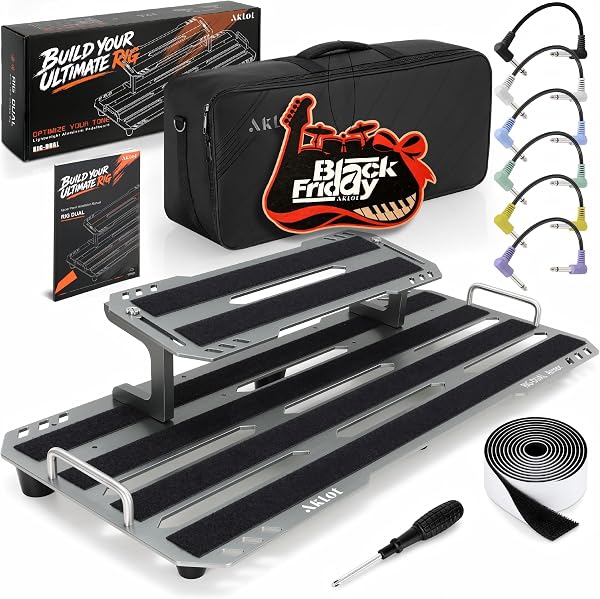
Standard flat or slightly angled pedalboards often force guitarists to reach awkwardly over front-row knobs to engage back-row footswitches. The AKLOT Dual Tier Guitar Pedalboard solves this ergonomics problem by utilizing vertical elevation. Featuring a main 26" x 11" deck paired with a raised 15.75" x 5.5" upper platform, it puts secondary delay, reverb, and modulation footswitches on a distinct higher level.
We may earn a commission when you buy through this link, at no additional cost to you.
Built from strong, lightweight aluminum alloy, the frame weighs approximately 6 pounds while supporting heavy footswitching without flex. The upper tier is fully removable, giving you the flexibility to install the upper deck for complex multi-row rigs or remove it to accommodate large loop switchers, expression pedals, or oversized multi-effects units.
Open rail slots across both levels allow for clean under-deck cable routing and power supply placement. AKLOT packages the board with six quality patch cables, mounting tape, assembly tools, layout support, and a heavily padded carry bag designed to protect the dual-tier layout during transport.
Elevating back-row pedals by several inches creates physical clearance over front-row control knobs, allowing you to stomp back-row delay or boost switches confidently during live solos.
For complex rigs, ambient soundscapes, and players who want fast, error-free footswitching without accidental knob bumps, the AKLOT Dual Tier Pedalboard delivers professional two-level functionality.
Minimalist players needing a lightweight single-row travel board.
We may earn a commission when you buy through this link, at no additional cost to you.
Selecting the ideal pedalboard involves balancing deck size, structural materials, power integration, mounting preference, and travel protection to build a reliable rig.
The material used to construct a pedalboard directly impacts its durability, stage stability, and transport ease. High-grade aluminum alloy is the industry standard for modern boards—featured on models like the Vangoa PD-M, STRICH Standard 18, and Donner DB-2—because it delivers high structural rigidity without adding excessive weight to your gig gear. Aluminum rail frames resist flexing under heavy foot pressure while remaining light enough to carry across long parking lots to venue stages.
Alternative materials offer distinct trade-offs. Heavy-duty steel boards, such as the Guitar Pedal Board with Power Supply Tray, provide exceptional physical mass (weighing over 5 pounds empty), creating an immovable anchor on slick venue floors that will never slide during aggressive stomping. On the other hand, real-wood boards like the Wooden Folding Pedal Board offer warm aesthetic appeal and natural vibration damping, though they require careful moisture protection during outdoor gigs. Consider how often you travel when selecting frame materials.
If you travel frequently by foot or public transit, select an ultralight aluminum frame under 3 pounds. If your board remains in a studio or on a permanent stage, a heavier steel or solid wood board provides superior floor stability.
Power distribution is one of the most critical aspects of pedalboard setup. Powered pedalboards with integrated power supplies—such as the Vangoa PD-M, Donner Wood-Grain, LEKATO Compact, and Extra Large Powered Board—build isolated multi-output power systems directly into the chassis. This eliminates the need to buy a separate power brick, saves under-board mounting space, and reduces cable clutter, delivering clean 9V, 12V, and 18V power right out of the box.
Unpowered rail frames like the STRICH Standard 18, Donner DB-2, and AKLOT Dual Tier require you to purchase and mount an external power supply. While this adds to your initial setup budget, it offers flexibility for guitarists who already own premium isolated power units or have specialized voltage/milliamp requirements. Many unpowered boards include universal mounting brackets or under-deck trays to secure external power bricks out of sight.
Choose an integrated powered board if you want an all-in-one setup with minimal assembly. Opt for an unpowered open-rail frame if you already own a high-end isolated power brick or run high-draw digital units requiring custom power specs.
Deck size must accommodate your current pedal collection while leaving room for potential additions. Small single-row boards measuring around 19″ x 5″ or 20″ x 8″ (like the LEKATO Compact or Donner DB-2) comfortably hold 4 to 6 standard pedals in a clean line. Medium decks measuring 18″ x 12″ or 19″ x 12″ (such as the Vangoa PD-M or STRICH Standard 18) fit 6 to 10 pedals in two rows, while extra-large decks (24″ to 26″ wide) host 10 to 14 pedals including expression pedals and switchers.
Deck ergonomics play a huge role in performance comfort. Flat boards can make reaching back-row footswitches tricky on dark stages, whereas angled boards (featuring 7-degree tilts or golden-angle slants) lift the rear row for easier foot access. Advanced designs like the AKLOT Dual Tier introduce a physical raised upper deck, placing back-row pedals on a completely elevated level to prevent accidental bumps to front-row control knobs.
Map out your pedal footprint on floor tape before buying. Choose angled or dual-tier decks for multi-row setups to ensure easy footswitch access during performances.
Securing pedals to the deck surface is traditionally done using adhesive hook-and-loop (Velcro) tape. Most boards come with adhesive strips that attach to the deck and pedal undersides, providing strong holding power and allowing quick pedal repositioning. However, adhesive tape can leave sticky residue, damage pedal bottom labels, and degrade resale value on expensive vintage or boutique pedals.
Adhesive-free mechanical systems, such as the Clip-On GPB-03 L Pedal Board, use sliding fixture blocks to clamp pedals firmly by their edges. This mechanical method keeps pedals rock-solid without glue or tape, preserving 100% of their original physical condition and finish. While setup takes slightly more time initially, it is ideal for collectors and players who frequently trade gear.
Use standard hook-and-loop tape for fast, flexible board layouts. Choose a mechanical clip-on system if you use expensive boutique or vintage pedals and want to preserve their finish and resale value.
A clean pedalboard setup requires routing audio patch cables and power leads underneath the deck. Open-rail aluminum frames (like the STRICH Standard 18 and Donner DB-2) and slotted top decks feature openings that let cables drop beneath the surface. This keeps the playing surface uncluttered, prevents accidental cable disconnects, and protects wiring from foot stomps.
Proper cable separation also reduces electrical interference. Running high-voltage AC/DC power leads parallel to unshielded instrument patch cables can induce unwanted hum into your audio path. Slotted decks allow you to secure power leads along under-board rails while keeping audio patch cables neatly routed on top.
Prioritize boards with slotted decks or open rail channels, and use zip-ties to keep power cables separate from audio patch leads to maintain a quiet signal chain.
A pedalboard is only as portable as its carrying case. Most pedalboards include a padded Oxford fabric gig bag or canvas tote. High-quality bags feature thick foam padding, reinforced zippers, and heavy-duty handles to absorb travel bumps and protect pedal knobs from getting bent during transport.
Carrying style is another key detail. Backpack-style gig bags (included with the Vangoa PD-M and Donner Powered boards) distribute weight evenly across both shoulders, keeping your hands completely free to carry a guitar case and amplifier. Ensure the bag has sufficient vertical clearance so it zips closed smoothly with your pedals and tall knobs attached.
Verify that the included bag features thick internal foam padding and shoulder straps. If you travel frequently without a personal vehicle, prioritize backpack-style bags for hands-free convenience.
Building a clean, reliable pedalboard starts with planning your pedal layout before attaching any mounting tape or clips. Lay your pedals out on a table in order of signal flow—typically starting with tuners and wahs, moving into compressions and overdrives, followed by modulation effects, and ending with time-based delays and reverbs. Test patch cable lengths and power jack placements to ensure every pedal connects comfortably without straining cables or blocking footswitches.
When mounting pedals and routing cables, take time to isolate power leads from audio signal paths. Clean the underside of your pedals with isopropyl alcohol before applying adhesive hook-and-loop tape to ensure maximum grip. If using a powered board, plug digital pedals with high milliamp draws into dedicated high-current outputs and reserve 12V or 18V ports strictly for compatible pedals. Secure excess cable slack underneath the board using zip-ties and cable clips to prevent snagging during live shows.
Routine maintenance keeps your board operating quietly and looking sharp for years. Periodically inspect patch cable jacks and DC power plugs for loose connections or dust accumulation. Clean aluminum and steel frame rails with a soft microfiber cloth, and avoid leaving powered boards exposed to rain or damp environments. When traveling, ensure all pedals are firmly anchored before zipping up your padded gig bag to prevent internal shifting during transit.
A built-in isolated power supply eliminates the need to purchase and mount an external power brick underneath your board. Isolated power channels supply clean, independent DC voltage to each pedal, preventing ground loops, hum, and digital clock noise from bleeding into your guitar amplifier's audio signal.
A medium-sized 18" x 12" pedalboard typically holds between 6 and 10 standard compact stompboxes arranged in two horizontal rows. If you use larger dual-footswitch delay pedals or expression pedals, total pedal count will be closer to 5 or 6 units.
Aluminum pedalboards offer the best strength-to-weight ratio, making them ideal for gigging guitarists who need lightweight durability. Steel boards provide superior floor stability but add noticeable weight, while wooden boards offer classic boutique styling and natural vibration damping.
Yes, adhesive-free pedalboards like the Clip-On GPB-03 L use adjustable mechanical clamping blocks that hold pedals firmly by their edges. This prevents sticky tape residue and preserves the original finish and resale value of vintage or boutique pedals.
A dual-tier pedalboard features a raised upper deck that elevates back-row pedals above front-row stompboxes. This physical elevation makes back-row footswitches easier to reach without accidentally stepping on or changing control knobs on front-row pedals.
Powered pedalboards like the Vangoa PD-M and Donner Wood-Grain include dedicated 12V and 18V DC output ports alongside standard 9V jacks. Always check your pedal's voltage and polarity requirements before connecting power leads to avoid damaging sensitive circuitry.
Yes, select powered pedalboards (such as the Donner Wood-Grain and LEKATO Compact) include a built-in 5V USB charging port designed to keep smartphones, tablets, digital music stand devices, or wireless receivers charged during rehearsals and gigs.
Most open-rail aluminum boards include mounting brackets, elastic straps, or dedicated under-deck space to hold external power bricks. You can also secure power supplies using heavy-duty zip ties or industrial hook-and-loop tape along the bottom rails.
Included padded gig bags are excellent for local rehearsals, gig transport, and studio trips. For heavy tour buses or airline travel, upgrading to a hard flight case with custom foam inserts provides maximum protection against severe impact and luggage compression.
The Vangoa PD-M Powered Pedalboard earns our top overall recommendation for guitarists seeking an all-in-one stage rig. Featuring a solid one-piece-bent aluminum frame, ten isolated power outputs (including 9V, 12V, and 18V options), 7-degree folding legs, and a premium backpack gig bag, it delivers clean power and exceptional portability right out of the box.
If you prefer a lighter unpowered frame or specialized deck layout, our other top picks offer outstanding performance. The STRICH Standard 18 Angled Board is our Best Value choice, delivering an ultralight 1.98-pound aluminum rail frame at an affordable price. For musicians with large pedal collections, the AKLOT Dual Tier Pedalboard provides a spacious 26-inch two-level deck that makes back-row footswitching effortless.
Before finalizing your decision, map out your pedal count, measure your board footprint, and determine whether an integrated powered board or unpowered rail frame best fits your setup. Choosing the right foundation ensures a clean, quiet, and reliable signal chain for every gig and rehearsal.