Celestron Alt-Az Tripod
8.4Editor scoreAlt-azimuth mount type
Two slow-motion controls
1/4-20 mounting plate
Two-section adjustable legs
Find the right telescope mounts for 2026. We compare 10 standout options by build quality, useful features, owner feedback, value, and everyday trade-offs.
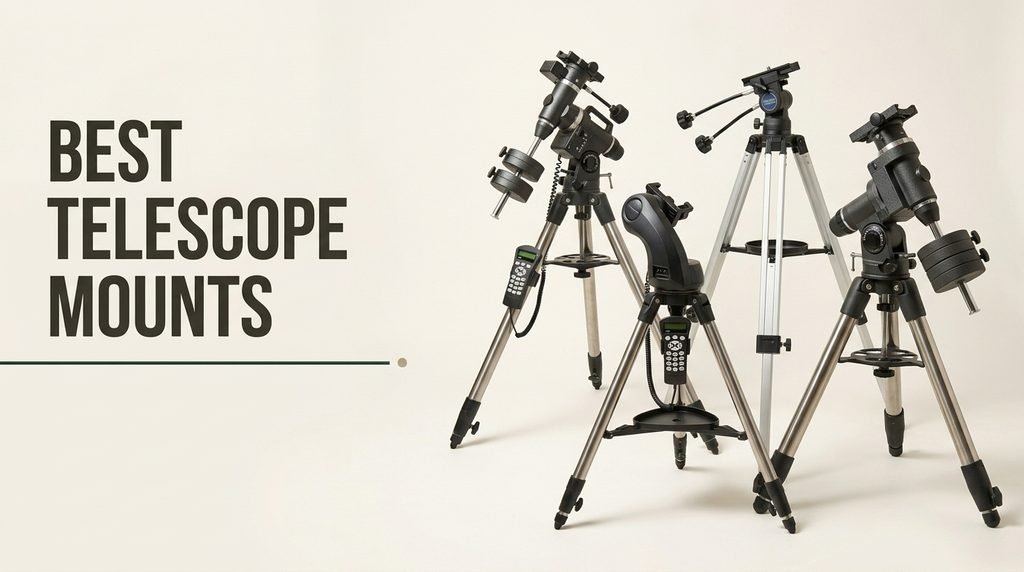
Choosing the right telescope mount for 2026 comes down to matching your observing goals with the right platform type, payload capacity, tracking precision, portability, and control features. This guide compares 10 standout options spanning alt-azimuth tripods, manual equatorial mounts, GoTo systems, and portable astrophotography trackers so you can find the right foundation for your optical tube.
Telescope mounts vary dramatically in capability and price. A basic alt-azimuth tripod handles casual backyard viewing, while a computerized German equatorial mount tracks celestial objects through hours of astrophotography. Understanding the difference between mount types, payload limits, and tracking modes is the key to spending your money on the features that actually improve your sessions.
The reviews below cover the practical details that matter: mount type, weight capacity, tracking rates, setup complexity, portability, and compatibility with popular telescope tubes and cameras. Each pick includes clear notes on who the mount serves best and where it falls short, so your decision is grounded in how you actually plan to observe and image the night sky.
We compared 10 telescope mounts and mount accessories using the factors that genuinely shape a buying decision: mount type (alt-azimuth versus equatorial), payload capacity, tracking accuracy and rates, GoTo database size, portability and total weight, build materials, setup complexity, tripod stability, and value for the price. Each review focuses on real trade-offs so you can match a mount to your telescope, your imaging goals, and the locations where you plan to set up.

Compare key features, scores, and current prices side by side. A shorter feature list means fewer details were available, not necessarily fewer capabilities.



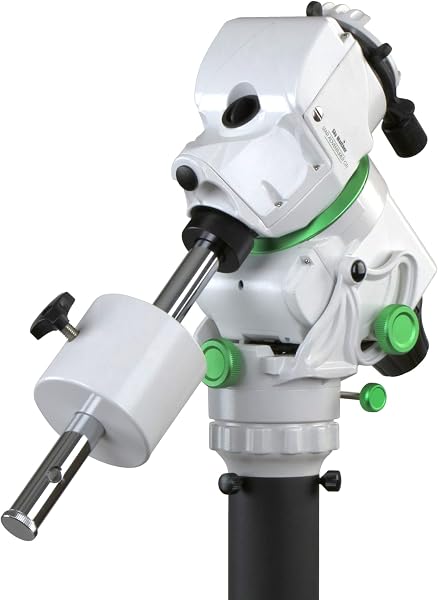
The SVBONY SV225 fills a useful niche between basic alt-azimuth tripods and full equatorial mounts. Its CNC-machined hollow structure keeps the mount weight down to just 2.34 kg while supporting payloads up to 10 kg, which is enough for most small to mid-size telescope tubes and spotting scopes. For observers who want a capable alt-azimuth platform without the weight penalty of a traditional mount, this is a compelling option.
We may earn a commission when you buy through this link, at no additional cost to you.
The variable speed gear system on both axes is the standout feature. Instead of a single fixed ratio for slow-motion adjustments, the variable gearing lets you switch between coarse and fine movements depending on whether you are centering a target or making subtle tracking corrections. This makes following the moon and planets noticeably smoother than with basic alt-azimuth controls.
Fine-tuning shift capability adds another layer of precision for critical alignment, and the overall build quality from CNC machining feels more solid than cast or stamped alternatives at this price point. The mount works well for both astronomical visual observation and terrestrial viewing, giving it flexibility across different use cases.
A 10 kg payload rating means the mount can physically support that weight, but stability decreases as you approach the limit. For the best performance, keep your total load including the telescope tube, finder, eyepieces, and any camera around 7 to 8 kg. Running at maximum capacity can introduce vibration and make fine adjustments less precise.
Choose the SV225 if you want a lightweight, high-capacity alt-azimuth mount with better-than-basic controls. Be aware that the fine adjustment lever has some intentional play, which is normal for this design but can feel unfamiliar at first. For long-exposure astrophotography, you will still need an equatorial mount with motorized tracking.
Astrophotographers who need motorized tracking or GoTo functionality.
We may earn a commission when you buy through this link, at no additional cost to you.
The Celestron Heavy-Duty Alt-Azimuth Tripod is the right starting point for anyone who needs a stable, straightforward platform for a spotting scope, binoculars, small telescope, or camera. The alt-azimuth design moves in simple up-down and left-right directions, which makes it intuitive for beginners and casual observers who do not want to learn equatorial alignment procedures.
We may earn a commission when you buy through this link, at no additional cost to you.
Two slow-motion control handles let you track objects smoothly across the sky or across a landscape, which is a meaningful upgrade over basic photo tripods that lack fine adjustment. The 1/4-20 threaded mounting plate slides forward and backward in its slot, letting you balance different optical tubes and camera bodies without struggling to find the center of gravity.
The two-section legs with a center brace and metal accessory tray provide reasonable stability for lightweight optics on calm evenings. Height adjustment is straightforward, and the overall build quality reflects Celestron’s long experience in the telescope market. The included two-year US warranty and access to US-based support add confidence for first-time buyers.
Alt-azimuth mounts move in the same directions you naturally look: up, down, left, right. This makes them the easiest type to learn and use for visual observing. Equatorial mounts align with the Earth’s rotation axis and require polar alignment, which adds setup time but enables accurate long-exposure tracking for astrophotography. Start with alt-azimuth if your priority is simplicity.
Choose this tripod if you need a versatile, affordable platform for casual visual observing or terrestrial viewing with small optics. For anyone planning to do astrophotography or mount a heavier telescope tube, an equatorial mount with motorized tracking further down this list will serve you much better.
Astrophotographers or observers with heavy telescope tubes exceeding the mount’s payload limit.
We may earn a commission when you buy through this link, at no additional cost to you.
The Star Adventurer GTI Mount Head Kit is designed for astrophotographers who already own a suitable tripod and want to add a portable GoTo equatorial tracking head to their setup. The full GoTo capability means the mount can automatically locate and track celestial objects from its internal database, which is a significant step up from manual tracking for anyone doing long-exposure imaging in the field.
We may earn a commission when you buy through this link, at no additional cost to you.
Built-in WiFi lets you control the mount from a smartphone or tablet without additional cables or hand controllers, which simplifies the setup process at dark sky sites where fumbling with cables in the cold is a real frustration. The built-in polar scope with illuminator makes polar alignment faster and more accurate, which is critical for tracking precision during long exposures.
The included counterweight bar lets you balance your camera and lens or small telescope tube properly on the equatorial axis. Proper balancing reduces strain on the motors and improves tracking accuracy, so having the bar included saves a separate purchase. The mount head is compact enough to fit in a camera bag alongside your imaging gear.
Polar alignment positions the mount’s rotation axis parallel to the Earth’s axis, which allows it to track stars by rotating on a single axis. Without accurate polar alignment, stars drift during long exposures, producing streaks instead of sharp points. The built-in polar scope on the GTI makes this process faster and more precise than relying on drift alignment alone.
Choose the GTI Head Kit if you already have a sturdy tripod and want to add GoTo astrophotography capability without buying a full-size mount. For buyers who need the complete package including tripod and pier extension, the full GTI Kit further down this list is the better value despite the higher price.
Buyers who need a complete mount-and-tripod package or who plan to mount heavy telescope tubes.
We may earn a commission when you buy through this link, at no additional cost to you.
The Celestron Advanced VX is the most capable mount in this guide for observers and imagers who need to support heavier telescope tubes. The 30-pound payload capacity handles mid-size Schmidt-Cassegrains, larger refractors, and Newtonian reflectors that would overwhelm lighter mounts. If your optical tube weighs more than 15 to 20 pounds, this is the mount class you should be looking at.
We may earn a commission when you buy through this link, at no additional cost to you.
The NexStar+ hand control provides access to over 40,000 celestial objects with multiple alignment procedures, making it straightforward to locate targets even if you are not familiar with the night sky. Sidereal, solar, and lunar tracking rates cover the most common observation scenarios, and the EQ North and EQ South modes let you use the mount from either hemisphere.
The 2-inch stainless steel tripod legs provide the stability needed at higher magnifications and during long-exposure imaging, where even small vibrations can ruin a frame. The latitude adjustment range of 7 to 77 degrees covers most inhabited locations on Earth, and the total kit weight of 47 pounds is manageable for car-based transport to dark sky sites.
A good rule of thumb is to keep your total payload at 50 to 70 percent of the mount’s rated capacity for the best tracking performance. A 30-pound mount performs best with 15 to 21 pounds of total load. Running at or near the maximum rating works for visual use but can degrade tracking accuracy for long-exposure imaging.
Choose the Advanced VX if you have a heavy telescope tube and need reliable computerized tracking for both visual observing and astrophotography. The price and weight are significant commitments, so this mount makes the most sense for dedicated astronomers who plan to use it regularly rather than casual observers.
Casual observers who need a lightweight, portable setup or who have small telescope tubes.
We may earn a commission when you buy through this link, at no additional cost to you.
The tridaptor is not a telescope mount in the traditional sense, but it is a mounting accessory that solves a real problem for anyone who wants to capture what they see through their telescope, spotting scope, or binoculars with a smartphone. The 3-axis alignment system lets you adjust your phone left-right, up-down, and forward-backward to perfectly center the camera lens over the eyepiece, which eliminates the dark edges and vignetting that plague cheaper adapters.
We may earn a commission when you buy through this link, at no additional cost to you.
The all-metal aluminum construction is a significant upgrade over the plastic phone clamps that ship with many budget adapters. Metal holds alignment under the weight of larger smartphones and does not flex or creep during long observation sessions. Rubber contact pads protect both your phone and the eyepiece from scratches during attachment and removal.
The included Bluetooth remote is a practical addition that lets you trigger the camera shutter without touching the phone or the scope, which prevents the vibration that blurs handheld shots. The adapter fits most iPhone and Android phones from 60 to 87.5 mm wide and eyepieces from 22 to 61 mm in outer diameter, covering the majority of popular optics from brands like Vortex, Swarovski, Celestron, and Nikon.
Single-axis phone clamps only adjust left-right, leaving the camera misaligned vertically and at the wrong distance from the eyepiece. The Z-axis adjustment on the tridaptor sets the correct eye relief distance, which is critical for eliminating the dark ring around the image that ruins most digiscoping photos taken with basic adapters.
Choose the tridaptor if you want to add smartphone photography capability to your existing telescope or spotting scope setup. Measure your eyepiece diameter before ordering to confirm compatibility. This is an accessory that complements a telescope mount rather than replacing one.
Buyers looking for a standalone telescope mount or tracking platform.
We may earn a commission when you buy through this link, at no additional cost to you.
The Sky Watcher Star Adventurer Latitude Base is a dedicated accessory that adds precision latitude adjustment to the Star Adventurer tracking platform. If you already own a Star Adventurer and want to improve your polar alignment accuracy for longer focal length imaging, this base provides the fine-tuning capability that the standard wedge lacks.
We may earn a commission when you buy through this link, at no additional cost to you.
The micro-adjustment knobs let you dial in your exact latitude with much greater precision than the basic adjustment on the Star Adventurer body, which translates directly to better tracking accuracy during long exposures. The latitude lock secures the setting once you have it dialed in, preventing drift during the night as the mount tracks.
The V-style dovetail plate provides a secure connection between the base and the Star Adventurer head, and the overall build quality is consistent with Sky Watcher’s reputation for reliable accessories. Setup adds a few minutes to your alignment routine but pays off in noticeably better star shapes on exposures longer than a couple of minutes.
For wide-angle astrophotography with a camera lens under 100mm, the standard Star Adventurer alignment is usually sufficient. Once you move to longer focal lengths or exposures beyond two to three minutes, even small polar alignment errors become visible as star trailing. The latitude base addresses this by letting you fine-tune alignment to within fractions of a degree.
Choose this EQ base if you already own a Star Adventurer and want to push your imaging to longer focal lengths or longer exposures. This is not a standalone mount and only works within the Star Adventurer ecosystem, so it is only relevant for existing Star Adventurer owners.
Anyone who does not already own a Sky Watcher Star Adventurer tracker.
We may earn a commission when you buy through this link, at no additional cost to you.
The Celestron CG-4 is one of the most popular manual German equatorial mounts ever made, and it earns its reputation through a combination of solid build quality, reasonable payload capacity, and straightforward operation. For visual observers who want equatorial tracking without the complexity and cost of a computerized GoTo system, the CG-4 is the classic choice.
We may earn a commission when you buy through this link, at no additional cost to you.
The 20-pound payload capacity handles most small to mid-size telescope tubes including 6-inch Newtonians, 80mm to 102mm refractors, and compact Schmidt-Cassegrains. The 1.75-inch stainless steel tripod legs provide a stable platform that minimizes vibration at higher magnifications, and the adjustable height range of 33 to 47 inches accommodates both seated and standing observing positions.
Manual slow-motion controls on both the right ascension and declination axes let you track objects smoothly across the sky once the mount is polar aligned. The controls are responsive without being overly sensitive, which makes it easy to keep a planet or lunar feature centered in the eyepiece. Setup is straightforward enough that most observers can be aligned and observing within 15 to 20 minutes.
Using a manual equatorial mount teaches you the coordinate system of the night sky in a way that GoTo mounts do not. You learn to star-hop, understand right ascension and declination, and develop a deeper familiarity with the constellations. Many experienced astronomers keep a manual mount for casual sessions even after upgrading to computerized systems for imaging.
Choose the CG-4 if you want a dependable manual equatorial mount for visual astronomy and do not need computerized GoTo or motorized tracking. For astrophotography or automated object location, you will want to step up to a computerized mount like the Advanced VX or the Star Adventurer GTI.
Astrophotographers who need motorized tracking or observers who want automated GoTo object location.
We may earn a commission when you buy through this link, at no additional cost to you.
The Star Adventurer GTI Mount Kit is the complete package for portable astrophotography, bundling the GoTo mount head with a dedicated tripod, pier extension, counterweight bar, and counterweight. For astrophotographers who want to travel light but still have full GoTo capability and accurate tracking, this kit eliminates the need to source individual components separately.
We may earn a commission when you buy through this link, at no additional cost to you.
The full GoTo system with built-in WiFi lets you control the mount from your phone or tablet, selecting targets from the internal database and letting the mount slew and track automatically. This is especially valuable at unfamiliar dark sky sites where you may not know the sky well enough to align manually. The built-in polar scope with illuminator speeds up the polar alignment process even in complete darkness.
The pier extension raises the mount head above the tripod legs, providing additional clearance for longer telescope tubes and camera setups that might otherwise collide with the tripod at certain angles. The included counterweight and bar let you balance your imaging payload properly, which is essential for accurate tracking during long exposures.
Buying mount components separately often leads to compatibility issues and higher total cost. A complete kit ensures the tripod, pier extension, counterweight, and mount head are designed to work together, which reduces setup frustration and eliminates the guesswork of matching parts from different manufacturers.
Choose the GTI Kit if you want a complete, portable astrophotography setup that you can carry to dark sky sites and set up quickly. The payload capacity is limited to lightweight camera and lens combinations or small telescope tubes, so this is not the right choice for heavy SCT or large refractor setups.
Observers with heavy telescope tubes or those who need a permanent observatory-class mount.
We may earn a commission when you buy through this link, at no additional cost to you.
The iEXOS-100-2 PMC-Eight takes a unique approach to mount control by using eight independent CPUs instead of the single processor found in most competing systems. Each processor handles a specific function, which theoretically improves responsiveness, timing accuracy, and overall reliability. For technically minded astrophotographers who want to push the boundaries of tracking precision, this architecture is genuinely interesting.
We may earn a commission when you buy through this link, at no additional cost to you.
The clutched dual-axis worm gears with belt-driven stepper motors provide smooth, quiet tracking that minimizes vibration during long exposures. The clutched RA and declination axes allow you to reposition the telescope by hand for rough alignment before engaging the motors for fine tracking, which speeds up the initial setup process considerably.
Control is handled through the ExploreStars app, available for Apple, Android, and Windows tablets, which provides GoTo functionality and access to tens of thousands of celestial objects. WiFi and Bluetooth connectivity give you flexibility in how you connect your control device, and the polar alignment sight hole through the RA axis provides a quick alignment option without a separate polar scope.
Traditional mounts use a single processor to handle all functions including motor control, GoTo calculations, and communication. The PMC-Eight distributes these tasks across eight dedicated processors, which can reduce timing errors and improve tracking smoothness. The practical benefit is most noticeable during long-exposure astrophotography where tiny tracking inconsistencies accumulate over time.
Choose the PMC-Eight if you are a technically inclined imager who values processing architecture and open-system compatibility. The 3.9 rating suggests that the user experience can be less polished than more mainstream options, so be prepared for a steeper learning curve and potentially more troubleshooting during initial setup.
Beginners or casual observers who want a simple, plug-and-play setup experience.
We may earn a commission when you buy through this link, at no additional cost to you.
The Sky Watcher Star Adventurer Tripod is a dedicated support platform designed to pair with the Star Adventurer Mini, Star Adventurer GTI, AZ-GT series, and AZ5 mount heads. If you own one of these mount heads and need a stable, well-matched tripod, this is the purpose-built solution rather than adapting a generic photo tripod that may not provide the right connection or stability.
We may earn a commission when you buy through this link, at no additional cost to you.
The 4.6 rating is the second highest in this guide, reflecting consistent satisfaction from owners who appreciate how well the tripod integrates with the Star Adventurer ecosystem. The build quality provides the stability needed for astrophotography tracking, where even minor tripod flex can introduce star trailing during long exposures.
Compatibility with multiple Sky Watcher mount heads gives this tripod flexibility within the brand’s lineup. If you upgrade from a Star Adventurer Mini to a GTI head in the future, the tripod remains useful rather than becoming obsolete. This kind of ecosystem compatibility is worth considering when building a long-term astrophotography setup.
Photo tripods are designed for lightweight cameras and static shooting. Telescope mounts need to handle heavier payloads, resist wind vibration, and maintain stability through hours of tracking. Purpose-built astronomy tripods use thicker legs, stronger locks, and mount-specific connections that generic photo tripods simply cannot match for long-exposure work.
Choose this tripod if you already own a compatible Sky Watcher mount head and need a stable, purpose-built support platform. This is not a standalone mount and does not include any tracking or GoTo capability on its own. For a complete package, the Star Adventurer GTI Kit includes both the mount head and a tripod with pier extension.
Buyers who need a complete mount system or who use non-Sky Watcher mount heads.
We may earn a commission when you buy through this link, at no additional cost to you.
A telescope mount is the foundation of your entire observing or imaging setup. Choosing the right one means understanding your goals, your telescope, and the practical constraints of where and how you observe. The factors below cover what genuinely matters.
Alt-azimuth mounts move in two intuitive directions: altitude (up and down) and azimuth (left and right). This makes them the easiest type to set up and use, especially for beginners and casual observers. They work well for visual observation, terrestrial viewing, and short-exposure lunar and planetary imaging. The main limitation is that they cannot track the apparent rotation of the sky with a single axis, which causes field rotation during long-exposure deep-sky astrophotography.
Equatorial mounts align one axis parallel to the Earth’s rotational axis, allowing them to track celestial objects by rotating on a single axis. This eliminates field rotation and enables long-exposure deep-sky imaging. The tradeoff is more complex setup requiring polar alignment, a steeper learning curve, and typically higher cost. German equatorial mounts like the Celestron CG-4 and Advanced VX are the most common type for amateur astronomy.
Choose alt-azimuth for casual visual observing and terrestrial use. Choose equatorial if you plan to do long-exposure astrophotography or want to learn the celestial coordinate system. Many serious observers own both types for different purposes.
Payload capacity is the maximum weight a mount can support while maintaining stable tracking. This includes the telescope tube, finder scope, eyepieces, camera, and any other accessories attached to the mount. Exceeding the rated capacity leads to vibration, poor tracking, and potential damage to the mount’s gears and motors.
A practical guideline is to keep your total payload at 50 to 70 percent of the mount’s rated capacity for the best performance. A mount rated for 20 pounds performs optimally with 10 to 14 pounds of total load. Running at or near the maximum rating may work for casual visual use but typically degrades tracking accuracy for imaging. The Celestron Advanced VX at 30 pounds handles heavier tubes, while the Star Adventurer GTI is designed for lightweight camera and lens setups.
Before buying, weigh your complete telescope setup including all accessories you plan to use simultaneously. Compare that total to the mount’s rated capacity and aim for the 50 to 70 percent range. If you plan to upgrade your telescope in the future, buy a mount with enough headroom to accommodate the larger tube.
Tracking accuracy determines how well the mount keeps a celestial object centered in the eyepiece or camera sensor over time. For visual observing, moderate tracking accuracy is sufficient because you can make small manual corrections. For astrophotography, tracking accuracy is critical because even tiny errors accumulate during long exposures and produce elongated or trailed stars.
Motorized tracking is essential for any serious astrophotography. Manual mounts like the Celestron CG-4 require you to turn slow-motion knobs by hand to follow objects, which is impractical for exposures longer than a few seconds. Motorized equatorial mounts drive the right ascension axis at the sidereal rate to match the Earth’s rotation, keeping objects stationary in the field of view for minutes or hours.
If astrophotography is your goal, prioritize a mount with motorized equatorial tracking and, ideally, GoTo capability. For visual-only use, a manual mount saves money and complexity while still providing a stable platform for high-magnification planetary and lunar observing.
GoTo systems use a database of celestial objects and motorized drives to automatically locate and track targets. The user selects an object from the hand controller or app, and the mount slews to the correct position. This is especially valuable for beginners who are still learning the night sky and for experienced observers who want to quickly locate faint deep-sky objects.
Database sizes range from a few thousand objects on basic systems to over 40,000 on advanced mounts like the Celestron Advanced VX. Larger databases include more obscure objects but also require more accurate initial alignment to function properly. WiFi and Bluetooth connectivity on modern mounts like the Star Adventurer GTI and iEXOS-100-2 allow control from smartphones and tablets, which many users find more intuitive than traditional hand controllers.
GoTo is a convenience feature, not a necessity. Many experienced astronomers prefer to star-hop manually, especially with smaller telescopes. If you are new to astronomy or plan to image specific deep-sky targets regularly, GoTo saves significant time and frustration. If you primarily observe the moon, planets, and bright star clusters, manual pointing is often faster than waiting for GoTo alignment.
Portability matters if you plan to transport your mount to dark sky sites away from home. Total weight, the number of components, and setup time all affect how practical a mount is for field use. A 47-pound mount like the Celestron Advanced VX requires a vehicle and significant effort to set up, while a Star Adventurer GTI head weighs just a few pounds and fits in a camera bag.
Setup time includes assembling the tripod, attaching the mount head, balancing the payload, and performing polar alignment or GoTo alignment. Simple alt-azimuth mounts can be ready in under five minutes. Manual equatorial mounts typically take 15 to 20 minutes. Computerized GoTo mounts with polar alignment can take 20 to 40 minutes depending on the alignment procedure and your experience level.
Be honest about how often you will transport your setup. If you observe primarily from a fixed backyard location, weight and portability matter less and you can prioritize stability and payload capacity. If you regularly drive to dark sky sites, a lighter, faster-to-set-up mount will get used more often than a heavier system that stays home because setup feels like a chore.
The tripod is the foundation that supports the mount and everything attached to it. A wobbly tripod ruins the performance of even the best mount head. Look for tripods with thick legs (1.75 inches or larger for mid-size mounts), sturdy leg locks, and a center brace or spreader that prevents the legs from splaying under load.
Material matters too. Stainless steel legs provide excellent rigidity and vibration damping but add weight. Aluminum legs are lighter and more portable but may transmit more vibration. For astrophotography, the extra weight of steel is usually worth the improved stability. For portable visual setups, aluminum is a reasonable compromise.
Never underestimate the tripod when budgeting for a mount system. A premium mount head on a flimsy tripod will underperform compared to a modest mount on a rock-solid tripod. If you are buying a mount head separately, invest in the best tripod you can afford that is compatible with your mount.
Mount compatibility extends beyond the telescope tube to include dovetail plates, counterweight systems, guide scopes, camera adapters, and control software. Most mounts use standard Vixen-style or Losmandy-style dovetail plates, but it is worth confirming that your telescope’s dovetail matches the mount’s saddle before purchasing.
Ecosystem compatibility also matters for accessories and future upgrades. Sky Watcher’s Star Adventurer line shares components across multiple mount heads and tripods, which means you can upgrade individual parts without replacing the entire system. Celestron’s mounts integrate with the NexStar hand controller ecosystem and are compatible with popular astrophotography software through standard protocols.
Before buying, make a list of all the equipment you plan to attach to the mount and verify compatibility with each item. Check dovetail sizes, counterweight shaft diameters, thread sizes for guide scope mounts, and software compatibility if you plan to use computerized control for imaging.
Set up your mount on the most stable surface available, avoiding wooden decks, soft grass, and gravel when possible. Concrete or packed earth provides the best foundation for minimizing vibration. Level the tripod before attaching the mount head, as an unlevel base makes polar alignment more difficult and can introduce tracking errors. For equatorial mounts, take the time to perform a careful polar alignment using a polar scope or drift method, since this single step has the greatest impact on tracking accuracy.
Balance your telescope on both axes before engaging any motors or slow-motion controls. An unbalanced payload strains the gears and motors, reduces tracking accuracy, and can cause the mount to drift or slew unpredictably. For German equatorial mounts, balance the right ascension axis first with the counterweight, then balance the declination axis by sliding the telescope tube forward or backward in the dovetail saddle. Recheck balance whenever you add or remove accessories like cameras or guide scopes.
Store your mount in a dry location and cover it when not in use to prevent dust accumulation on the gears and optical surfaces. Periodically check the grease on the worm gears and reapply if the mount feels stiff or develops backlash. For computerized mounts, update the firmware and object database when new versions are available. Avoid leaving the mount outdoors overnight in dew-prone conditions without a dew heater or cover, as moisture can damage electronic components and corrode metal surfaces over time.
An alt-azimuth mount is the easiest type for beginners because it moves in intuitive up-down and left-right directions without requiring polar alignment. A basic alt-azimuth tripod works well for visual observing with small telescopes and spotting scopes. As your interest grows and you want to try astrophotography, you can upgrade to an equatorial mount with motorized tracking.
No, GoTo is a convenience feature rather than a requirement for visual observing. Many experienced astronomers find objects manually using star-hopping techniques and enjoy the process of learning the sky. GoTo is most valuable for locating faint deep-sky objects that are difficult to find by eye, for beginners who are still learning the constellations, and for astrophotographers who need to quickly slew to specific imaging targets.
Weigh your complete telescope setup including the tube, finder, eyepieces, camera, and any other accessories you plan to use simultaneously. Choose a mount rated for at least 1.5 to 2 times that total weight for the best tracking performance. A mount running at 50 to 70 percent of its rated capacity tracks more accurately and vibrates less than one running near its limit.
Light photo tripods can work for very small spotting scopes and compact telescopes at low magnification, but they generally lack the stability needed for astronomical use. Telescope mounts generate more vibration than cameras due to their weight and the magnification involved, which amplifies even tiny movements. A purpose-built astronomy tripod with thick legs and a center spreader provides significantly better stability.
Polar alignment positions the mount's rotational axis parallel to the Earth's axis by pointing it at the celestial pole near Polaris in the Northern Hemisphere. This allows an equatorial mount to track stars accurately by rotating on a single axis. Without proper polar alignment, objects drift out of the field of view during long exposures, producing streaked or elongated stars in astrophotography.
Yes, many telescope mounts are designed to accept different telescope tubes and accessories over time. You can start with a basic mount and upgrade to a more capable system as your interests and equipment grow. Some ecosystems like the Sky Watcher Star Adventurer line share components across models, making incremental upgrades easier. Just confirm that your new mount is compatible with your existing dovetail plates and counterweights.
Keep the mount clean and dry, and store it in a protected location when not in use. Periodically check the worm gears for proper lubrication and reapply grease if the mount feels stiff or develops backlash. For computerized mounts, keep the firmware updated and check cable connections regularly. Avoid exposing electronic components to moisture and extreme temperatures.
Sidereal rate matches the apparent motion of the stars caused by Earth's rotation and is the standard tracking rate for deep-sky observing and imaging. Solar rate is slightly slower to match the sun's apparent motion across the sky, which differs from the stars due to Earth's orbital movement. Lunar rate falls between the two and matches the moon's apparent motion, which is affected by both Earth's rotation and the moon's orbit.
Alt-azimuth mounts work well for short-exposure lunar and planetary imaging where field rotation is not a significant issue. For long-exposure deep-sky astrophotography, field rotation caused by the alt-azimuth tracking geometry produces curved star trails even when the target stays centered. An equatorial mount or an alt-azimuth mount with a field de-rotator is needed for exposures longer than a minute or two.
Heavier is generally better for astrophotography because mass dampens vibration from wind, footsteps, and motor movement. A tripod that feels overly heavy to carry is often the right weight for stable imaging. As a rough guideline, the tripod and mount together should weigh significantly more than the telescope tube and accessories they support. If your setup feels tippy or vibrates when you touch the focuser, the tripod is too light.
The Celestron CG-4 earns the top overall recommendation as the most versatile and reliable manual equatorial mount in this guide. Its 20-pound payload capacity, sturdy steel tripod, and smooth slow-motion controls make it the right foundation for visual observers who want equatorial tracking without the complexity and cost of a computerized system. It handles a wide range of popular telescope tubes and teaches the fundamentals of equatorial operation that transfer to more advanced mounts later.
Several alternatives stand out for specific needs. The SVBONY SV225 offers the best value in alt-azimuth mounts with CNC construction and variable speed gears at a reasonable price. The Star Adventurer GTI Kit is the clear premium pick for portable astrophotography with full GoTo and WiFi control. The Celestron Advanced VX handles the heaviest payloads for dedicated imagers, while the iEXOS-100-2 PMC-Eight appeals to technically minded users who want cutting-edge processing architecture.
Match the mount to your actual observing goals, your telescope weight, and how often you plan to transport your setup. A stable, well-matched mount transforms the performance of even a modest telescope, while an undersized or poorly aligned mount frustrates even experienced observers. Invest in the right foundation now, and your telescope will deliver the views and images it was designed to produce.