Yakima PowderHound 6
8.6Editor scoreSix pair ski capacity
Four snowboard capacity
Integrated SKS locks
Glove-friendly large button
Find the right ski racks for 2026. We compare 10 standout options by build quality, useful features, owner feedback, value, and everyday trade-offs.
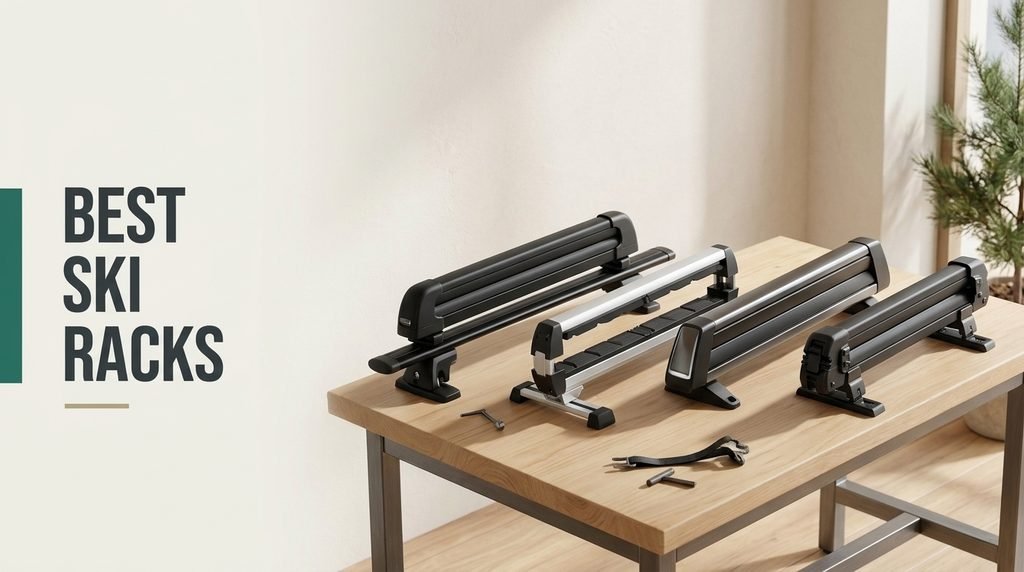
Find the right ski racks for 2026. We compare 10 standout options by the factors that matter in this category, including carrier style, ski and snowboard capacity, crossbar compatibility, locking security, cold-weather material performance, loading ergonomics, and practical off-season storage value.
Getting gear to the mountain is only half the job. A good carrier keeps wet skis and boards out of the cabin, protects fragile bases from road grime, and locks everything down during lunch stops. Once the season ends, the right wall or freestanding rack keeps that same equipment organized until snow returns.
The biggest decision is matching rack style to your vehicle and routine. Roof carriers need existing crossbars, hitch carriers need a receiver, and garage racks need only a drill and free wall or floor space. Capacity, locks, and glove-friendly operation separate models that feel effortless from those that frustrate every trip.
We compared 10 ski racks using the details that actually help a buyer decide: carrier type and mounting compatibility, ski and snowboard capacity, locking security, cold-weather material flexibility, loading and unloading ergonomics, build materials, installation effort, and value. The notes also weigh off-season storage trade-offs, because most skiers need gear organized between trips, not just hauled to the resort on Saturday morning.

Compare key features, scores, and current prices side by side. A shorter feature list means fewer details were available, not necessarily fewer capabilities.






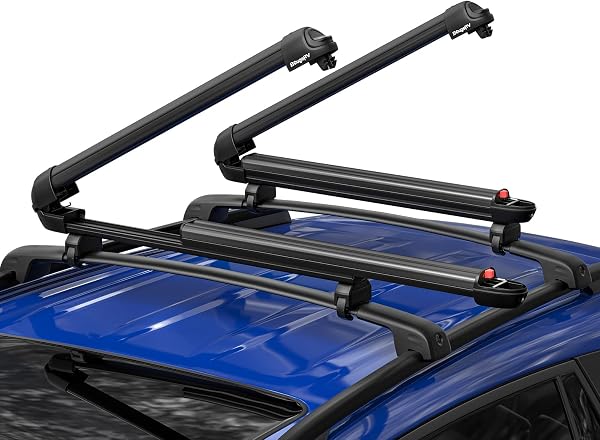
This carrier earns the top spot in the comparison with the strongest owner rating, at a price that undercuts several less flexible rivals. The 28-inch loading width handles six pairs of skis or four snowboards, and the rack also moves fishing rods, paddleboards, ski poles, and wakeboards through the warmer months.
We may earn a commission when you buy through this link, at no additional cost to you.
Build materials are the differentiator: a heavy-duty aluminum frame combined with thermoplastic elastomer components rated for extreme cold down to -40°C. Rust and corrosion resistance holds up against road salt, and the ultra-soft rubber cradles skis and boards gently enough to avoid marks and scratches on finishes.
Everyday use mirrors the best practices in this category. The sliding extension brings gear to the side of the vehicle, preventing roof scratches and dirty jackets. One key locks the skis and the rack itself to the crossbars for roadside stops. The crab mounting system fits aero, oval, square, and round bars, with rubber padding protecting the bars and the vehicle finish, and the extra-large buttons are deliberately sized for gloved hands.
Ordinary rubber hardens as temperatures plunge, losing grip and sometimes cracking where it wraps a binding. Thermoplastic elastomer rated to -40°C stays pliable through deep cold, so the clamping pressure on your skis stays even from the first load in a frigid parking lot to the last unload at night. For skiers in genuinely cold regions, that consistency is a quiet but meaningful reliability factor.
The honest limits: capacity falls with very wide boards, as it does on any 28-inch carrier, so check your widest snowboard first. The brand also lacks the decades-long heritage of Yakima. Neither changes the equation much. For most drivers who already own crossbars, this is the best-balanced purchase in the guide.
Cars without any roof crossbars installed.
We may earn a commission when you buy through this link, at no additional cost to you.
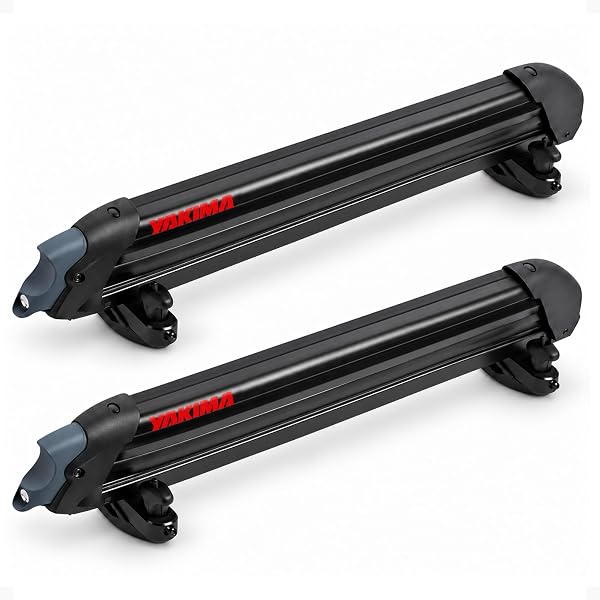
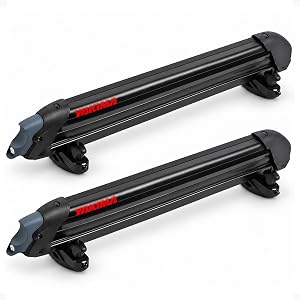
The Yakima PowderHound 6 targets resort regulars and family drivers who want a roof carrier from a company that has been building car-rack gear since 1979. Rated for up to six pairs of traditional skis or four snowboards, it frees cabin space on packed ski mornings and keeps dripping bases and sharp edges away from upholstery and passengers.
We may earn a commission when you buy through this link, at no additional cost to you.
Operation centers on a single large release button sized for gloved hands, which matters more than it sounds when temperatures drop and you are reloading at the end of a long day. The OverHang clamp attachment point keeps gear positioned within reach at the edge of the roof rather than forcing you to stretch toward the center. Integrated SKS locks use a key to help protect skis and boards during pit stops and apres-ski detours.
Mounting requires no drilling and no power tools, and the clamps fit a variety of roof rack crossbars. For thick bars, you can unscrew the T-bolt from the knob and push it up through the clamp to gain clearance. Wind noise at speed is considered normal behavior for this style of carrier, so plan on removing it between ski weekends to quiet the drive and trim fuel use.
The Same Key System means one key secures the carrier rather than a jumble of separate padlocks and straps. In a cold parking lot with mittens on, unlocking one mechanism instead of threading a cable lock through six pairs of skis saves real time, and there is only one key to keep track of all season.
The tradeoff is price and capacity math. Wide skis reduce the six-pair rating, and the PowderHound costs noticeably more than the generic sliding-extension rivals in this guide. For shoppers who value brand accountability, integrated locking, and simple dependable operation, it remains a safe long-term purchase.
Drivers without roof crossbars or anyone shopping strictly at budget pricing.
We may earn a commission when you buy through this link, at no additional cost to you.
BougeRV's 28-inch roof carrier is aimed at families and group trips that need six pairs of skis or four snowboards up top at a midrange price. It also works as a general outdoor carrier for fishing rods, paddles, ski poles, and water skis, which extends its usefulness well beyond the ski season.
We may earn a commission when you buy through this link, at no additional cost to you.
The headline feature is the sliding extension. The rubber bar slides outward so you can load and unload from the side of the vehicle instead of reaching across the roof, preventing scratches to the paint and keeping your ski jacket clean. The updated lock design ties the four mounting supports to the gear lock, so locking your boards also locks the entire rack to the crossbars.
The crab-shaped mounting clamps grip aero, oval, and square bars with rubber padding that protects both the rack and the vehicle, though dimension limits apply to each crossbar style, so measure before ordering. The aluminum frame resists rust, the hollow rubber bars stay soft rather than stiffening in winter, and the oversized button is easy to press in gloves. Twelve-month tech support covers fit questions and replacement keys.
Aero, oval, and square bars come in many profiles, and the crab clamps have dimension limits for each. Before ordering, measure the width and height of your crossbars and compare them against the fit specifications. If the numbers are borderline, contact support with your vehicle details rather than guessing, since a loose clamp is the single most common roof-rack complaint.
The compromise is compatibility. Round crossbars are excluded, and the 28-inch loading width demands a quick check against your widest snowboard before purchase. Within those limits, the sliding extension and combined locking make this one of the more convenient carriers for the money.
Round-crossbar owners and loads wider than the 28-inch bed.
We may earn a commission when you buy through this link, at no additional cost to you.
This six-pair carrier is built around family logistics: enough capacity for a full crew of skis or four snowboards, with room left for paddles, fishing rods, and ski poles when winter gives way to summer trips. It lands in the midrange on price while packing the sliding-extension and dual-purpose locking features that premium carriers popularized.
We may earn a commission when you buy through this link, at no additional cost to you.
The updated mounting system adds a third clamp for stronger gripping force, spreading the clamping pressure so crossbars are held firmly without being dented or scratched. Compatibility covers aero, oval, square, and round crossbars, which removes the guesswork that trips up buyers with older or factory bar setups.
Cold-weather behavior is well considered. The soft rubber bars remain flexible in low temperatures instead of turning rigid, the oversized buttons operate in gloves, and the frame resists rust and corrosion through salty road seasons. Locking with the included key secures both your skis and the rack itself to the crossbars at the same time. Support continues after purchase for installation questions, lost keys, and compatibility checks.
Most budget carriers grip the crossbar at two points, which concentrates pressure and can let the rack shift under wind load at highway speed. A third contact point spreads the clamping force, reduces stress on the bar finish, and keeps the carrier more stable on rough access roads to smaller resorts.
Because the loading width is described only as ample, measure your widest board before buying to confirm fit. Shoppers who want a household brand name with dealer presence should look at Yakima, but for capacity, features, and fit flexibility, this rack covers the practical bases for a family vehicle.
Buyers who prioritize a big-name brand with an established dealer network.
We may earn a commission when you buy through this link, at no additional cost to you.
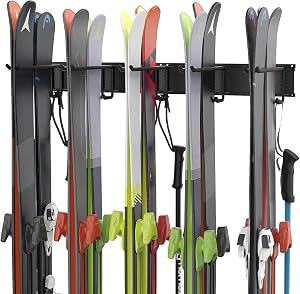
For around forty dollars, this wall-mounted rack answers the question every ski household faces in spring: where do all these skis go until next December? Two 32-inch rails carry five adjustable 11-inch hooks, and the spacing can be customized to fit skis of various sizes, from junior planks to adult all-mountain boards.
We may earn a commission when you buy through this link, at no additional cost to you.
Pairing skis in bundles keeps the wall orderly, and the design also accommodates snowboards. The garage stays walkable, gear stays visible instead of buried in a corner pile, and nothing leans against a car door waiting to be knocked over. For families with a quiver that outgrew the closet years ago, this is the cheapest path to order.
Construction is powder-coated steel rated to 300 pounds, with rubber sleeves on the hooks that prevent chips and scratches on topsheets. Installation uses pre-drilled holes spaced 16 inches apart to line up with typical stud framing, and the package includes screws and anchors. Note the hardware limits: the plastic expansion tubes are for drywall only, while brick and concrete walls require appropriate fasteners.
Mounting into wall studs with the included screws is the strongest option and the one the 16-inch hole spacing anticipates. If studs are not where you need them, the drywall expansion tubes work for lighter loads, but masonry walls call for proper concrete or brick anchors. Matching the fastener to the wall material is the difference between a rack that holds for years and one that pulls out under a full load.
Understand what this is: storage, not transport. You will still need a roof or hitch carrier for the drive to the mountain. For off-season organization at a minimal price, it is the entry point most garages need, and it pairs naturally with any of the transport racks covered elsewhere in this guide.
Anyone who needs to carry skis on a vehicle rather than store them.
We may earn a commission when you buy through this link, at no additional cost to you.
Leader Accessories keeps the formula simple for budget-minded skiers: a basic aluminum roof carrier near the eighty-dollar mark that still locks and still carries six pairs of skis or four snowboards. The internal length is 25.8 inches with a maximum gear height of 5.5 inches, which covers standard skis and boards without excess bulk.
We may earn a commission when you buy through this link, at no additional cost to you.
The standout material choice is the low-temperature rubber padding, which stays flexible down to -40°F and keeps ski bases and snowboard tops from being scratched or abraded on highway trips. The aluminum alloy body shrugs off road salt and rust, a meaningful detail for anyone who drives treated winter roads all season.
A metal locking mechanism secures the lid during transport, and the large opening button works with thick winter gloves. Installation is deliberately minimal: a single hex wrench tightens the four bolts for the entire assembly, and the universal mounting hardware fits most non-round crossbar sizes on cars, SUVs, trucks, and RVs.
Clamps designed for flat or aerodynamic profiles cannot wrap securely around a round tube, and forcing the fit risks both a loose rack and scratched bars. If your vehicle has round bars, either replace them with square or aero bars, or choose a carrier like the JOYTUTUS or the top pick in this guide, whose clamps are shaped to grip round profiles.
The compromises are clear. Round crossbars are explicitly excluded to avoid performance issues and surface damage, and you give up conveniences like the sliding extensions and combined gear-and-rack locking found on pricier rivals. For a straightforward seasonal hauler, the value case is strong, and the freed-up budget can go toward a garage rack.
Round-crossbar vehicles and buyers who want sliding extensions.
We may earn a commission when you buy through this link, at no additional cost to you.
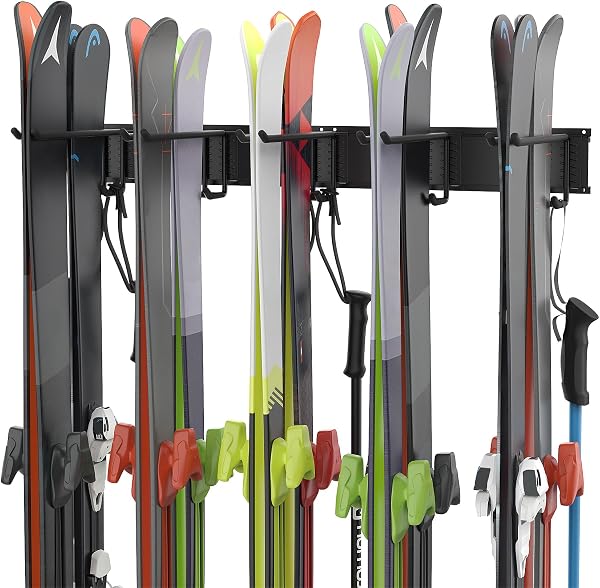
This premium wall system turns ski storage into something closer to display. Vertical mounting saves floor space in the garage, cabin, or gear room, and the staggered arrangement presents skis neatly instead of piling them in a corner. Beyond skis and snowboards, it fits skateboards, and the side hanging points hold poles alongside skis so nothing gets separated.
We may earn a commission when you buy through this link, at no additional cost to you.
Each hold uses soft rubber that both protects gear and prevents slipping, with a capacity of about 25 pounds per item; heavier loads can be reinforced with added straps. An automatic locking mechanism keeps skis in place, so nothing works loose over months of storage, and the grip surfaces will not mar delicate top sheets on expensive boards.
Daily convenience comes from the swivel arms: push up to open, and the arm locks automatically when you return gear. Installation is a matter of measuring, marking, and mounting with the five pre-drilled screw holes and included drywall screws. The multi-purpose hooks on both sides let poles, brooms, and sleds live in the same zone, ending the morning scramble for missing equipment.
The staggered arm arrangement spaces gear in offset rows rather than one cramped column. Beyond looking tidy, the offset keeps grips from colliding when several pairs are hung in the same stretch of wall, and it lets each pair be lifted out individually without disturbing its neighbors.
It requires drilling and free wall space, and the per-item capacity rewards spreading gear rather than stacking it. For households serious about organization, the grab-and-go access and polished appearance justify the step up from basic garage hooks.
Renters who cannot drill or garages with no open wall space.
We may earn a commission when you buy through this link, at no additional cost to you.
Not every ski household can or wants to drill into walls. This freestanding organizer stands on its own heavy-duty steel frame, holding a family's worth of gear anywhere from a home garage to a cabin to a ski lodge gear room, and it can be relocated whenever the layout of the space changes.
We may earn a commission when you buy through this link, at no additional cost to you.
The punch-free design means no studs, no anchors, and no holes. Assembly takes about two minutes with the included hardware and instructions, so the rack can go from box to loaded in a single evening. The black powder-coated finish resists rust, chipping, and scratching, holding up in the humid corners where wet winter gear dries.
Compatibility spans the realistic range of a family quiver, from kids’ skis through adult models, including racing, all-mountain, and cross-country skis. The compact footprint keeps the rack from consuming the garage, which matters when the same space needs to park a car and store bikes and summer toys.
Because nothing is permanently attached, the rack can follow the gear: set it in the mudroom through winter, then move it to a basement or gear closet in summer. Rental properties and shared ski condos, where drilling is usually off limits, are exactly the environments where a punch-free freestanding unit earns its keep.
The tradeoff is floor area. A wall rack consumes zero square footage, while a freestanding unit occupies some, and it carries gear rather than moving it to the mountain. For renters, lodge owners, and families who reconfigure storage seasonally, the mobility and drill-free setup win the argument.
Garages with no spare floor space for a standing unit.
We may earn a commission when you buy through this link, at no additional cost to you.
The BougeRV hitch carrier takes a different route to the mountain: instead of lifting gear overhead, you load at waist height from beside the vehicle. It fits standard 2-inch receivers on SUVs and trucks and carries six pairs of skis or four snowboards, plus fishing rods, paddles, ski poles, and water skis when the season turns.
We may earn a commission when you buy through this link, at no additional cost to you.
The materials pair a steel base for stability with aluminum alloy parts that stay rust-proof and lighter, which eases installation and removal. Rubber strips on the upper rack clamp boards firmly, while the lower rack supports the bindings on soft, thick padding that prevents scratches. Four webbing buckles double-secure the load and stop boards from colliding with each other over rough roads.
An integrated anti-rattle hitch pin connects the rack to the receiver and reduces wobble in transit, adjusted by rotating a yellow knob. Pull pins fold the upper and lower sections for compact storage when the rack is not in use, and the tilt function swings it away for rear hatch access. Double locks secure both the rack and the gear with the same key, the rack plates mount at adjustable heights to suit different board lengths, and a security strap adds stability. Twelve-month tech support rounds out the package.
Roof carriers ask you to hoist skis above shoulder height, often onto a vehicle with a liftgate in the way, while balancing on icy ground. A hitch rack positions the load at hip level where you can see every strap and adjust padding without a step stool. The tradeoffs are receiver requirements, added vehicle length, and slightly worse departure angles on steep access roads.
This is the most expensive option in the guide, and it adds length behind the vehicle, so rear parking and tight garages need extra attention. For skiers who dislike lifting gear overhead, or who drive tall SUVs where the roof is genuinely out of reach, the loading height alone changes the daily experience.
Vehicles without a 2-inch trailer hitch receiver.
We may earn a commission when you buy through this link, at no additional cost to you.
The JOYTUTUS carrier competes on completeness: a 27.5-inch loading area rated for six pairs of skis or four snowboards, with space left over for fishing rods, paddles, and ski poles. It is aimed at family trips and group adventures where one load-out has to carry everything for several people.
We may earn a commission when you buy through this link, at no additional cost to you.
Its signature advantage is fit. The crab-style mounting works with aero, oval, square, and round crossbars, the one category most rivals skip, and the reinforced rubber-padded clamps grip bars firmly without scratching the vehicle or the gear. The sliding extension brings the load to the side of the vehicle so you never have to lean across the roof, even while wearing gloves.
Security is handled by a built-in lock that secures both the gear and the rack to the crossbars at once, covering pit stops and all-day resort parking. Materials are rust-resistant, the rubber stays ultra-flexible in freezing temperatures, and oversized buttons keep operation easy in mittens. Support runs around the clock for installation help and compatibility questions.
If your vehicle wears round crossbars, either from an older rack system or a basic factory setup, most clamp-style carriers simply are not an option. This rack’s clamps are shaped to grip round profiles along with the aero, oval, and square styles, which spares you from buying replacement bars or cobbling together adapters that add wobble.
The 27.5-inch bed runs a touch narrower than the 28-inch competitors, so confirm the width of your widest snowboard before ordering. Otherwise, the universal fit, sliding access, and combined locking deliver strong everyday value at a midrange price.
Buyers needing hitch mounting or garage storage.
We may earn a commission when you buy through this link, at no additional cost to you.
A ski rack has to match two things at once: your vehicle, for the drive to the mountain, and your home, for the eight months the gear sits idle. This guide walks through the decisions that separate a rack you forget about from one that annoys you every weekend.
Roof carriers are the default choice, and every transport-focused product in this guide except the hitch model mounts to crossbars. They keep gear out of the cabin, do not add length behind the vehicle, and leave the rear hatch free. The costs are overhead lifting, extra vehicle height that complicates parking garages and drive-throughs, and some wind noise at speed, which Yakima openly notes is normal. Fuel use rises slightly as well, so many owners remove the carrier between trips.
Hitch carriers trade that overhead lifting for waist-height loading. The BougeRV hitch rack fits a 2-inch receiver, folds its upper and lower sections when idle, and tilts away so you can still open the rear hatch. The downsides are a required receiver, added vehicle length that affects parking, and rear visibility changes. For tall SUVs where the roof is out of comfortable reach, the loading height is transformative.
If your question is really about April through November, look at storage instead. Wall racks like the ten-pair steel unit and the premium swivel-arm version need free wall space and drilling, while the freestanding organizer needs floor space but no tools or anchors. Many households end up pairing one transport carrier with one storage rack, which is the most complete solution.
The standard capacity in this category is six pairs of skis or four snowboards, and nearly every roof and hitch carrier here hits that number. Two practical caveats apply. First, wide skis and wide snowboards reduce the pair count, because the loading bed has a fixed width. Second, the beds differ slightly: 28 inches on the BougeRV and the top pick, 27.5 inches on the JOYTUTUS, and 25.8 inches internally on the Leader Accessories, which also caps gear height at 5.5 inches.
Measure your widest pair before buying, not after. A fat powder ski or a wide snowboard can turn a six-pair rating into four pairs quickly, and families with mixed gear should assume the lower number when planning. Also consider what else rides up there: several of these carriers double as transports for fishing rods, paddles, ski poles, and water skis in the off-season, which effectively amortizes the purchase across the whole year.
Match capacity to your real crew, not your aspirational one. A household of two skiers rarely needs six-pair capacity, while a family of four with visitors does. Buyers who expect growth, or who carpool to the mountain, should size up.
Roof carriers mount to crossbars, not to the bare roof, so your first job is identifying what bars your vehicle has. The common types are aero, oval, square, and round. Most carriers in this guide cover the first three, but round bars are the outlier: the BougeRV roof rack and the Leader Accessories both exclude them, while the JOYTUTUS and the top-rated pick clamp onto round profiles along with everything else. Yakima fits a variety of bars and offers a T-bolt adjustment for thick profiles.
Dimension limits matter as much as bar shape. The crab-style clamps on several of these racks specify size ranges for each bar type, and a clamp that almost fits is a clamp that loosens over highway miles. Factory bars on SUVs and crossovers often have unusual aero profiles, so measure width and height and compare them against the fit specs before ordering. Support teams for BougeRV, JOYTUTUS, and the sliding six-pair rack all handle compatibility questions if the numbers are ambiguous.
Before buying anything, walk out to the driveway and write down your bar type and dimensions. That five-minute check prevents the single most common ski rack return, which is a perfectly good clamp that does not match the bars it was supposed to grip.
Ski gear is expensive and rack locks exist because resort parking lots are exactly where unattended gear sits for hours. The strongest designs lock two things at once: the skis inside the carrier and the carrier to the crossbars. The BougeRV 2026 system, the JOYTUTUS, the sliding six-pair rack, and the top pick all use this combined approach, so a thief cannot simply remove the loaded rack from the bars. The BougeRV hitch version goes further with double locks securing the rack and gear with one key, plus an anti-rattle pin that keeps the assembly tied to the receiver.
Yakima takes a different route with its SKS Same Key System, integrating keyed locks into the carrier itself. Whatever system you choose, plan for the key problem: keys get lost, and cold hands drop them in snow. Several brands here explicitly offer replacement key support, including BougeRV and the team behind the sliding six-pair rack, so register or photograph the key number when the rack arrives.
Treat locks as a requirement, not a bonus, if you ever leave the vehicle unattended with gear mounted. If you only load at home and unload at a watched lot, a simpler system like the Leader Accessories metal lock may be enough, but for all-day resort parking, combined gear-and-rack locking is worth paying for.
Ski racks live in the worst conditions your car encounters: slush, road salt, freeze-thaw cycles, and direct sun reflecting off snow. The material details that seem minor in a listing decide whether a rack grips gently in January or cracks and stains. Rubber padding is the critical part. The Leader Accessories padding stays flexible to -40°F, and the top-rated rack uses thermoplastic elastomer rated to -40°C, both of which keep clamping pressure even in deep cold. The BougeRV uses hollow rubber bars specifically chosen because they will not stiffen in winter.
Frames follow a similar logic. Aluminum alloy bodies on the roof and hitch carriers resist rust, which matters on salted highways, and steel components on the wall and freestanding racks rely on powder coating to resist chipping and corrosion in damp garages. For storage hardware, load ratings matter too: the ten-pair wall rack is rated to 300 pounds, while the premium wall rack holds about 25 pounds per item and suggests added straps for heavier loads.
If you ski in genuinely cold regions, treat sub-zero rubber ratings as a hard requirement rather than a nicety. In milder climates, prioritize frame material and lock quality instead, since the padding will rarely see the temperatures that stress it.
The difference between carriers shows up in the parking lot, at the end of the day, when you are tired and cold. Sliding-extension racks move the rubber bar toward the side of the vehicle so you can load without stretching across the roof, which protects the paint and keeps your clothes clean. The BougeRV, the sliding six-pair rack, the JOYTUTUS, and the top pick all include this feature, and it is the single most appreciated convenience in the category. Oversized operation buttons, present on nearly every carrier here, exist because small latches are impossible in mittens.
Other ergonomics are structural. Yakima’s OverHang clamp keeps gear positioned within reach at the roof edge rather than the center. The hitch rack sidesteps the whole problem by loading at hip height, and its adjustable rack plates accommodate different board lengths, while webbing buckles keep boards from banging into each other. On storage racks, swivel arms with automatic locking, like the premium wall rack’s, turn gear retrieval into a one-handed push rather than an unstacking chore.
Choose based on who loads the car. If a shorter adult or a teenager handles weekend duty, sliding extensions and low loading heights are not luxuries, they are the features that make the rack get used instead of skipped.
Transport racks are designed for tool-light installation. Yakima needs no drilling or power tools, the Leader Accessories assembles with one hex wrench and four bolts, and the crab-clamp systems tighten by hand. Expect to spend twenty to forty minutes on a first install, and plan on rechecking clamp tightness after the first highway drive, since vibration settles hardware. Hitch installation is heavier, but the anti-rattle pin and folding design of the BougeRV simplify both mounting and storage.
Storage racks ask different questions. The ten-pair wall rack pre-drills its rails on 16-inch spacing to match studs, includes screws and anchors, and specifies that the drywall expansion tubes must not be used on brick or concrete, which needs proper masonry hardware. The premium wall rack mounts with five pre-drilled holes per unit. The freestanding rack avoids the wall entirely with a punch-free, two-minute assembly, making it the only option for renters. Pair your choice with a plan for the off-season: remove roof carriers to cut noise and drag, and store them indoors where rubber and locks are not baked by summer heat.
Decide how much installation you are willing to do once, and how often you want to repeat it. Frequent removers should favor tool-free clamps and folding designs; set-and-forget owners can accept simpler hardware as long as it matches their walls or bars.
Start the season with a deliberate setup day. Confirm your crossbar type and dimensions against the fit specifications, install the carrier following the included instructions, and snug every clamp evenly rather than cranking one side tight first. Then take a short drive and recheck everything, because hardware settles after the first miles of vibration. Load a test pair of skis, lock and unlock the mechanism a few times, and confirm the buttons work with the gloves you actually wear, not bare hands. Twenty minutes of checking at home beats discovering a loose clamp at the trailhead.
On trip days, build a repeatable loading routine. Use the sliding extension where your rack has one, position the widest boards in the middle of the bed, and run any included straps or webbing buckles so boards cannot shift into each other over rough access roads. Lock the gear and rack before leaving the driveway, and glance up at the carrier after the first few miles of driving, since a settle-and-recheck habit catches nearly every developing problem. Remember that a loaded roof raises your effective vehicle height, so approach garages, drive-throughs, and low branch cover accordingly, and remove the empty carrier between trips to quiet the wind and save fuel.
Off-season care protects a multi-year investment. Rinse road salt and grime off the carrier, dry it completely, and store it indoors where sun and heat cannot degrade the rubber padding. Inspect the pad surfaces for embedded grit before the next season, because trapped sand scratches topsheets no matter how soft the rubber is. Keep keys labeled with the lock code, and use the replacement-key support that brands like BougeRV and JOYTUTUS provide rather than improvising. For wall and freestanding racks, wipe down hooks and rubber sleeves, recheck anchors or the frame’s footing before reloading, and let gear dry fully before hanging it so a damp garage does not become a corrosion problem.
Yes. Every roof carrier in this guide mounts to existing crossbars, not to the bare roof. If your vehicle has no rack system, you will need to add factory or aftermarket bars first, and the bar type matters: aero, oval, square, and round profiles each have different clamp compatibility. Measure your bars before ordering any carrier.
Yes. The standard six-pair ski carriers in this guide are all rated for four snowboards, and the hitch rack carries the same load at bumper height. Note that wide snowboards eat into capacity, since the loading bed is a fixed width of roughly 25.8 to 28 inches depending on the model. Check your widest board against the bed width before buying.
Generally yes, when it comes to loading. A hitch rack like the BougeRV positions gear at hip height so you can see every strap and never lift skis above your head, which matters most on tall SUVs. The tradeoffs are a required 2-inch receiver, added length behind the vehicle, and the need to tilt the rack for rear hatch access. Roof racks keep your rear end clear but demand overhead lifting.
Properly used, no. These carriers clamp gear against soft rubber padding, and several models use materials specifically chosen to stay flexible in extreme cold so pressure stays even. Damage usually comes from grit trapped in the padding or gear shifting in transit, so wipe the pads clean before loading and use any included straps or webbing buckles to stop boards from colliding.
Most racks here use a combined system: one key locks the gear inside the carrier and the carrier to the crossbars at the same time, so a thief cannot simply walk off with the loaded rack. The BougeRV hitch version uses double locks on the same principle. Locks are a strong deterrent for resort parking, though no lock makes gear immune to a determined thief with time and tools.
Some wind noise is normal, and added drag can trim fuel efficiency slightly, particularly at highway speeds. The effect is modest with a low-profile ski carrier compared with a cargo box, but it is real. Most owners simply remove the carrier between ski trips, which eliminates both the noise and the drag and takes only a few minutes with these clamp systems.
Wall-mounted racks with rubber sleeves, like the ten-pair steel unit or the premium swivel-arm version, keep skis organized and off the floor without pressure points. Renters or households without free wall space can use the freestanding organizer, which needs no drilling. Let gear dry completely before storing it, and keep the storage area reasonably stable in temperature and humidity.
Only with the right hardware and realistic expectations. The ten-pair wall rack includes plastic expansion tubes rated for drywall, and its rails are pre-drilled on 16-inch spacing specifically to align with studs, which is the stronger mounting option. For brick or concrete walls, you need appropriate masonry anchors, and the included drywall tubes should not be used there.
Yes, and that is one of the better value arguments for the roof and hitch carriers. Several models explicitly carry fishing rods, paddles, ski poles, and water skis, and the top-rated roof rack even lists paddleboards and wakeboards. The premium wall rack also holds skateboards, brooms, and sleds, so the hardware keeps earning its place outside the winter months.
Count your widest gear first. Six pairs of traditional skis is the standard rating, but fat skis and wide snowboards reduce that number because the loading bed is fixed at roughly 28 inches. A family of four with mixed skis and boards is usually well served by a six-pair rating, while couples who never carpool can save money with a smaller or simpler carrier.
The Lockable Sliding Roof Rack earns our Editor's Choice with the strongest owner rating in the comparison, a 28-inch loading bed, crab clamps that fit every crossbar type including round bars, combined gear-and-rack locking, and thermoplastic elastomer components rated to -40°C, all at a price below several less capable rivals. For most drivers with existing crossbars, it is the most complete transport package here.
Different needs point to different picks. The BougeRV hitch rack is the premium choice for tall SUVs and anyone who wants curb-height loading, folding storage, and double locks. The JOYTUTUS wins on value for round-bar owners, the Yakima PowderHound 6 suits buyers who want a legacy brand with one-key SKS locking, and the Leader Accessories covers basic seasonal hauling at the lowest roof-carrier price. For the off-season, the ten-pair wall rack, the swivel-arm wall rack, and the punch-free freestanding organizer handle the storage half of the equation.
Decide in this order: whether you need transport, storage, or both, then what your vehicle can actually mount, and finally how much capacity and security your crew requires. Measure your crossbars and your widest snowboard before ordering, treat locks as mandatory if you park unattended at resorts, and plan a storage solution for the months gear sits idle. Those steps will land you on the right ski rack for many seasons, not just one.