CC Skywave SSB
8.8Editor scoreFull band coverage
SSB reception
400 memory presets
70-hour battery life
Find the right shortwave radios for 2026. We compare 10 standout options by build quality, useful features, owner feedback, value, and everyday trade-offs.
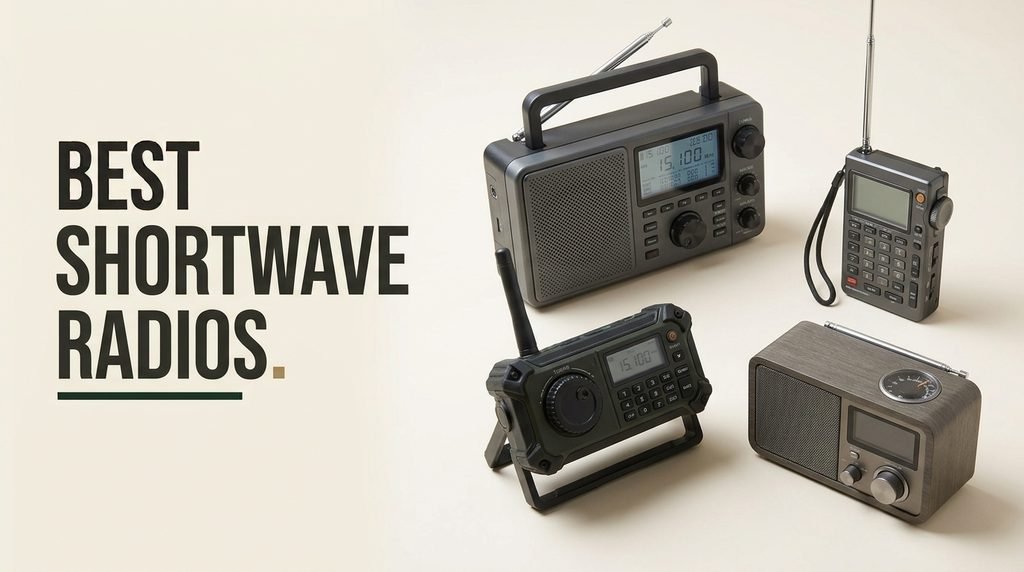
Find the right shortwave radio for 2026. We compare 10 standout models by the factors that genuinely matter for global listening: frequency coverage across AM/FM/longwave/shortwave bands, Single Side Band reception capability, NOAA weather alerts, audio quality, power options, portability, durability, memory presets, and practical trade-offs between sensitivity and size.
Shortwave radios range from compact travel units to feature-packed desktop receivers. The biggest differences are in band coverage, Single Side Band capability for long-range communication, emergency weather alert functionality, and whether the radio includes practical extras like multiple power options, external antenna jacks, or Bluetooth connectivity.
This guide breaks down each option by use case, from emergency preparedness kits to international broadcasting enthusiasts. Use the comparison table and detailed reviews to match frequency bands, reception quality, and special features to your actual listening needs and environment.
We compared 10 shortwave radios using the details that actually help a buyer decide: frequency coverage across AM/FM/longwave/shortwave bands, Single Side Band reception capability, reception sensitivity and selectivity, NOAA weather alert functionality, power options, portability, audio quality, durability, memory presets, and value. The notes focus on practical trade-offs so each pick connects to how people actually use shortwave radios for emergency preparedness, international broadcasting, camping, and long-distance communication.


Compare key features, scores, and current prices side by side. A shorter feature list means fewer details were available, not necessarily fewer capabilities.


The Kaito KA500 is one of the most practical emergency radios for buyers who prioritize power redundancy and NOAA weather alerts. It offers comprehensive coverage of AM, FM, 2-band shortwave, and 7 pre-programmed NOAA weather channels with PEAS (Public Emergency Alert System) for 24/7 real-time weather forecasts in the USA and Canada. This makes it an excellent choice for emergency preparedness in North America.
We may earn a commission when you buy through this link, at no additional cost to you.
The six-way power system is the standout feature. You can power the radio via hand crank generator, solar panel, compartment for 3 AA batteries (not included), 5V USB input, 5V AC/DC input with a wall power adapter (sold separately), or the built-in NiMH replaceable and rechargeable battery pack. This redundancy ensures you can keep the radio running in virtually any situation. The radio also works as an emergency mobile battery charger with a built-in standard DC 5V USB output port for charging phones, GPS units, MP3 players, and digital cameras.
Additional features include a 5-LED reading lamp, LED flashlight, and a red LED SOS beacon light. The telescopic antenna extends up to 14.5 inches for high sensitivity reception, assisted by advanced semiconductor circuitry design and an LED signal strength indicator for precise tuning. The built-in speaker delivers loud and crisp sound. The radio is made of strong premium impact-resistant and water-resistant ABS material, suitable for both indoor and outdoor use.
A six-way power system provides the ultimate redundancy for emergency preparedness. With hand crank, solar panel, AA batteries, USB input, AC/DC input, and built-in rechargeable battery, you have multiple fallback options if one power source fails. This is particularly valuable during extended outages where you cannot predict which power sources will be available. The KA500’s six-way system ensures you can stay informed regardless of the circumstances.
The main trade-off is the lack of SSB reception, which limits long-range communication capabilities. For buyers who prioritize emergency preparedness with maximum power options and NOAA weather alerts at an affordable price, however, the Kaito KA500 is one of the most practical and reliable options available.
Not ideal for buyers who need Single Side Band (SSB) reception or international shortwave listening beyond basic coverage.
We may earn a commission when you buy through this link, at no additional cost to you.
The C. Crane CC Skywave SSB 2 stands out as one of the smallest multiband radios that includes Single Side Band (SSB) reception, making it a powerful tool for long-range communication when normal channels are down. Its comprehensive coverage includes AM, FM, NOAA Weather with Alert, Shortwave (1711-29999kHz), and VHF Aviation bands, which is unusual for a radio this compact. For travelers, preppers, and emergency responders who need maximum frequency coverage in a portable package, this is one of the most versatile options available.
We may earn a commission when you buy through this link, at no additional cost to you.
The radio features a digitally tuned multiband receiver with superior sensitivity and selectivity, enhanced by multiple bandwidth settings. Selectable fast or fine tuning on all bands (except weather) gives you precise control over reception. The 400 memory presets let you store your favorite stations, and 10 aviation memories can be scanned for activity. A clock with 12/24-hour format, alarm, rotary volume and tuning knob, lighted LCD display, and stereo headphone jack round out the feature set.
Practical extras include a shortwave antenna jack for improved reception with an external antenna, high-quality CC Buds earphones, a faux leather carry case, and a 23-foot portable shortwave reel antenna. Battery life is impressive at approximately 70 hours with earbuds or 60 hours with the built-in speaker, running on two AA alkaline batteries. The radio weighs just 6 ounces without batteries and measures 4.75 x 3 x 1.1 inches, making it genuinely pocketable.
Single Side Band (SSB) is a mode of radio transmission that allows for long-range communication on shortwave frequencies. Unlike standard AM/FM, SSB can propagate across continents, making it one of the most reliable ways to receive information when local communications are down. For emergency preparedness, SSB provides access to international broadcasts and amateur radio networks that can be lifelines during disasters.
The main trade-off is that it requires AA batteries, which are not included. The small built-in speaker also means audio quality is good but not exceptional for music listening. For buyers who prioritize comprehensive band coverage, SSB capability, and genuine portability for emergency preparedness or travel, however, the CC Skywave SSB 2 is one of the most complete compact options available.
Not ideal for buyers who want a large speaker for music listening or a radio that runs on rechargeable batteries.
We may earn a commission when you buy through this link, at no additional cost to you.
The Tecsun PL880 is built for serious radio enthusiasts who demand the best reception quality across all bands. As a PLL synthesized digital dual conversion receiver, it offers unparalleled sensitivity and selectivity, with 4 selectable bandwidth filters on AM and 5 on SSB. This level of control lets you fine-tune reception to cut through interference and pull in weak signals that other radios might miss.
We may earn a commission when you buy through this link, at no additional cost to you.
Full range coverage includes AM, FM, Longwave, and Shortwave with Single Side Band reception, making it one of the most comprehensive radios in this comparison. The SSB capability is particularly valuable for long-distance listening and emergency communication. The 10 Hz tuning step on SSB provides extremely precise frequency adjustment, which is essential for pulling in specific international broadcasts.
Practical features include an alarm clock and sleep timer up to 120 minutes, which are useful for both daily use and emergency scenarios. The radio comes with a 1-year USA warranty, providing peace of mind for your investment. The compact, portable design makes it easy to take on trips or use as a backup at home.
PLL (Phase Locked Loop) synthesized tuning uses digital circuitry to lock onto frequencies with extreme precision. This technology provides superior stability and accuracy compared to analog tuning, reducing drift and improving reception of weak signals. For serious radio listeners and emergency preparedness, PLL synthesized receivers like the PL880 offer a noticeable advantage in signal clarity and reliability.
The main trade-offs are the lack of NOAA weather alerts and the higher price point compared to more basic models. For buyers who prioritize reception quality and SSB capability above all else, however, the Tecsun PL880 delivers exceptional performance that justifies the premium.
Not ideal for buyers who need NOAA weather alerts or a budget-friendly option.
We may earn a commission when you buy through this link, at no additional cost to you.
The Tecsun PL330 delivers impressive performance at a more accessible price point while still including Single Side Band reception. As a digital portable receiver, it covers AM, FM, Longwave, Shortwave, and SSB bands, giving you comprehensive frequency coverage for international listening and emergency preparedness. The modern DSP (Digital Signal Processing) digital demodulation technology enhances reception sensitivity, selectivity, and anti-image interference capability across all bands.
We may earn a commission when you buy through this link, at no additional cost to you.
With 850 memory presets, you can store a vast number of favorite stations for quick access. The alarm clock and sleep timer up to 120 minutes add practical daily utility. The radio includes a 3.5mm stereo earphone jack for private listening, and stereo earphones are included in the package. The keylock function helps preserve your settings during transport or use.
The PL330 uses synchronized detection for enhanced reception, which helps pull in weak signals more effectively than basic analog radios. The latest firmware version (3307) ensures you have the most up-to-date performance. For the price, this is one of the most feature-rich SSB-capable radios available, making it an excellent value for both beginners and experienced listeners.
Digital Signal Processing (DSP) uses computer algorithms to enhance radio reception by filtering out interference, reducing noise, and improving signal clarity. This is particularly valuable for pulling in weak shortwave signals from distant stations. DSP-equipped radios like the PL330 often outperform analog models in challenging reception conditions, making them ideal for both serious hobbyists and emergency preparedness.
The main trade-offs are the lack of aviation band and NOAA weather alerts. For buyers who want SSB capability and comprehensive band coverage at a reasonable price, however, the Tecsun PL330 offers an outstanding balance of features and value.
Not ideal for buyers who need aviation band reception or NOAA weather alerts.
We may earn a commission when you buy through this link, at no additional cost to you.
The C. Crane CC Skywave 2 is designed for travelers and preppers who need a compact, capable radio for staying informed anywhere in the world. It covers AM, FM, Shortwave (2300-26100 kHz), and VHF Aviation bands, with NOAA Weather plus Alert functionality. This combination makes it particularly valuable for monitoring weather conditions and aviation communications during travel or emergencies.
We may earn a commission when you buy through this link, at no additional cost to you.
The digitally tuned multiband receiver offers superior sensitivity and selectivity with multiple bandwidth settings. Selectable fast or fine tuning on all bands (except weather) gives you precise control. The radio includes direct frequency entry, auto scan and store, with 400 memory presets. 10 aviation memories can be scanned for activity. A clock with 12/24-hour format, alarm, rotary volume and tuning knob, lighted LCD display, and stereo headphone jack are all included.
Practical features include a shortwave antenna jack for improved reception with an external antenna, high-quality CC Buds earphones, and a faux leather carry case. Battery life is approximately 70 hours with earbuds or 60 hours with the built-in speaker, running on two AA alkaline batteries. The radio weighs just 6 ounces and measures 4.75 x 3 x 1.1 inches, making it one of the most portable full-featured radios available.
NOAA Weather Radio broadcasts continuous weather information and emergency alerts directly from the National Weather Service. During severe weather events, these alerts can provide critical warnings before local media or smartphone apps. For emergency preparedness, having a radio with NOAA alert functionality means you can receive life-saving information even when power and cellular networks are down.
The main trade-off is the lack of SSB reception, which limits long-range communication capabilities compared to its SSB-equipped sibling. For buyers who prioritize portability, NOAA weather alerts, and aviation band monitoring for travel or emergency preparedness, however, the CC Skywave 2 is an excellent choice.
Not ideal for buyers who need Single Side Band (SSB) reception for long-range communication.
We may earn a commission when you buy through this link, at no additional cost to you.
This portable shortwave radio is built for buyers who want maximum power flexibility in an emergency. It covers NOAA, AM, FM, and Shortwave bands with both manual and scanning tuning modes. The standout feature is its three power options: a built-in 4000mAh rechargeable battery with Type-C charging, a hand crank generator, and a solar panel. This redundancy ensures you can keep the radio running even when wall power is unavailable.
We may earn a commission when you buy through this link, at no additional cost to you.
Beyond radio functionality, this unit doubles as a multimedia device. Bluetooth 5.0 connectivity lets you use it as a wireless speaker for your phone or other devices. There is a 3.5mm headphone jack for private listening, and a USB drive/TF/Micro SD card slot for playing stored audio. The digital search function can automatically scan and store up to 70 channels per band, for a total of 210 channels.
Emergency features include NOAA weather alerts, a 120LM flashlight, compass, and SOS alert. The radio can also serve as a mobile power source for charging your devices during emergencies. The package includes the radio, Type-C cord, user manual, military-style box, and carrying strap. The 4000mAh battery provides up to 32 hours of playback time on a full charge.
During extended power outages, having multiple ways to power your radio can be the difference between staying informed and being in the dark. A combination of rechargeable battery, hand crank, and solar panel provides genuine redundancy. The hand crank can generate power when all other sources fail, while the solar panel can provide passive charging during the day. For serious emergency preparedness, multiple power options are one of the most valuable features to prioritize.
The main trade-offs are the lack of SSB reception and a more limited shortwave frequency range (not specified in the data, but likely narrower than dedicated shortwave radios). For buyers who prioritize power redundancy, emergency features, and multimedia capability over maximum shortwave performance, however, this is one of the most versatile options available.
Not ideal for buyers who need Single Side Band (SSB) reception or maximum shortwave frequency coverage.
We may earn a commission when you buy through this link, at no additional cost to you.
The Tecsun PL990 represents the premium tier of portable worldband radios, combining comprehensive frequency coverage with advanced audio features. It covers AM, FM, Longwave, Shortwave, and Single Side Band, giving you access to virtually any broadcast signal. The addition of an MP3 player with micro-SD input (compatible with FLAC, WAV, APE, WMA, and MP3 formats) transforms this from a radio into a complete audio entertainment system.
We may earn a commission when you buy through this link, at no additional cost to you.
Reception quality is exceptional thanks to analog high-IF AM circuitry plus triple conversion IF and modern DSP digital demodulation technology with synchronized detection. This combination provides unparalleled sensitivity, selectivity, and anti-image interference capability across all bands. A premium full-range 4 ohm / 3 watt speaker with built-in class AB amplifier delivers loud, rich, crisp, and distortion-free sound.
Practical features include an alarm clock with snooze function, a sleep timer up to 120 minutes, USB audio input, external antenna input, 3.5mm audio output, and a keylock function for preserving settings. The radio comes with stereo earphones and a Sandisk Ultra 16GB micro-SD card, providing everything you need for immediate use. With 3,150 memory presets, you can store an enormous number of favorite stations.
Triple conversion receivers use multiple intermediate frequency (IF) stages to improve selectivity and reduce image interference. This is particularly valuable for shortwave listening, where stations can be crowded together and weak signals need to be separated from strong ones. The PL990’s combination of analog high-IF AM circuitry and triple conversion IF provides superior performance for pulling in distant shortwave stations with clarity.
The main trade-offs are the high price point and lack of NOAA weather alerts. For buyers who want the ultimate in reception quality, audio performance, and feature set without compromising on band coverage or SSB capability, however, the Tecsun PL990 is one of the most capable radios available.
Not ideal for buyers on a budget or those who need NOAA weather alerts.
We may earn a commission when you buy through this link, at no additional cost to you.
The Raddy RF919 is one of the most feature-packed shortwave radios in this comparison, offering multi-band reception across FM, AM, SW, SSB, VHF, UHF, AIR, CB, and WB frequencies. This comprehensive coverage is adaptable to multi-ITU regions, making it ideal for international travelers and serious radio enthusiasts. The built-in frequency range and step selection settings ensure local acceptance wherever you go.
We may earn a commission when you buy through this link, at no additional cost to you.
Tuning options are exceptionally flexible. Dual knob tuning provides main and fine frequency adjustments with a retro click sound. You can also use up and down buttons or number button key tuning. Signal tuning is available through the rear antenna tuner along with the side knob for clear reception. The radio can store up to 1,600 channels, providing vast capacity for your favorite stations.
The display system is unique with a 3.54-inch main screen showing reception status and a customizable seven-color backlit display. The secondary screen offers signal strength, time, and a rhythmic music spectrum light in BT mode that flashes in sync with the melody. The Radio-CT app provides intelligent control from your phone with robust wireless capabilities and a user-friendly interface, freeing your hands for other tasks.
Smartphone app control like the Radio-CT app for the RF919 provides intuitive single-handed operation that can be easier than navigating complex radio menus. This is particularly valuable for making fine adjustments to tuning, managing presets, and accessing advanced features. For users who want modern convenience with traditional radio functionality, app control bridges the gap between analog and digital experiences.
Audio features include a 20W speaker with subwoofer for immersive sound, Bluetooth connectivity, and micro SD card support for an expandable music library. The 5000mAh battery allows for extended usage, and a 3.5mm headphone jack provides private listening. Three external antenna interfaces (VHF/UHF SMA Male, AM Antenna, and 3.5mm SW) ensure unparalleled reception. The main trade-off is the size and weight, making it less portable than compact options.
Not ideal for buyers who prioritize portability or have a limited budget.
We may earn a commission when you buy through this link, at no additional cost to you.
The XHDATA D808 offers impressive multi-band coverage at a very accessible price point. It covers FM (64-108MHz), AM (520-1710KHz), LW (153-513KHz), Shortwave (1711-29999KHz), Air Band (118-137MHz), and SSB, giving you comprehensive frequency access for both domestic and international listening. The DSP chip makes it easy to pick up stations, and the 360° antenna helps improve reception across all bands.
We may earn a commission when you buy through this link, at no additional cost to you.
Practical features include an alarm clock so you will not miss your favorite radio station, time and temperature setting, and signal-to-noise ratio monitoring to help you find the optimal position for listening. With 500 station memories, you can store a large number of your favorite stations for quick access. The large display makes it easy to see information at a glance.
Power options include a high-capacity replaceable battery and Type-C USB DC 5V input for recharging. The screen displays the remaining power so you can use the radio with confidence. The built-in speaker with external large-caliber horn design provides clear, bright sound with strong noise reduction and sensitivity. The package includes a specific bag, external antenna, USB charging cable, and English manual.
Air Band (also called Aviation Band) covers the frequencies used by aircraft for communication with air traffic control and between planes. This can be valuable for aviation enthusiasts, pilots, or anyone who wants to monitor local air traffic. Air Band reception is relatively rare in portable shortwave radios, making the D808 a good choice for buyers who specifically need this capability.
The main trade-offs are the lack of NOAA weather alerts and a lower battery capacity compared to some competitors. For buyers who want comprehensive band coverage including Air Band and SSB at a budget-friendly price, however, the XHDATA D808 is an excellent entry-level option.
Not ideal for buyers who need NOAA weather alerts or maximum battery life.
We may earn a commission when you buy through this link, at no additional cost to you.
The Tecsun H501 is designed for audiophiles who want exceptional sound quality from their worldband radio. It features dual premium full-range 6 ohm / 3 watt speakers with built-in class AB amplifier and treble/bass controls, delivering loud, rich, crisp, and distortion-free sound. This stereo speaker system provides a genuine listening experience that goes beyond typical portable radios, making it ideal for music as well as talk radio.
We may earn a commission when you buy through this link, at no additional cost to you.
Comprehensive band coverage includes AM, FM, Longwave, Shortwave, and Single Side Band reception. The radio also includes an MP3 player with micro-SD input, compatible with FLAC, WAV, APE, WMA, and MP3 formats. A Sandisk Ultra 16GB micro-SD card is included, so you can start listening to your digital music library immediately. With 3,150 memory presets, you can store an enormous number of favorite stations.
Additional features include an alarm clock with snooze function, a sleep timer of up to 120 minutes, USB audio input, external antenna input, 3.5mm audio output, and a keylock function for preserving settings. Stereo earphones are included for private listening. The analog high-IF AM circuitry plus triple conversion IF and modern DSP digital demodulation technology provide unparalleled reception sensitivity, selectivity, and anti-image interference capability across all bands.
Dual speakers provide stereo sound separation that single-speaker radios cannot match. This creates a more immersive listening experience, particularly for music. The H501’s dual 3W speakers with bass and treble controls allow you to tailor the sound to your preferences, providing audio quality that rivals dedicated portable speakers. For buyers who want to enjoy music as well as radio broadcasts, dual speakers are a worthwhile investment.
The main trade-offs are the very high price point and large, heavy design. For buyers who prioritize audio quality and want a complete entertainment system with worldband radio capability, however, the Tecsun H501 is one of the most impressive options available.
Not ideal for buyers on a budget or those who prioritize portability over audio quality.
We may earn a commission when you buy through this link, at no additional cost to you.
The best shortwave radio for you depends on how you plan to use it, which frequency bands you need to access, and whether you prioritize portability, audio quality, or emergency features. This section breaks down the factors that genuinely matter so you can match a radio to your actual listening needs.
Frequency coverage is the most fundamental specification and determines what you can listen to with your radio. Basic shortwave radios cover AM and FM bands, while more advanced models add Longwave, Shortwave, Single Side Band (SSB), and VHF Aviation bands. Full-band radios like the Tecsun PL880, PL990, and H501 cover AM, FM, Longwave, and Shortwave with SSB, giving you access to virtually any broadcast signal worldwide.
Shortwave bands (typically 1711-29999 kHz) are where you will find international broadcasts, amateur radio operators, and long-distance communications. SSB is particularly valuable for long-range listening and can propagate across continents, making it essential for emergency preparedness. Aviation bands let you monitor aircraft communications, which can be valuable for aviation enthusiasts or emergency monitoring. NOAA Weather bands provide critical weather information and emergency alerts in the United States.
If you primarily want to listen to local AM/FM stations with occasional shortwave, a basic model like the XHDATA D808 is sufficient. If you need comprehensive international coverage, prioritize full-band radios with SSB capability. For emergency preparedness in North America, NOAA Weather band coverage with alert functionality is essential.
Reception quality determines how well your radio can pull in weak signals and separate them from interference. This is particularly important for shortwave listening, where stations can be crowded together and signals may be faint. Digital Signal Processing (DSP) technology, found in radios like the Tecsun PL330, PL880, PL990, and H501, uses computer algorithms to enhance reception by filtering out interference, reducing noise, and improving signal clarity.
PLL (Phase Locked Loop) synthesized tuning, as used in the Tecsun PL880, provides superior stability and accuracy compared to analog tuning, reducing drift and improving reception of weak signals. Multiple bandwidth filters, like the 4-5 selectable filters on the PL880, let you fine-tune reception to cut through interference and pull in specific stations more effectively. Triple conversion receivers, such as those in the PL990 and H501, use multiple intermediate frequency stages to improve selectivity and reduce image interference.
For maximum reception quality, prioritize radios with DSP technology, PLL synthesized tuning, and multiple bandwidth filters. If you are on a budget, basic analog radios can still provide good reception for strong local signals, but you will notice a difference in weak signal performance compared to digital models.
Single Side Band (SSB) is a mode of radio transmission that allows for long-range communication on shortwave frequencies. Unlike standard AM, which transmits both sidebands, SSB transmits only one sideband, effectively doubling the range and improving efficiency. This makes SSB one of the most reliable ways to receive information when local communications are down, as it can propagate across continents.
SSB is particularly valuable for emergency preparedness, as it provides access to international broadcasts, amateur radio networks, and maritime communications that can be lifelines during disasters. It is also essential for serious radio enthusiasts who want to monitor utility stations, military broadcasts, and other long-distance communications. Radios with SSB capability include the C. Crane CC Skywave SSB 2, Tecsun PL880, PL330, PL990, H501, Raddy RF919, and XHDATA D808.
If you need SSB for long-range communication or serious radio monitoring, prioritize models that explicitly include this feature. If your needs are limited to local AM/FM and basic shortwave, SSB may be unnecessary and you can save money by choosing a model without it.
NOAA Weather Radio broadcasts continuous weather information and emergency alerts directly from the National Weather Service in the United States. During severe weather events, these alerts can provide critical warnings before local media or smartphone apps, potentially saving lives. Radios with NOAA alert functionality can automatically scan for emergency warnings and sound an alarm when a threat is issued.
NOAA Weather bands are particularly valuable for emergency preparedness in North America. Radios with this feature include the C. Crane CC Skywave SSB 2, CC Skywave 2, Portable Shortwave Radio, and Kaito KA500. The KA500 also includes PEAS (Public Emergency Alert System), which ensures you receive alerts for your specific area. For buyers in the United States, NOAA Weather alert functionality is one of the most important features to prioritize.
If you live outside the United States or do not need weather alerts, you can save money by choosing a model without NOAA functionality. However, for emergency preparedness in North America, this feature provides genuine peace of mind and can be critical during severe weather events.
Power options determine how you can keep your radio running during extended use or emergencies. Basic radios run on AA batteries, while more advanced models offer rechargeable batteries, hand cranks, solar panels, and USB charging. The most versatile power systems provide multiple options for redundancy. The Kaito KA500 offers six-way power including hand crank, solar panel, AA batteries, USB input, AC/DC input, and built-in rechargeable battery.
Battery life varies significantly between models. The C. Crane CC Skywave SSB 2 and CC Skywave 2 offer approximately 70 hours of runtime on two AA batteries. The Portable Shortwave Radio includes a 4000mAh rechargeable battery with up to 32 hours of playback time. The Raddy RF919 has a 5000mAh battery for extended usage. For emergency preparedness, longer battery life and multiple power options provide the most reliability.
If you plan to use your radio primarily at home, battery life and power options are less critical. For camping, travel, or emergency preparedness, prioritize models with long battery life and multiple power sources to ensure you can stay informed regardless of the situation.
Portability is a key consideration that often gets overlooked until you need to take your radio on a trip or evacuate. Compact, lightweight radios like the C. Crane CC Skywave SSB 2 and CC Skywave 2 (both 6 ounces) are easy to carry in a pocket, backpack, or emergency kit. Larger desktop models like the Tecsun PL990, H501, and Raddy RF919 are better suited for home use or base camps where weight and size are less critical.
The ideal size depends on your intended use. For travel, hiking, or bug-out bags, prioritize compact, lightweight models that you can realistically carry. For home preparedness or stationary use, larger radios with better audio quality and more features may be worth the extra size. Many buyers end up with multiple radios: a compact model for travel and a larger model for home use.
Consider where you expect to use your radio most often. If portability is a priority, look for models under 1 pound with compact dimensions. If you want maximum features and audio quality, larger desktop models provide better performance but sacrifice portability.
Audio quality varies dramatically between shortwave radios, from basic built-in speakers to premium stereo systems. Compact travel radios like the C. Crane models have small speakers that are adequate for talk radio and news but may not satisfy music lovers. Desktop models like the Tecsun PL990, H501, and Raddy RF919 feature larger, more powerful speakers that deliver richer, more dynamic sound.
The Tecsun H501 stands out with dual 3W speakers and bass/treble controls, providing stereo sound quality that rivals dedicated portable speakers. The Raddy RF919 includes a 20W speaker with subwoofer for immersive audio. For buyers who want to listen to music as well as radio broadcasts, audio quality should be a higher priority. All radios in this comparison include a 3.5mm headphone jack for private listening, and some include stereo earphones.
If you primarily listen to talk radio and news, basic speaker quality is usually sufficient. If you want to enjoy music or high-quality audio, prioritize models with larger speakers, higher wattage, and audio controls. For the best audio experience, consider connecting external speakers or using high-quality headphones.
Memory presets allow you to store your favorite stations for quick access, which is particularly valuable for shortwave listening where you may want to return to specific international broadcasts. The number of presets varies from 210 on the Portable Shortwave Radio to 3,150 on the Tecsun PL990 and H501. More presets provide greater flexibility for storing a wide range of stations across different bands.
Tuning features also impact usability. Direct frequency entry lets you input specific frequencies quickly. Auto scan and store functions make it easy to find and save new stations. Selectable fast or fine tuning, as found on the C. Crane models, gives you precise control over reception. Some radios also include signal strength indicators to help you find the optimal position for listening.
For serious radio enthusiasts who listen to many different stations, prioritize models with a large number of memory presets and advanced tuning features. For casual listeners, basic preset and tuning capabilities are usually sufficient.
Durability is particularly important for emergency preparedness and outdoor use, where your radio may be subjected to rough handling, moisture, or temperature extremes. Radios like the Kaito KA500 are made of strong premium impact-resistant and water-resistant ABS material, suitable for both indoor and outdoor use. The C. Crane models include faux leather carry cases for protection during transport.
Build quality also affects long-term reliability. Established brands like Tecsun, C. Crane, and Kaito have reputations for consistent manufacturing quality and customer support. Radios with solid construction, quality components, and rigorous testing tend to last longer and perform more reliably over time. For emergency preparedness, durability can be the difference between a radio that works when you need it and one that fails.
If you expect to use your radio in challenging environments, prioritize models with strong build quality and protective features. For indoor use, durability is less critical, but higher-quality construction still provides better long-term value.
Shortwave radios range from under $50 for basic models to nearly $300 for premium options. The Kaito KA500 at $49.99 offers exceptional value with six-way power options and NOAA weather alerts. The C. Crane CC Skywave SSB 2 at $189.99 provides comprehensive band coverage including SSB and aviation in a compact package. The Tecsun PL990 at $289.99 represents the premium tier with MP3 player, 3150 memory presets, and high-quality audio.
Value for money depends on your specific needs and priorities. For emergency preparedness, features like NOAA weather alerts, multiple power options, and durability provide the most practical value. For international listening, SSB capability and comprehensive band coverage are worth the investment. For audio quality, dual speakers and advanced audio features justify higher prices.
Calculate the cost per feature to determine which radio offers the best value for your specific needs. Sometimes paying a little more upfront provides significantly better long-term value and performance, while other times a budget model will meet your needs perfectly well.
Start by fully charging your radio or installing fresh batteries, depending on the power requirements. For rechargeable models, use the included Type-C cable or adapter to ensure a full charge before first use. For battery-powered radios, insert the required batteries (usually AA) and verify that the radio powers on correctly. Check that all bands, features, and accessories are functioning as expected before relying on the radio in an emergency.
For best reception, extend any telescopic or external antennas fully and position them for optimal signal strength. Shortwave reception is particularly sensitive to antenna orientation and local interference. Try different locations and antenna positions to find the best reception for your favorite stations. External antennas can significantly improve shortwave and SSB reception, particularly for distant or weak signals.
Store your radio in a cool, dry location when not in use to maximize its lifespan. Avoid extreme temperatures, humidity, and direct sunlight, as these can degrade performance and damage components over time. For emergency preparedness, keep your radio with fresh batteries or a full charge, and periodically test it to ensure it remains functional. Clean the radio gently with a soft cloth, and avoid harsh chemicals that could damage the finish or controls.
AM (Amplitude Modulation) and FM (Frequency Modulation) are standard broadcast bands used for local radio stations, with AM typically covering 530-1700 kHz and FM covering 88-108 MHz. Shortwave radio uses higher frequencies (typically 1711-29999 kHz) that can travel much farther, allowing you to receive international broadcasts from around the world. Shortwave is particularly valuable for long-distance listening and emergency communication when local stations are unavailable.
Single Side Band (SSB) is a mode of radio transmission that transmits only one sideband of the signal, effectively doubling the range and improving efficiency compared to standard AM. SSB can propagate across continents and is used for long-distance communication by amateur radio operators, maritime services, and international broadcasters. For emergency preparedness, SSB provides access to critical information when local communications are down.
If you live in the United States, NOAA Weather Radio provides continuous weather information and emergency alerts from the National Weather Service. During severe weather events, these alerts can provide life-saving warnings before local media or smartphone apps. For emergency preparedness in North America, NOAA Weather Radio with alert functionality is one of the most valuable features to prioritize.
Shortwave reception can be improved by using an external antenna, positioning your radio near a window or outside, and experimenting with different antenna orientations. External antennas can significantly enhance reception, particularly for distant or weak signals. Avoid locations with electrical interference, and try different times of day, as shortwave propagation varies with atmospheric conditions and solar activity.
For emergency preparedness, prioritize radios with multiple power options for redundancy. Hand crank generators, solar panels, rechargeable batteries, and AA battery compartments provide the most flexibility. The Kaito KA500 offers six-way power including all these options plus USB and AC/DC input. Multiple power sources ensure you can keep your radio running regardless of the circumstances during an extended outage.
Yes, many shortwave radios can receive music broadcasts from international stations, particularly on FM and shortwave bands. Some models like the Tecsun PL990 and H501 also include MP3 players with micro-SD card slots, allowing you to play your own digital music library. For the best music listening experience, prioritize models with high-quality speakers, dual speaker systems, and audio controls.
Analog tuning uses a traditional dial to select frequencies, which can be less precise and more susceptible to drift. Digital tuning uses electronic circuits to lock onto frequencies with greater accuracy and stability. PLL (Phase Locked Loop) synthesized digital tuning, as used in the Tecsun PL880, provides superior performance with precise frequency selection and reduced drift, making it easier to find and maintain weak signals.
Yes, shortwave radios are legal to own and use for receiving broadcasts in most countries, including the United States. Listening to shortwave broadcasts does not require a license. However, transmitting on shortwave frequencies typically does require a license from the appropriate regulatory body, such as the FCC in the United States. Always check your local regulations regarding radio transmission.
Most shortwave radios in this comparison are receive-only, meaning they can pick up broadcasts but cannot transmit. To communicate with others, you would need a transceiver, which is a different type of radio that can both transmit and receive. Transceivers require appropriate licenses for legal operation. For emergency communication, consider models with SSB reception, which can receive long-range transmissions from amateur radio operators.
Portable shortwave radios are compact, lightweight, and battery-powered, making them ideal for travel, camping, or emergency kits. Desktop models are larger, often with better audio quality and more features, but are less portable. Consider your primary use case: if you need to take your radio with you, prioritize portability. If you primarily use your radio at home or in a fixed location, a desktop model may provide better performance and features.
The C. Crane CC Skywave SSB 2 earns the top overall spot for its combination of comprehensive band coverage, Single Side Band capability, aviation band support, NOAA weather alerts, and genuine portability in a compact package. For buyers who want a single radio that can handle emergency preparedness, international listening, and travel without compromise, it covers the widest range of use cases while delivering excellent reception quality and practical features.
Buyers with different priorities have strong alternatives. The Tecsun PL990 is the clear choice for audiophiles and serious radio enthusiasts who want premium audio quality with MP3 player functionality and extensive memory presets. The Kaito KA500 provides exceptional value with six-way power options and NOAA weather alerts for emergency preparedness. The Tecsun PL330 offers the best budget SSB option, while the Raddy RF919 delivers the most feature-packed experience with app control and dual screens.
Start by identifying your primary use case, whether that is emergency preparedness, international broadcasting, camping, or travel. Then match frequency bands, SSB capability, power options, and special features to your actual needs. For emergency preparedness in North America, prioritize NOAA weather alerts and multiple power options. For international listening, prioritize comprehensive band coverage with SSB. For the best audio experience, prioritize models with high-quality speakers and audio controls.