Newport NV-Series 55
9.0Editor score55 lb thrust
30-inch shaft length
Transom-mount tiller
Saltwater compatible
Find the right trolling motors for 2026. We compare 10 standout options by build quality, useful features, owner feedback, value, and everyday trade-offs.
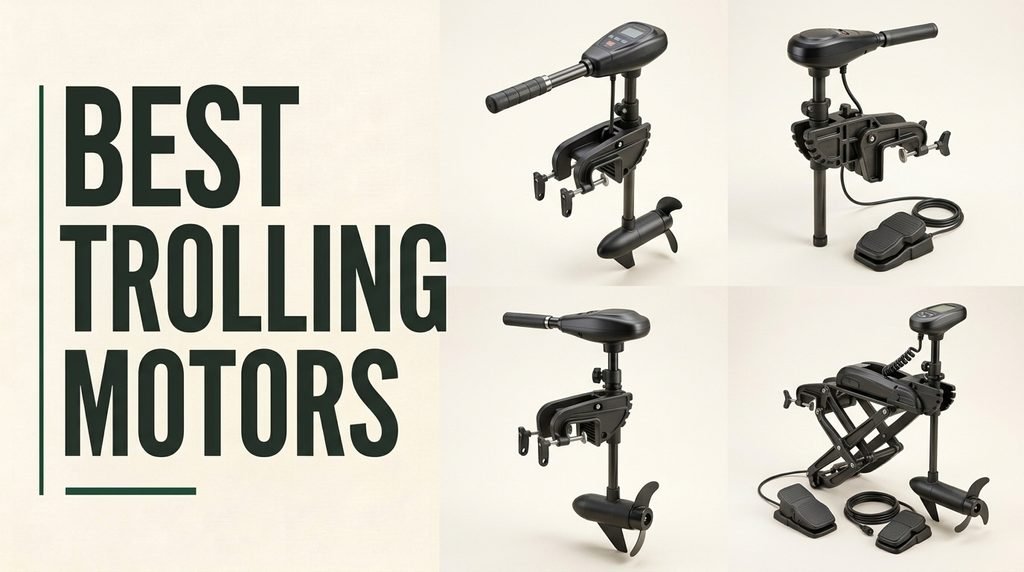
Choosing the right trolling motor means matching thrust rating, shaft length, mount style, freshwater or saltwater construction, and control type to your boat size, fishing style, and typical waters. We compare 10 standout electric trolling motors from Minn Kota, Newport, and Garmin, covering transom-mount and bow-mount designs with thrust ratings from 45 pounds up to 100 pounds for applications ranging from small jon boats to large bass rigs.
The motors in this guide span four distinct price tiers: affordable transom-mount tiller motors under $300, mid-range bow-mount units with foot pedal control around $550, premium GPS-enabled Minn Kota bow mounts with Spot-Lock in the $1,500 to $2,600 range, and flagship Garmin Force models above $4,000 that include built-in sonar transducers and wireless chartplotter integration.
This guide breaks down each option with clear specs, honest pros and cons, and practical buying advice. Whether you need a reliable transom motor for occasional lake fishing, a feature-rich bow mount with GPS anchoring for tournament bass, or a saltwater-ready unit for coastal flats, you will find a model that fits your boat and your budget.
We compared 10 trolling motors using the details that actually help a buyer decide: thrust rating relative to boat weight, shaft length for your transom or bow mount, mount type and deployment system, voltage requirements, control method including foot pedal or wireless remote, GPS and Spot-Lock capability, freshwater or saltwater construction, propeller design for weeds or power, battery management efficiency, brand reputation, warranty terms, owner feedback, and overall value. The notes focus on practical trade-offs so each pick connects to how anglers actually position boats, troll for fish, and navigate varied water conditions.


Compare key features, scores, and current prices side by side. A shorter feature list means fewer details were available, not necessarily fewer capabilities.



The Garmin Force Pro Trolling Motor earns a perfect 5.0 owner rating in this guide, reflecting exceptional satisfaction with Garmin's flagship trolling motor that integrates built-in UHD scanning sonar directly into the motor body. The GT56UHD-TR transducer eliminates the need for separate transducer mounting and wire routing, providing brilliant sonar returns with extremely low noise levels through direct integration with Garmin chartplotters.
We may earn a commission when you buy through this link, at no additional cost to you.
Multiband GPS provides superior positioning accuracy for anchor lock, heading hold, and route following functions compared to single-band systems. Wireless integration with Garmin chartplotters allows you to create routes, control steering, thrust level, and anchor lock positioning directly from your display, bringing boat control into the same interface as your chartplotter, sonar, and navigation data.
The scissor-style mount includes a durable pull cable and dual gas springs for easy deployment and stowing even with heavy use. Two propellers come included: a high-efficiency prop for open water trolling and a weedless prop for vegetation-heavy conditions, allowing you to match prop choice to actual conditions rather than compromising with a single design. The 50-inch shaft fits most bass boat configurations.
Built-in sonar transducers eliminate the mounting challenges, wire routing problems, and position compromises that affect add-on transducers. Having the transducer at the motor shaft provides consistent sonar views that follow the motor direction, which is particularly useful for Spot-Lock positioning where you want sonar views of the structure you’re fishing. For Garmin ecosystem users, this integration is a significant advantage.
This motor is the right pick for serious tournament anglers and dedicated Garmin ecosystem users who want the most integrated boat control experience available. The included remote enables point-and-go and gesture steering, while the foot pedal provides instant response. The premium price reflects flagship capability, and the Garmin chartplotter requirement means this motor delivers maximum value for anglers already invested in Garmin electronics.
Non-Garmin ecosystem users or budget-conscious anglers who don’t need built-in sonar.
We may earn a commission when you buy through this link, at no additional cost to you.
The Newport NV-Series 55-pound thrust trolling motor targets anglers who need a dependable transom-mount motor for small to mid-sized boats on either freshwater or saltwater. The 55 pounds of thrust works well for jon boats, aluminum fishing boats, and small bass rigs up to about 1,500 pounds, and the saltwater-rated construction using stainless steel, magnesium, and zinc hardware stands up to coastal use that would corrode freshwater-only motors.
We may earn a commission when you buy through this link, at no additional cost to you.
The 30-inch shaft fits most small-boat transoms with standard freeboard, and the mount angle, height, and direction all adjust and lock into place for proper prop depth. The 5 LED battery meter integrated into the motor head gives you real-time awareness of charge state so you can plan when to head back to shore before the battery drops below the point where you can safely motor in.
Eight speed settings including 5 forward and 3 reverse let you dial in precise trolling speeds for different lure presentations and fish species, with a top speed around 4 mph depending on boat weight and conditions. The 6-inch telescoping tiller handle extends your reach for comfortable operation while sitting at the stern, and the 3-blade propeller delivers good low-end torque to move boats against light wind and current.
Trolling motor shaft length determines whether the propeller stays properly submerged in various water conditions. A shaft that’s too short causes the prop to cavitate when the boat pitches in waves, while a shaft that’s too long creates drag and steering difficulty. For transom-mount motors, 30 inches works for most small boats with low freeboard, while taller transoms need 36 to 42-inch shafts.
This motor is the right pick for budget-conscious anglers who want saltwater compatibility and reliable Newport brand backing without paying premium prices. The 50-amp circuit breaker is included for battery protection, though you’ll want a quality deep cycle battery around 50Ah to match the motor’s needs. For larger boats or longer transoms, step up to the Newport L-Series 86-pound model or consider a bow-mount design with GPS features.
Owners of larger boats needing bow-mount configurations or GPS positioning features.
We may earn a commission when you buy through this link, at no additional cost to you.
The Minn Kota Endura Max 55-pound trolling motor stands out among transom-mount motors with Digital Maximizer technology that can extend battery runtime up to 5 times longer than conventional motors by matching power draw to your speed setting instead of running at full voltage. For anglers who fish long days or want to minimize battery weight on smaller boats, this efficiency translates to meaningful real-world advantage.
We may earn a commission when you buy through this link, at no additional cost to you.
The 42-inch shaft length provides good versatility for various freshwater boats, giving you adequate depth clearance on larger aluminum fishing boats or taller-sided jon boats where 30-inch shafts would run too shallow. The 10-position lever lock bracket adjusts and secures the motor angle quickly for different water conditions, and the reinforced composite construction resists flexing, warping, and UV damage season after season.
The Power Prop designed for the 3-1/4 inch motor diameter delivers extra thrust specifically for powering through thick vegetation like lily pads, hydrilla, and milfoil that bog down standard propellers. For anglers who fish weed-choked waters, this prop design can be the difference between making productive casts and spending the day clearing weeds from your motor.
Digital Maximizer replaces traditional 5-speed potentiometer control with pulse-width modulation that delivers exactly the power needed for your selected speed. Conventional motors waste energy at low speeds by converting excess voltage to heat. Variable speed motors like the Endura Max use that energy efficiently, extending battery life 3 to 5 times during normal trolling operation.
This motor is the right pick for freshwater anglers who prioritize battery runtime efficiency and plan to fish long days without battery charging opportunities. The 6-inch telescoping tiller and variable speed control give you precise finite adjustment for optimal boat positioning during trolling runs. For saltwater applications or more advanced features like GPS positioning, consider the Minn Kota Riptide PowerDrive or Terrova options instead.
Saltwater anglers or those who need wireless remote control and GPS positioning.
We may earn a commission when you buy through this link, at no additional cost to you.
The Minn Kota Terrova 55 earns the editor's choice position by delivering the Spot-Lock GPS positioning that transforms modern bass fishing combined with the highest owner rating in this guide at 4.6 stars. Spot-Lock uses the most-trusted navigation system in fishing to maintain your precise position over productive structure without manual steering, letting you focus entirely on casting while the motor handles boat control automatically.
We may earn a commission when you buy through this link, at no additional cost to you.
The included wireless remote with LCD screen enables hands-free operation and automatic positioning changes without needing to walk to the bow or use foot pedals. The Jog function lets you move your locked position 5 feet in any direction with simple button presses, perfect for repositioning over structure as fish move or you work different presentation angles. Drift mode, follow mode, and dodge mode handle different scenarios from downwind drifts to following contours.
The one-touch deploy and stow lever uses fall-away ramps to slide the motor into the water smoothly, eliminating the awkward manual deployment that frustrates owners of older bow-mount motors. The Weedless Wedge 2 propeller features swept-back flared blades that power through vegetation without the battery-draining chopping that affects standard propellers in weed-heavy conditions.
Spot-Lock uses GPS to maintain your exact position without manual steering, which lets anglers fish structure precisely without worrying about boat drift. This technology has become standard equipment on serious bass fishing boats because it dramatically improves productivity on offshore structure, docks, and specific waypoints. Once you experience hands-free positioning, going back to manual steering feels inefficient.
This trolling motor is the right pick for serious freshwater bass anglers and tournament fishermen who want proven Minn Kota GPS positioning technology at a reasonable price for the category. The 54-inch shaft handles most bass boat deck heights, and the Digital Maximizer battery efficiency extends runtime up to 5 times longer than conventional motors. For saltwater applications, consider the Riptide PowerDrive instead.
Saltwater anglers who need corrosion-resistant construction for coastal use.
We may earn a commission when you buy through this link, at no additional cost to you.
The Minn Kota Riptide PowerDrive brings Spot-Lock GPS positioning technology to saltwater anglers who need the premium corrosion resistance required for coastal fishing. Motor lower unit housings receive grit-blasting followed by aluminum coating to prevent oxidization and rust, with a final layer of powder coat paint providing comprehensive protection in saltwater environments that destroy freshwater-rated motors within a few seasons.
We may earn a commission when you buy through this link, at no additional cost to you.
The Bluetooth micro remote with non-slip grip provides automatic boat positioning and control from anywhere on the boat, which is particularly useful on larger coastal boats where walking to the bow for adjustments becomes impractical. The deploy-assist lever simplifies raising and lowering the motor compared to pure manual deployment, which matters when you’re fishing in choppy conditions where motor handling becomes challenging.
The 55-pound thrust rating works well for bay boats, flats skiffs, and smaller coastal fishing boats up to about 20 feet. The 54-inch shaft provides adequate depth clearance for most coastal fishing boat deck heights, and the Spot-Lock GPS system maintains precise position over productive flats structure or marker buoys regardless of wind or current direction.
Saltwater trolling motors use specialized corrosion-resistant materials, protective coatings, and sealed electrical components to survive the harsh saltwater environment. Using a freshwater-rated motor in saltwater voids warranties and causes rapid deterioration of exposed components. Always match motor construction to your typical water type, and rinse thoroughly with fresh water after any saltwater use.
This motor is the right pick for saltwater anglers who want GPS positioning capability combined with proper marine construction. The Digital Maximizer technology extends battery runtime up to 5 times longer than conventional motors, which matters during long coastal fishing days where recharging opportunities don’t exist. For strictly freshwater applications where saltwater construction isn’t needed, the Terrova 55 provides similar features at the same price point.
Freshwater-only anglers who can save money with the equivalent Terrova model.
We may earn a commission when you buy through this link, at no additional cost to you.
The Minn Kota Edge 45-pound bow-mount trolling motor serves as the entry point into bow-mount foot pedal control for anglers transitioning from transom motors without jumping to premium GPS models. The 4.6-star owner rating ties for the highest in this guide, reflecting consistent satisfaction with the Edge's reliable foot pedal operation and build quality.
We may earn a commission when you buy through this link, at no additional cost to you.
The ultra-responsive heel-toe cable-steer foot pedal includes speed control plus momentary and constant on/off functions, giving you precise control through natural foot movements while keeping both hands free for casting and fish fighting. The high-impact composite material construction stands up to the daily abuse that foot pedals experience on fishing boats. The latch and door bracket provides secure hold while stowing and allows easy removal at the end of the day.
The built-in directional indicator on top of the motor head helps you stay oriented when the propeller is below the surface, which prevents the frustrating situation of steering in unexpected directions when you can’t see the prop angle. The Power Prop designed for 3-1/4 inch motor diameters delivers extra thrust specifically for powering through heavy vegetation that would stop standard propellers.
Cable-steer foot pedals use mechanical cables to control motor direction, providing immediate tactile response that experienced anglers prefer. Electric-steer systems use motors to turn the trolling motor shaft, which allows features like GPS positioning but introduces slight delay. For traditional foot pedal fishing, cable-steer feels more responsive. For GPS features and hands-free positioning, electric-steer enables modern capabilities.
This motor is the right pick for anglers upgrading from transom-mount motors who want proven foot pedal operation and don’t need GPS positioning features. The 5-speed settings let you dial in appropriate speed for different trolling presentations and conditions. The 45-pound thrust limits applications to smaller fishing boats, so owners of larger boats or those who need GPS features should step up to the Terrova 55 instead.
Anglers who want GPS Spot-Lock features or need thrust ratings above 45 pounds.
We may earn a commission when you buy through this link, at no additional cost to you.
The Minn Kota Endura C2 50-pound transom-mount trolling motor represents the entry point into the trusted Minn Kota brand ecosystem at an accessible price. The time-proven C2 design has been refined through generations of improvements and delivers reliable performance for freshwater fishing on small to mid-sized boats including jon boats, aluminum fishing boats, and smaller bass rigs.
We may earn a commission when you buy through this link, at no additional cost to you.
The 6-inch telescoping tiller provides comfortable intuitive control throughout the fishing day, and the push-to-test battery meter integrated with the motor head lets you check battery status with a simple button press rather than requiring separate meters. The 10-position lever lock bracket adjusts motor angle quickly and secures firmly, with reinforced composite construction that resists flexing, warping, and UV damage over multiple seasons.
The Power Prop for heavy vegetation provides extra thrust to power through thick cover like lily pads and submerged weeds that stop standard propellers, which matters significantly when fishing weed-heavy lakes and ponds. Five forward speeds and three reverse speeds give you precise speed control from slow trolling presentations to quick repositioning when needed.
Not every angler needs premium features like GPS positioning or Digital Maximizer efficiency. For occasional lake fishing, basic trolling, or secondary motors on smaller boats, proven entry-level designs like the Endura C2 deliver reliable performance without premium pricing. Save the budget for other fishing equipment or future upgrades when your needs grow.
This motor is the right pick for budget-conscious freshwater anglers who want proven Minn Kota reliability without paying for Digital Maximizer efficiency or GPS features. The 36-inch shaft works well for smaller boats with modest freeboard, and the indestructible composite shaft handles bump impacts without breaking. For taller boats, step up to the Endura Max 42-inch shaft, and for maximum battery efficiency, choose the Endura Max with Digital Maximizer.
Anglers who need battery efficiency features or longer shaft lengths for taller boats.
We may earn a commission when you buy through this link, at no additional cost to you.
The Newport L-Series 86-pound thrust trolling motor targets anglers with larger saltwater boats who need maximum thrust in a transom-mount configuration. The 86 pounds of thrust handles bay boats, larger center console fishing boats, and heavier aluminum boats that would overwhelm 55-pound motors, and the saltwater-rated construction protects against the corrosion that destroys freshwater motors in coastal environments.
We may earn a commission when you buy through this link, at no additional cost to you.
The 24V dual-battery system provides the voltage needed for high-thrust operation while maintaining reasonable amp draw. Two 12V deep cycle batteries wire in series to produce 24V, with the 48-amp maximum draw spreading battery load across two sources for better runtime than attempting the same thrust at 12V. The 50-amp circuit breaker provides essential protection against the voltage surges that damage motors and electronics.
The 40-inch shaft length provides adequate depth clearance for most larger fishing boats where shorter shafts would run too shallow, and the 5 LED battery meter gives real-time awareness of combined battery charge state. Eight speed settings with 5 forward and 3 reverse allow precise control from slow trolling presentations up to the approximately 4.5 mph top speed, with the 3-blade propeller delivering strong low-end torque to overcome wind and current.
Trolling motors over 55 pounds of thrust typically require 24V systems using two 12V batteries in series. This higher voltage reduces amp draw at a given power level, which means smaller gauge wire can handle the current and batteries last longer per trip. The tradeoff is doubled battery investment and weight. For boats needing more than 55 pounds of thrust, 24V systems are generally required.
This motor is the right pick for saltwater anglers with larger boats who need serious thrust in a transom configuration without the complexity of bow-mount GPS systems. The 2-year Newport warranty provides substantial protection, and the stainless steel, magnesium, and zinc hardware stands up to saltwater exposure that destroys lesser motors. For freshwater applications or boats under 1,500 pounds, the lower-thrust NV-Series 55 provides better value.
Owners of smaller boats where 55 pounds of thrust is sufficient.
We may earn a commission when you buy through this link, at no additional cost to you.
The Garmin Force Kraken Trolling Motor claims the title of most powerful trolling motor on the market with 100 pounds of thrust rated in compliance with ISO standard 13342. For large bass boats, deep V boats, and anglers who need maximum thrust for serious wind and current conditions, the Kraken delivers the pulling power that lesser motors cannot provide. The 90-inch shaft length accommodates many different boat sizes and deck layouts, particularly larger boats where standard shaft lengths would be inadequate.
We may earn a commission when you buy through this link, at no additional cost to you.
Anchor lock uses multi-band GPS and integrated AHRS (Attitude and Heading Reference System) for heading hold, which provides Garmin’s most precise boat positioning capability. The AHRS integration allows the motor to maintain not just position but also boat heading, keeping the bow pointed in your desired direction for optimal fishing presentations even in changing wind conditions.
Wireless integration with Garmin chartplotters allows you to create routes, patterns, and tracks for the trolling motor to follow automatically. This feature-level integration goes beyond basic Spot-Lock to enable automated fishing patterns like S-curve retrieves along structure contours, following specific depth lines, or executing predefined patterns around waypoints. The pivot-style mount works where space is limited.
Maximum thrust ratings matter for large boats, extreme conditions, and tournament situations where every advantage counts. For boats over 20 feet, strong wind and current conditions, or heavy loaded boats, the extra thrust of 100-pound motors provides meaningful performance advantages over 55 to 80-pound motors. For most recreational fishing on smaller boats, this much thrust is overkill.
This motor is the right pick for serious tournament anglers with larger boats who need maximum thrust and the most advanced GPS positioning capability available. The premium price reflects flagship capability and requires significant deck space for the pivot-style mount. For boats under 20 feet or anglers who don’t need the maximum thrust, the Garmin Force Pro or Minn Kota Terrova options provide excellent capability at lower prices.
Owners of smaller boats where 55 to 80 pounds of thrust is sufficient.
We may earn a commission when you buy through this link, at no additional cost to you.
The Minn Kota Ultrex 80-pound bow-mount trolling motor combines serious 80-pound thrust with built-in Dual Spectrum Chirp sonar that visualizes fish, structure, and bottom contours with enhanced clarity compared to traditional sonar. All transducer components stay safely concealed within the trolling motor shaft, which eliminates the mounting challenges and vulnerability of add-on transducers while providing sonar views that follow the motor's direction.
We may earn a commission when you buy through this link, at no additional cost to you.
The patented lift-assist design uses a stainless steel, nitrogen gas-charged spring system to reduce stow and deploy effort by half, which matters significantly for the Ultrex’s heavier motor assembly. The system makes handling the motor at the dock or during fishing much more comfortable than brute-force manual deployment that affects owners of large bow-mount motors without lift assistance.
The advanced GPS trolling system with Spot-Lock and Jog maintains precise position and allows 5-foot adjustments in any direction, equipped with drift mode, follow mode, and dodge mode for different scenarios. Power steering with steering lock delivers responsive control that keeps the motor pointed in your desired direction when the pedal is released, and the heel-toe foot pedal provides all-day comfort with programmable steering sensitivity.
Built-in Chirp sonar in the trolling motor shaft provides sonar views that automatically follow motor direction, giving you consistent views of structure you’re actively fishing. This eliminates the mounting compromises of transom-mounted transducers and the installation complexity of shaft-mounted add-on transducers. For anglers who rely heavily on sonar for structure fishing, integration is a significant advantage over separate systems.
This motor is the right pick for serious freshwater anglers who want integrated sonar and the strongest Minn Kota freshwater bow-mount available. The 80-pound thrust handles larger bass boats and deep-V configurations that would overwhelm the 55-pound Terrova, and the built-in Chirp sonar eliminates the separate transducer mounting challenges. For saltwater applications, the Riptide line provides similar features in saltwater-rated construction.
Budget-conscious anglers or those who already own compatible sonar systems with transducers.
We may earn a commission when you buy through this link, at no additional cost to you.
Picking the right trolling motor means matching thrust rating, shaft length, mount style, voltage system, control type, and water compatibility to your specific boat, fishing style, and typical conditions. Here is what to prioritize before you buy.
Trolling motor thrust ratings should match your boat’s total loaded weight using the general rule of 2 pounds of thrust per 100 pounds of boat weight. A 1,500-pound jon boat with gear and anglers needs 30 to 40 pounds of thrust minimum, while a 3,000-pound bass boat with full tournament gear needs 60 to 80 pounds. The products in this guide range from 45 pounds on the Minn Kota Edge up to 100 pounds on the Garmin Force Kraken.
Undersized motors struggle against wind and current, which drains batteries quickly and leaves you unable to reach fishing spots in challenging conditions. Oversized motors waste money and battery capacity without providing meaningful benefits for lighter boats. The 55-pound thrust motors like the Terrova and Riptide represent the sweet spot for most mid-sized fishing boats, while serious bass boat owners typically step up to 80 or 100-pound options.
Calculate your fully loaded boat weight including anglers, gear, batteries, livewell water, and typical catch, then add at least 20 percent margin for wind and current conditions. Err toward slightly more thrust rather than less, since underpowered motors create frustrating situations more often than oversized motors cause real problems.
Transom-mount trolling motors like the Newport NV-Series, Minn Kota Endura, and Endura C2 attach to the back of the boat for pushing operation controlled by tiller handle. These motors cost significantly less than bow-mount designs, work well for solo anglers in smaller boats, and don’t require foot pedal operation. The tradeoff is less precise boat control compared to bow-mount pulling operation that keeps the boat tracking straight even in wind and current.
Bow-mount motors like the Minn Kota Edge, Terrova, Riptide, Ultrex, and Garmin Force models pull the boat from the front, which provides superior tracking control and allows foot pedal or GPS operation that frees your hands for casting and fighting fish. The tradeoff is significantly higher cost, more complex deployment and stowage, and the need for suitable bow deck space to accommodate the mounting bracket.
For small boats under 16 feet and casual fishing, transom-mount motors provide excellent value. For serious bass fishing, tournament use, or boats where GPS positioning features matter, bow-mount motors are essentially required. Many anglers eventually own both for different fishing situations.
Saltwater trolling motors like the Newport NV-Series, Newport L-Series, and Minn Kota Riptide use specialized corrosion-resistant materials, protective coatings, and sealed electrical components that survive saltwater exposure. These motors typically cost 10 to 20 percent more than equivalent freshwater models but last significantly longer in coastal environments where freshwater-only motors fail within one to two seasons.
Freshwater motors like the Minn Kota Endura C2, Endura Max, Terrova, Edge, and Ultrex use lighter construction without the premium corrosion protection, which keeps costs lower for the vast majority of anglers who fish freshwater lakes and rivers. Using freshwater motors in saltwater voids warranties and causes rapid deterioration of exposed hardware, mounting brackets, and internal electrical components.
Match motor construction to your water type. If you fish saltwater regularly, invest in the saltwater-rated version even at higher cost. If you fish exclusively freshwater, save money with freshwater-rated motors. Mixed-use anglers who occasionally fish saltwater should either rinse thoroughly after saltwater use or invest in saltwater construction.
Trolling motor shaft length determines whether the propeller stays properly submerged in various water conditions. For transom-mount motors, measure the distance from the top of the transom to the water surface and add about 10 inches to keep the prop below the surface during normal operation. For bow-mount motors, measure from the deck mounting location to the water surface and add 20 to 30 inches.
Shafts that are too short cause the prop to cavitate when the boat pitches in waves, generating noise that spooks fish and reducing propulsion efficiency. Shafts that are too long create drag during travel, create steering difficulty in weeds, and may hit the bottom in shallow water. The products in this guide range from 30-inch transom shafts on the Newport NV-Series up to 90-inch bow shafts on the Garmin Force Kraken.
Measure carefully before purchasing and err toward slightly longer shafts for rough water use or boats with high freeboard. The small performance penalty of a slightly longer shaft is minor compared to the problems caused by shaft lengths that are too short.
Trolling motor controls range from basic tiller handles on transom motors through foot pedals on traditional bow-mount motors up to wireless remotes and GPS-controlled systems on modern premium motors. Tiller handles like those on the Newport NV-Series and Minn Kota Endura require operator attention and physical adjustment but work reliably without electronics. Foot pedals like the Minn Kota Edge free your hands while maintaining operator steering control.
GPS-equipped motors like the Minn Kota Terrova, Riptide PowerDrive, Ultrex, and Garmin Force models add Spot-Lock capability that maintains position automatically without manual steering. This technology transforms modern fishing by letting anglers focus entirely on casting and fighting fish while the motor handles boat positioning. Wireless remotes allow operation from anywhere on the boat.
For traditional fishing styles and budget-conscious buyers, foot pedals provide excellent control. For serious tournament fishing, structure fishing, or anglers who want to maximize fishing time, GPS positioning features justify the premium cost. Once you experience Spot-Lock, going back to manual steering feels inefficient.
Trolling motors operate on 12V, 24V, or 36V systems based on thrust rating. Motors up to 55 pounds typically use single 12V batteries, 60 to 80-pound motors use dual 12V batteries in series for 24V, and 80 to 112-pound motors use triple batteries for 36V. Higher voltage systems reduce amp draw at a given power level, which allows smaller gauge wiring and provides better battery life per charge.
Battery runtime depends heavily on motor efficiency and your typical speed settings. Digital Maximizer technology in Minn Kota motors like the Endura Max, Terrova, Riptide, and Ultrex can extend runtime up to 5 times longer than conventional motors by matching power draw to speed selection. For all-day fishing, this efficiency is a significant advantage over basic 5-speed motors that run at full voltage regardless of selected speed.
Match battery size to motor requirements with at least 50Ah deep cycle batteries for 12V systems and larger for higher voltage setups. For long fishing days, prioritize motors with battery efficiency features. Factor battery costs into total system investment, which can significantly exceed motor cost for high-voltage systems.
Trolling motor mounting systems vary from simple transom clamps up to sophisticated bow-mount brackets with lift-assist deployment. Transom clamps like those on the Newport and Minn Kota transom motors install quickly on most boats without permanent modifications, which makes them ideal for anglers who switch between boats or want easy removal.
Bow-mount brackets require permanent installation on the deck or specific mounting location, and deployment systems range from basic manual lift up to sophisticated lift-assist designs like the Minn Kota Ultrex and Garmin Force models. Lift-assist systems use gas springs or similar mechanisms to reduce the physical effort of deploying heavy motors, which matters significantly for 80 to 100-pound motors.
For small boats and shared use, transom-mount motors offer flexibility. For dedicated fishing boats and heavier motors, bow-mount installation provides superior performance and the lift-assist deployment is worth the premium for heavier models. Measure available mounting space carefully, particularly for pivot-style mounts like the Garmin Force Kraken that require specific clearances.
When installing a new trolling motor, follow the manufacturer’s instructions carefully for mounting location, electrical connections, and circuit breaker installation. Use properly sized wire gauge based on the motor’s amp draw and the wire run length between battery and motor, and always install the recommended circuit breaker between battery and motor to protect against voltage surges. Test the motor in a controlled environment like a backyard pool or boat storage area before taking it on the water to verify proper operation, steering direction, and speed control response. Register your motor with the manufacturer to activate warranty coverage.
During regular use, operate the motor at the lowest speed setting that accomplishes your trolling or positioning goal to maximize battery life and reduce fish-spooking noise. Monitor the battery meter and plan return trips to shore before the battery drops below 25 percent to avoid being stranded without power. For boats with GPS-equipped motors, learn the Spot-Lock, Jog, and various mode functions through practice sessions before you need them for actual fishing. Keep the motor’s deployment and stow mechanisms clean of weeds and debris, and never leave the motor deployed when trailering or during storm conditions.
After each fishing trip, rinse the motor thoroughly with fresh water, paying special attention to the lower unit, propeller, and any exposed metal components. For saltwater use, this rinsing is critical for motor longevity. Inspect the propeller for damage, line wraps, or weed buildup, and address any issues promptly. Check battery connections for corrosion and clean as needed, and always disconnect the battery when storing for extended periods. Lubricate the deployment and stow mechanisms periodically according to manufacturer recommendations, and store the motor in the stow position when not in use to protect the lower unit from damage. Quality trolling motors properly maintained provide 10 or more years of reliable service for recreational fishing use.
Use the general rule of 2 pounds of thrust per 100 pounds of boat weight including gear, batteries, anglers, and typical catch. A 1,500-pound boat needs 30 to 40 pounds minimum, while a 3,000-pound bass boat needs 60 to 80 pounds. Add 20 percent margin for wind and current conditions. Err toward slightly more thrust rather than less to avoid underpowered situations in challenging conditions.
Transom-mount motors like the Newport NV-Series attach to the back of the boat and push, controlled by tiller handle. They cost less and work well for solo anglers in smaller boats. Bow-mount motors like the Minn Kota Terrova attach to the front and pull, providing superior tracking control and allowing foot pedal or GPS operation. Bow-mount motors cost significantly more but enable serious tournament fishing capabilities.
Yes, if you fish saltwater regularly. Saltwater motors use specialized corrosion-resistant materials and coatings that survive the harsh marine environment. Using freshwater motors in saltwater voids warranties and causes rapid deterioration within one to two seasons. Saltwater-rated motors like the Newport L-Series and Minn Kota Riptide cost 10 to 20 percent more but last significantly longer in coastal environments.
Spot-Lock uses GPS to maintain your exact boat position automatically without manual steering, available on motors like the Minn Kota Terrova, Riptide, Ultrex, and Garmin Force models. This technology lets anglers focus entirely on casting and fighting fish while the motor handles boat positioning over productive structure. Once you experience hands-free positioning, going back to manual steering feels inefficient for serious fishing.
Battery runtime depends on motor efficiency, selected speed, boat size, and conditions. Basic 5-speed motors run full voltage at any speed, draining batteries faster at low speeds. Digital Maximizer motors like the Minn Kota Endura Max match power to speed selection, extending runtime up to 5 times longer. A 50Ah deep cycle battery typically provides 4 to 8 hours of mixed trolling use with efficient motors.
For transom-mount motors, measure from the top of the transom to the water surface and add 10 inches. For bow-mount motors, measure from the deck mounting location to the water surface and add 20 to 30 inches. Err toward slightly longer shafts for rough water use or boats with high freeboard. The small performance penalty of longer shafts is minor compared to problems caused by shafts that are too short.
Trolling motors are designed for low-speed positioning and trolling, not primary propulsion. Top speeds typically max out around 4 to 5 mph, which is too slow for covering significant distances or dealing with strong currents. Use trolling motors for fishing presentations, boat positioning, and short repositioning moves. For primary propulsion, use outboard motors matched to your boat's horsepower rating.
Quality trolling motors range from about $160 for basic Minn Kota Endura 55 transom motors up to $4,500 for flagship Garmin Force Kraken with 100 pounds of thrust and multi-band GPS. Entry-level bow-mount motors like the Minn Kota Edge start around $550, while GPS-equipped bow mounts like the Terrova 55 cost around $1,500. Factor in battery costs separately, which can add $150 to $500 depending on battery type and quantity needed.
Yes, trolling motors require regular maintenance for optimal performance and longevity. Rinse thoroughly with fresh water after each use, especially after saltwater exposure. Inspect propellers for damage and remove weed wrap. Check battery connections for corrosion. Lubricate deployment mechanisms periodically. Inspect wiring for damage or wear. Store properly when not in use. Quality motors properly maintained provide 10 or more years of reliable service.
Yes, most trolling motor installations are DIY-friendly for mechanically inclined boat owners. Transom-mount motors install in 15 minutes with basic tools. Bow-mount motors require more complex installation including drilling mounting holes, running wiring, and installing circuit breakers. GPS-equipped motors may require additional integration with chartplotters. For complex installations or those involving boat modifications, consider professional installation to ensure proper setup and warranty compliance.
The Minn Kota Terrova 55 stands out as the strongest overall choice for most serious anglers, combining the industry-leading Spot-Lock GPS positioning system with the highest owner rating in this guide at 4.6 stars. Its 55 pounds of thrust works well for mid-sized bass boats and multi-species fishing boats, the 54-inch shaft handles most deck heights, and the wireless remote with LCD screen enables hands-free control throughout the fishing day. The combination of Digital Maximizer battery efficiency, Weedless Wedge 2 propeller, and one-touch deployment make this the sweet spot for serious freshwater anglers at a reasonable price for the category.
Budget-conscious buyers should strongly consider the Minn Kota Endura C2 for reliable transom-mount performance from the trusted Minn Kota brand at an entry-level price, or the Newport NV-Series 55 for saltwater capability at an accessible price point. Serious tournament anglers with larger boats should look at the Minn Kota Ultrex 80 for its built-in Chirp sonar and 80-pound thrust, or step up to the premium Garmin Force Pro with its perfect 5.0 owner rating and integrated UHD sonar transducer for Garmin ecosystem users. For saltwater anglers who want GPS features, the Minn Kota Riptide PowerDrive brings Spot-Lock to coastal fishing with proper marine corrosion protection. The Garmin Force Kraken represents the ultimate flagship choice for anglers with the largest boats needing maximum 100-pound thrust and multi-band GPS positioning.
Start by matching thrust to your boat's loaded weight using 2 pounds per 100 pounds minimum, then decide between transom-mount or bow-mount configuration based on your fishing style and budget. Choose freshwater or saltwater construction based on your typical waters, measure shaft length requirements carefully, and determine whether GPS features justify the premium cost for your fishing approach. The right trolling motor transforms your boat into a precision fishing platform that lets you focus on catching fish rather than fighting wind and current. Any motor in this guide can be the right choice for the right angler when matched to realistic boat requirements, fishing style, and budget.