Cobra BlueBound 350
9.0Editor score6-watt handheld radio
Floating orange core
Tri-watch channel monitoring
IPX7 waterproof rating
Find the right marine radios for 2026. We compare 10 standout options by build quality, useful features, owner feedback, value, and everyday trade-offs.
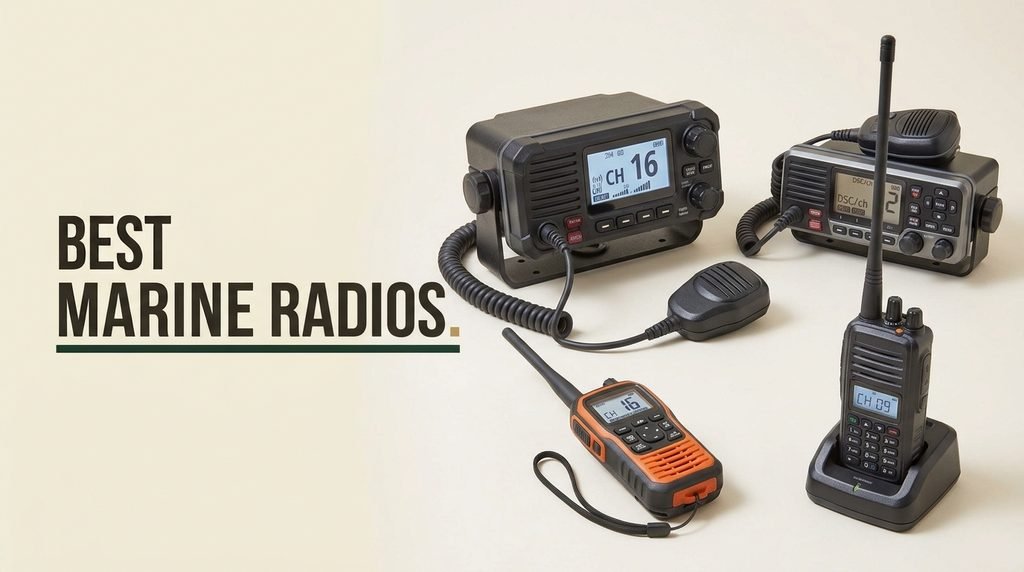
Selecting the right marine radio for 2026 means weighing transmit power, DSC safety features, waterproofing, GPS integration, and portability against your boating style and typical waters. We compare 10 standout VHF radios by the factors that matter most on the water: handheld versus fixed-mount design, 6-watt versus 25-watt transmit power, floating construction, DSC distress calling, NOAA weather alerts, battery life, and whether the radio suits coastal, offshore, or small-boat use.
Marine VHF radios split clearly into two main categories. Fixed-mount units like the Uniden UM385BK and UM725G transmit at the full 25-watt legal maximum for the longest range, serving as primary communication on larger boats. Handheld models like the Standard Horizon HX210 and Icom M94D provide portability, backup capability, and smaller boat practicality at 6 watts.
Whether you need a floating handheld for a kayak, a primary fixed VHF for a center console, or a DSC-equipped radio with built-in GPS and AIS for offshore safety, the picks below cover the most practical options available. Read on to find the marine radio that matches your vessel, your typical waters, and the kind of boating you actually do.
We compared 10 marine radios using the details that actually help a boater decide: transmit power rating, DSC and AIS capability, GPS integration, waterproofing rating, floating construction, battery life for handhelds, NOAA weather alert reception, channel coverage across US, Canadian, and international bands, and value against competing radios. The notes focus on practical trade-offs so each pick connects to how boaters actually use VHF communication, from primary helm installation to backup handheld use and emergency safety situations.


Compare key features, scores, and current prices side by side. A shorter feature list means fewer details were available, not necessarily fewer capabilities.


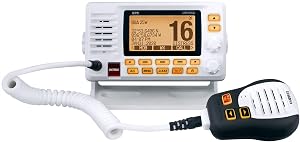


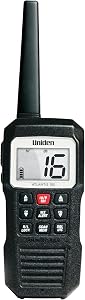
The Uniden UM385BK is a fixed-mount marine VHF radio designed as the primary communication system for coastal and offshore boats. The full 25-watt transmit power provides maximum legal VHF range, which can mean the difference between reaching distant marinas, bridges, or rescue services during emergencies. For any boat that ventures beyond protected waters, a fixed VHF with full power is a fundamental safety requirement.
We may earn a commission when you buy through this link, at no additional cost to you.
DSC capability with a dedicated distress button lets you call for help with a single press, automatically transmitting your position and vessel identity to all Coast Guard stations and nearby boats within range. The Full Class D DSC implementation provides position send and request functionality, enabling direct communication with specific vessels without broadcasting to all channels. This capability is now standard on quality marine VHFs but remains critical for safety.
Triple watch monitoring tracks three channels simultaneously, which lets you keep ears on channels 9 and 16 for safety plus one working channel. SAME weather alert reception warns you of severe conditions in your specific area through NOAA weather broadcasts, which can be lifesaving when offshore. The rugged handheld microphone with transmit button lets you communicate from the helm without having to reach for the mounted radio.
Fixed-mount VHF radios transmit at 25 watts compared to the typical 6 watts of handheld units, which translates to significantly greater range in both calm and challenging conditions. Fixed radios also connect to external antennas mounted high on the vessel, further extending effective range through improved line-of-sight to distant stations. For primary communication, fixed radios are the clear choice. Handheld VHFs serve best as backup units or for dinghy use rather than as primary vessel communication.
This radio is the right choice for recreational boat owners who need a reliable primary VHF system with modern safety features. The IPX4 rating protects against splashes and rain but is not rated for submersion, so the radio should be mounted in a protected location. For primary helm installation on center consoles, sport boats, and small cruisers, this Uniden delivers the critical communication capability that every boat should have.
Dinghy sailors or boats without permanent helm installation space who need portable handheld VHF solutions.
We may earn a commission when you buy through this link, at no additional cost to you.
The Cobra BlueBound 350 White handheld marine radio targets boaters who want a reliable backup VHF or primary portable radio for smaller vessels. The high-visibility orange floating core serves two important purposes: it keeps the radio buoyant if dropped overboard, and the bright color makes retrieval easier compared to all-black radios that disappear quickly on dark water. For dinghy sailors, kayak anglers, and small boat operators, this safety-focused design matters.
We may earn a commission when you buy through this link, at no additional cost to you.
The 6-watt maximum transmit power provides the full legal handheld VHF range, with switchable 1-watt and 3-watt settings for shorter-range use and battery conservation. The ability to reduce power when communicating with nearby vessels extends battery life significantly during long days on the water. Tri-Watch mode monitors channels 9, 16, and any user-specified channel simultaneously, which lets you stay aware of safety traffic while listening to your working channel.
The day and night selectable LCD display provides clear visibility in bright sunlight and preserves night vision during evening operation. Access to 12 NOAA weather channels keeps you informed of changing conditions, and emergency broadcast access alerts you to severe weather in your area. The IPX7 waterproof rating protects against full immersion for brief periods, which covers accidental drops and heavy spray during rough conditions.
Marine VHF channel 16 is the international distress and calling frequency that all boats should monitor whenever practical. Channel 9 is often used in the US as a working channel to keep channel 16 clear. Tri-Watch mode lets you monitor both of these safety channels plus your current working channel simultaneously, which provides maximum safety awareness without having to constantly change channels manually. For busy waterways and offshore operation, this capability is particularly valuable.
This radio is the right choice for boaters who want a quality handheld with practical visibility features at a mid-range price. The main tradeoffs are the absence of DSC distress calling capability, which is becoming increasingly standard on modern marine radios, and Cobra’s smaller brand presence in marine electronics compared to Uniden and Standard Horizon. For boaters who want simple reliable handheld communication with floating recovery, however, the BlueBound 350 delivers meaningful practical features.
Boaters who need DSC distress calling capability as a primary safety feature, which requires other radio models.
We may earn a commission when you buy through this link, at no additional cost to you.
The Standard Horizon HX210 is designed for boaters who need a reliable backup VHF or a primary unit for small vessels, kayaks, and dinghies where a fixed-mount radio is impractical. The floating design keeps the radio on the surface if dropped overboard, and the IPX7 submersible rating ensures it will continue to work after being retrieved from the water. For any marine environment, this water-tolerance combination is essential.
We may earn a commission when you buy through this link, at no additional cost to you.
The 6-watt transmit power provides maximum legal handheld VHF range, with selectable 6W, 2.5W, and 1W output power settings for conserving battery when range needs are lower. All USA, Canadian, and International marine channels are included, along with FM broadcast band reception from 76 to 108 MHz, which lets the radio double as an entertainment source during slower moments on the water.
The water-activated emergency strobe light is a safety feature that activates automatically when the radio detects water contact, which can be lifesaving during an unexpected overboard situation. The oversized full dot matrix display provides clear visibility of channel information and status, and the programmable function keys let you customize operation for your most common use patterns. A 3-year waterproof warranty backs the ruggedness claims with meaningful coverage.
The 3-year waterproof warranty on the HX210 is significantly more substantial than the limited coverage offered by many competitors. If the radio fails to maintain its waterproof integrity within three years of purchase, Standard Horizon will repair or replace it. This warranty reflects genuine confidence in the construction quality and provides meaningful assurance for buyers investing in equipment that will face regular water exposure during normal use.
This handheld is the right choice for boaters who want a reliable backup VHF, dinghy sailors, kayak anglers, and small boat operators who need portable communication capability. The main tradeoffs are the smaller 1850 mAh battery that provides shorter talk time than larger handhelds and the lack of DSC capability, which newer safety-focused buyers may prefer. For general handheld use where simplicity and ruggedness matter most, however, the HX210 delivers excellent value.
Buyers who need DSC distress button capability or primary helm radio coverage with 25-watt fixed-mount transmission.
We may earn a commission when you buy through this link, at no additional cost to you.
The Uniden Atlantis 275 brings serious feature density to the handheld marine VHF category with a combination of practical safety additions and quality display design. The 25mm by 40mm LCD screen is the largest in its class, which makes channel and status information easy to read even in challenging conditions or with poor eyesight. The paper-white backlight for daytime use and red backlight for nighttime preserve night vision while still providing clear visibility.
We may earn a commission when you buy through this link, at no additional cost to you.
IPX8 and JIS8 waterproof ratings represent the highest level of submersible protection, meaning the radio continues working after extended immersion. The floating design keeps the radio on the surface if dropped overboard, and the speaker water-clearing feature ejects water from the speaker port after submersion to restore normal audio operation. For boaters who deal with regular water exposure, these features matter significantly.
The 6-watt transmit power with user-selectable 6W, 2.5W, or 1W settings provides full handheld VHF range with battery conservation options. The built-in flashlight is a thoughtful addition for finding your way around the boat at night or in enclosed spaces. The emergency strobe light provides additional safety signaling during overboard situations. Three-year warranty with full 3-year waterproof warranty backs the construction quality.
Red backlighting at night is a long-established practice in marine electronics because red light preserves night vision much better than white light. When you need to check your radio in darkness, a red backlight lets you see the display without destroying your eye adaptation to darkness. The Atlantis 275 implements this dual-color approach with paper white for daytime and red for night, which represents thoughtful design focused on actual boater needs during real operating conditions.
This handheld is the right choice for boaters who want a feature-rich portable VHF with the best display quality in the handheld category. The main tradeoffs are the higher price compared to basic handhelds and the absence of DSC distress capability. For boaters who prioritize display quality, lighting features, and warranty coverage over DSC calling, the Atlantis 275 delivers compelling value with the added safety of the flashlight and strobe functions.
Buyers who prioritize DSC distress calling capability or those who want the most compact handheld design possible.
We may earn a commission when you buy through this link, at no additional cost to you.
The Cobra BlueBound 350 Black provides the same feature set as the white BlueBound 350 in a darker exterior finish for buyers who prefer the aesthetic or want the radio to be less visible on the deck when stowed. The floating orange core remains visible when the radio is dropped overboard, so recovery visibility is not compromised by the darker external coloring.
We may earn a commission when you buy through this link, at no additional cost to you.
The 6-watt maximum transmit power with switchable 1-watt and 3-watt options matches the white model exactly, as does the Tri-Watch monitoring of channels 9, 16, and your selected working channel. Access to 12 NOAA weather channels keeps you informed of severe weather, and the day/night selectable LCD display provides clear visibility in all lighting conditions.
The IPX7 waterproof rating protects against full immersion for brief periods, and the floating construction keeps the radio on the surface after accidental drops. All USA, Canadian, and International marine channel coverage ensures compatibility with any marine radio communication you encounter. The compact design works well for belt carry or storage in protective pouches.
Some buyers may wonder whether a darker exterior defeats the purpose of the high-visibility floating design. The answer is that the orange floating core remains the key visibility element when the radio is in the water, since the core is what shows above the water surface when the radio floats. The exterior color affects visibility only when the radio is on the deck or in your hand, where darker colors are often preferred for low-glare appearance that does not reflect bright sunlight into your eyes.
This radio is the right choice for buyers who want the Cobra BlueBound 350 features in a darker exterior color. The functional tradeoffs match the white version exactly, including the absence of DSC distress calling capability. For boaters who prefer a less visually prominent radio on deck or in storage, the black version provides the same practical features in a more discreet appearance. The orange floating core preserves recovery visibility regardless of exterior color choice.
Buyers who need DSC distress calling or prefer the white exterior finish of the alternative BlueBound 350 variant.
We may earn a commission when you buy through this link, at no additional cost to you.
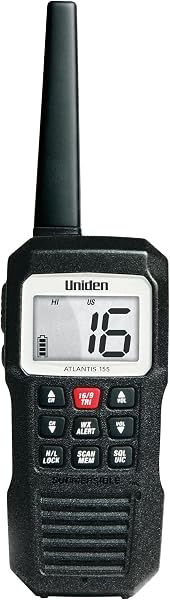
The Uniden Atlantis 155 brings handheld VHF capability to budget-conscious buyers without sacrificing the essential safety features that matter most on the water. The compact submersible floating design means the radio survives accidental drops overboard and continues working after retrieval, which is the fundamental reliability requirement for any marine handheld. The 3-year warranty backs the construction quality.
We may earn a commission when you buy through this link, at no additional cost to you.
IPX8 and JIS8 waterproof ratings represent the highest level of submersible protection among handheld VHF radios. The floating design keeps the radio on the surface after drops, and all USA, Canadian, and International marine VHF channels are supported, including the newer 4-digit channels and Canadian B channels. NOAA weather channel reception with alerts keeps you aware of changing conditions.
The 3-watt transmit power with selectable 3W or 1W settings is lower than the 6-watt radios in this guide, which translates to reduced maximum range. However, 3 watts is sufficient for communication within typical handheld-to-handheld range and for reaching nearby boats and shore stations in most protected waters. The 950 mAh NiMH rechargeable batteries in a 4xAAA configuration provide approximately 10 hours of operation and can be replaced with standard AAA cells in a pinch.
Marine VHF communication is primarily line-of-sight, which means that transmit power matters most when you need to reach stations far beyond the horizon. For communication within a few miles on protected waters, 3 watts of transmit power is usually sufficient for reliable contact. The Atlantis 155’s 3-watt power is appropriate for inland waterways, protected bays, and nearshore use where you are not trying to reach distant stations. For offshore use or communication with distant shore stations, step up to a 6-watt handheld.
This radio is the right choice for budget-conscious boaters, kayakers and paddlers who need basic VHF capability, or anyone who wants a secondary backup radio without major investment. The main tradeoffs are the reduced 3-watt transmit power that limits maximum range compared to 6-watt alternatives, and the AAA battery configuration that provides shorter talk time than larger Li-ion packs. For protected water use and backup applications, however, the Atlantis 155 delivers meaningful value.
Offshore boaters who need maximum range or anyone who wants full 6-watt transmit power for distant communication.
We may earn a commission when you buy through this link, at no additional cost to you.
The Uniden MHS75 is a proven handheld marine VHF that has served boaters reliably for years, delivering solid JIS8 waterproof performance and the practical features that matter most for daily use. The full JIS8 waterproof rating is equivalent to IPX8, meaning the radio survives extended immersion. The floating design and 30-minute submersion survival at 5 feet depth provide meaningful protection against accidental drops.
We may earn a commission when you buy through this link, at no additional cost to you.
Selectable 1-watt, 2.5-watt, or 5-watt transmit power lets you match transmit power to your communication needs. For nearby stations, 1 watt is often sufficient and conserves battery life significantly. For longer-range communication, you can boost to 2.5 or 5 watts for maximum reach. The 5-watt maximum is slightly lower than the 6-watt radios in this guide, but the practical range difference is minimal in most situations.
All USA, Canadian, and International marine channels are supported, with preprogrammed NOAA weather channels and weather alert reception. The emergency weather alert sounds an audible tone when NOAA issues severe weather warnings while the feature is active, which can provide critical early warning during changing conditions. Instant Channel 16 and 9 access provides one-button access to the primary safety and calling channels.
Triple Watch mode monitors channels 16 and 9 for activity while you listen to your currently selected working channel. The radio checks channels 16 and 9 every 2 seconds for incoming signals, which lets you stay aware of safety traffic without missing conversations on your working channel. For boaters who need to monitor multiple channels in busy waterways or during emergency conditions, this feature provides essential safety awareness that single-channel operation cannot match.
This radio is the right choice for boaters who want a proven handheld VHF from an established brand with reliable construction and sensible feature set. The main tradeoffs are the 5-watt rather than 6-watt maximum power and the absence of DSC distress capability. For general handheld use where simplicity and reliability matter more than the latest features, the MHS75 continues to deliver solid value backed by Uniden’s long history in the marine radio category.
Buyers who want the full 6-watt transmit power or those who need modern features like DSC and AIS capability.
We may earn a commission when you buy through this link, at no additional cost to you.
The Icom M94D handheld VHF sets a new standard for portable marine radios by integrating both DSC distress calling and AIS target reception into a handheld form factor. For coastal and offshore boaters who want portable radio capability with the safety features previously limited to fixed-mount units, this capability is genuinely transformative.
We may earn a commission when you buy through this link, at no additional cost to you.
The built-in AIS receiver displays nearby vessel traffic directly on the radio screen, letting you see commercial ships and other AIS-equipped vessels and their course information. The AIS target call feature makes setting up DSC individual calls and distress alerts fast and easy, since you can select other vessels directly from the AIS display rather than entering MMSI numbers manually. For safety awareness in high-traffic coastal areas, this integration is particularly valuable.
The 6W transmit power delivers maximum handheld range, and the 1500 mW speaker provides class-leading audio output that stays intelligible in noisy marinas, engine rooms, and offshore conditions. The 2400 mAh Li-ion battery provides up to 10 hours of typical operating time, which supports extended trips without charging. GPS navigation with up to 50 waypoint storage lets the radio serve as a basic backup navigation tool.
AIS, or Automatic Identification System, is required on most commercial vessels and voluntarily installed on many recreational boats. AIS receivers display these vessels and their course information, which dramatically improves situational awareness in congested waters, poor visibility, and night navigation. Having AIS capability on a handheld VHF means this safety information travels with you between vessels and provides backup if your primary chartplotter fails. For coastal and offshore navigation, this is a significant safety enhancement.
This radio is the right choice for coastal and offshore boaters who want handheld VHF capability with the full safety feature set, including DSC distress, AIS awareness, and float-and-flash recovery. The main tradeoff is the higher price compared to basic handheld VHFs, which may not justify the investment for occasional day boaters. For serious coastal and offshore use where safety features matter most, the M94D delivers capabilities that no basic handheld can match.
Casual day boaters on protected inland waters who do not need DSC and AIS capabilities and would benefit from simpler handheld options.
We may earn a commission when you buy through this link, at no additional cost to you.
The Icom IC-M330G addresses a specific installation challenge: small helms, tight consoles, and compact boats where traditional fixed-mount VHF radios simply do not fit. The palm-sized chassis provides full fixed-mount VHF capability in a footprint small enough for center console helms, cuddy cabin cruisers, and other space-constrained installations where mounting location options are limited.
We may earn a commission when you buy through this link, at no additional cost to you.
Built-in Class D DSC capability continuously monitors Channel 70 for distress, individual, group, all-ships, safety, position request/report, polling, and DSC test calls. The integrated GPS/GLONASS/SBAS receiver provides position, course, and speed data for accurate DSC calls and enhanced safety on the water. For boats where adding an external GPS would be impractical, this integrated capability is particularly valuable.
The new speaker design delivers loud, clear sound with rich bass and crisp treble, providing distortion-free audio even at full volume in noisy marine environments. More than 70 dB selectivity and intermodulation distortion performance ensure reliable reception and clear communication in RF-busy areas like marinas and harbors. The directional keypad and soft keys offer intuitive operation with frequently used functions assigned to one-touch keys.
DSC distress calls automatically transmit your position when properly configured, but this requires accurate position data from a GPS source. Fixed VHF radios without built-in GPS require connection to an external GPS, which adds installation complexity and the risk of connection failure. Built-in GPS on radios like the IC-M330G ensures that distress calls always include accurate position information regardless of other system status, which is a significant safety advantage during actual emergencies.
This radio is the right choice for boaters with small helms or tight console spaces who need fixed-mount VHF capability with modern DSC and GPS features. The main tradeoffs are the smaller display compared to larger fixed units and the premium Icom brand pricing. For installations where larger radios simply will not fit or when buyers want Icom’s Made in Japan reliability in a compact package, the IC-M330G delivers full fixed-mount capability in a space-efficient design.
Boaters with ample helm space who would benefit from larger displays, or those on tight budgets who do not need Icom’s premium build quality.
We may earn a commission when you buy through this link, at no additional cost to you.
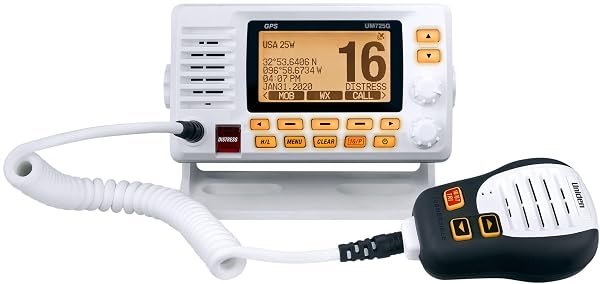
The Uniden UM725G steps up from the UM385BK by adding built-in GPS and a unique text messaging capability that lets boats communicate privately rather than broadcasting voice over channels for all nearby vessels to hear. For boats that regularly travel in groups or want private communication without a cellular signal, this text messaging feature represents a genuinely useful capability that no other marine radio in this guide offers.
We may earn a commission when you buy through this link, at no additional cost to you.
The built-in GPS receiver eliminates the need for external GPS connection to enable position reporting during DSC distress calls, which is a significant installation simplification and safety improvement. The 25-watt transmit power with selectable 1-watt option provides maximum legal range for primary vessel communication, with the 1-watt setting conserving transmission power for nearby stations and reducing interference with distant users.
The IPX8 submersible waterproof rating provides the highest level of water protection among fixed-mount marine radios, significantly exceeding the IPX4 rating of the UM385BK. For exposed helm installations or boats that take significant spray, this additional protection extends useful life considerably. The largest LCD display in its class at 68mm by 38mm shows more information at readable sizes, which matters when checking frequencies and status while underway.
The UM725G’s text messaging capability lets compatible Uniden marine radios send text messages privately between vessels rather than voice broadcasts that everyone in range hears. For groups of boats traveling together, this provides discreet coordination capability for fishing spot information, meeting locations, or non-urgent updates without using cellular service that may not be available offshore. All boats in the group must have compatible Uniden radios for the feature to work, which limits usefulness to pre-arranged groups.
This radio is the right choice for boat owners who want the most capable fixed-mount VHF with modern GPS integration, private text messaging for group communication, and maximum waterproofing. The main tradeoffs are the higher price compared to the UM385BK and the text messaging capability limited to boat-to-boat communication between compatible units. For boaters who travel with friends on multiple boats and want private communication capability, however, this UM725G delivers unique functionality worth the premium.
Budget-conscious buyers who do not need text messaging or built-in GPS and could be served by the lower-cost UM385BK.
We may earn a commission when you buy through this link, at no additional cost to you.
Selecting a marine VHF radio involves matching transmit power, waterproofing, safety features, and installation type to your boat and typical boating conditions. The radios in this guide span handheld and fixed-mount designs with different capabilities. This guide walks through the factors that genuinely matter when choosing marine VHF communication equipment.
The first decision when choosing marine VHF is between handheld and fixed-mount radios. Handheld units like the Standard Horizon HX210, Cobra BlueBound 350, and Icom M94D operate on internal batteries and move with you, making them essential for dinghies, kayaks, small boats without electrical systems, and as backup communication for larger vessels. Fixed-mount radios like the Uniden UM385BK and UM725G install permanently at the helm with external power and antenna connections, providing the primary communication capability on most boats.
Fixed-mount radios transmit at the full 25-watt legal maximum compared to the typical 6-watt handheld limit, which translates to significantly greater range. Fixed radios also connect to external antennas mounted high on the vessel, further extending effective range through improved line-of-sight. For boats venturing beyond protected waters, a fixed VHF should be the primary communication tool with a handheld as backup. For small boats and portable use, handhelds serve as primary communication within their range limitations.
Most serious boaters eventually own both a fixed-mount primary radio and a handheld backup. If you can only afford one radio initially, choose based on your most common use case: fixed-mount for established helm installations, handheld for portable and small boat applications.
Marine VHF transmit power is regulated to 25 watts maximum for fixed-mount radios and 6 watts maximum for handheld units. Within these limits, you can select lower power levels for shorter-range communication to conserve battery or reduce interference with distant users. The 1-watt setting is appropriate for nearby stations within a mile or two, while higher power settings reach progressively farther distances.
VHF range depends heavily on antenna height because signals travel primarily by line-of-sight. Fixed-mount 25-watt units with properly installed mast antennas typically reach 20 to 25 miles over water to other similar stations. Handheld 6-watt units achieve 5 to 8 miles at best, more realistically 3 to 5 miles due to lower antenna height. Range to Coast Guard stations with high elevated antennas is typically much greater than station-to-station range between recreational boats.
For boats that only operate in protected waters near marinas and civilization, lower power handheld radios often provide adequate range. For offshore and coastal boats that may need to reach distant stations during emergencies, fixed-mount 25-watt capability becomes essential.
Digital Selective Calling, or DSC, has become standard on quality marine VHF radios and should be considered essential rather than optional for serious boaters. DSC enables one-button distress calling that automatically transmits your vessel identity and position to Coast Guard stations and nearby DSC-equipped vessels. The Uniden UM385BK, UM725G, and Icom radios in this guide include Class D DSC capability. Many handheld radios still lack DSC, so verify this feature when choosing a handheld as your primary radio.
To use DSC effectively, you must register the radio and obtain an MMSI number that identifies your specific vessel to responders. The MMSI must be programmed into the radio before DSC calling will work properly. The Coast Guard needs accurate MMSI information to respond effectively to distress calls, so this registration step is critical rather than optional. Fixed-mount radios typically also include GPS connection requirements for position reporting during DSC calls, which units with built-in GPS like the UM725G and IC-M330G eliminate.
Prioritize DSC capability on your primary marine radio. If your handheld lacks DSC, ensure your fixed radio has it and that you have obtained and programmed an MMSI number.
Water resistance ratings vary significantly across marine radios and matter especially for handheld units that face constant exposure risk. IPX4 ratings like the Uniden UM385BK protect only against splashes and rain, which is adequate for protected helm installations but insufficient for exposed locations. IPX7 ratings like the Standard Horizon HX210 and Cobra BlueBound 350 protect against brief submersion. IPX8 and JIS8 ratings like the Uniden Atlantis 275 and MHS75 provide the highest level of submersible protection.
Floating design is essential for handheld radios used around water. A radio that floats keeps you from losing it permanently when it drops overboard, and floating designs typically include high-visibility colors or features like the orange floating core on the Cobra BlueBound 350 to aid recovery. For dinghy, kayak, and small boat use, floating construction is a fundamental safety and practical requirement. Several models in this guide also include water-activated emergency strobes that activate automatically during overboard situations.
For fixed-mount radios in protected helm locations, IPX4 or higher ratings are adequate. For handheld radios used around water, prioritize floating construction with IPX7 or higher ratings.
GPS integration on marine VHF radios provides two important benefits. First, GPS enables automatic position reporting during DSC distress calls, which eliminates the need to manually report your position when every second matters. Second, GPS allows navigation features like waypoint storage and distance calculation, giving the radio basic backup navigation capability. The Uniden UM725G, Icom IC-M330G, and Icom M94D all include built-in GPS.
AIS, or Automatic Identification System, is a newer capability that displays nearby vessel traffic directly on the radio screen. The Icom M94D is unique in this guide for including AIS receive capability in a handheld form factor. AIS significantly improves situational awareness in congested waters, poor visibility, and night navigation by showing the identity, position, and course of commercial vessels and other AIS-equipped boats within range.
For modern boats with chartplotters that already handle GPS and AIS, radio integration may be less important. For boats without comprehensive electronics or those wanting backup capability, radios with built-in GPS and AIS provide meaningful safety benefits.
All quality marine VHF radios cover the standard USA marine channels, with most also including Canadian and International marine channels for operation in other waters. The newer 4-digit channels and Canadian B channels appear on current-generation radios like the Uniden Atlantis series. For boaters who travel internationally or into Canadian waters, International channel coverage matters. For purely domestic use, USA channel coverage is sufficient.
NOAA weather channel reception and weather alert capability should be standard on any quality marine radio. SAME weather alert on the UM385BK provides targeted warnings for your specific county, which is more useful than broad regional alerts. Tri-watch or triple-watch monitoring tracks multiple safety channels simultaneously while you listen to a working channel, which is valuable for busy waterways. Features like FM broadcast reception on the Standard Horizon HX210 add entertainment capability during quieter moments.
Verify your target radio includes all channel bands you need and prioritize NOAA weather alert capability for safety awareness.
Proper installation and setup establishes the foundation for reliable VHF performance. For fixed-mount radios, use quality marine-grade coax cable and connections to the external antenna, following manufacturer recommendations for cable length and routing. Keep antenna cable runs as short as practical and avoid tight bends that can damage the cable or degrade signal. Register your DSC-equipped radio and obtain an MMSI number before taking it on the water, since DSC distress calling will not work properly without this registration. For GPS-equipped radios, verify GPS acquisition before relying on the radio for position reporting.
Routine maintenance keeps marine radios performing reliably in challenging conditions. For handheld units, rinse the radio with fresh water after saltwater exposure to prevent salt crystal buildup around buttons, speaker ports, and antenna connections. Charge batteries fully before trips and consider carrying spare batteries or a backup charging method for extended outings. For fixed-mount radios, check wiring connections annually for corrosion and water infiltration that can degrade performance over time. Keep displays clean using soft cloths and avoid harsh chemicals that could damage anti-glare coatings or waterproof seals.
Regular communication practice ensures you can actually use the radio when needed. Perform radio checks on channel 09 or 68 periodically to verify your radio transmits and receives properly. Avoid using channel 16 for radio checks, which is reserved for distress and calling. Learn the proper distress call procedure before you need it, including the proper use of Mayday, Pan-Pan, and Securite priorities. Review the DSC distress call procedure on your specific radio and ensure your crew knows how to use the emergency button in your absence. Many boating accidents result from radios that work perfectly but users who do not know how to communicate effectively during stressful situations.
Handheld marine radios operate on internal batteries and move with you, transmitting at a maximum of 6 watts. Fixed-mount radios install permanently at the helm with external power and antenna connections, transmitting at the full 25-watt legal maximum. Fixed radios provide significantly greater range due to higher power and better antenna installation. Handhelds offer portability, backup capability, and smaller boat practicality. Most serious boaters eventually own both types for different applications.
In the United States, recreational boaters operating only in US waters generally do not need an individual license to use marine VHF radio on their own boat. However, boats traveling internationally or operating commercially require an FCC Ship Station License and operator permits. Any boat using DSC capability needs an MMSI number, which is free from BoatUS for recreational use or from the FCC for commercial use. Always verify current requirements before relying on licensing exemptions.
Digital Selective Calling, or DSC, enables one-button distress calling that automatically transmits your vessel identity and position to Coast Guard stations and nearby DSC-equipped vessels. All modern quality marine VHF radios include DSC, which has effectively become standard. To use DSC, you must register the radio and obtain an MMSI number that identifies your specific vessel to responders. DSC significantly improves emergency response times and should be considered essential rather than optional.
VHF range depends on transmit power and antenna height. Fixed-mount 25-watt units with properly installed mast antennas typically reach 20 to 25 miles over water to similar stations. Handheld 6-watt units achieve 5 to 8 miles at best, more realistically 3 to 5 miles due to lower antenna height. Range to Coast Guard stations with high elevated antennas is typically much greater than station-to-station range between recreational boats. Weather conditions affect range as well.
Yes, floating construction is essential for handheld marine radios used around water. A radio that floats keeps you from losing it permanently when dropped overboard, and floating designs typically include high-visibility features that aid recovery. The Cobra BlueBound 350 has a high-visibility orange floating core. The Uniden Atlantis 275 and MHS75 offer floating submersible designs. For dinghy, kayak, and small boat use, floating construction is a fundamental safety requirement that pays for itself the first time it saves a dropped radio.
A Maritime Mobile Service Identity, or MMSI, is a unique 9-digit number that identifies your vessel for DSC distress calls and radio communications. Recreational boaters in US waters can obtain an MMSI free from BoatUS or the US Power Squadrons. Commercial boats or boats traveling internationally need an MMSI from the FCC. The MMSI must be programmed into your DSC radio before distress calling will work properly, so this step is critical rather than optional for any DSC-equipped radio.
Automatic Identification System, or AIS, broadcasts vessel identity, position, course, and speed to other AIS-equipped vessels. Required on commercial vessels and increasingly common on recreational boats. AIS receivers like the one in the Icom M94D handheld display nearby traffic directly on the radio screen, dramatically improving situational awareness in congested waters, fog, and at night. For coastal and offshore boaters, AIS receive capability significantly enhances safety and is worth paying extra for.
Channel 16 is the international distress and calling frequency that all boats should monitor whenever practical. Channel 9 is often used as the calling channel in the US to keep channel 16 clear for emergencies. Channel 13 is for bridge-to-bridge commercial vessel communication. Specific working channels vary by region and use case, with channels 68, 69, 71, 72, and 78 commonly used for recreational communication. Tri-watch or triple-watch modes let you monitor multiple safety channels simultaneously.
Quality marine VHF radios typically last 10 to 15 years with proper care and reasonable use. The main factors that end useful life are hardware failure from water damage or physical damage, battery degradation on handheld units, and feature obsolescence as safety standards and features advance. A radio from 10 years ago probably works fine but lacks modern features like DSC and GPS integration. Replace your radio when it stops working reliably or when newer features provide meaningful safety or convenience improvements.
No, marine VHF frequencies are reserved for use on vessels on the water. Using marine VHF radios on land violates FCC regulations and can result in significant fines. The only exception is for emergency communications when no other means are available, and even then limited to actual emergencies rather than general use. For land-based radio communication, use other radio services like FRS, GMRS, or amateur radio depending on your needs and licensing.
The Uniden UM725G stands out as the strongest overall fixed-mount choice for boat owners who want the most capable VHF system available, combining full 25-watt transmit power with built-in GPS, text messaging capability, and IPX8 submersible waterproofing. For primary helm installation on center consoles, sport boats, and small cruisers that need serious communication capability with modern features, this radio delivers everything in a reliable Uniden package. The private text messaging feature between compatible radios adds unique value that no other marine radio in this guide offers.
For buyers with different needs, several strong alternatives serve specific use cases. The Icom M94D delivers reference-class handheld capability with DSC, AIS receive, and float-and-flash recovery for serious coastal boaters. The Uniden UM385BK provides essential fixed-mount VHF with DSC at a lower price point for budget-conscious installations. The Standard Horizon HX210 and Uniden Atlantis 275 offer excellent floating handheld options with 6-watt transmit power. The Uniden Atlantis 155 brings submersible handheld capability to budget buyers. The Icom IC-M330G addresses the specific need for ultra-compact fixed-mount installations in tight helm spaces.
Choosing the right marine radio starts with understanding whether you need primary fixed-mount communication, portable handheld capability, or both. For primary vessel communication on boats venturing beyond protected waters, a fixed-mount VHF with DSC capability and built-in GPS should be the first priority. For small boats, portable use, and backup communication, floating handheld radios with IPX7 or higher waterproofing provide essential capability. Any of the 10 radios in this guide will serve its intended purpose well when matched to the right boat and user, so focus on fit for your specific situation rather than chasing the most impressive specifications on paper.