Dell 15.6" Core
8.4Editor scoreIntel Core 3 100U
8GB system memory installed
15.6-inch Full HD display
Ergonomic lifted hinge design
Compare 10 top laptops for students in 2026 by battery life, backpack weight, RAM capacity, display clarity, bundled Office software, and campus value.
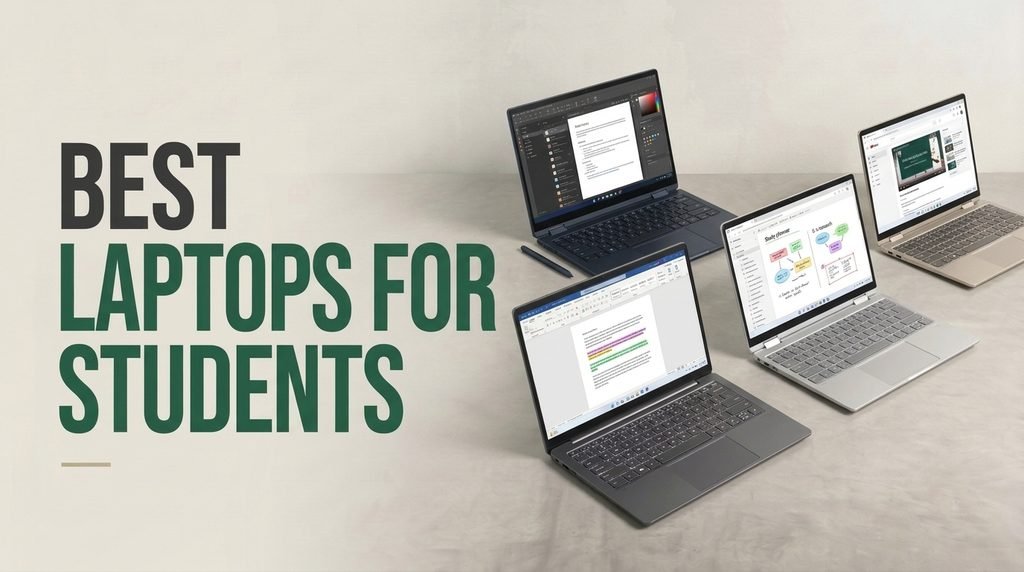
Find the right laptops for students for 2026. We compare 10 standout options by the factors that matter across campus and at home, including unplugged battery life, backpack weight, multitasking memory, screen resolution, keyboard comfort, bundled Microsoft 365 software, and everyday student value.
Academic computing needs vary widely between majors and grade levels. While some learners only need a sub-$300 notebook for cloud-based essays, learning management portals, and Zoom seminars, others benefit from 16GB of memory, multi-core processors, or macOS ecosystem continuity that lasts through a four-year degree.
Choosing wisely means looking past surface marketing to evaluate practical daily trade-offs. Details like anti-glare IPS panels for bright library tables, fanless silent designs for quiet lecture halls, and USB-C fast charging between classes make the biggest difference during busy semesters.
We compared 10 laptops for students using the details that actually help learners and parents decide: unplugged battery stamina, backpack weight and thickness, RAM and storage speeds for multi-tab research, screen resolution and blue-light filtering, webcam and microphone clarity for online seminars, port selection for dorm monitors, and bundled Office software value. The notes focus on practical trade-offs so each pick connects directly to how students take lecture notes, write papers, and study across campus.


Compare key features, scores, and current prices side by side. A shorter feature list means fewer details were available, not necessarily fewer capabilities.


For commuters, middle and high school students, and liberal arts majors whose daily routine revolves around taking lecture notes, writing papers in Microsoft Word, and submitting assignments through online portals, carrying a heavy 5-pound laptop is unnecessary burden. The 2027 Edition HP New Everyday Slim Laptop strips weight down to just 3.24 pounds within a sleek 0.71-inch profile, making it effortless to carry across campus or between home and school all week.
We may earn a commission when you buy through this link, at no additional cost to you.
Inside the slim frame, HP pairs the Intel N150 processor with 4GB of modern DDR5 RAM and a 128GB solid-state drive running 64-bit Windows 11 Home. Because both the DDR5 memory and the 128GB SSD prioritize fast data access and low power draw, the laptop wakes up quickly when you open the lid at the start of a lecture and runs cool and quiet throughout the period. Built-in Copilot AI integration and included Office 365 give students immediate access to essential writing, spreadsheet, and presentation tools.
Everyday usability is straightforward and hassle-free. Long battery stamina lets students work through morning and afternoon lectures without hunting for scarce classroom wall outlets, while integrated Wi-Fi and Bluetooth keep wireless earbuds and campus networks connected seamlessly. When you return to your desk or need to present slides in a classroom, built-in USB 3.0 Type-C, USB 3.0 Type-A, HDMI, and a headphone/microphone combo jack cover all standard peripherals without extra adapters.
When you carry a backpack on public transit or walk two miles across campus daily alongside textbooks, a water bottle, and a charger, every half-pound counts. Keeping the laptop chassis down to 3.24 pounds and 0.71 inches thin dramatically reduces shoulder fatigue over a four-month semester.
Because this configuration includes 4GB of RAM, a helpful habit for getting the best speed is closing unused background apps and keeping browser tabs focused on your current subject. For students who want a 3.24-pound ultraportable notebook with SSD responsiveness and included Office 365 near the $315 mark, the HP Everyday Slim 2027 is a reliable, travel-ready pick.
Students majoring in computer science, architecture, or digital media who need 16GB of RAM.
We may earn a commission when you buy through this link, at no additional cost to you.
Undergraduate students juggling research papers, statistics modules, and browser-heavy learning portals often want a noticeable step up from entry-level budget processors without spending past the $400 mark. The Dell 15.6-inch Laptop with an Intel Core 3 100U processor bridges that gap effectively. Designed for everyday academic efficiency, it pairs hybrid Intel Core 3 processing power with 8GB of system memory and a crisp Full HD display, making it a strong match for business, humanities, and general science majors.
We may earn a commission when you buy through this link, at no additional cost to you.
The core advantage here is the Intel Core 3 100U architecture. Unlike basic quad-core efficiency processors that can hesitate when loading dense PDF textbooks alongside web applications, the Core 3 100U provides higher single-core responsiveness so apps open briskly and multi-tab research stays fluid. Coupled with the 15.6-inch Full HD panel, students can comfortably snap a reference source on one half of the screen and a Word document on the other without squinting at cramped text.
During marathon study sessions at the library or dorm desk, physical comfort matters just as much as processor clock speed. Dell engineers this chassis with a lifted hinge that subtly raises the back of the base when opened, creating a natural typing incline for your wrists while improving airflow underneath the computer. Finance, accounting, and math students will also appreciate the roomy keyboard layout, which includes a full numeric keypad and a dedicated calculator hotkey for instant calculations.
Typing thousands of words on a flat laptop deck often causes wrist strain over a full semester. When you open the Dell 15, the bottom edge of the lid gently lifts the keyboard into an ergonomic tilt while exposing intake vents for cooler operation. Paired with a dedicated 10-key pad and single-press calculator launcher, numerical data entry for lab reports and economics problem sets becomes noticeably faster.
Eye comfort and charging convenience round out the package: Dell ComfortView software tempers blue light emissions during evening reading, and ExpressCharge support tops up the battery quickly when you only have 30 minutes near an outlet at the student union. While creative majors running heavy 3D rendering software will want more than 8GB of RAM, students seeking snappy Core 3 performance and superior typing ergonomics under $400 will find this Dell hard to beat.
Engineering or film students who require 16GB+ of RAM and dedicated graphics for heavy rendering.
We may earn a commission when you buy through this link, at no additional cost to you.
Ask any college student what actually slows down their computer during finals week, and the answer is almost always running out of memory while keeping 35 scholarly journal tabs, a citation manager, lecture slides, and a Zoom study group open simultaneously. The 2026 Edition Acer Aspire Lite 15 directly targets that memory bottleneck by equipping a full 16GB of RAM—double the capacity of most laptops in its price tier—alongside bundled Office 365 software and 1TB of cloud storage.
We may earn a commission when you buy through this link, at no additional cost to you.
Powering the system is the efficient 4-core, 4-thread Intel Core N150 processor capable of boosting up to 3.7 GHz within a cool 15-watt thermal envelope. Because the processor draws minimal power, the chassis stays comfortable on your lap while the 16GB of memory keeps browser tabs and homework applications cached in fast RAM rather than swapping to the drive. Between the local solid-state drive for immediate bootups and 1TB of cloud storage for archiving semester projects, students have flexible space for both offline and online files.
Visual quality is another major strength for the Aspire Lite 15. It features a 15.6-inch Full HD 1920×1080 display built with Acer’s anti-glare ComfyView IPS technology. Because IPS panels maintain accurate contrast across wide viewing angles, two or three classmates can gather around the screen for group projects without colors washing out, and the matte surface suppresses glare from library windows. A full-size keyboard with an integrated numeric keypad makes spreadsheet homework effortless.
Modern web browsers isolate every open tab as a separate process in system memory. On a 4GB or 8GB notebook, opening 25 research PDFs alongside Canvas, Spotify, and Word forces Windows to constantly reload tabs when you click back to them. Having 16GB of RAM keeps all of those study resources live in memory simultaneously for instant switching.
Campus connectivity is thoroughly modern, combining Wi-Fi 6 and Bluetooth 5.2 with a full-function USB-C port, two USB-A ports, and an HDMI 2.1 port capable of driving high-resolution external dorm monitors. For students who regularly drown their browser in open research tabs and want 16GB of memory, an IPS 1080p screen, and included Office 365 ready to go on day one, the Acer Aspire Lite 15 is a standout choice.
Students who need high-wattage H-series processors for compiling large software projects or 3D CAD modeling.
We may earn a commission when you buy through this link, at no additional cost to you.
When a student heads away to college, parents and learners alike worry about what happens if a hardware issue strikes right before midterm exams—mailing a laptop off to a repair depot for three weeks simply isn't practical. The Dell 15.6-inch Laptop powered by the AMD Ryzen 5 7520U stands out not only for its dependable AMD processor and Radeon 610M graphics, but also because it includes 1 Year of Dell Onsite Service, bringing technician support directly to your home or dorm if a covered warranty issue cannot be solved remotely.
We may earn a commission when you buy through this link, at no additional cost to you.
Performance is anchored by the AMD Ryzen 5 7520U processor paired with integrated AMD Radeon 610M graphics running Windows 11 Home. This architecture excels at everyday student workloads, from streaming high-definition video lectures and editing slide decks to running statistical spreadsheets and multi-window web research. Furthermore, Dell integrates intelligent adaptive thermals that detect whether the laptop is resting on a solid library desk or directly on your lap in a lecture seat, automatically adjusting power and heat output to stay cool and stable.
Just like its Intel-powered sibling, this Dell 15.6-inch chassis prioritizes typing comfort for long essay sessions. The lifted hinge elevates the keyboard to an ergonomic wrist angle, while the full-size key deck includes a separate numeric keypad and a one-touch calculator hotkey that streamlines math and science assignments. An integrated HD webcam at the top bezel keeps students clearly visible during remote advising sessions and online seminars.
Students rarely keep their laptops strictly on flat desks; couches, beds, and lecture laps are everyday realities. Dell’s adaptive thermal sensors prevent uncomfortable heat buildup during lap use and step up performance when placed back on a desk. Meanwhile, included 1-Year Onsite Service eliminates lengthy mail-in repair delays during the semester.
For students and families who value the peace of mind of 1-Year Onsite Service alongside proven AMD Ryzen 5 efficiency and comfortable full-size typing ergonomics, this sub-$400 Dell configuration is one of the smartest, lowest-stress investments for the upcoming school year.
Hardcore gamers seeking a dedicated GPU or travelers who only carry small 13-inch messenger bags.
We may earn a commission when you buy through this link, at no additional cost to you.
Walking across a sprawling university campus with heavy textbooks quickly teaches you the value of a compact, lightweight laptop that fits on tiny fold-out auditorium desks. The HP 2027 Everyday Laptop features a trim 14-inch micro-edge anti-glare display housed in a Modern Silver chassis that weighs just 3.24 pounds and measures only 0.71 inches thin. Combined with up to 11 hours of video playback battery life, it is purpose-built for students who spend all day moving between classrooms, coffee shops, and study lounges.
We may earn a commission when you buy through this link, at no additional cost to you.
Inside, the quad-core Intel N150 processor (boosting up to 3.6 GHz with a 6MB L3 cache) works alongside 4GB of high-frequency LPDDR5-4800 RAM and 128GB of quick-booting UFS storage. While 4GB of memory means you should keep browser tab counts reasonable rather than leaving 30 heavy apps open at once, LPDDR5-4800 bandwidth keeps everyday note-taking, email, and streaming responsive. A bundled 1-year Microsoft 365 Personal subscription provides full access to Word, Excel, PowerPoint, and OneDrive cloud storage right out of the box, complemented by a dedicated Copilot AI key.
Online class quality and wireless reliability are standout strengths on this 2026 model. It upgrades wireless networking to Wi-Fi 6 (2×2) and Bluetooth 5.4 for stable connections in crowded lecture halls, while the HP True Vision 720p HD webcam uses temporal noise reduction and dual-array digital microphones with AI Noise Reduction to filter out dorm hallway chatter during Zoom, Teams, or Google Meet sessions.
Standard 15.6-inch laptops often overhang the edges of small flip-up lecture auditorium tablets, leaving nowhere to rest a notebook or coffee cup. At 14 inches and 3.24 pounds, this HP sits securely on narrow classroom surfaces and slips into any standard daypack alongside binders.
Physical ports are equally impressive for a 14-inch budget notebook: you get a 10Gbps USB Type-C port supporting DisplayPort 1.2 video output, two 5Gbps USB Type-A ports, HDMI 1.4b, and a multi-format SD card reader for instant storage expansion. If you prioritize a featherweight 14-inch frame, all-day battery endurance, and included Office 365 software at a wallet-friendly price, this HP is an effortless daily companion.
Power users who keep dozens of heavy apps open simultaneously or demand a 1080p screen for detailed photo editing.
We may earn a commission when you buy through this link, at no additional cost to you.
Finding a laptop near the $230 mark usually means settling for a low-resolution 768p screen and proprietary barrel chargers, which makes this 15.6-Inch Laptop Computer a compelling budget outlier for K-12 learners, high schoolers, and light-duty college writers. Its biggest everyday asset is its 15.6-inch Full HD (1920×1080) anti-glare micro-edge display, giving budget-conscious students crisp, eye-friendly text resolution for reading digital textbooks, writing essays, and viewing side-by-side browser notes.
We may earn a commission when you buy through this link, at no additional cost to you.
Because it runs on the ultra-low-power Intel Celeron N4020 processor paired with 4GB of LPDDR4/DDR4 RAM and 128GB of eMMC storage under Windows 11 Home, expectations should be matched to light, focused study routines. It is designed for handling one or two essential tasks at a time—such as Google Docs, Canvas portals, email, and video lectures—rather than heavy software suites. If you need extra space for saved lectures, study PDFs, or offline media, the built-in TF card slot supports expansion cards up to 1TB.
Two hardware details make this budget notebook uniquely practical on campus. First, it utilizes a completely fanless passive cooling design; there are zero spinning fans to whine during a quiet library study session or suck in dust when used on a dorm bedspread. Second, it features two full-featured USB Type-C ports that support data transfer, 45W Type-C fast charging, and dual external monitor output, alongside two USB 3.2 Gen 1 Type-A ports and a 3.5mm headphone jack.
Having a fanless chassis means zero mechanical noise in pin-drop-quiet testing centers and no internal fan fins to clog with lint over time. Even better, having two full-featured USB-C ports means you can charge the laptop with a standard 45W USB-C charger while still having a second full-function USB-C port free for an external monitor or flash drive.
If your coursework involves coding, data science, or heavy multitasking, you should spend slightly more for an 8GB or 16GB machine with a newer Core 3 or N150 chip. However, for students on the tightest possible budget who want a silent, fanless 15.6-inch 1080p notebook with modern USB-C charging for essays and online classes, this model offers remarkable utility per dollar.
Multitaskers who run heavy desktop applications or keep more than 8 to 10 browser tabs open at once.
We may earn a commission when you buy through this link, at no additional cost to you.
Shopping for a student laptop around $300 usually forces a choice between adequate memory and adequate local storage, as most entry-level machines stop at 4GB or 8GB of RAM and 128GB drives. This 15.6-inch FHD IPS Student Laptop breaks that mold by providing 12GB of DDR4 RAM and a 256GB SSD right out of the box, plus expansion paths up to a 2TB SSD or 1TB microSD card. It is tailored for high school and college students who store lots of local files, keep multiple apps open, and want included Office 365 software without stretching their budget.
We may earn a commission when you buy through this link, at no additional cost to you.
Paired with its quad-core J4105 processor, the 12GB memory pool provides extra breathing room when alternating between Word essays, Excel tables, PowerPoint slides, and multi-tab web research. An integrated AI assistant helps students brainstorm outlines, summarize dense reading assignments, and organize lecture notes, while the pre-installed 1-year Office 365 subscription ensures full compatibility with syllabus formatting standards.
Collaboration is a standout ergonomic highlight thanks to the 15.6-inch Full HD 1920×1080 IPS display mounted on a 180-degree lay-flat hinge. When working with lab partners or study groups around a library table, you can fold the screen completely flat so everyone across the table can read charts and diagrams clearly without straining the display hinges. Weighing 3.7 pounds with a 0.79-inch profile, it fits comfortably in standard campus backpacks.
Standard laptop hinges stop opening around 130 degrees, which makes sharing your screen across a study table awkward and risks snapping the hinge if someone pushes the lid back accidentally. The 180-degree lay-flat hinge works with the wide-angle IPS display so study partners sitting opposite you can view documents comfortably.
Connectivity includes a full-function USB-C port supporting data, video output, and charging, alongside USB 3.2, Mini HDMI, a microSD slot, and dual-band Wi-Fi 5. Keep in mind that the 53.2Wh battery is rated for up to 6 hours of use, so bringing your USB-C charger for full-day schedules is smart. For buyers wanting maximum RAM (12GB) and double the base SSD storage (256GB) under $300, this IPS notebook delivers outstanding spec density.
Students who need 10+ hours of unplugged battery life without carrying a charger in their bag.
We may earn a commission when you buy through this link, at no additional cost to you.
Earning our Best Value badge, the Acer Aspire Go 15 (model AG15-32P-352Z) delivers a specification sheet that rarely appears at the $300 price point. Instead of settling for older quad-core processors or washed-out TN panels, Acer equips the Aspire Go 15 with the Intel Core 3 Processor N355, 8GB of fast DDR5 memory, 128GB of UFS flash storage, and a vibrant 15.6-inch 1080p Full HD IPS display. For high school and college students seeking maximum modern hardware longevity on a lean budget, it is a top-tier contender.
We may earn a commission when you buy through this link, at no additional cost to you.
In everyday academic use, the combination of the Intel Core 3 N355 processor and 8GB of DDR5 RAM keeps research workflows, web apps, and streaming lectures smooth and responsive. Pressing the dedicated Copilot key summons centralized generative AI assistance in Windows 11 to help summarize complex concepts, while the dedicated AcerSense key gives one-touch control over battery optimization and storage diagnostics. The 15.6-inch Full HD IPS screen incorporates Acer BluelightShield technology to protect eyes during late-night exam prep.
Where the Aspire Go 15 truly shines for dorm and campus life is its port and conferencing package. It provides two full-function USB 3.2 Gen 2 Type-C ports (up to 10 Gbps) that both support DisplayPort video output and up to 45W USB charging, plus two USB 3.2 Gen 1 Type-A ports, an HDMI 2.1 port, and a Kensington lock slot for securing the laptop at a library desk. Remote classes look and sound sharp thanks to Acer Temporal Noise Reduction (TNR) on the 720p camera and Acer PurifiedVoice AI noise cancellation.
Having two 10Gbps full-function USB-C ports alongside HDMI 2.1 gives students desktop-grade flexibility in their dorm room, allowing easy hookups to external monitors, fast SSD drives, and universal USB-C chargers. Meanwhile, the built-in Kensington lock slot lets you physically tether the laptop to a study carrel when stepping away in the library.
One practical shopping tip: this notebook ships with Windows 11 Home in S Mode for enhanced security and speed with Microsoft Store apps; if a class requires downloading third-party desktop software like Chrome, RStudio, or Zoom outside the Microsoft Store, you can permanently switch out of S Mode to standard Windows 11 Home for free in the Windows Settings menu in under a minute.
Students who need 512GB+ of internal offline storage without using external drives or cloud folders.
We may earn a commission when you buy through this link, at no additional cost to you.
For years, students wanting a brand-new Apple laptop with an aluminum chassis, Liquid Retina screen, and all-day battery had to spend close to a thousand dollars. The 2026 Apple MacBook Neo 13-inch changes the campus landscape entirely at $649, earning our Editor's Choice award as the strongest overall student laptop. Encased in a durable recycled aluminum enclosure (60% recycled content by weight) with a color-coordinated keyboard in Blush, it combines premium build quality with up to 16 hours of unplugged battery life.
We may earn a commission when you buy through this link, at no additional cost to you.
At the core of the MacBook Neo is the Apple A18 Pro chip paired with 8GB of fast unified memory and a 256GB SSD. Because macOS and Apple silicon share unified memory architecture with exceptional efficiency, everyday academic apps, creative presentations, and Apple Intelligence tools—such as summarizing lecture notes, refining essay tone, and organizing tasks with built-in privacy—run effortlessly. Furthermore, if you already carry an iPhone, macOS continuity lets you view and control your iPhone directly on your Mac screen, copy photos from your phone to a slide deck instantly, and start an email on one device and finish it on the other.
Screen and audio-visual quality outclass every budget plastic notebook in this guide. The 13-inch Liquid Retina display supports 1 billion colors, rendering dense scholarly PDFs, digital art, and streaming shows with vibrant clarity that reduces eye strain. While nearly every budget Windows laptop still uses a 720p webcam, the MacBook Neo upgrades to a full 1080p FaceTime HD camera paired with a focused dual-mic array and immersive side-firing speakers.
When you snap a photo of a professor’s whiteboard diagram on your iPhone, macOS Continuity lets you paste that image directly into your MacBook Neo notes in seconds without emailing files to yourself. Combined with a 1-billion-color Liquid Retina display and 16 hours of battery stamina, you can leave the charger in your dorm room all day with complete confidence.
The primary check before buying is confirming that your major doesn’t mandate a niche Windows-only desktop application. For the vast majority of high school and university students, the combination of a 16-hour battery, a 13-inch Liquid Retina display, a 256GB SSD, a rigid aluminum body, and seamless iPhone integration makes the 2026 MacBook Neo the gold standard for campus computing.
Buyers on a strict sub-$400 budget or courses requiring legacy Windows-only engineering software.
We may earn a commission when you buy through this link, at no additional cost to you.
Shoppers looking for a brand-new laptop under $250 often end up looking at outdated dual-core processors from years ago, which makes the HP 14-inch Laptop (model 14-dq6199nr) in Jet Black a standout value pick. Priced at $249 and bundled with a 1-year Microsoft 365 Personal subscription, it equips the modern Intel N150 processor alongside 128GB of high-efficiency Universal Flash Storage (UFS), giving students a compact, reliable machine for essays, online homework portals, and remote classes.
We may earn a commission when you buy through this link, at no additional cost to you.
The inclusion of the Intel N150 processor and 128GB UFS storage at this price tier makes a tangible difference in daily responsiveness compared to older eMMC budget notebooks. Boot times into Windows 11 Home are fast, power consumption while on the go stays low, and pressing the dedicated Copilot button on the keyboard gives instant access to AI study assistance. With 4GB of RAM installed, it runs smoothly when focused on core tasks like Microsoft Word, PowerPoint, email, and web browsing.
Built for students who move constantly from room to room or across campus, the 14-inch micro-edge HD display uses slim bezels to keep the overall Jet Black footprint small and backpack-friendly. When you forget to plug in overnight before an early morning class, HP Fast Charge technology can take the battery from 0% to 50% charge in approximately 45 minutes—just enough time to get ready in the morning or grab lunch between classes.
Every student occasionally forgets to plug their laptop in after a late-night study session. Because HP Fast Charge replenishes the battery from empty to 50% in roughly 45 minutes, a quick charge during breakfast or a single free period gives you hours of study runtime back without staying tethered to a wall.
For remote study groups and online tutoring, the HP True Vision HD camera pairs with two microphones and advanced noise reduction so your voice comes through clearly even in low-light dorm rooms. While students wanting to run multiple heavy programs side by side should look to an 8GB or 16GB Full HD model, learners seeking a compact 14-inch notebook with an Intel N150 chip, fast charging, and 1 year of Microsoft 365 under $250 will find exceptional everyday utility here.
Students who need a 1080p high-resolution screen or 8GB+ of RAM for heavy multi-tab research.
We may earn a commission when you buy through this link, at no additional cost to you.
A student laptop has a tougher job than a stationary home computer: it gets carried miles in a backpack, squeezed onto narrow lecture hall desks, used for hours away from wall outlets, and relied upon during high-stakes exam weeks. Use the seven factors below to match hardware specifications to your academic workload and budget.
The first practical decision every student faces is balancing screen workspace against daily carrying comfort. Compact 13-inch and 14-inch laptops—such as the 13-inch Apple MacBook Neo or the 3.24-pound HP 14-inch series—are effortless to carry across large university campuses, slip easily into standard daypacks alongside heavy textbooks, and fit securely on tiny fold-out auditorium desks without overhanging the edges.
Conversely, 15.6-inch laptops—like the Acer Aspire Lite 15, Acer Aspire Go 15, and Dell 15.6-inch models—provide substantially more physical screen area for viewing a textbook PDF and a Word document side by side. A 15.6-inch chassis also creates enough keyboard width to include a dedicated 10-key numeric keypad, which is a huge time-saver for accounting, finance, statistics, and STEM coursework. Modern slim-bezel 15.6-inch notebooks typically weigh around 3.5 to 3.7 pounds, making them manageable in a 15.6-inch backpack sleeve.
Choose a 13-inch or 14-inch laptop if you walk long distances between lecture halls with tiny flip-up desks; choose a 15.6-inch laptop if you study primarily at library tables or dorm desks and want split-screen room plus a numeric keypad.
Classroom power outlets are almost always scarce, and sitting on the floor next to a wall socket during a seminar is frustrating. Battery runtime depends heavily on processor efficiency and screen resolution. At the top of the class sits the Apple 2026 MacBook Neo 13-inch, delivering up to 16 hours of battery life thanks to its ultra-efficient A18 Pro architecture, followed closely by the HP 2027 Everyday 14-inch with up to 11 hours of video playback.
Even on laptops with moderate 6-to-8-hour batteries, fast-charging technology acts as a crucial safety net between classes. Features like HP Fast Charge (reaching 50% capacity in roughly 45 minutes on the HP 14-dq6199nr), Dell ExpressCharge, and 45W USB Type-C Power Delivery (supported on the Acer Aspire Go 15 and the 15.6-inch Fanless N4020 model) let you plug in during a quick coffee break at the student union and gain hours of afternoon runtime.
If your class schedule keeps you away from your dorm room for eight hours straight, prioritize a laptop rated for 10+ hours of battery life or one that supports USB-C fast charging so you can share a single compact USB-C charger with your phone.
System memory (RAM) dictates how smoothly your laptop runs when you open multiple browser tabs, citation managers, Spotify, and video calls simultaneously. Entry-level 4GB DDR4 or DDR5 configurations (found on the sub-$250 to $320 budget models) are engineered for focused single-tasking—such as writing an essay in Word, taking notes in OneNote, or attending a Zoom lecture with only a few tabs open. If you push a 4GB machine to 25 heavy browser tabs, the system will slow down as it swaps data to the storage drive.
Stepping up to 8GB of DDR5 or Unified Memory (found on the Acer Aspire Go 15, Dell Core 3 100U, and Apple MacBook Neo) provides comfortable smoothness for everyday undergraduate workloads. For heavy research majors who leave dozens of scholarly PDFs, spreadsheets, and reference portals open for days at a time, choosing 12GB of RAM (on the 15.6-inch IPS Student Laptop) or 16GB of RAM (on the Acer Aspire Lite 15) eliminates memory lag completely.
Because memory on modern slim laptops is almost always soldered to the mainboard and cannot be upgraded later, spend the extra $50 to $80 for 8GB, 12GB, or 16GB of RAM if you are a heavy browser tab multitasker.
Student laptop processors fall into distinct performance and acoustic tiers. At the entry budget level, the Intel Celeron N4020 and quad-core J4105 handle basic web apps and documents, with the N4020 model utilizing a completely fanless cooling design that operates in dead silence during quiet exams. A major generational step up at the affordable tier is the quad-core Intel Processor N150 (up to 3.6–3.7 GHz), which delivers much brisker everyday speed for streaming, Office suites, and web portals while running cool at 15 watts.
For students needing stronger multi-app computing power, look to the 8-core Intel Core 3 N355 (in the Acer Aspire Go 15), the hybrid Intel Core 3 100U (in the Dell 15.6-inch), the AMD Ryzen 5 7520U with Radeon 610M graphics, or Apple’s A18 Pro chip. These higher-tier chips process large datasets, complex slide decks, and AI workloads noticeably faster and offer greater headroom across a four-year degree program.
Select an Intel N150 or fanless N4020 for light everyday coursework on a strict budget, or step up to an Intel Core 3, AMD Ryzen 5, or Apple A18 Pro if you want snappy performance through four years of university.
Students spend hours staring at digital textbooks, coding assignments, and lecture recordings, making screen quality a critical health and productivity factor. While 14-inch budget notebooks often use 1366×768 HD resolution to keep cost and battery consumption low, 15.6-inch models featuring 1920×1080 Full HD (FHD) resolution—or the 13-inch MacBook Neo with its 1-billion-color Liquid Retina display—render text with far greater sharpness and fit twice as much information on screen for split-window writing.
Panel technology and eye-care coatings matter just as much as pixel count. Inexpensive TN panels look washed out if you tilt the screen slightly forward or backward on a lecture desk, whereas IPS (In-Plane Switching) panels—featured on the Acer Aspire Go 15, Acer Aspire Lite 15, and 15.6-inch 12GB Student Laptop—maintain crisp contrast from any angle, which is ideal for group projects. Additionally, anti-glare matte coatings and blue-light filters like Dell ComfortView and Acer BluelightShield reduce eye fatigue during late-night study sessions.
Whenever your budget reaches $300 or more, prioritize a 1920×1080 Full HD IPS anti-glare display (or Liquid Retina panel) so your eyes stay comfortable during long nights of reading and writing.
Student laptops utilize three main types of solid-state internal storage: 128GB eMMC, 128GB UFS (Universal Flash Storage), and 128GB to 256GB NVMe SSDs. While all three run silently with no moving parts to break if your backpack is bumped, UFS and NVMe SSDs boot Windows and launch applications much faster than older eMMC flash. A 256GB SSD—found on the MacBook Neo and the 15.6-inch 12GB Student Laptop—provides comfortable offline space for software suites and four years of coursework.
If you choose a budget-friendly 128GB laptop, pay close attention to bundled Microsoft 365 Personal subscriptions and built-in card slots. Models like the HP 2027 Everyday 14-inch, HP 14-dq6199nr, and Acer Aspire Lite 15 include 1 year of Microsoft 365 with 1TB of cloud storage, allowing you to save Word, Excel, and PowerPoint files directly to the cloud while keeping your local drive lean. Furthermore, built-in SD or microSD/TF card slots let you snap in an inexpensive memory card to add up to 1TB of offline storage instantly.
Factor the ~$70 value of a bundled 1-year Microsoft 365 subscription into the laptop’s price tag: a $315 laptop that includes Office 365 and 1TB of cloud storage often costs less overall than a $270 laptop without software.
Modern campuses rely on dense wireless networks and hybrid video seminars. Laptops equipped with Wi-Fi 6 (802.11ax)—such as the Acer Aspire Go 15, Acer Aspire Lite 15, and HP 2027 14-inch—maintain steadier speeds in crowded 200-seat lecture halls than older Wi-Fi 5 adapters. For remote classes and virtual office hours, look for webcams enhanced with Temporal Noise Reduction (TNR) and AI microphone noise reduction, or step up to the 1080p FaceTime HD camera on the MacBook Neo.
Finally, understand the operating system environment before classes begin. Most Windows models run standard Windows 11 Home, whereas the Acer Aspire Go 15 ships in Windows 11 Home in S Mode (which restricts installs to the Microsoft Store until you toggle S Mode off for free in Windows Settings). Meanwhile, the MacBook Neo runs macOS, offering unmatched iPhone integration and Apple Intelligence tools. Also check for full-function USB-C ports (supporting video output and charging) and HDMI ports so you can easily hook up to classroom projectors and dorm monitors.
Check your department’s syllabus requirements before buying: both Windows 11 and macOS handle 95% of college majors effortlessly, and switching a Windows laptop out of S Mode takes less than a minute if you need third-party desktop apps.
Set your laptop up for academic reliability during the first week before classes get hectic. First, run all pending Windows 11 or macOS updates so your computer never forces a surprise restart in the middle of an online timed quiz. Activate your bundled 1-year Microsoft 365 subscription right away and turn on automatic cloud saving to OneDrive or iCloud; that way, if your battery dies or a browser crashes while writing a 10-page term paper, every paragraph is already backed up safely in the cloud. If your laptop ships in Windows 11 S Mode and you need to install third-party class software like Chrome or Python, open the Windows Settings app, navigate to System > Activation, and switch out of S Mode permanently for free.
Adopt smart campus habits to protect the physical hardware inside your backpack. Always carry your laptop in a dedicated, padded laptop compartment rather than wedging it loose between heavy hardcover textbooks, which can press against the lid and leave permanent pressure marks on the LCD panel. Never close the lid with a pen, pencil, or earbud resting on the keyboard deck, as even a thin plastic pen will crack a micro-edge screen immediately. When studying in your dorm room, place the laptop on a hard desk or lap tray rather than directly on a thick duvet so cooling vents stay clear and battery temperatures remain low.
Keep your screen, keyboard, and battery healthy across all four years of school. Wipe anti-glare IPS and Liquid Retina displays gently using only a clean, dry microfiber cloth—never spray household glass cleaner or rubbing alcohol onto the screen coating. Avoid running the battery down to 0% every single day; instead, plug in when capacity drops around 20%, and take advantage of 45W USB-C or fast-charging blocks between morning and afternoon lectures. Finally, use a physical cable lock in the Kensington slot or carry your laptop with you whenever you leave your library table to use the restroom.
A 4GB RAM laptop works reliably if the student focuses on one or two lightweight tasks at a time, such as typing an essay in Microsoft Word, completing assignments in a browser portal, or watching a video lecture. However, if a student likes to keep 15 to 30 research tabs open alongside Spotify, Zoom, and multiple documents, 4GB will feel sluggish. Upgrading to an 8GB, 12GB, or 16GB model—like the Acer Aspire Go 15 (8GB), the 15.6-inch Student Laptop (12GB), or the Acer Aspire Lite 15 (16GB)—provides much smoother multi-tab multitasking.
Windows 11 Home in S Mode is a locked-down configuration that only allows apps from the official Microsoft Store and requires Microsoft Edge for browsing to maximize security and battery efficiency. If your school requires Google Chrome, Zoom desktop clients, Lockdown Browser, or specialized course software, you can switch out of S Mode to regular Windows 11 Home in about 60 seconds. The switch is completely free and built right into the Windows Settings menu under Activation.
Choose the 13-inch Apple MacBook Neo if you want the longest battery life (up to 16 hours), a durable recycled aluminum body, a 1-billion-color Liquid Retina screen, a 1080p webcam, and seamless continuity with an iPhone. Choose a 15.6-inch Windows laptop if you want a larger split-screen workspace, a dedicated 10-key numeric keypad for accounting or math courses, or a lower upfront price between $230 and $475.
A 128GB drive holds Windows 11, Microsoft Office, and thousands of Word documents and PDFs easily, but it can fill up if you download massive video files or games. The easiest solution is utilizing the 1TB of OneDrive cloud storage included with the 1-year Microsoft 365 Personal subscription bundled on many HP and Acer models, which keeps your files accessible without eating up local space. You can also pop an inexpensive SD or microSD card into the laptop's built-in card reader to add up to 1TB of local offline storage.
Basic USB-C ports only transfer files, whereas a full-function USB-C port supports high-speed data transfer, DisplayPort video output, and USB Power Delivery charging over the exact same port. Models like the Acer Aspire Go 15, Acer Aspire Lite 15, and 15.6-inch Fanless N4020 laptop include full-function USB-C ports, allowing you to plug a single cable into a USB-C dorm monitor to charge your laptop and extend your desktop onto a big screen simultaneously.
Standard budget TN screens have narrow viewing angles, meaning colors invert or look washed out if the screen isn't tilted at the exact right angle—or if two classmates sit beside you to look at a group presentation. An IPS (In-Plane Switching) Full HD display maintains crisp contrast, accurate colors, and sharp text from wide angles, reducing eye strain during long nights of reading and making group study sessions much easier.
With a standard mail-in laptop warranty, if a hardware component fails during the semester, you have to box up your laptop, ship it to a service center, and wait weeks to get it back. On the Dell 15.6-inch AMD Ryzen 5 7520U model, 1 Year Onsite Service means that if Dell's remote troubleshooting team confirms a covered hardware defect, they dispatch a technician to your home, office, or campus location to repair it in person.
A fanless laptop—such as the 15.6-inch N4020 model—cools its low-wattage processor passively through internal heat spreaders rather than spinning mechanical fans. That means the laptop operates in complete, 0-decibel silence during quiet library study blocks or in-class exams, and it never sucks lint or dust inside the chassis when you use it on a dorm bed or couch.
Several models in our comparison—including the HP 2027 Everyday 14-inch, HP 14-dq6199nr, HP Everyday Slim 2027, Acer Aspire Lite 15, and the 15.6-inch 12GB Student Laptop—come bundled with a 1-year subscription to Microsoft 365 Personal (Office 365) at no extra cost. That gives you full desktop versions of Word, Excel, and PowerPoint plus 1TB of cloud storage for your first full academic year. Additionally, many colleges provide free Microsoft 365 educational logins via your student `.edu` email address.
For students and families who want a durable, long-lasting machine that can breeze through a full day of classes without touching a charger, the Apple 2026 MacBook Neo 13-inch is our top overall choice. Combining the A18 Pro chip, 8GB of unified memory, a 256GB SSD, a 1080p FaceTime HD camera, a 13-inch Liquid Retina display, and up to 16 hours of battery life inside a recycled aluminum body at $649, it delivers unmatched campus longevity and ecosystem integration.
If you prefer Windows 11 or are shopping on a tighter back-to-school budget, several targeted alternatives stand out. The Acer Aspire Go 15 takes our Best Value crown at $299.99 by pairing an Intel Core 3 N355 processor and 8GB of DDR5 RAM with a 15.6-inch FHD IPS screen and dual 10Gbps full-function USB-C ports. Heavy browser multitaskers who keep dozens of tabs open should step up to the 16GB Acer Aspire Lite 15, while budget-conscious learners under $300 can choose between the 12GB/256GB 15.6-inch IPS Student Laptop, the fast-charging HP 14-inch series, or the whisper-quiet fanless 15.6-inch N4020 notebook.
Before clicking buy, match three details to your daily schedule: pick 8GB to 16GB of RAM if you juggle lots of research tabs, choose a 13-inch or 14-inch frame if you walk miles across campus to tight lecture halls, and confirm whether a bundled 1-year Microsoft 365 subscription will save you extra money on day one.