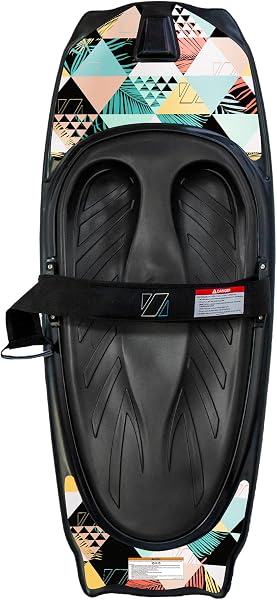
O'Brien Black Magic
9.2Editor scoreCable-actuated retractable fins
Symmetric twin-tip hull
Removable aquatic tow hook
Three-inch padded knee strap
Find the right kneeboards for 2026. We compare 10 standout options by build quality, useful features, owner feedback, value, and everyday trade-offs.
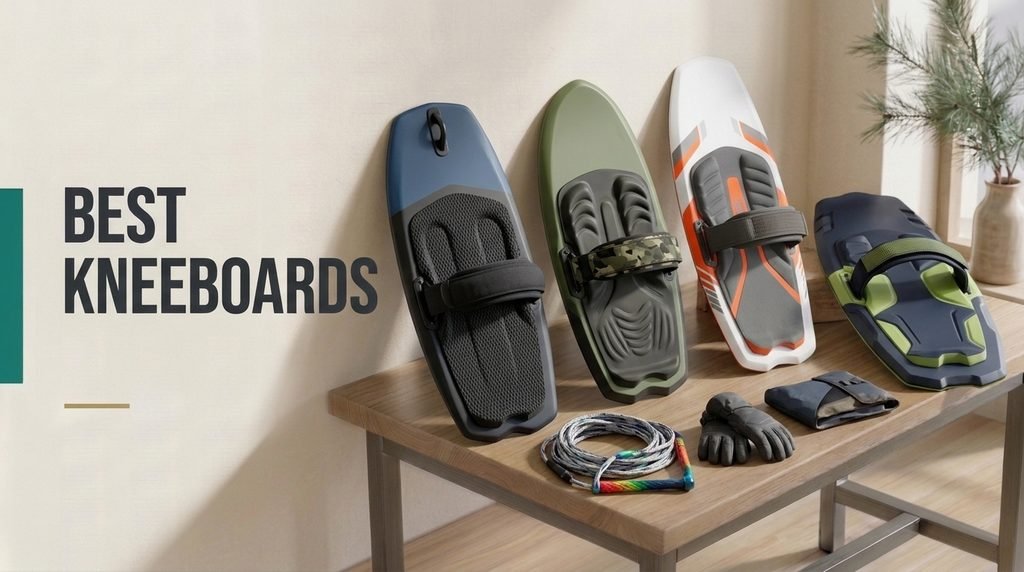
Finding the right kneeboards in 2026 starts with matching hull construction and fin geometry to your riding style behind the boat. We compare 10 standout options across the details that matter on the water, including core materials, aquatic tow hooks, fin setups, EVA knee pad cushioning, strap security, rider versatility, and overall value.
Buoyant rotomolded plastic boards with integrated tow hooks give beginners and families effortless deep-water starts and forgiving wake crossings. Meanwhile, compression-molded fiberglass and fusion-core designs reduce swing weight and sharpen edge hold for experienced riders chasing big wake-to-wake air, crisp surface spins, and fast, responsive slalom cuts across the lake.
Before choosing a board for your boat locker, decide whether your crew needs a dedicated kneeling platform with cable-actuated fins, a strap-free multipurpose board that also wakesurfs, or a lightweight pro hull. Our reviews below break down each model’s strengths and trade-offs so you can invest with complete confidence.
We compared 10 kneeboards using the factors that actually help boaters and riders decide: hull construction, buoyancy, fin configuration, deep-water start hooks, EVA foam pad density, knee strap width, weight limits, and price-to-performance value. Rather than treating every board as interchangeable, our evaluation highlights real on-water trade-offs between forgiving rotomolded family boards, strap-free multi-sport platforms, and responsive compression-molded trick boards so you can match the right deck to your boat and skill level.


Compare key features, scores, and current prices side by side. A shorter feature list means fewer details were available, not necessarily fewer capabilities.




Once a kneeboarder progresses past basic wake crossings and wants to generate real line tension, boost wake-to-wake jumps, and spin effortlessly in the air, thick rotomolded plastic hulls start to feel sluggish. Stepping up to the Connelly Boost Kneeboard transforms how the water feels beneath your knees, replacing hollow plastic with a lightweight, high-performance compression-molded fiberglass build.
We may earn a commission when you buy through this link, at no additional cost to you.
Compression molding allows Connelly to craft a much thinner, stiffer, low-profile twin-tip hull with sharp edge rails. Instead of bobbing on top of the water, the thin fiberglass rails knife cleanly into the trough, allowing you to build progressive edge speed all the way up the transition of the wake. Because fiberglass is significantly lighter and stiffer than rotomolded polyethylene, energy transfers directly from the wake into upward pop, and the reduced swing weight makes mid-air grabs, 180s, and 360s feel remarkably light.
To match its high-energy hull, the Connelly Boost features a soft, ergonomically contoured EVA foam pad paired with a plush knee strap that holds your thighs securely without pinching during hard flat-water landings. Its clean twin-tip symmetry ensures that riding switch (backward) feels just as balanced and predictable as riding forward.
Rotomolded plastic boards have thick, rounded rails and hollow interiors that flex and absorb energy when hitting a steep wake. Compression-molded fiberglass compresses a dense core between rigid fiberglass laminates under high heat, creating a razor-thin rail that holds an unyielding edge under high line tension and rebounds cleanly off the wake lip.
As a true performance board, the Connelly Boost omits a beginner front tow hook, meaning you must know how to perform a traditional deep-water start while holding the rope handle. You will also want to keep the fiberglass rails off abrasive gravel beaches and rough boat docks. For intermediate and advanced riders ready to graduate from bulky family boards to genuine fiberglass performance, the Connelly Boost is a game-changer.
First-time beginners who need a front tow hook or families who drag boards onto rocky beaches.
We may earn a commission when you buy through this link, at no additional cost to you.
Boat owners who host riders of varying skill levels often struggle to find a single kneeboard that keeps everyone happy. Beginner boards with permanent deep fins feel locked onto rails when teens try surface spins, while finless trick boards slide out uncontrollably under novices. The O'Brien Black Magic solves that dilemma better than any board in its class, earning our Editor's Choice badge by pairing a symmetric twin-tip hull with an on-the-fly cable-actuated retractable fin system.
We may earn a commission when you buy through this link, at no additional cost to you.
The standout engineering feature here is the shift lever wired directly to the fins. With the fins dropped down into the water flow, the Black Magic bites firmly into the face of the wake, giving riders predictable tracking and hard-carving stability across choppy open water. Flip the cable actuator to retract the fins flush into the hull, and the board immediately loosens up for butter-smooth 180s, 360s, and reverse landings encouraged by its symmetrical twin-tip outline.
Comfort and accessibility are equally well sorted for all-day lake sessions. The removable aquatic hook lets first-timers hook the tow rope handle directly onto the nose of the board, freeing both hands to pull their knees onto the deck and cinch the 3-inch padded strap once planing. Once everyone on the boat has mastered deep-water starts, you can unscrew and remove the aquatic hook completely so it never snags a tow line or bruises a shin during aerial tricks. Underneath the rider, a premium dual-density molded EVA pad provides deep, contoured knee wells that absorb wake impact for youth and adult riders alike.
Permanent molded tow hooks are fantastic during a rider’s first weekend on the lake, but once you start throwing handle-pass tricks, riding backward, or leaning forward over the nose on landings, a fixed plastic hook becomes an obstacle. Because the Black Magic’s aquatic hook is completely removable, the board grows alongside your family’s skills rather than forcing an equipment upgrade.
While the mechanical cable assembly adds a bit more weight than a stripped-down fiberglass pro hull and benefits from a quick freshwater rinse if you beach the board on sandy shorelines, its versatility is unmatched. If you want one quiver-of-one board that takes riders from their very first hands-free pull to advanced wake-to-wake spins, the O’Brien Black Magic is the smartest buy on the water.
Competitive aerial kneeboarders who only want an ultralight compression-molded core for maximum wake pop.
We may earn a commission when you buy through this link, at no additional cost to you.
Shoppers looking for trusted brand-name watersports performance without crossing the $150 mark will find the O'Brien Radica hard to overlook. Designed as an approachable, confidence-inspiring family board, the Radica blends water-ski carving predictability with wakeboard-inspired edge control, making it an ideal staple for weekend runabouts and pontoon boats.
We may earn a commission when you buy through this link, at no additional cost to you.
On the water, the Radica’s defining characteristic is its variable beveled edge paired with quad molded fins positioned near the corners of the hull. Along the flat middle section of the board, a softer bevel keeps the rail riding slightly higher in the water so inexperienced riders don’t accidentally catch an edge and tumble when crossing the wake flat. As soon as a rider leans their hips into a turn, the sharper bevel toward the tip and tail engages the water, working in tandem with the four molded fins to hold a clean, predictable line outside the boat’s spray.
Getting up on plane is virtually effortless thanks to the integrated aquatic hook mounted at the front of the deck. Beginners simply place the ski rope handle in the hook, lie on their stomach as the boat idles forward, and slide their knees onto the 3/4-inch EVA foam pad once the board planes out on top of the water. With both hands free to secure the strap before taking the handle, first-time falls are drastically reduced.
The most common crash in kneeboarding happens when a rider crosses the wake slightly off-balance and the leading edge digs into the water, flipping the board over. A variable beveled edge rounds off the rail profile under the rider’s center of gravity so water releases smoothly beneath the hull, only biting aggressively when the rider intentionally rolls the board onto a high edge angle.
Because the quad fins are molded permanently into the bottom hull and the tow hook is fixed, the Radica is less tailored for advanced surface 360s than the cable-actuated O’Brien Black Magic. However, for families, summer camps, and recreational boaters who prioritize dependable carving, easy starts, and wallet-friendly pricing, the Radica delivers exceptional value.
Freestyle riders who want a finless base for slick surface spins and reverse wake-to-wake tricks.
We may earn a commission when you buy through this link, at no additional cost to you.
Teaching new riders how to get up behind a boat requires two things above all else: natural buoyancy and predictable straight-line stability. The O'Brien Voodoo Kneeboard is purpose-built around those fundamentals, utilizing heavy-duty rotomolded construction and a generous hull volume that pops quickly onto plane even at slower boat speeds.
We may earn a commission when you buy through this link, at no additional cost to you.
Rotomolded plastic construction gives the Voodoo two major practical advantages for busy family boats. First, the hollow, high-volume profile displaces plenty of water, which prevents the nose from diving during initial throttle-up and makes deep-water starts far less intimidating for younger or heavier beginners. Second, the thick rotomolded exterior is tough enough to endure being dragged onto sandy lake shores, bumped against aluminum pontoons, or tossed into crowded ski lockers without delaminating or chipping.
Once moving, four molded fins—one positioned at each corner of the hull—act like guide rails in the water. They stop the tail from fishtailing while a rider is pulling their knees up onto the deck, and they provide smooth, predictable edge-to-edge transitions when cutting across the wake. An integrated front aquatic hook holds the tow handle during launch, while a plush 3/4-inch EVA foam deck pad and a wide 3-inch padded pull strap keep knees cushioned and locked in tight.
Not every family boat has a 350-horsepower V8 inboard wake engine; many lake days happen behind modest outboard runabouts, fishing boats, or mid-powered pontoons. Because the O’Brien Voodoo’s rotomolded hull offers high natural flotation, it climbs onto the surface with less initial boat acceleration, reducing drag on the tow boat and strain on the rider.
The trade-off with a buoyant rotomolded learn-and-ride hull is that it sits higher on the water and carries more physical bulk than a thin compression-molded board like the Connelly Boost. Advanced riders looking to launch massive airs will eventually want a thinner rail, but for learning the ropes, teaching kids, and enjoying carefree recreational runs, the O’Brien Voodoo is a durable, frustration-free performer.
Advanced riders seeking a thin, low-volume compression-molded edge for aggressive wake jumping.
We may earn a commission when you buy through this link, at no additional cost to you.
Riders who have already mastered basic deep-water starts and want a nimble, lively board at a budget-friendly price will appreciate the ZUP Retro Palms Kneeboard. Measuring 50 inches long by 20 inches wide, this compact deck blends design cues from both water skis and wakeboards to deliver quick edge-to-edge responsiveness without a steep price tag.
We may earn a commission when you buy through this link, at no additional cost to you.
Unlike high-riding beginner hulls that float like a cork on top of the chop, the ZUP Retro Palms is engineered with a beveled edge profile that lets the board sit slightly lower in the water. Sitting deeper in the water line lowers your center of gravity and gives the rails immediate engagement when you lean into a turn, translating to faster cuts across the boat wake and more secure landings. At the same time, its quad molded fins provide steady directional tracking while still releasing cleanly when you flatten the board out for surface spin tricks.
Comfort on the deck is handled by a 3/4-inch EVA foam pad molded with deep, ergonomic contours for both your knees and ankles. Those deep knee wells keep your lower body from sliding laterally when cutting hard outside the wake, while the softly padded adjustable strap cinches snugly across your thighs for confident control.
When a kneeboard sits low in the water rather than skimming high on the surface, more of the beveled rail stays in direct contact with the water flow. As you shift weight from your left hip to your right hip, the board transitions edge-to-edge without the tippy delay common to thick, boxy hulls, rewarding active riders with crisp slalom carves.
The most important detail to check before buying is the nose: unlike the O’Brien Radica or Voodoo, the ZUP Retro Palms does not feature an integrated front aquatic tow hook. That means riders must hold the tow rope handle in their hands while pulling their knees onto the board during traditional deep-water starts. For experienced kneeboarders and athletic teens who prefer an uncluttered nose and lively, low-sitting edge control under $125, the ZUP Retro Palms is a standout pick.
First-time riders or young kids who rely on a front tow hook to get up on the board hands-free.
We may earn a commission when you buy through this link, at no additional cost to you.
Keeping a spare kneeboard in the boat locker or truck bed for spontaneous lake afternoons does not have to cost a fortune. As the most budget-friendly option in our guide, the SereneLife Water Sport Kneeboard delivers a complete, ready-to-tow package—including an integrated front tow hook, contoured EVA knee pad, and adjustable strap—while weighing in at less than 9 pounds.
We may earn a commission when you buy through this link, at no additional cost to you.
That sub-9-pound weight makes a noticeable difference both off and on the water. Carrying heavy water toys down long marina docks or loading them into overhead boat racks can be a chore; the SereneLife board is light enough to tuck under one arm alongside a cooler and life jackets. Measuring 50 inches long by 20 inches wide, the deck offers a universal footprint proportioned for older youth, teens, and adult riders whether towing behind a motorboat, river cruising, or knee surfing in coastal waves.
Despite its entry-level price, SereneLife did not skip the front tow hook. Riders can drop the tow handle into the nose hook during initial acceleration, climb onto the cushioned EVA foam pad without fighting rope tension in their arms, and strap in securely before grabbing the handle. Built from water-resistant, corrosion-proof marine-grade materials, the hull handles both freshwater lakes and brackish or saltwater bays without rusting or absorbing water.
Because the SereneLife kneeboard weighs under 9 pounds and uses corrosion-proof marine-grade materials, it transitions easily from freshwater boat towing to coastal beach trips. Even without a boat, riders can use the cushioned EVA pad and strap to catch nearshore ocean rollers kneeling boogie-board style.
Buyers should note that the 50-inch length and strap geometry are tailored for teens and adults rather than small children, and the hull lacks advanced variable bevels or retractable fin systems found on pricier O’Brien or HydroSlide boards. If you want an inexpensive, featherweight board for casual weekend towing and beach fun, the SereneLife offers unbeatable affordability.
Young children who need a smaller deck footprint, or aggressive wake riders jumping wide boat wakes.
We may earn a commission when you buy through this link, at no additional cost to you.
For families who want every single guest on the boat—from nervous six-year-olds to 300-pound uncles—to succeed on their very first pull, the ZUP You Got This 260 Board and Handle Combo is in a league of its own. Rather than functioning solely as a traditional strapped kneeboard, this 51.7-by-23.8-inch, 4.6-inch-thick marine-grade ABS platform serves as an all-in-one kneeboard, boogie board, wakeboard, wakeskate, wakesurfer, and water-ski trainer.
We may earn a commission when you buy through this link, at no additional cost to you.
The secret to the ZUP system is how it breaks getting up on the water into stress-free stages. First, the rider hooks the included Double ZUP tow handle into the integrated front tow hook and lies prone while gripping the indestructible side handles. Once the wide, high-buoyancy board planes out at slow boat speeds, the rider smoothly pulls up to a kneeling position on the plush, full-deck non-skid EVA foam pad. Riders can cruise happily on their knees all afternoon, or—when ready—place their feet into the molded footwells, grab the upper bar of the double handle, and stand straight up like a wakeboarder or wakesurfer.
Because there are no tight ankle bindings or constricting thigh straps to get tangled in, falls are completely separation-free: if a rider loses balance, they simply step or roll off into the water while the boat idles back. With a massive 350-pound weight capacity, it accommodates virtually every adult and child on the dock without swapping equipment.
Standard single-bar ski ropes make transitioning from kneeling to standing while moving at 12 to 15 mph tricky because you have to unhook the handle under tension. The bundled Double ZUP handle features two stacked grips: a lower loop that stays hooked to the nose of the board to pull the hull, and an upper crossbar you hold in your hands so you can pull yourself from your knees to your feet without ever uncoupling the tow line from the board.
Keep in mind that because the You Got This 260 intentionally omits a thigh strap so riders can stand up, you cannot boost inverted aerials or strapped wake-to-wake jumps from a kneeling position. It also costs considerably more upfront, though the included specialized double handle and rope combo offsets the price of buying separate kneeboards, wakeboards, and trainer skis.
Traditional kneeboard purists who want a tight 3-inch thigh strap for launching big wake-to-wake jumps.
We may earn a commission when you buy through this link, at no additional cost to you.
Riders who love the idea of on-the-fly retractable fins and want a slightly longer, wider platform with classic sidecut carving geometry should look closely at the HydroSlide Pro XLT Performance Kneeboard. Measuring 51.75 inches long by 21 inches wide, the Pro XLT pairs a buoyant rotomolded twin-tip hull with a distinct parabolic waist that helps the board arc naturally into turns.
We may earn a commission when you buy through this link, at no additional cost to you.
Just like a parabolic snow ski or slalom wakeboard, the tapered waist of the HydroSlide Pro XLT creates a natural turning radius as soon as you tip the board onto its edge. When you drop the cable-actuated retractable fins down, the board locks into that parabolic arc to charge hard toward the wake for maximum pop. When you want to slide across the crest of the wake, ride backward, or spin 360s on the flats, pulling the cable lever retracts the fins out of the water so the hull breaks free effortlessly.
HydroSlide equips the nose with its signature integrated HydroHook, allowing beginners and tired veterans alike to hook the tow handle on the bow for strain-free deep-water starts. Once kneeling, your legs rest inside a dual-layer EVA foam pad sculpted with deep knee wells and secured by a 3-inch padded shock strap that keeps your hips connected to the deck through choppy double-ups.
A parabolic profile narrows slightly through the midsection between a wider tip and tail. When you roll your weight onto the rail, that curved sidecut pulls the nose of the kneeboard smoothly into the turn without requiring aggressive upper-body twisting, making sustained slalom cuts behind the boat feel effortless.
At 51.75 by 21 inches, it carries a bit more surface area than 50-by-20-inch boards, which is a plus for taller or heavier adults who want extra planing stability, though smaller kids may find the width takes more leverage to tilt on edge. Unlike the O’Brien Black Magic, the HydroHook is permanently mounted, but for all-around recreational carving and trick progression, the Pro XLT is a proven workhorse.
Smaller youth riders who find a 21-inch-wide deck too broad to edge comfortably.
We may earn a commission when you buy through this link, at no additional cost to you.
If you love the multi-position freedom of a strap-free family board—where riders can lie down, kneel, or stand up and surf the wake—but want a sleeker, more affordable option that works with your existing boat tow rope, the O'Brien Freeboard V2 is a brilliant choice. Earning an impressive 4.7-star rating from boaters, it delivers three distinct riding experiences on one tough, rotomolded deck for well under half the cost of oversized combo boards.
We may earn a commission when you buy through this link, at no additional cost to you.
The Freeboard V2 is built around relaxation and creative expression behind the boat. Beginners and kids can drop the standard ski handle into the integrated front aquatic hook and cruise hands-free on their stomachs or knees while the boat pulls the board directly. When you want traditional kneeboard action without the constriction of a thigh strap, take the handle in hand and carve across the wake on the plush 3/4-inch EVA deck pad. Ready for a bigger challenge? Plant your feet on the high-traction EVA foam and stand up for a loose, surf-style or wakeskate-like ride.
Underneath the rotomolded hull, dual molded fins provide just the right balance of directional stability and surfy playfulness. The board tracks straight when being towed by the front hook, yet remains loose enough when standing or kneeling to slash the wake face and slide 180s.
For many first-time watersports participants, the idea of cinching a tight Velcro strap over their legs in deep water causes hesitation. Because the O’Brien Freeboard V2 uses a grippy, contoured 3/4-inch EVA traction pad without a leg strap, riders know they can simply step or roll free of the board at any moment, building instant confidence on the water.
Because the Freeboard V2 is a strap-free multipurpose board, you won’t be strapping your thighs down to launch inverted air off the wake, and it does not feature molded side grab handles like the ZUP 260. However, for boat owners who want one fun, durable, easy-to-store toy that lets everyone ride their own way using a standard ski rope, the O’Brien Freeboard V2 is a crowd-pleasing winner.
Riders who want a strapped-in kneeboard specifically for jumping wakes and landing aerial tricks.
We may earn a commission when you buy through this link, at no additional cost to you.
At the pinnacle of modern kneeboard engineering sits the O'Brien Sozo. Designed for dedicated kneeboarders who treat the boat wake like a terrain park, the Sozo leaves conventional construction behind in favor of wakeboard-grade composite technologies—including a lively Fusion Core, poured urethane Durarail sidewalls, and a specialized Delta Base hull.
We may earn a commission when you buy through this link, at no additional cost to you.
What makes the Sozo feel instantly alive underfoot is its Fusion Core. While traditional boards can feel either dead and heavy (rotomolded plastic) or overly rigid (basic fiberglass), the Fusion Core is tuned to load up with flex energy as you press into the wake transition and snap back at the lip, launching you higher with less physical strain. Underneath, the Delta Base channels water flow to accelerate your edge approach while breaking surface tension cleanly at the crest of the wake so the hull never sticks on takeoff.
Durability on a pro-level composite board is reinforced by O’Brien’s Durarail sidewalls—an impact-resistant urethane rail poured around the perimeter of the board that shrugs off bumps against boat swim platforms or occasional cable-park obstacles. On top of the deck, O’Brien’s most supportive pad and a heavy-duty 3-inch cinch strap keep your knees cushioned and locked down tight through big wake-to-wake airs and technical spins.
Getting massive air on a kneeboard requires carrying maximum speed into the wake without losing your edge, then releasing cleanly at the peak. The Sozo’s Delta Base reduces hydrodynamic drag as you cut hard across the trough, while the snappy Fusion Core stores and releases flex energy right at the wake crest for explosive vertical lift.
Priced near five hundred dollars and built without a beginner tow hook, the O’Brien Sozo is unapologetically overbuilt for casual 12-mph tubing families. But if kneeboarding is your primary passion behind the boat and you want the fastest edge, liveliest pop, and toughest urethane-railed construction money can buy, the Sozo stands alone at the top.
Casual boaters looking for an entry-level family board with a hands-free starter hook.
We may earn a commission when you buy through this link, at no additional cost to you.
Choosing the best kneeboard for your boat locker means matching hull materials, fin systems, starter hooks, and deck ergonomics to the ages, weights, and riding ambitions of your crew.
The material and molding process used to build a kneeboard’s hull dictate its weight, buoyancy, edge sharpness, durability, and price. Most recreational and family kneeboards—including the O’Brien Voodoo, O’Brien Freeboard V2, and HydroSlide Pro XLT—use rotomolded polyethylene plastic. Rotomolding creates a hollow, thicker-walled board with tremendous natural buoyancy. Because a rotomolded hull floats high on the water, it planes out quickly at slow boat speeds and forgives sloppy balance across the wake. Furthermore, tough plastic shells resist dents, scratches, and delamination when bumped against fiberglass swim platforms or dragged up onto sandy beaches.
At the performance end of the spectrum, boards like the Connelly Boost utilize compression-molded fiberglass, while flagship models like the O’Brien Sozo combine a wood-and-foam Fusion Core with poured urethane Durarail sidewalls. Compression molding presses dense foam and fiberglass layers into a thin, rigid profile with crisp rails. These boards weigh significantly less in the air and slice deeply into the water rather than floating on top of it, allowing experienced riders to generate high line tension and explosive pop off the wake.
Decision advice: Choose rotomolded or marine-grade ABS construction if you are buying a shared boat board for beginners, families, and carefree durability. Upgrade to compression-molded fiberglass or a Fusion Core hull if you want lightweight swing weight and sharp rail hold for jumping wakes and landing aerial tricks.
Fins control how firmly a kneeboard tracks in a straight line versus how easily it breaks loose for surface spins. Many beginner and intermediate boards—such as the O’Brien Radica, O’Brien Voodoo, and ZUP Retro Palms—feature quad molded fins (four permanent fins molded into the tip and tail corners of the hull). Quad fins provide constant directional stability, preventing the tail from washing out when cutting hard outside the wake and keeping the board tracking straight while a novice rider climbs onto the pad.
If your boat crew includes both beginners who need tracking stability and intermediate riders who want to spin 360s, cable-actuated retractable fin systems—found on the O’Brien Black Magic and HydroSlide Pro XLT—offer the best of both worlds. A handlebar-style lever mounted near the nose connects via steel cables to retractable fins; flipping the lever mid-ride raises or lowers the fins on demand. Meanwhile, high-end compression-molded boards like the Connelly Boost and O’Brien Sozo rely on sharp edge rails and base channels rather than deep drag-inducing fins, giving advanced riders a fast, catch-free base for sliding and landing switch.
Decision advice: Pick fixed quad molded fins for straightforward recreational carving and beginner stability, choose cable-actuated retractable fins for multi-rider versatility and trick progression, and opt for rail-driven performance hulls once you are consistently jumping wake-to-wake.
Historically, the hardest part of kneeboarding was the deep-water start: a rider had to hold the tow rope handle with one or both hands while simultaneously pulling their knees up onto a slippery moving board and fastening the Velcro strap. Modern aquatic tow hooks (also called HydroHooks) solved that bottleneck completely. Models like the O’Brien Radica, O’Brien Voodoo, HydroSlide Pro XLT, SereneLife, O’Brien Freeboard V2, and ZUP 260 feature a front-mounted hook that holds the tow rope handle for you during launch. With the boat pulling the board directly via the hook, both of your hands remain free to balance, climb onto the knee pad, and cinch your strap.
As riders advance into aerial tricks and surface spins, however, a permanent plastic hook sticking up on the nose can snag a slack tow line or get in the way during forward-leaning landings. That is why advanced boards like the Connelly Boost and O’Brien Sozo omit the hook entirely, and why the O’Brien Black Magic uses a smart removable aquatic hook that unbolts cleanly once your crew no longer needs launch assistance.
Decision advice: Never skip an aquatic tow hook if children, first-timers, or occasional guests will be riding the board. If you want a board that accommodates beginners today and advanced tricks tomorrow, choose a model with a removable hook like the O’Brien Black Magic.
Before comparing dimensions, decide whether you want a dedicated strapped kneeboard or a strap-free multipurpose board. Traditional kneeboards use a wide, Velcro-adjustable padded strap that cinches tightly across your upper thighs, locking your lower body to the contoured knee wells. That mechanical connection is what allows a kneeboarder to lean aggressively against the boat’s pull, edge hard through rough chop, and launch the board high into the air over the wake without separating from the deck.
In contrast, multipurpose boards like the O’Brien Freeboard V2 and the ZUP You Got This 260 omit the thigh strap and cover the entire top deck in high-traction EVA foam. Without a strap holding your legs down, you can transition fluidly while moving—starting on your stomach, pulling up to your knees, and standing all the way up to ride like a wakeboard, wakeskate, or wakesurfer. Strap-free boards are also less intimidating for nervous swimmers who dislike feeling strapped to a board.
Decision advice: Choose a traditional strapped kneeboard if your goal is classic high-energy carving, wake jumping, and 360 spins on your knees. Choose the O’Brien Freeboard V2 or ZUP You Got This 260 if you want one versatile family toy that lets riders kneel, lie down, or stand up.
Because your knees and ankles absorb every ripple of lake chop and every wake landing directly, the thickness and contouring of the EVA foam deck pad are critical for preventing bruised patellas and lower-leg numbness. Look for pads with at least a 3/4-inch thickness or dual-density EVA construction, such as those on the O’Brien Black Magic, Voodoo, Radica, ZUP Retro Palms, and HydroSlide Pro XLT. Deeply sculpted knee wells and raised ankle bolsters distribute your body weight across your shins and insteps rather than concentrating pressure on your kneecaps.
The thigh strap is equally important for comfort and leverage. Narrow, unpadded webbing digs into the tops of your thighs when cutting hard or landing off the wake. A 3-inch-wide padded shock or cinch strap—featured on the O’Brien Black Magic, Voodoo, Sozo, and HydroSlide Pro XLT—spreads upward pull force across a broad surface area of your quadriceps, giving you superior board control without painful pinching.
Decision advice: Prioritize a 3-inch padded strap and deep dual-density or 3/4-inch contoured EVA knee wells if you plan to take long runs in choppy water or jump the boat wake.
Kneeboard outlines generally follow either a directional profile or a twin-tip profile. Directional hulls have a distinctly shaped nose and a squared or tapered tail designed primarily to travel forward. They track straight and plane efficiently, making them comfortable cruisers for open-water slalom runs.
Twin-tip kneeboards—including the O’Brien Black Magic, HydroSlide Pro XLT, and Connelly Boost—feature symmetrical or near-symmetrical rockered tips at both ends of the board. That upward rocker at the tail prevents the back edge from catching when you spin 180 degrees and ride backward (fakie) or when you spin a full 360 across the wake. Parabolic twin-tips, like the HydroSlide Pro XLT, add a curved sidecut along the waist so the board initiates turns naturally when tilted on edge.
Decision advice: If anyone on your boat wants to learn surface 180s, 360s, or reverse wake crossings, make sure to select a twin-tip hull design.
Standard recreational kneeboards measure between 50 and 52 inches in length and 20 to 21 inches in width, a sweet spot that fits most youth, teens, and adults while sliding easily into under-seat boat lockers or clamp-on wakeboard tower racks. Ultralight models like the 50-by-20-inch SereneLife weigh under 9 pounds, making them easy for younger riders to carry and maneuver in the water, though very small children may still find a 50-inch adult strap loose unless cinched all the way down.
If you are shopping for heavier adults up to 350 pounds or want maximum slow-speed stability behind a pontoon or lower-powered boat, wider high-volume platforms like the ZUP You Got This 260 (measuring 51.7 by 23.8 by 4.6 inches) provide extra surface area to stay on plane without sinking. Just remember to measure your boat’s ski locker hatch or tower rack jaws before buying an extra-wide or extra-thick multi-sport board.
Decision advice: Stick to a 50-to-51.75-inch by 20-to-21-inch kneeboard for standard boat locker storage and agile handling, or step up to the wider 23.8-inch ZUP 260 for maximum buoyancy and riders up to 350 pounds.
Before entering the water, always put on a U.S. Coast Guard-approved personal flotation device (life jacket) and inspect the kneeboard’s strap Velcro, fin cables, and tow hook for tight hardware. On the boat deck, sit on the EVA knee pad and pre-adjust the padded strap so you know roughly where it cinches over your thighs, then loosen it slightly so you can slide your knees underneath once in the water. For boards equipped with an aquatic tow hook, place the tow rope handle securely into the front hook slot while floating in the water, lie flat on your stomach on the back half of the board with your elbows resting on the deck, and keep your knees off the pad until the boat begins to move.
Signal the boat driver to take up slack in the tow line and accelerate smoothly to a gentle planing speed—typically between 10 and 15 mph for beginners and youth, or 15 to 19 mph for adults and trick riders. As the nose settles and the board planes flat on top of the water, slide your knees forward into the contoured EVA wells, pull the 3-inch padded strap snugly across your upper thighs, and press the Velcro down firmly. Once strapped in, lift the tow rope handle out of the front aquatic hook, sit upright with your weight centered over your hips, and look toward the boat; lean gently onto your inside hip and rail to cut across the wake, keeping your elbows slightly bent to absorb chop.
After each day on the lake, river, or bay, rinse the entire kneeboard thoroughly with fresh water—paying special attention to cable-actuated retractable fin slots, Velcro strap hooks, and metal mounting screws to flush out sand, silt, and corrosive salt. Allow the EVA foam pad and nylon strap to air-dry completely in the shade before sealing the board inside a closed boat locker to prevent mildew odors. Avoid leaving any kneeboard baking face-up in direct midday sun on a hot boat deck or dock when not in use, as prolonged UV exposure and extreme heat can fade EVA foam and prematurely age adhesives.
Most beginners and younger riders feel most comfortable planing at slower speeds between 10 and 14 mph, especially on buoyant rotomolded boards or wide multi-sport platforms like the ZUP 260 and O'Brien Voodoo. Intermediate adults carving across the wake typically prefer 15 to 17 mph. Advanced riders using compression-molded fiberglass boards like the Connelly Boost or O'Brien Sozo often ride between 17 and 20 mph to generate strong line tension and firm wake pop.
Without a tow hook, a rider has to hold the full pull of the boat in their hands while trying to climb onto a moving board and fasten a leg strap one-handed. An integrated aquatic hook holds the tow rope handle directly on the nose of the kneeboard during launch. This transfers the boat's pull straight to the hull and leaves both of your hands completely free to balance on the edges, slide your knees into the pad, and secure the strap before grabbing the handle.
Choose a rotomolded plastic kneeboard if you want high buoyancy for easy deep-water starts, forgiving edges across choppy water, and rugged durability against docks and beaches. Choose a compression-molded fiberglass or Fusion Core board if you already know how to get up without a tow hook and want a thinner, lighter, stiffer board that edges hard and launches high off the wake. Most families start with a rotomolded board and add a fiberglass board once riders start jumping wake-to-wake.
Fixed fins keep a kneeboard tracking straight and prevent sliding out during hard turns, which is ideal for carving and learning. However, deep fins will catch the water if you try to spin 180 or 360 degrees on the surface. Cable-actuated retractable fins—featured on the O'Brien Black Magic and HydroSlide Pro XLT—let you flip a lever while riding to drop the fins down for hard slalom cuts or retract them flush into the hull for catch-free spins.
Yes, kneeboarding requires significantly less boat horsepower and speed than adult water skiing or barefooting because the wide board surface area planes easily. Behind a pontoon boat or smaller outboard runabout, high-buoyancy rotomolded models like the O'Brien Voodoo, O'Brien Freeboard V2, or the wide ZUP You Got This 260 perform best because they pop onto the surface quickly without dragging down the boat.
A traditional kneeboard uses a 3-inch Velcro strap over your thighs to lock your knees into deep foam wells so you can lean hard and jump wakes. The O'Brien Freeboard V2 is a strap-free multipurpose board with a full-coverage EVA traction deck and an integrated front tow hook. Without a leg strap in the way, riders on the Freeboard V2 can lie prone, kneel comfortably, or stand all the way up for a surf-like ride behind the boat.
Out of the 10 kneeboards in our guide, only the ZUP You Got This 260 Board and Handle Combo includes its specialized Double ZUP tow handle and rope in the package. All nine other kneeboards are sold as the board only, and they work seamlessly with any standard single-handle watersports, wakeboard, or water-ski tow rope.
When floating in deep water before the boat accelerates, leave the strap unfastened or completely loose—never strap your legs into a kneeboard before the board is up on plane. Once the board is planing smoothly on top of the water and your knees are seated in the EVA wells, cinch the strap snugly across your upper thighs just above the knees. It should feel firm enough that your knees do not lift off the pad over wakes, yet easy to peel open with one hand when you finish your run.
Most standard 50-to-51.75-inch kneeboards accommodate older kids, teenagers, and adults well because the Velcro thigh strap adjusts across a wide range of leg sizes. For younger or lighter children, boards with an integrated front tow hook—like the O'Brien Black Magic, Voodoo, Radica, or ZUP 260—are much easier to manage because the child does not have to fight rope tension during the start. Always check manufacturer guidance, as models like the SereneLife specifically note they are sized for teens and adults rather than young children.
For most boating families and watersports enthusiasts, the O'Brien Black Magic Towable Kneeboard stands out as our overall Editor's Choice. By combining a symmetric twin-tip hull with on-the-fly cable-actuated retractable fins, a plush dual-density EVA pad, and a removable aquatic tow hook, it effortlessly bridges the gap between stress-free beginner starts and advanced wake-to-wake freestyle progression.
If your crew prefers strap-free versatility that lets riders kneel, lie prone, or stand up and surf behind the boat, the O'Brien Freeboard V2 offers tremendous multi-style fun with a standard ski rope, while the ZUP You Got This 260 Board and Handle Combo supports riders up to 350 pounds with its bundled double-handle system. Budget shoppers will find dependable carving value in the O'Brien Radica and featherweight portability in the SereneLife kneeboard, while experienced riders chasing maximum wake pop should step straight up to the fiberglass Connelly Boost or our Premium Pick, the Fusion-Core O'Brien Sozo.
Ultimately, the right kneeboard depends on whether your summer lake days revolve around teaching new riders, cruising comfortably with the family, or boosting big air across the wake. Match your pick to the hull material and fin setup that fits your boat crew, keep a U.S. Coast Guard-approved life vest buckled on, and enjoy effortless fun behind the boat all season long.