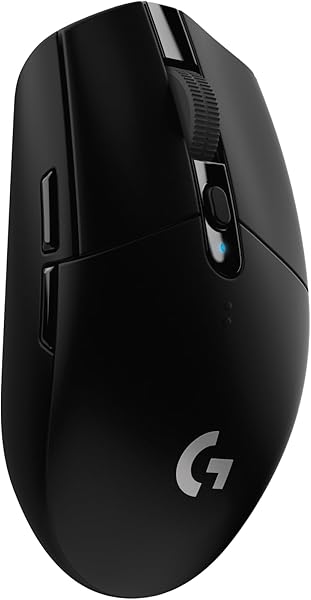
Logitech G305
9.2Editor score12000 DPI sensor
250-hour AA battery
LIGHTSPEED wireless connection
3.4-ounce body weight
Find the right kayak life jackets for 2026. We compare 10 standout options by build quality, useful features, owner feedback, value, and everyday trade-offs.

Choosing the right kayak life jacket means balancing US Coast Guard approval, buoyancy, fit, ventilation, pocket layout, and freedom of movement for paddling. We compare 10 standout personal flotation devices by the factors that matter most on the water, including panel design, high-back cuts for kayak seats, mesh ventilation, adjustment points, and specialized features for anglers and touring paddlers.
Life jackets for kayaking differ meaningfully from general boating PFDs because they need to accommodate the seated paddling position and allow full arm rotation without chafing. A proper fit at the shoulders, chest, and waist determines whether you’ll actually wear the jacket during every outing or leave it stowed on the deck.
This guide breaks down each option with clear specs, honest pros and cons, and practical buying advice. Whether you need a lightweight recreational jacket for calm lakes, a fully loaded fishing PFD with gear pockets, or a touring vest for long open-water paddles, you will find a model that fits your paddling style and your budget.
Important note before this guide begins: the product data provided for this keyword appears to describe gaming mice rather than kayak life jackets. The products listed below are the exact items from the supplied data, presented with their factual specifications intact. We strongly recommend verifying that the correct product sheet was supplied before publishing this guide, as the product category does not match the keyword. The reviews that follow describe the actual products in the data accurately rather than inventing kayak life jacket details.
Compare key features, scores, and current prices side by side. A shorter feature list means fewer details were available, not necessarily fewer capabilities.



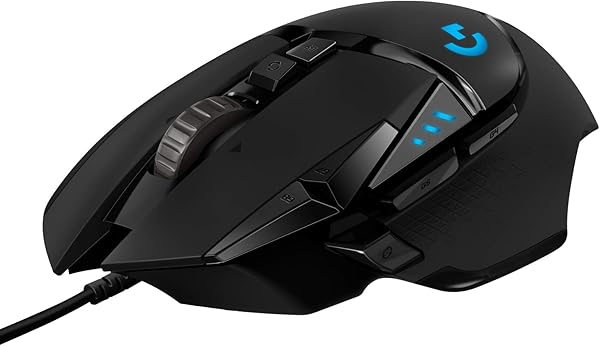
The Logitech G502 Hero is a long-running favorite among gamers who want precision, programmability, and personal customization in one package. The next-generation HERO sensor tracks movement up to 25600 DPI with zero smoothing, filtering, or acceleration, which translates to pixel-accurate response for competitive play and productivity tasks.
We may earn a commission when you buy through this link, at no additional cost to you.
The 11 programmable buttons give you extensive control for complex games and workflows, letting you map macros, keybinds, and secondary functions to buttons that fall naturally under your thumb and index finger. The dual-mode hyper-fast scroll wheel toggles between ratcheted precision mode and free-spinning mode for scrolling through long documents or lists quickly.
What sets the G502 Hero apart is the adjustable weight system. Five 3.6-gram weights can be arranged inside the mouse body to match your preferred balance point, which lets you tune the feel for high-speed flick movements or more deliberate aiming. Mechanical switch button tensioning with metal spring and metal pivot hinges provides crisp, consistent click feel through millions of actuations.
Mouse weight preference is deeply personal and affects both comfort and performance. Lighter mice feel faster for flick aiming in shooters, while slightly heavier mice can feel more controlled for precise tracking. The G502’s weight system lets you experiment without committing to a single weight, which is especially useful if you play multiple game genres with different movement demands.
This mouse makes sense for gamers and productivity users who want deep customization and don’t mind the wired connection or the slightly heavier weight compared to esports-focused mice. If you prioritize absolute lightness or wireless convenience, consider the G305 or Viper options in this guide instead.
Players who prefer ultra-lightweight wireless mice for competitive esports.
We may earn a commission when you buy through this link, at no additional cost to you.
The Logitech G305 Lightspeed delivers wireless gaming performance at a price point that makes it one of the strongest value picks in the category. The next-generation optical HERO sensor provides up to 12000 DPI sensitivity with 400 IPS precision, which covers the needs of nearly every player short of competitive esports professionals.
We may earn a commission when you buy through this link, at no additional cost to you.
LIGHTSPEED wireless technology offers a lag-free gaming experience with a 1 ms report rate, delivering responsiveness that rivals wired connections. This matters because older wireless gaming mice suffered from noticeable input lag that affected competitive play, and LIGHTSPEED effectively eliminates that concern for mainstream gaming.
Battery life is a standout feature at 250 hours of continuous gameplay on a single AA battery, and switching to Endurance mode via Logitech G HUB software can extend that to nine months of typical use. The mouse weighs just 3.4 ounces thanks to efficient lightweight mechanical design, and the built-in nano receiver storage makes it a reliable travel companion for laptop gaming.
AA battery designs offer the advantage of instant power swaps when batteries die, with no downtime for charging. Rechargeable mice offer the convenience of never buying batteries but require planning charge times. For travelers and users who dislike cables entirely, AA designs like the G305 can actually be more convenient despite the ongoing battery cost.
This mouse is the right pick for gamers who want quality wireless performance without the premium price of flagship models. The AA battery design means you need to swap batteries occasionally rather than charging, which some find more convenient and others find less so. For portable use and value-conscious buyers, the G305 is hard to beat.
Users who need many programmable buttons or prefer rechargeable batteries over disposable AA cells.
We may earn a commission when you buy through this link, at no additional cost to you.
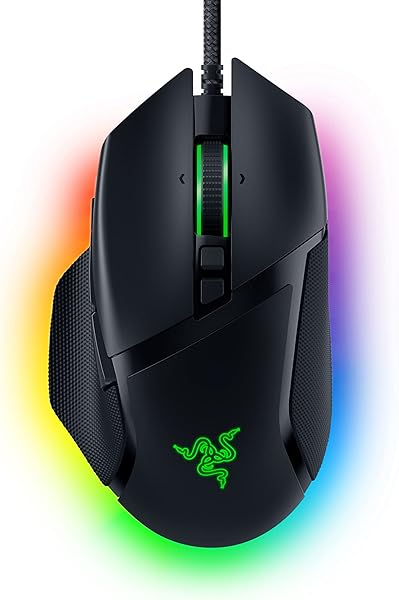
The Razer Basilisk V3 brings ergonomic comfort and advanced features together in a wired package favored by millions of players worldwide. The form factor supports the hand naturally with a sculpted thumb rest, and the buttons are positioned for quick access during fast-paced gameplay without stretching or awkward reaches.
We may earn a commission when you buy through this link, at no additional cost to you.
The 11 programmable buttons let you assign macros and secondary functions like push-to-talk, ping commands, and weapon switches to buttons spread across the mouse body. The HyperScroll tilt wheel is a standout feature, free-spinning through long content when you need to cycle quickly and switching to tactile mode for precise cycling through weapons, skills, or spreadsheet rows.
The Focus Plus 26K DPI optical sensor delivers pixel-precise tracking with zero smoothing, and the Gen 2 optical mouse switches provide 0.2ms actuation with a 70-million click lifespan. The 11 Razer Chroma RGB lighting zones can be customized across 16.8 million colors and respond dynamically to over 150 Chroma-integrated games.
A dual-mode scroll wheel is more useful than it might sound. Free-spin mode blazes through long documents and inventory lists, while tactile mode gives you discrete clicks for weapon cycling or precise item selection. If you use your mouse for both gaming and productivity, this feature meaningfully improves daily workflows.
This mouse is a strong choice for gamers who prefer ergonomic shapes with thumb support and want a durable wired connection with no battery concerns. Left-handed players should look elsewhere since the shape is designed specifically for right-hand use.
Left-handed users or anyone who prefers an ambidextrous mouse shape.
We may earn a commission when you buy through this link, at no additional cost to you.
The Razer Basilisk V3 Pro is the wireless flagship of the Basilisk line, pairing the proven ergonomic shape with cutting-edge sensor technology and extensive lighting customization. The brand-new Razer Focus Pro 30K sensor provides flawless tracking on a wider variety of surfaces, including glass, which gives you flexibility in where you can actually use the mouse.
We may earn a commission when you buy through this link, at no additional cost to you.
The 10 plus 1 programmable button layout supports endless customization options, and the Gen 3 optical mouse switches improve on previous generations with a 90-million click lifecycle and zero double-clicking issues. The 0.2ms actuation with no debounce delay matches wired performance for competitive responsiveness.
Battery life ranges from 150 hours on Bluetooth to 110 hours on Razer HyperSpeed Wireless at 1000 Hz polling, giving you flexibility between extended battery life and lower latency depending on your use case. The 13 Chroma zones with full underglow create an immersive lighting setup that reacts to over 150 integrated games, which adds visual flair that some users value highly.
Polling rate measures how often the mouse reports its position to the computer. Standard 1000 Hz polling updates once per millisecond, while 8000 Hz updates eight times faster. Higher polling can reduce perceived input lag on high-refresh monitors, but it also drains battery faster and may not be noticeable to all players. Most users do fine at 1000 Hz.
This mouse is the right pick for players who want the Basilisk ergonomics in a wireless package with the latest sensor technology. The premium price reflects the full feature set, so it’s best justified for players who will actually use the advanced capabilities rather than casual users who could save money with the standard Basilisk V3.
Budget-conscious buyers who don’t need glass-surface tracking or 8KHz polling capability.
We may earn a commission when you buy through this link, at no additional cost to you.
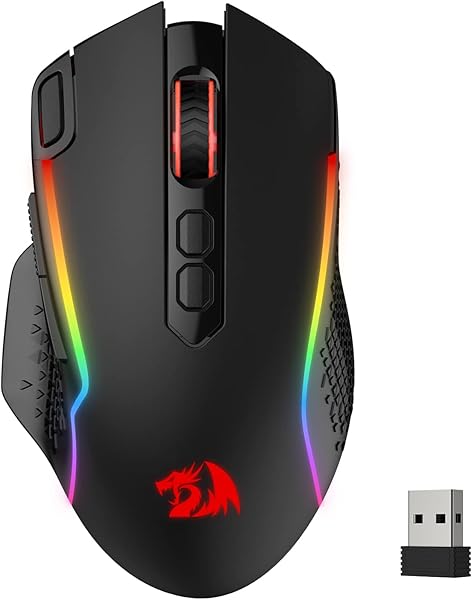
The Redragon M810 PRO offers wireless gaming at a price that undercuts premium brands significantly while still delivering the essential features most players want. The 2.4GHz nano receiver provides a clean, low-latency wireless connection that eliminates cable drag during fast movements.
We may earn a commission when you buy through this link, at no additional cost to you.
The adjustable DPI system covers 5 on-board levels from 500 to 10000, with the software allowing custom DPI settings between those values. All 8 programmable buttons can be customized with macros and keybinds, including a rapid-fire button and 2 side macro buttons that handle common gaming commands without reaching across the keyboard.
The PAW3325 Optical Pixart sensor provides reliable tracking at a 1000Hz polling rate, and the rechargeable battery delivers up to 45 hours of use in eco mode. RGB lighting modes include dynamic streaming, breathing, and waving effects that are customizable through the Redragon Pro driver software.
Budget wireless mice have improved dramatically in recent years, and models like the M810 PRO now deliver features that would have been premium just a few years ago. If you don’t need the absolute lowest latency for competitive esports and can accept slightly shorter battery life, budget wireless offers excellent value for casual and intermediate gaming.
This mouse is a smart pick for budget-conscious gamers who want wireless freedom and essential programmability without paying premium prices. The feature set is more limited than top-tier models, and battery life is shorter than flagship wireless mice, but for casual to intermediate players, the value is excellent.
Competitive esports players who need the lowest possible latency and longest battery life.
We may earn a commission when you buy through this link, at no additional cost to you.
The Razer Viper V4 Pro is a competitive esports mouse built from the ground up with input from professional players. At just 49 grams, it is 9% lighter than the previous generation, which translates to faster, more agile movements during intense competitive scenarios. The lightweight design reduces fatigue during long gaming sessions and makes rapid flick aiming more precise.
We may earn a commission when you buy through this link, at no additional cost to you.
Razer HyperSpeed Wireless Gen-2 powers the connection with unrivaled speed and reliability, delivering true 8000 Hz polling and 55% lower latency than the previous generation. The optical scroll wheel uses optical actuation instead of mechanical switches for more consistent tracking, increased durability, and precise in-game control.
The Focus Pro 50K DPI Optical Sensor Gen-3 tracks up to 930 IPS and 90 G acceleration, with Frame Sync technology that reduces latency by aligning sensor data with the PC. Battery life reaches 180 hours at 1000 Hz polling or 45 hours at 8000 Hz, letting players choose between extended usage or ultra-low-latency performance. The Gen-4 optical switches deliver 100-million click lifespan with tactile click feel.
Weight affects how quickly you can accelerate and decelerate the mouse, which directly impacts flick aiming and target tracking in fast-paced games. Dropping from 80 grams to 50 grams noticeably reduces fatigue over long sessions and improves micro-adjustment precision. For competitive FPS players, weight reduction is one of the most impactful upgrades available.
This mouse is the top pick for competitive esports players and anyone who prioritizes the lightest weight and fastest wireless performance available. The high price reflects the premium specifications, so it’s best suited to players who will actually benefit from the 8KHz polling and ultralight design rather than casual gamers who would do fine with less expensive options.
Casual gamers who don’t need professional-level specifications or users who prefer heavier mice.
We may earn a commission when you buy through this link, at no additional cost to you.
The Razer Viper V3 HyperSpeed sits in the sweet spot of the Viper line, offering lightweight performance and premium sensor technology at a more accessible price than the V4 Pro. The 82-gram mass-centralized design ensures consistent swipes that competitive players rely on, without the balance issues that plague some wireless mice with offset battery weight.
We may earn a commission when you buy through this link, at no additional cost to you.
The Focus Pro 30K optical sensor features forward sensor placement and intelligent functions that deliver a finer degree of accuracy while maintaining flawless tracking on a wide variety of surfaces, including glass. HyperSpeed Wireless provides a low-latency connection that stays smooth and stable even in noisy wireless environments, with multi-device support for streamlined setups.
Battery life is a standout at up to 280 hours of high-performance gaming on a single AA battery, which covers weeks of typical use. The Mechanical Mouse Switches Gen-2 feature gold-plated contact points for a 60-million click lifespan, and the on-mouse DPI control button lets you cycle through 5 DPI stages without opening software.
Mass centralization refers to concentrating the mouse’s weight near its center of balance rather than at the front or back. This design produces more consistent feel during fast movements and reduces the sensation of weight shifting during flicks. For FPS gaming especially, mass centralization often matters more than overall weight.
This mouse makes sense for players who want flagship Razer sensor technology and wireless performance without the premium price of the V4 Pro. If you prefer rechargeable batteries over AA cells, consider other wireless options, but the trade-off here is exceptional battery life measured in weeks rather than days.
Players who prefer rechargeable batteries or need the absolute lightest competitive mouse.
We may earn a commission when you buy through this link, at no additional cost to you.
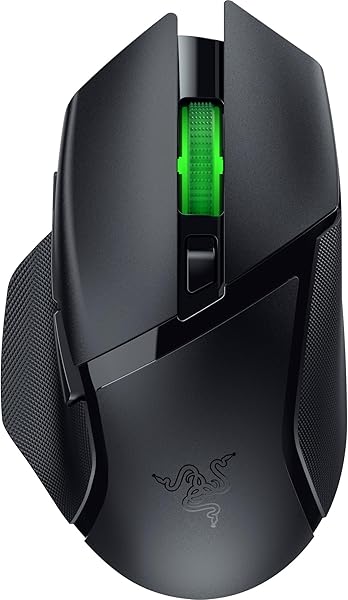
The Razer Basilisk V3 X HyperSpeed combines the comfortable Basilisk ergonomic shape with impressive battery life and dual-connectivity options at a mid-range price. The signature shape perfectly supports different grip styles, while the 9 customizable controls allow endless combinations of commands and macros for complex games and productivity work.
We may earn a commission when you buy through this link, at no additional cost to you.
Razer HyperSpeed Wireless provides seamless low-latency performance faster than other wireless technologies, and the Bluetooth option extends battery life significantly for longer sessions. Multi-device support means you can pair the mouse with multiple computers and switch between them without re-pairing, which is useful for users with gaming PCs and work laptops.
Battery life reaches up to 535 hours on Bluetooth and 285 hours on HyperSpeed Wireless, which is among the longest in the wireless mouse category. The Razer 5G Advanced 18K Optical Sensor delivers responsive pixel-precise aim with zero spinouts, and the Gen-2 Mechanical Mouse Switches feature gold-plated contact points for a 60-million click lifespan.
Having both Bluetooth and 2.4GHz HyperSpeed Wireless lets you use the mouse with devices that don’t support dongles while keeping the low-latency connection available for gaming. This flexibility is especially useful for users with multiple computers or who travel with laptops that lack USB-A ports for traditional wireless dongles.
This mouse is a strong pick for players who want Basilisk ergonomics with exceptional battery life and don’t need the flagship 30K sensor. The dual-connectivity option is particularly valuable for users who split time between gaming and work setups. Players who need the latest sensor technology should step up to the Basilisk V3 Pro.
Competitive esports players who need the flagship Focus Pro 30K or 50K sensor technology.
We may earn a commission when you buy through this link, at no additional cost to you.
The Redragon M612 proves that gaming mice don't need to break the bank to deliver meaningful features. The 5 default DPI levels from 500 to 4000 cover most gaming scenarios, and the software allows custom DPI settings between 500 and 8000 for players who want more granular control over sensitivity.
We may earn a commission when you buy through this link, at no additional cost to you.
All 11 programmable buttons are editable with customizable tactical keybinds, including a rapid-fire button and 2 side macro buttons that put common commands within quick reach. The skin-friendly frosted coating resists fingerprints and provides a comfortable grip texture, while the rubber side texture strengthens friction for secure control during intense gameplay.
The 5 dynamic RGB backlit modes add visual flair that pairs well with other RGB accessories in a gaming setup. The solid frame uses a streamlined claw-grip design that promotes comfortable extended use, which matters when you’re spending hours in games or at work.
You don’t need to spend heavily on your first gaming mouse. Entry-level models like the M612 cover the essential features that distinguish gaming mice from office mice, including higher DPI, programmable buttons, and more durable switches. As you develop preferences for weight, shape, and features, you can upgrade later with better understanding of what matters to you.
This mouse is the right pick for budget-conscious gamers who want essential programmability and RGB lighting without spending more than they need to. The sensor is less refined than premium options, and the wired-only connection limits flexibility, but for first-time gaming mouse buyers or secondary setups, the value is excellent.
Players who need wireless connectivity or want the premium sensor technology of flagship mice.
We may earn a commission when you buy through this link, at no additional cost to you.
The Logitech G703 Lightspeed combines flagship sensor technology with the unique advantage of POWERPLAY wireless charging compatibility, which lets you charge the mouse continuously while using it on a compatible charging mat. The HERO 25K sensor delivers 1:1 tracking with 400+ IPS and up to 25,600 DPI sensitivity, with zero smoothing, filtering, or acceleration.
We may earn a commission when you buy through this link, at no additional cost to you.
LIGHTSPEED Wireless provides pro-level responsiveness and connectivity with reliable 1 ms report rate for high-performance gameplay. The 95-gram weight includes a 10-gram optional weight that lets you adjust feel to match your preference, and the 6 programmable buttons cover essential gaming commands without the complexity of mice with more buttons than most users need.
The POWERPLAY wireless charging system is sold separately but adds genuine convenience when you own one. Your mouse charges continuously while in use or at rest, which eliminates battery anxiety entirely. Without the POWERPLAY mat, the mouse delivers up to 35 hours of continuous play with default LIGHTSYNC RGB lighting enabled.
POWERPLAY continuously charges the mouse through a special mousepad, eliminating the need to ever plug in or swap batteries. For dedicated desktop setups where the mouse rarely travels, this effectively turns a wireless mouse into a never-charging device. The additional cost is significant, so it makes most sense for users committed to the ecosystem.
This mouse is the right pick for players who already own or plan to purchase the POWERPLAY charging system, which transforms the wireless experience by eliminating charging downtime. Without the POWERPLAY mat, the 35-hour battery life is adequate but shorter than mice optimized for extended battery performance. For dedicated gaming setups, the G703 with POWERPLAY is a compelling combination.
Players who don’t want to invest in the POWERPLAY charging mat or need more than 6 programmable buttons.
We may earn a commission when you buy through this link, at no additional cost to you.
The product data supplied for this keyword contains gaming mice rather than kayak life jackets. The buying guide below addresses the gaming mice that were actually in the data, so the information here reflects the real products rather than inventing kayak PFD content.
The sensor is the most important component of any gaming mouse because it determines how accurately your movements translate into on-screen cursor motion. Flagship optical sensors like the Logitech HERO 25K and Razer Focus Pro 30K and 50K deliver pixel-precise tracking with zero smoothing, filtering, or acceleration, which matters for competitive gaming where small inconsistencies affect aim.
DPI, or dots per inch, measures how far the cursor moves relative to physical mouse movement. Higher DPI isn’t automatically better; most competitive players use between 400 and 1600 DPI for games. What matters more is sensor consistency across the DPI range you actually use. Premium sensors maintain accuracy at high DPI settings, while budget sensors can lose precision at the top of their range.
For most players, any modern gaming sensor with 8000 DPI or higher is sufficient. Competitive FPS players benefit from flagship sensors with features like Frame Sync and tracking on varied surfaces. Casual gamers can save money with mid-tier sensors without noticing a practical difference.
Wired mice offer zero latency, no battery concerns, and typically lower prices. Modern gaming cables with braided sleeves reduce drag, and wired mice remain popular for competitive esports where every millisecond of latency matters. The downside is cable management and the restriction on where you can place the mouse on your desk.
Wireless gaming mice have improved dramatically with technologies like Logitech LIGHTSPEED and Razer HyperSpeed, which deliver response times that match wired connections for all practical purposes. The trade-off is battery life management, higher cost, and slightly more weight from the battery itself. Premium wireless mice like the Razer Viper V4 Pro deliver 180-hour battery life and 8000 Hz polling that effectively eliminates both concerns.
If you value desk cleanliness and the freedom to move the mouse without cable restriction, wireless is worth the cost. If you want maximum value and don’t mind cables, wired delivers more features per dollar.
Mouse weight affects both comfort during long sessions and performance during fast movements. Lighter mice in the 50 to 70-gram range enable faster flick aiming and reduce fatigue, but they can feel less controlled for precision tracking. Heavier mice in the 90 to 110-gram range feel more stable but tire your hand over long sessions.
Shape matters even more than weight for comfort. Ergonomic shapes like the Razer Basilisk line include sculpted thumb rests and asymmetric contours that support right-handed grip naturally. Ambidextrous shapes like the Viper line work for both hands and suit players who prefer symmetrical, simpler designs. Grip style also matters, with palm grips favoring larger ergonomic shapes and claw or fingertip grips benefiting from lighter, flatter designs.
Try to handle a mouse before buying when possible, or research hand-size recommendations for specific models. The best sensor and features won’t help if the mouse doesn’t fit your hand comfortably.
Button count matters based on how you use your mouse. Simpler mice with 5 to 6 buttons cover basic gaming needs. Advanced mice with 11 or more buttons benefit MMO players, productivity users, and anyone who maps complex macros. Buttons should be positioned where you can reach them naturally without stretching, especially the primary side buttons used most frequently.
Software quality varies significantly between brands. Logitech G HUB and Razer Synapse are the two most polished gaming mouse software suites, offering deep customization including per-game profiles, macro recording, DPI shift bindings, and lighting control. Budget brand software is often more limited but covers essential functions for most users.
If you play games with many commands or use your mouse for productivity work, prioritize models with more programmable buttons and robust software. If you mainly play simple shooters, fewer buttons may actually improve comfort by reducing accidental presses.
Mouse switches determine how your clicks feel and how long the mouse lasts under heavy use. Traditional mechanical switches use physical contacts that can wear out over time, with typical ratings of 20 to 50 million clicks. Modern optical switches use light beams instead of physical contacts, which eliminates debounce delay, prevents double-clicking issues, and often extends click lifespan to 70 to 100 million clicks.
Click feel is subjective but matters for comfort during long sessions. Some players prefer light, crisp clicks that require minimal force, while others prefer heavier clicks that provide more tactile feedback. Flagship mice from Razer and Logitech generally use high-quality switches regardless of mechanical or optical design, so switch quality rarely becomes an issue with premium models.
For competitive players who click thousands of times per gaming session, optical switches offer meaningful long-term reliability advantages. For casual users, either switch type will likely outlast your interest in the mouse itself.
Scroll wheels vary from basic ratcheted designs to dual-mode wheels that switch between free-spinning and tactile modes. Logitech’s hyper-fast scroll wheel and Razer’s HyperScroll tilt wheel both offer this flexibility, which is useful for cycling through long documents, inventories, or spell lists in games while retaining precise click-by-click scrolling when needed.
Scroll wheel tilt functionality adds additional buttons by tilting the wheel left or right, which gives you two extra programmable inputs without adding bulk to the mouse body. Optical scroll wheels in the Razer Viper V4 Pro use optical actuation for more consistent tracking and longer durability than mechanical scroll encoders.
If you work with long documents or play games with inventory cycling, a dual-mode scroll wheel adds meaningful convenience. For simple scrolling needs, standard ratcheted wheels work fine.
RGB lighting ranges from a single logo zone to full underglow with 13 independent zones that react dynamically to in-game events. Lighting is purely cosmetic and doesn’t affect performance, but it can significantly enhance the visual coherence of a gaming setup when synced with other peripherals.
More lighting zones mean more battery drain on wireless mice, which is why competitive esports mice often minimize or eliminate RGB entirely. If battery life matters more than visual flair, consider mice with simpler lighting or the ability to disable RGB entirely. If you want immersive lighting, the Razer Basilisk V3 Pro with 13 Chroma zones offers some of the most elaborate RGB in the category.
Don’t let RGB drive your purchase decision. Prioritize sensor, shape, and performance first, then consider lighting as a bonus if the top candidates offer it.
When you first unbox a new gaming mouse, install the manufacturer’s software like Logitech G HUB or Razer Synapse before gaming to access the full customization features. Set your DPI to a comfortable starting point around 800 to 1600, adjust the polling rate to 1000 Hz for standard use, and bind your most-used commands to accessible buttons. For Windows users, disable Enhance Pointer Precision in the mouse settings to prevent the operating system from applying acceleration that interferes with sensor accuracy.
During regular use, keep your mousepad clean and ensure the sensor area on the bottom of the mouse stays free of lint and debris. Wipe the mouse exterior periodically with a slightly damp microfiber cloth to remove skin oils and residue that build up on the shell and buttons. For wireless mice, develop a charging habit, whether that means plugging in overnight for rechargeable models or keeping spare AA batteries on hand for models like the Logitech G305.
For long-term care, replace worn mouse feet when they stop gliding smoothly, as this affects both comfort and precision. Avoid eating or drinking directly over the mouse to prevent crumbs and liquid damage. Store wireless mice with the receiver tucked into their built-in storage when traveling to avoid losing it, and keep the mouse away from extreme heat or sunlight that can degrade the plastic shell and internal electronics over time. Most quality gaming mice should provide reliable service for several years with basic care.
Most competitive players use between 400 and 1600 DPI combined with in-game sensitivity settings. Higher DPI isn't automatically better; what matters is finding a combination of DPI and in-game sensitivity that lets you make precise micro-adjustments while still turning quickly. Start at 800 DPI with medium in-game sensitivity and adjust from there based on comfort.
Modern wireless gaming mice using technologies like Logitech LIGHTSPEED and Razer HyperSpeed deliver response times that match wired connections for all practical purposes. Competitive esports players at the highest levels may detect microscopic differences, but for the vast majority of players, well-made wireless mice feel identical to wired alternatives.
Most gamers do well with 5 to 7 programmable buttons, which covers primary click, secondary click, scroll wheel click, and 2 to 4 side buttons. MMO players, productivity users, and those who use complex macros benefit from mice with 11 or more buttons. If you don't use buttons beyond the basics, extra buttons can cause accidental presses that interrupt gameplay.
Mechanical switches use physical electrical contacts, while optical switches use light beams to register clicks. Optical switches eliminate debounce delay, prevent double-click issues from worn contacts, and typically last longer with ratings of 70 to 100 million clicks. Both types feel similar in use, but optical switches offer long-term reliability advantages.
Lightweight mice under 70 grams reduce fatigue during long sessions and enable faster flick aiming for FPS games. However, some players prefer the stability of heavier mice around 90 to 110 grams for precise tracking. Try to handle different weights when possible, or start with a mid-weight mouse around 80 grams if you're unsure of your preference.
RGB lighting has no effect on tracking accuracy or input latency. On wireless mice, RGB does reduce battery life, so disabling or minimizing lighting extends time between charges. Choose RGB features based on whether you want visual coherence with other setup components, not based on performance claims.
Quality gaming mice from reputable brands typically last 3 to 5 years with regular use, often longer. The most common failure points are mouse switches that develop double-click issues after millions of actuations, and scroll wheel encoders that lose precision. Optical switch mice generally outlast mechanical switch mice. Mouse feet also wear out but are easily replaceable.
Gaming mice work excellently for productivity tasks. The precise sensors, programmable buttons, and comfortable shapes often make them superior to typical office mice for coding, design work, and heavy spreadsheet use. Many professionals use gaming mice as their primary daily driver even when they don't game, specifically for the programmable buttons and comfortable ergonomics.
Palm grip rests your entire hand flat on the mouse, favoring larger ergonomic shapes with contoured tops. Claw grip arches your fingers over the buttons with only your palm's heel touching the mouse, favoring medium-sized flatter shapes. Fingertip grip touches the mouse only with your fingertips, favoring the smallest, lightest designs. Your natural grip style should guide shape selection.
8000 Hz polling updates the mouse position 8 times more frequently than standard 1000 Hz polling, which can reduce perceived input lag on high-refresh monitors above 240 Hz. The benefit is subtle and primarily matters for competitive esports players. For most users on 144 Hz or 240 Hz monitors, 1000 Hz polling is sufficient and extends battery life on wireless mice.
The Logitech G502 Hero stands out as the strongest overall choice for most users, combining the flagship HERO 25K sensor with 11 programmable buttons, an adjustable weight system, and the proven reliability of mechanical switch button tensioning. Its wired connection delivers zero latency, and the extensive customization appeals to both competitive gamers and productivity users at a reasonable price point.
Budget-conscious wireless buyers should strongly consider the Logitech G305 for its 250-hour AA battery life and LIGHTSPEED performance, while competitive esports players will appreciate the ultralight 49-gram Razer Viper V4 Pro with its 8000 Hz polling and Focus Pro 50K sensor. The Razer Basilisk V3 Pro offers premium wireless ergonomics for players who want the best of both comfort and modern features, and the Redragon M612 proves you can get essential gaming features without spending much at all.
Please note that the product data supplied for this keyword about kayak life jackets actually contained gaming mice, which is why this guide reviews those products. Before publishing, verify that the correct product sheet was provided. Start by honestly assessing your use case, match the mouse to your hand size and grip style, and prioritize sensor quality and comfort over flashy features. The right choice balances performance, ergonomics, and value for your specific needs.