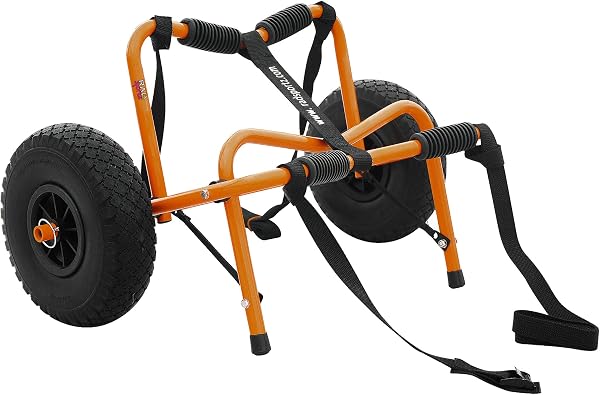
Wilderness Systems Heavy
9.4Editor score450-pound load capacity
Bunker bar frame
Two height settings
Fully collapsible design
Find the right kayak carts for 2026. We compare 10 standout options by build quality, useful features, owner feedback, value, and everyday trade-offs.
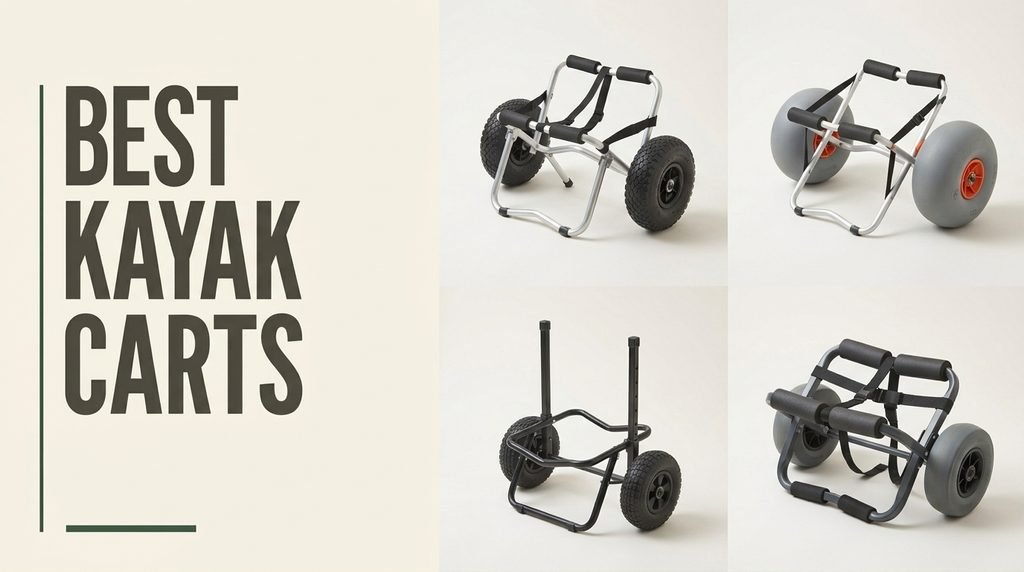
Hauling a kayak from your vehicle to the water shouldn’t drain your energy before you even launch. We compare 10 standout kayak carts by load capacity, wheel type, frame durability, terrain handling, adjustability, and real-world trade-offs to help you choose the right dolly for your paddling routine.
The biggest differences come down to weight rating, tire style, and how the cart connects to your hull. Bunker-bar cradles suit wider or heavier boats, while scupper-post designs offer quick plug-in loading for compatible sit-on-top kayaks. Matching the cart to your typical launch surface matters just as much as raw capacity.
Whether you cross sandy beaches, rocky trails, or paved parking lots, the right wheel type and frame material will determine how smoothly your kayak rolls. This guide breaks down each option so you can prioritize the features that fit your launch conditions, boat size, and storage constraints.
We compared 10 kayak carts using the details that matter most at the launch ramp: load capacity, wheel diameter and type, frame material, width adjustability, folding size, kickstand design, strap systems, and owner feedback. The notes focus on practical trade-offs so each pick connects to how paddlers actually move heavy watercraft across sand, gravel, grass, and pavement.


Compare key features, scores, and current prices side by side. A shorter feature list means fewer details were available, not necessarily fewer capabilities.




With the highest owner rating in this guide, the Adjustable Canoe Cart has earned strong marks from a wide range of paddlers. The 300-pound capacity covers most single kayaks, many tandem models, and even lighter canoes, while the gray anodized aircraft aluminum frame provides excellent corrosion resistance without the weight penalty of steel. It is the kind of cart that works well for a paddler who owns multiple boats or shares a dolly with a partner who has a different hull shape.
We may earn a commission when you buy through this link, at no additional cost to you.
The key to its versatility is the adjustable support bar spacing, which ranges from 2.4 to 14.3 inches. That wide adjustment window means you can position the cradle bars to match narrow recreational kayaks, wider fishing models, and flat-bottom canoes with equal stability. The 31.8-inch support bar length provides a broad cradle that distributes weight evenly and reduces the risk of the boat tipping sideways on uneven ground.
The 12-inch flat-free wheels handle sand, grass, gravel, and pavement without requiring air pressure checks or puncture repairs. Their larger diameter bridges small obstacles more effectively than 8- or 10-inch wheels, and the airless construction means you can leave the cart in a hot car trunk or a freezing garage without worrying about tire degradation. The padded support bars add a layer of hull protection that prevents the aluminum from scratching your gelcoat.
Aircraft-grade aluminum alloys are formulated for a higher strength-to-weight ratio than the standard aluminum used in less expensive carts. In practical terms, this means the frame can support 300 pounds without the flexing or bending that can occur in thinner-walled tubes. The anodized finish also creates a harder surface layer that resists scratches, UV fading, and saltwater corrosion more effectively than painted or bare aluminum.
The main gap in the feature set is the lack of a kickstand, which means you need to balance the cart manually while loading or lean it against your kayak. For experienced paddlers this is a minor inconvenience, but beginners may find a kickstand-equipped model easier to manage. If you value high owner satisfaction, rustproof construction, and broad hull compatibility above all else, this cart is the strongest all-around choice in the lineup.
Paddlers who need a kickstand for solo loading or who regularly haul kayaks exceeding 300 pounds.
We may earn a commission when you buy through this link, at no additional cost to you.
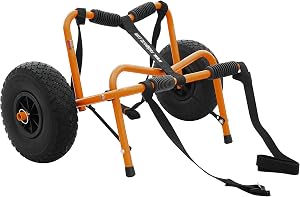
If you own a fully rigged fishing kayak or a tandem that pushes past 100 pounds empty, the Wilderness Systems Heavy Duty cart is built to take that weight off your shoulders. Its 450-pound rating places it among the strongest options available, and the bunker bar cradle design means you simply rest the hull on the padded bars rather than threading posts through scupper holes. That universal approach works with virtually any kayak or canoe shape.
We may earn a commission when you buy through this link, at no additional cost to you.
The adjustable-width bunker bars are the real standout here. By widening or narrowing the cradle, you prevent the kayak from twisting or sliding sideways during transport, which is a common frustration with fixed-width dollies. Two height settings add further versatility: the high position lifts odd-shaped hulls above the wheels to prevent rubbing, while the low position drops the center of gravity for better stability on uneven ground.
Loading is straightforward because the design eliminates the need for a kickstand or scupper alignment. You slide the cart under the kayak and secure it, which saves time when you are launching solo. The entire frame collapses flat enough to fit inside most kayak storage hatches, so you do not need to leave it behind at the launch ramp or strap it to the deck.
Many kayak carts offer a single fixed axle height, which works fine for standard hull profiles but can cause problems with deeper V-hulls or pontoon-style fishing kayaks. The low setting on this cart keeps the center of gravity down for stable rolling on flat surfaces, while the high setting lifts the hull clear of the wheels when the keel line sits unusually deep. Switching between the two takes only a few seconds and can prevent hull scuffing on longer carries.
The tradeoff is cost and weight. This cart sits at the premium end of the price range and weighs more than simpler aluminum models. For paddlers with lighter recreational kayaks who launch from paved ramps, the extra capacity may be unnecessary. But if your boat is heavy, your launch path is rough, and you want a cart that will last for years of hard use, this is one of the most capable options in the lineup.
Paddlers with lightweight recreational kayaks who want the lightest and most affordable cart for occasional paved-ramp use.
We may earn a commission when you buy through this link, at no additional cost to you.
The VEVOR Heavy Duty cart delivers a 450-pound load rating at a price that undercuts many competitors with half the capacity. That combination makes it a compelling choice for paddlers who need serious hauling power without spending close to two hundred dollars. The 2mm thickened aluminum alloy frame provides the structural backbone, while the wide adjustability range from roughly 6.7 to 17.3 inches lets you dial in the cradle for different hull widths.
We may earn a commission when you buy through this link, at no additional cost to you.
The 12-inch solid tires are the main reason this cart handles rough terrain well. Because they are airless, you never need to check pressure or worry about punctures from sharp rocks or shells. The larger diameter rolls over gravel, grass, and packed sand more smoothly than smaller wheels, and the solid construction absorbs impacts that would jar a rigid plastic tire. For launch paths that cross uneven ground, those wheels make a noticeable difference.
Loading is aided by a single-foot kickstand that props the cart upright while you position the kayak. The tie-down strap features a non-slip coating that grips the hull more securely than smooth nylon webbing, and the foam-padded support rods cushion contact points to reduce scratching. The detachable design breaks down quickly for storage in a vehicle or kayak hatch.
Solid tires eliminate the most common maintenance headache with kayak carts: flat tubes. Pneumatic tires can offer a slightly softer ride on very rough terrain, but they require inflation checks and are vulnerable to punctures from thorns, sharp rocks, and hot pavement. Solid tires trade a small amount of cushioning for total reliability, which is the better tradeoff for most paddlers who launch in varied conditions and do not want to carry a pump.
The main compromise is refinement. The frame finish is functional rather than polished, and the overall weight is higher than some premium carts with similar ratings. If you care more about raw capability and value than sleek aesthetics, this VEVOR model punches well above its price point and handles the kind of rough launch paths that destroy cheaper dollies.
Buyers who prioritize ultralight weight and premium finish over maximum capacity and terrain performance.
We may earn a commission when you buy through this link, at no additional cost to you.
When your launch path crosses loose rock, root-covered trails, or deeply rutted dirt roads, wheel diameter becomes the single most important spec on a kayak cart. The Suspenz All-Terrain Super Duty uses 15-inch airless wheels, the largest in this guide, to bridge gaps and roll over obstacles that would stop smaller tires in their tracks. That extra clearance makes a real difference on wilderness launches where paved paths are nonexistent.
We may earn a commission when you buy through this link, at no additional cost to you.
The five-position bunker bar system adjusts from 9 to 20 inches wide and accommodates V-hulls, tunnel hulls, catamaran-style fishing kayaks, and flat-bottom canoes. Each position changes the angle and height of the padded cradle bars so the hull sits securely without rocking. The powder-coated steel frame provides the rigidity needed to support 350 pounds without flexing, which matters when you are navigating side slopes or dropping off curbs.
Loading is easier thanks to the spring-loaded kickstand, which holds the cart steady while you lift the stern onto the cradle. Two sets of cam-buckle straps create a four-point tie-down that locks the boat in place and prevents the load from shifting on downhill sections. The cart folds to roughly 31 by 16 by 9 inches, which fits in most car trunks and storage sheds without disassembly.
A 15-inch wheel bridges a 3-inch gap or rock far more easily than a 10-inch wheel because the contact angle is shallower. On smooth pavement the difference is minimal, but on rocky shorelines, gravel parking lots, and root-covered portage trails, larger wheels prevent the cart from catching and jerking to a stop. If your typical launch involves more than a few yards of uneven ground, investing in larger wheels will save you frustration and reduce strain on the frame.
The main consideration is corrosion. Steel is stronger than aluminum at the same price point, but it will rust if exposed to saltwater or left wet for extended periods. If you paddle primarily in saltwater environments, applying a corrosion protectant after each use is essential. For freshwater paddlers who need maximum wheel clearance and a bombproof frame, this Suspenz dolly is hard to beat on rugged terrain.
Saltwater paddlers who want a maintenance-free frame or anyone who needs the lightest possible cart for long carries.
We may earn a commission when you buy through this link, at no additional cost to you.
At under forty dollars, the GanFindX Stainless Steel scupper cart is the most affordable option in this guide and one of the simplest to use. The plug-in design inserts two vertical posts directly into your kayak's scupper drain holes, which means no straps, no kickstand, and no width adjustments to fuss with. You line up the posts, lower the kayak, and start walking. For solo paddlers who want the fastest possible setup, that simplicity is a genuine advantage.
We may earn a commission when you buy through this link, at no additional cost to you.
The stainless steel frame offers better corrosion resistance than painted or powder-coated alternatives, which is helpful if you frequently launch in brackish or saltwater environments. Rubber sleeves cover the contact points where the posts meet the scupper holes, reducing metal-on-plastic wear and helping to keep the connection stable during transport. The 8-inch foam wheels handle paved paths, grass, and packed sand adequately for shorter carries.
The critical limitation is compatibility. The upright posts measure 0.8 inches in diameter, so your kayak’s scupper holes must be larger than 0.8 inches at the narrowest point. Many sit-on-top fishing kayaks and recreational models meet this requirement, but some narrower scupper designs do not. Measuring your drain holes before ordering is essential to avoid a cart that simply will not fit your boat.
Scupper hole diameters vary significantly between kayak brands and even between models from the same manufacturer. Use a caliper or a simple ruler to measure the inner diameter of your drain holes at the narrowest point. If the measurement is 0.8 inches or less, this cart will not fit. Also check whether the scupper holes on your kayak are positioned close enough together to align with the cart’s fixed post spacing, since scupper carts do not offer width adjustability.
This cart is best suited for paddlers with lighter sit-on-top kayaks who launch from relatively smooth surfaces and want a no-fuss, budget-friendly solution. If your kayak weighs more than 200 pounds loaded or your launch path crosses deep sand or large rocks, you will want a higher-capacity bunker bar cart with larger wheels. But for casual weekend outings on calm terrain, the GanFindX scupper cart gets the job done at a fraction of the cost.
Paddlers with kayaks that lack scupper holes, have holes smaller than 0.8 inches, or need to haul boats heavier than 240 pounds.
We may earn a commission when you buy through this link, at no additional cost to you.
Not every paddler needs a 450-pound capacity cart. If you own a single recreational kayak or a lightweight paddleboard that weighs under 80 pounds, the Rad Sportz 150 lb cart provides more than enough hauling power in a package that is easy to carry and store. The powder-coated aluminum frame keeps the overall weight low, and the included mesh carry bag lets you sling the folded cart over your shoulder while you walk back from the water.
We may earn a commission when you buy through this link, at no additional cost to you.
The 10-inch polyurethane wheels are airless and puncture-proof, which means zero maintenance between outings. They roll smoothly across parking lots, wood-chip trails, and firm grass, making this cart a good match for typical suburban and state park launch areas. The rubber cushioning on the cradle bars and the tie-down straps help protect your hull from scratches during transport.
One of the more thoughtful design details is the double kickstand, which provides a wider base of support when you are loading the kayak onto the cart. Single-kickstand designs can tip sideways if the ground is uneven, but the dual-leg setup keeps the cart upright while you position the bow or stern. The wheels also feature release pins for quick removal, which further reduces the folded size for storage in small spaces.
A mesh carry bag might seem like a minor accessory, but it solves a real problem at the launch ramp. After you unload your kayak, you need somewhere to put the cart while you are on the water. A carry bag lets you fold the dolly, stow it in your vehicle, or even tuck it into a kayak hatch if space allows. Without a bag, loose cart parts can rattle around in your trunk or get left behind at the ramp.
The main limitation is the 150-pound capacity, which rules out heavier fishing kayaks, tandems, and loaded touring boats. The 10-inch wheels also lose traction in deep sand or loose gravel more quickly than larger tires. If your kayak is light and your launch path is relatively smooth, this Rad Sportz cart is a practical, affordable, and easy-to-store companion that covers the basics well.
Owners of heavy fishing kayaks, tandem boats, or anyone who regularly launches from soft sand or deeply rutted trails.
We may earn a commission when you buy through this link, at no additional cost to you.
If your launch involves crossing a wide stretch of soft beach sand, standard solid or foam tires will sink and stall under the weight of a loaded kayak. The Bonnlo Balloon Beach Cart solves this problem with 12-inch low-pressure balloon wheels that distribute weight over a much larger contact patch, allowing the cart to float across sand rather than dig in. For coastal paddlers and surf kayakers, this single feature can transform a grueling drag into a smooth roll.
We may earn a commission when you buy through this link, at no additional cost to you.
The width adjustability is among the broadest in this guide, spanning from 6.3 to 18.7 inches with measurement markings printed directly on the axle. That range accommodates everything from narrow touring kayaks to wide pontoon-style fishing boats and even canoes. The marine-grade heat-treated aluminum frame supports 330 pounds and resists the corrosion that salt air and spray can inflict on lesser materials.
Loading is simplified by the integrated kickstand, which holds the cart upright while you position the kayak on the padded support bars. Two 11.8-foot tie-down straps are included to secure the boat firmly, and the free pump lets you adjust tire pressure to match the surface: lower pressure for deep sand, higher pressure for firm ground and pavement. The two-year warranty adds confidence for a cart that will see heavy use in harsh coastal conditions.
Balloon wheels perform best when you match the air pressure to the terrain. On soft, dry sand, running the tires at lower pressure widens the contact patch and prevents sinking. On packed wet sand or firm ground, adding a few more PSI reduces rolling resistance and improves tracking. The included pump makes these adjustments quick at the launch site, and experimenting with pressure on your first few outings will help you find the sweet spot for your typical conditions.
The tradeoff with balloon tires is that they can feel less stable on hard surfaces like concrete ramps and asphalt parking lots, where the soft sidewalls allow more lateral flex than solid tires. They also add bulk when folded, which can make storage in a small vehicle more challenging. If the majority of your launch path is sand, those compromises are well worth the dramatic improvement in rolling performance.
Paddlers who launch exclusively from paved ramps and want the most compact, low-profile cart for tight storage spaces.
We may earn a commission when you buy through this link, at no additional cost to you.
The GanFindX 300 lb Aluminum Dolly occupies a practical middle ground in the kayak cart market. Its 300-pound capacity handles most single kayaks and many tandem models, while the aluminum frame keeps the cart light enough to carry with one hand when folded. The black protective coating is more than cosmetic: it adds a barrier against moisture, UV exposure, and the salt spray that can pit bare aluminum over time.
We may earn a commission when you buy through this link, at no additional cost to you.
The 11-inch no-flat wheels strike a balance between the compact size of 8-inch foam tires and the bulk of 15-inch airless wheels. They roll well across grass, gravel, packed sand, and pavement without the maintenance concerns of pneumatic tires. The padded support bars cushion the hull at the contact points, reducing the risk of gelcoat scratches and pressure marks that can develop during longer carries over bumpy ground.
The detachable frame design breaks down into smaller components for storage in a vehicle trunk, garage shelf, or kayak hatch. The support bar spacing adjusts up to 14 inches, which covers most standard kayak hull widths. While that maximum is narrower than some competitors that reach 18 inches or more, it is sufficient for the majority of recreational and fishing kayaks on the market.
Bare aluminum develops a natural oxide layer that provides some corrosion resistance, but prolonged exposure to saltwater, humidity, and UV radiation can still cause pitting and surface degradation over time. A protective coating like the black finish on this cart adds an extra barrier that slows this process significantly. If you frequently launch in saltwater or store your cart outdoors, a coated frame will maintain its structural integrity and appearance longer than an uncoated alternative.
This cart is a strong choice for paddlers who want a reliable, corrosion-resistant dolly without paying premium prices. The main limitation is the narrower adjustment range, which may not accommodate the widest pontoon-style fishing kayaks or large canoes. If your boat falls within the 14-inch cradle width and you value a clean, durable finish, this GanFindX model delivers solid performance at a reasonable cost.
Owners of very wide pontoon kayaks or canoes that require cradle widths beyond 14 inches.
We may earn a commission when you buy through this link, at no additional cost to you.
The Bonnlo 450 lb Flat-Free cart delivers the same 450-pound load rating as the most expensive models in this guide at roughly half the price. That value proposition makes it the top pick for paddlers who need serious hauling capacity for heavy fishing kayaks, loaded tandems, or small canoes but do not want to spend close to two hundred dollars. The marine-grade heat-treated aluminum frame provides the structural strength to back up the rating.
We may earn a commission when you buy through this link, at no additional cost to you.
The 12-inch solid wheels are airless and puncture-proof, which eliminates the most common maintenance task associated with kayak carts. They handle sand, grass, gravel, and pavement competently, though they transmit more vibration on rocky surfaces than balloon or pneumatic tires would. The wide bar adjustability from 6.3 to 18.7 inches, with measurement markings on the axle, ensures a secure fit for virtually any hull shape from narrow touring kayaks to wide recreational boats.
The integrated kickstand holds the cart steady during loading, which is especially helpful when you are launching solo and need both hands to guide the kayak onto the cradle. Two 11.8-foot tie-down straps secure the boat firmly to the frame, and the padded support bars protect the hull from scratches. The two-year warranty provides additional peace of mind for a cart that will likely see heavy use over many seasons.
A common mistake is choosing a cart based on the empty weight of the kayak alone. Once you add gear, coolers, fishing tackle, and water, a 70-pound kayak can easily exceed 120 pounds. Always estimate your fully loaded weight and choose a cart with a capacity rating that provides at least a 50 percent margin above that number. A 450-pound cart gives you plenty of headroom for even the heaviest fishing setups, while a 150-pound cart may be dangerously close to its limit with a loaded tandem.
The primary tradeoff is ride quality on very rough terrain. Solid wheels are durable and maintenance-free, but they do not absorb impacts as effectively as balloon or pneumatic tires on rocky or deeply rutted paths. If your launch involves long stretches of broken pavement or loose rock, you may notice more jarring than with a softer tire option. For the vast majority of launch conditions, however, this Bonnlo cart offers outstanding capacity and versatility at a price that is hard to beat.
Paddlers who regularly cross extremely rocky or root-covered terrain where softer balloon tires would provide better shock absorption.
We may earn a commission when you buy through this link, at no additional cost to you.
The YakAttack TowNStow Bunkster is engineered for paddlers who want a premium cart that stows as easily as it performs. The tool-free collapsible design breaks the cart down into five compact parts in seconds, with no wrenches or pins to lose. The disassembled components fit inside most kayak hulls, which means you can store the entire cart in your boat during transport and reassemble it at the launch ramp without rummaging through your vehicle.
We may earn a commission when you buy through this link, at no additional cost to you.
The marine-grade construction sets this cart apart from less expensive alternatives. The anodized aluminum frame, stainless steel hardware, and UV-resistant polymer components are specifically chosen to withstand prolonged exposure to saltwater, sunlight, and the abrasive sand that accelerates wear on lesser materials. If you paddle in coastal environments and want a cart that will resist corrosion for years without special treatment, the Bunkster’s material selection is a significant advantage.
Six bunk positions and adjustable spacing from 6.25 to 16 inches provide a customized fit for a wide range of hull shapes, from narrow sea kayaks to wider recreational and fishing models. The dual kickstands offer superior loading stability compared to single-leg designs, and the grippy rubber bumpers at the bunk contact points prevent the hull from sliding during transport. Multiple tie-down points let you secure the boat at several angles for balanced load distribution.
Most kayak carts advertise a single maximum capacity, but real-world performance varies dramatically depending on the surface. A cart that handles 450 pounds on a smooth parking lot may struggle with 250 pounds on a rocky trail with sudden drops. The YakAttack Bunkster is one of the few carts that publishes tiered ratings for flat surfaces, rugged trails, and drop impacts, giving you a more realistic picture of what the cart can handle in the conditions you will actually encounter.
The important caveat is that the 450-pound rating applies to flat, smooth surfaces. On rugged trails the capacity drops to 300 pounds, and over 5-inch drops it falls further to 200 pounds. This tiered rating system is more honest than a single headline number, but it means you should consider your typical terrain when evaluating whether the capacity meets your needs. For paddlers who value compact storage, marine-grade durability, and precise hull fit, the Bunkster justifies its premium price.
Budget-conscious buyers or paddlers who need maximum capacity on rough, uneven terrain where the tiered rating drops significantly.
We may earn a commission when you buy through this link, at no additional cost to you.
Selecting a kayak cart involves more than picking the highest weight rating or the lowest price. The right dolly depends on your kayak’s size and hull shape, the terrain between your vehicle and the water, how you plan to store the cart, and whether you launch solo or with a partner. This buying guide walks through the most important decision factors so you can match a cart to your specific paddling routine.
Load capacity is the first spec most shoppers check, and for good reason. A cart rated below your kayak’s actual weight will bend, wobble, or fail entirely under the strain. The key is to calculate your fully loaded weight, not just the empty hull weight listed on the manufacturer’s spec sheet. A 75-pound fishing kayak can easily reach 130 pounds or more once you add a cooler, tackle boxes, a battery, and safety gear. Choosing a cart with a capacity rating that exceeds your loaded weight by at least 50 percent provides a safety margin that accounts for dynamic forces like bumps, drops, and side slopes.
The highest-capacity carts in this guide reach 450 pounds, which is sufficient for virtually any single kayak, most tandems, and even small canoes. Mid-range options around 300 pounds cover the majority of recreational and fishing kayaks with gear. Lighter carts rated at 150 to 240 pounds work well for solo recreational kayaks and paddleboards but will be overwhelmed by heavier boats. Pay attention to whether the manufacturer specifies a single flat-surface rating or tiered ratings for different terrain types, as the real-world capacity on rough ground can be significantly lower than the headline number.
Start by weighing your kayak fully loaded with your typical gear, then choose a cart whose rated capacity exceeds that number by a comfortable margin. If you plan to upgrade to a heavier boat in the future, buying a higher-capacity cart now can save you from purchasing a second dolly later.
The wheels on a kayak cart determine how smoothly your boat rolls across the surface between your vehicle and the water, and the differences between wheel types are substantial. Solid polyurethane and foam-filled tires are airless and puncture-proof, which makes them virtually maintenance-free. They perform well on pavement, packed gravel, and firm grass but can transmit more vibration on rocky surfaces and may sink in deep, dry sand. Balloon tires use low air pressure to create a wide contact patch that floats over soft sand and loose surfaces, making them the clear choice for beach launches. Larger-diameter wheels, such as 15-inch airless models, bridge gaps and roll over obstacles more easily than smaller 8- or 10-inch tires.
Consider the terrain you cross most frequently when choosing a wheel type. If you launch from a paved parking lot and walk down a short gravel path to a concrete ramp, almost any wheel type will work fine. If your launch involves a long stretch of soft beach sand, balloon tires will make the difference between a smooth roll and an exhausting drag. For rocky shorelines and root-covered trails, larger-diameter solid or airless wheels provide the clearance and impact absorption needed to keep the cart moving without catching on every obstacle.
Match the wheel type to your most challenging launch surface, not your easiest one. A cart that handles your toughest terrain will also work on smoother paths, but a cart designed only for pavement will leave you stranded in sand or stuck on rocks.
Kayak cart frames are typically made from aluminum or steel, and each material has distinct advantages. Aluminum is lightweight, naturally corrosion-resistant, and easy to carry, which makes it the most popular choice for recreational paddlers. Higher-end aluminum carts use aircraft-grade alloys and anodized finishes that provide additional strength and surface protection against saltwater, UV radiation, and abrasion. Steel frames are heavier but offer greater rigidity at a lower cost, which is why they appear on some heavy-duty models designed for maximum load capacity.
The corrosion environment where you paddle should influence your material choice. Freshwater lakes and rivers are relatively gentle on both aluminum and steel, especially if you rinse and dry the cart after use. Saltwater and brackish environments are far more aggressive and can cause untreated steel to rust within a single season. If you paddle in coastal waters, an anodized aluminum frame with stainless steel hardware is the most durable option. Some steel carts can be protected with corrosion inhibitors, but this requires regular maintenance that many paddlers find inconvenient.
Choose aluminum for saltwater use and lightweight portability. Choose steel if you need maximum rigidity for heavy loads and primarily paddle in freshwater, and be prepared to apply a rust protectant after each outing.
Kayak carts connect to your boat in one of two primary ways, and the right choice depends on your kayak’s design. Bunker bar carts use two padded horizontal bars that cradle the hull from underneath, similar to the bunks on a boat trailer. This style works with virtually any kayak, canoe, or paddleboard regardless of hull shape, and it distributes weight across a broad area to reduce pressure points. Scupper post carts use two vertical posts that plug into the scupper drain holes found on sit-on-top kayaks, providing a quick, strap-free connection that takes seconds to set up.
Bunker bar carts are the more versatile option because they do not depend on specific hull features. They handle V-hulls, flat bottoms, pontoon shapes, and rounded touring hulls with equal ease, and they can support heavier loads because the weight is spread across the cradle rather than concentrated on two small scupper holes. Scupper post carts are faster to load and unload because you simply align the posts with the drain holes and lower the kayak into place, but they only work with sit-on-top kayaks that have scupper holes large enough to accommodate the posts.
If you own a sit-on-top kayak with scupper holes larger than 0.8 inches and want the fastest possible setup, a scupper post cart is a convenient choice. For all other hull types, or if you want the flexibility to use the cart with multiple boats, a bunker bar design is the safer and more versatile option.
The distance between the support bars on a bunker bar cart determines how securely the kayak sits in the cradle. If the bars are too narrow, the hull will rock side to side and may slip off during transport. If they are too wide, the kayak will sit too low and the hull may rub against the wheels or axle. Adjustable-width carts let you dial in the spacing to match your specific hull, and the range of adjustment varies significantly between models. Some carts offer a narrow range of a few inches, while others span from 6 to nearly 19 inches to accommodate everything from narrow sea kayaks to wide pontoon fishing boats.
Measurement markings on the axle are a useful feature that lets you set the bar spacing precisely and replicate the setting quickly if you remove and reattach the bars for storage. Without markings, you may need to experiment each time to find the right width, which adds frustration at the launch ramp. The support bar length also matters: longer bars provide a broader cradle that distributes weight more evenly and improves lateral stability on uneven ground.
Measure the widest point of your kayak’s hull where the cart will sit, then choose a cart whose adjustment range comfortably includes that measurement. If you own multiple kayaks with different hull widths, prioritize a cart with the broadest adjustment range.
A kayak cart spends most of its life folded and stored, so the collapsed dimensions matter more than many shoppers realize. Some carts fold flat enough to fit inside a kayak’s rear storage hatch, which lets you stow the dolly on the water and retrieve it at your takeout point. Others break down into several compact components that pack into a carry bag or fit on a garage shelf. The least compact designs may require you to leave the cart at the launch ramp or strap it to the deck of your kayak during paddling.
Tool-free disassembly is a feature worth paying attention to if you plan to break the cart down frequently. Carts that require wrenches, pins, or multiple steps to collapse are less likely to be stored properly after each outing, which increases the risk of damage and loss. The most convenient designs separate into a few large pieces by hand in under a minute, and some include a mesh carry bag for transport.
Before buying, check the folded dimensions against your available storage space, whether that is a kayak hatch, a car trunk, or a garage shelf. A cart that is too bulky to store conveniently will end up unused.
Loading a kayak onto a cart solo can be the most physically demanding part of the process, and a kickstand makes a significant difference. A kickstand props the cart upright while you lift the stern or bow onto the cradle, freeing both hands to guide the hull into position. Without a kickstand, you need to balance the cart with one hand while maneuvering the kayak with the other, which is awkward and increases the risk of dropping the boat or tipping the dolly.
Dual kickstands provide a wider and more stable base than single-leg designs, especially on uneven ground where a single leg can sink or slip. Spring-loaded kickstands deploy automatically when the cart is set down and retract when you start pulling, which streamlines the loading process. Some scupper post carts eliminate the need for a kickstand entirely because the posts plug into the kayak from below, but this only works if your kayak is already positioned at the right height.
If you frequently launch alone, prioritize a cart with a sturdy kickstand, preferably a dual-leg or spring-loaded design. The few extra seconds a kickstand saves on each loading cycle add up over a season and reduce the physical strain on your back and shoulders.
Once the kayak is on the cart, tie-down straps keep it from shifting, sliding, or bouncing off during transport. The quality and configuration of the strap system varies widely between models. Basic carts may include a single strap that loops over the hull, while more robust designs provide two or more cam-buckle straps with multiple attachment points for four-point security. Non-slip coatings on the strap webbing improve grip on smooth gelcoat surfaces and reduce the need to overtighten, which can dent or deform softer hull materials.
Strap length is another practical consideration. Short straps may not reach around wider kayaks or canoes, forcing you to purchase aftermarket replacements. Look for straps that are at least 10 feet long to ensure they can wrap around the hull and secure to the cart frame with enough overlap for a firm buckle connection. Cam-buckle straps are generally easier to adjust and release than ratchet straps, which can apply excessive pressure if over-tightened.
Check the included strap length against your kayak’s circumference at the cradle point before your first outing. If the straps are too short or lack a non-slip surface, upgrading to aftermarket cam-buckle straps is an inexpensive improvement that significantly improves load security.
To get the best performance from your kayak cart, position the cradle bars or scupper posts near the kayak’s balance point, which is typically slightly behind the cockpit on a single kayak and near the center on a tandem. Placing the cart too far forward or too far back will cause the bow or stern to drag on the ground, making the cart harder to pull and increasing wear on the hull. Once the kayak is seated on the cart, secure the tie-down straps snugly but not so tightly that they deform the hull, and give the boat a gentle shake to confirm it is stable before you start walking.
After each outing, especially in saltwater or sandy environments, rinse the cart frame, wheels, and hardware with fresh water to remove salt, sand, and debris that can accelerate corrosion and wear. Pay particular attention to the wheel axles and any moving joints where grit can accumulate and cause binding. Allow the cart to air dry completely before folding it for storage, as trapping moisture inside a folded frame promotes rust on steel components and mildew on foam padding.
Inspect the wheels, straps, and frame connections periodically for signs of wear. Solid and foam tires should be checked for cracks, flat spots, or chunks missing from the tread. Straps should be examined for fraying, UV damage, and buckle function. If your cart has a steel frame, apply a corrosion protectant spray at the start of each season and after any outing in saltwater. Storing the cart in a cool, dry location out of direct sunlight will extend the life of the tires, straps, and any polymer components.
The right size depends on your kayak's loaded weight and hull width. Choose a cart with a weight capacity that exceeds your fully loaded kayak by at least 50 percent, and make sure the support bar width range includes your hull's widest point. Most recreational kayaks work well with 300-pound carts, while heavier fishing kayaks and tandems may need 450-pound models.
Yes, but wheel type matters enormously. Standard solid or foam tires tend to sink in deep, dry sand and make pulling very difficult. Balloon tires with low air pressure distribute weight over a larger surface area and float across sand much more effectively. If beach launching is your primary use case, choose a cart specifically designed with balloon or wide-profile tires.
Bunker bar carts cradle the hull from underneath using two padded horizontal bars and work with virtually any kayak, canoe, or paddleboard shape. Scupper post carts use vertical posts that plug into the drain holes on sit-on-top kayaks for quick, strap-free loading. Bunker bars are more versatile and handle heavier loads, while scupper posts are faster to set up but only fit compatible sit-on-top kayaks.
Kayak cart capacities range from about 150 pounds for lightweight recreational models to 450 pounds for heavy-duty designs. Most mid-range carts support 300 to 350 pounds, which covers the majority of single kayaks with gear. Always check the loaded weight of your kayak, including all gear and accessories, before selecting a cart.
Most modern kayak carts use airless solid, foam-filled, or no-flat tires that cannot puncture or lose pressure. Balloon tires are the exception: they use low air pressure for soft-sand performance and can technically go flat, though they are typically made from thick, puncture-resistant materials. If you want zero maintenance, choose a cart with solid or foam tires.
A properly designed kayak cart should not scratch your hull. Look for models with foam-padded or rubber-covered support bars that cushion the contact points. Scupper post carts with rubber sleeves also reduce metal-on-plastic wear. Avoid overtightening tie-down straps, which can press the hull hard against the frame and cause pressure marks or gelcoat damage over time.
Yes, especially if the cart has a kickstand that holds it upright while you position the kayak. The easiest technique is to lift the stern of the kayak onto the cradle first, then walk the bow forward until the boat is balanced on the cart. Heavier kayaks may require a cart with a sturdy dual kickstand and a low loading height to make solo loading manageable.
Many kayak carts work well with canoes and stand-up paddleboards, especially bunker bar designs with wide adjustability ranges. Check the cart's maximum width setting and weight capacity to ensure it can accommodate your canoe's broader hull or your paddleboard's flat profile. Scupper post carts are not compatible with canoes or paddleboards since those watercraft lack scupper holes.
Most kayak carts fold or disassemble for compact storage. Look for a model that breaks down small enough to fit in your vehicle, garage, or kayak hatch. After each use, rinse the cart with fresh water, let it dry completely, and store it in a cool, dry location out of direct sunlight to prevent UV damage to tires and polymer components.
A roof rack or trailer solves the vehicle transport problem, but you still need to move the kayak from the parking area to the water's edge. A kayak cart bridges that gap, especially at launch sites where the parking lot is far from the ramp or beach. Many paddlers use both a roof rack for highway travel and a cart for the final carry to the launch point.
The strongest all-around kayak cart in this lineup is the Adjustable Canoe Cart with 300-pound capacity, which earned the highest owner rating thanks to its rustproof aircraft aluminum frame, broad width adjustability, and reliable 12-inch flat-free wheels. It handles the widest variety of hull shapes and launch conditions without the premium price tag of the heaviest-duty models, making it the most practical choice for the majority of paddlers.
For buyers with specific needs, the alternatives are compelling. The Bonnlo 450 lb Flat-Free cart delivers maximum capacity at a mid-range price for heavy fishing kayaks and tandems. The Bonnlo Balloon Beach Cart is the clear winner for soft-sand launches. The Wilderness Systems and YakAttack models offer premium build quality and thoughtful features for paddlers who want long-term durability and compact storage. Budget-conscious shoppers can rely on the GanFindX scupper cart or the Rad Sportz dolly for lighter boats and smoother paths.
The best kayak cart for you depends on three things: how much your kayak weighs when fully loaded, what surface you cross between your vehicle and the water, and how you plan to store the cart between outings. Start with those three factors, use the comparison table and buying guide above to narrow your options, and choose the model that matches your real-world launch conditions rather than the one with the highest headline spec.