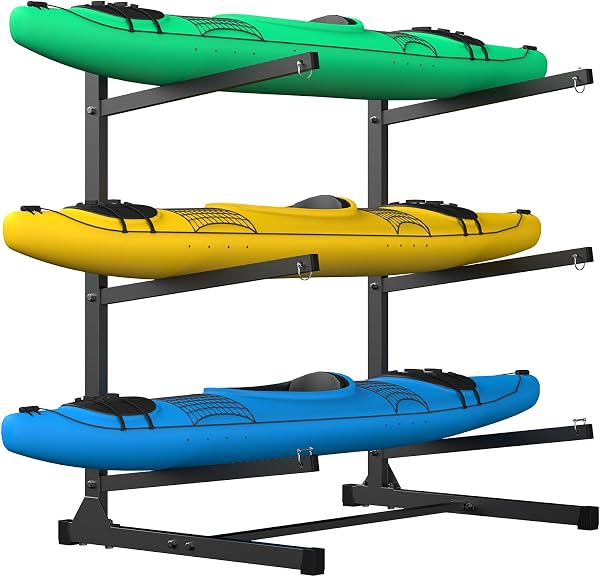
3-Tier Freestanding Rack
8.6Editor score300 lb total capacity
100 lb per level
Weatherproof felt arm padding
Three tier freestanding frame
Find the right canoe racks for 2026. We compare 10 standout options by build quality, useful features, owner feedback, value, and everyday trade-offs.
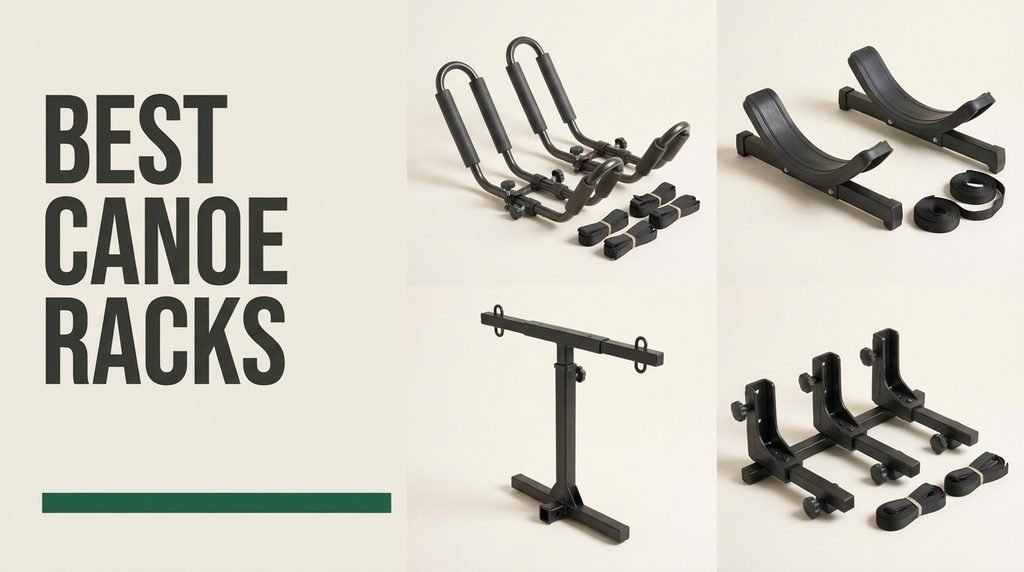
Find the right canoe racks for 2026. We compare 10 standout options by the factors that matter in this category, such as per-tier load capacity, hull distortion protection, steel gauge thickness, weatherproof finishes, arm adjustability, footprint efficiency, and everyday loading convenience.
Leaving a canoe or heavy kayak directly on concrete floors, damp grass, or narrow sawhorses invites hull warping, gelcoat scratches, and tripping hazards in your garage. Purpose-built storage racks distribute watercraft weight across padded support arms or suspension straps while organizing multiple hulls into a clean vertical footprint.
Choosing the right setup depends on your storage environment and fleet size. Homeowners with open stud walls can reclaim floor space using multi-tier wall hangers, while lakeside dock owners and renters often prefer freestanding steel frames, portable folding trestles, or hitch-mounted truck bed extenders for transport.
We compared 10 canoe racks using the details that actually help a buyer decide: weight rating per level, structural steel thickness, corrosion-resistant coatings, vertical tier spacing, hull contact cushioning, mounting versatility, and floor footprint. The notes focus on practical trade-offs so each pick feels connected to how paddlers store, secure, maintain, and transport canoes and kayaks year-round.


Compare key features, scores, and current prices side by side. A shorter feature list means fewer details were available, not necessarily fewer capabilities.


Standing out as our Editor's Choice, this Pro-Grade 3-Tier Dock and Garage Rack bridges the gap between residential convenience and commercial-grade marine hardware. Many consumer racks rely on thin-walled, multi-piece vertical poles that bolt together at the midpoint and flex under heavy canoe loads. By contrast, this system uses a one-piece vertical body forged from ultra-thick 11-gauge industrial steel, eliminating mid-post joint wobble and supporting three to four kayaks, canoes, or paddleboards with rock-solid rigidity.
We may earn a commission when you buy through this link, at no additional cost to you.
Its signature advantage is true dual-mode installation versatility combined with granular height customization. Using the heavy-duty lower base legs, you can deploy the unit as a stationary freestanding rack on a garage floor or lakeside pier. If your floor plan changes later and you want to park a truck closer to the wall, the included specialized wall brackets allow you to remove the floor feet and lag-bolt the vertical columns directly to wall studs or solid masonry. Along those uprights, a 45-slot precision-drilled track paired with quick D-locking pins lets you fine-tune arm spacing in small increments to clear high canoe stems or compact SUP stacks.
Designed specifically to survive harsh waterfront environments, the metal surfaces are treated with a marine-grade powder coating engineered to resist salt-air corrosion, UV fade, and persistent dock splash. Each support arm also provides dedicated attachment loops for threading your own heavy-duty cam straps or ratchet tie-downs, ensuring that sudden lakeside squalls cannot lift a lightweight canoe off the cradle.
Traditional racks with only three or four pre-drilled bolt holes often leave either too little room for a canoe’s upturned bow or waste a foot of vertical wall space. The 45-slot D-pin track allows you to move arms up or down in minutes without wrenches, letting you dial in exact gunwale clearance whenever you swap out watercraft.
The only minor omission is that tie-down straps must be supplied separately, and you will want an extra set of hands if bolting the weighty 11-gauge uprights onto a wall. For buyers who demand uncompromising steel thickness, micro-adjustable tier spacing, and the freedom to switch between freestanding and wall-mounted setups, this is the most versatile and durable canoe rack available.
Paddlers looking for an ultralight folding travel stand to toss into the back of a vehicle on weekend trips.
We may earn a commission when you buy through this link, at no additional cost to you.
Homeowners and paddlers who want to organize up to three watercraft without drilling lag bolts into garage drywall or dock pilings will appreciate the straightforward utility of this 3-Tier Freestanding Rack. Constructed from a combination of industrial steel and aluminum components, the unit provides a stable, independent footprint suitable for indoor garages, backyard sheds, patios, and covered boathouses. With a 100-pound load rating per tier and a 300-pound total capacity, it handles typical solo canoes, recreational kayaks, surfboards, and stand-up paddleboards without straining the frame.
We may earn a commission when you buy through this link, at no additional cost to you.
Space efficiency is the strongest practical advantage of this design. Assembled dimensions measure 49 inches high, 35 inches wide, and 46 inches deep, creating a low-profile stand that takes up roughly the floor space of a single upside-down boat while tripling your vertical storage capacity. Unlike taller racks that reach six feet high, the 49-inch height makes lifting a heavy craft onto the top tier manageable for two people without requiring step stools or overhead hoists. Each support arm is wrapped in durable, weatherproof felt padding that prevents bare metal from scraping gelcoat, polyethylene, or composite finishes during loading and unloading.
In everyday use, the moveable freestanding frame gives you seasonal flexibility. You can position the rack along a boat dock or backyard fence from spring through autumn, then carry the unloaded frame inside a garage or basement for winter storage. Because the base measures 46 inches front-to-back, it offers dependable forward-and-aft anti-tip resistance on level concrete, asphalt, or wooden deck boards. To maximize stability, paddlers should always place their heaviest canoe or tandem kayak on the bottom cradle arms and reserve the upper tiers for lighter solo kayaks or paddleboards.
When organizing a mixed fleet of canoes, kayaks, and paddleboards on a 49-inch frame, load order matters for both balance and clearance. Place heavy, low-profile sit-on-top kayaks on the bottom tier to anchor the center of gravity near the floor, slide paddleboards or surfboards into the middle slot, and rest deep-bellied canoes upside down on the top arms where overhead height is unlimited.
The main trade-off to consider is the fixed vertical spacing across the three tiers. While the top level has unrestricted upward clearance for a deep-hulled canoe or wide fishing kayak, the lower and middle bays work best with sleeker touring kayaks, flat-bottomed boats, or paddleboards. If your collection consists of one deep canoe paired with a couple of lower-profile kayaks or boards, this compact rack delivers reliable, scratch-free organization.
Paddlers attempting to stack three high-profile, deep-hulled canoes simultaneously in the lower and middle fixed bays.
We may earn a commission when you buy through this link, at no additional cost to you.
Families and outdoor enthusiasts managing four separate watercraft often struggle to store their gear without filling an entire two-car garage bay. This 4-Tier Heavy-Duty Rack solves multi-boat clutter by arranging two vertical storage tiers on the front and two tiers on the back of a central high-strength steel upright frame. Engineered to hold 110 pounds per level for a substantial 440-pound total weight capacity, it provides the structural backbone needed for heavy rotomolded canoes, rigged angling kayaks, and family recreational fleets.
We may earn a commission when you buy through this link, at no additional cost to you.
Beyond raw weight tolerance, the dual-sided layout naturally balances the stand’s center of gravity. Single-sided freestanding racks carry all their cantilevered load on one side of the vertical post, whereas this symmetrical frame counterbalances the front payload with the rear payload. Furthermore, the support arms incorporate multiple height adjustment points along the central columns. You can raise or lower specific arms to match the exact beam and gunwale depth of your canoes, preventing wasted vertical gaps while keeping top-tier lifting height as low as possible.
Built for both indoor garage organization and outdoor lakeside placement, the steel tubing is sealed with a rust-resistant powder coating that fends off oxidation, rain, and morning dew. Because it stands independently on any flat surface without wall brackets or ceiling hooks, it works well in open pole barns, marinas, gravel boat yards, or wide decks. Assembly is straightforward with the included hardware kit, though tightening bolts systematically after positioning the arms at your preferred heights ensures the crispest alignment.
To get the best stability from a dual-sided four-boat stand, pair watercraft of similar weight on opposite sides of the bottom tier first. Keeping a heavy canoe on the lower front cradle balanced by a tandem kayak on the lower rear cradle keeps the frame rock-solid even when loading or removing boats from the upper arms.
Before purchasing a double-sided rack, verify your floor space layout. Because watercraft load onto both sides of the central spine, the unit takes up more front-to-back depth than a single-sided stand and works best when placed as an accessible island or aligned perpendicular to a wall so you can slide hulls in from the ends. For four-boat households seeking high load capacity and adaptable spacing, it is a highly capable freestanding powerhouse.
Narrow single-car garages where the rack must sit tight against a side wall with minimal walkway depth.
We may earn a commission when you buy through this link, at no additional cost to you.
Paddlers who own Kevlar, fiberglass, Royalex, or rotomolded polyethylene canoes know that resting a prized boat directly on rigid metal bars for months can cause flat spots, pressure dents, and hull oil-canning. The Suspenz Flat Rack earned our Premium Pick designation because it replaces hard contact surfaces with a tensioned suspension strap system. Instead of sitting on steel tubing, your canoe floats on heavy-duty nylon webbing slung across the support frame, allowing the strap to conform to the hull's curvature and distribute weight evenly.
We may earn a commission when you buy through this link, at no additional cost to you.
Built from rectangular powder-coated steel tubing that bolts flush against wall studs, each pair of racks supports up to 125 pounds and extends a generous 33 inches out from the wall. That extra arm length is crucial for canoe owners, as many budget kayak hooks stop at 22 to 26 inches and force wide canoes to lean awkwardly on their sides. out of the box, the Flat Rack holds watercraft up to 34 inches wide in a flat, shelf-like orientation, and mounting a standard 2×4 wood spacer block between the vertical bracket and the wall expands capacity to fit 36-inch-wide beams.
Usability and security are thoughtfully integrated into the frame. Overhead adjustable safety straps wrap around the hull or gunwales, anchoring the craft so wind gusts on an outdoor boathouse wall or accidental bumps in a busy garage cannot dislodge the boat. For owners who store their canoe in a lakeside shed during the summer and move it to a heated basement in the winter, Suspenz offers optional quick-release wall mount brackets (sold separately) that let you lift the arms out of one set of wall plates and drop them into another without unscrewing lag bolts.
During hot summer afternoons inside an uninsulated garage, plastic and composite hulls warm up and become more pliable. Resting a 90-pound boat on narrow padded pipes concentrates forty-five pounds of force onto two thin lines, whereas Suspenz webbing spreads that load across wide, flexible bands that flex with temperature changes.
While the price covers storage for only one boat, the investment pays for itself by preserving hull rocker and structural integrity on expensive watercraft or rooftop cargo boxes. Keep in mind that while the powder-coated steel handles freshwater humidity and indoor garages with ease, prolonged exposure to coastal salt spray will eventually cause corrosion on steel components.
Shoppers seeking a multi-boat rack on a single budget purchase or coastal users storing gear directly over saltwater.
We may earn a commission when you buy through this link, at no additional cost to you.
Standard 100-pound wall hooks can feel pushed to their limit when supporting three-person family canoes, outfitted pedal-drive fishing kayaks, or waterlogged wooden craft. This Wall Mount Adjustable Rack steps up structural assurance with industrial steel tubing rated to hold up to 150 pounds per individual tier. Available in multi-tier vertical track heights up to 52 inches with 29-inch support arms, it transfers heavy hull loads safely into your garage, shed, porch, or boathouse wall framing.
We may earn a commission when you buy through this link, at no additional cost to you.
Adjustability is clean and accessible thanks to a slotted vertical wall channel offering up to 25 positioning points. Rather than forcing you to unbolt hex nuts with two wrenches every time you reorganize your gear, each cantilever arm locks into the vertical spine with a hand-tightened butterfly screw alongside its structural pin. This makes it easy to widen a bay for a deep-draft canoe or compress the tiers when storing thin surfboards and wakeboards.
To protect delicate hull finishes, the top face of every 29-inch support arm is lined with thick, weatherproof felt padding that resists rot and peeling in damp outdoor environments. The outer steel frame is finished in a corrosion- and abrasion-resistant powder coat, and the manufacturer supplies rust-proof wall hardware suitable for exterior siding or dock posts. Keep in mind that installation requires drilling six anchor holes using a 12mm (approximately 1/2-inch) drill bit, which you will need to have in your toolbox prior to setup.
Because this system can carry 150 pounds on a single set of 29-inch cantilevered arms, significant outward torque is placed on the top wall fasteners. Always center the vertical steel channels directly over solid 2×4 or 2×6 wood studs, or anchor into solid concrete block using the required 12mm masonry holes.
Wait to measure your widest canoe’s beam before mounting: at 29 inches long, the support arms comfortably cradle most solo canoes, recreational kayaks, and SUPs flat, while canoes wider than 30 inches can rest slightly angled against the wall padded uprights. For wall-mount buyers who prioritize a 150-pound per-level safety margin, this rack delivers exceptional strength.
Renters who cannot drill 12mm anchor holes or owners of extra-wide 36-inch beam freighter canoes.
We may earn a commission when you buy through this link, at no additional cost to you.
Even if you already own a permanent multi-tier wall rack, washing, waxing, repairing fiberglass, or rigging fish-finders on a canoe while it rests on rocky gravel or concrete driveway slabs is tough on both your knees and the boat's hull. The Rad Sportz Kayak Storage Racks solve this problem as a portable set of two folding steel trestles. Standing 17 inches tall when unfolded, they hold a single canoe, tandem kayak, surfboard, or paddleboard up to 100 pounds at an ergonomic workbench height.
We may earn a commission when you buy through this link, at no additional cost to you.
Instead of rigid metal crossbars, the top of each folding A-frame stand uses adjustable nylon webbing straps supplemented by thick rubber corner bumpers. When you lower a canoe or kayak onto the stands, the flexible nylon sling cradles the bilge or gunwales gently without scratching gelcoat or slipping under wet soapy water. The powder-coated orange and black steel legs spread wide enough to stay planted while you scrub out mud, apply UV protectant, or pack dry bags at the campsite.
Portability is where this pair shines brightest. When you finish cleaning your boat or breaking camp, each stand folds flat to 16 inches long by 6.75 inches wide by 23 inches high and slips inside the included cinch-top mesh carry bag. You can hang the bag on a single garage nail, stash it inside a pickup truck cab, or stow it in an RV pass-through bay so you always have off-the-ground boat storage at the beach, lake edge, or dock.
Dragging or setting a canoe down on asphalt or sandy shorelines grinds abrasive grit into the hull outer layer, especially when loading heavy camping gear inside the boat. Unfolding these 17-inch stands at the launch area lets you load packs and inspect hull patches completely above ground clutter.
Naturally, a folding two-piece trestle set is not meant to stack three canoes vertically in a cramped shed, nor should it be overloaded with motorized fishing barges exceeding 100 pounds. For paddlers who want no-drill seasonal floor storage, an indoor display cradle, or a portable wash and maintenance stand, this compact kit is an indispensable companion.
Paddlers needing multi-boat vertical storage or support for heavy craft weighing over 100 pounds.
We may earn a commission when you buy through this link, at no additional cost to you.
Transporting a 15- or 17-foot canoe in a modern five-and-a-half-foot pickup truck bed leaves more than half the hull hanging unsupported past the tailgate. The MaxxHaul 70231 Hitch Mount Pick Up Truck Bed Extender turns any standard 2-inch hitch receiver into a rigid rear support T-bar, cradling the overhanging stern of canoes, long fishing kayaks, extension ladders, or lumber bundles so they cannot bounce or warp at highway speeds.
We may earn a commission when you buy through this link, at no additional cost to you.
Versatility is built into the adjustable steel tubing. Using four included quick-release clevis pins, you can adjust both the extension length and crossbar height without fumbling with sockets or wrenches. In its low horizontal setting, the support bar aligns level with your open tailgate to extend the pickup bed floor; flipped upright into its tall position, the crossbar rises to cab-roof level so you can carry extra-long canoes overhead across a cab roof bar and the hitch extender while leaving the truck bed completely clear for coolers and camping gear.
Once you arrive at the river put-in or job site, the side containment arms fold down horizontally to transform the T-bar into a waist-high portable work support for rigging tackle, sawing lumber, or staging paddles. To keep other drivers alert around your extended load, the black frame comes equipped with pre-applied reflective safety tape and a bright red tail flag. When the weekend trip is over, pulling the four clevis pins breaks the unit down flat to stow neatly behind a truck seat or on a garage shelf.
For solo kayaks and 12-to-14-foot canoes, bed-level extension keeps the watercraft tucked inside the truck’s aerodynamic slipstream and makes solo loading effortless. For 16-to-18-foot tripping canoes with upturned stems, configuring the extender to roof height prevents wide center beams from pinching against narrow truck tailgates.
While this is a transport rack rather than a stationary garage organizer, it is often the missing link for pickup owners who want to avoid lifting an 85-pound canoe onto a high SUV roof rack alone. If your truck has a 2-inch receiver hitch, this bed extender offers fast, back-saving canoe transport at an approachable price.
Shoppers seeking a stationary indoor garage storage stand or drivers with 1.25-inch compact car hitches.
We may earn a commission when you buy through this link, at no additional cost to you.
Storing multiple boats outdoors on a backyard patio, open carport, or lakeside dock brings two common headaches: uneven ground that causes racks to wobble and security concerns when expensive watercraft are left out of sight. This Freestanding 400 lb Rack directly addresses both challenges in a generous 71-inch-high by 46-inch-wide by 36-inch-deep industrial steel frame. Each of its four levels supports up to 100 pounds and features a built-in welded metal ring specifically designed for threading a steel theft-deterrent cable lock or heavy bungee cord.
We may earn a commission when you buy through this link, at no additional cost to you.
Unlike shorter compact stands that crowd multiple hulls together, the 71-inch vertical uprights allow up to 18 inches of vertical clearance between arms. Using quick-adjust buckle clamps on the laser-welded arms, you can slide tiers up or down to give deep-hulled canoes the breathing room they require. In addition, an integrated side paddleboard hook offers bonus hanging storage for paddles, life jackets, or an extra board alongside the main stack.
Outdoor longevity receives special engineering attention across the frame. The tubing ends are closed off with fully welded, sealed waterproof caps so rainwater cannot seep inside the vertical posts and corrode the steel from the inside out. Underneath the 36-inch-deep base legs, screw-adjustable leveling feet let you compensate for sloped garage aprons, settling patio pavers, or uneven dock planks so the fully loaded 400-pound stand sits plumb and rock-steady.
When placing a tall four-tier rack on patio stones or wooden docks, use a carpenter’s bubble level across the base rails and dial the threaded feet until all four corners bear equal weight. Afterward, pass a braided steel security cable through each tier’s welded ring and your canoe thwarts or carry handles.
Because the top cradle sits nearly six feet off the ground when set to maximum spacing, paddlers should plan to keep lighter kayaks or SUPs on the uppermost level and store heavier canoes on the lower two tiers. For buyers seeking a tall, single-sided four-boat freestanding rack with leveling feet and theft-locking points, this model is purpose-built for year-round peace of mind.
Low-ceiling basement storage rooms under six feet tall or solo paddlers who struggle with overhead lifting.
We may earn a commission when you buy through this link, at no additional cost to you.
Many paddlers simply want a clean, no-nonsense freestanding steel stand that assembles quickly on a Saturday morning and keeps their boats off the garage floor without complicated pins or bulky dual-sided footprints. This Compact Multi-Level Stand delivers exactly that balance. Crafted from heavy-duty steel tubing finished in a matte black powder coat, it supports up to 100 pounds per tier while maintaining a trim footprint that tucks neatly along a garage side wall or shed partition.
We may earn a commission when you buy through this link, at no additional cost to you.
One practical detail that sets this frame apart from basic pipe stands is the inclusion of dedicated strap anchor points on each support tier. When storing smooth polyethylene canoes or slick fiberglass kayaks, a bump from a lawnmower or kids’ bicycles can cause an unstrapped hull to shift on padded bars. The integrated anchor loops make it effortless to hook bungee cords or cam straps across each boat, holding every hull snugly in its cradle.
Day-to-day usability is straightforward and dependable. All required bolts and fasteners come in the box, allowing one person to assemble the base legs, vertical uprights, and padded cantilever arms in minutes using basic hand tools. Because the entire structure is freestanding, you never have to hunt for wall studs or worry about pulling drywall anchors loose in an older detached garage.
Even inside an enclosed garage where wind is not a factor, anchoring watercraft on upper tiers prevents accidental tipping when lifting lower boats in and out of the frame. Looping a simple quick-release cam strap through the arm anchor tabs locks upper hulls safely out of the way.
While the vertical uprights do not offer the 45-slot pin customization of our Editor’s Choice pick, the pre-spaced arm intervals accommodate standard canoes, recreational kayaks, and paddleboards cleanly. It is a sensible, well-built choice for homeowners who want straightforward freestanding storage with built-in tie-down points at a mid-range price.
Users who frequently swap between ultra-deep canoes and flat boards requiring tool-free daily arm adjustments.
We may earn a commission when you buy through this link, at no additional cost to you.
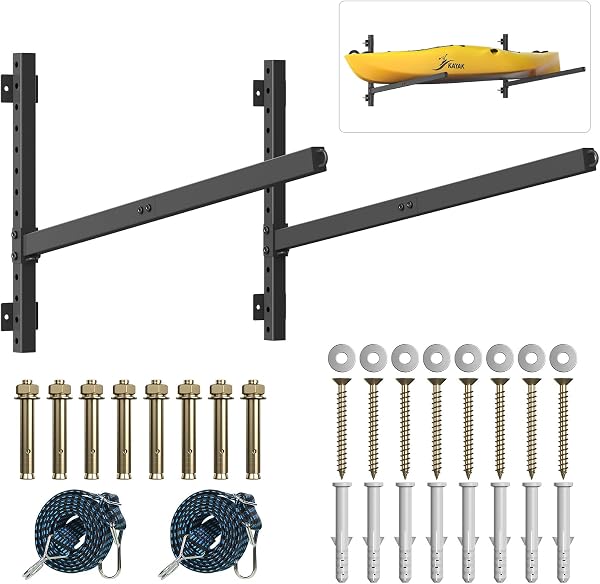
Shoppers searching for maximum wall-mounted load strength on a modest budget will find exceptional value in this Heavy-Duty Wall Hanger. Forged from industrial-grade iron rather than lightweight tubular aluminum, each tier supports 100 pounds and the multi-level wall rail system is rated for up to 500 pounds in total capacity. Priced well below freestanding quad stands, it turns unused vertical wall space in your garage, boathouse, warehouse, or outdoor yard fence into a high-capacity storage bay.
We may earn a commission when you buy through this link, at no additional cost to you.
Structural stability comes from two smart geometric choices: an upgraded triangular under-arm support structure and a built-in upward tilt angle on the 28-inch cantilever arms. The diagonal lower strut forms a rigid triangle with the vertical wall rail, transferring heavy downward canoe loads directly against the wall to prevent bending. Meanwhile, the slight upward angle of the padded arms uses gravity to cradle kayaks, canoes, and paddleboards gently toward the wall, preventing hulls from sliding forward while you attach the included elastic safety ropes.
Installation and daily versatility are equally strong. Each storage level can be shifted up or down along the wall track to fit recreational kayaks, sit-on-top fishing rigs, whitewater boats, or canoes. The mounting plates work across wood studs, solid brick, concrete block, and tiled masonry walls. In the off-season or in a busy household workshop, the angled iron arms double as heavy-duty hangers for extension ladders, lumber, bicycles, and folding camp chairs.
When lifting one end of a canoe or kayak onto an upper wall bracket by yourself, level horizontal arms can allow the first end of the boat to slide outward while you walk back to lift the stern. The gentle upward tilt and elastic retention ropes hold the bow safely captive against the wall channel during solo handling.
Because the support arms measure 28 inches in length, canoes with a wide 34-to-36-inch center beam will rest at a secure inward angle leaning toward the wall rather than sitting dead flat. If you have solid wall studs and want a 500-pound-capable multi-tier organizer for the cost of a single pair of premium hooks, this is our top budget recommendation.
Metal-stud drywall interiors or buyers who want a freestanding floor rack that requires zero drilling.
We may earn a commission when you buy through this link, at no additional cost to you.
Canoes present distinct storage and transport challenges compared to smaller recreational kayaks: they are longer, wider across the center beam, deeper at the bow and stern stems, and prone to hull deformation if supported improperly. Reviewing the six technical factors below will help you match the right rack architecture to your watercraft and available space.
Your first major decision is whether to support your watercraft from the floor or hang them on vertical walls. Freestanding racks—such as the 3-Tier Freestanding Rack, the dual-sided 4-Tier Heavy-Duty Rack, and the tall 71-inch Lockable Stand—require zero wall drilling. They rest on wide horizontal base legs that distribute load weight directly onto concrete garage floors, gravel boat yards, wooden piers, or backyard patios. Because they are self-supporting, freestanding frames are ideal for renters, buildings with unfinished or metal-stud walls, and paddlers who want to move their rack from a lakeside dock in summer to an indoor shed in winter.
Wall-mounted systems—including the Suspenz Flat Rack, the 150-Lb Wall Mount Adjustable Rack, and the 500-Lb Heavy-Duty Wall Hanger—bolt directly into structural wall studs, brick, or masonry. By eliminating floor legs, wall racks leave the space beneath the lowest boat open for rolling toolboxes, lawn equipment, or vehicle bumpers. Some advanced designs, like our Editor’s Choice Pro-Grade 3-Tier Rack, include both freestanding floor feet and wall-mounting brackets so you never get locked into a single configuration.
Choose a wall-mounted rack if you have accessible wood studs or masonry walls and want to keep your floor completely unobstructed. Choose a freestanding rack—or a dual-mode convertible system—if you need dockside placement, cannot drill into structural walls, or want seasonal portability.
Never evaluate a storage rack by its total combined weight rating alone; always verify the individual per-tier weight capacity alongside the frame’s metal gauge. While a lightweight kevlar solo canoe may weigh only 42 pounds, a traditional 17-foot rotomolded polyethylene tripping canoe or an outfitted fishing kayak often weighs between 85 and 115 pounds dry—and even more when wet or loaded with clamped seats and yokes. Most standard racks support 100 pounds per tier, whereas heavy-duty options step up to 110 pounds, 125 pounds, or 150 pounds per level.
Structural rigidity under those heavy loads is governed by the thickness (gauge) of the steel tubing and how the vertical uprights are constructed. In metal fabrication, lower gauge numbers denote thicker walls: ultra-thick 11-gauge industrial steel is substantially stiffer and less prone to flexing than standard 16- or 18-gauge tubing. Additionally, one-piece vertical posts and triangular under-arm support gussets resist outward cantilever sag far better than multi-piece segmented poles held together by thin slip-joints.
Weigh your heaviest watercraft—including any permanently attached seats, trolling motor mounts, or anchor trolleys—before shopping. For boats under 90 pounds, a 100-pound per-tier rack is plenty; for heavy tandem canoes and rigged fishing hulls over 95 pounds, prioritize 11-gauge steel frames or racks rated at 110 to 150 pounds per tier.
Many storage racks marketed for kayaks and paddleboards fail when loaded with a full-sized canoe because buyers overlook two key dimensions: arm length (beam width) and vertical tier spacing (hull depth). While a typical recreational kayak is 28 to 30 inches wide and 12 inches deep, a standard tandem canoe measures 33 to 36 inches across its center beam and rises 14 to 22 inches at the upturned bow and stern stems. If rack arms are too short or vertical tiers are bolted too close together, a wide canoe will either overhang precarious inches off the arm tips or jam against the upper tier.
Look closely at how each rack handles both dimensions. For flat horizontal storage of wide canoes, long 33-inch wall arms like the Suspenz Flat Rack allow a 34-to-36-inch beam to rest completely flat on its gunwales without leaning. On multi-tier vertical racks with 28- or 29-inch arms, adjustable vertical tracks—ranging from 25 mounting holes up to 45 D-pin slots—let you widen the vertical gap to 18 inches or more so wide canoes can rest securely on a slight inward angle or sit unobstructed on the top cradle.
Measure both the maximum width and the bow-to-keel height of every boat in your fleet. If you plan to store two canoes on the same vertical stand, insist on an adjustable-height rack with customizable pin or buckle slots rather than a fixed-tier frame.
How a rack touches your watercraft determines how well your hull survives months of stationary storage. When a heavy plastic, Royalex, fiberglass, or wood-canvas canoe rests on bare or thinly covered metal bars, gravity concentrates the entire weight of the boat onto two narrow contact lines. Over time—especially in warm garages exposed to summer heat—this point pressure causes permanent indentations, flat spots, or wavy bottom distortion known as oil-canning.
Quality canoe racks prevent hull damage using two primary cushioning methods. The gold standard for sensitive composite and rotomolded hulls is a suspension strap cradle, which slings heavy-duty nylon webbing between steel arms (seen on the Suspenz Flat Rack and the portable Rad Sportz folding stands) so the boat floats in a contour-hugging hammock free of hard pressure points. The second proven method uses wide steel arms wrapped in dense, weatherproof felt padding or non-slip rubber bumpers, which prevents gelcoat scratches and allows you to slide canoes smoothly onto the rack.
Prioritize nylon suspension strap racks if you are storing high-end composite canoes, thermoformed kayaks, or thin-skinned hulls susceptible to denting. Choose weatherproof felt-padded steel arms when storing multi-boat fleets upside down by their strong structural gunwales.
Because canoes are frequently between 14 and 18 feet long, many owners store them outside along a garage exterior wall, underneath a deck, or right on a lakeside boat dock. Outdoor racks face constant exposure to rain, morning condensation, snow loads, UV sunlight, and, in coastal areas, corrosive salt air. Unprotected steel tubing or racks with open pipe ends quickly collect rainwater internally, leading to rust streaks that stain boat hulls and weaken structural welds.
When selecting a rack for outdoor or dock duty, inspect the corrosion barriers and security attachments. Marine-grade powder coatings, fully welded waterproof end caps, laser-welded joints, and stainless or rust-proof mounting bolts drastically extend outdoor service life. Furthermore, outdoor setups benefit from integrated metal lock rings or tie-down anchor points on each arm—such as those on the Freestanding 400 lb Rack and the Compact Multi-Level Stand—which let you lash boats down against high winds and lock hulls with steel security cables.
For indoor dry garages, standard powder-coated steel or iron frames will last indefinitely. For open docks, carports, and backyard storage, select a rack featuring marine-grade powder coating, sealed pipe caps, and built-in strap or cable-lock anchor rings.
A complete canoe management setup often involves more than just a stationary wall or floor rack. Consider how you maintain your boat at the shoreline and how you haul it from your driveway to the water. Stationary multi-tier racks excel at long-term storage, but they are too heavy to take to the lake and keep upper boats too high for comfortable hull repairs or interior scrubbing.
Specialized portable and transport racks fill these practical gaps. Folding trestle stands like the Rad Sportz set collapse into a mesh carry bag and set up anywhere at a 17-inch height, giving you an instant wash rack or campsite cradle that keeps hulls off abrasive gravel. Meanwhile, if you haul long canoes in a pickup truck, a 2-inch hitch bed extender like the MaxxHaul 70231 supports the overhanging stern at bed level or cab-roof height and folds into a portable camp worktable.
If your primary pain point is getting a long canoe to the lake safely in a pickup truck, start with an adjustable hitch bed extender. If you need a mobile cleaning and rigging bench, grab a folding trestle pair; for permanent home organization, invest in a multi-tier wall or freestanding rack.
Proper setup and weight distribution are essential for safe canoe storage. When installing a wall-mounted rack, use an electronic stud finder to locate the center of solid wood studs and space the two vertical wall rails so they support the canoe roughly one-third of the way in from the bow and stern—typically five to six feet apart for a 16-foot canoe. Never mount heavy canoe brackets into hollow drywall anchors alone. For freestanding racks, assemble the frame loosely on a flat floor first, square the uprights, tighten all structural bolts evenly, and adjust any threaded leveling feet until the base sits completely wobble-free.
Load your watercraft with both hull longevity and center-of-gravity physics in mind. Whenever possible, store canoes upside down resting on their reinforced gunwales rather than flat on their bottom hull plates, unless you are using a contour-conforming suspension strap system. On multi-tier racks, always place your heaviest canoe or tandem kayak on the bottom tier closest to the floor to prevent top-heavy tipping, and assign lighter solo kayaks or paddleboards to the upper levels. Always fasten overhead safety straps, bungee cords, or cam straps across outdoor racks so gusty storms cannot lift or shift your boats.
Routine seasonal maintenance keeps both your rack and your watercraft in peak condition. Twice a year—at spring launch and autumn winterization—check all wall lag bolts, clevis pins, butterfly screws, and frame fasteners to ensure vibration or thermal expansion has not loosened any connections. Brush sand, pine needles, and dried mud off felt arm pads and nylon suspension straps so gritty debris does not scratch your hull finish during loading. If your steel rack is mounted near brackish or saltwater environments, rinse the frame periodically with fresh hose water and touch up any deep paint scratches with rust-inhibiting enamel.
Storing a canoe upside down on its gunwales is the safest method when using flat padded metal arms, because the gunwales and thwarts form the stiffest structural spine of the boat. Storing a canoe upside down also prevents rainwater, snow, leaves, and pests from accumulating inside the hull when kept outdoors. If you prefer to store your canoe right-side up, choose a suspension strap rack that cradles the curved bilge evenly without creating hard pressure points.
For optimal weight distribution, rack support arms should be positioned approximately 35 to 40 percent of the canoe's total length apart, centered under the main hull body. For a standard 15- to 17-foot canoe, spacing the support arms roughly 5 to 6.5 feet apart supports the strongest section of the hull while preventing sagging at the middle or excessive leverage at the overhanging ends. Avoid placing support bars directly beneath the extreme tips of the bow and stern.
Yes, provided you check the arm length, weight rating, and vertical tier clearance before buying. Many canoes measure 33 to 36 inches wide at the center beam and have high upturned ends, whereas kayaks are narrower and flatter. Look for wall racks with 28- to 33-inch arms, adjustable vertical tier tracks, or freestanding stands where you can place the deep canoe on the unrestricted top tier.
Oil-canning occurs when the bottom of a plastic, Royalex, or composite hull develops a flat indentation or flexible inward pop from resting on narrow, rigid bars for extended periods, especially in hot weather. You can prevent oil-canning by storing canoes upside down on their gunwales over wide felt-padded arms or by using a nylon suspension strap rack that conforms to the hull shape and eliminates point loads.
On level indoor garage floors or sheltered patios, freestanding racks remain stable under their own wide base footprint as long as the heaviest boats are loaded on the bottom tier. However, if you place a freestanding rack on an exposed lakeside dock or windy pier, anchoring the base legs to the dock decking or tying the frame and boats down with heavy-duty straps via the integrated anchor points is strongly recommended.
Most recreational and tripping canoes weigh between 55 and 95 pounds when empty, making a standard 100-pound per-tier rating sufficient for dry storage. If you own a heavy three-seat poly canoe, a waterlogged wooden hull, or a motorized square-stern canoe that exceeds 95 pounds, upgrade to a rack rated for 110, 125, or 150 pounds per level to maintain a safe structural margin.
A hitch-mounted bed extender slides into a standard 2-inch square trailer hitch receiver and extends a wide T-bar support behind your pickup truck's tailgate. You can pin the T-bar low to support the overhanging rear half of a canoe sliding out of the truck bed, or flip the upright post tall so the crossbar aligns with a cab roof rack for overhead hauling.
Choose a freestanding or wall-mounted rack built with closed metal lock rings or welded tie-down loops on the support arms. Thread a vinyl-coated braided steel security cable through the rack's metal ring and pass it around a structural canoe thwart, yoke, or cast-in carry handle—never just a removable seat strap—and secure it with a weatherproof padlock.
Quality powder-coated steel racks with sealed end caps and rust-proof hardware withstand freshwater rain, snow, and backyard humidity for years. However, near saltwater coastlines, salt air will eventually corrode standard steel wherever the coating is scratched, so coastal paddlers should choose marine-grade powder-coated racks and rinse them periodically with fresh water.
Selecting a well-engineered canoe rack protects your hull from costly distortion while reclaiming valuable floor space in your garage, shed, or boathouse. For most paddlers, the Pro-Grade 3-Tier Dock/Garage Rack is our top overall recommendation and Editor's Choice. Its one-piece 11-gauge industrial steel uprights, marine-grade powder coating, 45-slot D-pin height adjustability, and dual-mode freestanding or wall-mount hardware make it adaptable to virtually any fleet or storage layout.
Depending on your specific boats and budget, several specialized alternatives stand out. Paddlers protecting a single composite or rotomolded boat on a wall should choose our Premium Pick, the Suspenz Flat Rack, for its 33-inch arm length and pressure-free suspension strap cradle. If you want high-capacity multi-tier wall storage at the lowest cost, the 500-pound Heavy-Duty Wall Hanger is an unbeatable budget workhorse, while pickup owners and shoreline paddlers will get tremendous everyday mileage from the MaxxHaul Hitch Bed Extender and Rad Sportz Foldable Stands.
Before placing your order, take five minutes to measure the beam width, gunwale depth, and dry weight of your largest canoe, and check your wall stud spacing or garage ceiling clearance. Matching those exact numbers to the right tier rating and arm style guarantees safe, effortless watercraft storage season after season.