KingPavonini BM03-1
9.2Editor score380-pound weight capacity
ASTM-tested safety frame
17.6-20.9 inch height
3-12 inch mattresses
Compare 10 top bed rails for seniors by ASTM certification, weight capacity, adjustability, and night safety features. Practical buying guidance inside.
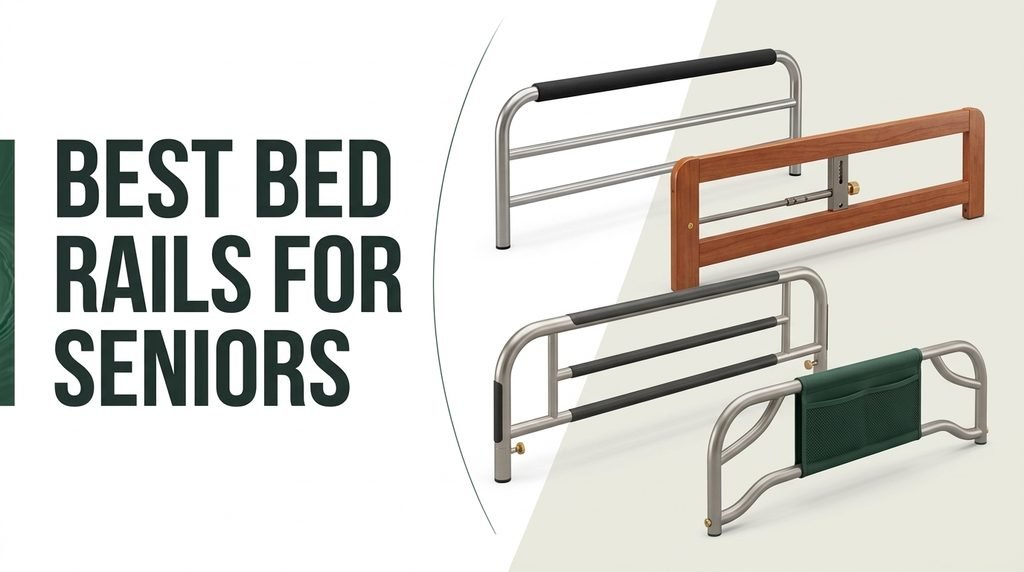
Choosing the right bed rail for an aging parent or a recovering family member comes down to more than weight capacity. We compare 10 safety rails by ASTM certification, stability, fit range, handle grip, adjustability, and features like motion lights that reduce nighttime fall risk.
These ten models range from simple under-mattress assist handles to premium foldable rails with motion-sensing lights. The biggest differences lie in ASTM safety certification, weight capacity, mattress thickness compatibility, handle design, and whether the rail can be lowered out of the way during the day.
For most families, the key question is whether the user mainly needs help standing up or protection against rolling out of bed. Assist rails emphasize a sturdy grab handle, while longer guard rails emphasize a horizontal barrier. Match the rail type, capacity, and bed compatibility to the user’s actual routine before ordering.
We compared 10 bed rails for seniors using the details that actually influence a buying decision: ASTM safety certification, weight capacity, height and horizontal adjustability, mattress thickness compatibility, handle comfort, base stability, installation effort, and extras like motion lights and storage pouches. The notes focus on practical trade-offs so each pick connects to how older adults and caregivers actually use a safety rail during nightly routines and recovery.


Compare key features, scores, and current prices side by side. A shorter feature list means fewer details were available, not necessarily fewer capabilities.


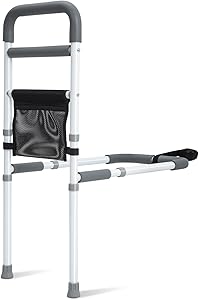


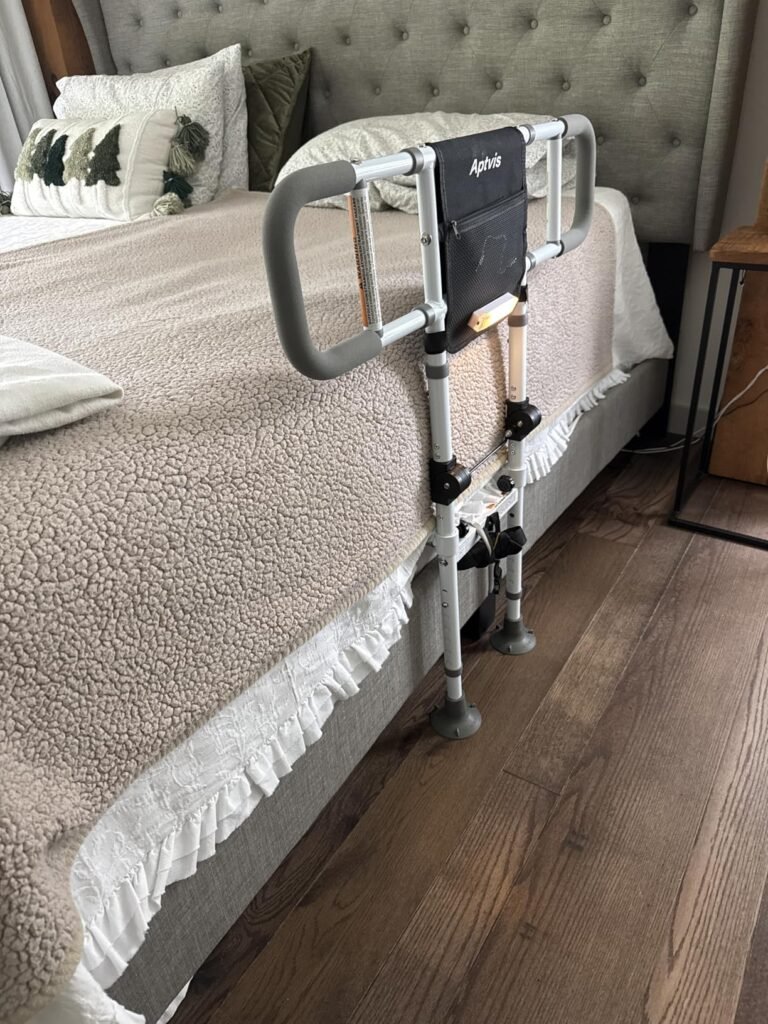
This rail holds the top user rating in this comparison at 4.8 stars, and its customization is likely why. Fourteen height settings from 13.8 to 20 inches combine with four frame length options from 26.4 to 30.7 inches, producing a fit that can be dialed in for nearly any user height, mattress height, and bed width combination.
We may earn a commission when you buy through this link, at no additional cost to you.
ASTM-compliant construction supports up to 350 pounds, and anti-slip foot pads on the base improve grip on hard flooring. The padded handle is designed to reduce hand and wrist strain during transfers, which matters for users with arthritis or limited grip strength. Together, the wide adjustment range and stable base cover the two things buyers complain about most with cheaper rails: poor fit and wobble.
A motion-activated night light improves visibility in low light and helps reduce nighttime fall risk, while a storage pouch keeps a phone, glasses, or remote within reach. The tool-free installation takes just minutes and does not require special tools or an extra set of hands, which keeps setup manageable for a solo caregiver.
Most rails offer either height adjustment or length adjustment, but not both. Having fourteen height positions and four frame lengths means the handle can be set at the exact elevation the user reaches most naturally, while the base spans enough of the mattress to resist side-to-side rocking. For shared beds, this range also lets the rail fit comfortably on either side without crowding a partner. If two different users occasionally use the same bed, the wide adjustment range makes readjusting between them quick.
Compatibility excludes adjustable, electric, reclining, and hospital-style beds, Sleep Number beds, and platform beds with recessed edges, so verify the frame type first. For standard flat-frame beds, this is the most adjustable and best-reviewed rail in the guide, and the motion light adds practical value for the price.
Not compatible with adjustable, electric, reclining, or hospital-style beds, Sleep Number beds, or platform beds with recessed edges.
We may earn a commission when you buy through this link, at no additional cost to you.
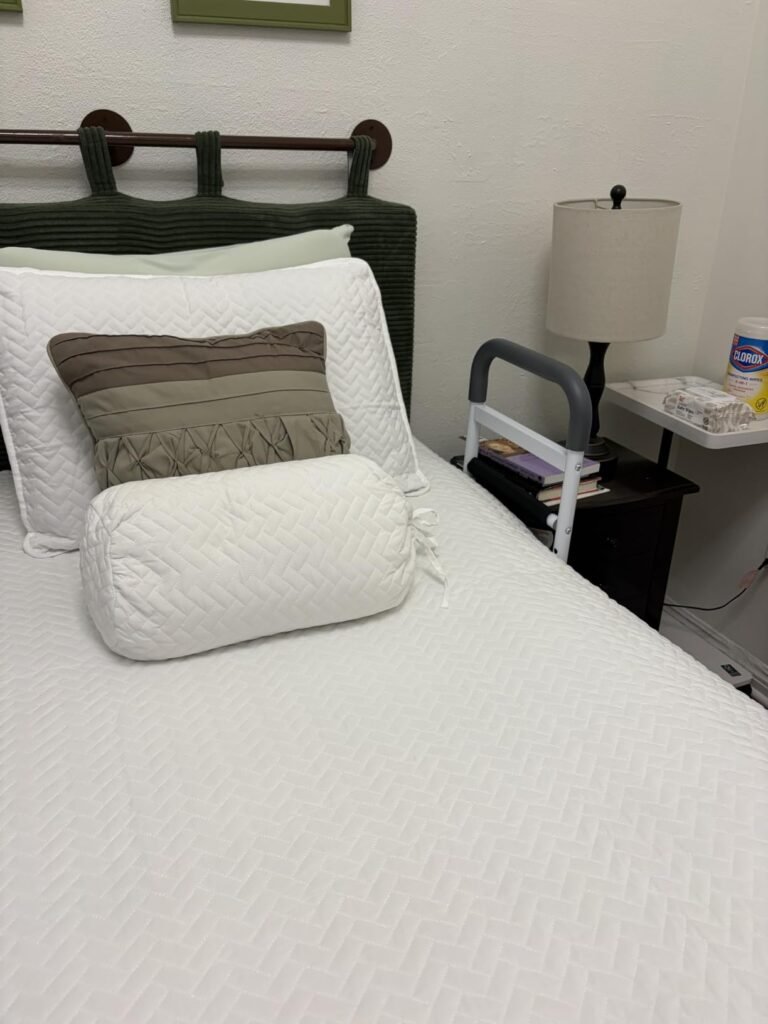
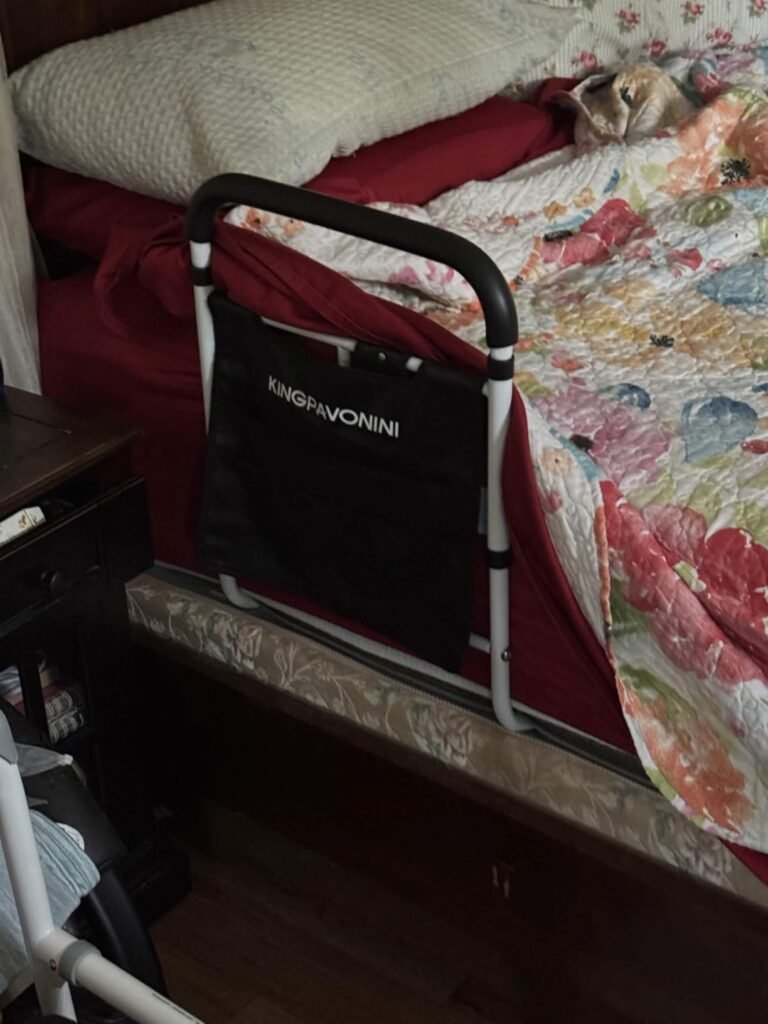
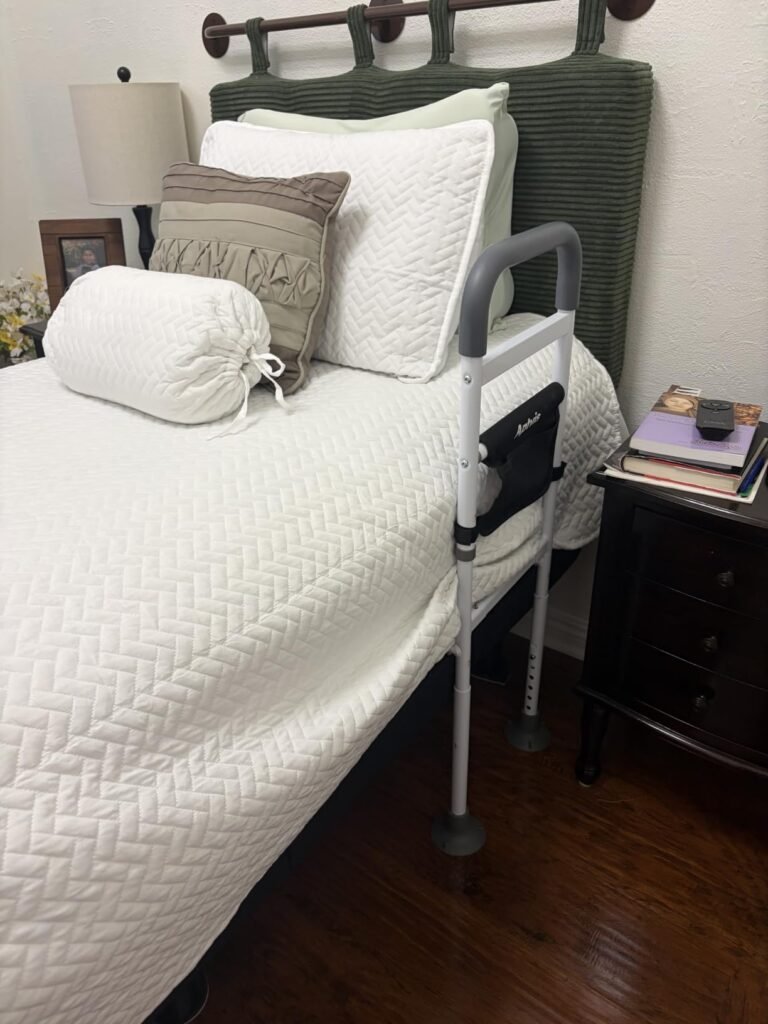
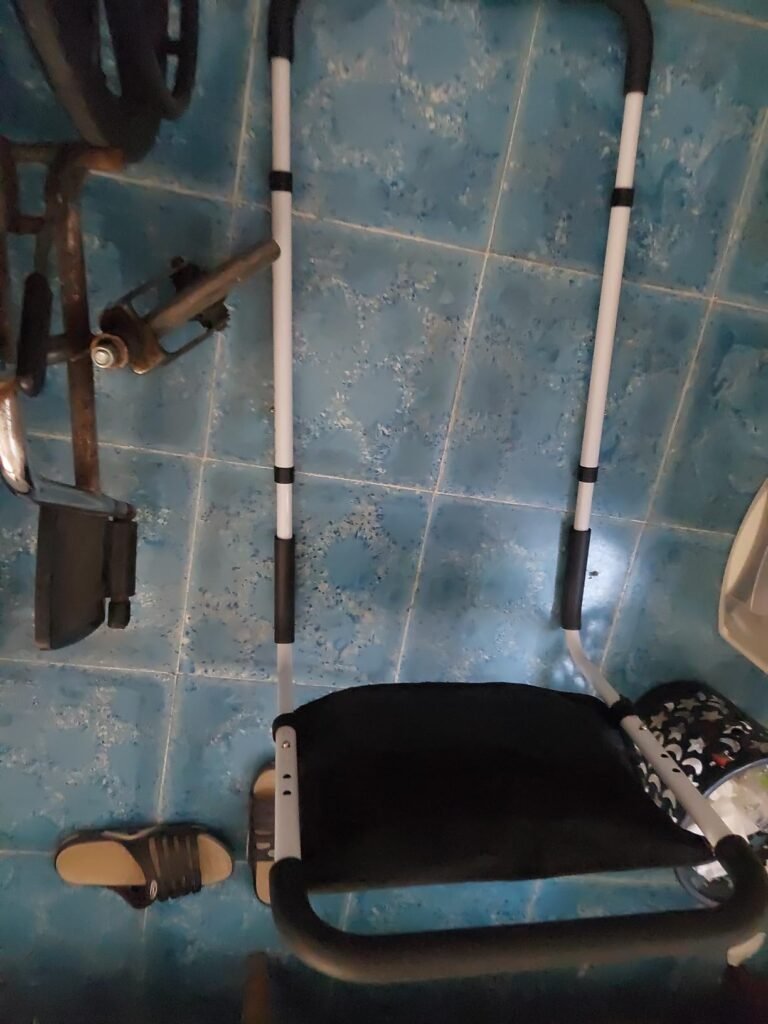
The KingPavonini BM03-1 targets families who need dependable bedside support without spending a lot. It carries the highest weight rating in this guide at 380 pounds, and it is tested to ASTM safety standards, so heavier users can lean on it confidently during sit-to-stand transitions. For the price, that combination of capacity and certification is hard to beat.
We may earn a commission when you buy through this link, at no additional cost to you.
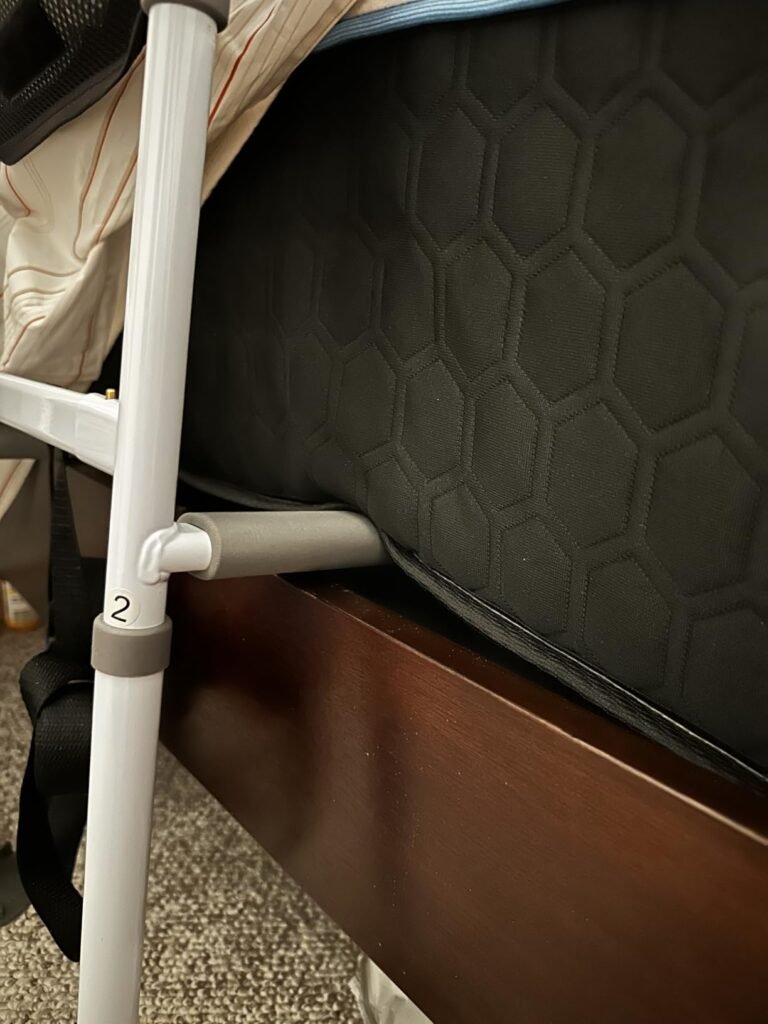
Fit flexibility is a strong point. The rail adjusts vertically from 17.6 to 20.9 inches and extends horizontally from 28.6 to 34.7 inches, letting you tune both the handle height and the protective span along the mattress edge. It works with twin, twin XL, full, queen, and king frames as long as the mattress is between 3 and 12 inches thick.
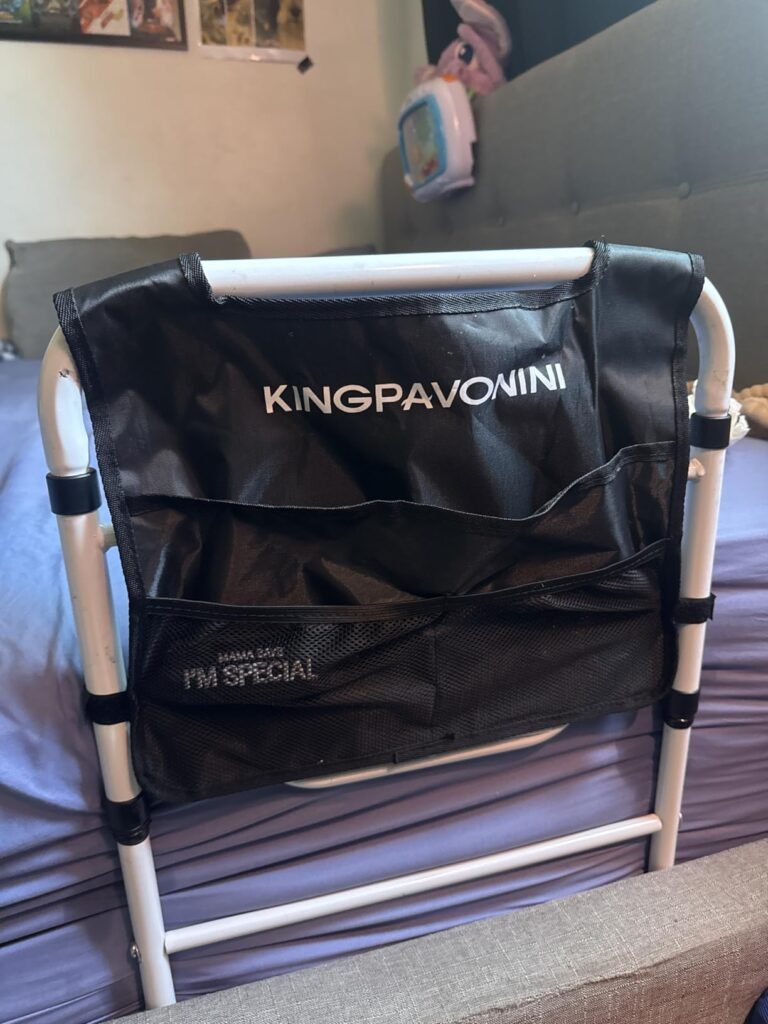
The curved upper handle is padded and designed to resist slipping, which matters when hands are weak or damp. Setup is tool-free, and the included storage pouch keeps glasses, remotes, or medication within reach. Because it is lightweight and portable, the rail can move between bedrooms or travel with the user without complicated disassembly.
A bed rail does two jobs: it gives the user something to grip during transfers, and it acts as a barrier against rolling out of bed. The horizontal extension range controls how much of the mattress edge the rail covers. At the shorter end, the BM03-1 works as a focused assist handle; extended toward 34.7 inches, it provides a longer protective span for restless sleepers. Matching that span to the user’s sleeping habits and the width of their bed helps the rail do both jobs well.
One limitation to keep in mind: this rail is not designed for adjustable beds, so households with electric or hospital-style frames should look elsewhere. Otherwise, the BM03-1 delivers strong support, wide compatibility, and the highest capacity rating here at a very accessible price, making it a smart first choice for most standard beds.
Not suitable for adjustable, electric, or hospital-style beds that require specialized rails.
We may earn a commission when you buy through this link, at no additional cost to you.
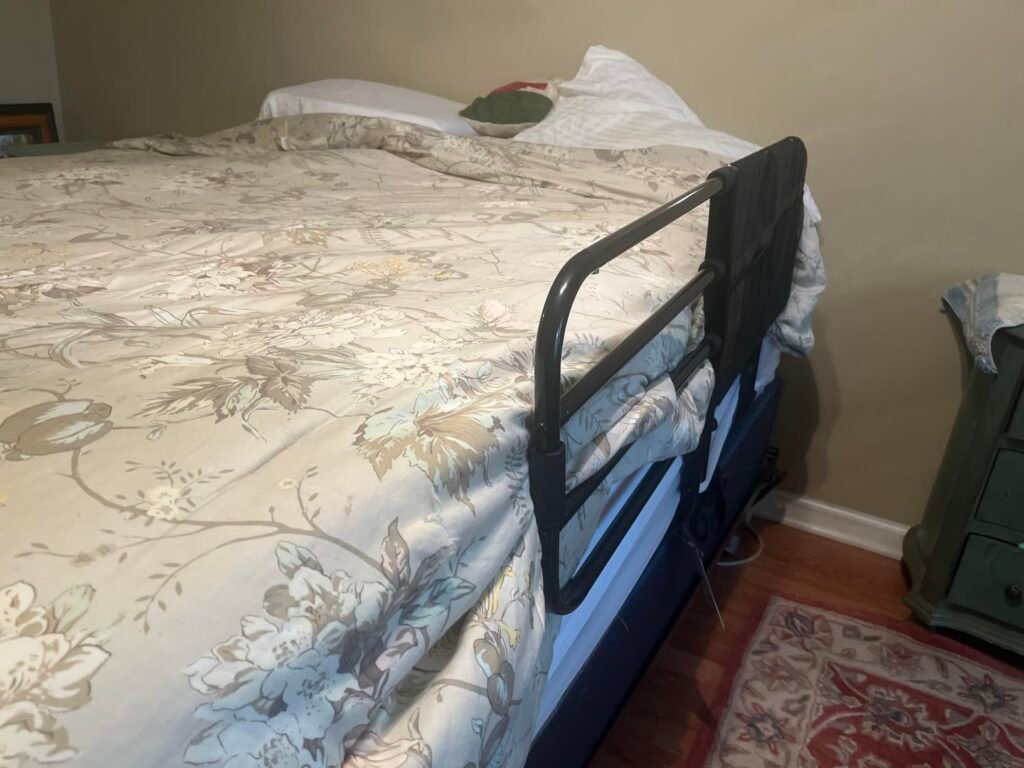
The Stander EZ Adjust is the pick for families who want the reassurance of a dedicated mobility brand and rigorous third-party testing. It is one of the few adult bed rails to pass the ASTM F3186-17 safety standard for portable bed rails, which specifically evaluates fall and entrapment risks. That certification earns it the Editor's Choice badge despite a price that sits at the top of the mid-range.
We may earn a commission when you buy through this link, at no additional cost to you.
The rail extends from 20 to 30 inches, and that range gives it a dual role. Fully extended, it acts as a guard rail to help prevent rolling out of bed. When the user sits up, the padded handle works as a stable assist bar rated for up to 300 pounds of support. Being able to adjust the length lets you cover more of the mattress edge than short assist handles can.
Day-to-day convenience is handled well. A large multi-pocket organizer pouch keeps remotes, glasses, medication, and phones within arm’s reach, cutting down on nighttime reaching and searching. Installation uses an included safety strap to attach the rail to platform beds, box springs, and slat beds, and the process is straightforward enough to complete without special tools.
ASTM F3186-17 is a dedicated safety standard for adult portable bed rails. Products that pass are independently tested for structural strength, durability, and specific hazards such as entrapment in the gaps between the rail, mattress, and bed frame. Because entrapment incidents have led to serious injuries with poorly designed rails, certification provides a documented safety baseline. When comparing rails, finding this standard number in the documentation is one of the fastest ways to identify products that went through third-party evaluation rather than self-declared safety claims.
The trade-offs are the price, which reflects the brand and certification, and the 300-pound support rating, which is lower than several less expensive competitors. It also fits mattresses 10 to 14 inches thick, so it suits standard and thicker mattresses but not very thin ones. If certification and a proven track record matter most, this is the rail to choose.
Not intended for adjustable beds or hospital-style beds, and not the best fit for very thin mattresses under 10 inches.
We may earn a commission when you buy through this link, at no additional cost to you.
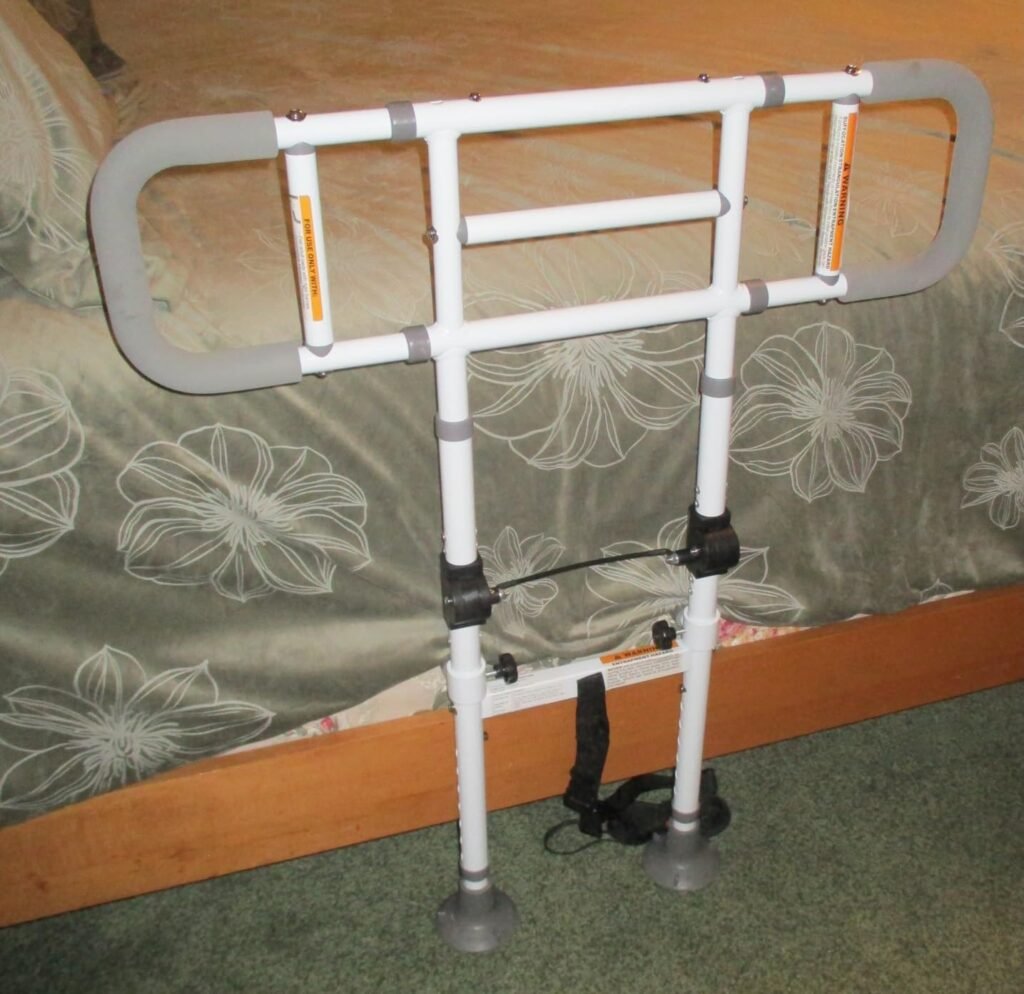
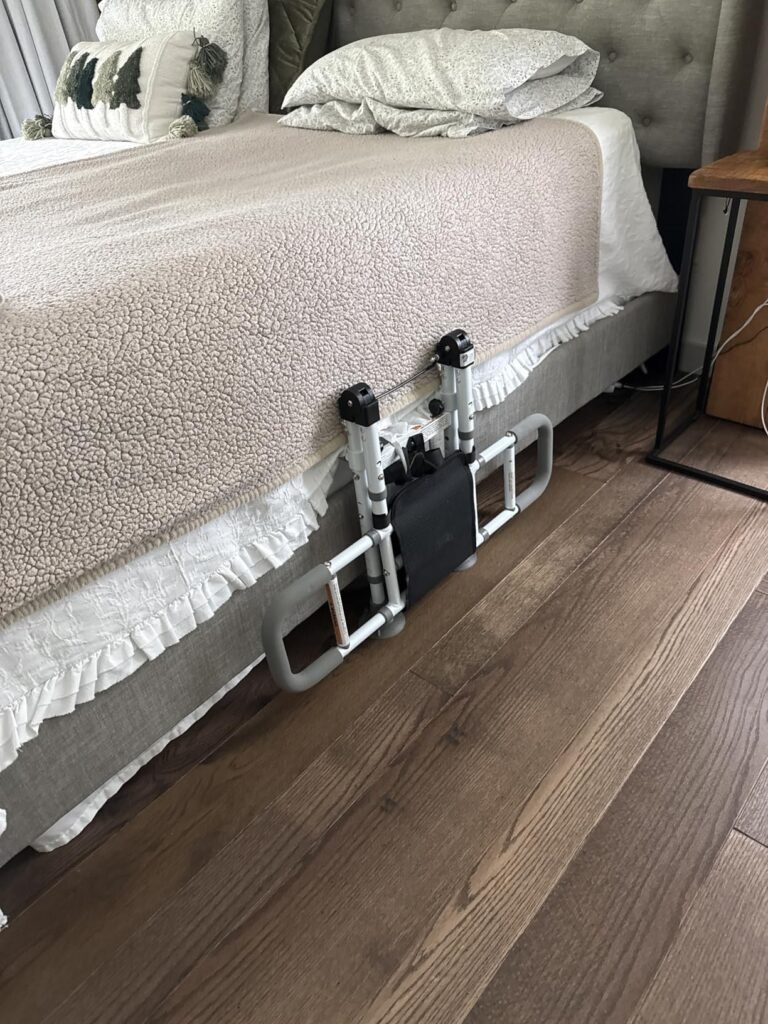
This foldable rail suits users who want protection at night but need the bed to stay accessible and easy to make during the day. The frame folds down when not in use, freeing up bedroom space and simplifying sheet changes. With a 350-pound ASTM-tested capacity, it supports a wide range of users without feeling flimsy.
We may earn a commission when you buy through this link, at no additional cost to you.
Height adjusts across 14 positions from 13.2 to 19.7 inches, and the handrail length ranges from 29.9 to 32.3 inches, giving caregivers flexibility to tune the fit. The dual-handle design and extra-wide base add balance during transfers, while the anti-slip EVA padded base keeps the legs planted on hard flooring instead of sliding out.
A detachable motion sensor night light is included and can be positioned where it is most useful. It turns on automatically in low light, which helps with nighttime bathroom trips without fumbling for switches. A removable mesh pouch keeps small essentials close, and the fold-down mechanism is simple enough for daily use by the user or a caregiver.
Foldable rails often carry longer exclusion lists than basic assist handles because their frames rely on specific anchor geometry. Before ordering, confirm that your bed is not adjustable, electric, or reclining, and that a platform base does not have a recessed or sunken edge where the mattress sits inside a lip. Sleep Number beds are also excluded here. Taking two minutes to identify your frame type prevents the frustration of a rail that cannot be installed securely.
Compatibility is the main caveat. The rail is not compatible with adjustable, electric, reclining, or hospital-style beds, Sleep Number beds, or platform beds with recessed edges, so check the frame type carefully before ordering. If your bed qualifies, this is one of the most flexible and feature-complete rails in the group.
Not compatible with adjustable, electric, reclining, or hospital-style beds, Sleep Number beds, or platform beds with recessed edges.
We may earn a commission when you buy through this link, at no additional cost to you.
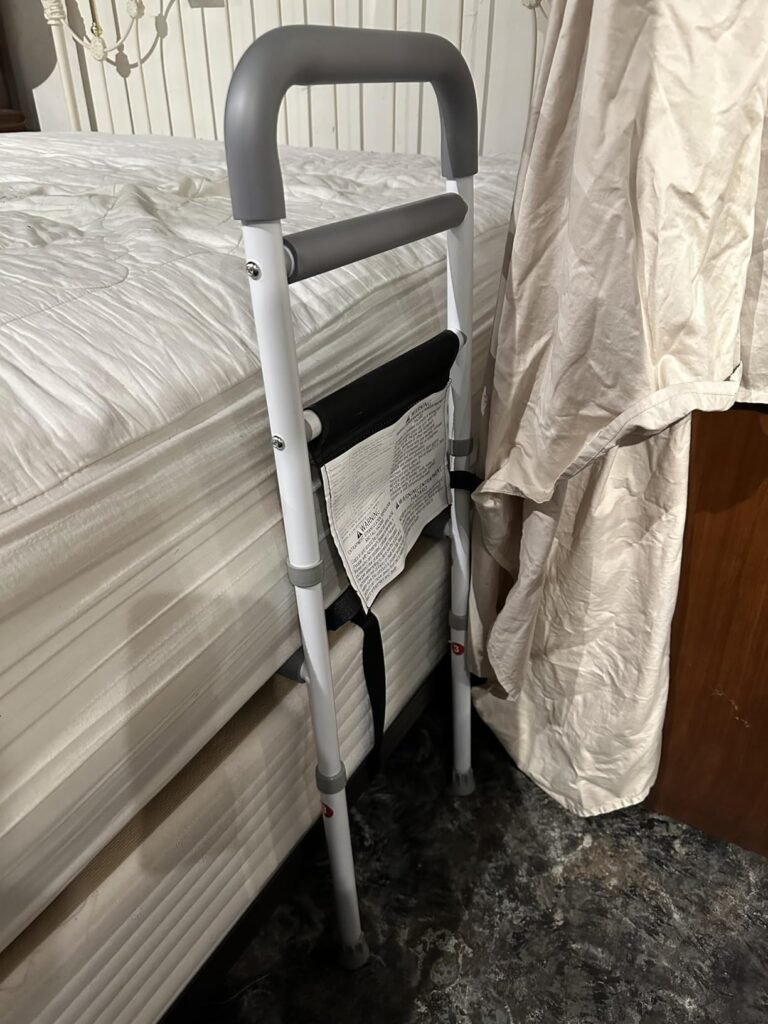
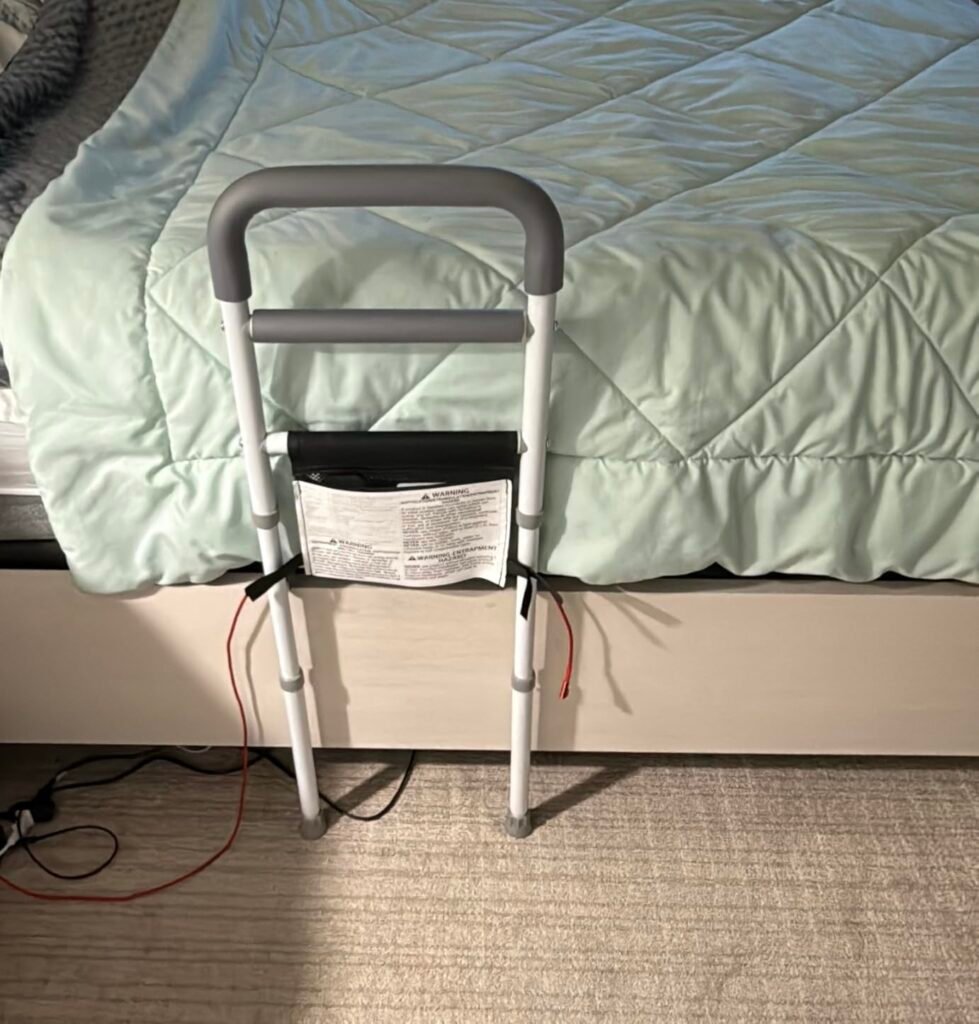
This rail is built around simplicity. Instead of a height-adjustable frame, it uses bedside support legs and a tool-free setup that takes just minutes. It is ASTM F3186-17 tested and rated for 350 pounds, and the compact design slides under the mattress, which suits smaller bedrooms, assisted living rooms, and hospital settings alike.
We may earn a commission when you buy through this link, at no additional cost to you.
The stabilizing leg is the defining feature. It plants the rail against the floor rather than relying entirely on the mattress for support, which adds steady resistance when the user pushes down to stand. The ergonomic non-slip foam grip on the bed cane is comfortable for weak or arthritic hands, and an integrated mesh pocket keeps daily items within reach.
Compatibility covers king, queen, full, and twin beds with mattresses 7.9 to 13 inches thick. Because the design is fixed, there are no adjustment steps, which reduces setup confusion for caregivers who may be assembling the rail alone. Upholstered beds and platform bases work, but recessed bed frames and adjustable beds do not.
Adjustability adds flexibility, but it also adds joints, hardware, and setup steps. For caregivers who want a rail installed quickly and left alone, a fixed-height design removes the risk of misadjusted parts working loose over time. Fixed rails also tend to feel slightly more rigid because there are fewer connection points. If the user’s bed height and mattress are already known and stable, there is little practical benefit to paying for adjustability, and simplicity often wins.
The trade-off is the lack of height adjustment. Users who need a taller handle or who switch between beds of different heights may prefer an adjustable model like the KingPavonini or the BigDolphin GS07. For a stable, straightforward rail on a standard bed in a small room, this design delivers dependable support at a low price.
Not compatible with recessed bed frames or adjustable beds, and not suitable for users who need a height-adjustable handle.
We may earn a commission when you buy through this link, at no additional cost to you.
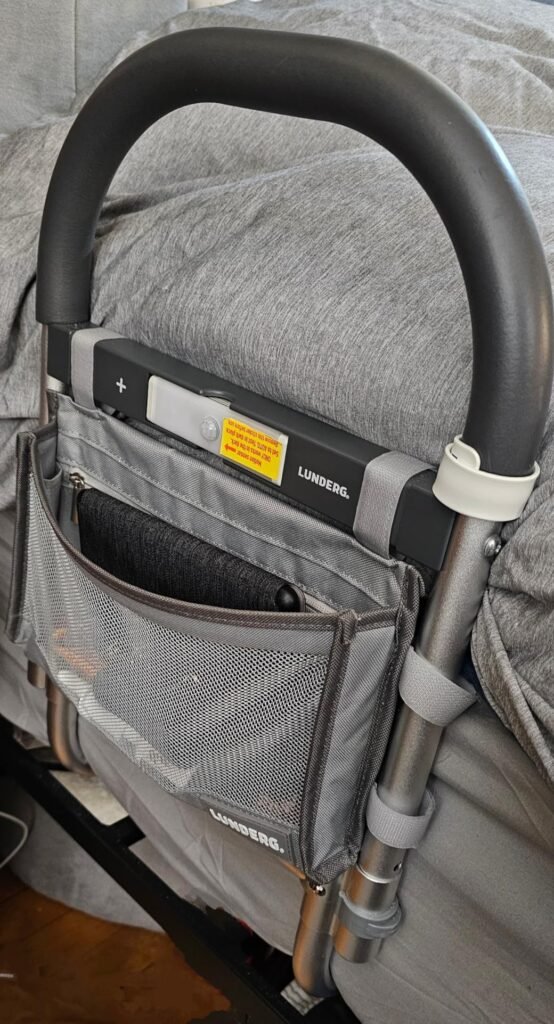
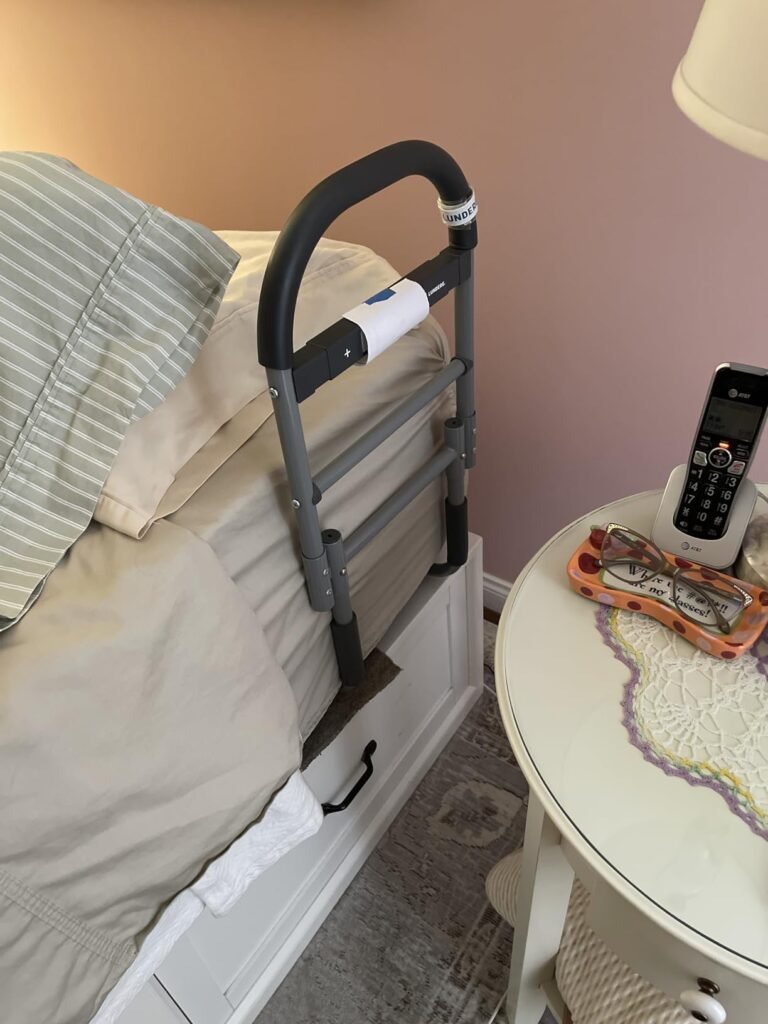
The Lunderg Bed Assist Rail earns its badge with a motion-activated light that illuminates nighttime bathroom trips. It stays on for 60 seconds after each activation, and the rechargeable battery lasts weeks between charges. For users at risk of falls in the dark, this feature directly addresses one of the most common overnight hazards in the home.
We may earn a commission when you buy through this link, at no additional cost to you.
Support comes from heavy-duty steel load-tested to 300 pounds, with four horizontal stabilizing bars that fight the wobble that undermines user confidence. The ergonomic non-slip grip handle helps users sit up and stand without caregiver assistance, which supports independence while lowering fall risk during transfers.
Setup is a standout in this group. The rail arrives partly pre-assembled, and installation uses pushpins and an adjustable strap rather than tools or loose small parts, so most people can complete it in about five minutes. It fits either side of the bed and works with box springs, slats, and platform frames on mattresses 7 to 13 inches thick.
Most falls involving older adults happen at night, often during trips to the bathroom when vision is poor and balance is groggiest. A light that automatically activates on movement removes the need to find a lamp or switch in the dark, which is exactly when fumbling causes stumbles. The Lunderg’s light only activates in low light and shuts off after a minute of inactivity, so it helps without flooding the room with bright light that would disrupt sleep. This is a small feature that quietly addresses a major risk category.
The 300-pound capacity rating is lower than several competitors in this guide, and like most rails here, it is not suitable for adjustable beds. Buyers who need maximum capacity should look at the 380-pound KingPavonini or one of the 350-pound models. For anyone whose main concern is safe nighttime movement, the Lunderg’s light and stability make it the most thoughtful choice.
Not suitable for adjustable beds, and not ideal for users above 300 pounds who need a higher tested capacity.
We may earn a commission when you buy through this link, at no additional cost to you.
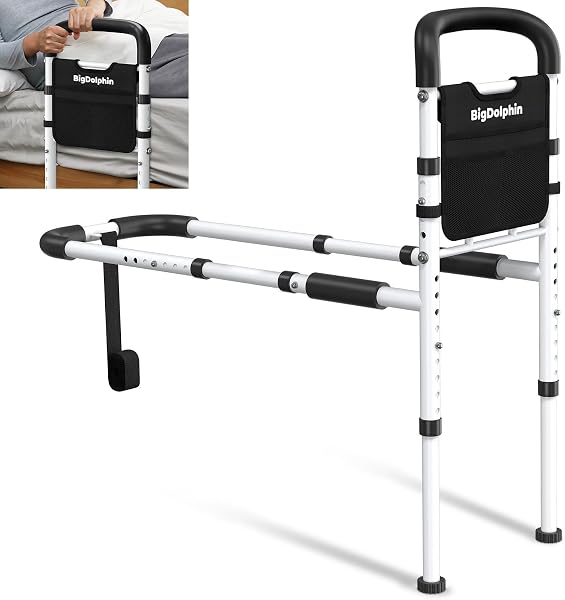
The BigDolphin GS07 solves a problem that frustrates many households: wobble caused by slightly uneven flooring. Its spinnable leg bottom can be adjusted to eliminate small gaps between the frame and the floor, so the rail stays planted instead of rocking when weight shifts onto the handle. For older homes, carpet transitions, and tiled floors that are not perfectly level, this is a quietly important feature.
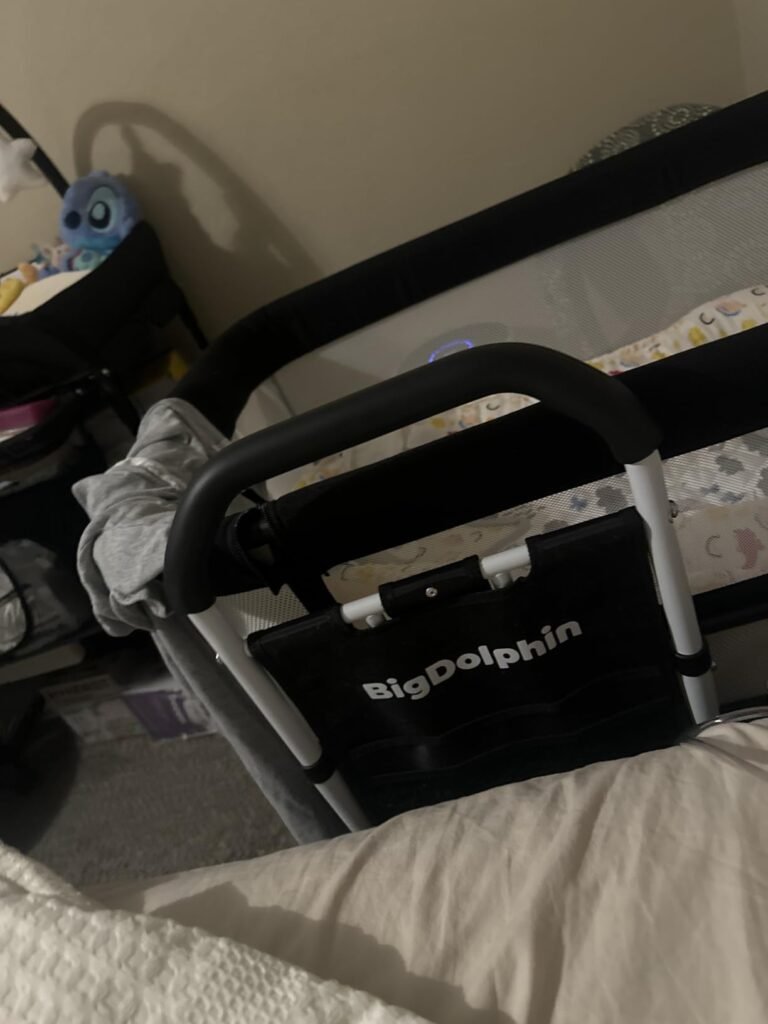
We may earn a commission when you buy through this link, at no additional cost to you.
The 30-degree ergonomic curved handle is designed to align with natural wrist movement, reducing strain during sit-ups and exits. The cushioned foam grip is waterproof and non-slip, which helps users with wet hands after washing up or showering. ASTM-tested construction supports up to 350 pounds, putting it near the top of this group for capacity.
Height adjusts from 16.5 to 19.7 inches and the frame extends horizontally from 30.3 to 35.8 inches, covering twin through king beds. Setup requires no tools, and the included storage pouch keeps essentials organized. The portable design lets the rail move between rooms or accompany the user on trips without major reassembly.
A rail only feels trustworthy if it stays perfectly still when the user leans on it. Even a small gap under one leg lets the frame rock slightly with each transfer, and that subtle movement erodes confidence and can shift weight in unpredictable ways. Leveling feet close those gaps so all contact points share the load. If you have ever tightened a wobbly table leg with a coin or a shim, the same principle applies here, just with more at stake.
The main limitation is the same one shared by most rails in this group: it is not compatible with adjustable beds. If your floor is level and your bed is standard, other models offer similar support for less money. If wobble has been a problem with previous rails, the leveling foot on the GS07 is worth the modest price premium.
Not compatible with adjustable beds, and unnecessary for households whose floors are already perfectly level.
We may earn a commission when you buy through this link, at no additional cost to you.
The BigDolphin BS05 is the lowest-priced rail in this guide, yet it still carries ASTM testing and a 350-pound capacity rating. That combination makes it a strong pick for households that need reliable bedside support on a tight budget, or for adding a second rail on the opposite side of the bed without doubling the spend.
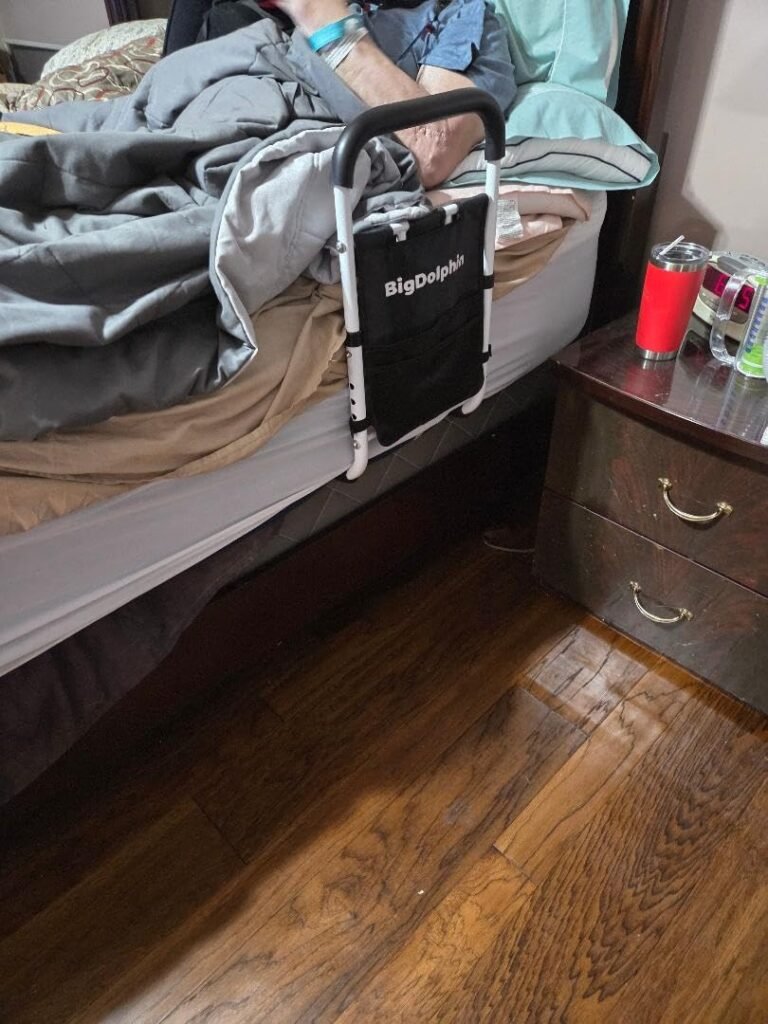
We may earn a commission when you buy through this link, at no additional cost to you.
An expanded chassis increases the contact area under the mattress, and multi-layer non-slip foam minimizes movement between the mattress and foundation. A safety strap anchors the frame to the opposite side of the bed, adding stability when the user leans hard on the handle during transfers. These structural details matter more than cosmetic ones at this price level.
The rail adjusts in height from 16.9 to 21.3 inches and extends horizontally from 23.6 to 31.5 inches, covering twin through king beds. It fits mattresses from 2 to 10 inches thick, which is a wider low-end range than most competitors and makes it one of the few options that works on very thin mattresses. Installation is tool-free, and a storage pouch is included.
The safety strap that runs to the far side of the bed is what keeps an under-mattress rail from sliding toward the user during transfers. When installing, pull the strap snug against the far edge and recheck it after the first few days of use, since straps can stretch slightly under load. Re-tightening takes seconds and should become part of a monthly stability check. A properly tensioned strap is often the difference between a rail that feels solid and one that creeps out of position.
The trade-offs are minor at this price. There is no night light, and the mattress range caps at 10 inches, so thick pillow-top beds are out. Users who want extra features should consider the higher-tier models, but for straightforward support at the lowest cost in this comparison, the BS05 delivers.
Not suitable for mattresses thicker than 10 inches, and not the best pick for users who want built-in lighting.
We may earn a commission when you buy through this link, at no additional cost to you.
This rail's extra-high design sets it apart from everything else in the guide. Stepless height adjustment from 31.9 to 35.8 inches, plus seven locking positions, raises the handle well above typical rails, which benefits taller users, people who cannot bend easily, and thick mattresses where a low handle would be awkward to reach.
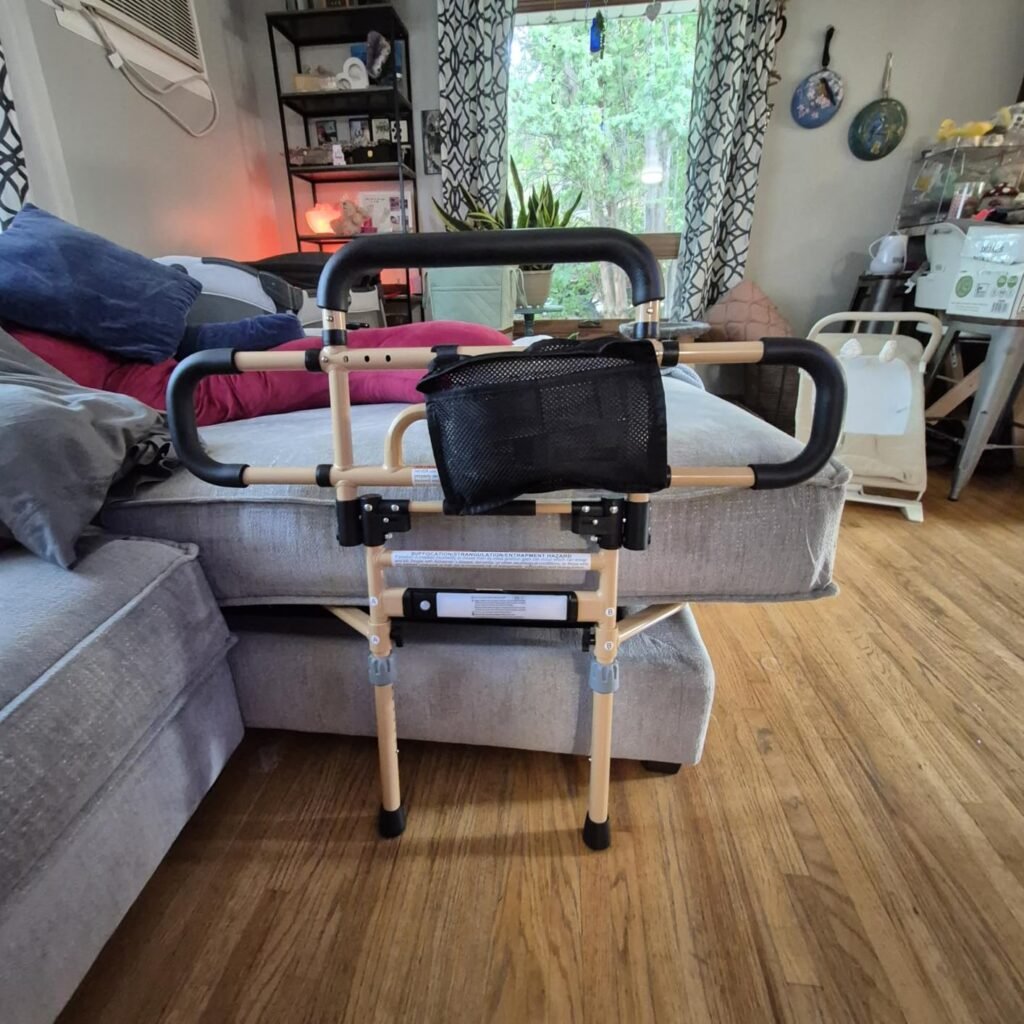
We may earn a commission when you buy through this link, at no additional cost to you.
The patented locking mechanism allows one-hand 180-degree folding, so users with weak grip can lower the rail independently rather than waiting for a caregiver. Width expands bi-directionally from 26 to 31.9 inches for broader roll-off protection. ASTM F3186-17 certification and a 350-pound load rating round out the safety credentials.
A smart LED light offers three modes, including a night-sensing mode with a 10-foot detection range that turns on for 25 seconds when movement is detected in low light. The foam-wrapped handrail feels warm and soft with an anti-slip grip, which is a comfort detail that matters during winter months. Long 13-foot straps secure the frame across large beds, and a mesh pouch keeps glasses, phone, and medication nearby.
Standard rails top out around 20 inches, which works for many users but forces taller people and those with limited bending ability into an awkward reach. A rail that adjusts up to nearly 36 inches meets users at standing height, letting them push up with straighter posture instead of folding at the waist. This design also suits thick pillow-top mattresses, where the combined mattress and bed height pushes the natural grab point higher than usual.
The trade-offs are the higher price, the lowest star rating in this group at 4.2, and a tall profile that may not suit every bedroom layout. It fits 7 to 13-inch mattresses and standard bed types, but not adjustable beds. If reaching height is the priority, no other rail in this guide offers this much elevation.
Not compatible with adjustable beds, and not ideal for users who prefer a low-profile rail that stays out of sight.
We may earn a commission when you buy through this link, at no additional cost to you.
This Medical King assist rail takes the simplest possible approach: it slides under the mattress, secures with a strap, and works with essentially any bed. It fits king, queen, and twin sizes, accommodates any mattress thickness, and can be installed on either side of the bed, which makes it the most flexible rail in this guide for households with multiple bed types.
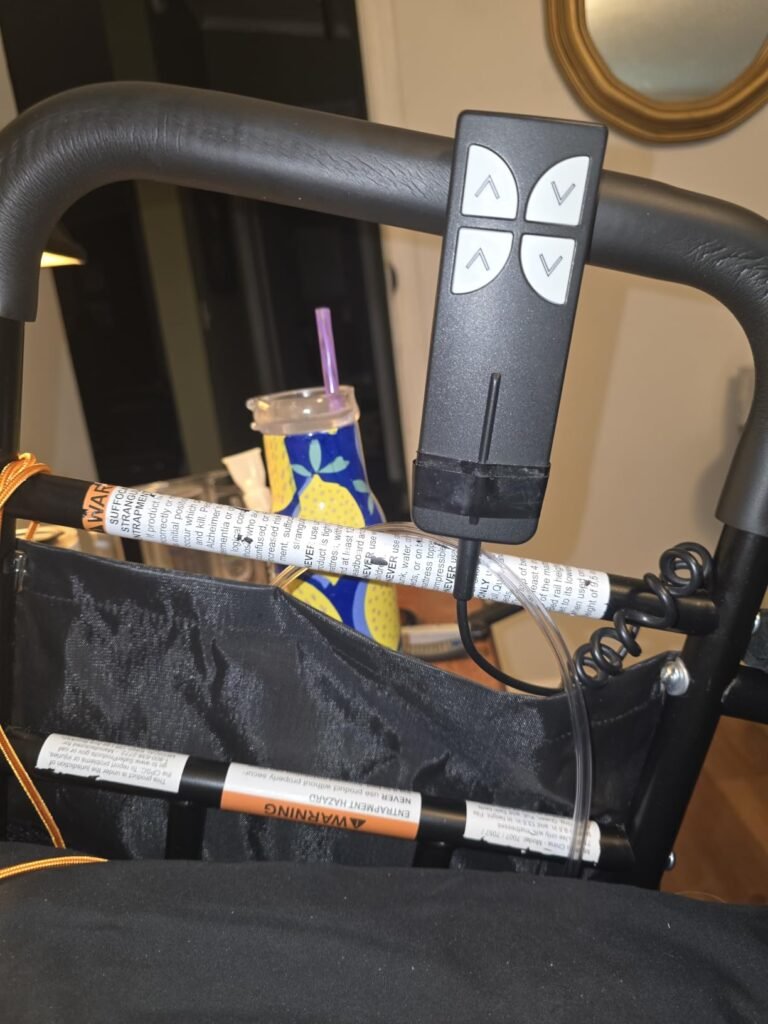
We may earn a commission when you buy through this link, at no additional cost to you.
The hand bar is padded with a non-slip grip for comfortable assistance during transfers, and the modern design blends into bedroom decor rather than looking clinical. Adjustable height settings let users tune the handle position, and setup is fully tool-free. The design meets USA safety requirements as stated for this assist rail.
A removable storage bag keeps glasses, television remotes, books, and other items close at hand, which is a genuine convenience during extended bed rest or recovery. Because the rail anchors under the mattress rather than to the frame, it can move between beds, guest rooms, or travel accommodations without fit concerns.
Which side of the bed a rail goes on should follow the user’s routine, not the layout of the room. Most people step out toward the bathroom or doorway, so placing the rail on that side supports the movements they actually make at night. Because this model installs on either side without extra parts, it can be repositioned if the user’s habits change or if the bed is rearranged. Recheck the strap tension after moving it, since fresh anchor points need time to settle under the mattress.
The trade-offs are the basic feature set and the absence of a published weight capacity, so heavier users may prefer a rail with a tested rating like the 380-pound KingPavonini. There is also no integral floor support leg, so stability depends on the under-mattress anchor and strap tension. For a lightweight, low-cost assist rail on a standard bed, it remains a practical choice.
Not the best option for heavier users who need a published weight capacity, or households that want floor-level stabilizing support.
We may earn a commission when you buy through this link, at no additional cost to you.
Selecting a bed rail for a parent, spouse, or patient involves more than picking the highest weight rating. The right choice depends on bed type, mattress thickness, user mobility, and how the rail will be used each day. The factors below explain what to check before ordering.
ASTM F3186-17 is the consumer safety standard for adult portable bed rails. Products that pass it have been independently tested for structural strength, durability, and specific hazards such as entrapment between the rail and mattress, which has been linked to serious injuries. Not every rail on the market carries this certification, so checking for it is one of the fastest ways to separate rigorously evaluated products from unverified ones.
Certification matters most for users with limited mobility, cognitive impairment, or a history of falls, because these users are the ones most likely to place unusual loads on the rail or become trapped in gaps. The Stander EZ Adjust and several other models in this guide explicitly meet the ASTM F3186-17 standard. Budget rails without a stated certification can still function, but you are relying on the maker’s own claims rather than third-party testing.
If safety certification is listed, verify the standard number matches F3186-17 for adult portable bed rails. If the rail will be used by someone with dementia or severe mobility limitations, also discuss the setup with their care team, since no rail substitutes for appropriate supervision.
Weight capacity tells you how much load the rail is engineered to handle when a user leans, pulls, or pushes during transfers. In this guide, ratings range from 300 to 380 pounds, with most models at 350. These figures cover the support role rather than the user’s full body weight alone, but they remain an important indicator of construction quality and the margin of safety built into the frame.
A higher rating generally means thicker steel, stronger joints, and a more stable base, which benefits lighter users too. A 380-pound rail is not overkill for a 150-pound user if the extra capacity comes from a design that also reduces wobble. However, capacity alone does not guarantee stability, since a rail can be rated highly but fit poorly on your specific bed or floor type.
Choose a rating comfortably above the user’s weight, especially if the rail sees daily use or the user tends to pull hard when standing. If no weight rating is published at all, treat that as a yellow flag and consider a model with a tested figure instead.
Most bed rails anchor between the mattress and the bed base using a bar, plate, or support leg, so mattress thickness determines whether the rail sits securely. The models here cover different ranges: 2 to 10 inches, 3 to 12 inches, 7 to 13 inches, 7.9 to 13 inches, and 10 to 14 inches. A rail designed for a thick mattress may not clamp securely on a thin one, and the reverse is just as true.
Bed frame type matters just as much. Nearly every rail in this guide is incompatible with adjustable, electric, reclining, or hospital-style beds, and several also exclude Sleep Number beds and platform beds with recessed edges. Standard platform beds, box springs, and slat bases are widely supported. Under-mattress straps anchor most of these rails, and long straps handle larger beds more easily, such as the 13-foot straps on the 180-degree foldable model.
Measure the mattress thickness with a tape measure before ordering, and check your frame type against the product’s exclusion list. If your bed is adjustable or uses a recessed platform, verify compatibility directly with the seller, since the majority of rails here will not fit those designs.
Adjustable rails let you change two things: the height of the handle above the floor or mattress surface, and the horizontal length the frame spans along the bed edge. Height ranges in this guide run from about 13 inches at the lowest setting up to nearly 36 inches on the extra-high model. Horizontal spans range from around 23 inches to nearly 36 inches depending on the product.
Getting the handle height right affects how much leverage the user can generate when standing, and a poorly matched height can force strained or unsafe movements. Horizontal extension matters for roll-over protection, since a longer span covers more of the mattress edge, while a shorter assist-style rail focuses on the transfer point. Fixed-height designs like the bedside support leg model trade flexibility for simpler setup and fewer joints to maintain.
Match the adjustment range to the user’s height and the mattress height. Taller users, people who cannot bend easily, and thicker mattresses generally call for rails that adjust higher, while low-profile beds work fine with shorter settings. Decide how much roll-off protection you need before choosing between a short assist rail and a longer guard rail.
The handle is the part of the rail users actually touch hundreds of times, so its shape and texture deserve attention. Most models here use foam or padded grips, and several add non-slip surfaces that stay grippy with damp hands. The BigDolphin GS07 goes further with a 30-degree curved handle designed to reduce wrist strain, while the 180-degree foldable model wraps the handrail in soft foam for warmth and comfort.
For users with arthritis, neuropathy, or weak grip strength, a soft, thick, non-slip handle makes a meaningful difference in confidence. Thin or bare metal handles force users to grip harder, which fatigues the hands and increases the chance of slipping mid-transfer. Dual-handle designs give users more options for where to grab depending on how they sit up.
Prioritize padded, non-slip grips if the user has hand weakness or joint pain. If wrist strain during transfers is a known issue, an ergonomically angled handle is worth seeking out over a straight bar.
Every rail in this guide installs without tools, but the processes differ. Some arrive partly pre-assembled and use pushpins, like the Lunderg, while others slide under the mattress and attach with straps. Bedside support leg designs take a few minutes more to position the leg correctly, and models whose straps anchor to the far side of the bed add stability at the cost of extra reach during setup.
Extra features increasingly shape the purchase decision. Motion-activated lights on the Lunderg, the foldable rail, and the 180-degree model help with nighttime visibility and directly address the fall risks that motivate many purchases. Storage pouches appear on most models here and keep glasses, medication, and remotes off the floor. Fold-down designs let the rail lower out of the way to make the bed or free up space.
If a caregiver does the installation, favor tool-free designs with few steps and clear instructions. If the user gets up at night frequently, prioritize a motion light. If the rail will move between rooms or travel, choose a light, portable model without permanent mounting hardware.
Before the first use, position the rail where the user naturally reaches when getting up, usually near the head of the bed. Slide the anchor bar or plate fully under the mattress, tighten the safety strap across to the opposite side or frame where applicable, and check that the frame sits level. Test the rail with firm pushes and pulls at handle height to confirm it does not slide or rock before the user depends on it.
In daily use, encourage the user to grab the handle before swinging their legs off the bed, using the rail for balance rather than as a substitute for their own strength where possible. Keep the floor beside the bed clear of clutter, and use the motion light features if the model includes them. Bed rails are aids, not restraints. If the user is confused or at high fall risk, ask their care team whether a rail is appropriate before relying on one.
Wipe foam grips and frames with a damp cloth periodically, checking for cracks, loose hardware, or worn foam. Retighten adjustable joints and straps every few weeks, since straps can stretch and joints can loosen under daily loading. If the rail moves between beds, re-verify mattress thickness and frame fit each time. Store the rail indoors, and discontinue use if any welded joint or bracket shows damage.
Bed rails can be a helpful mobility aid, but safety depends on choosing a well-designed product and using it correctly. Entrapment and fall risks exist with any bed rail, which is why third-party standards such as ASTM F3186-17 were created. Certified rails are independently tested to reduce those risks. For users with dementia or significant cognitive impairment, consult a healthcare professional before adding a rail, since a rail can create new hazards for confused users.
Choose a capacity well above the user's body weight so the rail keeps a margin of safety during pulls and leans. The models in this guide range from 300 to 380 pounds, with 350 being the most common. Heavier users should favor the highest rated option, while average-weight users can pick based on fit and features instead. If no capacity is listed, consider a different rail.
Fit depends on two things: mattress thickness and frame type. Mattress ranges across these models run from as low as 2 inches to as high as 14 inches, so measure your mattress before ordering. Standard platform beds, box springs, and slat bases are widely compatible, but adjustable beds, Sleep Number beds, and platform beds with recessed edges are excluded by most models here.
Most bed rails for home use are not compatible with adjustable, electric, or hospital-style beds. The mechanisms those beds use to articulate the mattress interfere with the under-mattress anchor points that keep a rail stable. If you need a rail for an adjustable bed, look specifically for products rated for that use, since none of the standard models in this comparison are designed for it.
ASTM F3186-17 is a safety standard specifically for adult portable bed rails. It covers structural integrity, durability, and entrapment risk through independent laboratory testing. Products that pass provide a documented baseline of safety that uncertified rails cannot match. Several models in this guide carry the certification, and it is one of the most useful filters when comparing options.
The rails here install without tools in a few minutes. Most slide a bar or plate under the mattress, then secure the frame with a strap that runs to the far side of the bed or attaches to the frame. Support-leg designs add a floor contact point for extra stability. After installation, push and pull on the handle firmly to confirm the rail does not shift before the user relies on it.
An assist rail centers on a grab handle that helps users sit up and stand, often with a shorter frame. A guard rail uses a longer horizontal section to help prevent rolling out of bed. Some products, like the Stander EZ Adjust, switch between both roles by extending or retracting the rail. Decide whether the main goal is standing support, roll-off protection, or both before choosing.
Wobble usually comes from an unstable anchor or uneven floor contact. Recheck that the under-mattress bar sits flat and the safety strap is tight, then retighten any hardware. On uneven floors, a rail with a leveling or spinnable foot, like the BigDolphin GS07, can eliminate the gap that causes rocking. If wobble persists, the rail may not match your bed type.
In this comparison, prices range from under 30 dollars for a basic universal assist rail to about 110 dollars for premium foldable and extra-high designs. Mid-range models between 40 and 65 dollars typically add features like wider adjustability, motion lights, or higher weight ratings. The right budget depends on which features the user will actually use daily.
The Stander EZ Adjust earns the overall recommendation for families who want documented safety and a trusted name in mobility products. Its ASTM F3186-17 certification, 20 to 30-inch extension, and organizer pouch make it a complete solution that works as both a guard rail and an assist handle on most standard beds.
Budget-conscious shoppers should look at the KingPavonini BM03-1, which pairs a 380-pound capacity with a low price, or the BigDolphin BS05 for the lowest cost in the group. For nighttime safety, the Lunderg's motion-activated light is hard to beat, while the 180-degree foldable rail suits users who need a taller handle and one-hand folding.
Whichever model you choose, confirm three things before buying: the mattress thickness falls within the rail's supported range, your bed frame is not on the exclusion list, and the weight capacity leaves a comfortable margin. With those basics covered, a good bed rail can meaningfully improve safety, confidence, and independence for the person who uses it.