YESWELDER LYG-L600A
9.2Editor score1/1/1/1 optical clarity
Shade 3/7-13 range
2 arc sensors
1/30000s switching speed
Find the right welding helmets for 2026. We compare 10 standout options by build quality, useful features, owner feedback, value, and everyday trade-offs.
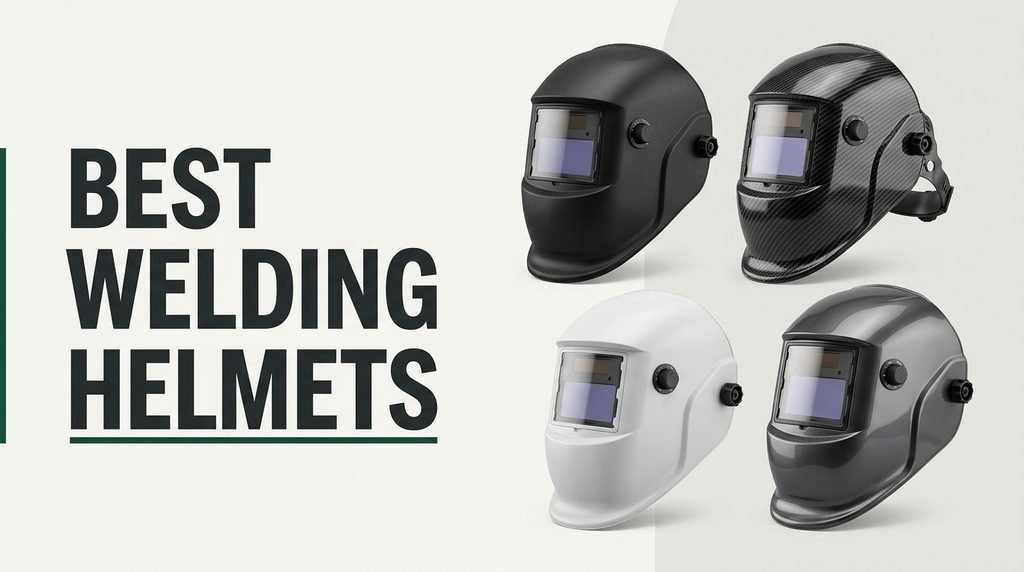
Choosing a welding helmet for 2026 comes down to optical clarity, shade range, arc sensor count, switching speed, viewing area, headgear comfort, and the processes you actually run. This guide compares 10 standout auto-darkening hoods so you can match a helmet to the type of welding you do, how many hours you wear it, and your budget.
The difference between a $40 entry-level helmet and a $350 professional hood is real, but it is not always the right choice for every welder. Some buyers need true-color optics and panoramic viewing for all-day production work, while others need a reliable budget hood for occasional garage projects. Understanding these differences prevents overspending or buying short.
Below you will find a side-by-side comparison, in-depth reviews, and a buying guide covering optical ratings, lens technology, shade adjustment, power sources, standards compliance, and long-term comfort. Use it to narrow your options to the helmet that fits your welding processes, work environment, and daily wear time.
We compared 10 welding helmets using the factors that matter most for safety, visibility, and daily comfort: optical clarity rating, auto-darkening switching speed, number of arc sensors, viewing area size, shade range coverage, true-color lens technology, headgear adjustability, weight, power source, ANSI and CSA standards compliance, warranty coverage, and value relative to intended use. The notes focus on practical trade-offs between budget hobbyist models and professional-grade hoods so each pick connects to real welder needs across stick, MIG, TIG, cutting, and grinding applications.

Compare key features, scores, and current prices side by side. A shorter feature list means fewer details were available, not necessarily fewer capabilities.



The Miller Classic Series with ClearLight lens technology is a mid-range offering from one of the most respected names in professional welding equipment. It is aimed at serious hobbyists and small-shop welders who want the reliability and support of an established brand without stepping up to the price of Miller's top-tier helmets.
We may earn a commission when you buy through this link, at no additional cost to you.
ClearLight lens technology provides high-definition optics that improve weld puddle visibility compared to standard green-tinted lenses. The shade range covers weld shades 8 through 13, cut shades 5 through 8, and a grind shade of 3, which handles the full range of common welding and fabrication tasks. The two arc sensors switch at 1/23,000 of a second, and the helmet is rated for welding at 5 amps or below, making it suitable for precision TIG work.
Digital controls for shade, delay, and sensitivity allow precise adjustment for different processes and operator preferences, and the ratchet headgear provides a secure, repeatable fit for extended sessions. The auto-on power control activates the lens at the strike of an arc, which eliminates the need to manually power the helmet before each weld. A 3.0 light state lets you keep the hood down between welds without lifting it, which improves productivity on repetitive work.
Many budget auto-darkening helmets struggle to reliably detect the low arc intensity of TIG welding at amperages below 10 amps. The Miller Classic is rated down to 5 amps, which means it will consistently darken for delicate TIG work on thin stainless steel, aluminum sheet, and small decorative projects. If you plan to do precision TIG, verify the amperage rating before buying any auto-darkening helmet.
This helmet is a strong pick for welders who value brand reputation, warranty support, and reliable TIG performance at a mid-tier price. The three-year warranty is well above average for this price range and reflects Miller’s confidence in long-term durability. The main tradeoff is the smaller 6 square inch viewing area compared to large-screen alternatives, which may not suit welders who prefer maximum peripheral visibility.
Welders who prefer large panoramic viewing areas or need built-in side view windows for peripheral awareness.
We may earn a commission when you buy through this link, at no additional cost to you.
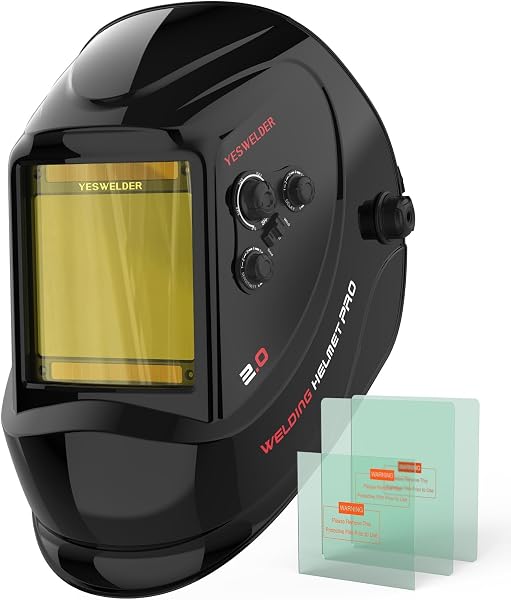
The YESWELDER LYG-L600A is aimed at hobbyists, beginners, and occasional welders who want proper true-color optical clarity without paying premium-brand prices. At well under $50, it provides a legitimate 1/1/1/1 optical rating, which is the highest clarity classification available and matches what you find on helmets costing three to five times more.
We may earn a commission when you buy through this link, at no additional cost to you.
The 3.64 by 1.67 inch viewing area is modest compared to large-screen panoramic hoods, but it is adequate for most stick, MIG, and TIG work on standard material. Two arc sensors switch in 1/30,000 of a second with adjustable sensitivity and delay controls, and the shade range of 3 for grinding and 7 to 13 for welding covers almost every common process a home or small shop welder will encounter.
A blue light blocking outer lens helps reduce eye fatigue during longer sessions, and the thickened PP shell with impact, flame, and corrosion resistance holds up to normal garage conditions. Power comes from a solar panel paired with a replaceable CR2450 battery, which is a sensible combination for occasional use since the battery provides startup power while the solar panel maintains it during welding.
The four-number optical rating evaluates optical class, diffusion of light, variations in luminous transmittance, and angle dependence. A rating of 1 in each category is the highest achievable classification and indicates the lens produces minimal distortion when viewing through it at various angles. A 1/1/1/1 rating is a meaningful indicator that the lens will not cause eye strain from blur or color shift during extended welding sessions.
This helmet is the right choice for budget-conscious buyers who want certified eye protection and good optical clarity for occasional projects. The main tradeoffs are the smaller viewing area and the two-sensor configuration, which is less forgiving than four-sensor helmets when working in positions that partially block the arc from the sensors. For daily professional use, step up to a four-sensor hood with a larger lens.
Production welders or professionals who need large viewing areas and four-sensor coverage for all-day work.
We may earn a commission when you buy through this link, at no additional cost to you.
The YESWELDER LYG-M800H expands the viewing area significantly over the entry-level L600A while keeping the price in the budget-friendly range. At 3.93 by 3.66 inches, the lens offers nearly 14 square inches of visibility, which is more than double the viewing area of the Miller Classic and makes a real difference for welders who need to see joint edges and work position clearly.
We may earn a commission when you buy through this link, at no additional cost to you.
Four arc sensors with a 1/30,000 second switching speed provide more reliable darkening response than two-sensor designs, especially when working in positions where part of the arc may be blocked from direct sensor view. The adjustable DIN 3 for grinding, 5 through 9 for lower-amperage work, and 9 through 13 for standard welding covers TIG, MIG, stick, cutting, and grinding across a wide range of applications.
The approximately 1.32 pound weight is notably light for a helmet with this viewing area, which translates directly into less neck fatigue during long sessions. The adjustable headgear with reinforced hinges and strengthened connection points addresses one of the common weak points on budget helmets, where plastic adjustment mechanisms can loosen or break under repeated use. The CR2450 lithium battery is widely available and easy to replace.
Two-sensor helmets work well when the welder is positioned directly in front of the arc, but out-of-position work such as overhead, vertical, or inside tight joints can occasionally block one sensor and leave the helmet relying on a single sensor for detection. Four-sensor designs provide redundancy that significantly reduces the risk of a missed arc flash, which is why most professional welders consider four sensors a baseline requirement for daily use.
This helmet is well-suited for home garage welders, fabricators, and metalworkers who want a large viewing area and reliable four-sensor performance without paying premium prices. The main tradeoffs are the two-stage shade adjustment range, which is less flexible than continuously variable premium hoods, and the lack of an internal digital display for precise numerical shade settings.
Welders who need internal digital shade controls or continuously variable shade adjustment for specialized work.
We may earn a commission when you buy through this link, at no additional cost to you.
The ARCCAPTAIN Intelligent panoramic helmet is engineered for welders who want modern smart-helmet features such as automatic shade adjustment, memory presets, and built-in lighting. The combination of a 4.6 by 3.2 inch main lens plus two 1.3 by 2.5 inch side lenses creates a 7.2 by 3.2 inch total viewing area that provides exceptional peripheral awareness for working in tight spaces or around moving equipment.
We may earn a commission when you buy through this link, at no additional cost to you.
The intelligent auto-shade adjustment is the standout feature. The helmet reads the arc brightness and automatically adjusts shade, sensitivity, and delay within a plus or minus 9-level range, which eliminates manual fiddling when moving between processes. Seven premium arc sensors with 1/30,000 second switching provide excellent coverage even in out-of-position work, and the 1/1/1/1 optical clarity rating ensures true color viewing across all lenses.
An internal screen with physical buttons allows direct adjustment of shade, sensitivity, and delay without removing the helmet. Nine memory modes save custom settings for different processes or jobs, which is particularly valuable for welders who switch between stick, MIG, and TIG multiple times per day. The integrated LED work light illuminates dark workspaces, and the rechargeable 500mAh battery provides up to 1,200 hours of operation without the LED or 500 hours with it running.
Welders who routinely switch between stick, MIG, and TIG often find themselves readjusting shade and sensitivity multiple times per day. Memory modes let you dial in optimal settings for each process once, then recall them with a button press. This saves setup time and ensures consistent lens behavior for the same job, which is particularly valuable when working on recurring production jobs or when training apprentices.
This helmet suits welders who want advanced features and panoramic visibility without stepping up to professional-grade pricing. The main considerations are the higher price compared to basic auto-darkening hoods and the rechargeable battery, which requires periodic charging and will eventually need replacement. For users who want set-and-forget shade control plus a large field of view, the smart features justify the premium.
Budget-focused buyers who do not need smart features or built-in lighting for occasional welding projects.
We may earn a commission when you buy through this link, at no additional cost to you.
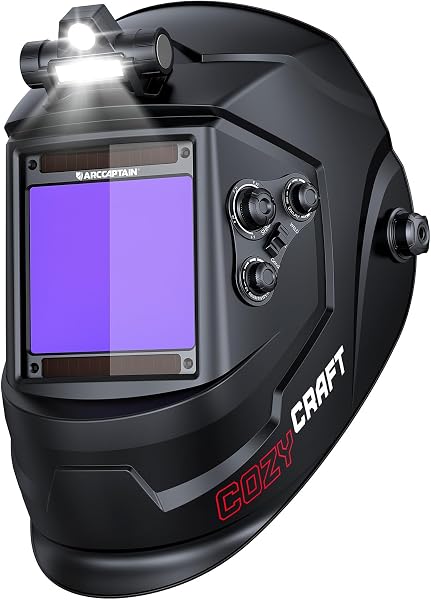
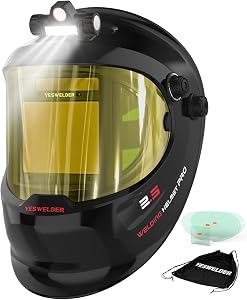
The ARCCAPTAIN helmet with integrated LED work light solves a common problem for welders working in dim shops, basements, mobile repair situations, or inside large fabrications where overhead lighting cannot reach. The USB-powered LED mounted on top of the helmet offers two brightness levels and provides direct illumination of the work area without casting shadows from your head or torso.
We may earn a commission when you buy through this link, at no additional cost to you.
The optical performance holds its own against larger-brand helmets at similar prices. The 3.94 by 3.66 inch viewing area with 1/1/1/1 optical clarity and true color technology provides excellent weld visibility, and four arc sensors switch from light to dark in 1/25,000 of a second. The adjustable shade range of 4, 5 through 8, and 9 through 13 covers stick, MIG, TIG, grinding, and cutting applications.
At approximately 1 pound, this is one of the lighter helmets in this guide, which matters when adding the LED light on top. The PP material shell provides reasonable flexibility and impact resistance, and the ergonomically designed headgear with breathable padding reduces pressure points during extended wear. The 12-in-1 smart filter with automatic DIN 16 ultraviolet and infrared protection filters harmful light across all operating modes.
Lighting matters most during arc setup, when you need to clearly see the joint before striking the arc. Shadow positioning, dark enclosed spaces, and overhead or vertical work all benefit from a direct light source mounted on the helmet. For field repair work, farm welding, and automotive welding where you are often working inside confined spaces, a helmet-mounted LED can meaningfully improve weld placement accuracy on the first attempt.
This helmet is the right choice for mobile welders, repair technicians, and anyone who regularly works in low-light environments. The main tradeoffs are the LED light’s USB power requirement, which means carrying a power bank or USB source, and the fact that the light comes uninstalled and requires simple attachment. For permanent shops with good overhead lighting, the LED may be unnecessary.
Welders working in well-lit permanent shops who do not need portable illumination for mobile or confined-space work.
We may earn a commission when you buy through this link, at no additional cost to you.
The ESAB Sentinel A60 is a professional-grade helmet aimed at serious welders, pipeline workers, and production fabricators who need best-in-class performance for daily work. The low-profile design uses high-impact resistance nylon construction that is purpose-built for the demanding environments where ESAB equipment is traditionally used, from shipyards to pipeline job sites to heavy fabrication shops.
We may earn a commission when you buy through this link, at no additional cost to you.
The ADF viewing area of 4.65 by 2.80 inches combined with ESAB OpTCS True Color Lens Technology delivers one of the clearest views available at any price point. The shade range of DIN 3 through 13 adjusts in half-shade increments, which allows fine-tuning for specific amperage and material combinations that other helmets round off. A shade lock setting prevents accidental changes during use, which is important for production work where consistency matters.
Four arc sensors with a 0.08 millisecond switching time rank among the fastest available in commercial auto-darkening helmets. This matters most for high-amperage work and processes with intense initial flash, where even a slight delay in darkening can cause eye fatigue. On-board memory for up to 9 settings allows welders to save presets for different processes, and LED indicators for low battery, grind mode, and shade lock provide clear status feedback.
Most auto-darkening helmets adjust in whole shade increments, which can leave welders choosing between shade 10 that feels slightly too light and shade 11 that feels slightly too dark for a particular job. The ESAB Sentinel A60’s 0.5 shade increment adjustment lets you dial in a shade 10.5 for that in-between amperage, which reduces eye strain over long sessions and improves weld pool visibility for critical work.
This helmet is the right choice for professional welders who make their living with the tool and want the best performance available without stepping into specialty category pricing. The main tradeoffs are the significantly higher price than consumer-grade helmets and the lack of panoramic side view windows. For welders who treat their helmet as a critical daily tool, the ESAB Sentinel A60 delivers the kind of precision and durability that justifies the investment.
Hobbyist welders or occasional users who do not need professional-grade precision and durability for daily work.
We may earn a commission when you buy through this link, at no additional cost to you.
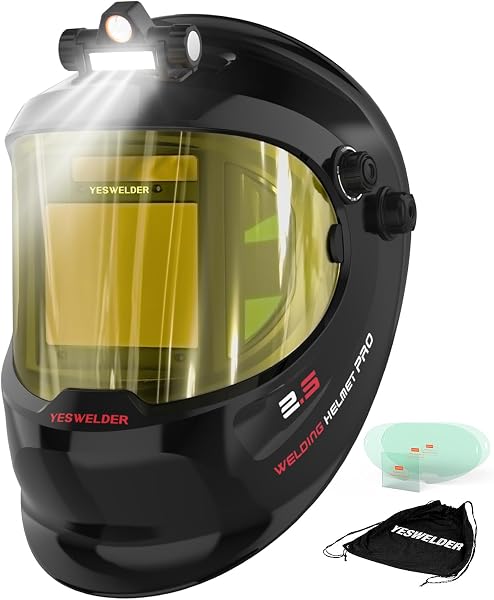
The YESWELDER panoramic digital helmet brings 180-degree visibility and internal digital controls to a mid-tier price point. The 8.89 by 3.23 inch total viewing area combines a 4.25 by 3.23 inch main lens with two 2.87 by 2.32 inch side views, which dramatically expands peripheral awareness compared to standard rectangular welding helmets.
We may earn a commission when you buy through this link, at no additional cost to you.
Smart auto-adjustment technology automatically tunes shade, sensitivity, and delay based on arc brightness, with fine-tuning available in plus or minus 9 levels. Five premium arc sensors with 1/30,000 second switching provide reliable coverage, and the shade range of 3 for grinding, 4 through 8 for cutting, and 9 through 14 for welding handles everything from thin aluminum TIG to high-amperage stick work on heavy plate.
The internal digital display and button controls are a significant upgrade over analog knobs for welders who want precise, repeatable settings. Being able to see exact numerical values for shade, sensitivity, and delay removes guesswork and allows exact replication of successful settings. Gradient control provides smooth transitions between light and dark states, which reduces the harsh flash that can cause eye fatigue over long sessions.
Panoramic helmets with side view windows provide awareness of movement and conditions outside the main welding focus area. On most panoramic helmets, these side windows are fixed-shade filters, typically around DIN 5, that let you see your surroundings during welding without the main lens darkening blocking peripheral vision entirely. They are safety and awareness tools rather than primary welding viewports, so always look directly through the main lens when actually welding.
This helmet is a strong value for welders who want panoramic visibility and digital precision without professional-grade pricing. The main considerations are that the side view windows are fixed at DIN 5 and do not auto-darken, so they help with ambient awareness but should not be used to view the arc directly. The digital interface also has a steeper learning curve than simple analog knobs for welders new to adjustable auto-darkening helmets.
Welders who prefer simple analog controls or who find complex digital interfaces distracting during work.
We may earn a commission when you buy through this link, at no additional cost to you.
The Lincoln Electric K4983-1 brings the brand reputation of one of the most established names in welding equipment to a competitively priced auto-darkening helmet. At 17.5 ounces with a 4.33 by 3.54 inch viewing area, it provides a good balance of visibility, weight, and professional-grade build quality for welders who value brand reliability and warranty support.
We may earn a commission when you buy through this link, at no additional cost to you.
The variable shade range of 7 through 13 covers stick, TIG, pulsed TIG, MIG, pulsed MIG, flux core, and gouging processes, which is the full range most industrial and construction welders use daily. The TIG rating of 5 amps or higher means it will reliably darken for low-amperage precision work on thin materials. A dedicated grind mode shade allows safe grinding without flipping up the helmet or switching to a separate face shield.
Hard hat compatibility is a significant practical feature for construction, pipeline, and industrial welders who are required to wear head protection on job sites. The ability to mount the helmet to a hard hat shell eliminates the need to switch between separate hard hats and welding helmets, which saves time and improves safety compliance. The adjustable ratchet headgear works for men and women and includes an oversized absorbent sweatband for comfort.
On many commercial construction, oil and gas, and heavy industrial sites, hard hats are mandatory personal protective equipment that must be worn whenever outside a controlled shop area. A hard-hat-compatible welding helmet attaches directly to the hard hat shell, which keeps the welder in compliance with site safety requirements without the awkward process of switching between separate head protection and welding helmets throughout the day.
This helmet is well-suited for professional welders who work on job sites requiring hard hats, as well as home shop welders who want the reliability of the Lincoln brand. The main tradeoffs are the shade range starting at 7 rather than lower, which limits very delicate TIG work on thin aluminum, and the absence of digital display or memory settings that higher-end helmets provide. The two included spare inside and outside lenses are a useful value addition.
Welders who need shade settings below 7 for very low-amperage TIG work on thin aluminum or stainless.
We may earn a commission when you buy through this link, at no additional cost to you.
The Hobart 770890 Inventor-series helmet is a dependable workhorse from a brand with deep roots in American welding equipment. The polyamide nylon shell with large 9.3 inch widescreen viewing area and PureColor lens technology provides a clear, accurate view of the weld puddle and surrounding work area without the complexity of digital interfaces.
We may earn a commission when you buy through this link, at no additional cost to you.
Four independent arc sensors provide reliable arc detection for out-of-position welding and work in enclosed spaces where sensor coverage matters. The auto-on and off power control activates the lens at the strike of an arc, eliminating the need to manually power the helmet before each weld. Continuous UV and IR protection ensures full-spectrum eye safety regardless of whether the lens is in its light or dark state.
The analog control knobs for shade, sensitivity, and delay are a feature rather than a limitation for many professional welders. Knobs provide tactile feedback and can be adjusted quickly without looking, which matters when you need to tweak settings mid-job. The dedicated weld-to-grind mode switch prevents the lens from darkening during grinding operations, which streamlines workflow when alternating between welding and metal preparation.
Analog knob controls offer tactile adjustment that works well with gloved hands and does not require looking at a display to verify changes. Digital controls provide precise numerical values and memory presets but can be harder to adjust quickly and may have smaller buttons that are difficult to operate with heavy welding gloves. For welders who stay with similar settings most of the time, analog controls are often faster and more intuitive.
This helmet is a strong pick for welders who value brand reliability and prefer simple, proven technology over feature-heavy digital interfaces. The main tradeoffs are the absence of memory presets and digital displays that premium helmets offer, and the single rectangular viewing area without panoramic side windows. For straightforward daily welding where simplicity equals reliability, the Hobart 770890 is a solid investment.
Welders who want digital precision, memory presets, or panoramic side viewing windows for peripheral awareness.
We may earn a commission when you buy through this link, at no additional cost to you.
The YESWELDER LYG-Q800D delivers a feature set that competes well with helmets costing significantly more. The combination of a 3.94 by 3.23 inch main viewing area with DIN 5 side view windows provides panoramic awareness during welding, and the blue light blocking outer lens helps reduce eye strain from harmful high-energy light exposure during extended sessions.
We may earn a commission when you buy through this link, at no additional cost to you.
Four arc sensors with 1/30,000 second switching provide reliable darkening for out-of-position work, and the adjustable shade range of 3 for grinding, 5 through 9 for lower-amperage work, and 9 through 13 for standard welding covers professional TIG, MIG, MMA, cutting, and grinding applications. Adjustable sensitivity and delay controls let you tune the helmet behavior for different lighting conditions and process requirements.
The pivot-style headgear is designed for comfort during long sessions, with balanced weight distribution that reduces neck fatigue. The reinforced PP material construction with thicker-than-average walls provides good durability for rigorous use, and the helmet accommodates magnifying cheater lenses for welders who need close-up detail enhancement. Power comes from a solar panel paired with a replaceable CR2450 battery, which provides long service life with minimal maintenance.
Welding exposes the eyes to high-energy visible light in the blue spectrum, which can contribute to eye fatigue and discomfort during extended sessions even when proper darkening shade levels are used. Blue light blocking outer lenses filter a significant portion of this harmful spectrum while maintaining accurate color rendering for the weld pool. For welders who spend many hours per day under the hood, this feature can meaningfully improve end-of-day comfort.
This helmet is a good value for welders who want panoramic side view windows and blue light protection at a mid-range price point. The main considerations are that the side view windows are fixed-shade and should not be used to view the arc directly, and the product name mentions LED but refers to the solar panel energy conversion rather than a built-in work light. For welders who need a built-in LED work light, consider the ARCCAPTAIN with Light model instead.
Welders expecting a built-in LED work light based on the product name, or those needing auto-darkening side windows.
We may earn a commission when you buy through this link, at no additional cost to you.
A welding helmet is both personal protective equipment and a visibility tool that directly affects weld quality. The factors below cover the most important specifications and features to evaluate before buying, along with common mistakes that can lead to eye fatigue, poor weld visibility, or inadequate protection.
Welding lens optical clarity is rated using a four-digit system that evaluates optical class, light diffusion, luminous transmittance variation, and angle dependence. A rating of 1 in each category is the highest classification and indicates minimal distortion when viewing through the lens from different angles. A 1/1/1/1 rating means the lens produces an essentially distortion-free view that will not cause eye strain over extended sessions.
Lower-rated lenses, such as those with a 1/2/1/2 rating, can produce subtle color shifts, blurring at the edges, or distortion when viewed from off-angle positions. For occasional short welding sessions, lower ratings may be acceptable, but for daily production work, the 1/1/1/1 rating pays off in reduced eye fatigue and clearer weld pool visibility.
If you weld more than a few hours per week, prioritize a 1/1/1/1 optical clarity rating. The feature is now available on budget helmets like the YESWELDER LYG-L600A, so there is little reason to accept lower optical quality unless the price difference is significant.
Welding shade requirements vary by process and amperage. Low-amperage TIG work on thin aluminum may need shades 8 to 9, while high-amperage stick welding on heavy plate requires shades 12 to 14. Grinding mode typically uses shade 3 or 4, which is darker than clear safety glasses but light enough to see the work clearly. A versatile helmet should cover at least shades 3 for grinding and 9 to 13 for most welding processes.
Shade adjustment granularity also matters. Most helmets adjust in whole-shade increments, but premium models like the ESAB Sentinel A60 adjust in half-shade increments, allowing fine-tuning for specific amperage and material combinations. Variable shade allows you to use one helmet for multiple processes rather than owning dedicated hoods for different amperage ranges.
Choose a shade range that comfortably covers your actual welding processes with margin on both ends. If you do only MIG welding, a basic 9 to 13 range is sufficient. If you work across TIG, MIG, stick, and cutting, look for a wider range such as 3/5-9/9-13 or better.
Arc sensors detect the welding arc and trigger the lens to darken from its clear state to the selected welding shade. Entry-level helmets typically use two sensors, which work well for direct in-position welding but can fail to detect the arc if both sensors are blocked by the workpiece, your body, or awkward angles. Four or more sensors provide redundancy that significantly reduces the risk of a missed darkening event in out-of-position work.
Switching speed is measured in fractions of a second and indicates how quickly the lens transitions from clear to dark when an arc is detected. Faster switching reduces the brief flash of unfiltered arc light that reaches your eyes, which cumulatively contributes to eye fatigue over long sessions. Speeds of 1/25,000 to 1/30,000 of a second are standard on quality helmets, while premium models like the ESAB Sentinel A60 switch at 0.08 milliseconds.
For daily professional use, prioritize helmets with four or more arc sensors and switching speeds of at least 1/25,000 second. For occasional hobbyist use, two sensors can be acceptable, but understand the limitation when working in confined spaces or out of position.
Viewing area size affects how much of the work you can see at once and how aware you are of your immediate surroundings. Standard rectangular viewing areas range from about 6 square inches on compact helmets to over 14 square inches on large-screen designs. Panoramic helmets add side view windows that provide peripheral awareness beyond the main lens, which is useful for working in busy shops or around moving equipment.
A larger viewing area reduces the need to constantly reposition your head to see different parts of the weld, which can improve weld quality and reduce neck fatigue. However, larger lenses also increase helmet cost and sometimes weight. Panoramic designs with side view windows typically use fixed-shade filters on the sides that are not safe for viewing the arc directly.
If you work on complex fabrications, long weld seams, or in congested environments, prioritize a larger viewing area or panoramic design. For straightforward production welding on consistent joints, a standard viewing area is often sufficient and more affordable.
Auto-darkening helmets use three main power configurations: solar only, battery only, and solar plus battery backup. Solar-only designs eliminate battery replacement but may struggle to initiate darkening in very low-light conditions. Battery-only designs provide consistent performance but require periodic battery changes. Solar plus battery combinations offer the best of both worlds, using solar energy to extend battery life while ensuring reliable operation in any lighting.
Replaceable batteries like the common CR2450 lithium cell are preferable to sealed internal batteries because they can be swapped in seconds when depleted. Rechargeable designs like the ARCCAPTAIN Intelligent helmet with its 500mAh battery provide long runtime but eventually require battery replacement by the manufacturer or a service center.
For most welders, a solar plus replaceable CR2450 battery combination offers the best balance of reliability and ease of maintenance. Rechargeable helmets make sense if you want integrated features like LED work lights that require more sustained power.
Welding helmets should meet recognized safety standards for impact resistance, UV and IR filtering, and auto-darkening lens performance. The ANSI Z87.1 standard is the primary North American benchmark and covers impact resistance and optical performance requirements. CSA Z94.3 is the Canadian equivalent, and CE marking indicates compliance with European safety standards.
Any helmet intended for actual welding use should carry ANSI Z87.1 certification at minimum. Reputable brands typically also carry CSA and CE certifications, which provides additional assurance of safety testing. Beware of extremely cheap helmets that lack any certification markings, as these may not provide adequate UV and IR protection and could cause eye damage even when the lens appears to be darkening properly.
Verify certification markings on the helmet shell or lens before purchasing. Legitimate certifications should be clearly molded or printed on the helmet, not just claimed in marketing descriptions.
Helmet weight directly affects neck fatigue during extended welding sessions. Lightweight designs around 1 to 1.5 pounds are significantly more comfortable than heavier helmets exceeding 2 pounds, especially when working overhead or in awkward positions. However, weight alone does not determine comfort, as balance and headgear quality matter equally.
Quality headgear should include a ratchet adjustment for consistent fit, pivot adjustments to balance the helmet weight across your head rather than concentrating it on the forehead, and padded contact points that distribute pressure comfortably. An absorbent sweatband becomes important in hot shops or during summer outdoor work where perspiration can affect comfort and visibility.
If you weld more than a few hours per day, prioritize helmets with adjustable pivot headgear and comfortable padding, even if it means spending more. Reduced neck fatigue translates directly to better focus, improved weld quality, and less soreness at the end of the day.
Before each welding session, inspect the outer cover lens for scratches, pits, or spatter buildup that could obscure your view. Replace the outer cover lens whenever damage affects visibility, which can be as often as weekly for heavy production use or monthly for occasional hobbyist work. Verify that batteries are seated properly and that solar panels are clean to ensure reliable auto-darkening performance. Test the darkening function by pointing the helmet at a bright light source or by using the test button if your model includes one.
Adjust the shade, sensitivity, and delay settings to match your welding process before striking an arc. For most MIG and stick welding, shade 10 to 12 is a good starting point depending on amperage. For low-amperage TIG work, shade 9 may be appropriate. Set sensitivity high enough to reliably detect your arc but low enough to avoid false triggering from ambient light or nearby welders. Set delay long enough to prevent the lens from clearing while the weld pool is still bright, which can cause flash-related eye discomfort.
Store the helmet in a clean, dry location away from direct sunlight when not in use. Periodic cleaning with a soft cloth and non-abrasive cleaner keeps the lens surfaces clear and extends the life of the shell. Replace cover lenses before scratches obscure your view, and replace the battery when the low-battery indicator activates. Keep the helmet away from solvents, grinding dust accumulation, and extreme temperatures that could damage electronic components or distort the shell.
Shade requirements for MIG welding depend on amperage. For light MIG work below 150 amps, shade 10 is typically appropriate. For medium-duty MIG at 150 to 250 amps, shade 11 works well. For heavy MIG above 250 amps, shade 12 or 13 provides adequate protection. Start with a shade that lets you clearly see the weld pool without eye strain, and darken if the pool appears too bright.
Yes, most modern auto-darkening helmets with variable shade ranges of 9 through 13 or wider work for TIG, MIG, and stick welding. For low-amperage TIG below 20 amps, verify the helmet's amperage rating because some budget models may not reliably darken for low-arc TIG work. Helmets like the Miller Classic Series are specifically rated down to 5 amps for precision TIG applications.
Fixed shade helmets use a permanently dark lens that requires flipping up to see between welds. Auto-darkening helmets start in a clear or light state and automatically darken when an arc is detected, allowing you to see the work before striking an arc. Auto-darkening designs are now standard for most welders because they improve productivity and reduce the risk of accidentally striking an arc with the hood up.
Battery life varies by helmet design and usage. Solar-assisted helmets with CR2450 batteries typically last 2 to 3 years of regular use before needing replacement. Rechargeable helmets like the ARCCAPTAIN Intelligent model provide up to 1,200 hours of operation per charge. Battery life is extended on helmets with solar panels because the solar cells provide operating power during welding, reducing battery drain.
Four or more arc sensors are strongly recommended for professional daily welding because they provide redundant arc detection for out-of-position work. Two-sensor helmets work fine for direct in-position welding but can occasionally fail to detect the arc when sensors are blocked by the workpiece or your body. For occasional hobbyist use with straightforward positioning, two sensors can be adequate.
The four numbers represent optical class, light diffusion, luminous transmittance variation, and angle dependence. A rating of 1 in each category is the highest classification and indicates the lens produces minimal distortion from any viewing angle. This matters for reducing eye strain during long sessions and ensuring accurate weld pool visibility. A 1/1/1/1 lens is now available even on budget helmets and should be a baseline requirement.
Yes, but only if the helmet is specifically designed for hard hat compatibility. The Lincoln K4983-1 is one example that attaches to standard hard hat shells for use on construction and industrial sites where head protection is mandatory. Standard welding helmets without hard hat adapters cannot be safely mounted to a hard hat and would require separate head protection to be worn and removed between welding tasks.
Replace the outer cover lens whenever scratches, pits, or spatter accumulation affect your visibility. Heavy production welders may need to replace cover lenses weekly, while hobbyist welders may only need replacement every few months. Keep spare lenses on hand because welding with a damaged cover lens strains your eyes and can hide weld defects. Most helmets include a few spare lenses in the box.
Premium helmets like the ESAB Sentinel A60 offer meaningful advantages for professional welders, including faster switching speeds, half-shade adjustment increments, memory presets, superior optics, and more durable construction. However, well-designed budget helmets like the YESWELDER LYG-L600A provide adequate performance for occasional hobbyist use. Match the helmet investment to your welding frequency, process requirements, and productivity needs.
Any welding helmet intended for actual use should meet ANSI Z87.1 safety standards at minimum, which covers impact resistance and optical performance requirements. CSA Z94.3 certification confirms Canadian compliance, and CE marking indicates European safety approval. Verify certification markings are molded or printed on the helmet itself, not just claimed in marketing descriptions. Uncertified helmets may not provide adequate UV and IR protection.
The Miller Classic Series stands out as the strongest overall choice for most buyers, combining the trusted Miller brand reputation, ClearLight lens technology for excellent weld pool visibility, a 3-year warranty, and reliable low-amperage TIG performance at a mid-tier price. For welders who want a dependable daily hood from an established manufacturer, it is hard to beat the balance of quality and value.
For buyers with different priorities, the ESAB Sentinel A60 delivers professional-grade precision with industry-leading switching speed and half-shade adjustment for serious production work, while the YESWELDER LYG-L600A offers legitimate 1/1/1/1 optical clarity at a hobbyist price. If you need panoramic visibility and smart features, the ARCCAPTAIN Intelligent model provides auto shade adjustment and nine memory presets, and the Lincoln K4983-1 remains the top pick for job sites requiring hard hat compatibility.
Your final decision should come down to how often you weld, which processes you use, and the environment where you work. Match the optical clarity, shade range, sensor count, and viewing area to your actual welding needs rather than paying for features you will not use. Prioritize ANSI Z87.1 certification, a comfortable headgear system, and a shade range that covers your common processes with margin on both ends.