SOARAISE 48000mAh Wireless
8.4Editor score48000mAh lithium polymer
Four solar panels
Four built-in cables
Wireless charging pad
Find the right solar power banks for 2026. We compare 10 standout options by build quality, useful features, owner feedback, value, and everyday trade-offs.
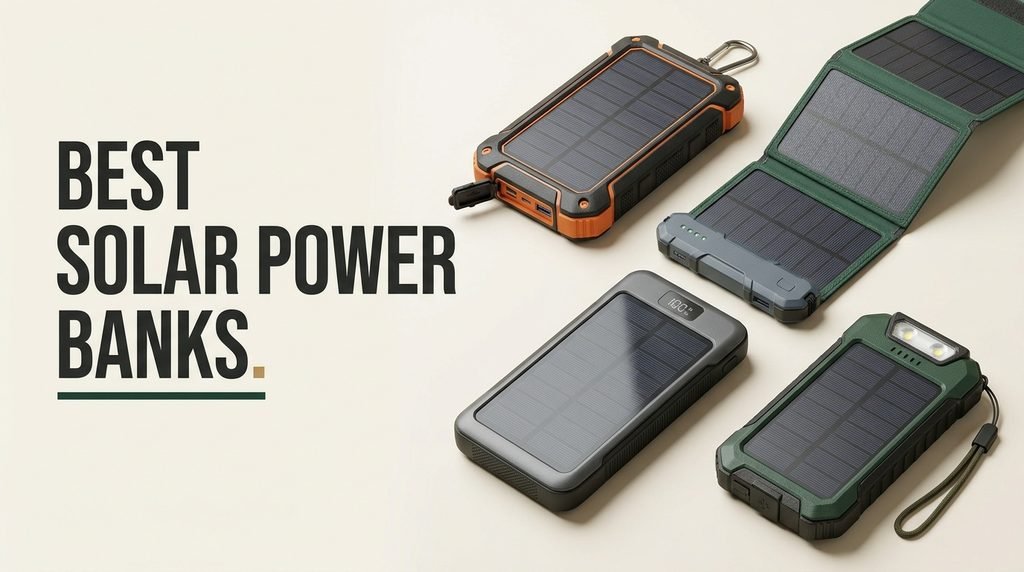
Find the right solar power bank for 2026. We compare 10 standout options by the factors that actually matter outdoors, including battery capacity, solar panel efficiency, wireless and wired charging speeds, built-in cables, waterproofing, emergency extras like hand cranks and flashlights, and the practical trade-offs between portability and runtime.
Solar power banks range from compact 10,000mAh units that slip into a daypack to 50,000mAh workhorses built for multi-day camping trips. Capacity, port layout, and solar panel size determine whether a model is a true off-grid charger or simply a backup topper that uses the sun as a trickle source.
This guide breaks down each option by use case, from emergency preparedness kits and weekend hikes to extended backcountry trips. Use the comparison table and detailed reviews to match wireless charging, fast-charging ports, and survival features to your real needs.
We compared 10 solar power banks using the details that genuinely help a buyer decide: battery capacity, solar panel efficiency, wired and wireless charging speeds, port variety, built-in cables, waterproofing, weight, and extras like hand cranks, flashlights, and compasses. The notes focus on practical trade-offs so each pick connects to how people actually use solar chargers on hikes, during camping trips, in emergency kits, and when traveling off-grid for days at a time.


Compare key features, scores, and current prices side by side. A shorter feature list means fewer details were available, not necessarily fewer capabilities.


This 49800mAh solar power bank is built for buyers who prioritize durability and raw capacity over slim design. The IP65-rated enclosure resists dust and splashing water, and the shockproof housing is well suited to tossing in a truck bed, strapping to a kayak, or stuffing into a camping bin. The combination of a large battery and tough shell makes it a solid choice for emergency preparedness kits.
We may earn a commission when you buy through this link, at no additional cost to you.
The 22.5W fast charging port keeps modern phones and small tablets refilling quickly, even from this larger battery, so you are not waiting half the day for a top-off. Four built-in cables cover USB-C, phone, USB-A, and Micro connectors, eliminating the usual cable chaos. For an extended camping trip or power outage, that cable integration is one of the most practical convenience features available in the category.
A built-in LED flashlight adds genuine utility for night navigation around camp or during a blackout. The solar panel on top provides a trickle charge that works best as a backup when wall power is unavailable for days. On a sunny afternoon it will meaningfully extend runtime, but it is not sized to fully recharge the 49,800mAh battery in a reasonable time frame.
An IP65 rating indicates complete dust protection and resistance to low-pressure water jets from any direction. That is enough to handle heavy rain, splashes from a lake, and the kind of dust you encounter on a desert camping trip. It is not full submersion protection, so you should not drop the charger in a river, but for the vast majority of real-world outdoor conditions, IP65 is more than adequate.
The main trade-off is weight and size. A rugged pack with this much capacity is noticeably bulky, which can be a drawback for ounce-counting backpackers. For truck campers, boaters, hunters, and anyone building a serious grab-and-go emergency kit, however, the ruggedness and fast charging combination make this a strong contender in the sub-$40 range.
Not ideal for anyone who needs to minimize pack weight for long trail miles.
We may earn a commission when you buy through this link, at no additional cost to you.
The SOARAISE 48000mAh is built for group outings and longer camping trips where keeping multiple phones, headlamps, and small electronics topped off becomes a logistical problem. Four fold-out solar panels sit on top of the pack, delivering noticeably more sunlight collection than typical single-panel designs. That extra surface area makes the solar function meaningful rather than purely decorative, though wall charging is still much faster for the initial fill.
We may earn a commission when you buy through this link, at no additional cost to you.
A 48,000mAh lithium-polymer battery provides enough reserve to recharge most smartphones ten or more times, which translates to several days of use for a small group. The 5V/3A USB-C port handles fast charging duties, bringing a modern iPhone from 15 percent to 60 percent in roughly 30 minutes. Combined with two USB-A outputs, the port layout can run a phone, tablet, and small accessory at the same time without juggling cables.
Four built-in cables, including USB-C, a phone-compatible connector, USB-A, and Micro, eliminate the need to carry a separate cable pouch. Add the integrated wireless charging pad and the unit can serve up to seven devices simultaneously, which is unusual at this price point. The cable integration is particularly handy during airport layovers or shared tent setups where cords get lost.
Single-panel solar chargers collect sunlight on a surface roughly the size of the device itself, which limits how much energy can enter the battery per hour. A fold-out four-panel design multiplies that collection area, giving the solar function a realistic chance of delivering useful power during a day in the sun. It will not replace wall charging, but it meaningfully extends how long you can stay off-grid between full recharges.
The trade-off is weight and size. A 48,000mAh pack with four panels is not something you want in a trail-running vest, and the solar panels, while helpful, will not fully recharge the bank in a day of casual sun exposure. Treat the solar function as a top-off tool rather than a primary input, and this charger makes sense for base camps, van life, and extended family outings.
Not ideal for ultralight backpackers who need to minimize every ounce in their pack.
We may earn a commission when you buy through this link, at no additional cost to you.
The FEELLE 50000mAh stands out as a serious emergency preparedness tool as much as a camping charger. The combination of a huge 50,000mAh battery, a built-in hand crank generator, a compass, and a multi-mode flashlight makes it a reasonable centerpiece for a home emergency kit or a long backcountry trip. When wall power is unavailable and the sun refuses to cooperate, the hand crank provides a last-resort way to generate electricity for a radio or phone call.
We may earn a commission when you buy through this link, at no additional cost to you.
Magnetic wireless charging at up to 15W is one of the more useful recent additions to this category. Compatible phones snap into perfect alignment on the pad without the usual fiddling, which matters at night inside a tent or during a stormy power outage. The 3.0A USB-C port supports fast charging and can refill a modern iPhone from empty to 60 percent in about 30 minutes, keeping pace with wall chargers for everyday use.
Four built-in cables and three ports allow up to six devices to be charged at once, so a family or small group can keep phones, lanterns, and portable radios running simultaneously. The housing combines silicone bumpers with an ABS and PC shell, and silicone covers protect the ports from dust and moisture. A hook built into the frame lets you attach the pack to a backpack strap so it can collect sunlight while you walk.
A hand crank is not meant to fully recharge a modern smartphone, which would require an impractical amount of cranking. It is designed to produce enough power for essential tasks such as a short emergency call, a few minutes of flashlight use, or keeping a small radio alive during a storm. Judged against that realistic standard, it adds meaningful peace of mind to any emergency kit.
The main trade-offs are size and the practical limits of each backup method. The pack is bulky, thick phone cases above 3mm will weaken magnetic attachment, and the hand crank produces modest power that is best thought of as emergency-only. For buyers who want one device that handles camping, long trips, and household emergency preparedness, however, the FEELLE is one of the most complete options available.
Not suitable for buyers who want a slim everyday carry charger.
We may earn a commission when you buy through this link, at no additional cost to you.
The BLAVOR 20000mAh hits a sweet spot that works for most weekend campers, day hikers, and travelers who need meaningful backup power without carrying a brick. The 20,000mAh capacity provides roughly four full charges for a current iPhone or around 2.3 charges for a 14-inch MacBook Pro, which covers most short-trip scenarios. The included 20W USB-C PD port means you can fast charge a phone from empty to full in about 50 minutes.
We may earn a commission when you buy through this link, at no additional cost to you.
Six devices can be powered at once thanks to four built-in cables and three ports, plus a dedicated wireless pad that supports both phones and the Apple Watch. The Apple Watch support is unusual at this price point and particularly useful for travelers who already carry one charger too many. The USB-C port handles both input and output, so the same cable can refill the bank or power a laptop depending on your current need.
Outside of charging, BLAVOR packs this unit with practical outdoor accessories. A three-mode flashlight, a three-level camping lantern, a compass, a thermometer, a carabiner, and a tie-off rope all come standard. The flame-retardant ABS and PC shell combined with waterproof silicone trim means the pack can handle rain, dust, and the occasional drop without issue. It is not an unlimited rugged device, but it is clearly built for life outside the house.
Many solar chargers include wireless pads sized only for phones, which leaves Apple Watch owners carrying a dedicated puck. The BLAVOR 20000mAh integrates a watch-compatible wireless area, delivering roughly 37 full watch charges from the pack. For frequent travelers and backpackers who track activity on their wrist, this one feature can meaningfully simplify what gear ends up in the bag.
Buyers should keep expectations realistic about the solar panel size. On a device this compact, the single panel is best used as an emergency top-off rather than a primary power source. For anyone who wants a mid-capacity solar power bank that fast charges modern phones, supports an Apple Watch, and bundles useful outdoor tools, however, this BLAVOR model is one of the strongest value picks in this lineup.
Not the best choice for multi-day group trips that need 40,000mAh or more capacity.
We may earn a commission when you buy through this link, at no additional cost to you.
The BLAVOR 10000mAh is aimed at travelers and day hikers who want a portable charger that is realistic to carry in a jacket pocket or small daypack. At its real-rated 10,000mAh, a full charge is enough for roughly 2.2 refills of an iPhone 14 Pro or a single top-off for an iPad Air, which covers most short outings. The compact footprint is one of the smallest in this group of solar chargers.
We may earn a commission when you buy through this link, at no additional cost to you.
Despite the size, BLAVOR did not skimp on charging speed. The USB-C port supports 20W fast charging, bringing an iPhone 15 to 65 percent in roughly 30 minutes, and three devices can be powered at once through a mix of wired and wireless outputs. Using a lithium-cobalt battery gives this unit a longer rated cycle life than many lithium-polymer alternatives, which matters if the charger lives in a go-bag and gets used for years.
The outer housing uses flame-retardant ABS and PC along with a waterproof silicone shell, carrying an IPX5 rating that handles rain and splashes well. Two bright LED flashlights, a compass, and a carabiner round out the outdoor extras. The rubber-coated finish feels secure in cold or wet hands, which is a small but welcome detail during real outdoor use.
Some manufacturers overstate battery capacity, counting raw cell numbers rather than actual deliverable power. BLAVOR specifies a real-rated 10,000mAh, which is the capacity your phone will actually see after conversion losses. When comparing solar power banks, pay attention to whether the number represents cell capacity or usable output, because the difference can easily be 30 percent or more.
The main trade-off is capacity. 10,000mAh will not sustain a group for an entire weekend, so this is not the right pick for base-camp duty or long emergency outages. For solo travelers, commuters who worry about a dead battery before dinner, or hikers who want a lightweight backup with real fast charging, however, this is one of the most practical solar power banks available.
Not large enough for extended group camping trips or multi-day power outages.
We may earn a commission when you buy through this link, at no additional cost to you.
The Jackery Explorer 300 operates in a different class from traditional solar power banks. With 292Wh of capacity, two AC outlets, a 100W USB-C PD port, two USB-A ports, and a 120W car port, it functions as a true portable power station rather than a pocket charger. For van lifers, CPAP users at camp, or anyone running a laptop or small kitchen appliance off-grid, that extra flexibility is hard to match.
We may earn a commission when you buy through this link, at no additional cost to you.
The move to LiFePO4 battery chemistry is one of the Explorer 300’s most meaningful upgrades. Rated for more than 4,000 cycles to 70 percent capacity, this chemistry can realistically deliver more than a decade of regular service. That longevity matters if the unit will be used weekly or kept in a home emergency kit for years, where traditional lithium batteries can degrade before they are needed.
At 7.5 pounds with an integrated handle, the Explorer 300 is portable enough for a camping trip but is not meant to live in a backpack. Paired with a compatible Jackery solar panel, it can reach 80 percent capacity in roughly 2.8 hours with a 100W panel or around 7.5 hours with a 40W panel. That kind of solar input turns the Explorer 300 into a genuine off-grid system rather than a one-shot battery.
LiFePO4 cells are heavier than traditional lithium-polymer alternatives, but they offer dramatically longer cycle life and improved thermal stability. For a power station that may sit charged for months at a time or get used daily on job sites, that durability translates into years of extra useful service. The trade-off in weight is usually worth it for stationary or vehicle-based use.
The main caveats are size, price, and the fact that solar panels are sold separately. If your goal is simply to recharge a few phones during a weekend hike, this is overkill. If you need to power laptops, cameras, drones, CPAP machines, or small appliances for days on end, however, the combination of AC outlets, high-wattage USB-C, and long-life LiFePO4 chemistry makes the Explorer 300 one of the most capable choices here.
Not a traditional pocket power bank and not meant for ultralight backpacking.
We may earn a commission when you buy through this link, at no additional cost to you.
This SOARAISE model shares many design cues with its sibling 48000mAh wireless charger, but it emphasizes the ability to handle a full group's charging needs in one place. With four built-in cables, three ports, and a wireless pad, up to seven devices can draw power simultaneously. For a family camping trip or a small outdoor event, that is often enough to replace multiple smaller chargers.
We may earn a commission when you buy through this link, at no additional cost to you.
The 48,000mAh lithium-polymer battery is positioned toward longevity, offering up to 80 percent more charging cycles than typical cells. That extra durability matters more than it might sound, because large solar power banks often sit unused between trips, and resilient cells tolerate that kind of occasional use much better. The 5V/3A USB-C output provides respectable fast charging for most modern phones.
Four fold-out solar panels sit across the top surface, giving the solar function a realistic chance of contributing meaningful power during long daytime exposure. The wireless charging pad on top is compatible with most Qi-enabled phones, which simplifies nightly top-offs inside a tent. Combined with the integrated cables, the setup eliminates the need to carry a cable organizer separately.
Charging seven devices from one unit sounds like marketing speak until you spend a weekend with a group whose phones all die at the same time. Shared chargers reduce arguments at camp, consolidate cables, and make it realistic to keep headlamps, phones, and small lights all running without rationing. This is where high-capacity multi-port banks genuinely earn their size.
The main caveats are size and the understanding that solar input, even from four panels, cannot keep up with heavy group use indefinitely. Plan to arrive with the bank fully charged and treat solar as a bonus. For group campers, scout leaders, and anyone running multi-device emergency drills, however, the SOARAISE 48000mAh battery pack is a reliable workhorse.
Not the right choice for solo users who want a slim everyday carry charger.
We may earn a commission when you buy through this link, at no additional cost to you.
This BLAVOR model takes the brand's familiar 20,000mAh outdoor charger and adds a hand crank generator for serious emergency scenarios. One minute of cranking produces up to five minutes of reliable emergency lighting, which is a meaningful difference when a storm has knocked out power for days. The combination makes this unit a strong candidate for a home emergency kit as well as a camping bag.
We may earn a commission when you buy through this link, at no additional cost to you.
The 15W wireless charging pad supports multiple power levels including 5W, 7.5W, 10W, and 15W max, refilling an iPhone to 50 percent in about 30 minutes. Add the 20W USB-C PD port and the pack can power devices up to three times faster than standard power banks. With four built-in cables and three ports, up to seven devices can draw power at the same time, which is excellent for shared use.
Essential survival accessories include a flashlight, a camping lantern, a compass, a thermometer, a carabiner, and a tie-off rope. The flame-retardant ABS and PC shell paired with waterproof silicone protection makes the unit genuinely rugged. BLAVOR notes the pack can be carried on airplanes as carry-on baggage, which is useful for travelers worried about airline battery restrictions.
The combination of 20W PD charging and a manual hand crank is unusual in the solar power bank category. On a normal day, you get modern fast charging speeds that keep up with the latest phones. In a worst-case scenario where solar and wall power are unavailable, the crank provides a last-resort method of generating emergency electricity. That dual-purpose design justifies the slightly higher price.
The 20,000mAh capacity is mid-tier, so this is not the right pick for multi-day group trips. The hand crank, while valuable in emergencies, is understandably slow and should not be viewed as a primary power source. For solo campers, travelers, and preparedness-minded buyers who want a feature-rich 20,000mAh pack with real backup options, however, this BLAVOR unit is tough to beat.
Not ideal for large group trips that need 40,000mAh or more capacity.
We may earn a commission when you buy through this link, at no additional cost to you.
The SOARAISE 50000mAh 22.5W is built for buyers who want massive capacity without giving up modern fast charging speeds. The 22.5W PD port fills a current iPhone from empty to 70 percent in roughly 30 minutes, which is noticeably faster than the 15 to 20W outputs common in this capacity class. For road trips and multi-day events, that speed advantage adds up quickly across multiple charge cycles.
We may earn a commission when you buy through this link, at no additional cost to you.
Six devices can be powered at the same time using two built-in cables, three additional ports, and a 15W wireless pad. The USB-C port handles both input and output through a single cable, so recharging the bank itself does not require tracking down a different cord. Multi-layer protection against overcharging, over-discharge, over-current, and short circuits keeps everything safe during long trips.
Outdoor extras include a three-mode flashlight, a built-in compass, and a thermometer, housed in a waterproof, shockproof, and dustproof body. The pack is approved for airline carry-on, which matters for international travelers who often struggle with battery size limits. The solar panel on top provides a backup trickle rather than a primary input, which is realistic framing for any device of this size.
Most high-capacity solar power banks top out at 15 to 20W output, which can noticeably slow charging on modern phones that support 25W or higher input. A 22.5W port keeps up with mainstream fast charging standards, meaning you spend less time tethered to the pack during a brief lunch stop or hotel-room pit stop. Over the course of a long trip, that time savings is real.
Two built-in cables are fewer than some competing 50,000mAh models offer, so travelers who rely on integrated cords for everything should consider that trade-off. For buyers who prioritize the fastest realistic charging speeds at a 50,000mAh capacity, however, this SOARAISE unit stands out as one of the strongest performance options available.
Not ideal for buyers who rely heavily on built-in cables for every device.
We may earn a commission when you buy through this link, at no additional cost to you.
The BLASOUL 49800mAh delivers one of the best capacity-to-price ratios in this comparison. For under $40, buyers get a 49,800mAh battery, 22.5W PD fast charging, 15W wireless charging, four built-in cables, and an IP65 rated enclosure. That combination of features at this price point is uncommon and makes the BLASOUL a strong value pick for first-time solar power bank buyers.
We may earn a commission when you buy through this link, at no additional cost to you.
The 22.5W USB-C port supports modern PD 3.0 and QC 3.0 fast charging protocols, bringing an iPhone 14 to 60 percent in roughly 30 minutes. Intelligent protection circuitry handles temperature, overvoltage, overcurrent, and short-circuit safeguards automatically, which reduces the risk of battery damage during long outdoor use. The USB-C port handles both input and output, so a single cable can refill the bank or power a device.
Four built-in cables including USB-C, Micro, phone, and USB-A cover almost every common device type, eliminating the need to pack separate cords. The 15W wireless pad supports modern iPhones and Samsung flagships, and the IP65 housing resists rain, snow, wind, and dust. A three-mode LED flashlight with steady, SOS, and strobe settings adds practical emergency utility.
To actually hit 22.5W charging speeds, you need a cable rated for the full wattage and a device that supports PD 3.0 or QC 3.0. Older cables and legacy phones will negotiate down to a lower wattage, so if you upgraded your phone recently but not your cables, consider swapping to a modern USB-C cable to unlock the full charging speed this pack is capable of delivering.
The main trade-offs are physical size and the small solar panel. Like most packs in this capacity class, it is not something you want to carry on an all-day trail run, and the solar function should be viewed as a backup rather than a primary charging source. For buyers who want the most capacity and features for the money and plan to primarily recharge from wall power, however, the BLASOUL is one of the smartest values in this guide.
Not suitable for ultralight backpackers who need to minimize weight on long trails.
We may earn a commission when you buy through this link, at no additional cost to you.
The best solar power bank for you depends on how long you plan to stay off-grid, how many devices need charging, and whether you want a true portable power station or a pocket-sized backup. This section breaks down the factors that actually matter so you can match a model to your real-world use.
Battery capacity is usually the first number buyers look at, and for good reason. A 10,000mAh pack delivers roughly two full charges to a modern smartphone, while a 50,000mAh pack can handle ten or more. If you are traveling solo for a single overnight trip, 10,000mAh is often enough. For a family camping weekend or multi-day emergency kit, you will want 40,000mAh or more to avoid rationing power across devices.
Keep in mind that advertised capacity and usable capacity are not always the same. Conversion losses during charging typically consume 20 to 30 percent of raw battery capacity. A pack labeled 50,000mAh may deliver closer to 35,000mAh to your actual device. Models that specify real-rated capacity, like the BLAVOR 10,000mAh, give you a more honest baseline for comparison.
If you are unsure how much capacity you need, start by estimating how many full phone charges you want to carry. Multiply that number by roughly 3,000 to 4,000mAh per modern phone charge, then add a 25 percent buffer for conversion losses. That calculation keeps you from overbuying a brick you do not need or undersizing a pack that will leave you stranded.
Solar panels on portable power banks vary dramatically in size and effectiveness. A single small panel on a 10,000mAh unit is realistically a trickle source rather than a meaningful recharge method. Multi-panel designs like the SOARAISE 48000mAh models fold out to collect several times more sunlight, which translates to genuinely useful power generation during a sunny afternoon.
Even the best integrated solar panels on power banks cannot match the output of dedicated solar panels paired with a power station like the Jackery Explorer 300. If your goal is to actually recharge the pack from the sun rather than simply top it off, consider pairing a power station with a 40W or 100W solar panel rather than relying on an integrated panel. Integrated panels work best as a backup when you are already running low and still need another day of charging capacity.
For most buyers, the practical approach is to recharge the pack fully via wall power before heading out and treat the solar panels as emergency insurance. If you expect to spend many days off-grid in reliable sunlight, invest in larger panels or a dedicated solar panel setup rather than depending on the integrated panel alone.
Charging speed is one of the most important real-world specifications and often gets lost behind capacity numbers. USB-C PD ports rated at 20W to 22.5W can recharge a modern smartphone to 60 or 70 percent in about 30 minutes, which is dramatically faster than older 5V/2A outputs. Models like the SOARAISE 50000mAh 22.5W and BLASOUL 49800mAh deliver these faster speeds, while entry-level banks top out at 15W or less.
Wireless charging convenience varies as well. 15W wireless pads, especially the magnetic version on the FEELLE 50000mAh, make it easy to charge compatible phones without hunting for cables in a dark tent. Standard wireless pads work fine but can require fiddling to align the device correctly. The combination of fast wired and wireless charging is particularly useful for travelers who want flexibility across different scenarios.
If you own a modern phone that supports fast charging, prioritize a model with at least a 20W USB-C PD port. If you share chargers with family members using multiple device types, pay close attention to the number of built-in cables and ports. Four built-in cables plus a wireless pad can effectively replace a cable organizer on long trips.
Outdoor power banks live hard lives. Rain, dust, drops, and temperature swings all stress the housing over time. An IP65 or IPX5 rating indicates the pack can handle rain and splashes, which is the minimum you want for camping, hiking, or boating. Several models in this guide, including the BLASOUL 49800mAh and the 49800mAh IP65 Charger, carry IP65 protection as standard.
Beyond the IP rating, look at the construction materials. Flame-retardant ABS and PC shells wrapped in waterproof silicone, like those used on the BLAVOR units, provide genuine shock resistance along with weather protection. Rubberized bumpers at the corners help absorb impacts from accidental drops onto rock or concrete, which is a real risk during active outdoor use.
If your pack will mostly live in a hotel room, car, or home emergency kit, extreme ruggedness is less critical. For buyers who plan to use the pack kayaking, hunting, or mountain biking, however, prioritize a model with at least IP65 protection and reinforced bumpers to ensure it survives the environment it is designed for.
There is a direct trade-off between capacity and portability. A 10,000mAh pack like the BLAVOR compact model fits in a jacket pocket and weighs very little, making it ideal for day hikes, commuting, and travel. A 50,000mAh pack can weigh over a pound and is noticeably bulkier, which rules it out for ultralight backpacking but makes it ideal for base camps and car camping.
Think honestly about where the pack will spend most of its time. If it will ride in a car or at a campsite most of the year, weight matters less and capacity matters more. If it will live in a daily carry bag or on long trail miles, every ounce counts and a smaller pack is usually the better choice. Carrying a 50,000mAh brick on a day hike wastes energy that could go toward actually enjoying the trip.
A good middle ground for most buyers is a 20,000mAh pack, which balances meaningful capacity with reasonable size. Models like the BLAVOR 20000mAh and BLAVOR Hand Crank Bank hit this sweet spot and work well across both weekend trips and emergency scenarios without becoming a burden to carry.
Many solar power banks include extras that genuinely matter during emergencies. LED flashlights with steady, SOS, and strobe modes provide real value during nighttime navigation or power outages. Built-in compasses can help with basic orientation when phone batteries die, and thermometers add situational awareness during cold-weather trips. These features cost very little to include but can make a real difference in a crisis.
Hand cranks like those on the FEELLE 50000mAh and BLAVOR Hand Crank Bank take backup power one step further. While they will not fully recharge a modern smartphone, they provide enough power for a short emergency call, a brief flashlight burst, or keeping a small radio alive during a storm. If your pack is intended for a home emergency kit or long backcountry trips, a hand crank adds meaningful insurance.
Think about what emergencies you are actually preparing for. If your main concern is a dead phone at the airport, you do not need survival tools. If you are building a kit for extended outages, remote travel, or disaster preparedness, prioritize models with multiple backup power options and genuine utility features over single-purpose banks.
Traditional solar power banks like most models in this guide are optimized for USB-powered devices such as phones, tablets, headlamps, and small accessories. They are portable, affordable, and effective for their intended use. However, they cannot run laptops over AC, kitchen appliances, CPAP machines without accessories, or power tools, which limits their usefulness for serious off-grid living.
Portable power stations like the Jackery Explorer 300 bridge that gap. With 292Wh of capacity, AC outlets, and 100W USB-C PD, they can realistically power laptops, CPAP machines, small coolers, and camera equipment for extended periods. The trade-off is weight, size, and price, and they require a dedicated solar panel for off-grid recharging rather than including an integrated one.
If your needs are limited to USB devices, a traditional solar power bank is the smarter buy. If you need to run anything larger or want serious multi-day off-grid capability, a portable power station paired with a dedicated solar panel is worth the investment. Many buyers end up owning both for different scenarios.
Fully charge your solar power bank from a wall outlet before using it for the first time, and before any trip where you will depend on it. Wall charging is dramatically faster than solar, and starting a trip with a full battery ensures the pack can meet your needs even if the weather turns cloudy. Use the included USB-C cable or a quality third-party cable rated for the pack’s maximum input wattage to minimize charging time.
When using the solar panel, position the pack in direct sunlight with the panels facing as perpendicular to the sun as possible. Even high-efficiency four-panel designs produce substantially less power in shade, through tinted windows, or at steep angles. Clipping the pack to the top of a backpack with the panels facing up during a daytime hike is one of the most practical ways to top off while you walk.
Store the pack at roughly 50 to 80 percent charge if you will not use it for a few months, and recharge it every three to six months to maintain battery health. Avoid leaving the pack in extreme heat, such as a parked car on a summer day, as high temperatures accelerate battery degradation. Clean the solar panels gently with a soft cloth to maintain efficiency, and keep port covers closed when the pack is not in use to prevent dust and moisture ingress.
In most cases, no. The integrated solar panels on portable power banks are too small to fully recharge a large battery in a reasonable time frame. Expect solar input to provide a useful trickle charge that can extend runtime by one or two phone charges per sunny day. For true solar self-sufficiency, pair a portable power station like the Jackery Explorer 300 with a dedicated 40W or 100W solar panel.
For a single person on a one or two day trip, 10,000 to 20,000mAh is usually sufficient. For a small group on a weekend camping trip, 20,000 to 48,000mAh covers most needs comfortably. For multi-day group trips or emergency preparedness kits, 48,000mAh or larger makes sense. Remember that advertised capacity typically delivers around 70 percent of its number to your actual device due to conversion losses.
Most consumer solar power banks under 100Wh, which includes essentially all the pocket-sized units in this guide, are allowed as carry-on baggage on commercial flights. They must be in your carry-on bag rather than checked luggage. Larger portable power stations like the Jackery Explorer 300 at 292Wh exceed airline limits and typically cannot fly. Always check your airline's current battery rules before traveling.
Modern solar power banks with 20W or 22.5W USB-C PD ports can refill a current smartphone from empty to around 60 to 70 percent in about 30 minutes. A full charge typically takes 60 to 90 minutes depending on the phone and cable. Older banks with 5V/2A ports are significantly slower and may take two to three hours for a full phone charge.
Wireless charging adds genuine convenience, especially in low-light situations like inside a tent at night. 15W wireless pads come close to standard fast charging speeds for compatible phones, and magnetic alignment on models like the FEELLE 50000mAh removes the frustration of misaligning the device. If you prefer not to deal with cables, wireless charging is a worthwhile feature.
Lithium-polymer batteries in most solar power banks are rated for 500 to 1,000 charge cycles before reaching 70 to 80 percent of original capacity. That typically translates to three to five years of regular use. LiFePO4 chemistry, as used in the Jackery Explorer 300, is rated for 4,000 or more cycles, offering ten or more years of service life. Storing the pack at moderate charge levels and avoiding extreme temperatures extends longevity significantly.
Most traditional solar power banks are not powerful enough to charge laptops effectively. A 20W USB-C PD port can trickle charge some ultralight laptops slowly but will not keep up with heavy use. For reliable laptop charging, you need a portable power station like the Jackery Explorer 300 with a 100W USB-C PD port or AC outlets. Check your laptop's charging requirements before buying any solar charger for this purpose.
Hand cranks are useful as a last-resort emergency power source rather than a primary charging method. One minute of cranking typically produces enough power for a few minutes of flashlight use or a brief emergency call. They will not realistically recharge a dead smartphone from empty, but they can provide critical power when solar, wall, and battery options have all failed. For home emergency kits and remote backcountry trips, a hand crank adds meaningful peace of mind.
IP65 or IPX5 is the minimum rating you want for outdoor use. These ratings protect against rain, splashes, and dust, which covers the vast majority of real-world outdoor conditions. IP67 and IP68 ratings add submersion protection but are less common in solar power banks. If you plan to use the pack kayaking or near water, prioritize the highest IP rating you can find within your budget.
If you only need to charge phones, tablets, and small USB devices, a solar power bank is the better choice because it is portable, affordable, and sized appropriately. If you need to run laptops, cameras with AC chargers, CPAP machines, or small appliances, a portable power station like the Jackery Explorer 300 is worth the investment. Many buyers eventually own both for different scenarios.
The FEELLE 50000mAh Magnetic earns the top overall spot for its combination of massive 50,000mAh capacity, 15W magnetic wireless charging, built-in hand crank backup, and genuine survival features like a compass and multi-mode flashlight. For buyers who want a single device that handles weekend camping trips, long backcountry adventures, and home emergency preparedness, it covers the widest range of use cases without compromising on capacity or charging speed.
Buyers with specific priorities have strong alternatives. The Jackery Explorer 300 is the clear choice for anyone needing AC outlets, laptop charging, or true multi-day off-grid power with LiFePO4 longevity. The BLAVOR 20000mAh delivers excellent value and features for solo travelers and weekend campers, while the compact BLAVOR 10000mAh is the right pick for daily carry and ultralight day hikes. For the biggest capacity-per-dollar at a reasonable price, the BLASOUL 49800mAh stands out.
Match your choice to how and where you will actually use the pack. Day hikers and travelers will be happiest with a 10,000 to 20,000mAh unit that stays out of the way. Weekend campers and small groups should look at 20,000 to 48,000mAh models with multi-device charging. Serious off-grid users and preparedness-minded buyers benefit most from either a hand-crank-equipped 50,000mAh pack or a true portable power station paired with a dedicated solar panel.