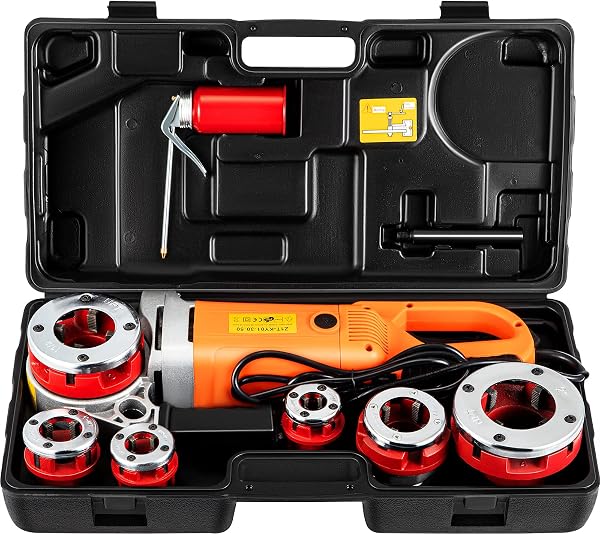
VEVOR 2300W Threader
6.8Editor score2300W copper motor
22 RPM speed
Six carbon-steel dies
1/2-2 inch range
Compare 10 pipe threading machines by motor power, die range, spindle speed, pipe capacity, portability, and job-site controls for plumbing and mechanical ...
Find the right pipe threading machines for 2026 by comparing motor power, die range, spindle speed, pipe capacity, portability, and job-site controls. We break down 10 electric, cordless, and manual options, including compact handheld units and complete power-drive kits, so you can match threading performance to plumbing, HVAC, mechanical, or maintenance work.
Threading machines differ in drive type, die material, size coverage, and setup support. Cordless models prioritize mobility, electric handheld units emphasize continuous production, and manual ratcheters suit occasional repairs or remote locations. Understanding those distinctions helps you avoid paying for excess capacity or discovering too late that a die set does not cover your common pipe sizes.
Before choosing, decide whether you need NPT dies, a support arm, oil-feed automation, or a full rolling stand. Weight, RPM, reversible operation, and die-change convenience all affect daily productivity. The comparison below highlights the practical strengths and meaningful limitations of each machine, helping you balance first cost against durability, runtime, accuracy, and long-term maintenance.
We compared 10 pipe threading machines using drive type, motor output, spindle speed, threading range, die material, pipe capacity, portability, controls, oil delivery, and included accessories. The evaluation emphasizes practical trade-offs between handheld electric units, cordless systems, stationary power drives, and manual ratcheters, so each recommendation connects to real plumbing, mechanical, HVAC, and maintenance workflows rather than specifications alone.


Compare key features, scores, and current prices side by side. A shorter feature list means fewer details were available, not necessarily fewer capabilities.


The Milwaukee 2870-22 is the strongest overall choice for mobile professionals who need threader performance without managing a power cord. It covers 1/2 through 1-1/4 inch pipe with durable aluminum dies and operates on the M18 FUEL platform, making it well suited to mechanical, HVAC, and plumbing work in basements, ceilings, rooftops, and partially finished buildings.
We may earn a commission when you buy through this link, at no additional cost to you.
The kit includes two M18 REDLITHIUM HIGH OUTPUT XC8.0 batteries, which support extended runtime and allow one pack to charge while the other remains in service. The compact design and included support arm improve stability in confined spaces while reducing operator fatigue and kickback risk. Aluminum dies also contribute to lighter handling without sacrificing the threaded range needed for common piping work.
ONE-Key technology adds remote tool tracking, theft protection, and customizable settings through the Milwaukee app, giving crews greater control over equipment on busy job sites. The cordless format removes tripping hazards and eliminates the time spent running extension cords to distant work areas. The 5.0-star owner rating is the strongest in this comparison and reflects strong user satisfaction.
Two 8.0Ah batteries improve continuity, but actual runtime depends on pipe material, size, thread depth, and feed pressure. Rotating packs between jobs keeps work moving while the depleted battery charges. Crews with full-day threading schedules should consider a third battery so charging downtime never stops production.
The tradeoff is capacity and cost: the 1-1/4 inch maximum is smaller than the 2-inch range offered by several competitors, and the professional kit carries a premium price. Choose this threader if mobility, battery runtime, digital management, and strong owner feedback are priorities. Buyers who routinely thread up to 2 inches should select a corded model with the larger die set instead.
Users who regularly thread pipe above 1-1/4 inches or who need a lower-cost corded setup for a fixed workshop.
We may earn a commission when you buy through this link, at no additional cost to you.
The VEVOR threader is aimed at maintenance crews, plumbers, and capable DIYers who want electric threading from 1/2 inch through 2 inches without investing in a full stationary rig. Its main appeal is the complete package: six carbon-steel dies, a pipe clamp, fixed bar, oil can, replacement brushes, and a carrying case arrive together, reducing the chance of buying accessories separately.
We may earn a commission when you buy through this link, at no additional cost to you.
The 2300W motor produces a stable no-load speed of 22 RPM, while the all-copper core coils are designed for durability under heavy loads. The six die heads are replaceable, which matters because a damaged or worn die can be swapped instead of replacing the entire threading assembly. Carbon-steel construction also suits repeated use on galvanized, iron, and plastic pipe when the correct die is selected.
Operation is straightforward thanks to the security button and forward/reverse switch, both of which help prevent accidental starts and make die release easier. The compact, ergonomic housing keeps the unit manageable for handheld work, and the case helps organize sharp dies and small accessories. The included oil can supports manual lubrication, which remains an important part of producing clean threads.
A 22 RPM no-load speed is adequate for controlled, intermittent threading, especially on smaller pipe sizes and softer materials. It is not necessarily a defect; slower rotation can encourage steady feed pressure and cleaner cuts. Production environments that thread many fittings consecutively, however, may notice a meaningful time difference compared with faster spindle speeds.
The tradeoff is pace and confidence: 22 RPM trails several 26 RPM competitors, and the 3.4-star owner rating suggests some buyers encountered issues. This unit makes sense for occasional to moderate threading work where low first cost and broad die coverage matter more than maximum production speed. High-volume shops should consider faster or more robust systems.
Shops needing fast continuous production or buyers who prioritize consistently strong owner feedback over a low package price.
We may earn a commission when you buy through this link, at no additional cost to you.
This handheld threader targets plumbers and maintenance technicians who work primarily with North American NPT connections and want a slightly quicker spindle than entry-level 22 RPM models. The 2300W copper motor maintains a 26 RPM no-load speed, and the full copper core design is intended to provide stable output and improved heat dissipation during longer threading sessions.
We may earn a commission when you buy through this link, at no additional cost to you.
The six NPT dies are made from high-hardness 9SiCr alloy steel, a material choice that helps resist slipping and wear while producing clean, precise threads. The set covers 1/2, 3/4, 1, 1-1/4, 1-1/2, and 2 inches, and handles galvanized steel, carbon steel, iron, copper, aluminum, and plastic. That versatility is useful for mixed repair work, provided the material and thread standard are confirmed before cutting.
The forward/reverse switch simplifies threading and die removal, while the built-in safety lock reduces the chance of accidental startup. The non-slip waterproof handle is designed to keep grip comfortable in damp plumbing environments, and the molded case organizes the threader, dies, pipe clamp, oil can, and carbon brushes. At approximately 29.5 pounds, it remains portable but is not the lightest option available.
NPT and BSPT threads use different profiles and sealing geometry, so a die intended for one standard will not create a reliable connection on the other. Mixing them can produce poorly fitting threads, leaks, and wasted material. Always confirm whether your project uses NPT or BSPT before purchasing, and keep dedicated dies clearly labeled if your shop handles both standards.
The major caution is the 3.0-star owner rating, which indicates a notable number of dissatisfied buyers despite the attractive specifications. The NPT-only dies also exclude users working with BSPT fittings. Choose this model if you need 26 RPM NPT threading and understand the thread standard requirement; otherwise, verify compatibility and consider a machine with stronger documented owner satisfaction.
Buyers working with BSPT fittings or those who need stronger owner-reported reliability before committing to a portable electric threader.
We may earn a commission when you buy through this link, at no additional cost to you.
The RIDGID Model 300 is designed for professional shops and higher-volume mechanical work rather than occasional household repairs. It centers, grips, and rotates pipe, conduit, and rod so cutting, threading, and reaming can be completed efficiently. The complete kit includes the power drive, stand with tray, carriage and lever, reamer, cutter, die head, universal alloy dies from 1/2 through 2 inches, and an oiler with one gallon of thread-cutting oil.
We may earn a commission when you buy through this link, at no additional cost to you.
The reversible 1/2 HP universal motor runs at 38 RPM and uses a RIDGID speed chuck for consistent performance. That speed advantage can improve throughput on repeated jobs, while the carriage is engineered to hold threading tools securely and glide along heavy-duty support bars. The same machine also supports roll grooving, which makes it attractive for shops that work with grooved pipe systems alongside conventional threaded connections.
Setup and mobility are addressed through the integral locking tray, folding legs, and transport wheels. The stand keeps the machine stable during production runs, and the folding design makes storage more practical than a fixed bench installation. The included oiler and full gallon of cutting oil also reduce the immediate accessory purchases required after unboxing.
Roll grooving creates a cold-formed groove in the pipe end for grooved couplings, offering an alternative to threaded joints in larger or higher-volume systems. Having threading and grooving functions in one stationary setup reduces the need to move work between separate machines. For contractors already installing grooved systems, this dual capability can streamline workflow and justify a larger equipment investment.
The tradeoff is cost and owner sentiment: this is by far the most expensive option in the comparison, and its 3.6-star rating is lower than several portable alternatives. It suits established mechanical, plumbing, or fabrication businesses that need a stationary threading and grooving station and can justify the investment through daily use. Occasional users should consider a handheld model instead.
Homeowners or occasional repair crews who need only light threading and do not want to invest in a large stationary power-drive station.
We may earn a commission when you buy through this link, at no additional cost to you.
This portable NPT threader is best suited to handheld maintenance work where motor durability and reduced component weight matter. It uses a 100 percent pure copper motor with a silicon lamination stator, which the design targets quieter, more stable operation than older copper-clad aluminum constructions. The 110V, 2300W unit maintains a rated spindle speed of 26 RPM across the 1/2 through 2 inch die range.
We may earn a commission when you buy through this link, at no additional cost to you.
The aluminum alloy die heads are 5.43 pounds lighter than comparable cast-iron heads and are intended to address the brittleness and fracture risk associated with cast iron. That reduction can make die changes and handheld positioning less strenuous over a full workday. The six high-speed steel dies provide stronger, more durable cutting edges than basic carbon-steel alternatives and are designed to produce clearer threads with higher precision.
Six replacement brushes are included, which is a practical advantage because brushes are a common wear item on electric motors. Having spares on hand reduces downtime during a project and makes field servicing simpler. The compact handheld format suits plumbers, maintenance workers, and industrial or mining crews who need a complete specification range in one portable kit.
Die heads endure repeated torque and vibration, so material choice affects both longevity and handling. Cast iron can be rigid but more vulnerable to cracking under impact, while aluminum alloy reduces weight and improves shock resistance. For technicians carrying equipment between floors or job sites, lighter alloy heads can reduce fatigue and make quick die changes easier.
The main limitation is the 2-inch ceiling, which excludes larger production threading tasks. The 3.8-star rating also suggests that some owners experienced issues despite the upgraded components. Choose this model if you value the pure copper motor, lighter alloy heads, and HSS dies; skip it if your work regularly exceeds 2 inches or requires a stationary support setup.
Users who need threaded pipe larger than 2 inches or a stationary carriage system for high-volume production.
We may earn a commission when you buy through this link, at no additional cost to you.
This handheld electric threader offers one of the strongest value propositions in the lineup, combining a 2300W motor with six die heads at a substantially lower price than most competing kits. It is a practical choice for homeowners, small plumbing contractors, and maintenance teams tackling galvanized, iron, and PP pipe across water, electrical, and gas applications from 1/2 through 2 inches.
We may earn a commission when you buy through this link, at no additional cost to you.
The pure copper construction is designed for durability and resistance to damage, while the external carbon brush replacement port simplifies servicing without disassembling the main housing. Standard pipe cutting threads are intended to improve precision, and the compact handle design reduces effort during extended use. The fixed rod helps secure the pipe so mating sections remain aligned during threading.
Controls are unusually thorough for this price range: a forward/reverse switch, locking power switch, and separate start switch let the operator select functions clearly. The heat dissipation window also improves safety during prolonged runs. Together, these features make the machine easier to manage than basic single-switch units, especially for users who alternate between threading and die removal.
Separate forward/reverse, locking power, and start controls reduce confusion during repetitive work. The locking switch can hold the tool ready, while the start switch initiates operation, and reverse assists with die release. New users should test each control on an unthreaded scrap piece before beginning production work so the function sequence becomes familiar.
The missing spindle speed specification makes it difficult to compare cutting pace directly with 22, 26, or 27 RPM models. The 2-inch maximum also rules out larger commercial stock. For buyers who need capable electric threading on a tight budget and work mostly within the 1/2 to 2 inch range, this kit delivers the strongest price-to-feature balance in the group.
Buyers who routinely thread pipe larger than 2 inches or who need a documented spindle speed for strict production scheduling.
We may earn a commission when you buy through this link, at no additional cost to you.
The Milwaukee 2874-22HD is positioned as a professional-grade M18 FUEL pipe threader for tradespeople who already rely on Milwaukee's cordless ecosystem. Its main advantage is the combination of portable threading power and the included ONE-Key kit, which connects the tool to Milwaukee's jobsite management platform. That makes it especially relevant for crews that want to organize equipment beyond basic operation.
We may earn a commission when you buy through this link, at no additional cost to you.
M18 FUEL tools are built around Milwaukee’s high-output battery platform, and the cordless format removes extension cords from congested work areas. The ONE-Key inclusion indicates support for tool tracking and digital management, although buyers should confirm exactly which app features apply to this model before assuming specific functionality. The 4.3-star rating reflects generally positive owner sentiment among professional users.
Because the available details do not list spindle speed, threading range, die material, or included accessories, verification is essential before purchase. Confirm the pipe sizes you thread most often, whether additional dies are required, and whether batteries and a charger are part of the kit. This prevents compatibility surprises on active job sites where downtime is costly.
ONE-Key is Milwaukee’s digital tool-management platform, and its value depends on the specific tool and crew workflow. It can help with equipment organization and location awareness on large sites, but feature availability varies by model. Before buying, review the current tool profile in the app to confirm that the functions you need are supported rather than assuming every ONE-Key tool offers identical capabilities.
This model is best for professional plumbers, mechanical contractors, and maintenance teams invested in M18 FUEL batteries who value cordless mobility and ONE-Key integration. It is less suitable for budget buyers or shops that need a documented 2-inch threading range and continuous corded power. Compare the complete package contents carefully against corded alternatives.
Buyers who need clearly documented 2-inch capacity, spindle speed, and die specifications or who do not already use M18 FUEL batteries.
We may earn a commission when you buy through this link, at no additional cost to you.
The RIDGID Model 690-I is a handheld power-drive kit intended for mobile tradespeople who frequently change die sizes on 1/2 through 2 inch NPT pipe. Its defining feature is the quick-release die head retaining system: a simple twist-and-release mechanism lets operators attach and detach die heads and adapters without extra tools, which can reduce setup time between differently sized jobs.
We may earn a commission when you buy through this link, at no additional cost to you.
The 11-R NPT die heads provide the standard thread form for plumbing and mechanical connections. The dual V jaw support arm firmly secures the workpiece and helps prevent slipping during rotation, contributing to more accurate threading on demanding applications. An over-molded handle and contoured grip are designed to improve control and reduce fatigue during extended use.
Maintenance is simplified through screw-in brush covers, which provide quick access to essential components and can reduce service downtime. The rugged carrying case keeps the power drive, die heads, and related components together, while the construction is engineered to withstand demanding job-site conditions. These practical details matter when the tool is loaded and unloaded frequently.
On jobs that alternate between pipe sizes, removing and installing die heads repeatedly can consume noticeable time. A twist-and-release system eliminates separate wrenches and reduces the chance of losing small retaining parts. The benefit is largest for maintenance crews and mechanical contractors handling mixed diameters in a single day rather than users who thread one size exclusively.
The tradeoff is owner feedback and price: the 3.3-star rating is a significant caution despite the professional features, and the cost is high for a handheld unit. It is most appropriate for contractors who value rapid die changes, dual-jaw stability, and RIDGID service infrastructure. Budget-conscious or occasional users should weigh the mixed reviews carefully.
Buyers sensitive to mixed owner reviews or those seeking a low-cost handheld threader for infrequent use.
We may earn a commission when you buy through this link, at no additional cost to you.
The BLUEROCK PTM50-C suits plumbing and maintenance users who want automated lubrication and combined pipe preparation in a 1/2 through 2 inch package. It threads, reams, and cuts pipe, allowing several preparation steps to be handled with one machine rather than switching between separate hand tools. The automatic oil feed is the standout convenience feature for repetitive work.
We may earn a commission when you buy through this link, at no additional cost to you.
The 110V, 750W, 7-amp motor drives the threader at 27 RPM, and the forward/reverse gearbox switch supports threading and die removal. HSS NPT dies are included, with a 14-thread-per-inch arrangement for the 1/2 and 3/4 inch set and larger 1 to 2 inch dies that fit RIDGID Type 811A. That compatibility can simplify replacement die purchases for users already invested in that system.
Automatic oil delivery helps maintain consistent lubrication at the cutting interface, which is important for thread quality and die life. Manual oiling between cuts becomes less necessary, and operators can focus more on alignment and feed pressure. The 27 RPM speed is competitive with other portable electric models, while the forward/reverse control adds practical flexibility.
Consistent lubrication reduces friction and heat as the die cuts into pipe, helping produce cleaner threads and extending die life. An automatic feed removes the guesswork from manual oiling and supports steadier production pacing. It is most valuable in shops and crews that thread numerous fittings daily rather than for one-off repairs.
The main limitation is power: 750W is substantially lower than the 2300W units in this comparison, which may matter on dense steel or during continuous production. The 3.9-star rating is respectable but not exceptional. Choose the PTM50-C if automatic oil feed and RIDGID-compatible larger dies are priorities; choose a higher-wattage model for heavier throughput.
Heavy production environments needing maximum motor power or users who frequently thread material beyond 2 inches.
We may earn a commission when you buy through this link, at no additional cost to you.
The RIDGID 36475 is a manual exposed ratchet threader set for plumbers, maintenance technicians, and field crews who need dependable threading without a power source. It is especially useful for remote repairs, tight utility spaces, and occasional pipe work where running a corded machine or charging batteries is impractical. The ratchet design makes threading quicker and less strenuous than basic manual dies.
We may earn a commission when you buy through this link, at no additional cost to you.
The set includes 1/2, 3/4, 1, 1-1/4, 1-1/2, and 2 inch die heads, each fitting the ratchet without additional adapters. The ductile cast iron heads are rugged and resistant to job-site impacts, while the alloy dies produce standard NPT threads. The exposed ratchet system is described as covering a 1/8 to 2 inch working range, giving flexibility across common pipe and conduit sizes.
Organization is a practical strength. The lightweight yet rugged carrying case has labeled compartments for every die head, keeping sharp components separated and easy to identify. The all-in-one package includes the die heads, ratchet assembly, ratchet handle, alloy dies, and case, so a crew can arrive with a complete manual threading solution in one manageable package.
Manual ratchet threaders excel when electricity is unavailable, when work occurs far from outlets, or when only a few fittings need threading. They are quieter, require no batteries or motor maintenance, and are simple to transport. For emergency repairs and light maintenance, the speed penalty is often less important than independence from power sources.
The tradeoff is effort and speed: manual ratcheting takes longer and demands more physical work than electric or cordless machines, particularly on larger pipe. The 4.7-star rating and professional RIDGID heritage make it a dependable choice for occasional use and power-free environments. High-volume production work is better suited to a powered threader.
High-volume threading operations or crews that need powered speed and reduced physical effort.
We may earn a commission when you buy through this link, at no additional cost to you.
A pipe threading machine is a production tool, not just a cutting accessory. The best choice depends on the pipe sizes you thread most often, the material, daily volume, available power, and how much physical effort you can reasonably manage. Review the following factors before comparing prices.
Corded electric threaders provide continuous power without battery management, making them suitable for workshops and job sites with reliable outlets. Models with 2300W motors and spindle speeds around 22 to 26 RPM are designed for handheld threading across 1/2 through 2 inch pipe. Lower-wattage units such as a 750W machine may still handle common work, but motor output affects how confidently the tool cuts denser steel and maintains speed under pressure.
Cordless threaders remove extension cords and reduce trip hazards, which is valuable in partially completed buildings, ceilings, and remote service calls. A professional cordless kit with two high-capacity batteries can support longer sessions through battery rotation, but you should verify the threaded size range before assuming it can replace a corded unit. Manual ratchet threaders require no power at all and remain practical for occasional repairs, though they demand more physical effort.
Choose the drive type that matches your work location and volume. Use corded electric for steady shop or site power, cordless for mobility within a battery platform, and manual for light, infrequent, or power-free work. Buying a powered machine solely to avoid effort is wasteful if you only thread a few fittings per month.
Threading range defines the largest and smallest pipe the machine can handle. Many handheld electric kits cover 1/2 through 2 inches, while compact cordless systems may stop at 1-1/4 inches. Select the range based on the pipe sizes you actually use, not the theoretical maximum. A 2-inch machine offers flexibility, but a 1-1/4-inch model can be lighter and easier to control if that is your regular limit.
Die standard and material are equally important. NPT dies are common in North American plumbing, while BSPT dies are used in many other regions; some machines explicitly support only NPT. Carbon-steel dies offer basic durability, high-speed steel dies resist wear and produce precise threads, and alloy die heads can reduce weight compared with cast iron. Replaceable die heads also lower long-term ownership costs because a worn die does not require replacing the entire machine.
Match the die set to your pipe material and thread standard before purchase. Confirm whether larger dies are compatible with an existing system, keep each die labeled by size, and avoid forcing a machine beyond its listed range. The lowest price is not useful if the included dies do not cover your most common fittings.
No-load spindle speed affects how quickly a threader can complete each cut, but higher RPM is not automatically better. Machines in this category range from 22 RPM to 38 RPM. Faster speeds can improve throughput on repetitive production work, while controlled speeds may allow steadier feed pressure and cleaner thread formation. Material hardness, pipe diameter, and die condition all influence the result.
Motor power and speed should be evaluated together. A 2300W motor at 26 RPM generally offers more reserve for demanding stock than a smaller motor at a similar speed, while a stationary 1/2 HP drive at 38 RPM is aimed at higher-volume professional use. Review the stated speed carefully because some budget kits do not publish it, making direct productivity comparisons difficult.
For occasional plumbing repairs, a 22 to 27 RPM handheld unit is usually sufficient. For daily production or mixed commercial work, prioritize documented speed, motor output, and die durability. Never judge capability by wattage alone; spindle design, die quality, and workpiece support matter just as much.
Threading accuracy depends on how securely the pipe and machine are held. A fixed bar, pipe clamp, or support arm helps align the workpiece, while a dual V jaw support arm can prevent slipping during rotation. On stationary models, a carriage gliding on heavy-duty support bars and a locking stand tray contribute to repeatable, stable cuts. Handheld units benefit from compact, balanced housings that reduce operator fatigue.
Weight and handling matter more than many buyers expect. A 29-pound handheld threader may still be awkward overhead or above a trench, and a stationary stand adds footprint even when folding legs and transport wheels improve mobility. Over-molded handles, contoured grips, and lightweight alloy die heads can reduce strain during long shifts, but they do not eliminate the physical demands of threading.
Choose support features based on your typical work position. For bench or floor production, prioritize a stand, carriage, and rigid base. For mobile repairs, prioritize compact weight, a support arm, and secure clamping. Test whether the included clamp can handle the pipe materials you use before relying on the machine for angled or overhead work.
Thread cutting oil reduces friction and heat where the die engages the pipe, helping produce cleaner threads and extending die life. Some machines include an oil can or oiler, while others offer automatic oil feed that delivers lubrication during operation. An automatic system is most useful on repetitive production runs because it removes the need to remember manual lubrication between cuts.
The quality of the finished thread also depends on die material, condition, and correct speed. High-speed steel dies are designed for clearer, more precise threads, while worn or incorrect dies can create burrs, poor fits, or leak-prone connections. A machine that cuts, reams, and threads can simplify preparation, but each function still requires proper alignment and sharp cutting components.
Plan lubrication as part of the workflow, not an afterthought. Use the recommended thread-cutting oil, inspect dies for wear, and replace damaged cutting heads promptly. If you thread large volumes daily, automatic oil feed and high-quality dies are worth the investment; for occasional use, a included oil can and careful technique may be enough.
Practical controls improve both safety and efficiency. Forward/reverse switching assists threading and die removal, while a security button or safety lock helps prevent accidental startup. Some handheld units add a locking power switch and separate start switch, along with a heat dissipation window for safer prolonged operation. Clear controls matter in noisy, crowded work areas where mistakes are more likely.
Maintenance access is another differentiator. An external carbon brush replacement port simplifies servicing, and screw-in brush covers reduce downtime on professional power drives. Six included replacement brushes can be valuable because brushes are routine wear parts. Quick-release die heads further reduce service and changeover time by eliminating extra tools.
Before buying, confirm that the controls are easy to reach and that the power direction is clearly marked. Check brush replacement access, die retention, and the availability of spare parts. A slightly cheaper machine can cost more over time if maintenance requires extensive disassembly or replacement components are difficult to obtain.
The listed price of a threader does not always reflect the complete working package. Some kits include six dies, a carrying case, pipe clamp, fixed bar, oil can, replacement brushes, or cutting oil, while others require additional purchases. A complete kit can save money and setup time, especially for crews that need multiple die sizes immediately.
Owner ratings and warranty support provide additional context, but interpret them carefully. A high rating usually indicates broad satisfaction, while a lower rating does not always mean poor construction; it may reflect shipping, assembly, or expectation issues. Professional stationary systems with stands, cutters, reamers, and grooving capability naturally cost more than compact handheld units.
Compare total value by adding required dies, batteries, oil, and accessories to the base price. Select the least expensive machine that covers your pipe sizes, thread standard, and expected volume with adequate support features. Paying more is justified only when durability, speed, mobility, or included components directly improve your workflow.
Set up the machine on a stable surface and secure the pipe with the supplied clamp, fixed bar, or support arm before starting. Inspect the die for the correct size, thread standard, and visible damage, then align the cutting head squarely with the pipe end. Let the powered machine reach full operating speed before contacting the material, apply steady pressure, and avoid forcing the cut. Use the forward/reverse control only as intended and never reach near the die while the spindle is moving.
During operation, watch for excessive vibration, smoke, unusual noise, or slowed rotation, all of which can indicate a dull die, insufficient lubrication, or overly aggressive feed pressure. Clear chips periodically rather than allowing them to accumulate around the die head or motor vents. For cordless models, rotate batteries and monitor charge level so a depleted pack does not interrupt a critical connection. On manual ratchet units, use smooth strokes and reposition the clamp if the pipe begins to shift.
After use, disconnect power or remove the battery, clean the die head and frame, and inspect the dies, brushes, clamp, and support arm for wear. Store the machine and die heads in a dry, organized case away from moisture and sharp debris. Lubricate according to the recommended procedure, replace worn cutting components promptly, and never use a threader with a damaged guard, loose fastener, or unreliable switch. Proper care improves thread quality and extends both motor and die life.
Choose a machine whose die range covers the largest pipe you regularly thread. Many handheld electric kits handle 1/2 through 2 inches, while compact cordless models may cover up to 1-1/4 inches. Buying a larger range than necessary adds weight and cost, but buying too small leaves you unable to handle occasional larger work.
Electric threaders are faster and require less physical effort, making them better for repetitive or production work. Manual ratchet sets need no power, are quieter, and are useful for remote repairs or occasional jobs. The best option depends on volume, site power availability, and the pipe sizes you thread.
NPT and BSPT are different pipe thread standards with distinct profiles and sealing methods. A die designed for one standard will not reliably create a proper connection for the other. Confirm the thread standard used in your region and existing fittings before purchasing, because some machines are NPT only.
Automatic oil feed is most valuable for shops that thread many pipes each day. It maintains consistent lubrication and reduces the chance of forgetting oil between cuts. For occasional repairs, a machine with an included oil can and proper technique can deliver acceptable results at a lower price.
Some machines are designed to cut, ream, and thread pipe, while others focus primarily on threading. Combined preparation functions can reduce tool changes, but the capability varies by model. Check the product specifications before assuming that a threader can also prepare the pipe end.
A support arm, clamp, or stand improves stability and helps keep the die aligned with the pipe. It is especially important for larger diameters, repetitive production, or overhead work. Small handheld jobs may be manageable with a basic clamp, but added support generally improves accuracy and reduces operator fatigue.
Clean chips from the die head and body after use, inspect dies for wear, and lubricate according to the recommended procedure. Check switches, guards, brushes, and clamps regularly, and replace damaged components promptly. Store the machine dry and keep sharp dies separated in a labeled case.
Die price reflects material, precision, durability, and thread standard. High-speed steel dies typically resist wear and produce cleaner threads longer than basic carbon-steel options. Alloy or ductile cast-iron die heads can also add strength and reduce weight, which may justify higher cost for frequent use.
A cordless threader can support production work when its battery capacity and pipe range match the job. Kits with two high-capacity batteries allow rotation during charging, but dense material and large diameters reduce runtime. Full-time shops should compare output, size limit, and spare battery cost before replacing a corded machine.
Wear eye protection and appropriate gloves, secure the workpiece, and keep hands away from the rotating die. Use the safety lock or security button to prevent accidental starts, and never bypass guards or controls. Follow the manufacturer instructions for speed, lubrication, and maintenance, and inspect the tool before each use.
The Milwaukee 2870-22 stands out as the strongest overall choice because it combines cordless M18 FUEL operation, two 8.0Ah batteries, aluminum dies, a compact support arm, ONE-Key integration, and a perfect 5.0-star owner rating. Its 1/2 to 1-1/4 inch range is well suited to mobile plumbing, HVAC, and mechanical work where cord management and setup speed matter.
Different buyers have strong alternatives. The RIDGID Model 300 is the premium stationary choice for shops that need a complete stand, carriage, cutting and reaming tools, roll grooving, and 38 RPM production speed. The 2300W handheld kit offers exceptional value for budget-conscious users, while the RIDGID 36475 manual ratchet set remains dependable for power-free repairs and occasional threading.
Match the machine to your most common pipe size, material, and daily volume before comparing price. Verify the thread standard, die compatibility, included accessories, and support features, then choose the drive type that fits your work environment. A correctly selected threading machine delivers cleaner connections, faster preparation, and more reliable performance for years of professional or household maintenance work.