Pyle PLMR605W
9.0Editor score400-watt peak power
200-watt RMS output
90dB sensitivity rating
85Hz-20kHz frequency response
Find the right marine speakers for 2026. We compare 9 standout options by build quality, useful features, owner feedback, value, and everyday trade-offs.
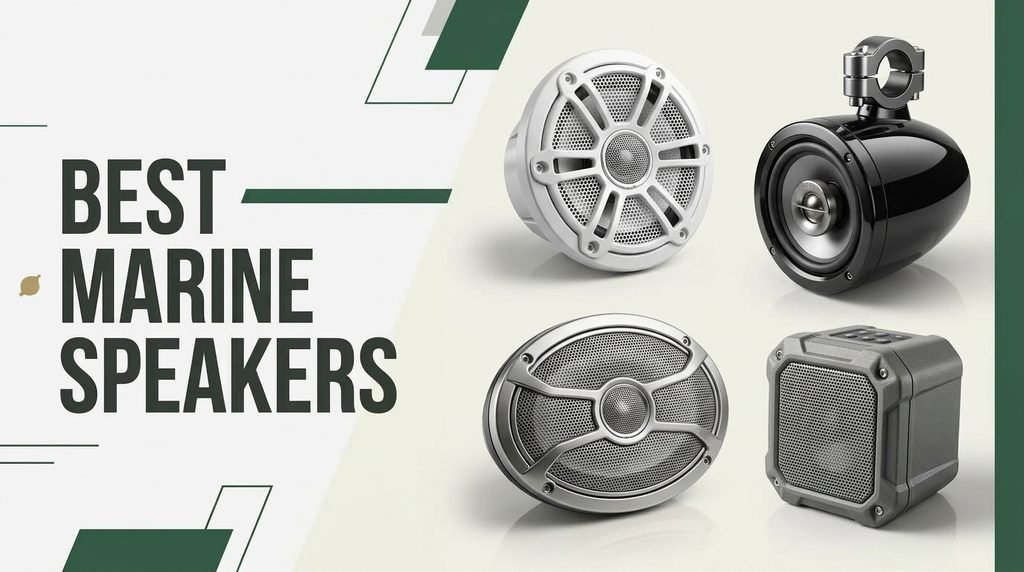
Find the right marine speakers for 2026 boating adventures. We compare 10 standout pairs by the details that matter most on the water: power handling, weatherproofing ratings, cone materials, UV resistance, salt-fog protection, mounting depth, frequency response, tweeter design, and long-term value for saltwater and freshwater environments.
The best speakers for your boat depend on where you cruise, how loud you want to play music, and whether you need pure marine construction or dual-purpose speakers that also work in vehicles. Cone materials, tweeter quality, and IP ratings all shape both sound quality and how long the speakers survive outdoor exposure.
Only nine speaker pairs are compared in this guide because that reflects the full set we researched for this category. The lineup spans budget-friendly upgrades under forty dollars all the way to premium branded pairs with two-year warranties, so you can match the right level of investment to how often you actually use your boat.
We compared marine speakers using the factors that shape real on-water performance: power handling in RMS and peak watts, cone and surround materials, tweeter design, UV and salt-fog resistance, mounting depth and cutout size, impedance, frequency response range, warranty signals, and owner feedback. The notes focus on practical tradeoffs so each pick reflects how people actually install, use, and maintain speakers on boats, personal watercraft, and off-road vehicles exposed to sun, spray, and humidity.

Compare key features, scores, and current prices side by side. A shorter feature list means fewer details were available, not necessarily fewer capabilities.
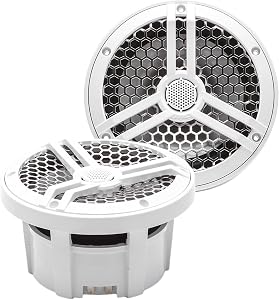


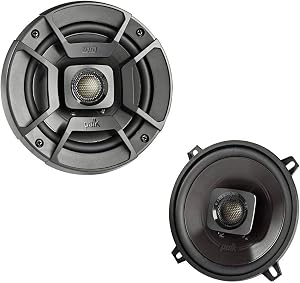


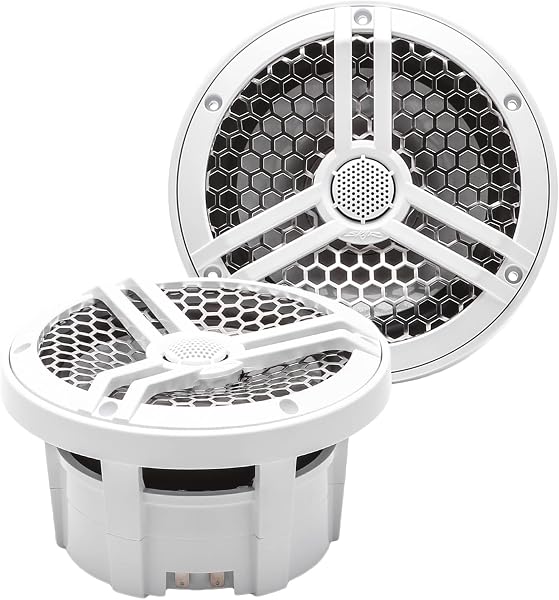
The Skar Audio SK65M earns our top pick by delivering a balanced combination of power handling, build quality, and price that suits most recreational boat owners. The 6.5-inch coaxial design fits standard marine speaker cutouts, and the 320 watts of peak power with 160 watts RMS gives you enough headroom to fill an open deck with music without pushing the drivers to distortion. This makes them a practical upgrade for anyone replacing weak factory speakers.
We may earn a commission when you buy through this link, at no additional cost to you.
The microfiber composite mineral-filled mid-woofer cone paired with a butyl rubber surround handles the physical demands of marine use well. Butyl surrounds resist moisture, salt exposure, and UV damage better than foam alternatives that tend to break down within a few seasons. The 1-inch silk dome tweeter mounted on top of the mid-range produces smoother, less fatiguing high frequencies than metal dome tweeters, which matters during long days on the water.
The frequency response of 57Hz to 20,000Hz covers most of what music needs to sound full, though pairing these with a dedicated subwoofer will still give you meaningfully more bass impact for genres like electronic or hip-hop. The 4-ohm impedance works with virtually any marine amplifier or head unit, and the 88dB sensitivity means these speakers do not require excessive amplifier power to reach comfortable listening levels.
Silk dome tweeters produce warmer, more natural high frequencies compared to aluminum or titanium tweeters that can sound harsh at high volumes. On a boat where wind noise and engine sound compete with your music, softer treble reproduction actually helps voices and instruments cut through without becoming fatiguing over a full day of listening. The silk material also handles humidity and salt exposure better than paper or fabric alternatives, extending the practical lifespan of the tweeter in marine environments.
For most boat owners who want a real audio upgrade without moving into premium branded territory, the SK65M delivers where it counts. The main tradeoffs are the white-only finish, which may not suit every boat aesthetic, and a sensitivity rating slightly below some competitors that means marginally more power is needed for the same volume. For everything else, this pair represents strong value in the mid-tier segment.
Buyers who need black or dark-colored speakers to match a specific boat interior aesthetic.
We may earn a commission when you buy through this link, at no additional cost to you.
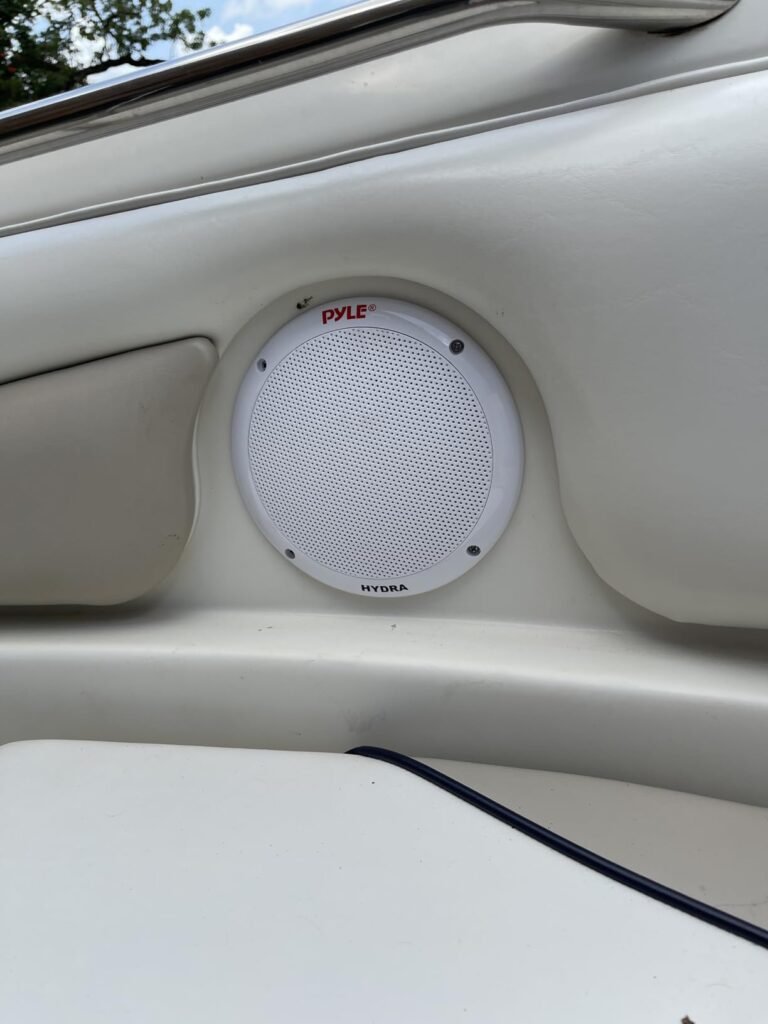
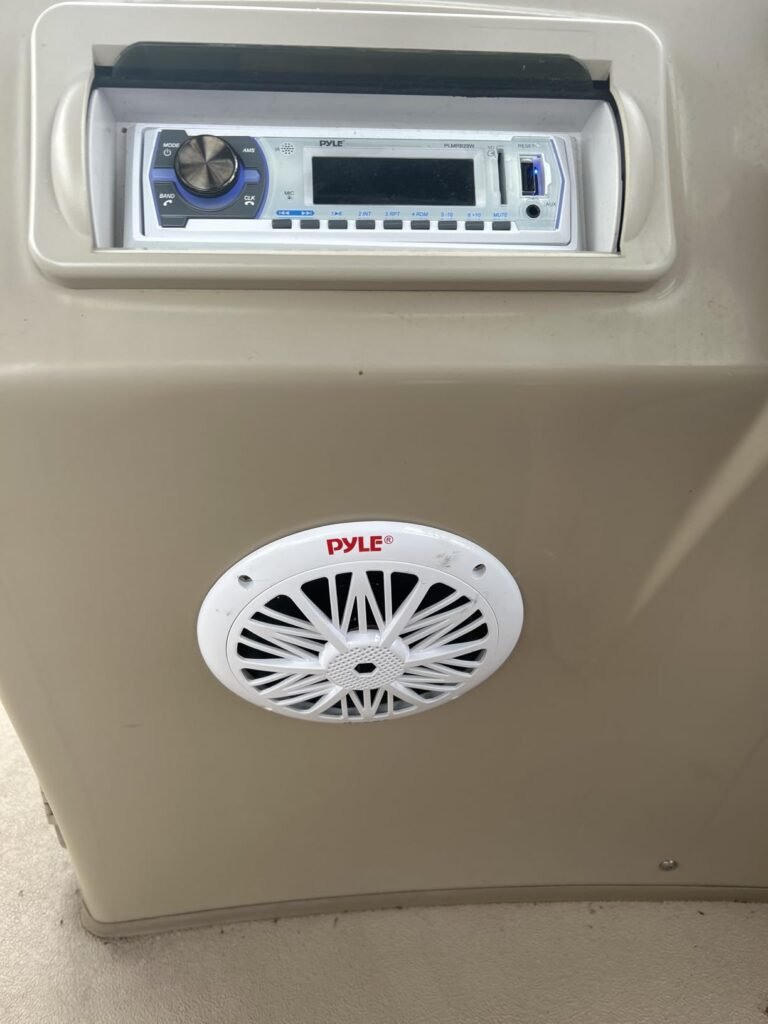
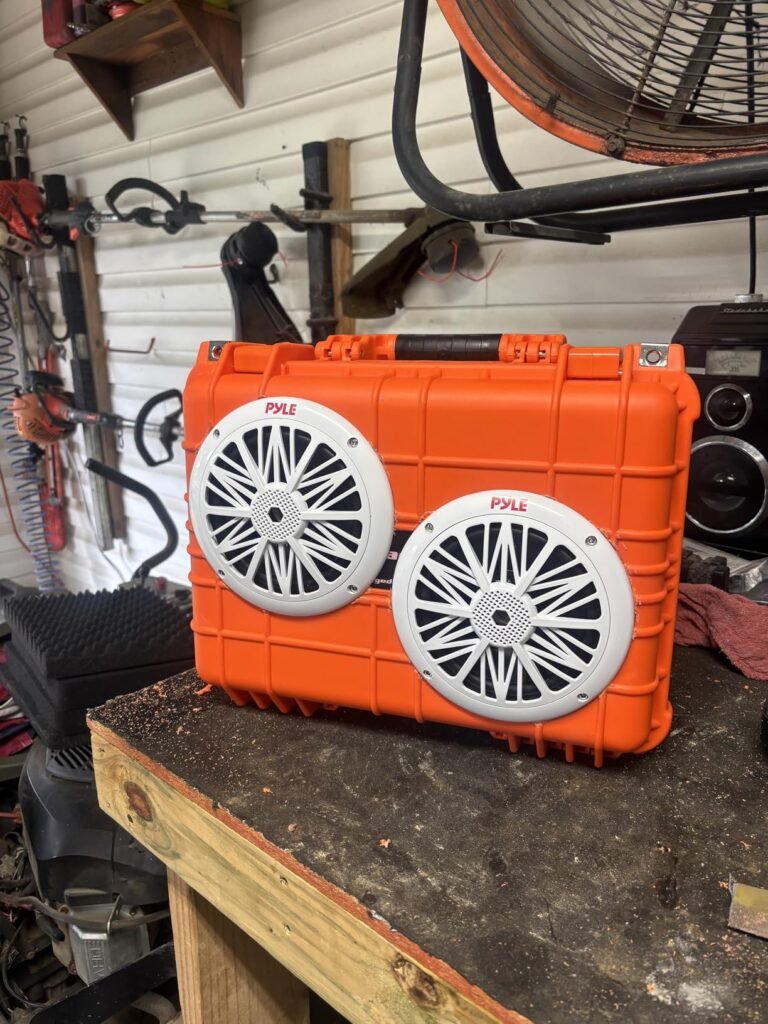
The Pyle PLMR605W hits an appealing price point for boat owners who need functional marine speakers without a major investment. At around thirty dollars for a pair, these are an easy upgrade from tired factory speakers or a first set for a project boat where budget matters more than premium audio performance. The 400-watt peak power rating gives them enough headroom for casual listening at reasonable volumes.
We may earn a commission when you buy through this link, at no additional cost to you.
The polypropylene cone paired with butyl rubber surround provides genuine water resistance and durability against splashes, spray, and typical marine exposure. Heavy-duty molded ABS plastic basket and grille construction help resist UV damage and the general beating that outdoor speakers take from sun and salt. The 20oz circuit magnet supports full-range audio, though the 85Hz low-frequency limit means these will not deliver deep bass without additional subwoofer support.
Installation is straightforward with the standard 6.5-inch size and included wiring and mounting hardware. The 2.48-inch mounting depth and 5.31-inch cutout size match universal OEM replacement dimensions, so these drop into most existing marine speaker locations without modification. The 90dB sensitivity is efficient enough to run off modest amplifier power, and the 4-ohm impedance works with virtually any head unit.
Not every boat needs premium marine audio. If you use your boat primarily for fishing and only occasionally play background music, or if you have a project boat where you want basic sound while working on other upgrades, spending forty dollars instead of two hundred lets you allocate budget to more critical items. Budget marine speakers also make sense for freshwater boats used in mild climates where extreme UV and salt exposure are less of a concern for long-term durability.
The clear tradeoff is that budget marine speakers cannot match the sound quality, cone materials, or long-term durability of premium options. Expect adequate but not audiophile-grade performance, and understand that these may not last as long in harsh saltwater environments as speakers costing three or four times more. For pontoon boats, fishing boats, or occasional-use watercraft where hearing music matters more than critical listening, the PLMR605W represents genuine value.
Audiophiles who want premium sound quality, deep bass response, or long-term durability in harsh saltwater conditions.
We may earn a commission when you buy through this link, at no additional cost to you.
The Kicker KM65 stands out for the level of thought Kicker put into marine-specific engineering. Every exposed component receives UV treatment, from the injection-molded cones through the santoprene surrounds down to the baskets and grilles themselves. This attention to material selection matters enormously in marine environments where standard car speaker materials fail within a season or two due to sun and salt exposure.
We may earn a commission when you buy through this link, at no additional cost to you.
The polypropylene woofer with rubber surround produces clean midrange and low-end frequencies, while the 3/4-inch tweeter handles highs with the clarity Kicker is known for. The sealed motor structure prevents moisture from reaching sensitive internal components, and locking terminal covers protect the wire connections from corrosion. These small engineering details make a real difference for speakers that live in high-humidity environments year-round.
One of the most practical features is the inclusion of both charcoal and white grilles in the box. This lets you match the speakers to your existing boat interior without buying separate accessories, or swap grilles later if you refresh your boat’s color scheme. The 4-ohm impedance works with any standard marine head unit or amplifier, and the coaxial two-way design provides full-range sound from a single mounting location per side.
Santoprene is a thermoplastic elastomer that combines the flexibility of rubber with better resistance to UV, ozone, and temperature extremes. In marine speakers, the surround is one of the first components to fail from sun exposure, so using santoprene instead of standard rubber can meaningfully extend the useful life of the speaker. This is particularly valuable for boats that live outdoors uncovered or in bright coastal environments where UV exposure is intense.
The tradeoff is a higher price than budget alternatives, though the improved build quality and marine-specific engineering justify the cost for serious boat owners. If you plan to keep your boat for many years or operate in demanding conditions like coastal saltwater, the KM65 will likely outlast several sets of cheaper speakers. For weekend freshwater use where budget matters more, cheaper options may serve you adequately.
Budget shoppers who need marine sound for occasional freshwater use and cannot justify the premium price.
We may earn a commission when you buy through this link, at no additional cost to you.
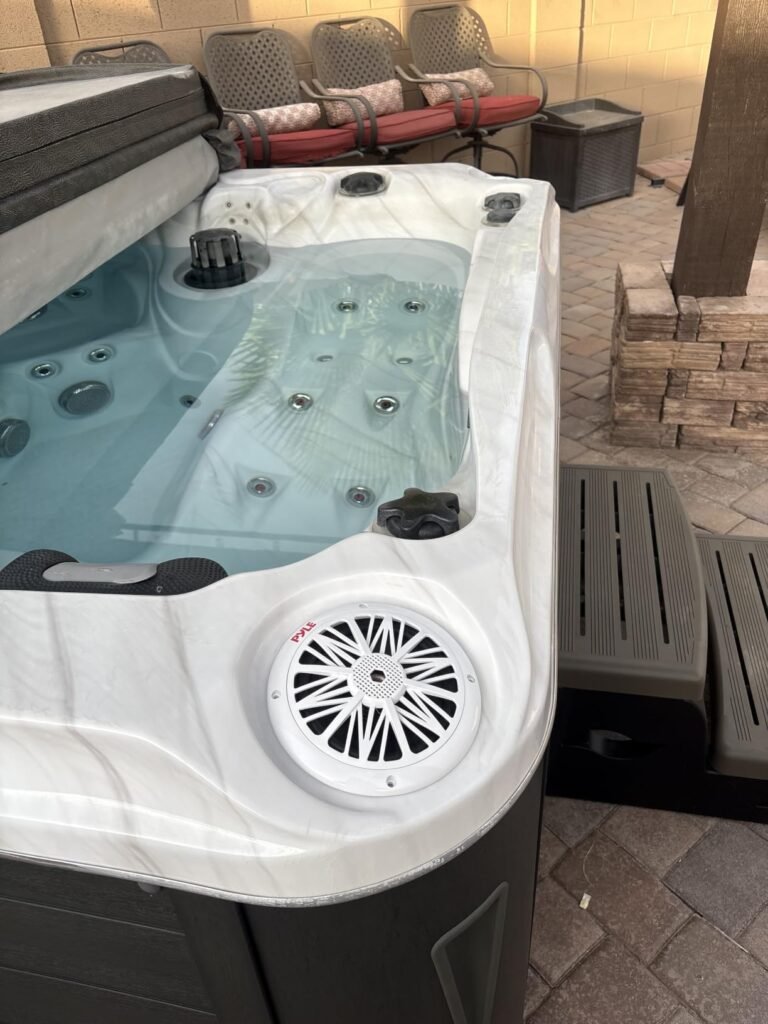
This Pyle 6.5-inch marine pair covers the essentials for buyers who need functional weatherproof speakers without complexity or high cost. The poly carbon cone with butyl rubber surround provides basic moisture resistance for typical splash and spray exposure, and the heavy-duty ABS plastic basket handles the UV rays and general environmental abuse that come with outdoor mounting.
We may earn a commission when you buy through this link, at no additional cost to you.
The 200-watt power rating is more modest than the PLMR605W but still adequate for filling a small deck with music at reasonable volumes. The 90dB sensitivity means these speakers make efficient use of amplifier power, and the 4-ohm impedance is compatible with virtually any marine head unit. The 1-inch aluminum voice coil handles the electrical demands of typical listening without stressing the drivers.
Installation is straightforward with the universal 6.5-inch fitment, 2.48-inch mounting depth, and 5.31-inch cutout size that matches OEM replacement dimensions. Complete wiring and mounting hardware come in the box, so most buyers can complete the installation with basic tools in an afternoon. The classic white finish blends with most boat interiors and complements the traditional marine aesthetic.
Marine speaker power ratings can be confusing because peak power figures often overstate what the speakers actually handle continuously. RMS ratings tell you what the speakers can handle for extended listening without damage, while peak power indicates brief maximum bursts. For most boat listening at reasonable volumes, matching your amplifier’s RMS output to the speaker RMS rating is more important than chasing the highest peak power number on the box.
For casual boaters who mostly want background music while fishing or cruising and do not need premium audio performance, this pair delivers acceptable results at a fair price. The main limitation is that basic marine speakers cannot match the sound quality or long-term durability of premium options in the Kicker, Rockford Fosgate, or Polk lineups. Choose this pair when budget matters and expectations are modest.
Serious audio enthusiasts who want detailed sound reproduction and premium construction for demanding marine environments.
We may earn a commission when you buy through this link, at no additional cost to you.
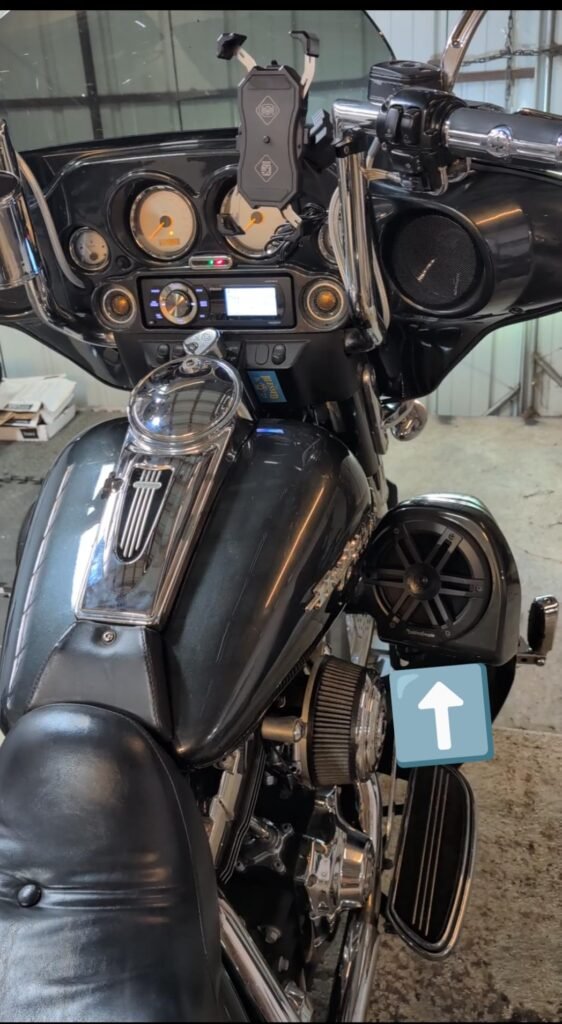
The Rockford Fosgate M0-65B delivers the confidence that comes with a two-year manufacturer warranty, which is meaningful for marine equipment that operates in demanding conditions. Rockford Fosgate has been in the automotive and marine audio business for decades, and the M0-65B reflects that experience with purpose-built weatherproofing designed specifically for marine watercraft and off-road vehicles.
We may earn a commission when you buy through this link, at no additional cost to you.
The 4-ohm coaxial design delivers 65 watts RMS and 250 watts peak power, which is well matched to typical marine amplifiers and head units. The 6dB per octave internal crossover network smoothly divides frequencies between the woofer and the grille-integrated LCP balanced dome tweeter, producing clean highs without the harshness some metal dome tweeters exhibit. The LCP tweeter material also resists moisture damage better than paper alternatives.
The Element Ready designation means these speakers are engineered to withstand water exposure, salt spray, dust, and UV rays that would degrade standard car speakers. This is critical for boats that stay uncovered between uses or operate in coastal saltwater environments where corrosion is a constant concern. The black finish suits modern boat aesthetics well, though buyers wanting lighter colors will need to look elsewhere.
Liquid crystal polymer, or LCP, is a material chosen for its combination of stiffness and moisture resistance. In tweeter dome applications, LCP produces detailed high frequencies without the harshness of metal domes or the moisture sensitivity of paper. For marine speakers where humidity is constant and salt spray is a regular hazard, LCP domes offer meaningfully better durability than traditional tweeter materials while still delivering clear treble reproduction.
The M0-65B requires a 5.38-inch mounting hole with 6.12-inch screw mounting diameter and 2.52-inch mounting depth, so verify your existing cutouts before purchasing. For buyers who value brand reputation, warranty coverage, and proven marine construction, this pair offers strong long-term value. The main tradeoffs are the black-only finish and the slightly larger mounting requirements that may not fit older factory openings without modification.
Buyers who need white grilles to match traditional boat interior colors or replace older factory speakers.
We may earn a commission when you buy through this link, at no additional cost to you.
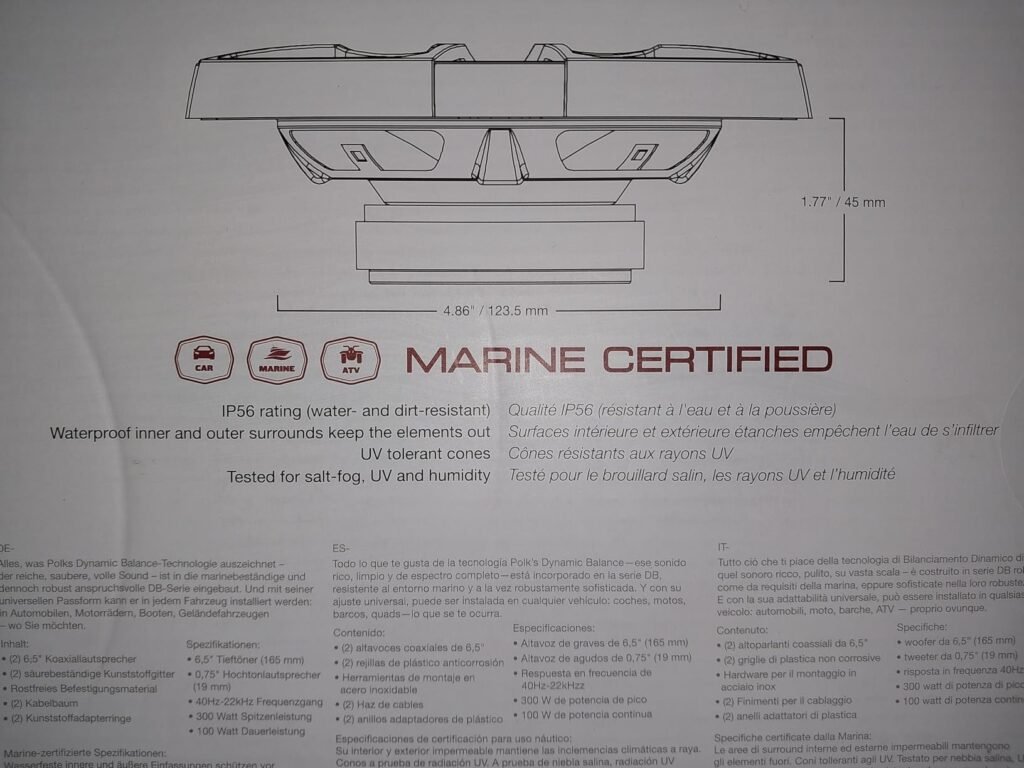
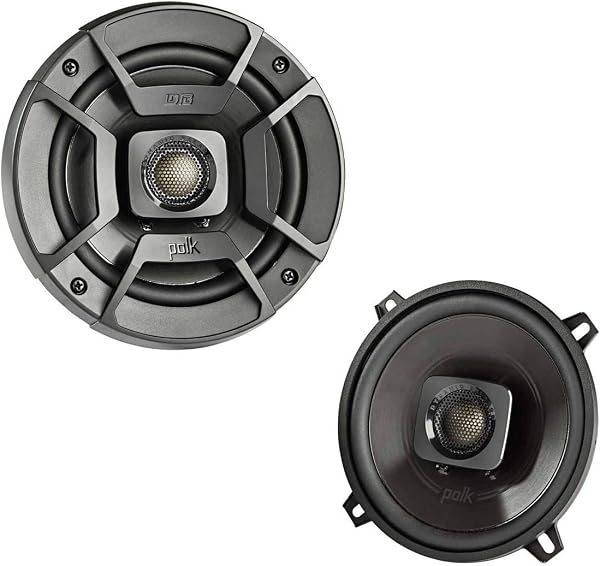
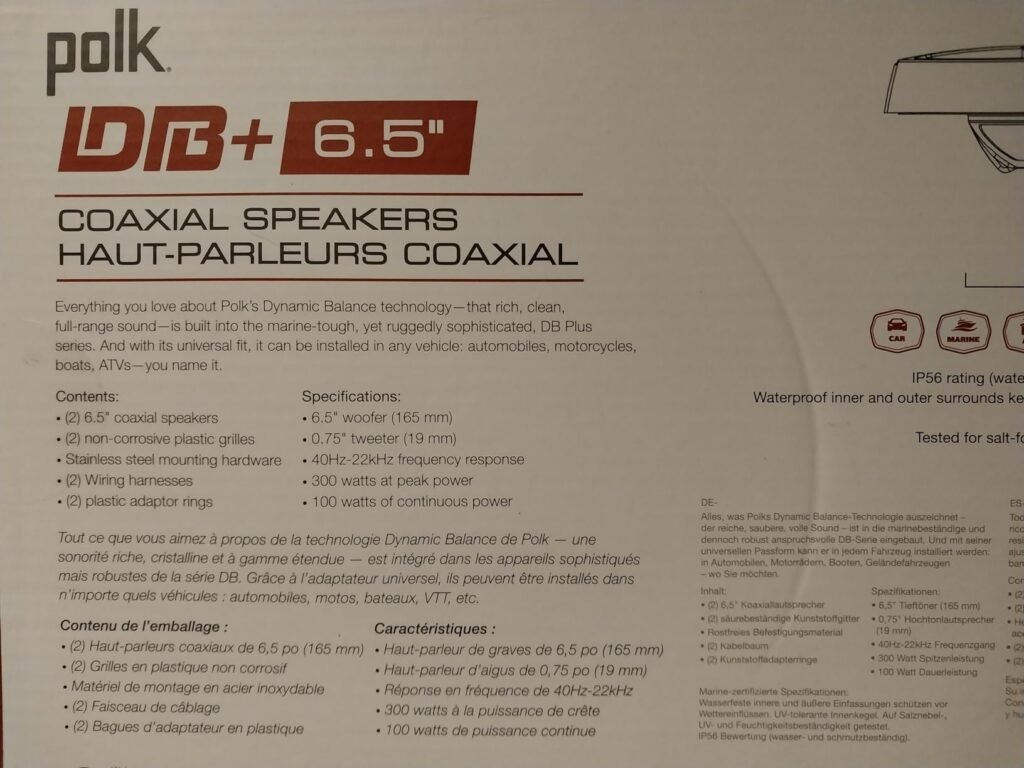
The Polk DB652 stands out for its formal IP56 marine certification, which means the speakers have been tested to specific standards for protection against dust ingress and powerful water jets. This is more meaningful than generic waterproof claims because IP ratings follow defined testing protocols. Polk also puts these speakers through salt-fog, UV, and humidity testing to verify long-term durability in outdoor environments.
We may earn a commission when you buy through this link, at no additional cost to you.
The 6.5-inch polypropylene woofer paired with a 3/4-inch silk dome tweeter delivers a wide 40Hz to 22kHz frequency response, which is notably broader than many competing marine speakers. The low-frequency extension down to 40Hz means you get more usable bass without needing a subwoofer, which matters for boats where subwoofer installation is impractical. Peak power of 300 watts with 100 watts RMS matches typical marine amplifier output well.
Polk’s Dynamic Balance technology uses laser imaging during product development to identify material combinations that resist unwanted resonances. In practical terms, this results in cleaner sound reproduction with less distortion, particularly at higher volumes where lesser speakers begin to break up. The coated steel baskets add both structural rigidity and additional protection against corrosion in the marine environment.
The IP56 rating comes from an international standard where the first digit indicates dust protection and the second indicates water protection. A 5 rating for dust means the speakers are protected from harmful dust ingress, while a 6 rating for water means they can withstand powerful water jets from any direction without damage. This is more rigorous than general waterproof marketing claims and gives you a defined performance standard to compare against other rated products.
The DB652 works equally well in car audio and marine applications, which is useful if you also want matching speakers for a truck or SUV. The IP56 rating focuses on freshwater environments, so saltwater boaters should still rinse and maintain the speakers regularly for maximum longevity. For buyers who want certified marine construction with proven sound quality technology, the DB652 delivers strong value.
Boats operating in extreme saltwater conditions where fully sealed marine-only speakers may perform better long-term.
We may earn a commission when you buy through this link, at no additional cost to you.
The Polk DB522 addresses a specific installation challenge: boats and vehicles with mounting locations too small for standard 6.5-inch speakers. At 5.25 inches, these fit in door panels, kick panels, and specialty marine mounting locations where a larger speaker would not physically install. This is particularly valuable for smaller boats, personal watercraft, or older boats with non-standard factory openings.
We may earn a commission when you buy through this link, at no additional cost to you.
Despite the smaller size, the DB522 delivers the same core Polk features as its larger siblings, including IP56 marine certification and Dynamic Balance technology for resonance-free sound reproduction. The polypropylene woofer cone paired with the crossover network directs highs and lows to their appropriate drivers, and the 4-ohm impedance works with any standard head unit or amplifier. Peak power handling reaches 200 watts with 100 watts RMS.
The 55Hz to 22kHz frequency response covers most of what music needs to sound complete, though the smaller cone naturally limits deep bass extension compared to 6.5-inch alternatives. For most boat listening where wind and engine noise mask the lowest bass frequencies anyway, this rolloff is not a significant limitation. Adding a subwoofer for genres that need bass impact remains an option if you want the full range.
Not every boat has room for 6.5-inch speakers, particularly older boats or smaller watercraft with tight mounting locations. Trying to force a larger speaker into a smaller opening leads to fitment problems, sealing issues, and often unfinished-looking installations. Choosing a properly sized 5.25-inch speaker for tight locations produces a cleaner install with better acoustics than a modified larger speaker. Verify your existing cutout before ordering to ensure the correct size.
For boats with limited mounting space or as fill speakers to complement larger main speakers, the DB522 delivers marine-grade construction and clean sound in a smaller package. The main tradeoff is the reduced bass response inherent to smaller drivers, so buyers wanting deep low-end from their primary speakers should look at 6.5-inch or 6×9 options. For everything else, this is a well-engineered compact marine speaker.
Buyers with standard 6.5-inch mounting locations where a larger speaker will produce fuller bass response.
We may earn a commission when you buy through this link, at no additional cost to you.
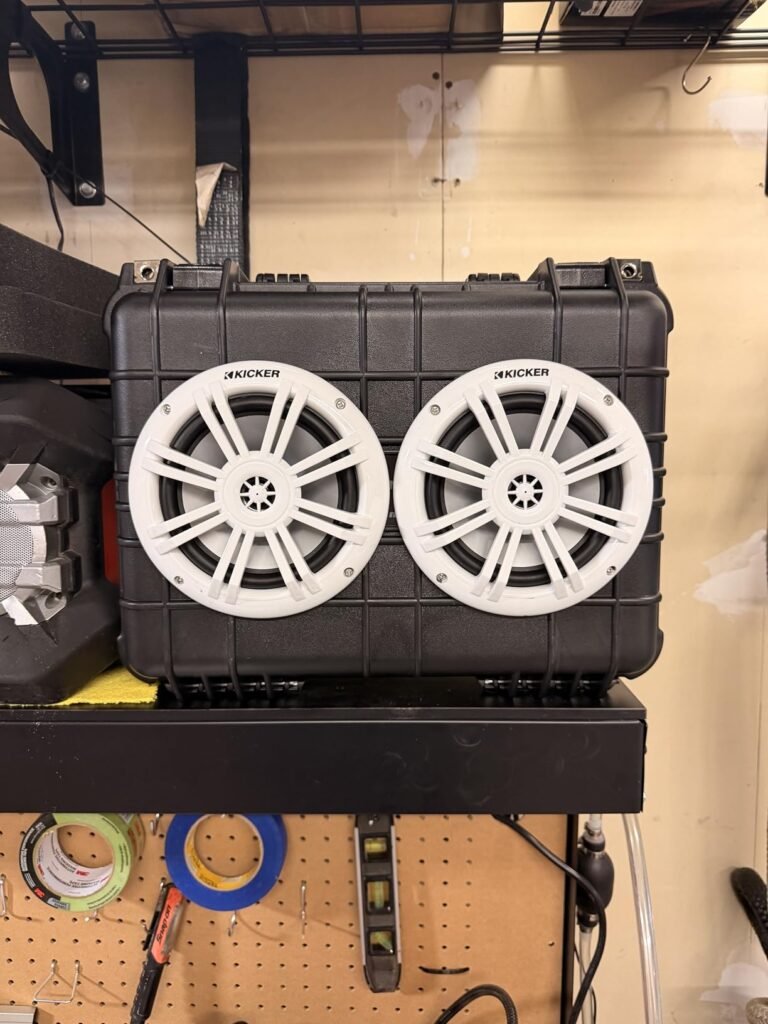
The Kicker KM604WL adds RGB LED lighting to the same core marine construction found in the KM series, giving buyers the ability to add nighttime visual effects to their boat audio system. For pontoons, party boats, and evening cruisers, the color-changing LED rings around the speakers create ambiance that fixed-lighting speakers cannot match. This is particularly popular for boats used for entertaining.
We may earn a commission when you buy through this link, at no additional cost to you.
The audio construction mirrors Kicker’s proven marine engineering with UV-treated polypropylene woofers, santoprene surrounds, and sealed motor structures that protect against moisture ingress. The 6.5-inch coaxial design fits standard marine cutouts and delivers spectacular highs paired with smooth, impactful midrange from the 4-ohm design. Stainless steel mounting hardware resists corrosion in the marine environment far better than standard steel alternatives.
Adding LED lighting to your marine audio system does require additional wiring for the RGB control, so budget extra installation time compared to plain speaker installs. Many buyers integrate the lights with existing boat lighting controllers or add dedicated RGB controllers to create custom effects. The lighting draws minimal power and does not affect audio performance in any way.
RGB LED marine speakers require separate power and control wiring beyond the standard speaker connections. Plan your installation to include a dedicated 12-volt power source for the LEDs, along with RGB control wires that connect to either a compatible controller or your existing boat lighting system. Some marine head units include RGB output capability that pairs well with LED speakers, providing coordinated control from a single interface. Consult a marine electrician if you are uncertain about the wiring requirements.
The main tradeoff is that adding the LED feature increases both the price and installation complexity compared to non-lighted alternatives. For buyers who value the visual aesthetic of illuminated speakers for evening use, the KM604WL delivers what few competitors offer at this quality level. For daytime-only boat use where lighting is unnecessary, the standard KM65 provides the same audio performance without the added complexity and cost.
Daytime-only boaters who do not need lighting effects and want to minimize installation complexity.
We may earn a commission when you buy through this link, at no additional cost to you.
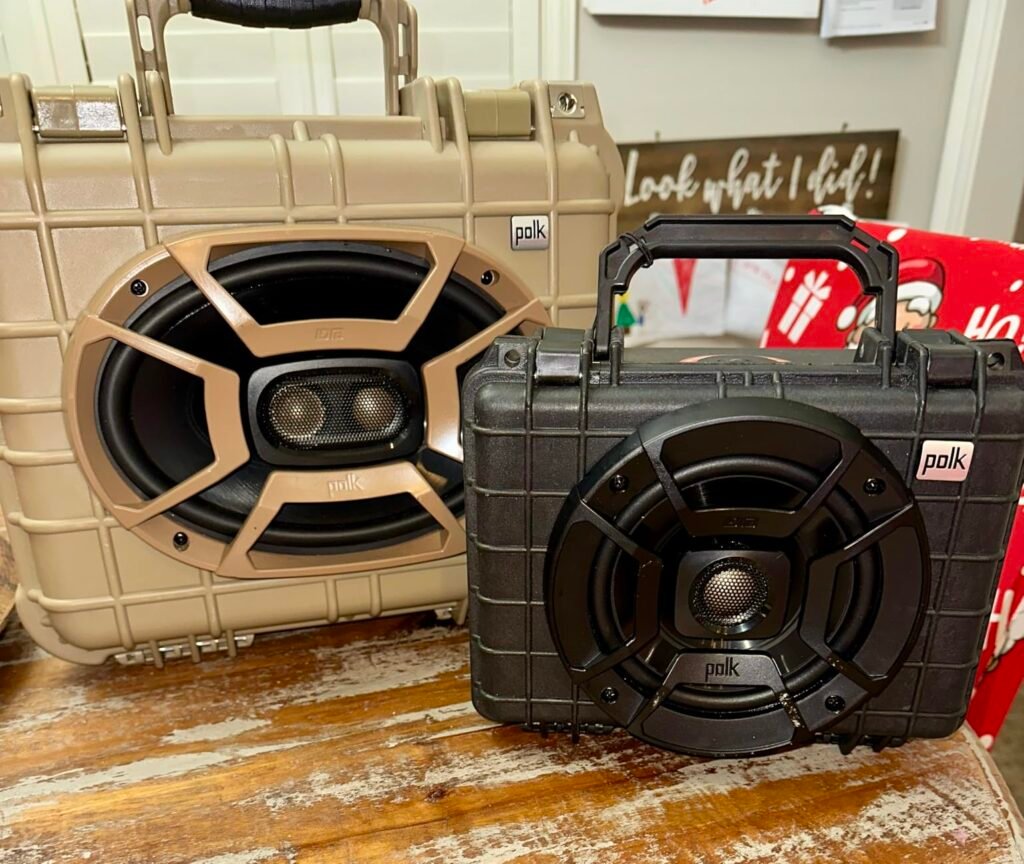
The Polk DB692 is the largest speaker in this comparison and delivers the fullest bass response as a result of its 6×9-inch cone area. For boats with mounting locations that accept the larger 6×9 dimensions, these speakers can produce genuinely satisfying low frequencies without needing a dedicated subwoofer. The three-way design uses separate drivers for bass, midrange, and treble, resulting in more detailed sound reproduction than two-way alternatives.
We may earn a commission when you buy through this link, at no additional cost to you.
Power handling reaches 450 watts peak with 150 watts RMS, which requires a capable amplifier to drive properly but rewards the investment with impressive dynamic range. The polypropylene woofer cone paired with the 1/2-inch super tweeter and dedicated midrange driver covers the full frequency spectrum from 30Hz to 22kHz. Dynamic Balance technology and IP56 marine certification match the quality standards of the other Polk models in this lineup.
The strong rubber surround handles the mechanical demands of the larger cone while resisting moisture and UV damage. Coated steel baskets add structural rigidity and corrosion resistance, and Polk tests the entire assembly for salt-fog, UV, and humidity exposure. Mounting hardware and stylish grilles come in the box, enabling relatively straightforward installation for buyers with existing 6×9 openings or willing to modify their boat for the larger fitment.
The oval 6×9 shape provides significantly more cone surface area than round 6.5-inch speakers, which translates directly to greater air displacement and stronger bass output. A larger cone can move more air with less excursion, producing lower frequencies more efficiently. For boats where you want serious bass impact without adding a separate subwoofer, 6×9 speakers offer the best compromise between full-range sound and installation complexity.
The primary tradeoff is that 6×9 speakers require larger mounting locations than the more common 6.5-inch standard, which limits where they can be installed on many boats. Additionally, the higher power handling means you need a matching amplifier to take full advantage of what these speakers can do. For buyers with the right mounting locations and a serious audio system, the DB692 delivers the fullest sound in this lineup.
Boats with only standard 6.5-inch mounting locations that cannot accommodate the larger 6×9 dimensions.
We may earn a commission when you buy through this link, at no additional cost to you.
Choosing marine speakers means balancing sound quality against weatherproofing, mounting compatibility, and long-term durability in outdoor environments. The sections below break down the factors that actually determine whether a pair of speakers will perform well on your specific boat over many seasons of use.
The single most important factor separating marine speakers from standard car speakers is their ability to withstand water, salt, UV rays, and humidity for years without failing. True marine speakers use UV-treated cones, moisture-resistant surrounds like butyl or santoprene, sealed motor structures that prevent water intrusion, and corrosion-resistant hardware. IP ratings like IP56 provide a defined standard for water and dust resistance, giving you a measurable specification rather than vague waterproof marketing claims.
Salt exposure is the harshest condition marine speakers face because salt crystals grow and expand during humidity cycles, damaging materials over time. Speakers designed for saltwater use include additional corrosion protection on baskets, hardware, and terminals. If you boat in coastal waters, prioritize speakers with explicit salt-fog testing rather than general waterproof claims. Freshwater boaters have more flexibility since salt corrosion is not a concern, though UV and humidity still degrade poorly constructed speakers.
Match the certification level to your boating environment. Coastal saltwater boaters should insist on marine-specific construction with corrosion-resistant hardware, while inland freshwater users can consider speakers with basic IP ratings and adequate UV treatment.
Speaker power ratings appear in two forms: RMS and peak. RMS wattage tells you what the speakers can handle continuously without damage, while peak wattage represents brief maximum bursts. Marine speakers in this lineup range from 65 watts RMS on some models to 200 watts RMS on others. For most recreational boating at reasonable volumes, matching your amplifier’s RMS output to the speaker RMS rating produces the best combination of sound quality and reliability.
Underpowering speakers with a weak amplifier can actually cause more damage than overpowering them, because insufficient power leads to clipping distortion that harms voice coils. Overpowering carries risk if you push volume too high, but modest headroom above the speaker’s RMS rating usually improves sound quality because the amplifier is not straining. Sensitivity ratings in decibels also matter because higher sensitivity speakers reach the same volume with less amplifier power.
For most boat installations, choose speakers with RMS ratings within 20 percent of your amplifier’s RMS output per channel. If you plan to add a more powerful amplifier later, buy speakers rated to handle the future upgrade to avoid replacing everything again.
The materials used for the speaker cone and surround directly affect both sound quality and long-term durability in marine environments. Polypropylene cones are common in marine speakers because they resist moisture damage and produce clean midrange frequencies. Higher-end options include microfiber composite mineral-filled cones like those on the Skar Audio SK65M, which combine stiffness for better bass response with moisture resistance. Poly carbon cones offer another moisture-resistant option at lower price points.
Surround materials are equally critical because the surround flexes with every note the speaker plays. Foam surrounds common in standard car speakers deteriorate rapidly in marine environments due to UV and moisture exposure, often failing within a season or two. Butyl rubber surrounds resist these conditions much better and are considered the minimum acceptable material for genuine marine use. Santoprene surrounds found on Kicker KM series speakers offer even better UV resistance and longer service life.
Prioritize butyl or santoprene surrounds for any marine installation, and pay attention to cone material for boats that will see heavy use. Cheaper foam-surrounded speakers marketed as marine may fail quickly in real outdoor conditions.
Speaker size determines both sound quality and installation compatibility. The 6.5-inch coaxial size is the most common marine speaker dimension and matches many factory openings without modification. This standardization means most boats can accept 6.5-inch speakers as direct replacements for factory units. The 5.25-inch size fits smaller mounting locations, while 6×9 oval speakers require dedicated 6×9 openings and deliver fuller bass response.
Beyond diameter, mounting depth and cutout size determine actual fitment. Marine speakers typically have mounting depths between 2.4 and 2.6 inches, which fits most boat panels without protruding into interior spaces. Cutout diameters vary slightly between brands, so measure your existing openings carefully before ordering. Some speakers require slightly larger cutouts than others, which may require modification of factory openings.
Measure your existing mounting locations for cutout diameter, mounting depth, and clearance behind the panel before purchasing. Match speakers to your existing openings when possible to avoid installation complications.
The tweeter handles all the high-frequency sound in a coaxial speaker and significantly affects overall sound character. Silk dome tweeters produce warmer, more natural highs that resist listening fatigue during long boat trips. Metal tweeters, either aluminum or titanium, deliver more detailed highs but can sound harsh at high volumes. LCP balanced dome tweeters like those on the Rockford Fosgate M0-65B offer a middle ground with good detail and moisture resistance.
Two-way coaxial speakers combine a woofer and a single tweeter, which works well for most listening. Three-way designs like the Polk DB692 add a dedicated midrange driver between the woofer and tweeter, providing more detailed sound reproduction especially for vocals and acoustic instruments. The tradeoff is added complexity and cost, so most buyers do fine with two-way designs for casual boat listening.
For long boat trips where music plays for hours, silk dome tweeters typically feel less fatiguing than metal alternatives. For detail-focused listening, three-way designs offer meaningful improvements at higher price points.
Frequency response tells you the range of sound the speakers can reproduce, expressed as the low-end limit through the high-end limit in Hertz. Marine speakers in this comparison range from 30Hz low-end extension on the 6×9 Polk DB692 up to 85Hz on the more basic Pyle models. Lower numbers mean deeper bass response without requiring a subwoofer, which matters for genres like rock, electronic, or hip-hop that depend on strong low frequencies.
The upper frequency limit of 20 to 22 kilohertz covers what human hearing can perceive, so differences at the top end are less significant than the bass extension. However, tweeter quality within that range affects perceived clarity and detail. For boats where wind noise and engine sound mask deep bass anyway, sacrificing some low-end extension for other qualities like durability or price often makes sense.
If bass response matters to your listening preferences, prioritize speakers with low-end extension below 50Hz or plan to add a subwoofer. If you mostly listen to acoustic music or podcasts, less bass extension is perfectly acceptable.
Impedance measured in ohms indicates the electrical resistance the speakers present to your amplifier. All the speakers in this comparison use 4-ohm impedance, which is standard for marine and car audio equipment. This makes them compatible with virtually any marine head unit or amplifier without special considerations. Some specialty setups use 2-ohm speakers for higher power output, but 4-ohm remains the most common and versatile choice.
Voice coil size and construction also affect how speakers handle amplifier power. The 1.2-inch voice coil on the Skar Audio SK65M or the 1-inch aluminum voice coil on the Pyle models influence how much continuous power the speakers dissipate as heat before damage occurs. Larger voice coils generally handle more sustained power without overheating, which matters for buyers who play loud music for extended periods.
For most installations, standard 4-ohm marine speakers work with any equipment without concern. Verify your amplifier is rated for 4-ohm loads before installing, though this is rarely a limitation.
Marine speakers operate in demanding conditions where poor construction leads to premature failure, so brand reputation matters more than in many audio categories. Established brands like Kicker, Rockford Fosgate, and Polk have decades of experience engineering products for harsh environments and back their products with meaningful warranties. The Rockford Fosgate M0-65B two-year warranty is particularly valuable for equipment that operates in unforgiving conditions.
Newer or lesser-known brands can offer better prices but sometimes cut corners on materials, corrosion protection, or manufacturing quality that only becomes apparent after a season or two of use. Reading owner feedback across multiple sources helps identify which budget brands actually deliver adequate marine performance and which fail prematurely. Skar Audio has built a solid reputation in the mid-tier segment, while Pyle serves the budget market with mixed but generally acceptable results.
For serious boaters who use their vessel regularly, investing in established marine audio brands with strong warranties pays dividends through longer service life and better resale value. For occasional-use boats or budget-conscious projects, value brands may serve adequately with appropriate expectations.
Install marine speakers in locations that provide some protection from direct water exposure when possible, even though the speakers are designed to handle wet conditions. Overhead mounting under a hardtop, side-mounted in cabin walls, or protected transom locations extend speaker life compared to fully exposed installations. Use marine-grade wiring rated for outdoor use, and seal all connections with heat shrink tubing or dielectric grease to prevent corrosion where wires meet speaker terminals. Follow the mounting hardware included with your speakers, and use stainless steel screws if your speakers did not include them.
For daily use, keep your marine speakers reasonably clean by wiping the grilles and surrounding areas with fresh water after saltwater exposure. Salt residue accelerates corrosion on hardware and can eventually work into the speaker components through the grille openings. Avoid pressure washing directly at the speakers even though they are waterproof, since focused high-pressure water can force moisture past seals that are designed to handle spray rather than direct jets. When covering your boat for storage, ensure the cover does not trap moisture against the speakers.
For long-term care, inspect the speaker surrounds and cones annually for signs of UV degradation like cracking, hardening, or fading. Butyl and santoprene surrounds should remain flexible and intact for many years with proper materials, but check them regardless. If your boat is stored uncovered outdoors, consider individual speaker covers to extend surround life significantly. Periodically test all speaker positions by playing music through each channel to catch any developing issues before they become audible during normal listening. With proper installation and reasonable care, quality marine speakers should provide many seasons of reliable service.
Marine speakers use UV-resistant cones, moisture-resistant surrounds, sealed motor structures, and corrosion-resistant hardware that car speakers lack. These materials handle sun exposure, humidity, salt spray, and occasional water contact without failing. Standard car speakers installed in a boat typically fail within one or two seasons due to the harsh outdoor environment. Marine-specific construction adds meaningful cost but provides the durability needed for outdoor watercraft use.
Match your amplifier's RMS output per channel to the speaker's RMS rating for best results. Speakers in this comparison range from 65 to 200 watts RMS, so an amplifier producing 75 to 200 watts per channel would suit them well. Underpowering causes distortion that can damage speakers, while modest overpowering usually improves sound quality by providing headroom for dynamic peaks. Most boats do fine with 50 to 100 watts RMS per channel for typical listening.
A subwoofer is not required but significantly improves low-frequency response for music genres that depend on deep bass. Larger speakers like the 6×9 Polk DB692 with 30Hz extension can produce satisfying bass without a subwoofer, while smaller 6.5-inch speakers typically roll off around 50-85Hz. Wind and engine noise on boats also mask some deep bass, so many boaters find full-range speakers adequate. Consider a subwoofer if you play a lot of electronic, hip-hop, or bass-heavy music.
Marine speakers can handle rain, spray, and occasional splashes without damage, but they are not designed for full submersion or direct high-pressure water jets. IP56-rated speakers handle powerful water jets from any direction, while lower-rated marine speakers protect against splash and rain only. Rinse saltwater exposure with fresh water when possible to prevent corrosion, and avoid pressure washing directly at speakers even though they are waterproof.
The 6.5-inch size is most common and matches many factory openings without modification. Measure your existing cutouts before ordering to confirm compatibility. Smaller 5.25-inch speakers fit tight spaces but produce less bass, while 6×9 oval speakers deliver fuller sound but need larger openings. Standard mounting depths run 2.4 to 2.6 inches, so check clearance behind the mounting panel before ordering.
Quality marine speakers from established brands like Kicker, Rockford Fosgate, or Polk can last 5 to 10 years or longer with proper installation and care. Budget marine speakers may only last 2 to 4 seasons in harsh conditions. UV exposure is often the primary factor that limits lifespan, so covered or protected mounting locations extend service life significantly. Regular rinsing after saltwater exposure and inspection for surround wear also help maximize longevity.
IP-rated speakers like the IP56 Polk DB series provide defined water and dust resistance standards rather than vague waterproof marketing claims. This certification gives you measurable performance you can compare across products. For coastal saltwater use or boats that stay uncovered outdoors, IP ratings provide meaningful assurance of durability. For occasional freshwater use in protected mounting locations, basic marine-rated speakers may serve adequately at lower cost.
Most marine speaker installations are straightforward for buyers comfortable with basic DIY work. Standard 6.5-inch replacements typically drop into existing openings using the included mounting hardware. You will need marine-grade wiring, wire connectors, a drill for mounting screws if replacing hardware, and basic hand tools. LED speakers or complex custom installs benefit from professional installation. Always disconnect the battery before working on boat electrical systems.
Two-way coaxial speakers use a woofer for low and midrange frequencies plus a tweeter for highs. Three-way designs add a dedicated midrange driver between the woofer and tweeter for more detailed sound reproduction. Three-way speakers like the Polk DB692 typically offer better vocal clarity and instrument separation, but they cost more and require more amplifier power. For most boat listening, two-way designs provide excellent sound at lower cost.
Matching brands is not required but often produces more consistent sound quality since all the speakers share similar voicing and design philosophy. Mixing brands works fine if you match specifications like power handling and sensitivity carefully. For most installations, buying all speakers from the same product line ensures compatibility and predictable results. Component matching becomes more important for higher-end systems where subtle sound differences matter.
The Skar Audio SK65M earns our overall top recommendation by combining strong power handling, silk dome tweeter smoothness, and butyl surround durability at a price that most boat owners can justify. The 320-watt peak power with 160 watts RMS gives you serious headroom for filling an open deck with music, while the microfiber composite mid-woofer cone and marine-grade construction provide the durability needed for years of outdoor use. For most recreational boaters seeking a meaningful audio upgrade, this pair delivers strong value.
For different priorities, the Pyle PLMR605W offers genuine value at an entry-level price point for budget-conscious buyers or project boats. The Kicker KM65 provides premium marine engineering with UV-treated materials and interchangeable grilles for those who prioritize long-term durability. Buyers wanting the fullest bass response should consider the Polk DB692 6×9 speakers, while boat owners with only smaller mounting locations will appreciate the Polk DB522 5.25-inch option. The Rockford Fosgate M0-65B stands out for buyers who value the two-year manufacturer warranty and proven brand reputation.
Match your choice to your actual boating environment, mounting locations, and audio expectations. Coastal saltwater boaters should prioritize corrosion-resistant construction and IP-rated weatherproofing even at higher prices, while freshwater weekend boaters can consider value-focused options that provide adequate performance at lower cost. Measure your existing speaker cutouts before ordering to ensure compatibility, and pair your speakers with an appropriate amplifier that matches their RMS power ratings for the best combination of sound quality and long-term reliability.