Anything Sports Base
8.8Editor scoreGalvanized steel frame build
Leaf spring road suspension
Removable bolt on tongue
Bright LED road lighting
Find the right kayak trailers for 2026. We compare 10 standout options by build quality, useful features, owner feedback, value, and everyday trade-offs.
Find the right kayak trailers for 2026. We compare 10 standout options by the factors that matter in this category, such as frame metallurgy, payload capacity, boat length limits, submersible wheel bearings, carrier rack configurations, suspension design, and portage versatility across highway tow rigs and beach transport carts.
Hauling watercraft on a tall vehicle roof rack requires heavy overhead lifting and risks hull damage during windy highway drives. Dedicated towing systems and rolling transport carts lower the loading height to waist level, allowing solo paddlers and families to move heavy fishing kayaks, tandem canoes, and paddleboards safely.
Whether you need a multi-boat galvanized road trailer with DOT-compliant lighting for cross-state trips, an e-bike towable frame for backcountry trails, or a compact airless-tire dolly for the final portage from the parking lot to the shoreline, matching capacity and rack style to your hull design ensures effortless launches.
We compared 10 kayak trailers using the details that actually help a buyer decide: maximum load capacity, supported boat length, corrosion-resistant frame materials, crossbar width, carrier cradle styles, wheel bearing sealing for water submersion, suspension absorption, assembly time, and storage footprint. The notes focus on practical trade-offs between full highway tow rigs, backcountry bike trailers, and shore portage carts so each pick connects directly to how paddlers transport, launch, and store their watercraft.

Compare key features, scores, and current prices side by side. A shorter feature list means fewer details were available, not necessarily fewer capabilities.


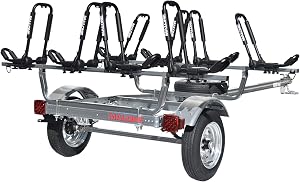


For kayak anglers and paddlers hauling heavy, wide watercraft, the Malone MPG464-LBS MicroSport LowBed 2 Kayak Trailer is the strongest all-around choice in our lineup. Its defining engineering feature is the lowered frame geometry that positions the crossbars just 22 inches above the ground—roughly knee height for most adults. Lifting a 100-pound pedal-drive fishing kayak onto a 22-inch crossbar requires a fraction of the physical effort needed for a 30-inch standard trailer or a 70-inch SUV roof rack.
We may earn a commission when you buy through this link, at no additional cost to you.
To match its low-profile loading height, this bundle includes two Malone SaddleUp Pro kayak carriers. Unlike J-cradles that require tipping a heavy kayak onto its side rail, SaddleUp Pro carriers cradle the bottom of the hull horizontally with self-adjusting rubberized pads. Combined with the trailer’s 800-pound total load capacity and 20-foot boat length support, it effortlessly handles two heavy fishing kayaks, tandem canoes, or oversized recreational boats.
At the launch ramp, the LowBed design shines even brighter. Because the crossbars sit only 22 inches off the ground and the trailer features oversized pontoon wheels with marine-grade sealed bearings and a submersible LED light kit, you only need to back the trailer a short distance into the water before your kayaks float directly off the SaddleUp cradles. Loading up at the end of the day is as simple as floating the bow onto the rear saddles and winching or sliding the hull forward.
Dropping the crossbar height to 22 inches above the pavement eliminates overhead lifting altogether. You can slide heavy fishing kayaks directly from the water or ground onto the horizontal SaddleUp Pro pads using your legs rather than your lower back.
Built in the USA from 11-gauge pre-galvanized steel, the package also includes a mounted spare tire and pre-assembled wheel hubs that keep initial assembly to about three to four hours. While the premium price reflects its specialized hardware, anyone dealing with heavy fishing hulls or shoulder and back limitations will find the 22-inch LowBed architecture worth every penny.
Budget shoppers with lightweight 35-pound recreational kayaks who do not need an 800-pound low-clearance chassis.
We may earn a commission when you buy through this link, at no additional cost to you.
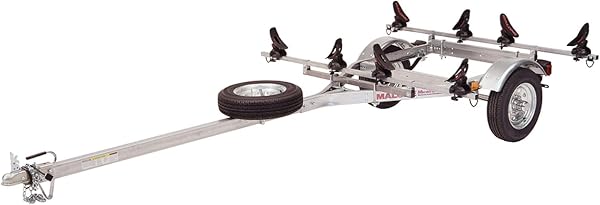
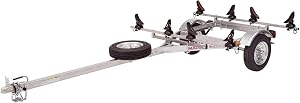
The Anything Sports Base Kayak Trailer is built for paddlers who want a road-legal, corrosion-resistant utility trailer behind their passenger car or crossover without spending thousands on pre-bundled carrier cradles they may not need. Because it ships with an official Vehicle Identification Number, registering and titling the trailer with your local motor vehicle department is straightforward. The lightweight footprint makes it easy to tow behind compact sedans, hatchbacks, and small SUVs while keeping fuel economy penalties minimal compared to heavy landscape trailers.
We may earn a commission when you buy through this link, at no additional cost to you.
Road manners are anchored by a genuine leaf-spring suspension paired with 4.80-8 tires. When towing lightweight fiberglass or rotomolded hulls over washboard dirt launch roads, expansion joints, and potholes, an unsprung axle transfers harsh jolts directly into your boat’s hull. The leaf springs flex to absorb those impacts, preventing stress cracks and keeping the trailer tracking straight without bouncing behind your bumper. Full LED stop and turn lighting, amber side marker lights, and safety chains at the coupler provide clear visibility during early morning or dusk drives.
Garage storage is one of the biggest hurdles for suburban kayak owners, and this chassis addresses that limitation directly. Measuring 99 inches long by 58 inches wide by 22 inches high, the frame features a bolt-on tongue that detaches cleanly when the paddling season ends. Once the tongue is unbolted, you can stand the lightweight galvanized frame upright against a garage wall or tuck it into a backyard shed. The adjustable crossbars accommodate kayaks, canoes, and stand-up paddleboards directly, or you can expand the setup later with dedicated single or multi-boat racks.
Standard boat trailers often monopolize an entire garage bay due to their fixed overall length. By allowing you to unbolt and remove the front tongue assembly, this frame shrinks its storage footprint considerably so you can still park your daily driver indoors.
While you will need to supply your own foam blocks, saddles, or upgrade racks if you prefer contoured hull cradles, starting with a clean base trailer gives you total freedom to customize your layout. For solo paddlers or couples seeking an affordable, rust-resistant highway trailer backed by responsive domestic customer support, this base rig hits a practical sweet spot.
Paddlers who want four pre-installed J-cradles and a mounted spare tire included in the initial box.
We may earn a commission when you buy through this link, at no additional cost to you.
The Malone MPG586XV EcoLight 2 Kayak Trailer is tailored for recreational paddlers and couples who own two kayaks or canoes up to 14 feet in length and want a turnkey towing package. With a 400-pound payload capacity and a lightweight 11-gauge pre-galvanized steel frame made in the USA, it places minimal tongue weight and drag on smaller tow vehicles. Because two V-rack kayak carriers are included in the package, you can strap down two recreational hulls right after assembly without shopping for third-party crossbar attachments.
We may earn a commission when you buy through this link, at no additional cost to you.
Unlike standard utility trailers that suffer bearing failure or shorted wiring if backed into lake or brackish water, the EcoLight is engineered for full submersion. It rolls on oversized pontoon-style wheels equipped with marine-grade sealed bearings that keep water and grit out of the hub internals. The plug-and-play LED lighting kit is equally submersible, meaning you can back the trailer directly down a boat ramp until your kayaks float nearly level with the V-racks, eliminating heavy carrying across slippery concrete.
Home assembly is straightforward and typically takes three to four hours using standard garage hand tools. Malone pre-assembles the wheel hubs at the factory, which eliminates the messy and error-prone chore of packing grease bearings yourself. The 11-gauge pre-galvanized steel panels bolt together cleanly, and the included five-year limited warranty provides long-term confidence against structural defects.
Backing a trailer directly into the water transforms how you load at the end of a tiring paddle. Sealed marine bearings and waterproof LED wiring let you submerge the tires at the ramp without worrying about blown bulbs or rusted axle spindles.
The primary trade-off to keep in mind is dimensional capacity. If you paddle 16-foot sea touring kayaks or heavy triple-seat canoes that exceed 14 feet in length, you will need a longer-tongue MicroSport model instead. However, for 10-foot to 14-foot recreational sit-in kayaks, sit-on-tops, and fishing hulls within the 400-pound combined limit, the EcoLight 2 offers effortless ramp launching.
Sea kayakers or canoeists transporting watercraft longer than 14 feet or exceeding 400 pounds total.
We may earn a commission when you buy through this link, at no additional cost to you.
Not every paddling destination has a paved boat ramp or vehicle access. The Rambo Bikes Canoe and Kayak Trailer Cart is specifically built for anglers, hunters, and backcountry paddlers who tow their watercraft down gated forest roads, neighborhood paths, or rugged trails behind an electric bike or by hand. Constructed from heavy-duty steel tubing, this extendable trailer bridges the gap between a walk-behind shore dolly and an off-road utility cart.
We may earn a commission when you buy through this link, at no additional cost to you.
Load capacity depends on how you pull it. When used as a manual walk-behind hand cart for portaging a fully rigged fishing kayak loaded with tackle crates, battery boxes, and coolers, the steel frame handles up to 300 pounds. When hitched to a compatible electric bike via the rear luggage rack, it is rated to haul up to 70 pounds of cargo effortlessly down trails where motor vehicles are prohibited. The frame extends up to 10 feet in length, providing balanced longitudinal support for both kayaks and canoes.
Off-road stability comes from the oversized 16-inch by 3-inch fat tires, which bridge roots, ruts, mud, and loose gravel far better than small 10-inch dolly wheels. To protect your watercraft from steel-on-plastic abrasion when bouncing over uneven terrain, all hull contact bars are wrapped in thick, high-density foam padding. Ratchet straps and buckles come in the box so you can cinch your boat down securely before pedaling out.
By pairing an extendable 10-foot steel cradle with 16×3-inch all-terrain wheels, you can tow a kayak straight from your driveway to a local neighborhood dock or down gated public-land logging roads behind an electric bicycle.
Buyers should clearly note that this is a trail and neighborhood bike trailer and hand cart—it has no coupler for a car hitch, no suspension or lighting for road speeds, and requires a Rambo luggage rack for direct e-bike attachment. If you live a few blocks from a lake launch or use a fat-tire e-bike to reach secluded backwater ponds, this specialized hauler unlocks waters you could never reach on foot.
Drivers looking for a highway-legal trailer that attaches to an automobile hitch receiver.
We may earn a commission when you buy through this link, at no additional cost to you.
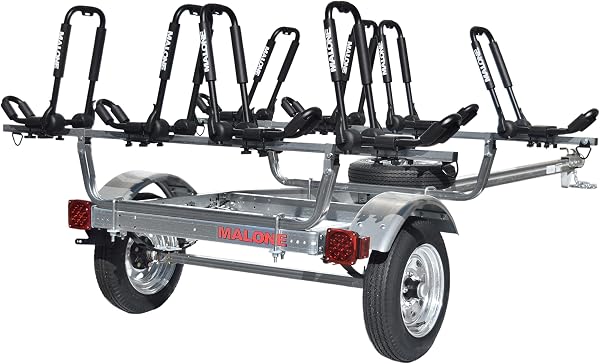
When a family of four or a group of paddling friends heads out for a weekend trip, trying to fit four kayaks onto a single vehicle roof is nearly impossible. The Malone MPG462G2 MicroSport 4 Kayak Trailer solves multi-boat logistics in one complete bundle. Built around a marine-grade pre-galvanized steel chassis measuring 78 inches wide by 159 inches long, this trailer includes four Malone FoldAway-J kayak carriers and a tongue-mounted spare tire right out of the box.
We may earn a commission when you buy through this link, at no additional cost to you.
With an 8-foot-long tongue equipped with a front support skid and lift handle, the trailer accommodates touring kayaks and canoes up to 19 to 20 feet in length without rear bumper interference during tight turns. The 78-inch coated steel cross rails provide generous lateral real estate to mount all four J-style cradles side by side. When you are only hauling one or two boats—or pulling the trailer empty—the FoldAway-J carriers hinge flat to reduce wind drag and overhead clearance.
Like Malone’s other marine trailers, the MicroSport features pre-assembled sealed wheel hubs and a submersible plug-and-play LED light kit, allowing you to back straight into the water at the launch ramp. The included spare tire mounts directly to the frame, providing essential peace of mind during long highway drives to remote rivers or coastal bays where small trailer tires can be difficult to source on a Sunday afternoon.
Fixed vertical J-hooks can catch low garage door headers when parked indoors. The included FoldAway-J carriers fold down flat against the 78-inch crossbars in seconds when not in use, simplifying garage clearance.
Keep in mind that J-style cradles hold kayaks at an angled edge, which works wonderfully for recreational and touring kayaks up to 355 pounds of rack payload across the carriers, while the base chassis itself is rated to 800 pounds. If you primarily haul ultra-wide, flat-bottomed 100-pound pedal fishing kayaks, a flat bunk or SaddleUp cradle style may be easier to load than angled J-racks. For four standard recreational or touring hulls, however, this bundle is ready for the road.
Anglers hauling wide, heavy pedal-drive fishing kayaks that should be transported flat on their hulls rather than on edge in J-cradles.
We may earn a commission when you buy through this link, at no additional cost to you.
Even if you transport your kayak on a vehicle rack or in a pickup bed, getting your boat across the last 200 yards of parking lot asphalt, grass, or packed beach sand to the water's edge can strain your lower back. The Bonnlo Kayak Cart Canoe Dolly is an ultra-portable, foldable shoreline trolley engineered for solo paddlers who need a lightweight portage companion that stows inside the kayak while on the water.
We may earn a commission when you buy through this link, at no additional cost to you.
Constructed from 20x2mm anodized aluminum tubing with stainless steel hardware, the frame weighs very little yet supports up to 200 pounds of watercraft and gear. It rolls on 10-inch diameter by 3-inch wide solid polyurethane airless tires. Because these tires are completely solid, you never have to worry about arriving at the launch to find a flat tire from a thorn, sharp shell, or valve leak. Foam bumpers on each cradle arm cushion your hull against scratches, while rubber foot bumpers protect the bottom frame tubes when resting on pavement.
Solo loading is often the hardest part of using a small dolly, because two-wheeled carts tend to tip over while you lift the bow or stern into place. Bonnlo solves this annoyance with a 12-inch-high spring-loaded double kickstand. The dual-leg kickstand props the cradle arms upright on shore while you position the hull, and two included 7.75-foot ratchet straps attach directly to the frame tubes to minimize hull slippage during the walk.
Trying to balance a kayak onto a single-leg cart on uneven ground often leads to the boat sliding off. The wide double kickstand keeps the cradle level while you center the hull and tighten the straps.
Once you reach the water, the wheels pop off quickly and the aluminum frame folds flat, allowing you to stow the entire cart inside a larger kayak hatch or bungee it to the rear tankwell. While it is strictly a walk-behind portage cart rather than a vehicle trailer, it is one of the smartest low-cost investments a paddler can make to eliminate solo carrying strain.
Paddlers looking for a hitch-mounted vehicle trailer or those hauling more than 200 pounds of gear.
We may earn a commission when you buy through this link, at no additional cost to you.
Modern tournament fishing kayaks equipped with pedal drives, trolling motors, lithium batteries, fish finders, and loaded tackle crates can easily weigh 180 to 250 pounds—pushing lightweight 150-pound beach dollies past their structural breaking point. The VEVOR Heavy Duty Kayak Cart is purpose-built for heavy watercraft, featuring a 2mm thickened aluminum alloy frame rated for an impressive 450-pound load capacity.
We may earn a commission when you buy through this link, at no additional cost to you.
To keep heavy loads rolling smoothly across gravel launch lanes, grassy banks, and compacted sand, VEVOR pairs the reinforced frame with tall 12-inch solid tires. The larger 12-inch diameter reduces rolling resistance over rocks and tree roots compared to smaller 8-inch or 10-inch wheels, and the solid puncture-proof construction means zero maintenance or air pressure checks before a trip.
Hull compatibility is highly versatile thanks to an adjustable carrying frame whose width slides between 170mm and 440mm. Whether you are moving a narrow touring kayak, a wide tunnel-hull fishing platform, a tandem canoe, a paddleboard, or even a lightweight Jon boat, you can tailor the foam-padded support rods to match the exact beam and chines of your vessel. An upgraded single-foot kickstand locks firmly to hold the cart stationary on uneven ground while you load.
Different watercraft have vastly different bottom contours. By adjusting the support spacing between 170mm and 440mm, you can position the foam-padded rods directly beneath the strongest structural ribs of your kayak or Jon boat.
To keep heavy boats from shifting when pulling up or down steep launch ramps, the included tie-down strap features a non-slip friction coating that grips the hull securely. Although the 12-inch wheels make this unit best suited for strapping onto a rear tankwell or stowing in your trunk rather than stuffing inside a tight bow hatch, anglers with heavy rigs will appreciate the 450-pound structural margin.
Motorists seeking a highway tow trailer or minimalist touring kayakers needing a tiny cart that fits inside a narrow 8-inch deck hatch.
We may earn a commission when you buy through this link, at no additional cost to you.
Paddlers who tow their boats behind overland trucks, Jeeps, and SUVs down rough forest service roads want a trailer that matches the durability and aesthetic of their rig. The Malone MPG440BLK MicroSport Off-Road Kayak Trailer starts with 11-gauge pre-galvanized steel and adds a durable black powder-coated finish over top, delivering dual-stage corrosion resistance with a stealthy, rugged appearance.
We may earn a commission when you buy through this link, at no additional cost to you.
Rated for an 800-pound payload capacity and capable of hauling canoes or kayaks up to 20 feet in length, this American-made trailer gives you a rock-solid foundation for custom outfitting. It features 78-inch-wide, 1.25-inch square steel load bars equipped with integrated D-ring tie-downs at the ends. Furthermore, the crossbar spread is adjustable between 44 inches and 63 inches, allowing you to space the bars closer together for shorter whitewater boats or wider apart for long tandem canoes and rooftop cargo boxes.
With a 30-inch ground-to-crossbar clearance and oversized pontoon wheels fitted with marine-grade sealed bearings, the trailer handles uneven dirt launch ramps and water submersion with ease. The DOT-approved plug-and-play submersible LED lighting kit comes standard, ensuring safe nighttime visibility on the highway and trouble-free wet launches at the ramp.
Fixed crossbars can force you to mount accessories in awkward positions. Being able to slide the crossbar spread between 44 and 63 inches lets you match the exact mounting footprint of rooftop tents, cargo boxes, or long boat cradles.
Because this model is sold as an open crossbar base trailer without pre-bundled J-racks or saddles, it is ideal for experienced paddlers who already own Thule, Yakima, or Malone crossbar accessories, or who want to mix and match a kayak carrier alongside a bike rack and gear basket. Assembly takes roughly three to four hours with common hand tools thanks to factory pre-assembled wheel hubs.
Shoppers who want boat cradles and a spare tire bundled in the initial purchase price.
We may earn a commission when you buy through this link, at no additional cost to you.
Active outdoor households rarely stick to just one sport. The Ruff-Sport Galvanized Trailer is designed as a multi-purpose adventure chassis capable of carrying fishing kayaks, stand-up paddleboards, bicycles, and hard-shell cargo boxes on the same trip. Constructed with a corrosion-resistant galvanized steel frame, it serves as a low-level mobile roof rack that trails effortlessly behind any vehicle with a standard hitch.
We may earn a commission when you buy through this link, at no additional cost to you.
One of the standout mechanical advantages of the Ruff-Sport is its wheel and suspension setup. While many compact kayak trailers use small 8-inch wheels that spin at higher revolutions per minute on the interstate, this trailer runs on taller 4.80×12-inch wheels paired with soft suspension springs. The larger tire diameter and tuned springs work together to soak up highway expansion joints and road vibration, protecting fragile carbon bicycles and composite paddleboards from jarring impacts.
Across the top of the frame sit 64-inch-wide crossbars engineered to accept standard aftermarket roof rack attachments from major brands like Yakima and Thule. If you already own roof-mounted bike trays, kayak saddles, or ski boxes that you are tired of hoisting overhead onto a tall SUV roof, you can transfer those exact accessories straight onto the Ruff-Sport’s crossbars.
Instead of locking you into proprietary mounting hardware, the 64-inch crossbars work with standard Yakima and Thule roof rack carriers, letting you repurpose existing bike racks, cargo boxes, and kayak cradles.
Everyday usability is enhanced by a standard fold-up locking tongue stand and full LED road lighting. When you uncouple the trailer at the campsite or in your driveway, the integrated tongue jack swivels down and locks into place so you can roll or park the loaded trailer level without resting the coupler on the dirt. While the 64-inch crossbar width is slightly narrower than 78-inch four-boat trailers, it makes the trailer easier to maneuver through tight parking lots and narrow camp lanes.
Paddlers needing extra-wide 78-inch load bars to carry four wide kayaks side by side.
We may earn a commission when you buy through this link, at no additional cost to you.
The Malone MPG461SRP MicroSport 4 Kayak Trailer is the ultimate group and family transporter, offering a streamlined alternative to individual J-cradles through its vertical stacker system. Engineered to carry up to four 20-foot kayaks or canoes with a total payload capacity of 800 pounds, this package includes four cushioned crossbar rack pads, two central vertical stacker posts, and a mounted spare tire.
We may earn a commission when you buy through this link, at no additional cost to you.
Vertical stacker posts are favored by experienced river shuttlers and paddling clubs because they maximize crossbar space and speed up strapping when hauling multiple whitewater, recreational, or touring kayaks. Instead of threading straps through four separate J-cradle frames, you place the cushioned pads directly onto the load bars, stand the kayaks on their side edges leaning against the central T-shaped stacker posts, and secure them cleanly to the bars. When you only want to haul two wide canoes or paddleboards flat on their hulls, the stackers can be positioned out of the way while the four rack pads cushion the gunwales.
Constructed in the USA from 11-gauge marine-grade pre-galvanized steel, the chassis stands up to years of wet launches and coastal road spray. Oversized pontoon wheels with factory pre-assembled sealed bearings and a plug-and-play submersible LED light kit allow you to back the trailer directly into the water without risking hub or electrical damage.
By combining four cushioned crossbar pads with two vertical stacker posts, you can haul four kayaks on edge during group trips or lay wide canoes and paddleboards flat across the padded crossbars when paddling solo.
With a three-to-four-hour assembly time using standard household tools and a five-year limited warranty, this complete package saves several hundred dollars compared to the four-J-rack configuration while providing identical 800-pound structural capacity. For families, scout troops, and paddling groups transporting up to four boats on weekend excursions, it delivers exceptional capacity and value.
Solo anglers who only ever transport a single wide pedal-drive fishing kayak.
We may earn a commission when you buy through this link, at no additional cost to you.
Selecting the right kayak transport solution starts with clarifying whether you need a highway-legal motor vehicle trailer, an off-road electric bike trailer, or a walk-behind portage dolly—and then matching weight capacity, crossbar geometry, and carrier style to your watercraft.
The term kayak trailer is used across three distinct equipment categories, and confusing them is the most common shopping mistake. Full highway tow trailers—such as the Malone MicroSport series, Malone EcoLight, Ruff-Sport, and Anything Sports Base Trailer—are DOT-compliant motor vehicle trailers equipped with a 2-inch hitch coupler, safety chains, leaf-spring suspension, highway-rated tires, LED brake and turn signals, and a Vehicle Identification Number for state registration. These rigs attach to your car, SUV, or truck to haul kayaks at highway speeds over long distances.
In contrast, backcountry bike trailers like the Rambo Bikes Canoe and Kayak Trailer Cart are low-speed trail haulers designed to attach to an electric bicycle rack or operate as a heavy-duty 300-pound walk-behind cart on gated logging roads and neighborhood paths. Finally, compact portage carts and dollies—such as the Bonnlo and VEVOR kayak carts—are two-wheeled frames that strap underneath the center or stern of a single hull so you can roll your boat by hand from a parking lot or campsite down to the shoreline.
Decide where your transport bottleneck happens before buying. Choose a highway trailer with a VIN if you want to eliminate rooftop lifting on road trips, an e-bike trailer for car-free trail launches, or a solid-tire dolly cart if you already haul your boat in a truck bed and just need shoreline rolling assistance.
Every trailer and cart has two critical ratings: total weight capacity and maximum boat length. Weight adds up faster than many paddlers realize. While a basic 10-foot recreational kayak might weigh only 42 pounds empty, a modern 13-foot rotomolded fishing kayak outfitted with a pedal drive, battery box, tackle crates, and cooler can easily exceed 140 pounds per boat. If you haul two loaded fishing kayaks or four family kayaks plus paddles and wet gear, a 400-pound trailer like the Malone EcoLight is near its ceiling, whereas an 800-pound chassis like the Malone MicroSport series provides generous safety headroom.
Boat length is dictated by the trailer’s tongue length and crossbar spread. A short-tongue trailer rated for 14-foot boats will cause the bow of a 17-foot sea kayak or tandem canoe to overhang too far forward, risking contact with your vehicle’s rear tailgate or bumper during tight parking lot turns. Trailers engineered with 8-foot tongues—such as the Malone MicroSport models—safely accommodate canoes and touring kayaks up to 19 or 20 feet long with balanced tongue weight.
Always total the fully rigged weight of all boats and gear you plan to carry and measure your longest hull from bow to stern. Select a trailer whose rated payload exceeds your total load by at least 20 percent and whose tongue length clears your longest boat.
One of the primary reasons paddlers transition from vehicle roof racks to dedicated kayak trailers is to protect their shoulders and lower back from heavy overhead lifting. However, crossbar height varies even among trailers. Standard highway kayak trailers position their load bars roughly 28 to 30 inches off the ground—about waist height—which offers extra ground clearance over rutted dirt roads. Specialized low-profile rigs like the Malone MicroSport LowBed drop the crossbar-to-ground clearance down to just 22 inches, placing the bars at knee height so you can pivot heavy fishing hulls onto the cradles using leg leverage.
Crossbar width and spread determine how many watercraft you can mount side by side and how well long hulls are supported. A 58-inch to 64-inch crossbar easily holds one or two boats flat or two to three boats on edge. If you plan to haul four kayaks simultaneously or combine two wide kayaks with a rooftop cargo box, look for extra-wide 78-inch steel load bars. Adjustable crossbar spread—such as the 44-to-63-inch adjustment on the Malone MicroSport Off-Road—lets you fine-tune the distance between the front and rear bars to match short whitewater boats or long canoes.
If you paddle heavy fishing kayaks exceeding 85 pounds or have back and shoulder sensitivity, prioritize a LowBed trailer with 22-inch crossbar clearance. If you haul three to four kayaks for family outings, choose a trailer with 78-inch-wide crossbars.
How your kayak rests on the trailer crossbars affects both loading effort and hull preservation during hot summer drives. J-style cradles (found on the Malone MicroSport 4 J-Rack model) hold each kayak at a 45-degree angle on its side edge, allowing four boats to fit across a 78-inch bar while providing dedicated tie-down points for each hull. Vertical stackers with crossbar pads (used on the Malone MicroSport 4 Stacker model) stand boats nearly upright against central T-posts, creating a fast, economical setup for hauling up to four recreational or whitewater hulls.
For heavier or flatter hulls, horizontal cradles are superior. V-racks (included on the Malone EcoLight 2) provide wide V-shaped support arms that cradle two recreational kayaks or canoes upright. Saddle-style carriers—such as the SaddleUp Pro system on the MicroSport LowBed 2—use four self-adjusting rubberized pads per boat to support wide, heavy fishing kayaks flat on their bottom hulls, preventing sidewall indentation or oil-canning distortion on hot days. Alternatively, buying a base crossbar trailer lets you mount flat padded bunks or reuse existing Yakima and Thule carriers.
Match the carrier style to your hull shape and weight. Use J-racks or vertical stackers to fit three to four lightweight touring or recreational kayaks across one bar, and choose horizontal SaddleUp cradles or flat bunks for heavy, wide fishing kayaks.
Kayak trailers live in wet, humid environments and frequently encounter boat ramps, puddles, and coastal salt air. Standard painted utility trailers bought from hardware stores quickly rust from the inside out when exposed to water, and their unsealed wheel bearings can seize if submerged in cold lake water while warm from highway driving. Dedicated kayak trailers use 11-gauge pre-galvanized steel or galvanized steel topped with powder coating (like the Malone MicroSport Off-Road) to prevent structural rust over years of outdoor storage.
Equally critical is whether the wheel hubs and lighting harness are rated as fully submersible. Models equipped with marine-grade sealed bearings and plug-and-play submersible LED lighting allow you to back the trailer directly into the water at a launch ramp until the kayaks float off the cradles. Without sealed bearings and waterproof LED housings, you must stop the trailer on dry ground above the waterline and carry the boats the remaining distance by hand.
If you launch at boat ramps or paddle in brackish and coastal waters, insist on a galvanized steel frame with marine-grade sealed submersible bearings and waterproof LED lighting.
Because kayaks are relatively lightweight compared to fiberglass motorboats, a trailer with overly stiff springs will bounce violently over bumps, jarring your watercraft and electronics. Quality road trailers pair leaf-spring suspension tuned for lighter payloads with pneumatic highway tires ranging from 8 inches to 12 inches in diameter. Oversized pontoon-style tires or taller 12-inch wheels (found on the Ruff-Sport Trailer) roll with lower rotational speed at highway cruising paces and bridge gravel potholes smoothly.
For walk-behind portage carts like the Bonnlo and VEVOR models, tire criteria shift from high-speed suspension to puncture resistance. Solid polyurethane or solid rubber airless tires in 10-inch to 12-inch diameters are ideal for shore carts because they never go flat after sitting in a trunk for months and cannot be punctured by sharp shells, thorns, or broken glass at public launches. On highway trailers, check whether a full-size mounted spare tire is included—several Malone MicroSport bundles include a spare tire standard, which saves you from being stranded on a highway shoulder.
For highway towing, look for leaf-spring suspension and either choose a bundle that includes a mounted spare tire or budget to add one immediately. For shore portage carts, choose 10-inch to 12-inch solid airless tires.
Most shippable kayak trailers arrive via freight in heavy cartons and require home assembly. Look for designs that include factory pre-assembled wheel hubs and pre-wired plug-and-play lighting harnesses, which cut build time down to three or four hours using standard socket wrenches. Before ordering any road-going trailer, verify that the manufacturer supplies a Certificate of Origin and a permanent Vehicle Identification Number plate, as state motor vehicle agencies require these documents to issue a license plate.
Finally, measure your available storage space at home. A full-size 20-foot boat trailer measures over 13 feet long and 6.5 feet wide across the load bars. If you need to store the trailer inside a standard residential garage alongside cars, look for space-saving features like a removable bolt-on tongue (featured on the Anything Sports Base Trailer), fold-down J-cradles (like Malone FoldAway-J racks), or a lightweight frame that can be tipped upright against a wall when unloaded.
Measure your garage door width and bay depth before purchasing, and keep all shipping paperwork and VIN certificates in a safe folder so you can complete state trailer registration smoothly.
Proper load distribution and tie-down technique are essential for safe highway towing. Always position your kayaks on the cradles so that roughly 60 percent of the boat’s weight rests slightly forward of the trailer axle, creating a positive downward tongue weight of 5 to 10 percent of the total loaded trailer weight at the hitch coupler. Too little tongue weight—or tail-heavy loading—causes dangerous trailer sway at highway speeds. Secure every boat across both crossbars using cam-buckle straps rather than over-tightened industrial ratchets that can deform warm plastic hulls, and always add bow and stern safety lines tied to the trailer tongue and rear frame.
Before every road trip, perform a quick walk-around inspection: verify that the hitch coupler is fully latched over the ball with the safety pin inserted, cross the safety chains underneath the tongue in an X-pattern so they catch the tongue if it ever uncouples, check tire inflation pressure when the tires are cold, and test your brake, turn, and running lights. After driving the first 10 miles with a newly assembled trailer or freshly loaded boats, pull over in a safe parking lot to re-check lug nut torque and strap tension.
To maximize the lifespan of galvanized steel frames, hubs, and portage carts, rinse the entire trailer—especially the wheels, axle, springs, and coupler—with fresh garden hose water after any launch in saltwater, brackish estuaries, or muddy ramps. Even on trailers with sealed marine bearings, periodically spin the wheels to listen for smoothness and inspect the rubber hub seals before long summer road trips. During off-season winter storage, elevate the tongue on a stand or blocks to prevent water from pooling on the frame and cover tires to shield the rubber from UV cracking.
In almost all U.S. states, any trailer towed behind a motor vehicle on public roads must be titled, registered, and fitted with a state license plate. Road-legal trailers like the Anything Sports Base Trailer, Ruff-Sport, and Malone EcoLight or MicroSport models ship with a Vehicle Identification Number and a manufacturer's Certificate of Origin for the DMV. Walk-behind portage carts and bicycle trailers do not require motor vehicle registration.
Yes, lightweight galvanized kayak trailers are specifically designed so that small cars and crossovers with Class I or Class II hitches can tow them safely. For example, a Malone MicroSport base frame weighs around 197 pounds empty; even loaded with four 50-pound kayaks, the total towed weight is around 400 pounds, which is well under the 1,000-to-1,500-pound towing rating of most compact vehicles. Always verify your vehicle owner's manual and hitch receiver coupler size before towing.
You can submerge trailers that are explicitly built with marine-grade sealed wheel bearings and submersible LED lighting kits, such as the Malone EcoLight and Malone MicroSport series. Backing a submersible trailer into the water allows you to float heavy kayaks directly off and onto the cradles without lifting. If a trailer uses unsealed utility bearings or standard non-waterproof wiring, you should keep the hubs above the waterline.
Most dedicated multi-kayak highway trailers, including the Malone MicroSport series, use a standard 2-inch hitch coupler that fits onto a 2-inch hitch ball. Before your trailer arrives, double-check the coupler stamped size on the tongue and ensure your vehicle's ball mount is set at a height that keeps the trailer frame level with the pavement.
Wide, heavy sit-on-top fishing kayaks—especially those weighing over 70 pounds—should be transported flat on their hulls using horizontal saddle carriers like Malone SaddleUp Pro cradles, V-racks, or padded bunks. Lifting a heavy fishing hull onto its side into high J-racks is physically straining, and carrying heavy rotomolded boats on edge in hot weather can cause sidewall warping.
Most compact kayak trailers running on 8-inch to 12-inch tires are rated for standard highway speeds up to 55 to 65 mph, depending on the specific tire speed rating stamped on the sidewall. Always check the maximum speed rating on your trailer tires and manufacturer manual, maintain proper cold tire PSI, and slow down over rough road construction zones.
A typical bolt-together galvanized kayak trailer takes approximately two to four hours to assemble in a driveway or garage using common socket wrenches and pliers. Trailers that come with factory pre-assembled wheel hubs and plug-and-play wire harnesses save substantial time because you do not have to pack wheel bearings or splice electrical wires.
Walk-behind portage carts often sit unused in hot car trunks or garage corners for weeks between trips, where pneumatic inner tubes slowly lose air or suffer dry-rot leaks around the valve stem. Solid polyurethane tires—like those on the Bonnlo and VEVOR carts—eliminate flat tires from thorns, sharp oyster shells, and neglect, ensuring the cart is always ready at the launch.
Yes, trailers with square or rectangular steel crossbars—such as the Ruff-Sport Trailer and Malone MicroSport models—accept many standard roof rack attachments from brands like Yakima, Thule, and Malone. As long as you stay within the trailer's total payload rating, you can mount a kayak carrier on one side of the crossbar and a bicycle tray or cargo box on the other.
Choosing the right kayak trailer transforms every paddling trip by replacing heavy overhead rooftop lifting with effortless waist-level or knee-level loading. For anglers and paddlers hauling heavy, wide watercraft, the Malone MicroSport LowBed 2 Trailer earns our top overall recommendation thanks to its 22-inch low-clearance crossbars, 800-pound capacity, horizontal SaddleUp Pro carriers, and fully submersible hubs.
If you regularly transport up to four boats for family adventures or group shuttles, the Malone MicroSport 4 Stacker Trailer and MicroSport 4 J-Rack Trailer provide complete turnkey bundles with 78-inch crossbars and included spare tires. Meanwhile, budget-minded drivers who want a customizable galvanized road frame with a detachable tongue can start with the Anything Sports Base Kayak Trailer, and paddlers who simply need shoreline portage help from the parking lot can rely on the high-capacity VEVOR 450-pound cart or foldable Bonnlo dolly.
Before making your final choice, verify whether you need a road-legal VIN trailer for highway towing or a walk-behind portage cart for the beach, measure your longest boat, and match the carrier cradle style to your hull profile for years of trouble-free launches.