XtremepowerUS 2200W Breaker
9.0Editor score2200-watt electric motor
1800 blows per minute
Heat-treated alloy chisels
360-degree rotating handle
Find the right jackhammers for 2026. We compare 10 standout options by build quality, useful features, owner feedback, value, and everyday trade-offs.
Find the right jackhammers for 2026. We compare 10 standout options by the factors that matter in this category, such as motor wattage, impact energy ratings, blow frequency, tool weight class, chuck retention systems, vibration isolation mechanisms, thermal cooling, long-term durability, and practical jobsite trade-offs across residential and light commercial demolition tasks.
Breaking cured concrete slabs, trenching through hardpack, chipping floor tile, and busting foundation footings require distinct mechanical characteristics. A heavy 30-pound breaker delivers the downward kinetic force needed for flatwork, while a nimble 12-pound chipping hammer prevents operator exhaustion when working horizontally on block walls or overhead masonry structures.
Modern electric demolition hammers bypass the noise, logistical complexity, and maintenance overhead of tow-behind air compressors and pneumatic hoses. By plugging straight into standard 110-volt or 120-volt circuits, these corded breakers deliver between 15 and 66 Joules of per-strike impact energy, offering dependable breaking power for contractors, remodelers, and serious property renovators alike.
We compared 10 electric jackhammers using the details that actually help a buyer decide: impact energy in Joules, motor power, blow frequency, chuck shank standard, operating weight, anti-vibration engineering, case transport solutions, included chisel profiles, and owner reliability records. The notes focus on practical trade-offs so each pick connects to how tradespeople, remodelers, and homeowners actually break concrete, trench clay, and chip masonry.


Compare key features, scores, and current prices side by side. A shorter feature list means fewer details were available, not necessarily fewer capabilities.




The Berserker 1700W 65F represents the modern evolution of the classic 30-pound medium demolition hammer. Designed for tradesmen, concrete contractors, and discerning remodelers who work full eight-hour shifts, this tool focuses on maximizing destructive energy transfer while minimizing the punishing physical shock that causes operator joint pain and fatigue.
We may earn a commission when you buy through this link, at no additional cost to you.
Driven by a high-efficiency 14-amp, 1700-watt motor, the Berserker 65F generates an impressive 55 Joules (40.6 foot-pounds) of impact energy via an oversized striker cylinder at 1900 BPM. The engineering differentiator lies within the pneumatic chamber: a lengthened internal air cushion acts as a progressive shock absorber on the piston’s return stroke. This maintains maximum downward driving velocity while preventing jarring harmonic kickback from entering the tool’s structural frame.
Operator ergonomics are further elevated by a dedicated anti-vibration system built directly into the main rear handle and the fully adjustable 360-degree secondary grip. The dual-grip layout encourages a comfortable, upright stance that allows the tool’s own 31-pound mass to do the cutting work, eliminating the harmful habit of leaning downward with full body weight. The quick-lock chuck utilizes the heavy-duty 1-3/16-inch (30mm) hex standard, incorporating automatic bit retention and internal dust sealing.
The 1-3/16-inch (30mm) hex shank format is engineered specifically for heavy-duty 30- to 40-pound demolition hammers. The broad dimensional flats distribute rotational and axial stresses evenly across the chuck retainers, preventing the shank from peening, mushrooming, or galling inside the barrel under sustained 55-Joule impacts. This ensures quick, tool-free bit changes even after hours of continuous, punishing operation.
Buyers must verify tooling compatibility before ordering: the 1-3/16-inch (30mm) hex receiver is precisely machined and will not accept common 1-1/8-inch or 5/8-inch hex shanks. For contractors who demand high-tier vibration damping, dependable build quality, and sustained slab-busting efficiency in a balanced 30-pound package, the Berserker 65F is a stellar professional investment.
Users with an existing stockpile of 1-1/8-inch hex bits or those needing a light hammer for horizontal wall tile chipping.
We may earn a commission when you buy through this link, at no additional cost to you.
The XtremepowerUS 2200W Demolition Jack Hammer is built for homeowners, plumbing contractors, and landscape builders who need serious concrete-busting muscle without the exorbitant rental fees of commercial hydraulic breakers. Delivering 2200 watts of electrical motor power to drive an 1800 beat-per-minute piston, this tool provides the direct, downward impact force required to fracture four-inch basement slabs, garden walkways, brick retaining walls, and stubborn patio footings.
We may earn a commission when you buy through this link, at no additional cost to you.
Performance is anchored by a rigid all-metal gear housing that protects the internal armature, striker mechanism, and cylinder assembly from structural deflection during aggressive operation. The 1800 BPM stroke velocity is tuned specifically for breaking unreinforced concrete: fast enough to cause rapid propagation of spiderweb fractures, yet deliberate enough that the piston transfers its full kinetic mass into the material rather than skimming the surface.
Ergonomically, the machine incorporates a 360-degree rotating auxiliary D-handle that clamps firmly along the barrel collar. This lets operators position their forward hand precisely where balance demands, whether driving straight down into floor footings or working on angled trench walls. The retaining chuck uses a proven mechanical collar lock that securely captures standard hex-shank bits, ensuring the included 16-inch bull point and 16-inch flat chisels never slip out during deep penetration.
The included 16-inch bull point chisel concentrates the full impact energy of the 2200-watt motor onto a minute surface area, making it the tool of choice for punching initial fracture lines through dense aggregate and high-PSI concrete. Once deep fractures form, switching to the 16-inch flat chisel allows the operator to exploit existing fault lines, shear away fractured chunks, and cleanly scrape concrete remnants off underlying subgrade or reinforcing mesh.
The primary operational trade-off is tool weight and recoil. Lacking a pneumatic decoupler on the primary rear handle, sustained sessions will transmit substantial vibration into the operator’s hands and forearms. For renovators and builders looking for maximum destructive power per dollar spent, this XtremepowerUS workhorse remains an exceptional, time-tested entry into the heavy demolition category.
Delicate indoor tile removal or overhead wall chipping where light tool weight and surgical control are mandatory.
We may earn a commission when you buy through this link, at no additional cost to you.
The VEVOR 1400W Demolition Jack Hammer occupies an essential middle ground between awkward, heavy pavement breakers and light-duty rotary drills. Designed for remodelers, electricians running conduit trenches, and masonry masons taking down cinderblock walls, this tool utilizes a 1400-watt copper motor to output 19 Joules of impact force at an aggressive 2900 blows per minute, emphasizing speed and precision over brute downward mass.
We may earn a commission when you buy through this link, at no additional cost to you.
That high blow frequency is precisely what makes this model so effective in lighter masonry, mortar joints, tile-covered screed, and soft rock. Where a slow, heavy 30-pound jackhammer would shatter surrounding brickwork unpredictably, the rapid 2900 BPM action acts like a high-speed chisel, allowing the operator to carve clean channels, pop bathroom floor tiles without cracking the plywood subfloor, and knock out basement window headers with pinpoint accuracy.
Comfort receives serious attention through an upgraded spring-cushioned handle structure. Rather than relying on simple rubber grip sleeves, the main handle is mechanically isolated from the striking cylinder via internal coil springs that compress under load, absorbing shock waves before they travel into the user’s wrists and elbows. An enlarged trigger switch provides easy throttling while wearing thick work gloves, and the 360-degree rotating side grip provides stability in tight mechanical chases.
The 5/8-inch hex shank standard utilized on this 1400W breaker represents a classic balance between tool weight and rotational rigidity. Unlike round shanks that can slip inside chuck collars under heavy side-loading, the hexagonal flats positively lock against the internal drive dogs. This ensures the chisel blade maintains its exact orientation when scraping mortar beds or shaving high spots off concrete slabs.
The main limitation is that 19 Joules cannot match the fracture depth required for six-inch reinforced highway concrete or massive granite boulders. If your task involves breaking up residential brick walkways, opening stucco walls, or excavating narrow plumbing trenches through hardpan dirt, this nimble VEVOR unit delivers outstanding control with minimal operator fatigue.
Shattering thick, wire-reinforced driveway slabs or breaking deeply buried concrete footings over five inches thick.
We may earn a commission when you buy through this link, at no additional cost to you.
When dealing with thick foundation walls, aged outdoor concrete slabs enriched with river rock aggregate, or massive fieldstone retaining walls, small chipping tools simply bounce off the surface. The VEVOR 3500W Demolition Jack Hammer is purpose-engineered for these unforgiving scenarios, packing a massive 3500-watt motor that channels 60 Joules of destructive kinetic energy into the workpiece on every cycle.
We may earn a commission when you buy through this link, at no additional cost to you.
At 60 Joules per impact, this machine operates in the true heavy-breaker territory. Instead of chipping away small surface fragments, a single burst drives deep shockwaves into the core of the concrete, splitting four- to six-inch thick slabs along natural aggregate planes within seconds. The heavy-duty cast aluminum casing houses an oversized piston and cylinder that generate immense air compression, driving the striker pin forward with industrial-grade authority.
Managing this level of energy requires robust vibration isolation. VEVOR outfits this model with a dual-spring rear handle suspension that mechanically floats the primary grip away from the violent percussion below. A built-in trigger lock button allows the operator to maintain continuous motor operation without squeezing the switch constantly, letting you focus all hand and arm strength on stabilizing the machine’s vertical orientation.
High-wattage electric motors like this 3500-watt unit draw substantial starting amperage when striking dense concrete. Running this machine through light-duty 16-gauge household extension cords causes voltage drops that can overheat the motor windings and trip upstream circuit breakers. To ensure maximum impact power and protect the internal motor brushes, always power heavy breakers via a dedicated 20-amp circuit using a heavy 10-gauge or 12-gauge cord no longer than 50 feet.
The clear trade-off is tool mass and electrical demand. At this power level, the machine is exclusively designed for downward vertical demolition; attempting to hold it horizontally to notch a wall will rapidly exhaust even conditioned workers. Furthermore, users must ensure their power source or generator can sustain the initial inrush current without tripping household breakers. For demanding flatwork, this breaker delivers commercial-tier destruction at a fraction of pro-tool costs.
Horizontal wall chiseling, overhead demolition, or operations restricted to weak 15-amp shared circuits.
We may earn a commission when you buy through this link, at no additional cost to you.
Demolition rarely involves just one uniform material. A typical foundation renovation might require breaking six-inch slab concrete, slicing through dense compacted clay in an exterior perimeter trench, and scraping adhesive mortar off a subfloor. The VEVOR 2200W 6-Chisel Demolition Hammer addresses this reality by pairing a heavy-hitting 66-Joule powerhead with a specialized six-piece chisel kit right out of the box.
We may earn a commission when you buy through this link, at no additional cost to you.
The mechanical tuning of this unit prioritizes maximum force per stroke: by operating at a measured 1350 blows per minute, each hammer stroke delivers an immense 66 Joules of kinetic force. This low-frequency, high-impact combination is specifically optimized to prevent the chisel from getting stuck in dense material, allowing the striker to deliver crushing blows that fracture structural aggregate rather than harmlessly buzzing against hard stone.
The six-piece bit set transforms the tool’s versatility on the jobsite. Beyond the standard pointed and narrow flat chisels, the kit includes a wide scraping chisel for floor tile removal, an oversized scraping bit for mastic cleanup, and dedicated clay spades. The clay spade turns this heavy breaker into an effortless trenching excavator, slicing through sticky clay and root-bound soil that would stop manual pickaxes and trenching shovels cold.
While pointed chisels fracture brittle masonry, they merely poke ineffective holes when driven into soft, plastic subsoils like hardpan, caliche, or sticky clay. The curved spade bit included in this kit spreads the 66 Joules of impact force across a broad, scooping edge. This shears tough earth into manageable clods, allowing plumbers and landscapers to dig deep utility trenches through rocky soil in a fraction of the time required by hand.
The trade-off reflects its heavy-duty classification: this is a substantial, downward-focused machine that requires proper body mechanics and lifting safety. If you need a complete demolition system that tackles everything from reinforced foundation pads to exterior landscape trenching without purchasing hundreds of dollars in aftermarket specialty bits, this package offers remarkable utility.
Lightweight wall restoration, overhead surface chipping, or casual users seeking a featherweight tool.
We may earn a commission when you buy through this link, at no additional cost to you.
One of the most physically draining aspects of concrete demolition is not the breaking itself, but hauling a heavy, awkwardly shaped breaker and its steel accessories across rough commercial jobsites, gravel driveways, and expansive backyards. The VEVOR 2100W Demolition Jack Hammer solves this logistical hurdle by bundling a high-output electric breaker with a purpose-built wheeled hand trolley.
We may earn a commission when you buy through this link, at no additional cost to you.
The hammer itself is an industrial powerhouse, driven by a 2100-watt motor cycling at 1650 BPM through a one-piece cast aluminum housing. This solid monocoque structure prevents motor alignment shifts under heavy lateral torque when prying fractured concrete blocks apart. The striking mechanism delivers rapid fracture development across dense masonry, foundation footings, and structural sub-slabs.
Vibration control utilizes a triple shock-absorption architecture. By combining mechanical dampening springs, elastomeric bushings, and a rigid T-shaped primary handle, felt impact at the operator’s hands is dramatically attenuated. However, the true productivity multiplier remains the wheeled trolley: operators can strap the breaker, cord, and four included chisels (two pointed, two flat) onto the cart, rolling effortlessly between work zones rather than dead-lifting 40 pounds of deadweight across the site.
Carrying a 35-pound breaker by a single top handle places severe, asymmetrical torque on an operator’s lumbar spine and shoulder joints before demolition even begins. By utilizing the heavy-duty rolling cart to transport the breaker and its heavy alloy bits, workers conserve core physical energy for actual tool operation, significantly reducing the risk of musculoskeletal injury over a long project.
The trade-off is the storage volume required in a contractor’s truck or utility trailer, as the trolley assembly cannot be condensed into a slim flat case. For solo contractors, commercial maintenance crews, and rental operators looking to protect their back and increase operational efficiency across large job sites, this mobile system represents brilliant practical packaging.
Cramped residential crawlspaces or jobs where equipment must be hauled up narrow, winding staircases.
We may earn a commission when you buy through this link, at no additional cost to you.
The Heavy Duty 30 Lbs In-Line Demolition Jack Hammer is tailored specifically for utility contractors, plumbing excavators, and foundation specialists who frequently work in narrow trenches, ditch lines, and restricted vertical shafts. While bulky T-handle breakers have wide motor housings that catch on trench sidewalls, this machine features a narrow, streamlined in-line profile that aligns the motor, piston, and chuck along a single vertical axis.
We may earn a commission when you buy through this link, at no additional cost to you.
Despite its slim geometry, it makes zero compromises on raw striking force. Delivering 55 Joules (40.57 foot-pounds) of impact force through a 31.2-pound operating chassis, this tool pulverizes dense cured concrete, asphalt roadways, and compacted shale. The straight-line design allows the operator to look directly down the barrel to trace underground pipes and footings with exceptional visual precision.
User convenience is supported by a lock-on trigger button that frees the operator from holding the switch continuously during long trench runs. The 1-3/16-inch (30mm) hex chuck mechanism permits swift, tool-free bit swaps without needing external wrenches or drift pins. For mobile tradesmen, the included heavy-duty blow-molded storage case features integrated roller wheels, allowing the 31-pound unit to be transported across the job site like rolling luggage.
Traditional breakers feature a transverse (side-mounted) motor that protrudes laterally, creating a wide footprint that obstructs sightlines and bumps against foundation walls in tight excavations. An in-line design places the motor armature parallel to the striking cylinder. This narrows the tool’s overall width, providing unobstructed downward visibility and allowing deep vertical penetration inside narrow utility trenches.
As with all dedicated 30mm hex machines, owners must ensure they stock bits that match the 1-3/16-inch hex specification. Backed by an extensive 24-month warranty, this in-line breaker provides contractors and serious DIY remodelers with a balanced, highly maneuverable demolition solution for vertical and trench-bound concrete removal.
Horizontal wall plaster scraping or users seeking a tool compatible with ubiquitous 1-1/8-inch hex tooling.
We may earn a commission when you buy through this link, at no additional cost to you.
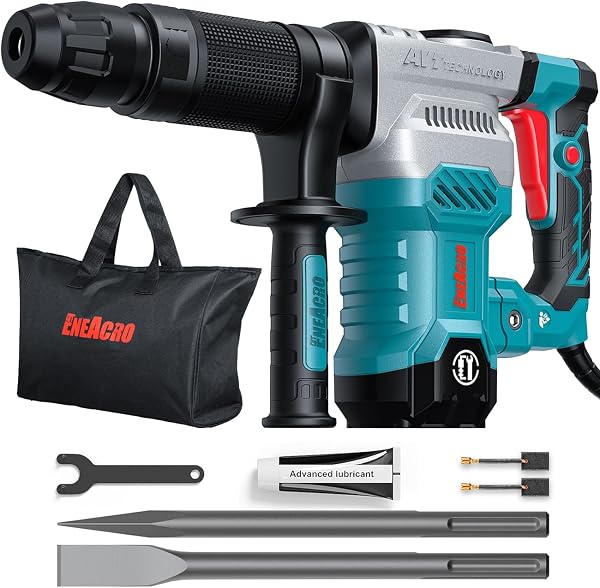
When bathroom remodeling, chimney repointing, or stucco abatement requires working on vertical surfaces or overhead masonry, conventional 30-pound jackhammers are completely unusable. The ENEACRO SDS-Max Demolition Hammer is engineered specifically to conquer this fatigue barrier, delivering professional chipping power in an agile, 12.8-pound package that operators can maneuver effortlessly all day long.
We may earn a commission when you buy through this link, at no additional cost to you.
Powered by an 11-amp copper motor delivering 11.6 foot-pounds (15.7 Joules) of impact energy at a rapid 4100 BPM cadence, this dedicated breaker functions like an electric scalpel. It strips ceramic tile, pops mortar beds, chips away spalled pool plaster, and notches concrete foundation blocks without delivering the structural shockwaves that crack surrounding finished walls. The anti-vibration system and PU soft-grip handle isolate the operator’s hands from high-frequency chatter.
A critical advantage is the commercial SDS-Max chuck mechanism. In addition to enabling rapid, tool-free bit insertion, the SDS-Max collar features an internal indexing system that locks flat chisels and scaling bits into twelve distinct rotational angles. This allows operators to align the cutting edge flat against a vertical wall or floor regardless of how the handles are oriented, preventing awkward wrist contortions.
When stripping tile from floors or shaving stucco off exterior framing, the flat chisel blade must meet the substrate at a shallow, precise angle to lift material cleanly without digging into the base layer. The 12-position indexing ring on the ENEACRO SDS-Max chuck lets the operator rotate and lock the chisel orientation independently of the motor body, ensuring an ergonomic wrist angle at all times.
Buyers must recognize that this is a dedicated hammer-only machine with no rotary drilling mode. It will not drill anchor holes in concrete, nor does it have the downward kinetic mass to bust heavy four-inch driveway slabs. For interior demolition, tile removal, plumbing wall penetrations, and light masonry sculpting, this lightweight ENEACRO tool is unmatched in comfort and efficiency.
Heavy floor slab demolition, busting thick roadway asphalt, or drilling round anchor holes in concrete.
We may earn a commission when you buy through this link, at no additional cost to you.
The ENEACRO 65 Joules SDS-Hex Concrete Breaker earns our top recommendation by delivering the optimal convergence of industrial breaking force, refined vibration control, job site mobility, and complete out-of-the-box utility. Engineered for general contractors, foundation specialists, and serious property renovators, this machine handles the toughest commercial and residential demolition jobs with authority.
We may earn a commission when you buy through this link, at no additional cost to you.
The heart of this breaker is a robust 1700-watt industrial motor paired with a heavy-displacement pneumatic cylinder that generates a staggering 65 Joules (48 foot-pounds) of impact energy. Whether shattering heavily reinforced garage aprons, breaking apart frozen subsoil, trenching through shale, or excavating commercial footings, this machine punches deep structural fractures into the hardest cured materials on the very first pass.
Recognizing that 65 Joules of kinetic power can quickly punish the user, ENEACRO incorporates an advanced multi-stage anti-vibration system. The rear handle utilizes heavy mechanical coil springs and dampening buffers to decouple the operator’s hands from the striking cylinder. Combined with a fully rotating 360-degree auxiliary handle and an automatic trigger lock-on button, operators can maintain productive downward passes for hours without debilitating hand numbness.
Airborne concrete dust is highly abrasive; when fine silica particles enter the chuck and striking barrel, they mix with internal lubricants to form a grinding paste that rapidly destroys internal O-rings and striker pins. ENEACRO’s SDS-Hex retention system features integrated elastomeric dust seals around the bit collar, blocking pulverized debris from contaminating the internal pneumatic chamber during heavy downward busting.
Transportation is streamlined through an included heavy-duty wheeled blow-molded case that securely houses the breaker, pointed chisel, flat chisel, oil bottles, and spare carbon brushes. The tool-free SDS-Hex chuck ensures positive bit retention while sealing out abrasive concrete dust. For buyers seeking a heavy-hitting demolition hammer that balances brutal breaking power with exceptional operator protection, this ENEACRO breaker is the premier overall choice.
Light residential wall chiseling or operators looking for a compact, sub-15-pound tool for delicate detailing.
We may earn a commission when you buy through this link, at no additional cost to you.
The XtremepowerUS 2200W Electric Floor Breaker with Case represents one of the most widely deployed electric demolition hammers across residential jobsites. Designed as a rugged, no-nonsense floor breaker, this unit delivers the raw destructive force needed to tear up cracked patios, break through basement plumbing trenches, and dismantle masonry chimneys without complex mechanical failure points.
We may earn a commission when you buy through this link, at no additional cost to you.
Built around an industrial 2200-watt electric motor encased in a rigid cast-aluminum housing, this tool delivers consistent, hard-hitting impact energy into high-strength alloy chisels. The high-volume internal cooling fan continuously draws ambient air across the copper windings and striker assembly, keeping operating temperatures stable even during hot summer demolition projects in unconditioned basements or direct sunlight.
The tool’s mechanical chuck features an alloy retention collar that locks bits securely in place with a simple twist-and-lock motion, preventing bits from dislodging when pulling the hammer out of deep fractures. A 360-degree rotating side handle lets operators fine-tune their balance point, while the lock-on button keeps the machine hammering continuously without demanding constant finger pressure on the main trigger.
Demolishing a 200-square-foot concrete slab involves extended cycles of high-load motor operation. The oversized cooling vents and direct-drive impeller on this XtremepowerUS breaker generate high-velocity airflow directly across the motor brushes and cylinder jacket. This aggressive thermal dissipation prevents armature insulation breakdown and brush degradation, ensuring the tool maintains consistent striking cadence throughout long workdays.
While this model lacks the sophisticated progressive spring-suspension handles found on higher-priced competitors, its sheer simplicity, durability, and raw power make it a favorite for cost-conscious contractors and property owners. If your demolition queue consists primarily of downward flatwork and you prioritize proven reliability at an accessible price, this XtremepowerUS kit gets the job done.
Horizontal wall plastering, delicate masonry detailing, or operators with sensitive wrists seeking low-vibration tools.
We may earn a commission when you buy through this link, at no additional cost to you.
Selecting the right demolition jackhammer requires an understanding of impact dynamics, weight classifications, chuck configurations, and operator ergonomics. The comprehensive buying guide below breaks down the technical criteria trade professionals and DIY renovators must evaluate before purchasing.
When evaluating electric jackhammers, buyers frequently make the mistake of looking solely at motor wattage or amperage. While a high-wattage motor (ranging from 1400W to 3500W) provides the electrical power necessary to drive heavy internal mechanisms without stalling, the true measure of a breaker’s destructive capability is its impact energy, measured in Joules or foot-pounds. Impact energy defines the exact kinetic force delivered to the chisel tip on every single stroke.
For light-duty tasks such as removing bathroom floor tiles, chipping brick mortar, or clearing stucco, an impact force of 15 to 20 Joules (exemplified by the ENEACRO 11A or VEVOR 1400W) is ideal because it chips away surface layers without pulverizing the underlying subfloor or framing. Conversely, cracking four- to six-inch cured concrete slabs, breaking foundation footings, or excavating hardpan soil demands a heavy breaker delivering between 50 and 66 Joules (such as the ENEACRO 65J or VEVOR 2200W models), which can drive deep fracture lines through coarse stone aggregate.
Match the impact energy rating to the compressive strength and thickness of your target material. Select a 15- to 25-Joule tool for precision masonry and wall work; choose a 50-plus Joule powerhouse for flatwork, outdoor paving, and reinforced structural concrete.
Demolition hammers are categorized into distinct weight classes that dictate their intended operating orientation and physical demands. The 10- to 15-pound class consists of compact, agile chipping hammers designed for horizontal and vertical work. Because an operator must hold the tool aloft when knocking down cinderblock walls, chiseling door headers, or stripping shower walls, keeping tool mass under 15 pounds is crucial to prevent shoulder exhaustion and spinal strain.
The 30-pound class represents the most versatile all-around category for residential remodeling and utility contracting. These tools possess sufficient downward deadweight to fracture floor slabs under their own inertia, requiring minimal downward pushing from the operator, while remaining light enough for one person to hoist in and out of a service van. The 40- to 60-pound class comprises heavy pavement breakers designed strictly for downward, vertical demolition on streets, parking pads, and thick commercial foundations.
Never purchase a heavy 30-plus pound jackhammer if your project involves significant horizontal wall demolition or overhead chipping. Conversely, do not expect a featherweight 12-pound chipping hammer to break thick driveway slabs efficiently, as it lacks the downward mass required to penetrate deep concrete.
The chuck and shank standard determines tool-free bit retention, rotational indexing capabilities, and aftermarket accessory availability. The SDS-Max standard (featured on tools like the ENEACRO 11A) is the industry benchmark for light to medium chipping hammers. SDS-Max bits slide into the chuck and lock automatically via spring-loaded ball bearings, and the chuck collar allows operators to index flat chisels into multiple rotational angles to maintain ergonomic wrist posture against flat walls.
For heavy 30-pound breakers and industrial pavement busters, hexagonal shanks reign supreme. The most common heavy standards are 1-1/8-inch hex, 1-3/16-inch (30mm) hex, and smaller 5/8-inch hex formats. The broad, flat faces of a hexagonal shank distribute immense axial and rotational torque across hardened steel dogs, preventing the bit from twisting or shearing off inside the chuck during 60-Joule impacts. However, buyers must pay close attention to exact shank dimensions, as a 30mm hex bit will not seat inside a 1-1/8-inch chuck.
Check the shank standard carefully before purchasing replacement tooling. Choose SDS-Max for versatile, angle-adjustable chipping and tiling work; insist on heavy-duty 30mm or 1-1/8-inch hex shanks for dedicated downward slab and trench demolition.
Blow frequency, measured in blows per minute (BPM), works in direct tandem with impact energy to determine how material fractures. There is an inherent mechanical trade-off in pneumatic cylinder design: tools with smaller pistons stroke rapidly at 2800 to 4100 BPM with moderate per-strike energy, whereas heavy breakers utilize massive, long-travel pistons that cycle more deliberately at 1350 to 1900 BPM with colossal per-strike force.
High blow frequency (2800 to 4100 BPM) excels in brittle, low-compressive-strength materials such as clay tiles, cinder blocks, brick mortar joints, and thin plaster. The rapid-fire percussion quickly breaks the bond between tile adhesive and concrete without shattering the surrounding structure. Lower blow frequencies (1350 to 1900 BPM) are necessary for dense, high-compressive-strength materials like road-grade concrete, granite, and foundation footings, where the piston requires full stroke travel to deliver high Joules into the aggregate.
Prioritize high BPM ratings (above 2500) for interior remodeling, wall demolition, and surface scraping. Prioritize lower BPM ratings (under 2000) paired with high Joule ratings for heavy structural slabs and outdoor excavation.
Prolonged exposure to the violent harmonic vibrations produced by demolition hammers can cause serious occupational health conditions, including Hand-Arm Vibration Syndrome (HAVS), carpal tunnel damage, and chronic joint pain. Premium manufacturers integrate multi-stage anti-vibration systems (AVT) that mechanically decouple the primary rear handle from the striking cylinder using progressive coil springs, internal counter-balancers, and elastomeric dampers.
Air-cushion technology inside the striking barrel also plays a crucial role. By maintaining an extended pocket of compressed air on the striker pin’s return stroke, the tool absorbs internal recoil before the steel piston collides with the back of the cylinder housing. Tools equipped with dual-spring floating handles—such as the Berserker 65F and ENEACRO 65J—can reduce felt vibration by up to 50 percent compared to rigid, un-damped metal frames, allowing operators to work longer with far less joint soreness.
If you plan to use your jackhammer for extended multi-hour shifts, prioritize models featuring spring-isolated handles and pneumatic air cushioning over budget tools with simple rubberized grips. Your wrists, elbows, and shoulders will immediately feel the difference.
A jackhammer is only as effective as the chisel bit attached to its chuck. Most breaker kits include a basic bull point chisel and a standard narrow flat chisel. The pointed chisel concentrates all striking force into a single contact point, making it the premier choice for punching initial pilot holes, fracturing high-strength concrete slabs, and splitting large boulders along structural fault lines.
Specialized bits vastly expand a jackhammer’s jobsite utility. Wide scaling chisels (two to four inches broad) are essential for peeling linoleum, scraping carpet adhesive, and knocking mortar splatter off brickwork. Clay spades feature broad, curved scoops that transform a heavy breaker into an effortless digging tool for plumbing trenches in hard-packed, root-bound soil. Asphalt cutters use a wide, sharp wedge to score clean, straight edges in driveway paving prior to patching.
Ensure the tool kit you purchase includes the specific chisels required for your upcoming project, or verify that aftermarket bits in that exact shank profile (SDS-Max, 30mm hex, or 5/8-inch hex) are readily available at your local supply house.
Demolition hammers generate immense friction and mechanical heat during continuous operation. The internal striker compresses air thousands of times per minute, while the electric motor draws continuous high current. High-quality breakers feature heavy cast-aluminum or magnesium alloy housings that act as massive heat sinks, rapidly drawing heat away from the internal piston seals and copper stator windings.
Lubrication maintenance is equally vital for commercial longevity. Most heavy demolition hammers utilize an internal grease chamber or oil crankcase that lubricates the striker assembly and prevents O-ring burn-in. Models with transparent oil sight glasses or accessible grease ports make it easy to inspect lubricant levels before starting a shift. Using the manufacturer-recommended synthetic grease or 40-weight mechanical oil prevents metal-on-metal galling during demanding summer demolitions.
Look for tools featuring cast metal gear cases and accessible grease ports. Establish a strict routine of checking grease levels every 20 to 30 operating hours to prevent internal cylinder scoring and premature motor burnout.
Electric demolition hammers draw substantial current, typically requiring 11 to 15 continuous amps, with inrush starting surges exceeding 20 amps when striking hard aggregate. Plugging a 2200W or 3500W breaker into an overloaded residential circuit sharing lighting and appliances will immediately trip the breaker, causing frustrating jobsite downtime.
Voltage drop through undersized extension cords is the leading cause of electric motor failure in demolition equipment. Running a heavy breaker through a thin 16-gauge or 14-gauge extension cord causes electrical resistance that starves the motor of operating voltage, causing the copper windings to overheat, the insulation to melt, and the motor brushes to wear out prematurely. A 50-foot run demands a heavy 12-gauge cord, while 100-foot runs strictly require a 10-gauge conductor.
Always identify a dedicated, unshared 20-amp electrical receptacle or utilize a commercial-grade generator rated for at least 4000 starting watts. Pair your breaker with a 10- or 12-gauge outdoor-rated extension cord to protect internal motor electronics.
Prior to plugging in the tool, conduct a thorough mechanical pre-check. Ensure the chisel shank is clean, free of grit, and lightly coated with high-pressure molybdenum or lithium grease before insertion into the chuck; running dry shanks causes rapid wear to the chuck locking dogs. Inspect the crankcase oil sight glass or grease port to verify that the internal striking mechanism has adequate lubrication, and check the power cord for cuts or damaged strain-relief boots. Secure all auxiliary handle clamping collars firmly, and always equip yourself with ANSI-certified eye protection, steel-toe boots, heavy leather gloves, and hearing protection rated for at least 30 decibels of noise reduction.
During demolition, body mechanics and tool angles dictate both speed and safety. Position the chisel approximately two to three inches inward from the edge of the concrete slab rather than driving straight into the dead center of a massive pad, which can trap the bit. Hold the hammer at a slight 70- to 80-degree angle rather than perfectly perpendicular, allowing fractured material to shear outward and fall away freely. Crucially, let the tool’s own downward weight and kinetic percussion do the cutting; never lean your full body weight onto the handles or attempt to use the long chisel bit as a mechanical pry bar, which will bend the alloy shank and crack the front chuck casting.
Post-operation maintenance preserves equipment longevity and ensures smooth starts on subsequent workdays. After turning off the machine, blow out accumulated concrete dust from the motor ventilation slots using compressed air to prevent thermal insulation buildup over the electrical stator. Remove the chisel bit, wipe the shank clean, and cap the chuck opening to prevent silica dust contamination during transport. Inspect the motor’s carbon brushes every 50 to 80 operating hours, replacing them before they wear down to the copper lead wire to prevent catastrophic armature commutator damage.
A rotary hammer drill combines rotation with hammering to bore round holes in concrete, offering a secondary chipping mode for light surface work. An electric jackhammer (or demolition breaker) is a dedicated non-rotary tool engineered exclusively for crushing and breaking material. Jackhammers possess significantly larger pistons, heavier internal strikers, and deliver much higher impact energy (often 30 to 65 Joules) compared to rotary hammers (typically 2 to 10 Joules).
Yes, but only if you use a lightweight chipping hammer in the 10- to 15-pound category, such as the ENEACRO SDS-Max. Attempting to hold a heavy 30-pound or 3500W floor breaker horizontally causes rapid operator muscle exhaustion, compromises balance, and places extreme lateral stress on the chuck. For vertical wall and header demolition, always select a lightweight, high-BPM chipping tool.
Chisels typically bind when driven too far into the center of a slab without an open edge for material to fracture away, or when the operator drives the bit too deeply without clearing debris. If a bit becomes stuck, never pry violently with the hammer body, as this cracks the chuck casting. Disengage the tool from the bit, insert a secondary chisel a few inches away to break the surrounding tension, and lift the stuck bit out freely.
High-draw demolition hammers (1500W to 2200W+) strictly require heavy-gauge extension cords to avoid dangerous voltage drop and motor burnout. For cord runs up to 50 feet, use a minimum of a 12-gauge (12/3 AWG) heavy-duty cord. For distances between 50 and 100 feet, you must step up to an industrial 10-gauge (10/3 AWG) cord connected to a dedicated 20-amp circuit.
Lubrication intervals depend on the tool's design and operating frequency. For oil-lubricated breakers equipped with an inspection window, inspect fluid levels before every shift, keeping the level roughly halfway up the sight glass using 40-weight non-detergent or synthetic compressor oil. For grease-lubricated hammers, check the gear and cylinder grease ports every 20 to 30 operating hours, replenishing with manufacturer-specified lithium or molybdenum grease.
SDS-Max is a standardized slotted drive system tailored for 10- to 20-pound chipping hammers, offering tool-free insertion and multiple rotational chisel locking angles for wall scraping. The 1-3/16-inch (30mm) hex standard is a heavy-duty hexagonal shank built for 30-pound and larger floor breakers, designed with broad flat sides that handle massive 50- to 66-Joule impacts without rotational slippage or chuck wear.
Yes, an electric jackhammer delivering 50 or more Joules easily fractures the concrete surrounding embedded steel rebar or wire mesh. However, a jackhammer chisel cannot cut through the steel rebar itself. Once the concrete aggregate is pulverized and cleared away, use an angle grinder with an abrasive cutoff wheel or a reciprocating saw with a metal blade to slice through the exposed rebar.
Yes, anti-vibration technology is one of the most important safety features on a heavy breaker. High-impact demolition transmits severe harmonic shock waves directly into the operator's hands, wrists, and elbows. Spring-isolated handles and pneumatic air cushions absorb up to 50 percent of this destructive energy, drastically reducing physical fatigue and preventing long-term nerve disorders such as Hand-Arm Vibration Syndrome (HAVS).
A pointed bull point chisel is the most effective profile for initiating fractures in flat concrete slabs because it focuses the tool's full impact energy onto a single microscopic point to start spiderweb cracks. Once deep fractures form, switch to a narrow flat chisel to exploit the cracks, slice underlying aggregate bonds, and break the slab into manageable chunks for disposal.
Most commercial-grade electric demolition hammers feature heavy aluminum heat sinks and direct-drive cooling fans, allowing continuous operation for 30 to 45 minutes under heavy load. However, if the gear housing becomes too hot to comfortably touch with a gloved hand, allow the tool to idle unloaded for two minutes to let the internal fan circulate ambient air through the motor, or switch off the tool for 15 minutes to cool down.
The ENEACRO 65 Joules SDS-Hex Concrete Breaker earns our top overall recommendation by mastering the crucial balance between immense destructive force, advanced vibration mitigation, and effortless jobsite mobility. Generating an authoritative 65 Joules of kinetic force through a multi-stage spring-isolated chassis and bundled with a rugged wheeled case, it shatters reinforced foundation pads, outdoor patios, and frozen soil while shielding the operator from debilitating recoil.
For buyers with different project scopes, distinct alternatives stand out. The XtremepowerUS 2200W Breaker offers proven, time-tested floor-breaking performance at an exceptionally accessible value point, making it a favorite for residential driveway and patio removal. If your tasks require knocking down interior cinderblock walls, stripping floor tile, or trenching narrow plumbing chases, the lightweight 12.8-pound ENEACRO SDS-Max chipping hammer provides surgical maneuverability and chisel indexing that heavy floor busters cannot match.
Selecting the ideal demolition hammer ultimately comes down to matching impact energy and tool weight to your specific working plane and material density. Keep the tool under 15 pounds for horizontal wall chiseling, step up to a 30-pound 50-plus Joule breaker for downward flatwork, and always power your equipment with a heavy 10- or 12-gauge extension cord. Prioritizing impact force, quality bit shanks, and vibration control will ensure your demolition projects move swiftly, safely, and cleanly from start to finish.