Polk Audio RC80i
9.4Editor scoreEight inch polymer woofer
Aimable soft dome tweeter
Moisture resistant rubber seal
Paintable round flush grille
Find the right in ceiling speakers for 2026. We compare 10 standout options by build quality, useful features, owner feedback, value, and everyday trade-offs.

Find the right in-ceiling speakers for 2026. We compare 10 standout options by the factors that matter in this category, such as woofer cone materials, directional tweeters, ceiling cut-out dimensions, moisture protection, power handling, acoustic tuning options, and overall value. These insights help you select the ideal architectural speakers for music or immersive home theater setups.
Architectural overhead speakers vary widely across engineering designs and intended room applications. Standard two-way circular models deliver broad ambient sound for open living areas, while three-way driver systems reproduce articulate midrange dialogue for dedicated media rooms. High-humidity locations like bathrooms and covered patios require specialized moisture seals, whereas compact spaces benefit greatly from dual-voice-coil single stereo units.
Choosing the right overhead setup requires balancing physical ceiling depth limitations against listening expectations. Larger eight-inch woofers generate satisfying low-end presence without an external subwoofer, while swiveling tweeters allow you to aim high frequencies directly toward primary seating positions. By evaluating room dimensions, amplifier compatibility, and paintable grille designs, you can achieve pristine sound that integrates cleanly overhead.
We compared 10 in-ceiling speakers using the details that actually help a buyer decide: acoustic driver layout, cone durability, moisture resistance, mounting depth, dog-leg clamp stability, power handling, amplifier impedance matching, owner feedback, and real-world value. The notes focus on practical installation trade-offs so each pick connects to how homeowners realistically mount, wire, calibrate, and enjoy flush overhead sound in diverse living spaces.

Compare key features, scores, and current prices side by side. A shorter feature list means fewer details were available, not necessarily fewer capabilities.




The Klipsch CDT-5650-C II addresses one of the most stubborn challenges in custom architectural audio: placing speakers where ceiling layout permits while directing acoustic energy precisely where listeners sit. Built around proprietary Controlled Dispersion Technology, this single architectural unit gives audio enthusiasts the flexibility to steer both mid-bass and high frequencies toward designated seating zones, solving uneven sound coverage in complex architectural floor plans.
We may earn a commission when you buy through this link, at no additional cost to you.
At the heart of its performance is a premium one-inch titanium dome tweeter paired with Klipsch engineering. Titanium offers remarkable rigidity and light mass, which allows the diaphragm to reproduce delicate transient spikes, brass instruments, and movie dialogue with sparkling precision. When paired with high-efficiency output characteristics, the CDT-5650-C II delivers dynamic clarity that easily penetrates large rooms without pushing your amplifier into distortion.
The mechanical adjustment allows users to pivot the high-frequency horn and rotate the driver assembly, creating focused acoustic sweet spots across challenging vaulted ceilings or asymmetrical rooms. The low-profile magnetic grille snaps flat against finished drywall, hiding the complex mechanical swivels behind an unobtrusive white face that accepts interior latex paint without clogging the perforations.
Ceiling joists rarely line up with optimal couch positions. Klipsch Controlled Dispersion Technology overcomes structural constraints by permitting mechanical driver rotation, helping you achieve precise stereo soundstaging even when installation positions are dictated by electrical runs and plumbing pipes.
Because this model is packaged and priced individually, outfitting a multi-speaker media room or stereo listening zone requires purchasing multiple units, which increases the total installation budget. For listeners prioritizing focused vocal clarity, high efficiency, and surgical directional control over broad ambient wash, the CDT-5650-C II is an exceptional technical investment.
Shoppers seeking an inexpensive matched stereo pair on a tight budget or those wanting heavy bass output without pairing an external subwoofer.
We may earn a commission when you buy through this link, at no additional cost to you.
The Polk Audio RC80i pair is engineered for homeowners who want room-filling, full-range audio without cluttering living areas with bulky floorstanding enclosures. Sold as a matched stereo pair, these circular architectural speakers combine an expansive eight-inch mineral-filled polymer cone with an aimable one-inch soft dome tweeter. This arrangement delivers warmth and authoritative bass that smaller in-ceiling units struggle to produce, making them an adaptable choice for open-concept kitchens, home theater overhead channels, and everyday music distribution.
We may earn a commission when you buy through this link, at no additional cost to you.
Performance centers on the cohesion between the eight-inch woofer and the pivoting high-frequency driver. Because higher audio frequencies travel in directional beams, fixed overhead speakers often sound muffled when seated off-axis. The RC80i solves this through an aimable tweeter mechanism that allows you to direct upper frequencies toward your couch or primary prep counter, while the broad woofer dispersion ensures rich lower-midrange response down into mid-bass registers.
Moisture resistance is an essential operational advantage for installed architectural speakers. The RC80i incorporates durable rubber surrounds and protective internal seals that defend critical voice coils against steam and ambient moisture. This design makes them well-suited for installation in master bathrooms, laundry rooms, and sheltered outdoor patio ceilings, providing reliable protection against humidity without degrading high-fidelity acoustic reproduction.
In rooms with irregular layouts or high ceilings, directing high-frequency energy makes a perceptible difference. Angling the RC80i tweeter toward the main listening area restores vocal clarity, stereo imaging, and high-frequency sparkle that would otherwise dissipate across ceiling drywall.
The tradeoff with an eight-inch design lies in the required physical ceiling footprint. You need sufficient depth between rafters and clearance from framing studs to accommodate the mounting cams. However, if your ceiling cavity offers adequate clearance, the RC80i stands as the most dependable and well-rounded pair for balancing musical clarity, robust low end, and environmental resilience.
Buyers dealing with shallow ceiling joists under 3.5 inches of depth or those needing fully weatherproof outdoor speakers exposed to open rain.
We may earn a commission when you buy through this link, at no additional cost to you.
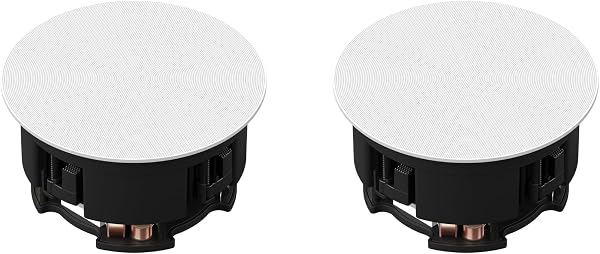
The Sonos in-Ceiling by Sonance represents a dedicated collaboration between two industry leaders in networked audio and architectural transducer design. Designed specifically for integration with the modern Sonos wireless ecosystem, these speakers are engineered to dissolve visually into high-end architectural ceilings while delivering room-filling, audiophile-grade fidelity across residential multi-room layouts.
We may earn a commission when you buy through this link, at no additional cost to you.
A standout feature of this system is its active acoustic optimization when driven by a Sonos Amp. By leveraging digital signal processing and Trueplay calibration software, the system measures reflections from hard floors, glass walls, and structural furniture, actively shaping the frequency curve to eliminate room modes and boomy nodes. With a 165 mm woofer, 25 mm tweeter, and an expansive 90-degree nominal dispersion angle, sound disperses evenly across broad open areas.
From an installation and architectural standpoint, Sonance hardware provides some of the cleanest aesthetic lines available. The wafer-thin magnetic grilles sit entirely flush without bulky raised bezels, allowing custom painters to match ceiling sheens perfectly. Furthermore, an efficient electrical load profile allows a single Sonos Amp to safely drive up to three pairs simultaneously, making whole-home background audio wiring clean and efficient.
In-ceiling speakers interact aggressively with floor tile, granite countertops, and bare drywall. When paired with the Sonos Amp, Trueplay uses algorithmic DSP correction to smooth out harsh secondary reflections, providing warm, balanced acoustic response regardless of complex interior acoustics.
The obvious tradeoff is the premium price tag, as these speakers represent a serious monetary commitment compared to generic ceiling drivers. However, for homeowners who value sophisticated whole-home app controls, automated room calibration, and uncompromising aesthetic refinement, this Sonance collaboration delivers unmatched everyday luxury.
Value-oriented DIY builders using basic analog stereo receivers or homeowners who do not plan to invest in the Sonos amplification ecosystem.
We may earn a commission when you buy through this link, at no additional cost to you.
The Polk Audio 70-RT from the Vanishing Series is tailored for critical home theater enthusiasts and discerning listeners who refuse to compromise sound quality for aesthetics. Unlike conventional two-way in-ceiling models that force one cone to handle both low bass and critical midrange frequencies, the 70-RT utilizes a true three-way driver architecture within a compact circular ceiling cutout.
We may earn a commission when you buy through this link, at no additional cost to you.
A dedicated 2.5-inch midrange driver, a 0.75-inch dome tweeter, and a recessed seven-inch subwoofer work in concert to reproduce a wide frequency spectrum spanning 34 Hz to 27,000 Hz. Separating the midrange band from the bass woofer prevents vocal distortion during intense cinematic explosions, ensuring film dialogue remains crisp, natural, and distinct even during demanding multichannel soundtrack sequences.
Acoustic bass output is further elevated through Polk’s patented Power Port venting design. By smoothly guiding turbulent airflow out of the driver assembly, the port minimizes distracting chuffing artifacts and structural ceiling rattles. Meanwhile, the ultra-thin Sheer-Grille magnetically locks over the frame with zero exposed rim, allowing the speaker to virtually vanish into the ceiling surface once painted.
Standard two-way speakers struggle when heavy bass and human vocals overlap. By isolating vocal frequencies to a dedicated 2.5-inch Dynamic Balance driver, the 70-RT ensures spoken dialogue and acoustic strings remain crystal clear without bass-induced modulation distortion.
The specialized three-way vertical motor assembly demands more mounting depth behind drywall than basic coaxial speakers. If your joist bays contain HVAC ductwork or shallow plumbing runs, you must verify vertical clearance before cutting. When ceiling depth permits, the 70-RT provides unmatched acoustic horsepower and dialogue intelligibility.
Homes with shallow ceiling cavities under 8 inches of total clearance or shoppers seeking inexpensive background speakers for utility areas.
We may earn a commission when you buy through this link, at no additional cost to you.
The Yamaha NS-IC800 stereo pair is tailored for homeowners who want clean acoustic reproduction across expansive living rooms, finished basements, and open-plan layouts. Delivering 140 watts of maximum input power and an extended high-frequency ceiling stretching up to 28 kHz, these eight-inch speakers project lively, airy high notes paired with solid, confident mid-bass dynamics.
We may earn a commission when you buy through this link, at no additional cost to you.
Yamaha centers this model around a blue polypropylene mica cone woofer matched to a centrally mounted coaxial dome tweeter. The sophisticated acoustic crossover operates at 3.5 kHz, which smoothly transitions energy away from the woofer before it exhibits cone breakup. This gives acoustic guitar strums, high-hats, and synth lines an open, airy texture that fills spacious volumes without feeling constrained.
Installing the NS-IC800 pair is straightforward due to its sturdy dog-leg mounting tabs that clamp down firmly against ceiling sheetrock. A magnetic paintable grille with thin borders provides clean visual closure. The stable eight-ohm nominal impedance load also ensures you can safely wire these speakers to multi-zone distribution amplifiers without risking thermal shutdown.
With an upper-frequency limit rated to 28 kHz, the NS-IC800 reproduces ultrasonic overtones and subtle room ambience effortlessly. This extended headroom ensures that high-resolution streaming tracks sound natural, open, and free from fatiguing harshness during all-day listening sessions.
The main limitation of the NS-IC800 is its fixed coaxial tweeter configuration. Unlike models featuring swiveling high-frequency capsules, these speakers broadcast their highs in a fixed downward dispersion pattern. Placing them centrally over primary seating zones yields fantastic balance, making them an exceptional option for broad ambient music distribution.
Installations where listeners sit far off-axis and require a mechanically aimable tweeter to direct treble energy toward a specific focal point.
We may earn a commission when you buy through this link, at no additional cost to you.
The Micca M-8C has established a stellar reputation among custom integrators and budget-conscious DIYers by delivering balanced, full-scale sound at a fraction of the cost of premium architectural brands. Designed around an eight-inch poly woofer and a pivoting one-inch silk dome tweeter, this speaker provides genuine hi-fi characteristics for secondary audio zones, basements, and surround setups.
We may earn a commission when you buy through this link, at no additional cost to you.
A critical acoustic strength is its smooth six-decibel crossover network, which maintains coherent phasing across the midrange boundary. Silk dome tweeters are renowned for their warm, forgiving character, which prevents the fatigue and harsh sibilance frequently encountered in entry-level ceiling hardware. When paired with an 8-inch high-excursion woofer that reaches down to 40 Hz, acoustic basslines and lower-register vocals sound remarkably robust.
Physical installation is notably accommodating thanks to a modest 3.5-inch mounting depth. Many eight-inch ceiling speakers require extensive overhead clearance, but the M-8C fits comfortably into conventional two-by-four ceiling cavities and between tightly packed wiring runs. Integrated dog-leg brackets lock securely into drywall, while paintable rimmed grilles blend easily with flat latex wall paint.
Renovating existing rooms often reveals shallow ceiling cavities obstructed by pipes or framing. The M-8C requires only 3.5 inches of depth, making it significantly easier to install than competing eight-inch models that demand over four or five inches of space.
While the plastic outer bezel is slightly wider than modern micro-flange or bezel-less architectural options, the acoustic output punches well beyond its accessible price point. For builders looking to outfit multiple rooms with eight-inch architectural sound without spending thousands, the Micca M-8C remains the benchmark for value.
Homeowners who insist on ultra-modern rimless magnetic grilles or dedicated audiophile installations demanding extreme surgical micro-detail.
We may earn a commission when you buy through this link, at no additional cost to you.
The Klipsch CDT-5800-C II represents the high-performance pinnacle of directional architectural audio, purpose-built for premium surround sound and Dolby Atmos overhead channels. Utilizing Klipsch's signature horn-loaded driver architecture combined with advanced Controlled Dispersion Technology, this unit delivers cinema-grade dynamics and focused clarity from above.
We may earn a commission when you buy through this link, at no additional cost to you.
Horn loading increases acoustic efficiency, allowing the titanium diaphragm compression driver to produce explosive dynamic peaks with minimal amplifier strain and lower distortion. In a dedicated multichannel setup, this gives overhead helicopter effects, falling rain, and spatial soundtrack cues incredible realism. Both the woofer assembly and the horn-loaded tweeter pivot independently, giving you total freedom to focus sound directly onto your home theater seating.
A standout technical feature is the inclusion of dedicated hardware attenuation switches on the speaker baffle. These controls allow you to boost or cut treble and mid-bass output directly on the physical unit. If your home theater features polished hardwood floors or large picture windows that create excessive brightness, toggling the high-frequency attenuation switch instantly restores balanced tonal neutrality.
Ceiling reflections can cause high frequencies to sound overly harsh in tile or hardwood rooms. Built-in boundary compensation switches allow you to adjust high-frequency and mid-bass energy at the speaker, delivering perfectly balanced sound before receiver software even runs.
As an individual, performance-tier architectural speaker, outfitting a complete 7.1.4 Dolby Atmos ceiling system with the CDT-5800-C II requires a sizable investment. However, if your goal is uncompromising dynamic impact, crystalline vocal articulation, and the ability to mechanically and electrically tune the speaker to your room, this model stands in a class of its own.
Budget-focused distributed background audio projects or casual utility rooms where high dynamic ceiling effects are unnecessary.
We may earn a commission when you buy through this link, at no additional cost to you.
The Pyle 8-inch architectural speaker pair provides a practical, high-output solution for workshops, garages, large recreation rooms, and home entertainment setups. Capable of handling up to 300 watts peak (150 watts RMS), this stereo pair combines robust high-power volume capability with essential sound-shaping features that are rarely found in this price category.
We may earn a commission when you buy through this link, at no additional cost to you.
Each unit pairs an eight-inch poly cone mid-bass woofer with a 1.0-inch pivoting silk dome tweeter. A three-position treble adjustment switch (+3 dB, 0 dB, -3 dB) lets you compensate for room characteristics directly at the speaker baffle. In heavily carpeted rooms with plush furniture, boosting treble by +3 dB restores air and brightness, while cutting by -3 dB tames reverberant echoes in concrete-floored garages or finished basements.
Physical installation is assisted by the included cardboard cut-out template and integrated quick-mount tabs. The spring-loaded terminal clips accommodate standard in-wall speaker wire, enabling fast, tool-free connections overhead on a ladder. Built from impact-resistant ABS composite, the speaker housing provides a rigid baffle that prevents acoustic chassis rattle under higher listening volumes.
Every room responds differently to overhead sound. The physical treble switch lets you adjust high-frequency output by three decibels up or down, allowing you to instantly brighten dull acoustic spaces or soften harsh reverberations without needing an external equalizer.
The visual appearance features a traditional raised-rim grille profile that stands slightly proud of the ceiling rather than sitting totally flush. If you need clean, high-volume sound with direct physical treble tuning across workshops, family dens, or entertainment basements, this Pyle pair represents an economical, workhorse choice.
Interior-conscious buyers requiring ultra-flush magnetic architectural grilles or ultra-delicate audiophile micro-dynamics.
We may earn a commission when you buy through this link, at no additional cost to you.
The VEVOR four-piece architectural set is tailored for large-scale renovation projects where broad multi-room sound coverage is needed without running up high equipment bills. Providing four matched eight-inch speakers in a single package, this kit is an ideal choice for running background audio through hallways, home offices, basements, and open dining rooms simultaneously.
We may earn a commission when you buy through this link, at no additional cost to you.
Each speaker is built with an eight-inch woofer cone and a one-inch dome tweeter capable of delivering 100 watts peak per channel. With a frequency range spanning 68 Hz to 20 kHz, these speakers provide articulate reproduction of vocal tracks, podcasts, and ambient musical playlists. An innovative rubber sealing strip lines the ABS chassis perimeter, creating an airtight acoustic seal against ceiling drywall to prevent sound bleed into adjacent floors.
Ease of installation is a major asset when cutting holes for multiple speakers across several rooms. The required cutout diameter is a relatively compact 8.1 inches (205 mm), which preserves ceiling structural integrity while still accommodating an eight-inch cone. The detachable white grilles can be spray-painted prior to installation, allowing you to seamlessly integrate all four speakers into varied interior color palettes.
Unsealed architectural speakers often leak sound upward into upper-story floor cavities. The integrated rubber sealing gasket on the VEVOR frame forms a snug acoustic barrier against drywall, containing sound energy within the room and minimizing unwanted vibrations.
Because low-end reproduction rolls off at 68 Hz, these speakers are designed primarily for balanced background listening rather than thunderous home theater sub-bass. For multi-room background audio or commercial retail distributed sound where cost per unit and simple installation are paramount, this four-speaker bundle delivers unbeatable practical utility.
Dedicated home theater main channels that require subterranean bass down to 30 Hz or audiophiles seeking intricate multi-driver crossover design.
We may earn a commission when you buy through this link, at no additional cost to you.
The Polk Audio RC6s solves a persistent challenge in architectural sound: delivering complete, immersive stereo sound inside compact rooms where cutting two separate speaker holes is physically impossible or visually intrusive. Using an ingenious dual-voice-coil driver architecture, this single 6.5-inch speaker accepts both left and right audio channels simultaneously, blending them into a rich, unified acoustic field.
We may earn a commission when you buy through this link, at no additional cost to you.
To achieve true stereo imaging from a single overhead cutout, the RC6s incorporates two independent 0.75-inch swiveling soft dome tweeters mounted over a 6.5-inch Dynamic Balance polypropylene woofer. By aiming the two tweeters in opposing directions, high-frequency stereo separation spreads across the room, preventing the hollow, one-sided sound typical of playing single mono channels in confined spaces.
Durability is a key hallmark of the RC-series platform. Built with resilient moisture-resistant rubber surrounds, the RC6s thrives in humid environments such as master bathrooms, walk-in steam showers, saunas, and covered outdoor entryways. The rotating cam mounting system locks the housing tightly against ceiling sheetrock, while the paintable round grille maintains a discreet profile overhead.
Wiring left and right channels to a standard speaker causes electrical damage or drops one channel entirely. The RC6s features two isolated voice coils wound on a single woofer motor, safely combining stereo signals into a unified low-end pulse while dual tweeters preserve stereo separation.
Keep in mind that running a dual-voice-coil speaker requires four-conductor wiring or two distinct two-conductor speaker lines connected to your amplifier’s left and right terminals. While it cannot match the physical stereo separation of two speakers spaced eight feet apart, the RC6s is undeniably the most elegant, high-performance solution for bathrooms, walk-in closets, and narrow hallways.
Large entertainment rooms where two physically separated speakers can be spaced out for genuine wide-soundstage stereo imaging.
We may earn a commission when you buy through this link, at no additional cost to you.
Installing architectural speakers is a permanent improvement to your home. Selecting the right models requires evaluating driver layouts, room acoustic dimensions, environmental moisture levels, and electrical compatibility with your amplifier.
Understanding the internal driver design is essential when matching architectural speakers to your listening habits. The vast majority of in-ceiling models utilize a two-way coaxial layout, where a central high-frequency tweeter is suspended directly over a larger low-frequency woofer cone. This arrangement provides a compact physical footprint, straightforward electrical crossover demands, and dependable acoustic performance for ambient background music across open living spaces.
More specialized applications require alternative architectures, such as three-way driver systems or dual-voice-coil arrangements. A three-way speaker isolates mid-frequency vocal reproduction to a dedicated midrange transducer, preventing heavy bass excursions from muddying human dialogue during intense movie scenes. In contrast, dual-voice-coil speakers accept separate left and right electrical signals into a single woofer basket, allowing homeowners to enjoy complete stereo sound in cramped bathrooms or hallways where installing two separate speaker grilles is impossible.
Evaluate the room purpose carefully before purchasing. For primary home theater overhead or center channels, prioritize three-way driver arrays for pristine dialogue intelligibility. For small bathrooms and walk-in closets, choose a dual-voice-coil stereo speaker. Standard two-way circular models remain the gold standard for multi-room background audio in kitchens and open family rooms.
The diameter of the primary woofer cone dictates how deeply and authoritatively an in-ceiling speaker reproduces low frequencies. Six-and-a-half-inch drivers represent the most common residential standard, offering a compact drywall cutout while delivering clean acoustic energy down to approximately 50 Hz. They blend smoothly with architectural lighting fixtures and perform admirably for casual background music, podcasts, and subtle surround ambient effects.
Stepping up to an eight-inch woofer yields a substantial increase in cone surface area, which translates into lower frequency extension, richer warmth, and improved bass fullness without requiring an external floor subwoofer. Eight-inch drivers reach deeper into sub-bass territory, providing the physical punch necessary to fill high-ceilinged basements, expansive open-plan great rooms, and outdoor covered patios where bass dissipates quickly into open air.
If your room features standard eight-foot ceilings and you plan to incorporate a standalone powered subwoofer, a 6.5-inch model provides ample fidelity and a discreet visual footprint. However, if you are outfitting large open spaces, high vaulted ceilings, or desire rich standalone musical warmth without an unsightly sub on the floor, invest in eight-inch woofers.
High-frequency audio waves travel in tight, directional beams compared to omnidirectional bass frequencies. Because in-ceiling speakers are mounted overhead firing downward, listeners seated off-axis often experience a muffled soundstage if the speaker uses a rigid, downward-facing tweeter. This is particularly problematic in home theater setups where sound effects must seem to originate from the screen rather than straight down from the ceiling.
Aimable, pivoting tweeters and horn-loaded directional drivers resolve this physical limitation by allowing you to steer the high-frequency capsule toward primary listening areas. Premium designs incorporate mechanical swivels that rotate 15 to 30 degrees, directing dialogue, string instruments, and spatial effects right at the couch. Advanced models even include boundary compensation and treble attenuation switches to tame harsh reflections caused by hardwood flooring, tile, and expansive glass windows.
Check whether the speaker features a pivoting tweeter assembly before finalizing your purchase, especially if ceiling structural constraints force you to mount the speaker off-center. Aimable tweeters grant you the flexibility to position speakers around joists and lighting cans while maintaining an accurate, balanced acoustic sweet spot.
Standard residential ceiling speakers feature paper cones and unsealed metal components that degrade rapidly when exposed to humidity and temperature fluctuations. In moist environments like master bathrooms, laundry rooms, kitchen cooking stations, and covered patio overhangs, rising steam causes untreated cones to soften, warp, and develop electrical short-circuits across voice coils.
Moisture-resistant architectural speakers incorporate specialized mineral-filled polypropylene cones, moisture-impervious rubber surrounds, and sealed rear chassis gaskets. These materials resist steam, mildew, and incidental condensation while maintaining consistent cone stiffness. Some models also utilize stainless steel or powder-coated aluminum grilles that prevent rust streaks from running down freshly painted drywall surfaces.
Whenever installing speakers in bathrooms, steam showers, spa zones, or covered exterior porches, verify that the manufacturer explicitly certifies the unit for moisture resistance. Never install standard indoor paper-cone speakers in humid zones, as they will degrade in sound quality and fail prematurely within a couple of seasons.
The physical mechanics of cutting into finished drywall requires precise planning. In-ceiling speakers use rotating dog-leg mounting cams that swing outward behind the drywall as you turn front-facing screws, sandwiching the sheetrock firmly between the outer flange and the cam. The depth of your ceiling cavity is a critical limiting factor; ductwork, plumbing, and structural framing often restrict available vertical space.
While smaller 6.5-inch models generally require between 3.5 and 4 inches of depth behind sheetrock, larger eight-inch or three-way drivers can demand 5 to 9 inches of clearance. Furthermore, ensure you verify joist spacing with a reliable stud finder before cutting. Standard ceiling joists run 16 or 24 inches on center, and hitting an unexpected framing timber or electrical conduit will force costly drywall repairs.
Always use the manufacturer’s supplied cardboard cutout template to score and cut your drywall aperture. Double-check vertical clearance with a bent coat hanger through a small pilot hole before making the full circular cut, ensuring the dog-leg clamps have ample room to rotate freely without binding against adjacent framing.
In-ceiling speakers are passive acoustic components that require external power from an audio receiver, multi-zone distribution amplifier, or streaming streaming amplifier. Matching the speaker’s continuous power handling (RMS) and electrical impedance (measured in ohms) to your amplifier’s output rating is vital for preventing voice coil distortion and amplifier thermal overload.
Most architectural speakers are rated at a nominal 8 ohms, which allows multi-zone amplifiers to drive them efficiently without overheating. However, wiring multiple speaker pairs in parallel to a single stereo amplifier channel drops electrical impedance to 4 ohms or lower, which can trigger safety protection shutdown circuits on basic consumer receivers. In large whole-home installations, selecting efficient speakers with high sensitivity ratings (90 dB or above) produces louder output with less amplifier wattage.
Check the continuous RMS output of your receiver or multi-room amplifier against the speaker’s recommended wattage range. For multi-room background systems, pair 8-ohm speakers with dedicated distribution amplifiers or impedance-matching speaker selectors to guarantee stable, clean audio distribution throughout your home.
Proper installation begins with strategic placement planning and careful cavity preparation. Before cutting drywall, map out your ceiling using a stud finder to identify joists, electrical wires, and recessed lighting cans. Drill a small pilot hole in the center of your chosen location and insert a bent coat hanger, rotating it 360 degrees to verify that nothing obstructs the mounting depth behind the sheetrock. For optimal soundproofing and acoustic performance, place unfaced fiberglass batt insulation loosely around the rear of the speaker basket inside the attic space, which dampens ceiling cavity resonance and prevents sound from bleeding into upstairs bedrooms.
Wiring and calibration play a crucial role in delivering balanced sound across the room. Always run CL2 or CL3 rated in-wall speaker wire through your walls to comply with building fire codes, choosing 16-gauge wire for runs under 50 feet and 14-gauge wire for longer distances. Ensure you maintain strict polarity when connecting the terminals: connect the positive red terminal on your amplifier to the positive red terminal on the speaker, and repeat identically for the negative black connections. Inverting polarity on one speaker puts the drivers out of phase, which cancels out bass frequencies and creates a hollow, unfocused listening experience.
Maintaining architectural speakers primarily involves keeping the grilles clean and protecting the internal drivers from environmental dust. To paint the grilles, remove them completely from the speaker frames, gently peel back any protective scrim cloth, and apply several light, even coats of diluted interior latex spray paint. Never use a heavy paint roller, as thick paint will clog the tiny acoustic perforations and noticeably degrade high-frequency output. For routine dusting, lightly vacuum the grilles using a soft brush attachment, or wipe them gently with a dry microfiber cloth to keep your overhead installation looking pristine.
Eight-inch in-ceiling speakers offer roughly 35 percent more surface area than 6.5-inch models, allowing them to reproduce deeper bass frequencies with greater authority and efficiency. They are ideal for high ceilings, large open-concept living rooms, and setups without a standalone floor subwoofer. However, 6.5-inch speakers require smaller drywall cutouts and fit more easily into shallow ceiling cavities where framing clearances are limited.
Standard indoor ceiling speakers should not be installed in bathrooms or outdoor spaces because rising steam and ambient moisture will warp paper cones and corrode voice coils over time. You should exclusively select models built with moisture-resistant rubber surrounds, polypropylene cones, and sealed internal chassis gaskets. These protective materials resist humidity, steam, and temperature fluctuations, ensuring long-lasting audio performance in wet areas.
Yes, nearly all architectural in-ceiling speakers are passive components, meaning they do not have built-in power amplifiers or power cords. They must be connected via in-wall speaker wire to an external AV receiver, a multi-zone whole-home amplifier, or a compact streaming amplifier like the Sonos Amp. The external amplifier provides both the audio signal and the electrical power required to drive the speaker cones.
High-frequency sounds travel in narrow directional paths, meaning listeners seated off-center can miss delicate treble details when speakers fire straight down from above. Pivoting tweeters allow you to physically angle the high-frequency driver toward your primary seating location or kitchen counter. This steering capability restores crisp dialogue, clear instrument separation, and natural stereo staging, even when ceiling joists force an off-center installation.
While in-ceiling speakers are primarily used for surround sound and Dolby Atmos overhead height channels, high-performance models can serve as front channels when room constraints prevent wall or floor speakers. Look for models with aimable drivers or three-way configurations that direct sound toward the seating area rather than straight down. Pairing them with a dedicated powered subwoofer is essential to capture the low-frequency impact of movie soundtracks.
To paint grilles properly, remove them from the speakers, detach any thin cloth scrim lining, and use light spray paint rather than a brush or roller. Applying multiple thin, dusting coats prevents wet paint from bridging and clogging the tiny perforations in the metal mesh. Clogged holes block high frequencies and degrade audio clarity, so inspect the holes against a light source between coats to ensure they remain open.
For most residential installations, 16-gauge CL2 or CL3 rated in-wall speaker wire is suitable for cable runs up to 50 feet. If your wiring path from the receiver to the ceiling speaker exceeds 50 feet, upgrade to thicker 14-gauge wire to prevent signal loss and preserve dynamic power handling. Always ensure your cabling carries an in-wall safety certification to comply with local residential building and fire safety codes.
A single stereo speaker features two separate voice coils on one woofer cone and incorporates two independent tweeters pointing in different directions. This engineering allows the speaker to receive both left and right audio channels simultaneously from two separate wire pairs, reproducing complete stereo sound from a single ceiling opening. It is the ideal space-saving solution for small rooms like half-baths, laundry rooms, and narrow hallways.
Selecting the right architectural speakers transforms your living environment by delivering rich, room-filling sound without cluttering your floor space with bulky enclosures and visible cables. For the best balance of full-range acoustic performance, deep bass response, and dependable moisture protection, the Polk Audio RC80i pair stands out as the premier overall choice for diverse home applications.
Homeowners seeking specialized capabilities have outstanding alternatives across the category. The Klipsch CDT-5800-C II delivers unmatched directional precision and dynamic impact for dedicated home theater surround setups, while the Sonos in-Ceiling by Sonance offers seamless multi-room streaming integration with Trueplay calibration. Budget-conscious builders can turn to the Micca M-8C for high-value eight-inch clarity, or select the Polk Audio RC6s to achieve complete stereo sound inside compact bathroom spaces.
Before making your final selection, take time to measure your ceiling joist bays, check vertical depth clearances, and run building-code-compliant in-wall speaker wiring. By matching driver size, directional tweeter functionality, and moisture ratings to your specific room environment, you can install an architectural sound system that provides pristine overhead music and cinematic entertainment for years to come.