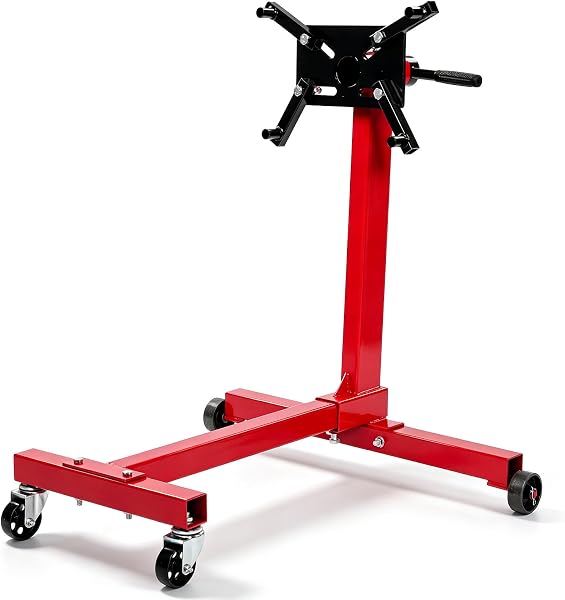
VEVOR 750 lb
9.0Editor score750 lb capacity
H-shaped base
Four adjustable arms
20-inch handle
Find the right engine stands for 2026. We compare 10 standout options by build quality, useful features, owner feedback, value, and everyday trade-offs.
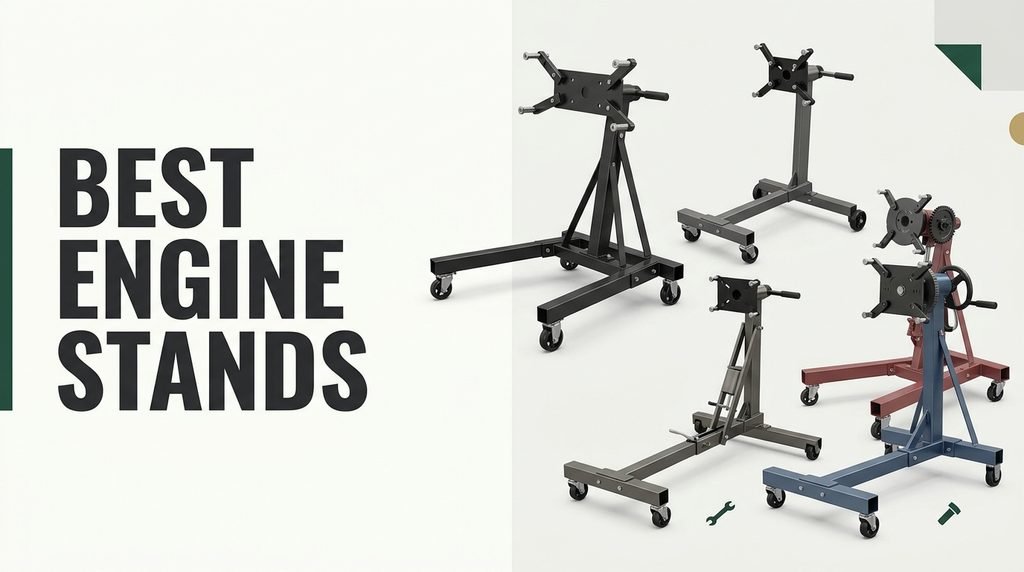
Choosing the right engine stand comes down to weight capacity, rotation smoothness, base stability, mounting arm versatility, and how well the stand folds for storage. We compare 10 standout rotating motor stands across cast iron and steel builds, from 750-pound DIY models to 2000-pound heavy-duty units built for V8 rebuilds and transmission work.
The gap between a budget stand and a professional-grade unit shows up in base design, caster quality, and arm adjustability. An H-shaped base resists tipping far better than a traditional T-base, and the number of casters directly affects how smoothly a loaded stand rolls across a shop floor during an engine swap or long rebuild.
This guide breaks down each model’s capacity, construction, and real-world strengths so you can match a stand to your engine size, workspace, and project scope. Whether you are rebuilding a small-block in a home garage or servicing diesel blocks professionally, the right pick depends on a few measurable specifications we cover below.
We compared 10 engine stands using the details that matter when supporting hundreds of pounds of iron and aluminum: load capacity, steel grade, base geometry, number and quality of casters, mounting arm adjustability, rotation smoothness, folding storage design, finish durability, and value. The notes focus on practical trade-offs so each pick connects to how mechanics and DIY builders actually mount, rotate, and move engines through a rebuild or swap.

Compare key features, scores, and current prices side by side. A shorter feature list means fewer details were available, not necessarily fewer capabilities.


This 2000-pound stand sits at the top of the capacity range in this comparison and is built for serious engine work. Big-block V8s, diesel truck engines, and large industrial powerplants all fall within its working range, which makes it a practical choice for professional shops and ambitious home builders tackling heavy rebuilds. The heavy-duty steel construction provides the structural margin needed to handle these loads without flex or deformation.
We may earn a commission when you buy through this link, at no additional cost to you.
The 360-degree swivel head is a critical feature when working on larger engines, where repositioning the block manually is impractical. Being able to rotate the engine to any angle lets you reach oil galleries, torque main cap bolts in sequence, and clean machined surfaces without constantly shifting your own position. For long rebuild sessions, this reduces back strain significantly and improves the quality of the work.
Six casters distribute the loaded weight across more contact points than the typical four or five, which translates to smoother rolling on uneven shop floors and less effort when positioning a fully assembled long-block. The H-shaped base folds flat in seconds via a lock pin, collapsing the stand for compact storage against a wall or under a workbench. This is a genuine advantage in home garages where every square foot matters.
More casters mean lower per-wheel load and less chance of a single caster collapsing under a heavy engine. Six-wheel stands also roll more predictably over cracks, cords, and small debris that would otherwise snag a four-caster design. For stands carrying over 1500 pounds, six casters are a meaningful upgrade in both safety and daily usability.
The trade-off with any 2000-pound stand is that the frame itself is heavier and larger than lighter-capacity models, so moving it when empty takes more effort. If your heaviest engine weighs under 500 pounds, you are paying for capacity you will not use. For anyone working on heavy engines, however, the extra margin provides real safety and confidence during critical operations like crankshaft installation.
Mechanics working exclusively on small four-cylinder engines or shops with very limited floor space.
We may earn a commission when you buy through this link, at no additional cost to you.
This VEVOR stand targets home mechanics and weekend builders who need a dependable rotating platform for small-block V8s, four-cylinder engines, and smaller diesel blocks. The 750-pound capacity covers a wide range of common passenger car and light truck engines, and the cast iron body provides a level of rigidity that most entry-level steel stands cannot match at this price point.
We may earn a commission when you buy through this link, at no additional cost to you.
The H-shaped base is a meaningful upgrade over the traditional T-base found on cheaper stands. T-bases concentrate stress at a single front leg, which can lead to tipping if the engine shifts during rotation. The H-base distributes weight across a wider footprint, keeping the stand planted even when the engine is rotated 90 or 180 degrees. The 1.1-inch hex head bolts on the mounting arms grip engine blocks firmly without working loose during long sessions.
Mobility comes from two fixed wheels and two 360-degree universal casters, one of which includes a brake. The QT450 cast iron casters resist flat-spotting under sustained load, which is a common failure point on budget stands with plastic or softer metal wheels. The 20-inch handle provides enough leverage to rotate most mounted engines smoothly, and the six locating holes let you lock the engine at common working angles.
The geometry of an H-shaped base places support legs at all four corners of the stand, which keeps the center of gravity contained even when the engine rotates past vertical. T-bases, by contrast, concentrate the forward load on a single arm, creating a tipping hazard when the engine swings to one side. If you plan to rotate the engine frequently, prioritize an H-base design regardless of the stated weight capacity.
The main limitation is the 750-pound ceiling, which rules out big-block V8s, large diesel engines, and transmission and engine assemblies carried together. For anyone working on standard small-block or four-cylinder engines, however, this stand delivers heavy-duty construction at a price that is hard to beat. Confirm your engine’s dry weight before ordering, and leave a safety margin for accessories still bolted on.
Big-block V8s, large diesel engines, or anyone needing more than 750 pounds of capacity.
We may earn a commission when you buy through this link, at no additional cost to you.
This 1000-pound steel stand hits a middle ground between the lightest 750-pound units and the heavy-duty 1500 to 2000-pound stands. The capacity covers most common small-block and mid-size V8 engines, and the high-grade steel frame provides enough rigidity to handle these loads without flexing under rotation. For a general-purpose garage stand, the specifications line up well with everyday automotive work.
We may earn a commission when you buy through this link, at no additional cost to you.
The face plate measures roughly 10 by 6 inches with a 7/16-inch thickness, which provides a solid mounting interface for the four adjustable arms. Overall dimensions of 31 by 36 by 34.75 inches make the stand compact enough for most garage bays, and the heavy-duty rolling swivel casters allow repositioning without lifting. The wide base helps prevent tipping, which is especially important when the engine is rotated to its sideways positions.
A key practical feature is the easy disassembly design, which lets you break the stand down for storage or transport between locations. If you only work on engines occasionally, being able to stow the stand in a closet or truck bed is more useful than it sounds. Reassembly is straightforward with basic hand tools, and the modular design makes replacement of individual components simpler if needed down the road.
On any budget engine stand, visually inspect every weld joint before mounting an engine. Look for consistent bead width, no visible cracks, and complete penetration at corner joints. Any suspect welds should be reinforced or the stand returned. This two-minute check is cheap insurance against a failure that could damage your engine or cause injury.
The 3.8-star rating suggests this stand is best suited to buyers who understand its limits and work within them. It is not a professional shop tool, but for the DIY builder tackling a weekend rebuild, it provides adequate capacity and function at a reasonable price. Pair it with quality mounting bolts and inspect the welds before first use to get the most out of this stand.
Professional shops or anyone working on engines heavier than 1000 pounds.
We may earn a commission when you buy through this link, at no additional cost to you.
The Maxority 1500-pound stand earns one of the higher ratings in this comparison through a combination of cast iron construction and a telescopic frame design. The capacity comfortably handles most V8 engines including larger small-blocks and smaller big-blocks, making it a strong choice for performance builders and restoration projects. Heavy-duty steel reinforcement at critical stress points supports the stated load with margin to spare.
We may earn a commission when you buy through this link, at no additional cost to you.
The telescopic frame is a less common feature at this price range and provides real flexibility. You can extend the frame to balance larger engines or retract it for compact storage. The rotating and pivoting head lets you position engines and transmissions at virtually any working angle, which is particularly useful for accessing deep oil pans, bellhousing bolts, and other hard-to-reach components during a thorough rebuild.
Five smooth-rolling casters provide better load distribution than typical four-caster designs, and the stand folds flat for storage when the project ends. The secure locking mechanisms reduce the risk of accidental movement or tipping, which is a genuine safety concern whenever a heavy engine is suspended on a stand. For garages where the engine stand lives against a wall between projects, the foldable design is a practical space-saver.
A telescopic frame lets you shift the engine’s position relative to the base, which changes the center of gravity for better balance with longer or heavier engines. This matters when rotating the engine, as a poorly balanced load can swing suddenly and strain the mounting hardware. Taking a moment to adjust frame length before loading can noticeably improve stability during rotation.
The main consideration is the overall weight of the stand itself, which is heavier than 750 or 1000-pound units due to the cast iron construction. This is a worthwhile trade-off for the capacity and rigidity, but moving the empty stand requires more effort. For buyers who want a long-lasting, high-capacity stand without jumping to a 2000-pound model, the Maxority offers excellent balance.
Budget buyers or anyone who only needs to support light four-cylinder engines.
We may earn a commission when you buy through this link, at no additional cost to you.
The TUFFIOM 1500-pound stand focuses on compact storage with a folded width of just 14.8 inches, which is one of the slimmest footprints among heavy-capacity stands. For home garages where every inch of wall space counts, the ability to tuck the stand into a narrow corner between projects is a genuine advantage. The reinforced H-base keeps the stand stable during use while still folding compactly for storage.
We may earn a commission when you buy through this link, at no additional cost to you.
The 1500-pound capacity handles the same range of V8 and larger engines as other mid-capacity stands, and the solid steel construction with electrostatic anti-rust coating is built to resist deformation and corrosion over years of use. The 360-degree rotating head paired with four adjustable arms accommodates a wide range of engine bolt patterns, from motorcycle engines to full-size automotive blocks.
Five universal casters with two brakes provide better position-locking than single-brake designs. When working on a rotated engine, having the stand firmly locked in place prevents it from rolling as you push or pull on wrenches. The 15-inch handle is shorter than the 20-inch handles found on some competitors, which means slightly less mechanical leverage when rotating heavy engines but easier maneuvering in tight workspaces.
A single-brake caster locks only one wheel, which can still allow the stand to pivot around that fixed point. Two brakes located on opposite sides of the base lock the stand in two places, preventing both rolling and pivoting. This matters most when applying significant torque to engine bolts, where even slight stand movement can cost accuracy and effort.
The 3.5-star rating indicates mixed owner feedback, which is worth considering alongside the stand’s otherwise solid specifications. Buyers should inspect the stand carefully upon arrival, verify all hardware is present, and check welds before loading an engine. For buyers prioritizing compact storage and willing to perform careful initial inspection, the slim folded profile remains a meaningful selling point.
Buyers who prioritize customer rating consistency or need a longer handle for maximum leverage.
We may earn a commission when you buy through this link, at no additional cost to you.
This 1000-pound stand uses heavy gauge square steel tube construction, which provides excellent rigidity and resistance to flexing under load. Square tubing resists twisting better than round tubing of equivalent weight, which translates to steadier rotation and more predictable behavior when the engine is tilted off-vertical. For mechanics who value structural stiffness over the lowest possible price, this is a meaningful difference.
We may earn a commission when you buy through this link, at no additional cost to you.
The ball-bearing swivel casters are a notable upgrade over the plain bushing casters found on budget stands. Ball-bearing casters roll more smoothly under load, pivot more easily, and last significantly longer before developing play or sticking. On a rough shop floor, this translates to much less effort when repositioning a loaded stand and a lower chance of a caster seizing at an inconvenient moment.
Rather than folding, this stand disassembles for storage or transport. The two approaches each have advantages: folding is faster between projects, while disassembly produces a smaller, flatter package for shipping or long-term storage. For buyers who move between locations or need to store the stand in tight spaces during off-seasons, the disassembly design can actually be more practical than a folding mechanism.
Plain bushing casters rely on a sliding contact surface between the wheel and axle, which creates friction and wears faster under heavy load. Ball-bearing casters use rolling elements to reduce friction, allowing smoother motion and much longer life. On a loaded engine stand, the difference between these two caster types is immediately noticeable when pushing the stand across a shop floor.
The main consideration is price relative to capacity, as this 1000-pound stand sits in the same range as some 1500-pound competitors. The higher price reflects the ball-bearing casters and heavier steel construction, which should translate to a longer service life. For buyers who prioritize smooth rolling and premium build quality within the 1000-pound class, this stand is a strong choice.
Budget buyers or anyone requiring a folding storage design.
We may earn a commission when you buy through this link, at no additional cost to you.
This 2000-pound stand provides a second option in the heavy-duty capacity class and uses high-grade Q235 steel for its primary frame construction. The extra-wide U-shaped base provides rock-solid stability during engine rotation, which is especially valuable when working on tall V8 or diesel blocks that create significant leverage as they swing. For professional shops handling a mix of engine sizes, this stand covers almost any job.
We may earn a commission when you buy through this link, at no additional cost to you.
The powder-coated finish adds both rust resistance and a clean, professional appearance that holds up well in a working shop environment. Four sturdy mounting arms with hexagonal bolts secure the engine firmly, reducing the risk of slips or shifts during critical operations. The arm adjustability accommodates a wide range of engine bolt patterns across different manufacturers and vehicle types.
A simple twist handle lets you adjust the rotation angle quickly and precisely, which is a practical convenience during long rebuild sessions where you may rotate the engine many times. Six 360-degree swivel casters make the loaded stand easier to maneuver than four-caster alternatives at this capacity. The foldable design helps reclaim shop space when the current project wraps up.
Powder coating creates a thicker, more durable finish than conventional spray paint, resisting chips, scratches, and chemical exposure far better. For an engine stand that sees frequent contact with oil, degreaser, and metal shavings, powder coating meaningfully extends the service life of the finish and keeps the stand looking professional for years.
As with any 2000-pound stand, the physical size and weight of the empty frame are higher than lighter-capacity alternatives. If your work focuses on small-block engines or lighter builds, the extra capacity is unused weight. For buyers who need the headroom to handle any engine that comes through the shop, this red stand provides a reliable option at a competitive price.
Small home garages where floor space is extremely limited or buyers working only on light engines.
We may earn a commission when you buy through this link, at no additional cost to you.
This two-piece cradle set serves a very different purpose than the rotating stands elsewhere in this guide. It is specifically engineered to cradle LS V8 engines for rolling storage and transport, making it ideal for LS swap builds, performance projects, and anyone who needs to park a complete engine out of the way between fabrication steps. The precise fit means your LS block sits securely without improvised blocking.
We may earn a commission when you buy through this link, at no additional cost to you.
The metal construction is built to handle the weight and stresses of LS engines, which are among the most popular swap platforms in modern performance work. The swivel caster wheels let you roll the cradled engine around the shop with minimal effort, which is a major convenience when space is tight and you need to shift the engine out of the way to work on other components or vehicles.
Installation is designed to be straightforward, with the necessary hardware and instructions included in the package. For LS swap builders who typically have multiple engines, cores, or project blocks sitting in the shop, having purpose-built cradles is far more practical than stacking engines on pallets or hunting for improvised stands. The cradles also protect the engine’s oil pan and critical mounting surfaces during storage.
Rotating engine stands are designed for repair work and require bolting the engine to a vertical face plate, which is overkill when you simply need to park an engine between stages of a build. Cradles support the engine from below in a stable, horizontal position with far less setup time. For storage, transport, and holding an engine during accessory fitment, cradles are often the more practical choice.
The clear limitation is that this is not a rotating repair stand and only fits LS-pattern engines. If you need to perform rotational work on an engine or you work on a variety of engine families, a traditional rotating stand is the correct tool. For LS-specific storage and transport, however, these cradles solve a very real problem that generic stands do not address well.
Non-LS engines or anyone needing rotational access for a full rebuild.
We may earn a commission when you buy through this link, at no additional cost to you.
BIG RED is a well-established name in automotive shop equipment, and this 1500-pound rotating stand carries the brand's reputation for solid, no-nonsense construction. The heavy-duty steel frame provides long-term durability with an industrial luster that holds up well in daily shop use. For buyers who value brand reliability over experimenting with newer or less-known names, this stand delivers predictable performance.
We may earn a commission when you buy through this link, at no additional cost to you.
The 1500-pound capacity covers the vast majority of automotive engines, from four-cylinder blocks to large V8s. The extra-wide base provides maximum stability during rotation, which is critical when working with heavier engines that create significant leverage as they swing off-center. The four adjustable arms with 360-degree rotation secure most foreign and domestic engine blocks without requiring custom adapters.
Five casters, consisting of two fixed and three 360-degree swivel units, provide smooth maneuverability while maintaining directional stability when rolling the stand across a shop. The quick folding mechanism lets you collapse the stand for storage when projects wrap up, which keeps your garage or shop floor clear during periods of lighter use. The design strikes a sensible balance between work capability and storage practicality.
Engine stands hold expensive engines in positions where failure can cause serious damage or injury. Established brands like BIG RED have longer track records of consistent quality control and better customer support if issues arise. Paying slightly more for a trusted name is often worthwhile insurance when the alternative is a stand with unknown long-term reliability.
The main consideration is the mid-range price, which is higher than budget stands of similar capacity but reflects the brand reputation and build quality. For buyers who want a dependable, long-serving stand from a known manufacturer and are willing to pay a bit more for peace of mind, the BIG RED delivers the structural confidence that matters most when supporting hundreds of pounds of iron and aluminum.
Buyers on the tightest budgets or anyone needing more than 1500 pounds of capacity.
We may earn a commission when you buy through this link, at no additional cost to you.
This VEVOR adjustable stand takes a different approach than traditional rotating stands by offering extensive dimensional adjustability. The width adjusts from 5.3 to 12.8 inches and the length offers four preset positions from 9 to 18.5 inches, allowing the stand to be sized precisely to the engine being held. For builders working on engines of varying sizes, this adjustability can eliminate the need for multiple stands or custom mounting adapters.
We may earn a commission when you buy through this link, at no additional cost to you.
The Q235B high-strength steel construction supports up to 750 pounds, which places this stand in the same capacity class as the standard VEVOR model. The movable mounting posts and flexible positioning make this stand particularly useful for alignment-sensitive work, where you need to position the engine precisely for machining, assembly, or accessory fitment. Two ratchet straps add a second layer of security beyond the mounting hardware.
Four 3-inch swivel casters provide smooth movement, though the design omits brakes in favor of quick position adjustments. This trade-off makes the stand faster to reposition during active work but requires wheel chocks or similar means to lock the stand when applying significant torque. The lack of brakes is a conscious design choice aimed at mechanics who prioritize mobility over fixed positioning.
Ratchet straps provide a secondary restraint beyond the primary mounting bolts, which is valuable for engines with awkward weight distribution or when the stand will be moved with the engine in place. The straps distribute shock loads that might otherwise concentrate on the mounting bolts alone, reducing the risk of a mounting point failure during transport or repositioning.
The 750-pound capacity and non-brake casters position this stand for lighter engine work and shops where frequent repositioning is more important than locked stability. The dual ratchet straps and extensive adjustability make it a particularly good fit for engine preservation, display builds, or specialized applications where a traditional rotating stand would be overkill. Match the stand’s capabilities to your specific work style before ordering.
Mechanics working on big-block V8s or anyone who needs lockable brake casters.
We may earn a commission when you buy through this link, at no additional cost to you.
Selecting the right engine stand comes down to matching capacity, construction, and features to the engines you work on and the space you have available. The following factors will help you narrow the options and avoid buying a stand that falls short of your needs or vastly overspends on unused capacity.
Weight capacity is the first and most important specification to confirm. Engine stands in this comparison range from 750 pounds to 2000 pounds, and your choice should be driven by the heaviest engine you expect to work on. A four-cylinder aluminum engine may weigh under 300 pounds, while a cast iron big-block V8 can approach 700 pounds and a diesel truck engine can exceed 1000 pounds. Always use the dry weight of the complete long-block as your baseline.
A proper safety margin is critical. Experienced mechanics typically select a stand rated at least 25 to 50 percent above the engine’s actual weight to account for accessories, mounting hardware, dynamic loads during rotation, and the possibility of inaccurate manufacturer capacity claims. A 500-pound engine should ideally sit on a 1000-pound stand, not a 750-pound unit operating near its limit. The extra margin provides real safety during rotation when leverage multiplies the effective load.
The shape of the base is one of the most important stability factors and often overlooked by first-time buyers. Traditional T-bases concentrate support at a single forward leg, which creates a tipping risk when the engine is rotated sideways and the center of gravity moves outside the support footprint. H-bases and U-bases provide support at all four corners, keeping the stand stable through the full rotation range.
The width of the base also matters significantly. A wider base provides more stability but takes up more floor space and may be harder to maneuver through doorways. Narrower bases save space but may feel tippy under heavy loads. Many modern stands fold or collapse to a narrower width for storage while deploying to a wider stance during use, which is a practical compromise for home garages where floor space is limited.
Casters affect both mobility and safety more than their modest appearance suggests. Cheap casters with plastic wheels or plain bushings can bind, develop flat spots under sustained load, or fail outright at the worst possible moment. Quality casters use metal wheels with ball or roller bearings, which roll smoothly even under heavy load and last for years of regular use.
The number of casters matters too. Four-caster designs are standard for lighter stands, while five or six-caster designs distribute heavier loads more evenly and roll more predictably across uneven floors. At minimum, look for one or two caster brakes that let you lock the stand firmly in place when applying torque to engine bolts. Without brakes, the stand can roll away from you at exactly the wrong moment.
The rotation mechanism is what makes an engine stand genuinely useful rather than just a mounting platform. Look for stands with a positive locking system that holds the engine at any desired angle, typically through a pin that engages with holes drilled in a rotation plate. More locating holes mean more fine-grained control over the engine position, which matters when accessing specific components during a rebuild.
Handle length determines the mechanical leverage you have when rotating a heavy engine. A 20-inch handle provides significantly more leverage than a 15-inch handle, which translates to less effort when rotating a 500-pound engine. Longer handles can be awkward in tight workspaces, however, so consider the trade-off between leverage and maneuverability based on your typical working environment.
Mounting arms must accommodate the specific bolt pattern of your engine. Four adjustable arms is the standard design, and the adjustment range should be wide enough to fit the engines you work on. Some stands offer arms that slide along both horizontal and vertical slots, providing maximum flexibility for unusual bolt patterns or custom adapter plates.
The quality of the arm attachment points also matters. Look for substantial mounting bolts, ideally 5/8 inch or larger, that thread into the engine’s bellhousing bolt holes or other reinforced mounting locations. Avoid stands with thin or short mounting bolts, which can strip, bend, or shear under the stress of a rotating engine. The investment in quality grade 8 bolts, if replacement is needed, is well worth the cost.
Steel construction is standard for engine stands, with higher grades like Q235 or Q235B providing better strength-to-weight ratios than generic steel. Cast iron is sometimes used for key structural components and offers excellent rigidity and vibration damping, though at the cost of additional weight. The gauge of steel tubing matters too, with heavier gauge providing more rigidity and resistance to flexing under load.
The finish affects both appearance and longevity. Powder coating is the most durable option, resisting chips, scratches, and chemical exposure far better than conventional paint. Electrostatic coating provides similar benefits. A quality finish keeps the stand looking professional for years and resists the oil, degreaser, and metal shavings that accumulate in any working shop environment.
Folding engine stands collapse to a smaller footprint for storage, which is a major advantage in home garages where floor space is at a premium. Some stands fold in seconds with a single lock pin, while others require more involved disassembly. Fixed-frame stands offer slightly more rigidity but take up permanent floor space whether or not they are in use.
If you only perform engine work occasionally, a folding stand that stores against a wall or in a corner between projects is almost always the better choice. Professional shops with dedicated engine work bays may prefer fixed designs for maximum stability. Consider your typical usage pattern and available storage space before deciding.
Most engine stands are general-purpose designs that fit a wide range of engine bolt patterns. For specific applications like LS swaps, however, dedicated cradles and application-specific stands can simplify the work and provide better fit than universal designs. These specialty tools make sense when you work exclusively on one engine family or need to store multiple engines of the same type.
For most buyers, a general-purpose rotating stand is the better investment because it accommodates whatever engine comes through the shop. Specialty cradles are worth considering as a secondary tool for storage or specific applications, but they rarely replace the versatility of a traditional rotating stand for actual repair work.
Before mounting an engine, verify that all four mounting arms are secured with quality grade 8 bolts of the correct length to engage the engine’s bellhousing bolt holes fully. Insufficient bolt engagement is one of the most common causes of catastrophic stand failures. Confirm the stand is on level ground, lock any brake casters, and ensure the base is fully deployed before lifting the engine onto the stand with a cherry picker or engine hoist.
During use, always keep the engine’s heavier end oriented downward when possible to reduce leverage on the rotation mechanism. Rotate the engine slowly and deliberately, never allowing it to swing freely. When applying significant torque to engine bolts, position yourself so the stand would roll away from you rather than toward you if the brakes failed. Keep bystanders clear of the rotation path, and never work under a stand-mounted engine.
After each project, clean oil and solvent residue from the stand with a shop rag before storage. Inspect welds, bolts, and casters periodically for signs of fatigue, corrosion, or wear. A light coat of silicone spray on the rotation mechanism and caster bearings keeps them operating smoothly for years. Store the stand in a dry location, folded if possible, and keep mounting hardware organized in a labeled container so it is ready for the next project.
Start with the dry weight of your engine's long-block and add 25 to 50 percent for a proper safety margin. A typical small-block V8 weighs around 500 pounds dressed, requiring at least a 750-pound stand but ideally a 1000-pound unit. Big-block V8s and diesel engines often exceed 700 pounds and need stands rated 1500 pounds or higher. Always err on the side of more capacity than less.
An H-base provides four points of ground contact in a wide rectangular pattern, which keeps the stand stable even when the engine is rotated sideways. A T-base concentrates support on a single forward leg, which can tip when the center of gravity shifts during rotation. H-bases are substantially safer and are now standard on most quality engine stands. Avoid T-base designs unless you have specific reasons to choose one.
Most engine stands are not rated to support the combined weight of an engine and transmission, and the extra leverage from the transmission can exceed the stand's rotational capacity even if the total weight is within limits. Remove the transmission before mounting the engine on a standard stand. If you must work with the transmission attached, use a stand specifically rated for the combined load.
Use grade 8 bolts that match the thread size of your engine's bellhousing bolt holes, typically 3/8-inch, 7/16-inch, or 1/2-inch depending on the engine family. The bolts must be long enough to engage at least six to eight full threads in the engine block for a secure hold. Never use lower-grade bolts, washers that do not match the bolt size, or improvised hardware.
For home garages where the stand lives between occasional projects, a folding design saves significant floor space when stored against a wall. For professional shops with dedicated engine work areas, fixed designs offer slightly more rigidity and faster deployment. Both work equally well during actual engine work. Choose based on your storage situation rather than any functional difference during use.
Four casters is standard for lighter stands up to 1000 pounds. For heavier capacities of 1500 to 2000 pounds, five or six casters distribute the load more evenly and provide smoother rolling. Look for at least one or two caster brakes to lock the stand in place during work. Ball-bearing casters roll better and last longer than plain bushing designs.
Many engine stands can hold transmissions if the mounting arms can be configured to engage the transmission's bolt pattern. However, the weight distribution of a transmission is very different from an engine, so verify the stand's capacity and center of gravity requirements before mounting. For dedicated transmission work, a purpose-built transmission jack or stand is usually a better tool.
Always use a wide-base H or U-shaped stand, keep the stand on level ground, and rotate the engine slowly and deliberately. Never allow the engine to swing freely under its own weight. Position the heavier end of the engine downward when possible to minimize leverage on the stand. If working on uneven floors, use leveling shims under the stand's feet before loading the engine.
Inspect all welds for consistent beads and no visible cracks, verify that all hardware is present and matches the parts list, and check that the rotation mechanism operates smoothly through its full range. Confirm the mounting arms adjust properly and lock securely in position. Report any defects to the seller immediately rather than attempting to use a compromised stand. A thorough initial inspection prevents problems during actual use.
The BIG RED 1500-pound rotating stand stands out as the strongest overall choice for most buyers, combining established brand reliability with a 1500-pound capacity, foldable storage, five casters, and a wide stability base. It handles the vast majority of automotive engines with comfortable safety margin and offers predictable long-term performance from a trusted manufacturer at a reasonable price point.
For buyers tackling heavy-duty builds like big-block V8s or diesel engines, the 2000-pound foldable stand with six casters offers the capacity headroom needed for the biggest jobs. Budget-conscious DIYers working on smaller engines will find excellent value in the VEVOR 750-pound cast iron stand, while LS swap builders should strongly consider the dedicated LS engine cradle set for storage and transport between fabrication stages.
Start by weighing your heaviest engine, add a 25 to 50 percent safety margin, and match that number to a stand with an H or U-shaped base, quality casters, and a secure rotation mechanism. The right engine stand is a tool you will use for decades across many projects, so investing in appropriate capacity and build quality from the start pays off many times over the life of the stand.