LiTime 12V 100Ah
9.0Editor score100Ah lithium deep cycle
Group 31 case footprint
Integrated 100A protection BMS
Lightweight 22.05 pound body
Compare the 10 best deep cycle batteries for RVs, marine trolling motors, and off-grid solar, with clear specs on chemistry, capacity, BMS, and lifespan.
Finding the right deep cycle batteries for 2026 requires understanding how different chemistries handle continuous power draw and repetitive charging cycles. We compare 10 standout options by the factors that matter in this category, including cell chemistry, usable amp-hour capacity, cycle life, discharge depth, cold-weather performance, weight, owner feedback, value, and everyday installation trade-offs.
Off-grid campers, RV travelers, and marine anglers face very different energy demands than drivers who merely need brief engine cranking power. While modern lithium iron phosphate batteries deliver incredible cycle longevity and save massive amounts of hull or tongue weight, sealed AGM batteries remain indispensable for dual-purpose starting duties and sub-freezing winter charging environments.
Before purchasing an auxiliary power source, calculate your daily watt-hour consumption and examine your onboard charging infrastructure. Using the detailed specifications and comparative evaluations below, you can match physical BCI group dimensions, continuous discharge limits, and battery management protections directly to your RV house bank, trolling motor, or solar cabin setup.
We compared 10 deep cycle batteries using the details that actually help an off-grid or marine buyer decide: usable amp-hour capacity, depth of discharge thresholds, integrated battery management safety features, physical group sizing, cold-temperature charge limits, weight-to-energy ratios, owner feedback, and true cycle-cost value. The notes focus on practical trade-offs between sealed AGM workhorses and advanced LiFePO4 cells so each pick connects to real-world power storage.


Compare key features, scores, and current prices side by side. A shorter feature list means fewer details were available, not necessarily fewer capabilities.




Many boaters operate with only a single battery compartment, forcing them to find a power source that delivers enough cold cranking amps to turn over an outboard engine while providing enough amp-hours to run sonar units, livewells, and anchor lights all day. The Mighty Max MM-G24M achieves an outstanding balance in this category, packing a massive 90 amp-hours of deep cycle capacity alongside 550 Cold Cranking Amps and 700 Marine Cranking Amps into a standard Group 24M case.
We may earn a commission when you buy through this link, at no additional cost to you.
The battery’s heavy-duty absorbent glass mat construction is engineered specifically to absorb the punishing physical shocks associated with high-speed boating across choppy water and trailering over rough roads. Encased in a thick, impact-resistant ABS shell, the sealed spill-proof design prevents hazardous acid leaks and terminal corrosion, ensuring steady electrical delivery across all four seasons regardless of mounting angle.
With an exceptional 145-minute reserve capacity rating, this battery gives anglers extended fishing time before voltage drops to critical thresholds. Furthermore, Mighty Max rates this model for up to 700 cycles at a 50 percent depth of discharge, offering roughly double the cycle life of entry-level flooded marine batteries. Measuring 10.25 inches long by 6.63 inches wide with a total height of 9.38 inches, it fits standard marine trays with room to spare.
Reserve capacity measures the exact number of minutes a fully charged battery can sustain a continuous 25-amp discharge at 80°F before dropping below 10.5 volts. A rating of 145 minutes gives boaters crucial peace of mind, ensuring that even if your alternator fails on the water, you have over two hours of emergency electrical reserve to run safety gear and bilge pumps.
Weighing in at 52.2 pounds, this is a dense, heavy battery that will require deliberate lifting during installation. It also requires standard multi-stage AGM charging routines rather than fast high-amperage lithium bursts. For boaters and RV owners who need verified dual-purpose starting and house power in a single Group 24 battery box without re-wiring their electrical system, Mighty Max delivers outstanding performance and reliability.
Kayak anglers or ultralight campers who cannot accommodate a 52-pound battery in their craft or rig.
We may earn a commission when you buy through this link, at no additional cost to you.
Recreational vehicle owners, off-grid solar builders, and electric trolling motor users looking to shed dead weight without sacrificing energy capacity will find a proven benchmark in the LiTime 12V 100Ah LiFePO4. Operating on advanced lithium iron phosphate chemistry, this Group 31 deep cycle unit delivers 1,280 watt-hours of stable power while tipping the scales at just 22.05 pounds. Swapping out a 65-pound flooded or AGM lead-acid battery immediately frees up precious payload capacity in an RV cargo bay or improves bow balance on an aluminum fishing boat.
We may earn a commission when you buy through this link, at no additional cost to you.
The internal battery management system (BMS) acts as a continuous electronic guardian, monitoring cell health in real time. Rated for 100 amps of continuous discharge, the BMS protects the internal cells from overcharging, excessive draining, short circuits, voltage spikes, and dangerous over-temperature conditions. This electronic supervision allows the battery to achieve an extraordinary service life of up to 15,000 cycles under partial depth of discharge, which is more than ten times the endurance of traditional lead-acid alternatives.
In everyday practical terms, this battery maintains a flat, stable discharge curve. While conventional lead-acid batteries experience noticeable voltage drop as they deplete—causing 12-volt refrigerators to fault out and trolling motors to lose thrust—the LiTime unit holds voltage above 12.8 volts through the vast majority of its discharge cycle. When your energy bank runs low, it accepts rapid recharging from dedicated lithium AC chargers, solar charge controllers, or DC-to-DC alternator chargers without developing chemical memory effect.
A standard 100Ah lead-acid battery is damaged if discharged beyond 50 percent, leaving you with only 50 usable amp-hours before requiring an immediate recharge. Because this LiFePO4 battery safely discharges down to 100 percent of its capacity without permanent cell degradation, a single 22-pound lithium unit delivers double the practical runtime of a heavy 100Ah lead-acid battery in the real world.
It is essential to recognize the functional boundary of this energy storage unit: it is strictly engineered for house power and auxiliary deep cycle loads, meaning it must not be used to start boat engines or automotive starters. Additionally, boaters running Mercury or MerCruiser outboard motors should note that an external current regulator is required to prevent alternator damage. For reliable off-grid camping, silent boat propulsion, and home solar storage, it sets the standard for modern lithium performance.
Boaters seeking an engine cranking battery to start high-horsepower outboard motors, or shoppers without a dedicated lithium-profile charging setup.
We may earn a commission when you buy through this link, at no additional cost to you.
Boaters and RV adventurers who need a single, rock-solid battery capable of cranking a large marine V8 engine while powering livewells, chartplotters, and bilge pumps require true dual-purpose capability. The OPTIMA D34M BLUETOP is specifically engineered for this hybrid workload. Featuring 750 Cold Cranking Amps (CCA) and 870 Marine Cranking Amps (MCA), it fires up stubborn marine engines on chilly mornings while still supplying dependable reserve power when drifting with the engine shut off.
We may earn a commission when you buy through this link, at no additional cost to you.
At the core of OPTIMA’s performance is proprietary Spiralcell technology, which replaces traditional flat lead plates with tightly wound spiral coils of 99.99% pure lead. This tightly compressed internal structure delivers up to fifteen times more vibration resistance than conventional flooded marine batteries. For offshore anglers slamming through rough chop or overland campers navigating corrugated washboard roads, that mechanical rigidity prevents internal short circuits and broken plate welds.
The sealed AGM construction makes this 43.5-pound battery completely maintenance-free, eliminating the need to check water levels or clean corrosive acid residue off terminal posts. It features dual connection options—standard SAE automotive lead posts alongside 5/16-inch stainless steel threaded studs—allowing you to connect heavy main starter cables and auxiliary marine electronics simultaneously without messy stacked adapters.
Conventional lead-acid batteries use lead-antimony or lead-calcium alloys to give flat plates structural rigidity, which increases internal electrical resistance and promotes plate corrosion. OPTIMA’s tightly wound Spiralcell design uses chemically pure lead, resulting in exceptionally low internal resistance, faster recharge acceptance, and superior cranking burst even when partially discharged.
Because the D34M is optimized to balance cranking burst with cycling endurance, its total deep cycle capacity is rated at 55 amp-hours at a 20-hour rate, paired with 120 minutes of reserve capacity. If your goal is running large residential RV air conditioners or multiple 12-volt refrigerators off-grid for days without running an engine, a dedicated 100Ah house bank is a better fit. But for ski boats, center consoles, and dual-battery marine setups needing elite cranking reliability and chop resistance, nothing tops the BLUETOP.
RV owners looking strictly for a massive off-grid house bank where starting amps are unnecessary and maximum amp-hours are paramount.
We may earn a commission when you buy through this link, at no additional cost to you.
For off-grid cabins, winter RV camping, and home emergency backup systems where temperatures routinely plunge below freezing, traditional sealed AGM batteries offer an ease of operation that lithium systems cannot match. The Renogy 12V 100Ah Deep Cycle AGM is one of the most trusted solar workhorses on the market, backed by more than 230,000 units deployed globally. It provides dependable 12-volt energy storage without the need for complex battery management systems or cold-temperature charging lockouts.
We may earn a commission when you buy through this link, at no additional cost to you.
A standout advantage of this AGM design is its upgraded electrolyte formula, which delivers consistent discharge performance across an extreme temperature envelope spanning from -4°F up to 140°F (-20°C to 60°C). Unlike lithium batteries that shut down or require auxiliary heating pads before accepting a charge in sub-freezing winter weather, this lead-acid chemistry charges safely in cold climates, making it ideal for unheated hunting cabins and four-season camper vans.
High-draw household appliances are easily supported thanks to a remarkable 1,100-amp peak discharge capability for five seconds. When connected to a quality pure sine wave inverter, it readily handles the initial inrush current required to start microwave magnetrons, induction cooktops, CPAP machines, and compact compressor refrigerators. Furthermore, its monthly self-discharge rate stays below 3 percent at 77°F, allowing it to retain stored energy across long periods of seasonal garage storage.
While lithium batteries risk permanent internal plating if charged below 32°F, sealed AGM batteries accept charging current in freezing winter conditions without electronic intervention. For remote off-grid cabins and unheated mountain sheds relying on solar panels during mid-winter months, this thermal resilience simplifies your electrical setup significantly.
As with any conventional lead-acid battery, physical weight and usable capacity represent the fundamental trade-offs. The unit is substantial to lift and install, and to ensure maximum cycle life, you should plan on using 50 amp-hours of its 100Ah capacity before initiating a recharge. If you prioritize hassle-free cold-weather charging, robust surge capability, and straightforward series or parallel expandability at an affordable entry price, Renogy’s AGM is an outstanding choice.
Weight-conscious trailer owners or kayak anglers who need an ultralight battery that can be easily carried with one hand.
We may earn a commission when you buy through this link, at no additional cost to you.
Many travel trailers and compact bass boats come from the factory with molded battery trays sized strictly for BCI Group 24 batteries, making it difficult to fit larger Group 27 or Group 31 lithium upgrades without cutting plastic or drilling new tie-down holes. The SUPER EMPOWER 12V 100Ah LiFePO4 directly solves this dimensional hurdle by packing a full 100 amp-hours of Grade A lithium energy storage into a true Group 24 enclosure measuring 10.24 inches wide, 6.49 inches deep, and 8.98 inches tall.
We may earn a commission when you buy through this link, at no additional cost to you.
Weighing only 21.6 pounds, it provides an immediate drop-in replacement that removes approximately 40 to 45 pounds of unnecessary weight compared to a typical Group 24 lead-acid battery. Inside, a smart 100A Battery Management System protects against common electrical faults, including overcharging, over-discharging, short circuits, and overcurrent. Crucially, the BMS also integrates automatic low-temperature protection, actively pausing incoming charge current below 32°F (0°C) and resuming above 41°F (5°C) to prevent irreversible lithium cell damage.
For system builders looking to scale their power over time, this battery offers impressive flexibility. The internal balancing circuitry supports multi-battery wiring up to four units in series and four in parallel (4S4P), allowing you to assemble a high-voltage 51.2V 400Ah power bank capable of storing 20.48 kilowatt-hours of energy for residential solar backup or off-grid RV living. Threaded M8 terminal studs provide solid, low-resistance connection points for heavy inverter cables.
Attempting to force charging current into a lithium iron phosphate cell at or below 32°F causes lithium metal to plate onto the negative electrode, leading to permanent capacity loss and internal short circuits. The automated thermal sensors in the SUPER EMPOWER BMS eliminate this risk by cutting off charging until the ambient air warms up safely.
Because this battery includes low-temperature charge protection, you cannot recharge it in sub-freezing weather unless it is placed inside a heated camper cabin or outfitted with an external heating pad. It is also engineered exclusively for house power and trolling motors, meaning it cannot be used for engine cranking. For owners with standard Group 24 battery boxes seeking modern lithium efficiency and true drop-in compatibility, this is a top-tier contender.
Shoppers looking for a multi-purpose starting battery, or users who need to charge outdoors in below-freezing weather without heating.
We may earn a commission when you buy through this link, at no additional cost to you.
Campers and van builders looking to maximize interior living space know that every cubic inch inside a battery compartment counts. The DUNFUME 12V 100Ah LiFePO4 stands out by delivering 1.28 kilowatt-hours of usable energy in an optimized casing that achieves a 25 percent reduction in overall volume compared to older lithium enclosures. This streamlined footprint allows multiple batteries to be nestled into tight cabinetry, under-seat storage boxes, or compact camper slide-outs.
We may earn a commission when you buy through this link, at no additional cost to you.
Weighing just 21.6 pounds, the DUNFUME is two-thirds lighter than a comparable 100Ah AGM battery, which typically weighs around 64 pounds. Inside, top-tier lithium iron phosphate cells paired with an integrated 100A BMS provide up to 4,000 cycles at 100 percent depth of discharge, stretching to an astonishing 15,000 cycles if discharges are limited to 60 percent. The smart management board continuously safeguards against overcharging, deep discharge, high temperature, and overcurrent.
The outer enclosure is molded from rugged ABS plastic, offering dependable dustproof sealing and weather resistance for semi-enclosed outdoor storage boxes. Drop-in replacement convenience means you can connect it directly to standard 12-volt inverter lines without complicated adapter brackets. If your energy storage requirements grow, it supports up to 4S4P configurations, forming a 51.2-volt, 400Ah whole-camper power plant.
Traditional lead-acid battery banks demand heavy floor bracing and take up substantial square footage in mobile builds. By engineering a 40 percent boost in volumetric energy density, the DUNFUME lets you install two or three 100Ah batteries in the exact footprint previously occupied by a single oversized commercial battery.
Prospective buyers must note that optimal battery performance and charging require ambient temperatures of 5°C (41°F) or higher, making it less suitable for unheated exterior tongue boxes during freezing winter conditions without supplementary heating. It is also strictly an energy storage battery, unsuitable for starting outboards or powering heavy electric tongue jacks. For indoor camper installations, solar sheds, and fair-weather boating, it offers impressive energy density at an economical price point.
Winter adventurers camping in sub-freezing temperatures without heated battery compartments, or engine-starting applications.
We may earn a commission when you buy through this link, at no additional cost to you.
For off-grid homeowners and leisure RVers who want the deep-discharge freedom of lithium but need the cold-weather charging reliability and chemical simplicity of lead-acid, lead-carbon AGM represents an advanced middle ground. The UPLUS 12V 100Ah (model LDC12-100M) combines thick absorbent glass mat separators with superior lead-carbon and gel electrolyte chemistry inside a standard Group 27 footprint, yielding a battery that bridges the gap between traditional technologies.
We may earn a commission when you buy through this link, at no additional cost to you.
The defining breakthrough of this lead-carbon construction is its recommended 80 percent depth of discharge (DOD) without accelerating plate sulfation or shortening cycle life. While standard AGM manufacturers warn against discharging past 50 percent, UPLUS gives you 80 usable amp-hours per cycle. The gel electrolyte forms a protective layer around the internal plates, doubling the operational service life compared to standard lead-acid batteries while eliminating water refilling and acid leaks.
Operating across a rugged temperature range of -4°F to 131°F (-20°C to 55°C), this battery thrives in harsh climates where unheated solar systems must function through winter blizzards and summer heatwaves. With a maximum charging current acceptance of 25 amps, it can be fully replenished in roughly 5 hours using a standard 0.25C AGM charger. Its monthly self-discharge rate stays under 3 percent, minimizing the need for constant maintenance trickling during storage.
The primary killer of traditional AGM batteries is operating in a Partial State of Charge (PSoC), which causes lead sulfate crystals to harden on the negative plates. Incorporating activated carbon into the negative plate composition prevents this crystalline buildup, allowing the UPLUS battery to withstand deep discharges and incomplete recharge cycles far better than standard AGM.
Buyers should consider two practical specifications: at 60 pounds, this is a hefty unit that demands solid physical mounting, and its maximum continuous discharge current is rated at 45 amps (with a 710A 5-second burst). That continuous 45A threshold makes it perfect for running 12-volt compressor fridges, diesel heaters, lights, CPAP machines, and small inverters, but unsuitable for continuous 2,000-watt heavy inverter loads. For cold-climate off-grid setups wanting maximum usable lead capacity, it is a stellar performer.
Users running massive continuous 1,500W to 2,000W inverter loads, or mobile travelers needing an ultralight power pack.
We may earn a commission when you buy through this link, at no additional cost to you.
Off-grid adventurers who travel through fluctuating weather conditions need a lithium battery that actively protects itself against accidental user error. This 12V 100Ah LiFePO4 battery features an upgraded 100A Smart BMS that includes automated low-temperature charge cutoff circuitry. By mechanically disabling charge acceptance whenever the internal temperature falls below 32°F (0°C), it eliminates the risk of catastrophic cell damage caused by cold-weather solar charging.
We may earn a commission when you buy through this link, at no additional cost to you.
Built with premium Grade-A lithium iron phosphate cells, this 1,280Wh battery delivers exceptional endurance: it is rated for over 6,000 cycles at full 100 percent depth of discharge, more than 8,000 cycles at 80 percent DOD, and over 15,000 cycles under moderate 60 percent cycling. Unlike lead-acid batteries that suffer from significant voltage sag under load, this unit maintains steady 12.8-volt output right up until total depletion, keeping 12-volt electronics operating at peak efficiency.
At 24 pounds, this Group 31 unit is roughly 70 percent lighter than traditional 100Ah lead-acid batteries, drastically reducing tongue weight on trailers or transom sag on small watercraft. The battery accepts fast charging up to 20 amps, allowing you to achieve a 100 percent state of charge in roughly 5 hours using a dedicated lithium profile charger, solar charge controller, or DC-to-DC alternator feed. For expanded setups, it supports up to 4S4P configurations for a 51.2V 400Ah array.
A key distinction in lithium battery operation is the difference between charging and discharging limits. This Smart BMS allows the battery to power 12-volt cabin appliances in temperatures as low as -4°F, ensuring your interior diesel heater or camper fan stays running through freezing nights, while safely blocking solar charging until the sun warms the cabin.
Keep in mind that when temperatures dip below freezing, the battery will continue to discharge power to run lights and heaters down to -4°F (-20°C), but it will refuse incoming charge current until the core temperature warms back up. As with all dedicated LiFePO4 storage units, it cannot be used to crank outboard or inboard engines. For RV house banks, saltwater trolling motors, and DIY solar installations requiring automated cold-weather safety, it provides outstanding protection.
Boaters needing an engine cranking battery, or users who must charge unheated batteries in sub-zero winter storage.
We may earn a commission when you buy through this link, at no additional cost to you.
Tournament bass fishermen and kayak anglers know the frustration of watching a trolling motor lose thrust halfway through a breezy afternoon on the water. The Eiiev 12V 100Ah LiFePO4 battery addresses this issue with a remarkably flat discharge curve, sustaining output above 12.8 volts for up to 95 percent of its total capacity usage. This constant voltage delivery ensures that a 30-to-70 pound thrust trolling motor maintains its top speed and maneuverability from morning launch until evening weigh-in.
We may earn a commission when you buy through this link, at no additional cost to you.
Under the cover, the battery utilizes Grade A+ lithium iron phosphate cells manufactured with UL testing safety certification. Its integrated 100A BMS actively monitors cell voltages, managing current flow to prevent overcharging, short circuits, and thermal runaway. At 24.25 pounds, it weighs half as much as a traditional 50Ah marine battery while delivering twice the usable runtime, dramatically improving hull draft and boat responsiveness.
Expanding your electrical setup is straightforward thanks to multi-battery support that allows up to four units in series and four in parallel (4P4S), making it capable of forming a massive 20.48 kWh energy storage system for larger yachts, off-grid cabins, or RV house systems. Because lithium chemistry has zero memory effect, you can top off the battery after a short morning fishing trip without degrading its operational lifespan.
Electric trolling motors run faster and generate more pounds of thrust when supplied with higher voltage. While a lead-acid battery steadily drops from 12.6V down to 11.5V as it drains—causing noticeable prop drag—the Eiiev LiFePO4 stays locked above 12.8V, delivering full motor speed and responsiveness right until the battery is nearly empty.
To get the best results, owners must use a dedicated 14.6V lithium charger (standard automotive or lead-acid maintenance chargers are strictly unsupported and may trigger BMS lockout). If the battery voltage drops below 12V due to deep BMS protection, an activating 14.6V pulse charge is necessary to wake the circuit. For dedicated trolling motor setups and mobile energy storage where sustained top-end voltage is critical, Eiiev provides exceptional power delivery.
Shoppers hoping to use an existing legacy automotive trickle charger, or applications requiring engine starting power.
We may earn a commission when you buy through this link, at no additional cost to you.
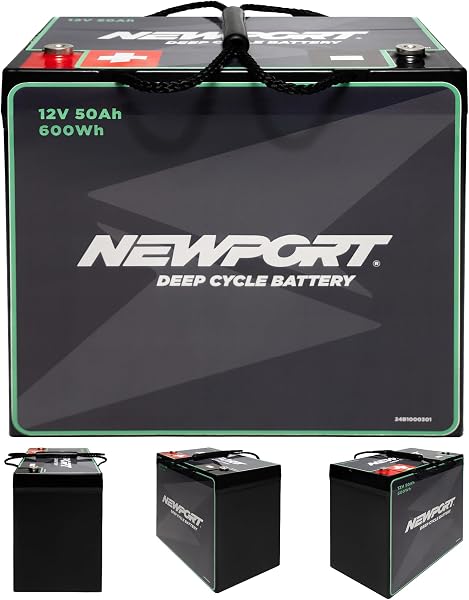
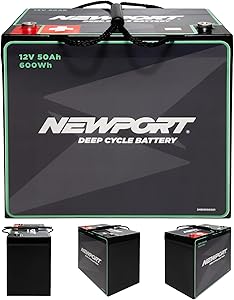
Anglers rigging small watercraft—such as motorized fishing kayaks, inflatable dinghies, canoe transoms, and aluminum jon boats—often find that full-size 100Ah batteries are simply too bulky or heavy for small stern compartments. The Newport 12V 50Ah Deep Cycle AGM Marine Battery is purposefully scaled for compact watercraft, providing steady electric propulsion in a manageable, self-contained footprint.
We may earn a commission when you buy through this link, at no additional cost to you.
Built using proven sealed lead-acid AGM technology, this battery is completely spill-proof and maintenance-free, allowing it to be safely secured inside tight kayak hatches or beneath bench seats without worrying about acid spills if the boat rocks or capsizes. The internal glass mat separators absorb all liquid electrolyte, creating a stable, vibration-resistant power pack that handles regular wake chop and wave action.
With 50 amp-hours of deep cycle capacity, it is specifically tuned to power 12-volt trolling motors (including Newport’s electric motor lineup) along with fish finders, navigation lights, and livewell aerators. For kayak anglers heading out for a half-day fishing trip on a local reservoir, it provides several hours of quiet, continuous cruising at moderate throttle speeds without requiring custom wiring or expensive lithium battery chargers.
Placing an oversized 65-pound battery in the stern of a 12-foot kayak can severely compromise trim, causing the bow to rise and making paddling or tracking difficult in crosswinds. A compact 50Ah AGM battery keeps center-of-gravity low and manageable, preserving small boat stability while delivering dependable electric thrust.
Because it is a 50Ah AGM battery, it supplies approximately 25 to 30 usable amp-hours before requiring a recharge, which is plenty for small watercraft but inadequate for large bass boats or multi-day RV boondocking. It also weighs more per stored watt-hour than modern lithium cells, though it costs substantially less and charges safely on any standard marine AGM charger. For small boat owners wanting reliable marine power backed by US-based support, Newport offers an accessible, proven solution.
Large multi-day RV house banks, or full-size tournament bass boats running high-thrust 24V or 36V motor systems.
We may earn a commission when you buy through this link, at no additional cost to you.
Selecting the right deep cycle battery requires balancing chemical composition, usable capacity, physical dimensions, discharge demands, and environmental factors to ensure dependable off-grid and marine power.
The first and most consequential decision when purchasing a deep cycle battery is choosing between Lithium Iron Phosphate (LiFePO4) and Absorbent Glass Mat (AGM) lead-acid chemistry. LiFePO4 batteries—such as the LiTime, SUPER EMPOWER, and DUNFUME models—represent the cutting edge of auxiliary energy storage. They are roughly 60 to 70 percent lighter than lead-acid batteries, can be safely discharged down to 100 percent of their rated capacity, and deliver between 4,000 and 15,000 charge cycles before experiencing noticeable degradation.
On the other hand, sealed AGM batteries like the Renogy 100Ah, Mighty Max MM-G24M, and OPTIMA D34M remain popular for specific, demanding use cases. AGM batteries require no specialized electronic Battery Management Systems, handle sub-freezing charging without auxiliary heaters, and can deliver the massive high-amperage bursts required to crank boat engines. They are also chemically stable, highly resistant to thermal runaway, and compatible with legacy automotive charging systems without requiring DC-to-DC converters or custom charge profiles.
Choose LiFePO4 lithium if your priority is saving weight, maximizing usable energy in tight spaces, and securing a 10-year lifespan for an RV house bank or trolling motor; select sealed AGM if you need dual-purpose engine cranking or must charge in unheated sub-freezing winter environments.
Understanding the difference between nameplate amp-hours and usable capacity is critical to sizing an off-grid battery bank correctly. With traditional AGM and flooded lead-acid batteries, the industry-standard recommended maximum Depth of Discharge (DOD) is 50 percent. Draining a standard 100Ah lead-acid battery past 50 percent triggers rapid plate sulfation, cutting its expected cycle life from several hundred cycles down to just a few dozen. This means a 100Ah AGM battery effectively provides only 50 amp-hours of usable power between charges.
In contrast, modern LiFePO4 lithium batteries allow for a 100 percent depth of discharge without damaging the underlying cell chemistry. When you buy a 100Ah lithium battery like the LiTime or Eiiev models, you genuinely have access to 100 amp-hours (1,280 watt-hours) of usable electricity. Advanced hybrid options, such as the UPLUS lead-carbon AGM, push lead technology forward by allowing an 80 percent depth of discharge, yielding 80 usable amp-hours per cycle.
To replace an existing bank of two 100Ah lead-acid batteries (providing 100 usable amp-hours combined), you only need a single 100Ah LiFePO4 battery, which cuts both physical footprint and onboard weight in half.
Every modern lithium deep cycle battery relies on an internal Battery Management System (BMS) to regulate power and protect individual cells from damage. The BMS acts as a computer brain that monitors individual cell voltages, shutting down charging if voltage climbs too high and halting discharging if voltage drops too low. It also protects against dead shorts, excessive amperage draw, and high operating temperatures. Most 100Ah lithium batteries feature a 100A BMS, meaning they support a maximum continuous discharge rate of 100 amps (roughly 1,280 watts of continuous inverter load).
A crucial feature to verify on any lithium battery is automated low-temperature charge protection. Charging lithium iron phosphate cells below 32°F (0°C) causes permanent lithium plating, which destroys the cells and creates internal short-circuit hazards. Smart BMS units—like those on the SUPER EMPOWER and Smart BMS Group 31 models—include integrated temperature sensors that automatically pause incoming charge current below 32°F while still allowing the battery to discharge power to run lights and heaters down to -4°F.
If you plan to mount lithium batteries in an unheated RV exterior storage bay or boat locker during winter, always choose a model with verified low-temperature charge protection, or budget for internal heating blankets.
A frequent point of confusion among buyers is the distinction between starting (cranking) batteries and deep cycle energy storage batteries. Engine starting batteries use numerous thin lead plates to maximize surface area, delivering a massive burst of hundreds of amps for two to three seconds to spin a starter motor, but they warp and degrade if drained continuously. Deep cycle batteries use thick solid plates or stable lithium cells designed to discharge a steady, low-to-moderate current over many hours.
Most dedicated 100Ah lithium batteries explicitly forbid engine starting because the sudden inrush current demanded by an automotive starter can trigger the BMS overcurrent protection or damage internal switching transistors. If you need a single battery that can crank a marine engine and run house electronics—common on fishing boats and small runabouts—you must choose a true dual-purpose battery like the OPTIMA D34M BLUETOP (750 CCA) or the Mighty Max MM-G24M (550 CCA).
Never attempt to use a dedicated lithium deep cycle battery to start a combustion engine unless the manufacturer explicitly certifies it for cranking; use a dedicated dual-purpose AGM battery for single-battery marine setups.
Batteries are categorized by Battery Council International (BCI) group sizes, which define standard physical dimensions, terminal placements, and mounting styles. The three most common group sizes in deep cycle applications are Group 24, Group 27, and Group 31. Group 24 batteries (like the SUPER EMPOWER lithium and Mighty Max AGM) measure roughly 10.25 inches long, making them ideal for compact RV tongue boxes and standard boat trays.
Group 27 cases (like the UPLUS lead carbon) measure approximately 12 inches long, offering a step up in capacity, while Group 31 batteries (like the LiTime, DUNFUME, and Eiiev models) measure approximately 13 inches long and represent the standard commercial size for heavy-duty 100Ah banks. Before ordering, always measure your battery tray, hold-down clamp width, and overhead vertical clearance, taking terminal stud height into account.
Measure the physical dimensions of your existing battery box carefully: if your tray is locked into a 10.5-inch Group 24 limit, choose a Group 24 lithium unit rather than trying to force a 13-inch Group 31 case into the space.
When comparing battery prices, calculating the true cost per kilowatt-hour cycle provides a much more accurate picture than looking at initial retail tags alone. A budget flooded lead-acid battery might cost $100 upfront but only deliver 300 to 500 cycles at 50 percent discharge before failing, requiring replacement every two to three seasons. Standard AGM batteries generally provide between 500 and 700 cycles under careful maintenance.
By contrast, quality LiFePO4 lithium batteries provide 4,000 to 6,000 cycles at 100 percent depth of discharge, and up to 15,000 cycles if cycled conservatively at 60 percent. Over a 10-year lifespan, a single $180 to $250 lithium battery outlasts five to eight lead-acid replacements, dramatically lowering the total cost of ownership while eliminating the labor and disposal hassle of frequent battery swaps.
If you use your RV, boat, or solar cabin frequently throughout the year, investing in a LiFePO4 battery delivers significant long-term financial savings compared to repeatedly buying cheap lead-acid replacements.
As energy needs expand, you may want to connect multiple 12-volt batteries together to increase voltage (series) or capacity (parallel). Connecting batteries in series (positive to negative) combines their voltage: two 12V batteries create a 24V bank, while four batteries create a 48V (nominal 51.2V) system, which is standard for large solar inverters and high-thrust 24V or 36V trolling motors. Connecting batteries in parallel (positive to positive, negative to negative) keeps voltage at 12V while doubling or quadrupling available amp-hours.
While AGM batteries can generally be connected in series and parallel with few limitations (Renogy supports unlimited series and up to 4 in parallel), lithium batteries are strictly governed by their internal BMS capabilities. Models like the SUPER EMPOWER, DUNFUME, and Eiiev support up to 4S4P configurations (forming a 48V 400Ah bank), but require that all connected batteries be identical in brand, capacity, voltage, and production batch.
Verify the manufacturer’s series and parallel specifications before purchasing, and never mix lithium batteries from different brands or combine old and new batteries in the same bank.
A battery is only as reliable as the charger replenishing it. Lead-acid AGM batteries use a three-stage charging profile (Bulk, Absorption, and Float) with an absorption voltage typically between 14.4V and 14.7V, followed by a lower float charge around 13.6V. Most older RV converter-chargers and automotive alternators are pre-set for these lead-acid profiles.
Lithium iron phosphate batteries require a Constant Current / Constant Voltage (CC/CV) charge profile, peaking at 14.4V to 14.6V with minimal to no float stage. Charging a LiFePO4 battery with an old lead-acid charger often results in the battery only reaching 80 to 90 percent charge, and desulfation pulses from lead chargers can trigger BMS shutdown. To charge lithium from a vehicle alternator safely, you must install a DC-to-DC charger to prevent alternator overheating and ensure proper voltage delivery.
Ensure your existing solar charge controller, AC converter, or marine charger includes a dedicated lithium (LiFePO4) setting before switching from lead-acid to lithium power.
Proper installation and terminal hygiene are the foundation of safe deep cycle battery performance. When mounting your battery in an RV compartment, marine transom, or solar cabinet, ensure it is firmly secured with heavy-duty tie-down straps or rigid brackets to prevent shifting and terminal stress under motion. Clean all terminal posts and cable lugs thoroughly to remove oxidation before bolting connections down, and torque M8 terminal bolts to manufacturer specifications (typically 9 to 11 Newton-meters) using insulated hand tools. Loose terminal connections create high electrical resistance, generating localized heat that can melt plastic terminal casings and trigger unexpected BMS shutoffs under heavy inverter draws.
During regular operation, tailor your charging routines to your specific battery chemistry. If you operate sealed AGM batteries, avoid discharging them below 50 percent capacity, and initiate a full three-stage recharge promptly after each outing—leaving an AGM battery sitting in a discharged state for days accelerates destructive plate sulfation. If you operate LiFePO4 lithium batteries, ensure your charge controller or AC charger is set to a dedicated lithium profile (14.4V to 14.6V absorption, 13.5V float or no float). Never attempt to charge lithium batteries when the core temperature is below 32°F unless your battery includes integrated self-heating elements or an automated low-temperature charge cutoff.
Seasonal storage requires simple but disciplined care to maximize service life across winter months. Before putting your camper or boat away for the off-season, fully charge AGM batteries and disconnect the negative terminal cable to eliminate parasitic phantom loads from stereo clocks, propane detectors, and solar monitors. For LiFePO4 batteries, store them disconnected at approximately 50 to 80 percent State of Charge (around 13.2V) in a dry, cool location between 30°F and 90°F. Because both AGM and lithium batteries exhibit low monthly self-discharge rates (typically 2 to 3 percent), a disconnected battery will easily survive five to six months of winter storage without needing continuous trickle charging.
Yes, in most cases a 12V LiFePO4 battery is a physical drop-in replacement that fits directly into existing Group 24, 27, or 31 battery trays. However, you should verify that your RV converter-charger or solar charge controller has a dedicated lithium charging mode to ensure the battery reaches a full 100 percent state of charge. If charging directly from your towing vehicle or motorhome alternator, installing a DC-to-DC charger is strongly recommended to protect the alternator from overheating.
Attempting to charge a LiFePO4 cell below 32°F (0°C) causes lithium ions to form metallic lithium plating on the anode rather than intercalating into the carbon structure. This permanently degrades battery capacity and can create internal microscopic dendrites that cause short circuits and ruin the battery. High-quality lithium batteries feature a Smart BMS with low-temperature cutoff that automatically blocks incoming charge current until the temperature rises above freezing.
While both batteries carry a 100 amp-hour rating, lead-acid AGM batteries should only be discharged to 50 percent of their capacity to prevent permanent plate sulfation, yielding just 50 usable amp-hours. LiFePO4 lithium batteries can be discharged down to 100 percent of their rated capacity without damaging the cells, providing a full 100 usable amp-hours. Furthermore, lithium maintains a higher, steady voltage throughout its discharge, whereas lead-acid voltage steadily drops under load.
Dedicated deep cycle lithium batteries should not be used to start combustion engines because the sudden starter surge current can trip the internal BMS or damage electronic components. However, true dual-purpose AGM marine batteries—such as the OPTIMA D34M BLUETOP and Mighty Max MM-G24M—are specifically engineered with high cranking amp ratings (550 to 750 CCA) to crank marine engines while still providing deep reserve capacity for onboard electronics.
A typical modern 12-volt RV compressor refrigerator consumes between 30 and 50 amp-hours of electricity per 24-hour day, depending on ambient summer temperatures and how often the door is opened. A 100Ah AGM battery (offering 50 usable amp-hours) will power the fridge for approximately one full day before needing a recharge. A 100Ah lithium battery (providing 100 usable amp-hours) will reliably run that same refrigerator for two to two-and-a-half full days off-grid.
Connecting batteries in series (linking positive terminals to negative terminals) increases overall system voltage while keeping amp-hour capacity the same, such as wiring two 12V 100Ah batteries to create a 24V 100Ah bank for high-thrust trolling motors. Connecting batteries in parallel (positive to positive, negative to negative) maintains the 12-volt output while doubling amp-hour capacity, turning two 12V 100Ah batteries into a 12V 200Ah house bank. Always verify that your battery's BMS supports your intended series or parallel setup.
Under normal operating and charging conditions, sealed AGM (Absorbent Glass Mat) batteries do not emit hazardous hydrogen gas because they utilize internal valve-regulated recombination technology that recombines oxygen and hydrogen back into water. However, if severely overcharged by a malfunctioning charger, safety pressure relief valves can vent excess gas. For this reason, AGM batteries should always be installed in naturally ventilated compartments rather than airtight containers.
No, you should never mix batteries of different brands, chemistries, capacities, or ages in the same bank. Different batteries possess different internal resistances, charge acceptance rates, and resting voltages, which causes them to charge and discharge unevenly. In parallel or series setups, a newer or stronger battery will constantly attempt to charge a weaker companion, leading to premature battery failure and potential overheating.
For AGM batteries, fully charge them to 100 percent, disconnect the negative terminal to eliminate parasitic draws, and store them in a cool, dry location, checking voltage every three months. For LiFePO4 lithium batteries, charge or discharge them to roughly 50 to 80 percent State of Charge (around 13.2 volts) and store them disconnected in a location that stays between 30°F and 90°F. Because lithium loses less than 3 percent capacity per month in storage, a disconnected battery will easily rest for six months without degradation.
For most RV travelers, solar builders, and marine anglers seeking the ultimate upgrade in usable energy and weight reduction, the LiTime 12V 100Ah LiFePO4 earns our top overall recommendation. Its 22.05-pound lightweight chassis, robust 100A BMS protection, standard Group 31 dimensions, and remarkable endurance of up to 15,000 cycles deliver modern lithium performance that outlasts traditional lead-acid alternatives by a decade.
If you operate a single-battery boat or compact RV setup where one unit must crank a marine engine and power electronics, the OPTIMA D34M BLUETOP stands as the premier dual-purpose choice thanks to its pure lead Spiralcell vibration resistance and 750 CCA punch. Meanwhile, off-grid cabin owners and winter campers needing dependable, hassle-free charging in sub-freezing temperatures will find incredible durability and value in the Renogy 12V 100Ah AGM, while the UPLUS Lead Carbon model provides an impressive 80 percent depth of discharge.
Before finalizing your purchase, carefully measure your existing battery tray, determine whether you need dual-purpose cranking or dedicated house storage, and verify your charger compatibility. Investing in the right battery chemistry and capacity ensures clean, silent, and dependable power wherever your road or water adventures take you.