ChocoVision Revolation 2
7.6Editor scoreSmall batch bowl capacity
Forced hot air heating
Tenth-degree Fahrenheit precision
Ten-pound daily production limit
Compare 10 top chocolate tempering machines and commercial melters. Discover precise temperature controls, dual-tank designs, and automated forced-air units.
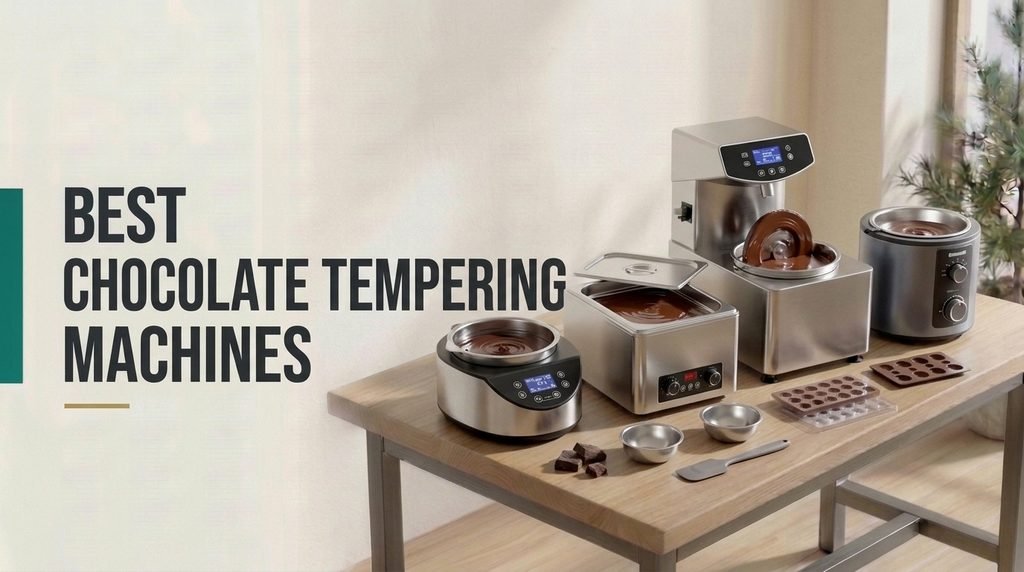
Find the right chocolate tempering machines for 2026. We compare 10 standout options by the factors that matter most in confectionery, including thermal control accuracy, bowl capacity, heating method, daily output, agitation mechanics, ease of cleaning, and long-term value. Whether outfitting an artisan chocolate shop or crafting holiday truffles at home, this guide clarifies your options.
Working with chocolate requires precise temperature curves to align cocoa butter crystals into stable Form V structures. Without exact heat management, melted chocolate dries dull, soft, and streaked with white fat bloom. Understanding whether you need an automated forced-air machine or a multi-tank water bath prevents ruined batches and wasted confectioner ingredients.
Our comparison contrasts microprocessor tempering units that automatically run heating, cooling, and seed cycles against manual dual-pot water-bath melters built for dipping strawberries and filling molds. Reviewing these 10 models side by side helps you match tank capacity, heating stability, and control features to your specific confectionery workflow and budget.
We compared 10 chocolate tempering machines using the details that actually help confectioners decide: thermal precision, heating mechanism, batch capacity, daily production limits, motor agitation, safety shutoffs, bowl materials, cleanup effort, and price-to-performance value. Our analysis evaluates real kitchen trade-offs between automated microprocessor forced-air units, continuous rotary wheel melters, and commercial multi-tank water-bath warmers so you can select the right tool for dipping, molding, and artisan production.


Compare key features, scores, and current prices side by side. A shorter feature list means fewer details were available, not necessarily fewer capabilities.


Commanding the highest customer satisfaction score in our roundup at 4.8 stars, the VEVOR 9 Lbs Chocolate Melting Machine is a workhorse designed for bakeries, dessert buffets, and small-batch confectioners. Built entirely from durable, food-grade stainless steel, this commercial melter utilizes dual removable food pans that collectively hold up to 9 pounds of chocolate, cheese, or dessert toppings.
We may earn a commission when you buy through this link, at no additional cost to you.
The machine’s performance advantage lies in its gentle, highly stable water-bath thermal transfer. Submerged U-shaped heating tubes disperse heat throughout the surrounding water reservoir, ensuring that warmth envelops the stainless steel pans uniformly from the bottom corners to the center. Coupled with an intelligent real-time temperature sensing probe, the system automatically modulates heating cycles to hold chocolate at a smooth, fluid viscosity without localized hot spots that ruin mouthfeel.
Kitchen safety and equipment protection receive high marks on this VEVOR unit. Commercial kitchens are fast-paced environments where heating water can evaporate unnoticed during long service hours; VEVOR addresses this with an integrated low-water automatic shutoff and dry-burn prevention system that cuts power before heating elements can overheat. The detachable containers lift out smoothly for swift refilling and end-of-day dishwashing.
In busy catering environments or dessert stations, staff can easily forget to check the water level beneath chocolate pans over an eight-hour shift. If a traditional water bath runs dry, the exposed heating elements rapidly spike to hundreds of degrees, burning the chocolate instantly and permanently scorching the vessel. VEVOR’s automatic cutoff eliminates this risk entirely by shutting down the circuit when water drops below the safety threshold.
Like other shared-basin warmers, both pans are exposed to the same water bath, making it less suitable if you require a high melt temperature in one pot while simultaneously keeping tempered white chocolate cooler in the other. But for reliable, clumping-free bulk melting and all-day dipping stability, it represents the gold standard in water-bath commercial melters.
Mobile caterers or home crafters who prefer dry electric heating without the logistical hassle of handling water.
We may earn a commission when you buy through this link, at no additional cost to you.
Chocolatiers who require repeatable, professional tempering without standing over a marble slab will find an exceptional partner in the ChocoVision Revolation 2. Engineered specifically for small-batch confectionery, this tabletop machine takes the guesswork out of crystal formation by automating the entire temperature curve. Rather than simply warming chocolate, it guides couverture through melting, brings it down to cultivate seed crystals, and holds it at exact working temperature for hours.
We may earn a commission when you buy through this link, at no additional cost to you.
Thermal accuracy is where this unit outclasses basic melting pots. Powered by an internal microprocessor and forced hot air heating element, the Revolation 2 regulates temperature to two-tenths of a degree Fahrenheit. Because it relies entirely on hot air circulation rather than a water bath, the risk of ambient steam or stray water droplets seizing your chocolate is completely eliminated. The integrated rotating bowl and scraper baffle constantly move the pool across a sensitive thermal probe, ensuring edge-to-center consistency.
From an operational standpoint, the Revolation 2 is built for seamless kitchen workflow. The removable stainless bowl and food-grade baffle lift out effortlessly for cleaning, while the digital LED screen keeps you informed of the exact melt and temper status. With a batch capacity of 1.5 pounds and an output rating of up to 10 pounds per day, it is perfectly proportioned for boutique dessert bars, wedding favors, and artisan chocolate experimentation.
Even microscopic amounts of moisture can cause the sugars in melted chocolate to clump together, turning a glossy liquid pool into a stiff, grainy paste known as seized chocolate. Water-bath melters always carry a slight vapor risk when removing pans or adding water. The Revolation 2 utilizes a fully dry forced hot air stream directed against the spinning metal bowl, maintaining pristine dry conditions that safeguard high-end single-origin couverture.
The primary compromise is scale. With a 1.5-pound limit per cycle, confectioners preparing dozens of large hollow figures or high-volume enrobing trays will find themselves reloading frequently. However, for uncompromising crystal stability, snappy chocolate shine, and countertop efficiency, the Revolation 2 remains the premier automatic tabletop choice.
Commercial bakeries needing to temper more than 2 pounds of chocolate in a single continuous dipping session.
We may earn a commission when you buy through this link, at no additional cost to you.
Artisanal dessert shops, bakeries, and boutique chocolate makers seeking a continuous flow of liquid chocolate for mold-filling will find huge utility in the Commercial 12kg Rotary Melter. Instead of scooping chocolate out of a deep basin with a ladle, this tabletop machine employs a motorized vertical wheel that rotates steadily through the melted pool, continuously lifting a curtain of chocolate up toward a dispensing spout.
We may earn a commission when you buy through this link, at no additional cost to you.
Thermal control is managed by a stable electric heating base with an infinitely adjustable thermostat spanning 0 to 95°C. This broad range allows the unit to gently melt delicate cocoa butter without scorching, while also providing the heat needed for praline fillings, ganache warming, and butter-based glazes. The mechanical wheel features adjustable rotary speed between 38 and 55 RPM, providing constant shear that homogenizes the liquid, eliminates hot spots, and reduces risk of phase separation.
Constructed from corrosion-resistant, food-grade stainless steel, the machine is built to endure the punishing sanitization routines of professional kitchens. Its low-noise electric motor operates smoothly over long hours, making it an attractive front-of-house fixture for fondue buffets or open-kitchen dessert bars where visual appeal matters.
Filling polycarbonate chocolate bar or bonbon molds directly from a standard bowl requires awkward ladle transfers that frequently trap air bubbles. A rotating wheel machine elevates liquid chocolate directly to a raised scraper lip, allowing you to hold molds flat beneath the stream. This continuous curtain ensures rapid filling and significantly fewer trapped voids in finished confections.
Prospective buyers should note that while this is a commercial-grade melter and mixing wheel, it does not execute automated cooling and seed-induction curves on its own. Confectioners must manually adjust the thermostat and introduce seed chocolate to lock in temper. For high-capacity manual molding, bar casting, and continuous truffle dipping, however, its 12-kilogram capacity and motorized wheel provide unmatched convenience.
Beginners who want a fully automated push-button machine that calculates tempering curves without manual intervention.
We may earn a commission when you buy through this link, at no additional cost to you.
Small cafes, dessert bars, and confectionery hobbyists who need to work with multiple chocolate varieties simultaneously will find a practical, budget-conscious solution in this Commercial Dual-Tank Melter Warmer. Offering two separate 2-kilogram stainless steel pots suspended over a shared water bath, it provides a generous 9-pound total capacity at an accessible sub-$100 price point.
We may earn a commission when you buy through this link, at no additional cost to you.
The machine relies on the classic bain-marie principle: water heated by a submerged U-shaped heating element transfers gentle, enveloping warmth through the walls of the stainless steel cylinders. This indirect method protects heat-sensitive milk and white chocolates from the localized scorching common to cheap hot plates. A built-in thermal sensor monitors the water bath, automatically cycling power on and off to maintain temperatures between 30 and 85°C.
Having dual pots substantially increases kitchen versatility. You can melt bittersweet dark chocolate in one basin while warming cream, dulce de leche, or white coating in the other, streamlining dessert plating and confectionery assembly. The 304 stainless steel body resists corrosion and wipes clean quickly, while the removable inner containers make kitchen turnover straightforward.
When using a shared water bath, fill the reservoir so the water level reaches midway up the outer basin without overflowing when the food pots are inserted. Always keep a dry kitchen towel nearby when removing a pot from the base; immediately wipe condensation off the exterior bottom before moving it over dipping trays to prevent water contamination.
Because both pots sit in the same water reservoir, you cannot run them at vastly different temperatures. It is also a manual melter rather than an automated tempering computer, meaning you must manage the cooling and seeding process yourself. For caterers and home bakers needing reliable, high-capacity dual warming, this stainless steel unit represents tremendous value.
Chocolatiers who require independent temperature settings for dark and white chocolate simultaneously.
We may earn a commission when you buy through this link, at no additional cost to you.
For home bakers, family treat makers, and crafters who dread washing hardened chocolate out of metal bowls, the LUSHYUM Electric Melting Pot is a revelation in practical design. Earning a strong 4.6-star rating, this compact countertop melter ditches traditional rigid steel pans in favor of heavy-duty, food-grade silicone inserts that make prep, pouring, and cleanup virtually effortless.
We may earn a commission when you buy through this link, at no additional cost to you.
The package includes two interchangeable inserts: a standard 4-cup (approximately 17.6 oz) bowl for larger batches of dipping chocolate, and an ingenious dual-compartment insert that lets you melt two different colors or flavors side by side. Operating via a clean, waterless electric base with two straightforward temperature settings, it can melt 11 to 15 ounces of chocolate buttons or candy melts in just 10 to 15 minutes without steam hazards.
Cleanup is where the LUSHYUM completely outshines traditional kitchen pots. Once your dipping session is finished, you can simply let any remaining chocolate cool and solidify inside the silicone insert. Flexing the bowl pops the hardened chocolate puck cleanly out for future reuse with zero waste, and the insert goes straight into the dishwasher while the exterior base only requires a damp cloth wipe.
Cleaning rigid metal chocolate pots often results in ounces of premium chocolate being scraped into the trash or rinsed down the drain with hot water. The flexible silicone structure of the LUSHYUM pots allows leftover chocolate to harden completely into a solid block that releases effortlessly with a gentle squeeze from behind, preserving your ingredients for the next baking project.
The limitation is thermal granular control. With only two preset heat positions (melt and warm), it does not provide the single-degree precision necessary for strict automated tempering curves. However, for cake pops, chocolate-covered pretzels, strawberries, and fun holiday confections, its zero-waste cleanup and silicone convenience make it an absolute joy to use.
Serious pastry chefs requiring exact degree-by-degree temperature readouts for artisan crystal alignment.
We may earn a commission when you buy through this link, at no additional cost to you.
If you want the flexibility of melting two completely different types of chocolate at two distinct temperatures—without dealing with messy water reservoirs—this Dual-Pot Ceramic Electric Melter is an outstanding solution. Built with a sleek 304 stainless steel outer housing and two independent non-stick inner basins, it solves one of the biggest drawbacks of traditional dual-tank melters by providing completely independent temperature controls for each side.
We may earn a commission when you buy through this link, at no additional cost to you.
Each pot is governed by its own front-mounted thermostat dial linked to an internal smart thermostat monitoring chip. This dual-zone setup means you can hold dark chocolate at its ideal working temperature of 88 to 90°F in the left basin while keeping heat-sensitive white chocolate comfortably at 84 to 86°F in the right basin. Utilizing advanced catering-grade dry heating plates, the unit transfers thermal energy rapidly, melting a full kilogram of chocolate wafers in just 10 to 15 minutes.
Inside each pot, food-grade ceramic coatings deliver remarkable non-stick performance. Even high-sugar candy coatings, caramel, or dairy-heavy glazes release smoothly from the slick ceramic walls, making mid-shift color swaps and end-of-day washing fast and painless. The built-in temperature protection indicator lights give clear visual feedback when the heating plates are actively cycling.
Dark chocolate, milk chocolate, and white chocolate possess completely different melting points and working ranges due to varying cocoa butter, milk fat, and sugar ratios. Attempting to work with dark and white chocolate in a shared single-thermostat bath either leaves the dark chocolate sluggish or causes the white chocolate to seize. Having independent dials allows you to dial in the exact thermal profile for both simultaneously.
Because this machine relies on dry conduction heating plates rather than an enveloping water bath, confectioners must stir the chocolate periodically during the first few minutes of melting to distribute heat evenly. For chocolatiers and dessert makers who regularly juggle dark and milk glazes side by side, its independent dual-zone heat control and non-stick convenience are tough to beat.
Cooks who prefer hands-off passive melting without the need to stir periodically during heat-up.
We may earn a commission when you buy through this link, at no additional cost to you.
High-volume bakeries, commercial chocolatiers, and banquet catering operations that find standard 9-pound warmers inadequate will appreciate the immense capacity of the VEVOR 18 Lbs Chocolate Melting Machine. Doubling the batch size of entry-level commercial units, this heavy-duty workhorse holds up to 18 pounds of chocolate simultaneously across two large, deep stainless steel food basins.
We may earn a commission when you buy through this link, at no additional cost to you.
What elevates this model above simpler multi-tank melters is its dual-zone electrical architecture. Each 9-pound tank is controlled by its own dedicated temperature knob and independent on/off rocker switch. This allows commercial kitchens to melt dark chocolate on one side while running white chocolate or warm fruit coulis on the other, or shut down one tank entirely during slower prep shifts to conserve energy.
Thermal management is executed through a high-efficiency water-bath system backed by round-shaped stainless heating tubes. This configuration gently circulates heat around the deep-drawn food containers, preventing scorched edges and ensuring smooth, lump-free dipping across long banquet services. Built-in low-water sensors and dry-burn safety circuits ensure that the machine automatically powers down if water levels drop, protecting staff and heating coils.
In high-output dessert kitchens, adding several pounds of solid chocolate callets into an active dipping pool can drop the reservoir temperature below working range, halting production. The robust heating coils in this 18-pound VEVOR unit deliver the thermal reserve necessary to melt newly added bulk ingredients quickly, minimizing production downtime during busy rushes.
Given its substantial weight and 18-pound capacity, this is a dedicated commercial fixture that demands sturdy counter space and dedicated plumbing access for filling and draining. For bakeries and dessert establishments handling peak-hour volume and multi-flavor production, however, this dual-zone powerhouse delivers exceptional capacity per dollar.
Home kitchens or small craft businesses with limited counter clearance and modest batch requirements.
We may earn a commission when you buy through this link, at no additional cost to you.
Confectionery crafters, home cooks, and small cafe owners seeking an affordable, mess-free alternative to double boilers will find a dependable entry point in the WICHEMI Electric Melting Pot. Priced under forty dollars, this compact electric melter relies on high-conductivity food-grade aluminum and energy-efficient PTC heating elements to melt chocolate, butter, and confectionery coatings quickly without a drop of water.
We may earn a commission when you buy through this link, at no additional cost to you.
The advantage of PTC (positive temperature coefficient) heating is self-regulating efficiency: as the ceramic elements reach their target temperature, their electrical resistance increases, preventing runaway heating and lowering overall power consumption. An intelligent temperature controller and constant-temperature indicator light work together to maintain a steady melting climate, ensuring chocolate wafers break down smoothly without burning.
Usability is centered around simple, one-touch operation. You simply place your chocolate chunks or callets into the removable aluminum pot, set the temperature dial, and switch the unit on. The non-stick interior finish ensures that melted confections pour cleanly into silicone candy molds or onto dipping trays, and the pot lifts away from the heating chassis for easy hand washing in warm soapy water.
Traditional wire heating elements continue to pull maximum power until an external switch turns them off, which can create extreme temperature spikes against thin metal pots. PTC ceramic elements feature an inherent physical resistance curve that automatically chokes off current draw once the designed temperature ceiling is approached, drastically reducing the risk of scorched chocolate.
While highly effective for small batches of cake pops, chocolate truffles, and dessert drizzles, this is fundamentally an entry-level conduction melter rather than an automated crystal-aligning tempering computer. Occasional stirring with a silicone spatula is required to circulate the melting chocolate. For hobbyists wanting reliable, dry heat without dealing with simmering pots on the stove, it is a practical, budget-friendly companion.
Pastry chefs preparing large batches or those who demand automated seed-and-cool cycles.
We may earn a commission when you buy through this link, at no additional cost to you.
Home bakers and dessert artisans looking for modern non-stick performance in an eco-friendly, low-wattage format will appreciate this Upgraded 1L Electric Melter. Drawing just 40 watts of power while running on standard 110V household current, this compact tabletop appliance pairs a bonded aluminum alloy thermal plate with an intelligent constant-temperature chip to deliver gentle, waterless melting from 32°F up to 176°F.
We may earn a commission when you buy through this link, at no additional cost to you.
The interior pan features an advanced ceramic non-stick coating that resists high heat, acids, and alkalis without flaking. Unlike bare aluminum or low-grade non-stick pans that can react with delicate ingredients, the ceramic surface provides an ultra-smooth food contact area where melted chocolate glides effortlessly. Even stubborn, high-sugar glazes or dairy coatings wipe away cleanly with a soft damp cloth and warm water.
Safety and longevity are well engineered for such an affordable machine. The outer chassis is wrapped in durable 304 stainless steel, and the internal circuitry includes anti-leakage and automatic power-off protections. Thoughtfully, the manufacturer incorporated an externally accessible, replaceable fuse; if an electrical surge or circuit trip occurs, replacing the inexpensive fuse restores full heating instantly without discarding the appliance.
Ceramic non-stick coatings are prized in pastry kitchens because they do not absorb cocoa butter fats or release synthetic chemicals into food. To preserve the slick surface over years of use, always use soft silicone spatulas rather than metal spoons when stirring, and avoid abrasive scouring pads during cleanup—a simple rinse under warm water is usually all that is required.
With a 1-liter capacity (roughly 2.2 pounds of liquid), it is tailored for domestic kitchens, boutique confection crafting, and small bakery garnish stations rather than continuous all-day enrobing. However, for clean ceramic hygiene, ultra-low power consumption, and precise thermostat control at an entry-level price, it is an exceptionally smart pick.
Commercial confectionery production lines requiring multiple pots or continuous motorized agitation.
We may earn a commission when you buy through this link, at no additional cost to you.
Understanding the fundamental differences between automated microprocessor tempering units, continuous rotary wheel mixers, and manual water-bath melters is essential for choosing the right confectionery equipment.
The most critical distinction when shopping in this category is the difference between a true automated tempering machine and a manual melting pot or warmer. A true automatic tempering machine—exemplified by ChocoVision’s Revolation 2 and Revolation Delta—contains specialized software programmed with exact confectionery heating curves. When you initiate a cycle, the machine heats the chocolate to completely melt all existing fat crystals, sounds an alert to prompt you to add solid seed chocolate, cools the pool down to cultivate stable Form V (Beta) crystals, and then gently raises the temperature to exact working range, holding it there for hours.
In contrast, manual melters and warmers—such as the multi-tank stainless steel models from VEVOR and tabletop pots like LUSHYUM and WICHEMI—are precision warming devices rather than automated crystal computers. They hold water or heating plates at an exact chosen temperature, allowing you to melt bulk callets and keep chocolate in a workable liquid state. However, the confectioner remains responsible for manually executing the temper: you must melt the chocolate, stir in seed chocolate by hand with a spatula, and test the temper on parchment paper before dipping.
Decision advice: Choose an automated forced-air machine like the Revolation 2 or Delta if you want push-button crystal alignment with zero guesswork for professional truffles and molded bars. Opt for a commercial water-bath or dry conduction melter if your primary tasks are holding chocolate for dipping strawberries, warm fondue stations, or manual seeding in multi-flavor batches.
How heat is transferred to your chocolate directly impacts both safety and ease of use. Forced hot air heating is the gold standard for dedicated automated tempering units. By directing a micro-filtered stream of warm air against the spinning bowl, forced air creates an entirely dry thermal environment. Because liquid chocolate seizes instantly into a stiff, ruined clump when exposed to even a single stray droplet of moisture, forced air completely removes the primary hazard associated with traditional confectionery double boilers.
Water-bath melters (bain-marie systems), found on the commercial 9-pound and 18-pound VEVOR units, remain extremely popular in commercial bakeries and catering kitchens because water provides unrivaled thermal mass. Submerged heating tubes warm a surrounding water reservoir, enveloping deep-drawn stainless steel food pans in gentle, indirect heat that eliminates hot spots. Dry conduction systems, utilized by the ceramic-coated pots and PTC units, use bonded aluminum or ceramic electric plates beneath the vessel for rapid, waterless warm-up times, though they require more frequent manual stirring to prevent bottom-settled chocolate from overheating.
Decision advice: Prioritize dry forced air if you are working with expensive single-origin couverture where moisture contamination cannot be tolerated. Choose water-bath systems for all-day commercial buffet holding and large dipping trays, and select dry conduction plates for compact, low-maintenance home countertop use.
Cocoa butter is a polymorphic fat capable of crystallizing into six distinct crystal forms, but only Form V (Beta crystals) produces the glossy surface, clean snap, smooth melt-in-the-mouth texture, and shrinkage required to release confections from molds. Form V crystals form within a narrow temperature window: dark chocolate must typically be melted to 113–120°F to destroy unstable crystal memories, cooled to approximately 82°F with constant agitation while seeding, and reheated to a strict working window of 88–91°F (slightly cooler for milk and white varieties).
Because a fluctuation of just one or two degrees can either melt your newly cultivated seed crystals or prematurely solidify the pool, temperature stability is paramount. Advanced units like the Revolation 2 boast micro-processor sensors accurate to two-tenths of a degree Fahrenheit, preventing temperature overshoot. Commercial water-bath melters utilize immersed thermal probes that cycle electric heating elements on and off automatically, maintaining stable holding conditions across long service shifts.
Decision advice: If you produce molded chocolate bars or glossy enrobed bonbons, insist on equipment with fractional-degree digital temperature displays and intelligent cycling chips. For casual dessert drizzles, cake pops, and ice cream toppings, standard rotary thermostat dials are perfectly sufficient.
Matching equipment capacity to your realistic production volume prevents costly kitchen bottlenecks. Tabletop home units typically hold between 1 and 4 cups (roughly 1 to 2 pounds) of melted chocolate. These smaller reservoirs are ideal for decorating a dozen cake pops or dipping holiday strawberries with children, but their small thermal mass means that dipping cool items will quickly lower the pool temperature, requiring brief pauses for the pot to recover.
For serious boutique chocolatiers, intermediate machines like the 1.5-pound Revolation 2 can output up to 10 pounds of tempered chocolate per day through sequential batches. At the commercial tier, dual-tank 9-pound and 18-pound water baths, along with the 10-pound ChocoVision Revolation Delta (rated for 100 pounds daily), accommodate full trays of polycarbonate molds and continuous dipping without temperature drops. The 12-kilogram commercial rotary wheel melter provides an immense reservoir designed for continuous, high-volume confectionery casting.
Decision advice: Calculate your largest anticipated single-day batch. Choose a 1-to-2-pound unit for domestic holiday baking, step up to a 10-pound commercial automatic unit for retail truffle production, and select an 18-pound dual-tank melter if running an active banquet dessert line.
Liquid chocolate requires continuous movement during the cooling and tempering phase to distribute seed crystals evenly and maintain uniform viscosity. Automated machines like the Revolation series feature a motorized rotating bowl paired with a stationary food-grade baffle. As the bowl spins, the baffle continuously shears the chocolate against the vessel wall, ensuring every drop contacts the temperature probe and preventing stagnant crusts from forming along the perimeter.
Rotary wheel machines take mechanical agitation a step further by using a variable-speed vertical wheel that turns through the liquid chocolate at 38 to 55 RPM. This not only keeps the bath thoroughly mixed and free of hot spots, but also continuously elevates chocolate to a dispensing spout for direct mold pouring. Simpler countertop melters rely entirely on the user to stir periodically with a heat-resistant silicone spatula, which is manageable for small bowls but labor-intensive for multi-pound commercial prep.
Decision advice: Choose motorized bowl or wheel agitation if you plan to temper larger batches unattended while you focus on piping ganache or filling molds. If you only melt chocolate occasionally for family desserts, manual spatula stirring is a sensible cost-saving tradeoff.
Handling chocolate involves sticky residues and cocoa butter fats that coat every surface. Commercial equipment heavily relies on heavy-gauge 304 food-grade stainless steel because it resists corrosion, withstands rigorous sanitization in commercial dishwashers, and does not retain food odors or flavors between batches. Stainless steel inner pans are durable, though hardened chocolate can require gentle warming or soaking to release cleanly.
Modern home and boutique melters often employ specialized non-stick alternatives. Food-grade silicone inserts, like those found on the LUSHYUM melting pot, offer flexible sides that allow leftover chocolate to cool into a solid block and pop out with a simple squeeze, virtually eliminating ingredient waste. Ceramic non-stick coatings, featured on several electric melters in our lineup, provide an ultra-slick, food-safe barrier that wipes clean effortlessly without scratching or degrading when handled with soft silicone tools.
Decision advice: Choose removable 304 stainless steel vessels if you operate under strict commercial health inspections and utilize high-temperature dishwashing machines. Choose flexible silicone or ceramic-coated pans for home kitchens where fast, low-waste cleanup is the top priority.
Before purchasing commercial confectionery equipment, verify your kitchen’s electrical infrastructure and safety features. Most compact tabletop melters draw modest power—often between 40W and 300W on standard 110V household circuits—making them easy to run on standard residential outlets without dedicated wiring. However, high-capacity commercial warmers running multiple heating coils pull heavier loads during initial warm-up.
Safety features are vital when running heating appliances over long shifts. Key protections to look for include low-water automatic shutoff and dry-burn prevention on water-bath melters, which protect heating elements from burning out if the bath evaporates. Grounded 304 stainless casings, anti-leakage circuitry, and externally replaceable safety fuses (as seen on upgraded 1L models) provide critical protection against kitchen electrical trips and expensive repair downtime.
Decision advice: Always choose water-bath equipment equipped with certified dry-burn or low-water auto-shutoff sensors to protect against accidental element fires during unattended commercial shifts.
Before starting any confectionery session, ensure that your machine, bowls, baffles, and spatulas are completely, impeccably dry. Liquid chocolate is exceptionally sensitive to moisture: even a single drop of water or condensation can cause cocoa solids and sugars to crystallize into a stiff, dull, seized paste. Place the unit on a level, draft-free countertop away from open kitchen windows, air conditioning vents, and boiling pasta pots that generate ambient steam. If your model uses a water bath, carefully fill the reservoir to the recommended fill line, taking care not to splash water into the stainless food containers.
To temper chocolate using an automated forced-air machine, load high-quality chopped chocolate or confectionery callets into the bowl, select your chocolate type (dark, milk, or white), and start the cycle. The machine will heat the chocolate to approximately 113°F to 120°F to melt all crystal memories. Once prompted by the machine’s alert tone, add your reserved tempered seed chocolate (roughly 10 to 15 percent of total batch weight) behind the baffle. The machine will cool the chocolate down to cultivate Form V crystals and gently reheat to working range. For manual melters, melt your chocolate gradually, turn the thermostat to working range, stir in your seed callets continuously with a flexible silicone spatula, and test the temper by spreading a thin smear on parchment paper—it should set firm, glossy, and streak-free within 3 to 5 minutes at room temperature.
Cleaning and caring for your tempering machine requires water-smart handling. Never immerse the electrical base, motor housing, or heating chassis in water; simply unplug the machine, allow it to cool, and wipe the exterior housing with a warm, damp microfiber cloth. For removable stainless steel bowls, baffle assemblies, and silicone inserts, scrape out excess liquid chocolate onto parchment paper for reuse before washing in warm soapy water. Dry every component thoroughly with clean lint-free towels, and inspect gear couplings or drive spindles periodically to ensure smooth, unhindered rotation.
A true chocolate tempering machine features internal computer programming that automatically executes precise heating, cooling, and seed-induction curves to align cocoa butter into stable Form V crystals. A chocolate melting pot or warmer simply heats ingredients to a set temperature and holds them there, requiring the confectioner to manually monitor temperatures and introduce seed chocolate to achieve proper temper. Melting pots are ideal for general dipping and fondue, while automatic tempering machines ensure professional snap and shine without manual labor.
Untempered chocolate suffers from fat bloom, which occurs when cocoa butter solidifies randomly into unstable crystal structures (Forms I through IV). Over time, unaligned cocoa butter fats separate and migrate to the surface, recrystallizing into a cloudy, whitish, or grayish film. Properly tempered chocolate forces cocoa butter into stable Form V crystals, resulting in a glossy sheen, clean audible snap, and extended shelf life without blooming.
No, each chocolate variety requires distinct temperature profiles due to differing amounts of cocoa butter, milk fat, and sugar. Dark chocolate typically melts around 113°F to 120°F, cools to 82°F, and works at 88°F to 90°F. Because milk and white chocolates contain dairy fats that melt at lower temperatures, they must be heated to a gentler 110°F, cooled to 79°F to 80°F, and held at a lower working window of 84°F to 86°F to prevent scorching and graininess.
Water baths always carry the risk of steam escaping around pan edges or stray condensation dripping into the chocolate during container removal, which immediately causes the chocolate to seize into a stiff, unusable clump. Forced hot air machines direct dry, heated air against the spinning bowl, providing precise thermal transfer in a 100% moisture-free environment. This dry operation eliminates the greatest point of failure when working with expensive couverture.
A standard rule of thumb is to add approximately 10 to 15 percent of your total batch weight in solid, well-tempered seed chocolate. For example, if you melt 1,000 grams of chocolate, reserve 100 to 150 grams of solid callets or finely chopped block chocolate to introduce once the melted pool cools to seeding temperature. The seed chocolate introduces ready-made Form V crystal templates that rapidly propagate throughout the liquid pool.
Yes, all of these machines can melt compound chocolate, candy melts, butter, and confectionery glazes. Compound coatings replace natural cocoa butter with vegetable fats like palm kernel oil, meaning they do not contain polymorphic cocoa butter and therefore do not require true tempering. For compound melts, you simply use the machine as a gentle warmer to melt the wafers and maintain dipping viscosity.
Never pour large quantities of liquid chocolate down kitchen drains, where it will solidify and cause severe plumbing clogs. While the chocolate is still warm, scrape as much as possible onto parchment paper or into silicone molds to save for future baking. For flexible silicone inserts, let the residue harden completely and flex the bowl to pop the solid puck out; for stainless steel pans, wipe out excess residue with paper towels before washing with warm soapy water.
Most tabletop chocolate tempering machines and warmers reviewed here run on standard 110V household electrical outlets and draw modest wattage (typically 40W to 300W for tabletop units). Even larger dual-tank commercial units generally operate on standard single-phase household current, though you should avoid sharing the same kitchen circuit with heavy draw appliances like commercial ovens or microwaves to prevent circuit breaker trips.
In an automated machine with active agitation and thermal pulsing, such as the ChocoVision Revolation Delta, tempered chocolate can be held in optimal condition for over 15 hours. In standard manual warming baths without active agitation, chocolate will eventually over-crystallize over 2 to 4 hours as seed crystals multiply, causing the pool to thicken. When this happens, gently raising the temperature by one or two degrees melts out excess crystals to restore fluid dipping viscosity.
For artisan chocolatiers, boutique pastry chefs, and dedicated home confectioners who demand professional, streak-free results, the ChocoVision Revolation 2 stands out as our Editor's Choice. By combining fully automated micro-processor temperature curves with dry forced hot air and fractional-degree precision, it eliminates the guesswork and moisture hazards of manual double boilers, delivering flawless snap and shine across every batch.
Commercial bakeries and high-volume catering lines will find powerful alternatives tailored to bulk production. The VEVOR 9 Lbs Melter earned top marks among water-bath warmers for its gentle thermal distribution and reliable dry-burn protection, while the heavy-duty ChocoVision Revolation Delta represents the gold standard for confectioners requiring up to 100 pounds of daily throughput and 15-hour continuous temper holding. For home crafters seeking fast, zero-waste cleanup, the LUSHYUM Electric Melting Pot and its flexible silicone inserts deliver unbeatable convenience.
Ultimately, your ideal machine depends on whether your priority is automated crystal programming, multi-tank flavor versatility, or high-capacity dipping volume. Match your pick to your typical batch size and workflow requirements, keep moisture strictly away from your chocolate, and you will enjoy stunning, professional-grade confections with every pour.