ACDelco Gold 48AGM
9.0Editor scoreGroup 48 AGM battery
36 month warranty
High density negative paste
Leak-resistant vent cap
Find the right car batteries for 2026. We compare 10 standout options by build quality, useful features, owner feedback, value, and everyday trade-offs.
Find the right car battery for 2026 by starting with fitment, not brand recognition. This guide compares 10 AGM options by group size, terminal layout, cold-cranking output, reserve capacity, electrical demands, warranty coverage, and practical trade-offs for daily drivers, SUVs, trucks, and start-stop vehicles.
A battery can have impressive cranking numbers and still be the wrong choice if its case dimensions, posts, or polarity do not match the vehicle. The models below cover common Group 48, 51, and 94R formats, plus Optima designs with different terminal arrangements and electrical capacity.
The best option depends on how the vehicle is used. Short trips and frequent restarts favor cycling capability, cold climates make CCA more important, and accessories or extended idle periods increase the value of reserve capacity. Use the comparison and buying guide to narrow the field before checking your vehicle manual.
We compared 10 car batteries using the factors that most affect a dependable replacement: BCI group size, physical dimensions, terminal layout, AGM construction, cold-cranking amps, reserve capacity, amp-hour rating, start-stop suitability, electrical-load support, warranty coverage, owner ratings, and value. The recommendations emphasize practical trade-offs so each battery is connected to a specific vehicle need rather than judged by a single headline specification.
Compare key features, scores, and current prices side by side. A shorter feature list means fewer details were available, not necessarily fewer capabilities.
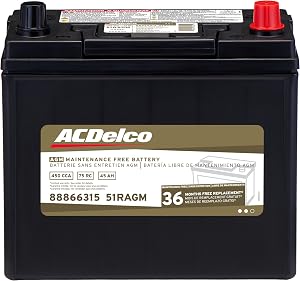




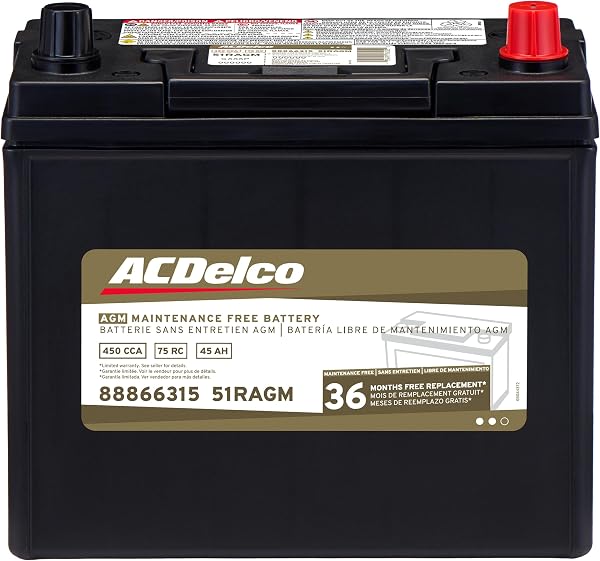
The ACDelco Gold 51RAGM is aimed at drivers who need a Group 51R AGM replacement and want a clearly stated warranty. Its product information focuses on fit, form, and function across General Motors vehicles and many other makes and models, making it a direct-replacement candidate rather than a battery chosen primarily for unusually high CCA or reserve capacity.
We may earn a commission when you buy through this link, at no additional cost to you.
Because the supplied specifications do not list CCA, amp-hour capacity, or reserve capacity, the most important buying step is verifying that the vehicle calls for the Group 51R format and AGM chemistry. The 36-month warranty provides a defined ownership signal, while the AGM designation indicates a sealed, maintenance-free battery style.
This battery may be appealing when the original equipment replacement path is more important than comparing a long list of performance figures. The 4.6 rating is the strongest owner score among the products in this guide, although ratings should not replace checking the vehicle’s battery tray, terminals, hold-down, and electrical requirements.
Some buyers want a battery that follows the original group designation and installation pattern without adding unusual terminal arrangements or a larger case. In that situation, a clearly identified Group 51R replacement can simplify the search. Still, direct replacement should mean matching the vehicle’s required battery type and dimensions, not merely selecting the same brand family.
Choose the 51RAGM when the vehicle’s fitment is confirmed and you want a straightforward aftermarket replacement with warranty coverage. It is not the best option for shoppers who need to rank batteries by published cold-cranking or reserve-capacity numbers, because those figures are not provided here.
Shoppers who need detailed CCA, reserve-capacity, or amp-hour comparisons before buying.
We may earn a commission when you buy through this link, at no additional cost to you.
The ACDelco Gold 48AGM is a sensible starting point for vehicles that call for a Group 48 AGM battery. Rather than focusing on a specialized terminal arrangement or an unusually large capacity, it concentrates on the construction details that matter in a replacement: a reinforced separator, low-resistance grid design, corrosion-conscious materials, and a 36-month warranty.
We may earn a commission when you buy through this link, at no additional cost to you.
Its high-density negative paste is intended to support consistent battery performance over repeated use, while the silver calcium stamped alloy is designed to improve cycle life. The calcium lead positive grid also emphasizes conductivity and low resistance. Those elements are useful considerations for a daily driver that experiences regular starts and normal accessory loads.
The envelope separator has a puncture-resistant back and is designed to encourage acid circulation while reducing the chance of internal shorts. A vent cap design that resists acid leakage adds another layer of practical reassurance, especially in an engine bay where vibration and temperature changes are unavoidable. As an AGM battery, it is also a sealed, maintenance-free style rather than a conventional refillable design.
Starting performance is not determined by one number alone. Separator design, plate materials, conductivity, and resistance to internal shorts all influence how a battery is built to handle repeated cycling and vibration. These details do not remove the need to verify fitment, but they help explain why two batteries with the same group size can have different ownership considerations.
This is the best fit for a shopper who wants a straightforward Group 48 replacement with a clearly stated warranty and well-defined internal construction features. The limitation is that the supplied specifications do not list CCA, reserve capacity, or amp-hour capacity, so buyers who need to compare those figures directly should confirm the vehicle requirement and consider a battery with a fuller performance specification.
Buyers who need published CCA, reserve-capacity, or amp-hour figures for a direct specification comparison.
We may earn a commission when you buy through this link, at no additional cost to you.
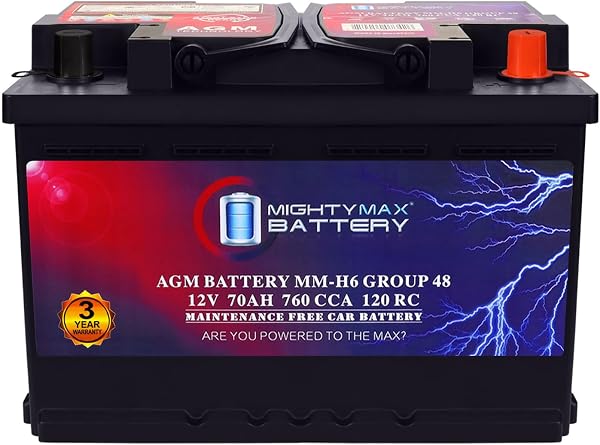
The Mighty Max MM-H6 is a strong option for a Group 48 application when you want the key performance numbers clearly stated. Its 70Ah rating, 760 CCA, and 120-minute reserve capacity give shoppers a useful basis for comparing starting power and stored energy rather than relying only on the battery's name or appearance.
We may earn a commission when you buy through this link, at no additional cost to you.
The AGM design is sealed and spill-resistant, and the battery is positioned for vehicles with start-stop systems and frequent engine restarts. That makes it more relevant to modern daily driving than a basic starting battery designed only around occasional ignition events. Its construction is also described as resistant to shock, vibration, and harsh conditions.
The case measures 10.94 by 6.88 by 7.48 inches, with the positive terminal on the right and the negative on the left. It can be mounted in multiple positions except upside down, which provides some installation flexibility, but the terminal orientation and physical dimensions still need to match the vehicle exactly. Mounting screws are included, while a wire harness and other mounting accessories are not.
Reserve capacity indicates how long a battery can provide power under a standardized load before reaching a specified voltage threshold. It is not a promise of a particular driving time with accessories running, but it is useful when comparing batteries in the same general class. The MM-H6 has a 120-minute figure, which gives it a clear reference point against other Group 48 options.
This battery suits drivers who want a clearly specified Group 48 AGM unit for a start-stop vehicle and who value a three-year warranty. Its owner rating is lower than some alternatives in this group, and the lack of included harness hardware means the installation may require existing vehicle components or additional parts.
Installations where the vehicle needs included harness hardware or a different terminal orientation.
We may earn a commission when you buy through this link, at no additional cost to you.
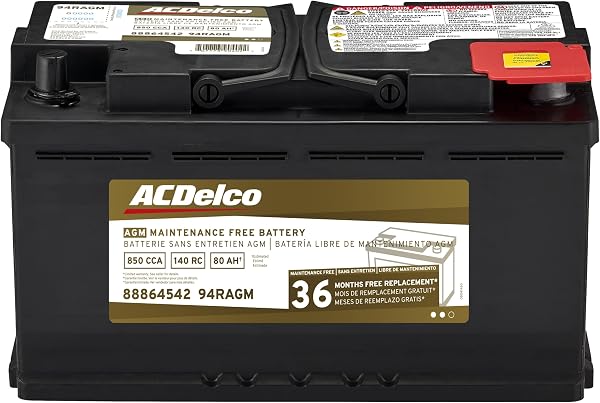
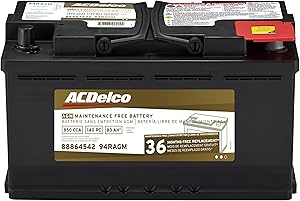
The ACDelco Gold 94RAGM is intended for vehicles that require the Group 94R format, often identified as H7 or L4 in some fitment systems. Its appeal is the combination of AGM construction, a reinforced case, and a 36-month warranty. It is a replacement-focused choice for buyers who already know their vehicle calls for this group size.
We may earn a commission when you buy through this link, at no additional cost to you.
The battery uses high-density negative paste and a silver calcium stamped alloy, with a high-density plate oxide intended to provide consistent power per pound and dependable cycling. A calcium lead positive grid is designed for conductivity and low resistance. These construction details are particularly relevant when a vehicle places regular demands on its starting battery.
The ribbed case is pressure tested for strength and leak resistance, while the envelope separator helps increase acid circulation and reduce the chance of internal shorts. Electrical short testing is also listed as part of the design process. Those features point toward a battery built around durability and controlled internal construction rather than a bare minimum replacement.
Group numbers narrow the search, but they do not replace a direct fitment check. Compare the existing battery’s length, width, height, hold-down arrangement, and terminal position with the replacement. The 94R designation should match the vehicle requirement, and the battery must also sit securely without forcing cables or clamps into an awkward position.
This model makes sense when Group 94R fitment is confirmed and you prefer a battery with a detailed construction profile and stated warranty. The supplied specifications do not provide CCA, amp-hour, or reserve-capacity figures, so it is not the easiest choice for shoppers comparing numerical output across several batteries.
Shoppers who need a battery with published CCA, amp-hour, and reserve-capacity numbers.
We may earn a commission when you buy through this link, at no additional cost to you.
The OPTIMA 34/78 RedTop is a starting battery for cars, trucks, and SUVs that need the Group 34 or 78 format and compatible terminal arrangements. Its dual SAE and GM posts provide more connection options than a battery with only one terminal style, but that flexibility still has to be matched to the vehicle's hold-down and cable layout.
We may earn a commission when you buy through this link, at no additional cost to you.
With 800 CCA, 100 minutes of reserve capacity, and a 50Ah C20 capacity, this battery offers a well-defined starting and stored-power profile. The RedTop design uses SpiralCell technology and 99.99 percent pure lead, while the sealed AGM construction is intended to be maintenance free. These details make it a candidate for drivers who prioritize starting performance and vibration resistance.
The battery measures 10.06 by 6.94 by 7.88 inches and weighs 38.8 pounds. That weight is worth considering when installing it in a cramped engine bay or lifting it into a vehicle with a high battery tray. The listed vibration resistance and faster charging capability may appeal to drivers who use their vehicles in demanding environments, though the battery remains primarily positioned as a starting unit.
Having both SAE and GM-style terminals can simplify certain installations, but it does not make the battery compatible with every vehicle. The case size, terminal position, cable reach, and retaining hardware still need to line up. Extra posts can also create clearance concerns, so inspect the battery tray and nearby components rather than choosing solely for connection flexibility.
This is a good choice when the vehicle accepts its size and the dual-post arrangement solves a genuine installation need. It is less compelling if the extra terminals provide no benefit or if a lighter battery would make replacement easier. Verify the case dimensions, terminal clearance, and hold-down before purchase.
Vehicles that require a smaller case or have insufficient clearance around dual terminal posts.
We may earn a commission when you buy through this link, at no additional cost to you.
The Renogy H6 is a Group 48 AGM battery for cars, SUVs, trucks, and marine starting applications that need a stated balance of capacity and environmental tolerance. Its 70Ah rating, 720 CCA output, and 120-minute reserve capacity give it a clear specification profile, while the wide operating range makes it interesting for drivers who deal with both winter cold and summer heat.
We may earn a commission when you buy through this link, at no additional cost to you.
The battery is designed for vehicles with start-stop technology and frequent restarts. AGM construction supports a sealed format that reduces the risk of acid leaks and corrosion under normal installation conditions. The 720 CCA rating is adequate for many Group 48 applications, but it is lower than the 760 CCA figure listed for the Mighty Max MM-H6, so buyers should follow the vehicle’s required minimum.
Renogy lists an operating range from minus 22 to 158 degrees Fahrenheit. That figure is useful as a stated design range, but it should not replace checking the vehicle’s charging system, battery tray, and terminal arrangement. A battery can be technically strong in temperature testing and still be incorrect if the group size or polarity does not match.
A broad temperature range can be reassuring, especially for vehicles exposed to freezing winters and hot engine bays, but it does not eliminate normal battery checks. Cold weather increases starting demand, while high temperatures can accelerate battery wear. Correct capacity, charging-system health, and secure connections remain essential to getting the intended benefit from a temperature-rated AGM battery.
Choose this model when a Group 48 start-stop battery with defined reserve capacity and broad temperature coverage fits your vehicle. It is less attractive when maximum CCA is the primary goal or when the vehicle requires a different case size. Measure the existing battery and verify the group designation before ordering.
Drivers whose vehicle requires more than 720 CCA or a group size other than Group 48.
We may earn a commission when you buy through this link, at no additional cost to you.
The OPTIMA 35 RedTop is a compact sealed AGM starting battery for vehicles that accept its physical size and SAE post arrangement. It weighs 31.7 pounds and measures 9.38 by 6.75 by 7.69 inches, making it one of the more manageable options in this guide for an installation where access and lifting space are limited.
We may earn a commission when you buy through this link, at no additional cost to you.
Its 720 CCA rating provides a clear starting-power benchmark, while the 90-minute reserve capacity and 44Ah C20 capacity describe its stored-energy profile. SpiralCell technology and 99.99 percent pure lead are central to the design, and the sealed format avoids routine water maintenance associated with traditional flooded batteries.
The RedTop is positioned for basic electrical demands and starting duty rather than as a high-capacity accessory battery. Its stated vibration resistance and faster charging capability may be useful in demanding vehicle environments, but drivers with extensive electrical loads should compare reserve capacity and amp-hour needs before selecting a compact starting-focused model.
A shorter or lighter battery can make installation easier, but the replacement must still lock into the original tray and connect without cable strain. Compare the length, width, height, positive-terminal position, and hold-down arrangement with the old battery. Do not assume that a similar-looking case will fit simply because the posts appear familiar.
This battery is a reasonable pick for a vehicle that calls for the Group 35 format and standard SAE posts, particularly when a lighter, compact case is valuable. The 90-minute reserve figure is lower than several alternatives here, so it may not be the best fit for vehicles with frequent prolonged accessory use.
Vehicles with high accessory demands or fitments requiring more than 90 minutes of reserve capacity.
We may earn a commission when you buy through this link, at no additional cost to you.
The OPTIMA 75/25 RedTop combines a compact starting-battery format with dual SAE and GM posts. That arrangement can be useful when a vehicle's original connection style requires more flexibility, but the case dimensions and terminal clearance still need to match. It is a starting-focused AGM battery rather than a large-capacity auxiliary power unit.
We may earn a commission when you buy through this link, at no additional cost to you.
The battery provides 720 CCA, 90 minutes of reserve capacity, and a 44Ah C20 capacity. Its SpiralCell technology uses 99.99 percent pure lead, and the sealed AGM format is intended to be maintenance free. The design also emphasizes vibration resistance and faster charging, two considerations that can matter in vehicles exposed to rough roads or repeated starts.
The listed dimensions are 9.38 inches long, 6.81 inches wide, and 7.75 inches tall, with a weight of 33.1 pounds. That gives buyers useful information for checking the battery tray before purchase. The dual posts may simplify some connections, but they can also create clearance issues if the tray or cover is tightly fitted.
Dual posts provide more connection possibilities, but they also add hardware to the top of the battery. Before buying, check whether the positive and negative cables reach the correct posts without crossing the case or touching nearby metal. Confirm that the battery cover and retaining bracket can close normally after the connections are installed.
This model suits drivers whose vehicle specifically accepts the 75 or 25 format and can use its dual-terminal layout. It is less suitable for applications that need the higher reserve capacity and 80Ah rating of a larger high-demand battery. Treat the extra posts as a fitment feature, not as a substitute for matching the vehicle’s required group.
Vehicles that require a higher-capacity battery or have very limited clearance around the terminal area.
We may earn a commission when you buy through this link, at no additional cost to you.
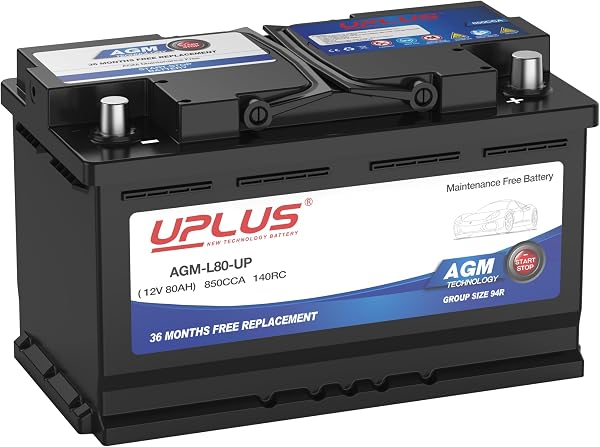
The UPLUS 94R AGM is one of the most fully specified batteries in this comparison, with an 80Ah rating, 850 CCA, and 140-minute reserve capacity. It is designed around Group 94R H7 or L4 fitment and is positioned for start-stop vehicles, frequent short trips, and cars with larger electrical loads such as heated seats, navigation systems, power doors, or in-vehicle entertainment.
We may earn a commission when you buy through this link, at no additional cost to you.
Its 850 CCA rating gives it the highest listed starting output among the Group 94R options here, while the 140-minute reserve figure provides a useful reference for stored energy. The battery uses high-density negative paste, a silver calcium alloy, and a calcium lead positive grid. Those construction details support the stated focus on cycling and low-resistance power delivery.
The case measures 12.04 by 6.89 by 7.48 inches, and the terminal layout places negative on the left and positive on the right. Those measurements and polarity details should be checked against the existing battery before ordering. A three-year warranty and local after-sales support add practical value, and the battery guidance recommends fully charging it before use to help extend service life.
A battery with higher capacity can be useful when a vehicle cycles frequently or supports many accessories, but the charging system and vehicle electronics still determine compatibility. Compare the replacement with the original battery’s group size, chemistry, and terminal layout. If the vehicle uses battery monitoring or start-stop controls, follow the vehicle’s replacement and registration procedures where applicable.
This is a strong choice for a compatible H7 or L4 vehicle with start-stop operation or significant electrical demands. It is not a universal upgrade for every Group 94R application, and its larger case means that tray depth, hold-down hardware, and cable reach must all be confirmed.
Vehicles that do not accept the Group 94R H7 or L4 case and terminal arrangement.
We may earn a commission when you buy through this link, at no additional cost to you.
The OPTIMA DH7 YellowTop is the high-capacity option in this group, with 880 CCA, 155 minutes of reserve capacity, and an 80Ah C20 rating. It is aimed at vehicles with high electrical demands rather than drivers looking for the smallest or lightest replacement. The battery uses DIN Type A1 terminals, so fitment must be confirmed carefully.
We may earn a commission when you buy through this link, at no additional cost to you.
PureFlow technology uses highly compressed radial grid plates made with 99.99 percent pure lead. The design is intended to resist damage from vibration and corrosion while providing starting power in difficult weather. Its sealed AGM construction is maintenance free, which means there is no routine water-filling task for the owner.
The battery measures 12.44 inches long, 6.88 inches wide, and 7.5 inches tall, and weighs 54 pounds. That is a meaningful installation consideration, especially where the battery tray is low in the engine bay or difficult to reach. The 155-minute reserve capacity gives it the highest listed reserve figure in this comparison, which can be valuable for a vehicle with substantial accessory demands.
The 155-minute reserve figure distinguishes this battery from the other options in the guide. Reserve capacity can matter when a vehicle has many electrical loads or spends time operating accessories without immediate charging support. It does not mean accessories can run indefinitely, but it gives shoppers a useful way to identify a battery designed for more demanding electrical use.
Choose the DH7 when its DIN terminal layout and dimensions match the vehicle and when reserve capacity matters as much as starting power. It is excessive for a basic commuter that needs only a compact starting battery, and the substantial weight makes installation less convenient than smaller RedTop or Group 48 models.
Basic vehicles that require a lighter battery or a different terminal and case configuration.
We may earn a commission when you buy through this link, at no additional cost to you.
Battery shopping becomes much easier when fitment is treated as a checklist rather than a guess. Confirm the vehicle’s group size, chemistry, dimensions, polarity, terminal style, and electrical requirements first, then compare CCA, reserve capacity, warranty, and convenience features.
The BCI group number identifies a battery’s general case dimensions, terminal arrangement, and fitment family. The products in this guide include Group 48, Group 51R, and Group 94R formats, along with Optima models identified by designations such as 34/78, 35, 75/25, and DH7. A battery can have excellent electrical specifications and still be unusable if the case does not sit correctly in the vehicle tray.
Compare the replacement with the old battery and the vehicle manual. Check length, width, height, hold-down position, terminal location, and cable reach. The UPLUS 94R, for example, lists a case measuring 12.04 by 6.89 by 7.48 inches, while the Optima 35 is much more compact. Those differences affect whether the battery can be secured and whether the hood or protective cover will close.
Treat the group size as the starting requirement, not a suggestion. If the number does not match, verify an approved equivalent before considering CCA or price.
Terminal position is one of the easiest details to overlook because two batteries can look similar while placing the positive and negative posts differently. The Mighty Max MM-H6 lists positive on the right and negative on the left, while the UPLUS 94R lists negative on the left and positive on the right. The vehicle’s cables must reach the correct posts without stretching, crossing unsafe areas, or contacting the case.
Terminal style matters as well. The OPTIMA 34/78 and 75/25 use dual SAE and GM posts, the OPTIMA 35 uses SAE posts, and the DH7 uses DIN Type A1 terminals. Extra connection options can be useful in a compatible vehicle, but they do not overcome a case or cable mismatch. They can also affect clearance under the battery cover or near nearby metal components.
Photograph the existing battery before removal and compare the terminal side, post shape, and cable routing with the replacement. Never reverse polarity to make a connection fit.
Cold-cranking amps, or CCA, describe a battery’s ability to deliver starting current under a standardized cold-temperature test. Higher CCA can be valuable in cold climates, for larger engines, or for vehicles that require a stronger starting specification. Among the listed models, output ranges from 720 CCA on the Renogy H6 and Optima 35 and 75/25 to 880 CCA on the Optima DH7 YellowTop.
CCA should be compared within the correct battery group and vehicle application. Selecting the highest number available is not automatically better if the battery is too large, uses the wrong terminal arrangement, or does not suit the vehicle’s charging and monitoring system. A Group 48 vehicle may have different requirements from a Group 94R vehicle even when both batteries advertise strong starting output.
Use the vehicle’s original CCA requirement as the baseline. Choose additional headroom only when the replacement remains a confirmed physical and electrical match.
Reserve capacity indicates how long a fully charged battery can provide power under a specified test load before reaching a defined voltage. It is useful for comparing how much support a battery may provide if the charging system is not immediately supplying power. Amp-hour capacity offers another reference for stored energy, although the test conditions and application still matter.
The reviewed batteries span from the Optima 35 and 75/25 at 90 minutes of reserve capacity to the Optima DH7 at 155 minutes. The Mighty Max and Renogy Group 48 batteries list 120 minutes, while the UPLUS 94R lists 140 minutes. These differences are most relevant to vehicles with frequent short trips, start-stop operation, or larger accessory loads, not necessarily to a simple commuter with modest electrical demands.
Prioritize reserve capacity when the vehicle regularly supports accessories or repeated restart cycles. For basic starting duty, do not sacrifice correct fitment just to gain a larger number.
All 10 batteries in this guide use AGM construction or are identified as sealed AGM models. AGM batteries contain the electrolyte within an absorbent material and are generally designed as sealed, maintenance-free units. They are commonly considered for vehicles with start-stop systems, frequent cycling, vibration exposure, or higher electrical demand, but the vehicle should still be designed or approved for the replacement chemistry.
The Mighty Max MM-H6, Renogy H6, and UPLUS 94R specifically emphasize start-stop use. The UPLUS model also targets vehicles with frequent short trips and larger loads such as heated seats and power doors. The Optima YellowTop DH7 is positioned for high electrical demands. These descriptions help identify the intended use, but they do not replace the vehicle manufacturer’s battery specification.
Choose AGM when the vehicle requires or supports it and when cycling or sealed construction is useful. Do not treat AGM as a universal upgrade without checking the charging system and battery-management requirements.
Start-stop vehicles shut the engine off and restart it repeatedly during traffic stops, placing more cycling demand on the battery than a vehicle that starts once at the beginning of a trip. Frequent short trips can also leave less time for the alternator to restore the energy used during starting. This makes battery chemistry, reserve capacity, and the vehicle’s battery-management system especially important.
The Mighty Max MM-H6, Renogy H6, and UPLUS 94R are specifically positioned for start-stop applications. The UPLUS battery also lists frequent short trips and vehicles that sit unused for days or weeks among its intended scenarios. That does not mean any of these batteries fits every start-stop vehicle; group size, terminal position, and vehicle programming still control compatibility.
If the vehicle has factory start-stop, replace its battery with the specified chemistry and group size. Avoid downgrading to a basic starting battery simply because it costs less.
A battery warranty is useful because it defines the manufacturer’s stated coverage period and gives the buyer a clearer ownership expectation. Several products here list three years or 36 months, including the ACDelco Gold 48AGM, ACDelco Gold 94RAGM, ACDelco Gold 51RAGM, Mighty Max MM-H6, and UPLUS 94R. The warranty term should be considered alongside the seller’s return procedure and the conditions required for a claim.
Warranty length does not prove that a battery will last for a particular number of years. Battery life is affected by climate, charging-system health, vehicle use, storage, vibration, and repeated deep discharge. The UPLUS product also lists local after-sales support, while the other batteries provide different levels of published construction and warranty information.
Use warranty as a supporting factor after fitment and electrical specifications are confirmed. Keep the receipt and installation details, and understand whether testing or proof of vehicle compatibility may be required.
A vehicle with heated seats, navigation, power doors, entertainment systems, winches, auxiliary lighting, or frequent accessory use may benefit from more reserve capacity and amp-hour capacity than a basic commuter. The UPLUS 94R lists an 80Ah capacity and 140-minute reserve, while the OPTIMA DH7 lists 80Ah and 155 minutes. Those figures make them more relevant to high-demand applications than a smaller 44Ah starting battery.
More capacity is not automatically a license to add electrical accessories. The alternator, wiring, charging controls, and battery-management system must still support the vehicle’s total electrical demand. A high-capacity battery can also be heavier and physically larger, as shown by the 54-pound DH7, which may complicate installation.
Match capacity to the vehicle’s original specification and real usage. If accessories are added, evaluate the entire charging system rather than relying on a larger battery alone.
Battery replacement is usually straightforward, but the physical work can be awkward because batteries are heavy and often sit in confined engine bays. The Optima 35 weighs 31.7 pounds, the Optima 34/78 weighs 38.8 pounds, and the DH7 weighs 54 pounds. A heavier battery may provide more capacity, but it also deserves a careful lifting plan and secure hold-down installation.
AGM batteries are sealed and maintenance free, so they do not require routine water additions. They still need clean, tight terminals, a secure retaining bracket, and a healthy charging system. Before installation, inspect the tray for corrosion, confirm that the positive and negative cables match the replacement layout, and follow the vehicle’s procedure for battery monitoring or start-stop systems.
Prioritize easy installation only after confirming fitment. A lighter battery is convenient, but the correct group, terminal layout, and chemistry matter more than a small difference in carrying weight.
Before installing a replacement, switch off the vehicle and all accessories, confirm the group size and polarity, and compare the new battery with the old one. Clean corrosion from the tray and cable connections, place the battery securely in the hold-down, and connect the terminals in the vehicle manufacturer’s recommended order. Do not allow a tool to bridge the positive terminal and nearby metal.
Keep the battery firmly restrained so vibration does not damage the case or connections. Inspect the terminals periodically for looseness or corrosion, and pay attention to slow cranking, dimming lights, or repeated start-stop warnings. If the battery has been stored or the vehicle has sat unused, use a charger designed for AGM batteries when appropriate and follow the charger instructions.
Do not attempt to open a sealed AGM battery or add water. Avoid charging in an unsafe, poorly ventilated area, keep sparks away from the battery, and use eye protection when working around terminals. If the vehicle uses a battery-monitoring or start-stop system, complete any required reset or registration procedure after replacement so the charging system can manage the new battery correctly.
Start with the vehicle owner's manual or the group number printed on the existing battery. Confirm the physical dimensions, terminal location, terminal type, hold-down arrangement, and required chemistry. A battery can have enough CCA and still be wrong if it does not fit the tray or the cables cannot reach the correct posts.
AGM can be a better match for vehicles that require it, especially those with start-stop systems, frequent cycling, vibration, or larger electrical demands. It is not automatically the right choice for every vehicle because the charging system and battery-management system must support the chemistry. Always follow the vehicle's specified replacement type.
The battery should meet or exceed the vehicle's required cold-cranking specification while preserving the correct fitment. Higher CCA can be useful in cold climates or for larger engines, but the highest number is not automatically the best choice. Compare CCA only after confirming group size, terminal layout, dimensions, and chemistry.
Reserve capacity describes how long a fully charged battery can provide power under a standardized test load before reaching a specified voltage. It helps compare stored-energy capability between batteries, particularly for vehicles with accessories or repeated restart cycles. It is not a guaranteed runtime for a particular vehicle's electronics.
Many start-stop vehicles require an AGM or another battery type specifically designed for repeated cycling. The exact requirement depends on the vehicle, so check the original battery and the owner's manual. Replacing a start-stop battery with an unsuitable basic starting battery can reduce cycling performance and may conflict with the vehicle's battery-management system.
A higher amp-hour rating may be useful in some applications, but the battery must still match the vehicle's physical and electrical requirements. Case size, terminal position, charging controls, and battery-monitoring systems can make a seemingly higher-capacity replacement unsuitable. Treat amp-hour capacity as one comparison point rather than a reason to ignore fitment.
SAE and GM terminals use different post and connection arrangements, so the vehicle cables must match the battery's terminal design. Some batteries, such as the Optima 34/78 and 75/25, provide both SAE and GM posts. Dual posts can add flexibility, but the case dimensions and clearance around the connections still need to be verified.
Warranty periods vary by product, and several batteries in this guide list three years or 36 months. A longer warranty can provide more defined coverage, but it is not a guarantee of service life. Climate, driving pattern, charging-system condition, vibration, and repeated discharge all influence how long a battery performs.
A new battery should be checked according to the product and vehicle instructions before installation. If charging is needed, use a charger compatible with AGM batteries and follow its settings. After installation, confirm that the vehicle's charging system is functioning correctly and complete any required battery-monitoring reset or registration.
The ACDelco Gold 48AGM is the strongest general choice for a confirmed Group 48 application because it combines AGM construction, a 36-month warranty, corrosion-conscious materials, and a clear focus on dependable replacement performance. It is a balanced option for drivers who want a familiar fitment without prioritizing an unusually large capacity.
The UPLUS 94R is better suited to compatible H7 or L4 vehicles with start-stop operation and heavier electrical demands, while the OPTIMA DH7 YellowTop offers the highest listed CCA, reserve capacity, and amp-hour rating for a more demanding application. The Mighty Max and Renogy models provide clearly stated Group 48 performance figures, and the Optima RedTop models add different terminal and case options.
Choose the battery by confirming group size, dimensions, polarity, terminals, and chemistry before comparing output. Then weigh CCA against climate, reserve capacity against electrical demand, and warranty against the expected ownership conditions. The correct fit with a healthy charging system is more important than simply selecting the largest number on the label.